


 |
市場調查報告書
商品編碼
2119584
歐洲感測器:市場佔有率分析、行業趨勢和統計數據、成長預測(2026-2031 年)Europe Sensors - Market Share Analysis, Industry Trends & Statistics, Growth Forecasts (2026 - 2031) |
||||||

※ 本網頁內容可能與最新版本有所差異。詳細情況請與我們聯繫。
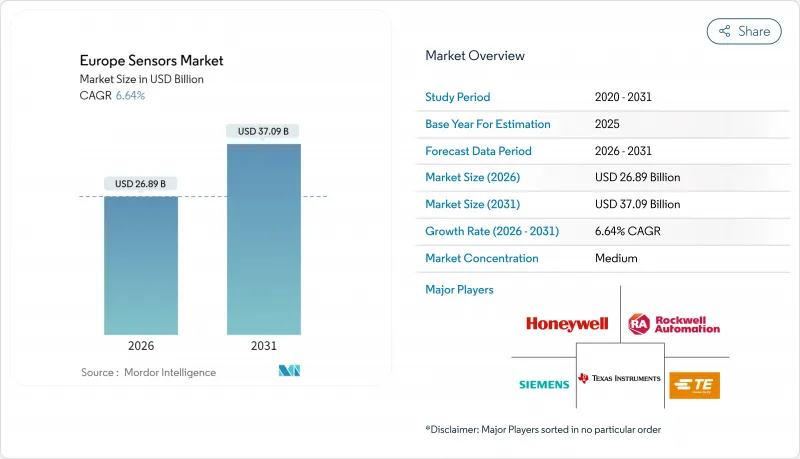
根據 Mordor Intelligence 預測,歐洲感測器市場規模預計將在 2026 年達到 268.9 億美元,到 2031 年達到 370.9 億美元,2026 年至 2031 年的複合年成長率為 6.64%。
本報告按測量參數(溫度、壓力等)、工作方式(光學、電阻式、生物感測器等)、終端用戶產業(汽車、家用電子電器、能源、工業、醫療保健、建築、農業和採礦等)、感測器技術(MEMS、非MEMS)以及國家/地區進行細分。市場預測以美元計價。
歐洲感測器市場的趨勢和洞察
汽車產業需求激增
歐洲汽車製造商計劃在其2026年車型中,每輛車配備150至200個感測器,較2020年的約100個大幅成長。這一成長主要受歐洲新車安全評價協會(Euro NCAP)協議的推動,該協議強制要求將高級駕駛輔助系統(ADAS)作為標準配置。雖然雷達、超音波和攝影機陣列仍佔據材料清單,但低成本固態雷射雷達(LiDAR)的出現,例如法雷奧(Valeo)的SCALA 3(售價低於1000美元),正逐步推動L3級高速公路自動駕駛的實現。此外,用於監測800伏電池組熱失控的電池管理感測器也促進了市場需求。大陸集團(Continental)計劃於2025年收購一家碳化矽企業,這預示著高溫電流感測領域正朝著垂直整合的方向發展。這些趨勢共同推動了銷量和平均售價的提升,進一步鞏固了歐洲感測器市場的成長勢頭。
工業4.0智慧工廠的普及
2025年,將部署超過200萬個工業IoT節點,每個節點配備3至5個感測器,用於測量振動、溫度和能量數據。預測性維護可將意外停機時間減少高達30%,維修成本可在兩年內收回。隨著一級供應商對即時品質可追溯性的需求日益成長,西門子的「Xcelerator」平台互聯資產數量實現了40%的年成長率。向邊緣推理的轉變正在推動對配備16位元ADC和板載DSP的智慧感測器的需求,例如BoschSensortec於2025年10月推出的「BHI360」。這些部署趨勢支撐了歐洲感測器市場的長期需求前景。
初始整合成本高
對傳統設備維修的成本在每台設備 5,000 歐元到 15,000 歐元之間,這對利潤率低於 10% 的中小型企業來說是一個巨大的障礙。 ERP 系統映射整合成本在 50,000 歐元到 100,000 歐元之間,延長了投資回收期。壓力和溫度迴路仍然主要採用類比方式,通常需要徹底更換設備或實施中間件以實現邊緣數位化。 Endress+Hauser 的「心跳技術」因其成本效益而備受關注,因為它可以延緩設備更換。在硬體價格進一步下降之前,成本問題可能會抑制其應用,並略微減緩歐洲感測器市場的複合年成長率。
細分市場分析
隨著企業永續性報告指令 (CSRD) 下第三方檢驗的範圍 1-3 資訊揭露的分階段實施,環境測量設備市場預計將在 2026 年至 2031 年間以 8.61% 的複合年成長率成長。該細分市場中的歐洲感測器市場正在快速擴張,因為顆粒物、氮氧化物和揮發性有機化合物 (VOC) 分析儀目前正為化學和冶金設施的連續排放監測系統提供數據。歐洲太空總署 (ESA) 於 2025 年 8 月發射的 Sentinel 5 衛星提供的衛星回饋正在提高地面站的校準精度並延長感測器的使用壽命。溫度感測器在 2025 年將佔據 26.87% 的市場佔有率,仍然是能源和食品加工行業交易流量測量的關鍵設備。隨著公共產業部署智慧電錶來偵測洩漏,對流量計的需求正在增加。同時,接近感測器正在滿足協作機器人領域 IEC 61496 標準的冗餘要求。
整合溫度、濕度和壓力測量功能的模組體現了融合趨勢,使擅長多晶片封裝的供應商受益匪淺。隨著即時監測葡萄糖和pH值在製藥生物反應器中變得日益重要,化學感測器正從利基市場走向主流市場。整合到無刷直流馬達中的磁感測器隨著各行業的電氣化程度不斷提高而持續蓬勃發展。總體而言,多樣化的應用場景確保了「測量參數」類別在歐洲感測器市場中始終保持穩定的銷售成長勢頭。
由安全簾、光纖應變感測器和光譜測量模組驅動的光學元件在2025年仍維持19.16%的市場佔有率。同時,固體雷達(LiDAR)的複合年成長率(CAGR)為8.43%,其低於500美元的價格使其在倉庫自動化和農業機械領域的應用範圍不斷擴大。熱敏電阻器式感測器(例如熱敏電阻)繼續應用於傳統的暖通空調(HVAC)和力測量領域,但利潤率面臨壓力。用於測量血糖值和乳酸水平的生物感測器即使在手持設備中也能達到臨床級別的精度,這為能夠進行多參數分析的穿戴式設備鋪平了道路。電容式和壓電感測器用於觸控操作和超音波應用,但由於技術成熟度較高,其成長速度仍然緩慢。
24 GHz 短程雷達和 77 GHz 遠端雷達仍然是盲點偵測系統和主動式車距維持定速系統系統的標準配置,NXP 和 Infineon 在晶片組供應方面主導。由於自動駕駛平台需要冗餘設計,感知堆疊擴大融合攝影機、雷達和雷射雷達數據,因此對同步、帶有時間戳的輸出的需求也隨之增加。在歐洲感測器市場,提供承包感測器套件的供應商具有競爭優勢。
其他好處:
- Excel格式的市場預測(ME)表
- 3個月的分析師支持
目錄
第1章:引言
- 研究假設和市場定義
- 調查範圍
第2章:調查方法
第3章執行摘要
第4章 市場狀況
- 市場概覽
- 市場促進因素
- 汽車產業需求激增
- 工業4.0時代智慧工廠的普及
- 加速推廣電動車
- 工業IoT邊緣人工智慧感測器的快速普及
- 歐盟關於氣候監測的強制法規
- 智慧基礎設施(鐵路、能源)的發展
- 市場限制因素
- 初始整合成本高
- 半導體供應鏈中斷
- 感測器融合工程領域的技能差距
- GDPR導致資料管治日益複雜。
- 產業價值鏈分析
- 監理情勢
- 技術展望
- 波特五力分析
- 宏觀經濟因素對市場的影響
第5章 市場規模與成長預測
- 透過測量參數
- 溫度
- 壓力
- 等級
- 流動
- 接近性
- 環境
- 化學品
- 慣性
- 磁性
- 振動
- 透過操作方法
- 光學
- 電阻
- 生物感測器
- 壓阻式
- 影像
- 電容式
- 壓電
- LiDAR
- 雷達
- 按最終用戶行業分類
- 車
- 家用電子產品
- 能源
- 產業
- 醫療保健與健康
- 建築業、農業、礦業
- 航太
- 防禦
- 感測器技術
- MEMS
- 非MEMS
- 國家
- 德國
- 英國
- 法國
- 義大利
- 西班牙
- 荷蘭
- 波蘭
- 其他歐洲國家
第6章 競爭情勢
- 市場集中度
- 策略趨勢
- 市佔率分析
- 公司簡介
- Texas Instruments Incorporated
- TE Connectivity Ltd
- Honeywell International Inc.
- Rockwell Automation Inc.
- Siemens AG
- STMicroelectronics NV
- AMS AG
- NXP Semiconductors NV
- Infineon Technologies AG
- Bosch Sensortec GmbH
- Sick AG
- ABB Limited
- Omron Corporation
- Continental AG
- Baumer Group
- Pepperl+Fuchs GmbH
- First Sensor AG
- Analog Devices Inc.
- Sensata Technologies Holding PLC
- Balluff GmbH
第7章 市場機會與未來展望
According to Mordor Intelligence, the Europe sensors market size stood at USD 26.89 billion in 2026 and is projected to reach USD 37.09 billion by 2031, advancing at a 6.64% CAGR during 2026-2031.
This report is Segmented by Parameters Measured (Temperature, Pressure, and More), Mode of Operation (Optical, Electrical Resistance, Biosensor, and More), End-User Industry (Automotive, Consumer Electronics, Energy, Industrial, Medical and Wellness, Construction, Agriculture and Mining, and More), Sensor Technology (MEMS, and Non-MEMS), and Country. The Market Forecasts are Provided in Terms of Value (USD).
Europe Sensors Market Trends and Insights
Surging Demand in the Automotive Sector
European automakers integrated 150-200 sensors per 2026 model, up from roughly 100 in 2020, a jump driven by Euro NCAP protocols that make advanced driver-assistance systems standard fitment. Radar, ultrasonic, and camera arrays dominate the bill of materials, yet cost-reduced solid-state LiDAR, such as Valeo's SCALA 3 at sub-USD 1,000, has begun enabling Level 3 highway autonomy. Additional content stems from battery-management sensors monitoring thermal runaway in 800-volt packs. Continental's 2025 acquisition of silicon carbide signals vertical integration in high-temperature current sensing. Together, these trends lift unit volumes and average selling prices, reinforcing the growth trajectory of the Europe sensors market.
Proliferation of Industry 4.0 Smart Factories
More than 2 million industrial IoT nodes were deployed in 2025, each bundling 3-5 sensors for vibration, temperature, and energy data. Predictive maintenance reduces unplanned downtime by up to 30%, justifying retrofit costs within 2 years. Siemens' Xcelerator platform posted 40% annual growth in connected assets as tier-one suppliers demanded real-time quality traceability. The pivot to edge inference boosts demand for smart sensors with 16-bit ADCs and on-board DSPs, typified by Bosch Sensortec's BHI360 launch in October 2025. These deployments underpin long-run demand visibility for the Europe sensors market.
High Initial Integration Costs
Retrofitting legacy equipment costs EUR 5,000-15,000 per asset, a hurdle for SMEs operating on sub-10% margins. Integration fees for ERP mapping range from EUR 50,000 to EUR 100,000, stretching payback timelines. Pressure and temperature loops often remain analog, forcing either rip-and-replace or edge-digitization middleware. Endress+Hauser's Heartbeat Technology is gaining traction as a cost-effective compromise that defers capital replacement. Until hardware prices drop further, cost sensitivities will curb uptake and slightly temper the Europe sensors market CAGR.
Other drivers and restraints analyzed in the detailed report include:
- Acceleration of Electric-Vehicle Adoption
- Rapid Uptake of Industrial IoT Edge-AI Sensors
- Semiconductor Supply-Chain Disruptions
For complete list of drivers and restraints, kindly check the Table Of Contents.
Segment Analysis
Environmental devices are forecast to grow at 8.61% during 2026-2031 as the Corporate Sustainability Reporting Directive phases in third-party-verified Scope 1-3 disclosures. The Europe sensors market for this sub-segment is expanding rapidly because particulate-matter, NOx, and VOC analyzers now feed continuous-emissions-monitoring systems across chemical and metallurgical sites. Satellite feedback from ESA's Sentinel-5, launched in August 2025, improves ground-station calibration and extends sensor life. Temperature sensors, at 26.87% share in 2025, remain indispensable in custody-transfer flows across energy and food processing. Flow instruments are rising as utilities deploy smart meters to spot leaks, while proximity sensors meet IEC 61496 redundancy rules in collaborative robots.
Combination modules that measure temperature, humidity, and pressure in a single package reflect a trend toward convergence that rewards suppliers skilled in multi-chip packaging. Chemical sensors are moving from niche to mainstream as pharmaceutical bioreactors demand real-time glucose and pH monitoring. Magnetic sensors embedded in brushless DC motors continue to proliferate as industrial electrification advances. Overall, diversified use cases ensure the parameters-measured category remains a steady volume driver within the Europe sensors market.
Optical devices retained a 19.16% share in 2025, driven by safety curtains, fiber-optic strain sensors, and spectrometry modules. However, solid-state LiDAR is tracking an 8.43% CAGR as sub-USD 500 pricing opens warehouse automation and agricultural machinery opportunities. Electrical-resistance sensors like thermistors continue to serve legacy HVAC and force applications but face a margin squeeze. Biosensors for glucose and lactate now achieve clinical accuracy in handhelds, setting the stage for multi-analyte wearables. Capacitive and piezoelectric sensors serve touch and ultrasonic applications, though growth is modest given the technology's maturity.
Radar, both 24 GHz short-range and 77 GHz long-range, remains standard in blind-spot and adaptive-cruise systems, with NXP and Infineon leading chipset supply. As autonomous platforms demand redundancy, perception stacks increasingly fuse camera, radar, and LiDAR data, thereby increasing the need for synchronized, time-stamped outputs. Suppliers offering turnkey sensor suites enjoy a competitive edge in the Europe sensors market.
Complete Report Scope:
- By Parameters Measured
- Temperature
- Pressure
- Level
- Flow
- Proximity
- Environmental
- Chemical
- Inertial
- Magnetic
- Vibration
- By Mode of Operation
- Optical
- Electrical Resistance
- Biosensor
- Piezoresistive
- Image
- Capacitive
- Piezoelectric
- LiDAR
- Radar
- By End-User Industry
- Automotive
- Consumer Electronics
- Energy
- Industrial
- Medical and Wellness
- Construction, Agriculture and Mining
- Aerospace
- Defense
- By Sensor Technology
- MEMS
- Non-MEMS
- By Country
- Germany
- United Kingdom
- France
- Italy
- Spain
- Netherlands
- Poland
- Rest of Europe
List of Companies Covered in this Report:
- Texas Instruments Incorporated
- TE Connectivity Ltd
- Honeywell International Inc.
- Rockwell Automation Inc.
- Siemens AG
- STMicroelectronics NV
- AMS AG
- NXP Semiconductors NV
- Infineon Technologies AG
- Bosch Sensortec GmbH
- Sick AG
- ABB Limited
- Omron Corporation
- Continental AG
- Baumer Group
- Pepperl+Fuchs GmbH
- First Sensor AG
- Analog Devices Inc.
- Sensata Technologies Holding PLC
- Balluff GmbH
Additional Benefits:
- The market estimate (ME) sheet in Excel format
- 3 months of analyst support
TABLE OF CONTENTS
1 INTRODUCTION
- 1.1 Study Assumptions and Market Definition
- 1.2 Scope of the Study
2 RESEARCH METHODOLOGY
3 EXECUTIVE SUMMARY
4 MARKET LANDSCAPE
- 4.1 Market Overview
- 4.2 Market Drivers
- 4.2.1 Surging Demand in Automotive Sector
- 4.2.2 Proliferation of Industry 4.0 Smart Factories
- 4.2.3 Acceleration of Electric-Vehicle Adoption
- 4.2.4 Rapid Uptake of Industrial IoT Edge-AI Sensors
- 4.2.5 Mandatory EU Climate-Monitoring Regulations
- 4.2.6 Growth of Smart Infrastructure (Rail, Energy)
- 4.3 Market Restraints
- 4.3.1 High Initial Integration Costs
- 4.3.2 Semiconductor Supply-Chain Disruptions
- 4.3.3 Skills Gap in Sensor Fusion Engineering
- 4.3.4 GDPR-Driven Data-Governance Complexity
- 4.4 Industry Value Chain Analysis
- 4.5 Regulatory Landscape
- 4.6 Technological Outlook
- 4.7 Porter's Five Forces Analysis
- 4.7.1 Bargaining Power of Suppliers
- 4.7.2 Bargaining Power of Consumers
- 4.7.3 Threat of New Entrants
- 4.7.4 Threat of Substitute Products
- 4.7.5 Intensity of Competitive Rivalry
- 4.8 Impact of Macroeconomic Factors on the Market
5 MARKET SIZE AND GROWTH FORECASTS (VALUE)
- 5.1 By Parameters Measured
- 5.1.1 Temperature
- 5.1.2 Pressure
- 5.1.3 Level
- 5.1.4 Flow
- 5.1.5 Proximity
- 5.1.6 Environmental
- 5.1.7 Chemical
- 5.1.8 Inertial
- 5.1.9 Magnetic
- 5.1.10 Vibration
- 5.2 By Mode of Operation
- 5.2.1 Optical
- 5.2.2 Electrical Resistance
- 5.2.3 Biosensor
- 5.2.4 Piezoresistive
- 5.2.5 Image
- 5.2.6 Capacitive
- 5.2.7 Piezoelectric
- 5.2.8 LiDAR
- 5.2.9 Radar
- 5.3 By End-User Industry
- 5.3.1 Automotive
- 5.3.2 Consumer Electronics
- 5.3.3 Energy
- 5.3.4 Industrial
- 5.3.5 Medical and Wellness
- 5.3.6 Construction, Agriculture and Mining
- 5.3.7 Aerospace
- 5.3.8 Defense
- 5.4 By Sensor Technology
- 5.4.1 MEMS
- 5.4.2 Non-MEMS
- 5.5 By Country
- 5.5.1 Germany
- 5.5.2 United Kingdom
- 5.5.3 France
- 5.5.4 Italy
- 5.5.5 Spain
- 5.5.6 Netherlands
- 5.5.7 Poland
- 5.5.8 Rest of Europe
6 COMPETITIVE LANDSCAPE
- 6.1 Market Concentration
- 6.2 Strategic Moves
- 6.3 Market Share Analysis
- 6.4 Company Profiles (includes Global Level Overview, Market Level Overview, Core Segments, Financials as available, Strategic Information, Market Rank/Share, Products and Services, and Recent Developments)
- 6.4.1 Texas Instruments Incorporated
- 6.4.2 TE Connectivity Ltd
- 6.4.3 Honeywell International Inc.
- 6.4.4 Rockwell Automation Inc.
- 6.4.5 Siemens AG
- 6.4.6 STMicroelectronics NV
- 6.4.7 AMS AG
- 6.4.8 NXP Semiconductors NV
- 6.4.9 Infineon Technologies AG
- 6.4.10 Bosch Sensortec GmbH
- 6.4.11 Sick AG
- 6.4.12 ABB Limited
- 6.4.13 Omron Corporation
- 6.4.14 Continental AG
- 6.4.15 Baumer Group
- 6.4.16 Pepperl+Fuchs GmbH
- 6.4.17 First Sensor AG
- 6.4.18 Analog Devices Inc.
- 6.4.19 Sensata Technologies Holding PLC
- 6.4.20 Balluff GmbH
7 MARKET OPPORTUNITIES AND FUTURE OUTLOOK
- 7.1 White-Space and Unmet-Need Assessment

 AI封裝感測器市場:按技術、感測器類型、應用、材料、國家和地區分類-全球產業分析、市場規模、市場佔有率及2026年至2033年預測
 中國感測器市場:市場佔有率分析、產業趨勢與統計、成長預測(2026-2031)美洲感測器:市場佔有率分析、行業趨勢和統計數據、成長預測(2026-2031 年)壓電薄膜感測器市場報告:趨勢、預測和競爭分析(至2035年)感測器:市場佔有率分析、行業趨勢和統計數據、成長預測(2026-2031 年)
 MEMS和感測器材料市場預測至2034年—按材料類型、感測器類型、製造技術、應用和地區分類的全球分析航太感測器材料市場預測至2034年-全球分析(按材料類型、複合材料、功能特性、感測器技術、製造技術、航太平台、應用、最終用戶和地區分類)
 踢擊感測器市場規模、佔有率和成長分析:按感測器類型、應用、輸出類型、最終用戶、分銷管道和地區分類-2026-2033年產業預測
 薄膜感測器市場:2026-2032年全球市場預測(依產品類型、技術、基板類型、整合度及最終用途產業分類)大氣感測器市場:2026-2032年全球市場預測(按感測器類型、技術、安裝方式、應用和最終用戶分類)