


 |
市場調查報告書
商品編碼
2119571
中國光電產業:市場佔有率分析、產業趨勢與統計及成長預測(2026-2031年)China Optoelectronics - Market Share Analysis, Industry Trends & Statistics, Growth Forecasts (2026 - 2031) |
||||||

※ 本網頁內容可能與最新版本有所差異。詳細情況請與我們聯繫。
根據 Mordor Intelligence 預測,中國光電市場規模將從 2025 年的 73.4 億美元成長到 2026 年的 76.3 億美元,然後從 2026 年到 2031 年以 3.96% 的複合年成長率成長,到 2031 年達到 92.7 億美元。
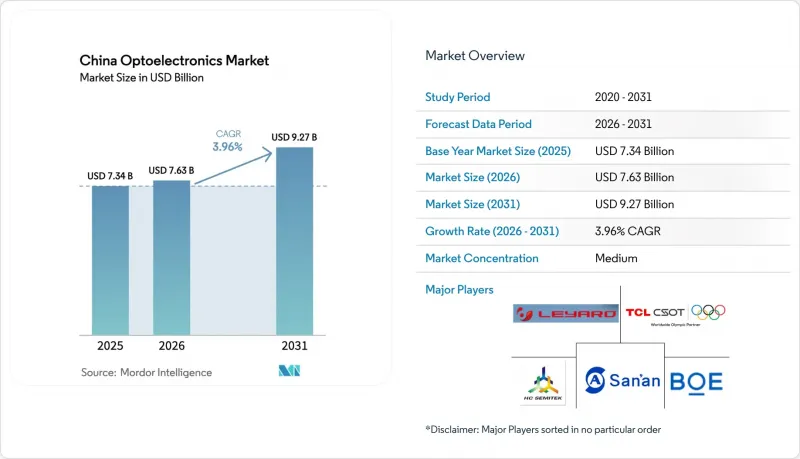
本報告按裝置類型(LED、雷射二極體、影像感測器等)、裝置材料(氮化鎵、砷化鎵等)、應用領域(照明和顯示、光纖通訊和Li-Fi等)以及終端用戶產業(消費性電子、汽車等)進行細分。市場預測以美元計價。
中國光電市場趨勢與洞察
政府措施旨在建構國內半導體供應鏈
國家積體電路產業投資基金第三期計畫在2024年將投資超過400億美元,明確目標是擴大化合物半導體的產能,而化合物半導體是光電裝置的關鍵材料。津貼資助的晶圓廠(製造廠)專案將降低實際資本成本,確保銀行貸款,並透過在地採購規則保障採購管道。這些措施共同作用,使得LED、雷射二極體和感測器等產品的採購來源集中於國內供應商,即使在經濟放緩時期,也為中國光電市場奠定了一定的基礎。此外,該政策也透過資助與大學合作建造聯合試驗生產線,縮短了技術引進的學習曲線。中期來看,國產化努力可望縮小金屬有機化學氣相沉積(MOCVD)和離子布植等製程技術的差距。
LED、迷你LED和微型LED的快速商業化
2024年,京東方科技(BOE Technology)實現了高階智慧型手機和平板電腦mini-LED背光燈從試生產到量產的過渡,證明了高產量轉移製程的有效性,該製程可將晶片鍵合週期縮短35%。單位成本的降低擴大了目標市場——二線行動電話和電視領域,並加速了國內基板、驅動IC和封裝廠商的營收成長。與OLED相比,mini-LED背光燈具有更優異的色域和更長的使用壽命,這推動了OEM廠商的設計採用。同時,貿易政策趨勢使得海外供應商在到貨成本方面競爭力下降。深圳組裝代工廠商提供的快速認證項目,只需六個月即可完成設計採用週期,而海外競爭對手則需要九個月甚至更長。因此,與商品化的LED照明產品相比,中國光電市場受益於更高的平均售價和更低的客戶流失風險。
美國和中國的技術出口限制
美國2024年10月推出的監管政策限制了先進氮化鎵和碳化矽製造設備的出貨,導致設備採購前置作業時間延長至18個月以上。國內晶圓廠被迫在繼續使用老一代反應器或加快自主設備設計之間做出選擇,這兩種方案都會降低初始運作並推高單片晶圓成本。跨國供應商推遲了本地服務中心的擴張,進一步延緩了產能擴張計畫。因此,短期晶圓產量無法滿足電動車和5G領域的需求,導致預測期內前兩年中國光電市場的複合年成長率下降。
細分市場分析
預計到2031年,雷射二極體的複合年成長率將達到4.86%,超過中國整體光電子市場的成長速度,儘管截至2025年,LED的銷量仍保持著33.68%的領先優勢。雷射雷達(LiDAR)的搭載率以及資料中心光學元件需求的成長,為市場提供了強勁的需求緩衝,緩解了行動電話用垂直腔面發射雷射(VCSEL)出貨量的波動。由於LED的價格彈性導致利潤率較低,供應商正將產能轉向平均售價超過20美元/件的連貫光學產品。用於金屬切割和積層製造(AM)的工業雷射陣列進一步拓展了目標收入來源,而光耦合器雖然成長速度放緩,但在電源轉換隔離應用中仍保持著效用。
同時,由於供應過剩,太陽能電池面臨價格壓力,但仍受益於基於碳中和政策的市電平價計畫。影像感測器的出貨量因智慧型手機雙攝和三攝的設計而成長,但其附加價值的獲取正轉向堆疊式像素架構,該架構將邏輯電路嵌入光電二極體下方。這些變化共同推高了整個裝置類別的平均售價,抵消了中國光電市場出貨量成長放緩的影響。
碳化矽 (SiC) 以 4.45% 的複合年成長率 (CAGR) 領先市場,逐漸蠶食氮化鎵 (GaN) 的主導地位。預計到 2025 年,GaN 的市佔率將達到 41.75%。在電動車 (EV) 牽引逆變器和 5G 基地台功率放大器 (PA) 模組中,SiC 優異的導熱性能備受青睞,能夠實現更高的功率密度並降低冷卻成本。天津中環半導體在 200mm SiC基板取得的技術突破,將缺陷密度降低了 40%,縮小了與 GaN 的成本差距,並促進了 SiC 的更廣泛應用。儘管 GaN 在高速開關充電器和射頻前端領域仍保持優勢,但磷化銦在 1550nm 車用雷射雷達雷射領域的需求正在成長。向化合物半導體的轉型提高了設備認證的門檻,但同時也帶來了更高的定價空間,並緩解了中國光電市場毛利率的波動。
儘管傳統的矽和砷化鎵在中功率LED燈和行動電話用光電二極體(P-A)領域仍佔據重要地位,但由於高性能替代材料的崛起,它們的市場佔有率正面臨長期下滑。隨著中國光電產業的發展,提高工藝良率和在地化基板供應對於維持成本競爭力至關重要。
其他好處:
- Excel格式的市場預測(ME)表
- 3個月的分析師支持
目錄
第1章:引言
- 研究假設和市場定義
- 調查範圍
第2章:調查方法
第3章執行摘要
第4章 市場狀況
- 市場概覽
- 市場促進因素
- 政府努力建構國內半導體供應鏈
- LED迷你和微型LED的快速商業化
- 5G和資料中心推動了對光收發器的需求
- 在電動車上安裝LiDAR
- 碳中和政策正在加速太陽能發電的普及。
- 新興量子點影像感測器新創公司
- 市場限制因素
- 美國和中國的高科技出口限制
- 化合物半導體製造業人員短缺
- 對8吋GaN和SiC製造的高額資本投入
- LED背光燈價格下降
- 產業生態系分析
- 監理情勢
- 技術展望
- 宏觀經濟因素的影響
- 波特五力分析
第5章 市場規模與成長預測
- 依設備類型
- LED
- 雷射二極體
- 影像感測器
- 歐普託卡普拉
- 太陽能電池
- 其他設備類型
- 裝置材料
- 氮化鎵(GaN)
- 砷化鎵(GaAs)
- 碳化矽(SiC)
- 磷化銦(InP)
- 矽和其他裝置材料
- 透過使用
- 照明和展示
- 光纖通訊和Li-Fi
- 感測與成像
- 電力轉換和太陽能發電
- 其他用途
- 按最終用戶行業分類
- 家用電子產品
- 車
- 資訊科技/通訊
- 醫療保健和生命科學
- 航太/國防
- 工業自動化
- 其他終端用戶產業
第6章 競爭情勢
- 市場集中度
- 策略趨勢
- 市佔率分析
- 公司簡介
- BOE Technology Group Co., Ltd.
- Shenzhen China Star Optoelectronics Technology Co., Ltd.
- Sanan Optoelectronics Co., Ltd.
- HC Semitek Corporation
- Leyard Optoelectronic Co., Ltd.
- Nationstar Optoelectronics Co., Ltd.
- Yangzhou AUO Optoelectronics Technology Co., Ltd.
- Focuslight Technologies Inc.
- Wuhan Raycus Fiber Laser Technologies Co., Ltd.
- Suzhou Everbright Photonics Co., Ltd.
- Truelight Corporation
- Zhuhai Orbita Aerospace Science and Technology Co., Ltd.
- GigaDevice Semiconductor(Beijing)Inc.
- OFILM Group Co., Ltd.
- Will Semiconductor Co., Ltd. Shanghai
- Shandong Inspur Huaguang Optoelectronics Co., Ltd.
- Goertek Inc.
- Tianjin Zhonghuan Semiconductor Co., Ltd.
- Advanced Micro-Fabrication Equipment Inc. China
- Ennostar Inc.
第7章 市場機會與未來展望
According to Mordor Intelligence, the China optoelectronics market size is expected to grow from USD 7.34 billion in 2025 to USD 7.63 billion in 2026 and is forecast to reach USD 9.27 billion by 2031 at 3.96% CAGR over 2026-2031.
This report is Segmented by Device Type (LED, Laser Diode, Image Sensors, and More), Device Material (Gallium Nitride, Gallium Arsenide, and More), Application (Lighting and Display, Optical Communication and Li-Fi, and More), End-User Industry (Consumer Electronics, Automotive, and More). The Market Forecasts are Provided in Terms of Value (USD).
China Optoelectronics Market Trends and Insights
Government Push for Domestic Semiconductor Supply Chains
The third phase of the National Integrated Circuit Industry Investment Fund injected more than USD 40 billion in 2024, with a clear mandate to scale compound-semiconductor capacity critical for optoelectronic devices. Subsidized fab projects lower effective capital costs, lock in bank financing, and guarantee procurement channels through local-content rules. Collectively, these measures tilt purchasing toward domestic LED, laser diode, and sensor vendors, creating a baseline floor for the China optoelectronics market even during cyclical slowdowns. The policy also shortens technology-learning curves by financing joint pilot lines with university partners. Over the medium term, the localization agenda should close process-technology gaps in metal-organic chemical vapor deposition and ion implantation.
Rapid LED Mini and Micro-LED Commercialization
BOE Technology transitioned from pilot to volume mini-LED backlighting for premium smartphones and tablets in 2024, validating mass-transfer processes that reduce die-bonding cycle times by 35%. Unit-cost compression widens the addressable tier-two handset and TV segments, accelerating revenue capture for domestic substrate, driver-IC, and packaging firms. Color gamut and lifetime advantages over OLED win OEM design slots, while trade policy dynamics render overseas supply less competitive on landed cost. Rapid-qualifier programs at Shenzhen-based contract assemblers enable six-month design-win cycles, compared with nine months or more for foreign rivals. As a result, the China optoelectronics market benefits from higher average selling prices and lower churn risk versus commoditized LED lighting.
US-China Tech Export Controls
The October 2024 revision of U.S. regulations curtailed shipments of advanced gallium-nitride and silicon-carbide equipment, lengthening tool-procurement lead times to more than 18 months. Domestic fabs either run older-node reactors or accelerate in-house tool designs, both scenarios depressing initial yields and raising cost per wafer. Multinational suppliers postpone local service-center expansion, further delaying ramp schedules. Consequently, near-term wafer output lags demand from EV and 5G segments, trimming the China optoelectronics market CAGR during the first two forecast years.
Other drivers and restraints analyzed in the detailed report include:
- 5G- and Data-Center-Driven Optical Transceiver Demand
- Electric Vehicle LiDAR Integration
- High CAPEX for 8-inch GaN and SiC Fabrication
For complete list of drivers and restraints, kindly check the Table Of Contents.
Segment Analysis
Laser diodes are expected to contribute a 4.86% CAGR through 2031, outperforming the broader China optoelectronics market despite LEDs retaining a 33.68% revenue lead in 2025. Rising LiDAR attach rates and data-center optics create resilient demand buffers that cushion cyclical swings in handset VCSEL volumes. The price elasticity of LEDs erodes margins, prompting vendors to migrate capacity to coherent-light products where ASPs exceed USD 20 per unit. Industrial laser arrays for metal cutting and additive manufacturing further widen addressable revenue pools, while optocouplers maintain utility in power-conversion isolation despite slower growth.
In parallel, photovoltaic cells wrestle with overcapacity-led price compression yet still benefit from grid-parity projects under carbon-neutral mandates. Image-sensor volumes climb on dual- and triple-camera smartphone designs, but value capture shifts toward stacked-pixel architectures that embed logic under photodiodes. Collectively, these shifts raise the blended ASP across device categories, helping the China optoelectronics market offset slower unit expansion.
Silicon carbide posted the fastest 4.45% CAGR, nibbling at gallium nitride's 41.75% revenue dominance in 2025. EV traction inverters and 5G base-station PA modules value SiC's superior thermal conductivity, enabling higher power density and reduced cooling overhead. Tianjin Zhonghuan's 200 mm SiC substrate breakthrough cut defect density by 40%, narrowing the cost delta with GaN and supporting wider adoption. GaN retains an edge in fast-switching chargers and RF front-ends, while indium phosphide rises for 1550 nm automotive LiDAR lasers. The shift toward compound semiconductors magnifies equipment-qualification hurdles but unlocks premium pricing that smooths gross-margin volatility across the China optoelectronics market.
Traditional silicon and gallium arsenide remain relevant in mid-power LED lamps and handset P-As but face secular share drift to higher-performance alternatives. Process-yield improvements and localized substrate supply are strategic for sustaining competitive cost structures as the China optoelectronics industry advances.
Complete Report Scope:
- By Device Type
- LED
- Laser Diode
- Image Sensors
- Optocouplers
- Photovoltaic Cells
- Other Device Types
- By Device Material
- Gallium Nitride (GaN)
- Gallium Arsenide (GaAs)
- Silicon Carbide (SiC)
- Indium Phosphide (InP)
- Silicon and Other Device Materials
- By Application
- Lighting and Display
- Optical Communication and Li-Fi
- Sensing and Imaging
- Power Conversion and Photovoltaics
- Other Applications
- By End-user Industry
- Consumer Electronics
- Automotive
- Information Technology and Telecom
- Healthcare and Life-Sciences
- Aerospace and Defense
- Industrial Automation
- Other End-user Industries
List of Companies Covered in this Report:
- BOE Technology Group Co., Ltd.
- Shenzhen China Star Optoelectronics Technology Co., Ltd.
- Sanan Optoelectronics Co., Ltd.
- HC Semitek Corporation
- Leyard Optoelectronic Co., Ltd.
- Nationstar Optoelectronics Co., Ltd.
- Yangzhou AUO Optoelectronics Technology Co., Ltd.
- Focuslight Technologies Inc.
- Wuhan Raycus Fiber Laser Technologies Co., Ltd.
- Suzhou Everbright Photonics Co., Ltd.
- Truelight Corporation
- Zhuhai Orbita Aerospace Science and Technology Co., Ltd.
- GigaDevice Semiconductor (Beijing) Inc.
- OFILM Group Co., Ltd.
- Will Semiconductor Co., Ltd. Shanghai
- Shandong Inspur Huaguang Optoelectronics Co., Ltd.
- Goertek Inc.
- Tianjin Zhonghuan Semiconductor Co., Ltd.
- Advanced Micro-Fabrication Equipment Inc. China
- Ennostar Inc.
Additional Benefits:
- The market estimate (ME) sheet in Excel format
- 3 months of analyst support
TABLE OF CONTENTS
1 INTRODUCTION
- 1.1 Study Assumptions and Market Definition
- 1.2 Scope of the Study
2 RESEARCH METHODOLOGY
3 EXECUTIVE SUMMARY
4 MARKET LANDSCAPE
- 4.1 Market Overview
- 4.2 Market Drivers
- 4.2.1 Government Push for Domestic Semiconductor Supply Chains
- 4.2.2 Rapid LED Mini and MicroLED Commercialization
- 4.2.3 5G-and-Data-Center Driven Optical Transceiver Demand
- 4.2.4 Electric Vehicle LiDAR Integration
- 4.2.5 Carbon-Neutral Policies Accelerating Photovoltaic Adoption
- 4.2.6 Emerging Quantum Dot Image Sensor Start-Ups
- 4.3 Market Restraints
- 4.3.1 US-China Tech Export Controls
- 4.3.2 Talent Shortage in Compound Semiconductor Processing
- 4.3.3 High CAPEX for 8-inch GaN and SiC Fabrication
- 4.3.4 Price Erosion in LED Backlighting
- 4.4 Industry Ecosystem Analysis
- 4.5 Regulatory Landscape
- 4.6 Technological Outlook
- 4.7 Impact of Macroeconomic Factors
- 4.8 Porter's Five Forces Analysis
- 4.8.1 Threat of New Entrants
- 4.8.2 Bargaining Power of Suppliers
- 4.8.3 Bargaining Power of Buyers
- 4.8.4 Threat of Substitutes
- 4.8.5 Intensity Competitive Rivalry
5 MARKET SIZE AND GROWTH FORECASTS (VALUE)
- 5.1 By Device Type
- 5.1.1 LED
- 5.1.2 Laser Diode
- 5.1.3 Image Sensors
- 5.1.4 Optocouplers
- 5.1.5 Photovoltaic Cells
- 5.1.6 Other Device Types
- 5.2 By Device Material
- 5.2.1 Gallium Nitride (GaN)
- 5.2.2 Gallium Arsenide (GaAs)
- 5.2.3 Silicon Carbide (SiC)
- 5.2.4 Indium Phosphide (InP)
- 5.2.5 Silicon and Other Device Materials
- 5.3 By Application
- 5.3.1 Lighting and Display
- 5.3.2 Optical Communication and Li-Fi
- 5.3.3 Sensing and Imaging
- 5.3.4 Power Conversion and Photovoltaics
- 5.3.5 Other Applications
- 5.4 By End-user Industry
- 5.4.1 Consumer Electronics
- 5.4.2 Automotive
- 5.4.3 Information Technology and Telecom
- 5.4.4 Healthcare and Life-Sciences
- 5.4.5 Aerospace and Defense
- 5.4.6 Industrial Automation
- 5.4.7 Other End-user Industries
6 COMPETITIVE LANDSCAPE
- 6.1 Market Concentration
- 6.2 Strategic Moves
- 6.3 Market Share Analysis
- 6.4 Company Profiles (includes Global level Overview, Market level overview, Core Segments, Financials as available, Strategic Information, Market Rank/Share for key companies, Products and Services, and Recent Developments)
- 6.4.1 BOE Technology Group Co., Ltd.
- 6.4.2 Shenzhen China Star Optoelectronics Technology Co., Ltd.
- 6.4.3 Sanan Optoelectronics Co., Ltd.
- 6.4.4 HC Semitek Corporation
- 6.4.5 Leyard Optoelectronic Co., Ltd.
- 6.4.6 Nationstar Optoelectronics Co., Ltd.
- 6.4.7 Yangzhou AUO Optoelectronics Technology Co., Ltd.
- 6.4.8 Focuslight Technologies Inc.
- 6.4.9 Wuhan Raycus Fiber Laser Technologies Co., Ltd.
- 6.4.10 Suzhou Everbright Photonics Co., Ltd.
- 6.4.11 Truelight Corporation
- 6.4.12 Zhuhai Orbita Aerospace Science and Technology Co., Ltd.
- 6.4.13 GigaDevice Semiconductor (Beijing) Inc.
- 6.4.14 OFILM Group Co., Ltd.
- 6.4.15 Will Semiconductor Co., Ltd. Shanghai
- 6.4.16 Shandong Inspur Huaguang Optoelectronics Co., Ltd.
- 6.4.17 Goertek Inc.
- 6.4.18 Tianjin Zhonghuan Semiconductor Co., Ltd.
- 6.4.19 Advanced Micro-Fabrication Equipment Inc. China
- 6.4.20 Ennostar Inc.
7 MARKET OPPORTUNITIES AND FUTURE OUTLOOK
- 7.1 White-space and Unmet-need Assessment

 光子和光電子材料市場:預測至2034年-全球材料類型、材料組成、頻譜範圍、材料形態、光學功能、應用、最終用戶和區域分析
 汽車光電市場:2026-2032年全球市場預測(依產品類型、技術、銷售管道、車輛類型及通路分類)光電子市場:依產品類型、材料類型和應用分類-2026-2032年全球市場預測
 汽車光電市場規模、佔有率和成長分析:按光學元件硬體類型、功能系統應用、驅動平台類型、車輛等級和地區分類-2026-2033年產業預測光電材料市場:預測(至2034年)-按材料類型、產品類型、波長範圍、應用、功能和地區分類的全球分析
 汽車光電市場-全球產業規模、佔有率、趨勢、機會、預測:按組件類型、最終用戶、地區和競爭格局分類,2021-2031年光電和光電子學市場預測至2034年-按產品、組件、波導管範圍、應用和區域分類的全球分析
 光電市場:依LED、影像感測器、紅外線、光耦合器、光電、顯示器 | 依GaN、GaAs、SiC材料 | 依汽車、消費性電子和通訊應用 - 全球趨勢及至2036年預測
 2026年全球光電市場報告
 光電子市場規模、佔有率及成長分析(按元件、裝置材料、應用、產業細分和地區分類)-2026-2033年產業預測