


 |
市場調查報告書
商品編碼
2119564
季銨化合物:市場佔有率分析、產業趨勢與統計、成長預測(2026-2031)Quaternary Ammonium Compounds - Market Share Analysis, Industry Trends & Statistics, Growth Forecasts (2026 - 2031) |
||||||

※ 本網頁內容可能與最新版本有所差異。詳細情況請與我們聯繫。
據 Mordor Intelligence 稱,2025 年季銨化合物的市場規模為 20.6 億美元,預計到 2031 年將從 2026 年的 21.7 億美元成長至 28.2 億美元,預測期(2026-2031 年)的複合年成長率為 5.39%。
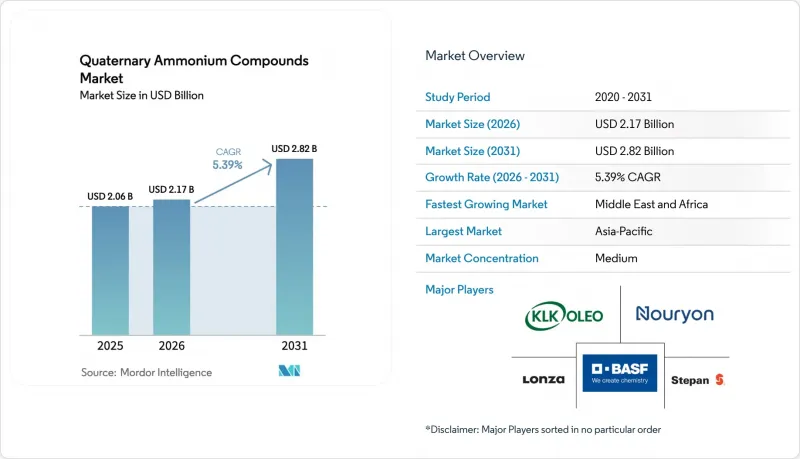
本報告按類型(工業級、醫藥級等)、應用(消毒劑、織物柔軟劑等)、終端用戶行業(醫療保健/生命科學、家庭和機構清潔等)以及地區(亞太地區、北美地區、歐洲地區、南美地區、中東和非洲地區)進行細分。市場預測以美元計價。
全球季銨化合物市場趨勢及洞察
為因應新冠疫情後的感染控制措施,醫院對消毒劑的需求增加。
疫情永久提高了人們對診所和長期照護機構衛生標準的期望。季銨化合物仍然是美國環保署 (EPA) N 類清單上 500 多種產品的關鍵活性成分。手術室、急診室和診斷檢查室在每個班次中都會多次使用苯扎氯銨或二烷基二甲基銨組合藥物進行清潔。它們對細菌、包膜病毒和真菌具有廣譜殺菌活性,並且對不銹鋼和聚合物塗層表面親和性,因此醫療機構對這類化合物的需求持續強勁。 EPA 近期推出的殘留分析技術使醫療機構能夠追蹤殘留量和沖洗效率,從而減少病患接觸。供應商的研發工作目前正專注於將季銨化合物與過氧化物結合的雙活性混合物,以將作用時間縮短至一分鐘以內。這項轉變符合提高病患週轉率高的科室運作效率的目標。
新興經濟體城市和工業用水處理基礎設施的擴建
中國、印度、印尼和奈及利亞的快速都市化需要建造新的飲用水處理設施並對供水管網進行維修。許多此類設施採用季銨化合物作為氯處理的替代或補充,以抑制生物膜的形成。工業園區採用封閉回路型冷卻塔循環利用大量製程用水,對耐高硬度和耐pH值波動的陽離子消毒劑產生了穩定的需求。利用季銨前驅物原位合成活性氯的電化學發生器降低了化學品處理成本,對於缺乏大宗化學品物流基礎設施的偏遠工廠來說極具吸引力。此類系統一旦安裝,即可確保20至30年的補給需求。此外,關於未計費水量水損失的政策要求也迫使供水事業採用殘留效果較強的化合物,以確保即使發生管線洩漏也能確保微生物安全。
原料(動物脂肪和石油衍生物)價格波動
東南亞和美國大規模的生物柴油生產設施運作導致動物脂肪需求激增,使得原本用於特種化學品的動物脂肪和油脂被轉用於生質柴油生產。同時,乙烯和丙烯的價格波動(與煉油廠的運轉率相關)也為石油衍生季銨鹽中間體的成本帶來了難以預測的不確定性。生產商正透過與一體化供應商簽訂多年期現貨供應協議以及採用選擇性生質能平衡採購機制來規避風險。如果投入成本飆升,化合物生產商會精簡產品線,優先生產利潤率更高的醫用級產品,並將額外費用根據指數掛鉤條款轉嫁給機構投資者。
細分市場分析
2025年,工業級產品佔總銷售額的45.22%。這主要歸功於供水事業、油田服務承包商以及紙漿和造紙廠對更高純度和性能標準的需求。沙烏地阿拉伯和奈及利亞海水淡化廠加速建設,推動了這個細分市場的發展。在這些工廠,為了在25年的運作週期中維持薄膜的效率,需要持續投加界面活性劑。二疊紀盆地的先導計畫採用了雙子型陽離子界面活性劑,即使在溫度高於120 度C、鹽度高於200,000 ppm的鹽度環境下也能保持穩定性,從而擴大了工業級流體用季銨化合物的市場規模。監管機構對氯化物排放的壓力促使鑽井公司從氯化鉀轉向季銨黏土封堵系統,也有助於減少地質損害。
該研究重點在於酯鍵季銨化合物,這類化合物在中性pH值的污水中可水解為無害的脂肪酸。這項轉變符合歐盟排放標準,並支持化妝品級季銨化合物市場的進一步成長,預計該市場將以5.95%的複合年成長率成長。化妝品開發商更傾向於使用具有較長烷基鏈的二烷基二甲基氯化銨衍生物,這類衍生物在添加量低於0.2wt%時即可改善濕潤狀態下的梳理性能,從而使護髮素無需使用矽油即可達到標籤標示的功效。隨著生物分解性的提高,化妝品級季銨化合物的出貨量將逐步蠶食工業級季銨化合物的市場佔有率,提升季銨化合物市場的整體價值。
區域分析
預計到2025年,亞太地區將佔全球銷售額的32.21%,這主要得益於其強大的紡織價值鏈、廣泛的化工產業叢集以及大規模的城市供水基礎設施。僅中國對織物柔軟劑的需求就佔該地區銷售量的近四分之一,隨著服裝出口商轉向高附加價值功能性服裝,預計這一數字還將進一步成長。印度智慧城市計畫的津貼正在加速建設利用陽離子殺菌劑控制生物膜的三級處理設施,這為採購合約的簽訂奠定了基礎,並支撐了季銨化合物市場的長期供應前景。
在北美,季銨化合物市場已透過醫院網路(這些醫院網路標準化使用美國環保署註冊的N類消毒劑)和頁岩氣業者(這些業者在傳統型油井中使用季銨黏土控制系統)而佔據穩固地位。美國每年鋪設超過1.8億平方公尺的商業地板材料,清潔服務提供者保持較高的訂單完成率,減輕了常規預算限制的影響。加拿大油砂生產商正在試驗在蒸氣輔助重力洩油中使用可生物分解的陽離子界面活性劑,隨著碳排放強度標準的日益嚴格,此舉可能會推動該地區季銨化合物市場的擴張。
在歐洲,永續化學技術日益受到重視,促使製藥公司採用酯鍵季銨化合物和生質能平衡的原料,將生產階段的排放量減少50%以上。主要消費品牌正積極爭取北歐白天鵝生態標章認證,該認證旨在限制累積水生毒性。預計符合監管要求的益處將提高規範制定者的轉換成本,最終促成更穩定的供應商組合。中東和非洲地區展現最強勁的成長前景,複合年成長率達6.91%。卡達、安哥拉和圭亞那的海上開採設施正在擴大陽離子界面活性劑項目,旨在最大限度地提高深海資產的回收率。在南美洲,以巴西為首,季銨消毒劑正被應用於不斷擴張的家禽和牛肉加工廠,這些工廠必須符合最新的美國和歐盟進口衛生標準。
其他好處:
- Excel格式的市場預測(ME)表
- 3個月的分析師支持
目錄
第1章:引言
- 研究假設和市場定義
- 調查範圍
第2章:調查方法
第3章執行摘要
第4章 市場狀況
- 市場概覽
- 市場促進因素
- 新冠感染疾病後,為因應感染控制措施,醫院對消毒劑的需求增加。
- 新興國家市政和工業用水處理基礎設施的擴建
- 亞洲服飾製造地織物柔軟精使用量激增。
- 低VOC表面清潔劑化學成分相關法規的支持
- 在強化採油溶液中採用陽離子界面活性劑
- 市場限制因素
- 原料(動物脂肪和石油基產品)價格波動
- 對抗生素抗藥性的擔憂促使監管機構加強了審查力道。
- 歐盟關於限制使用殘留化妝品的毒性討論
- 價值鏈分析
- 波特五力模型
第5章 市場規模與成長預測
- 按類型
- 工業級
- 醫藥級
- 化妝品級
- 其他(食品用途、實驗室用途)
- 透過使用
- 消毒劑
- 衣物柔順劑
- 木材防腐劑
- 界面活性劑
- 抗靜電劑
- 石油和天然氣化學產品
- 其他(例如個人護理護髮素)
- 按最終用戶行業分類
- 醫療保健和生命科學
- 住宅和商業清潔服務
- 紡織品和皮革
- 石油和天然氣
- 個人護理化妝品
- 農業
- 其他(水處理)
- 按地區
- 亞太地區
- 中國
- 印度
- 日本
- 韓國
- 其他亞太國家
- 北美洲
- 美國
- 加拿大
- 墨西哥
- 歐洲
- 德國
- 英國
- 法國
- 義大利
- 其他歐洲國家
- 南美洲
- 巴西
- 阿根廷
- 其他南美國家
- 中東和非洲
- 沙烏地阿拉伯
- 南非
- 其他中東和非洲國家
- 亞太地區
第6章 競爭情勢
- 市場集中度
- 策略趨勢
- 市佔率分析
- 公司簡介
- Arkema
- BASF
- Clariant
- Croda International plc
- Diversey Holdings Ltd.
- DuPont
- Evonik Industries AG
- Henkel AG & Co. KGaA
- Huntsman Corporation
- Kao Corporation
- KLK Oleo
- LANXESS AG
- Lonza Group
- Merck KGaA
- Nouryon
- Oxiteno SA
- Pilot Chemical Company
- Solvay SA
- Spartan Chemical Company
- Stepan Company
第7章 市場機會與未來展望
According to Mordor Intelligence, the quaternary ammonium compounds market size was valued at USD 2.06 billion in 2025 and estimated to grow from USD 2.17 billion in 2026 to reach USD 2.82 billion by 2031, at a CAGR of 5.39% during the forecast period (2026-2031).
This report is Segmented by Type (Industrial Grade, Pharmaceutical Grade, and More), Application (Disinfectants, Fabric Softeners, and More), End-User Industry (Healthcare and Life Sciences, Household and Institutional Cleaning, and More), and Geography (Asia-Pacific, North America, Europe, South America, Middle East and Africa). The Market Forecasts are Provided in Terms of Value (USD).
Global Quaternary Ammonium Compounds Market Trends and Insights
Rising Demand for Hospital-Grade Disinfectants for Post-COVID Infection-Control Protocols
The pandemic forever raised baseline hygiene expectations in clinics and long-term-care facilities, and quaternary ammonium compounds remain the primary actives in more than 500 products on the United States Environmental Protection Agency List N. Surgical suites, emergency units, and diagnostic labs maintain cleaning cycles that call for benzalkonium chloride and dialkyldimethylammonium blends several times each shift. Their broad-spectrum action against bacteria, enveloped viruses, and fungi, coupled with surface-compatibility on stainless steel and polymer finishes, sustains institutional demand. Recent EPA residue-analysis methods help facilities track deposition and rinse efficiency to limit patient exposure. Supplier R&D now centers on dual-active mixtures that pair quaternary ammonium compounds with peroxide to cut dwell times below one minute, a shift that aligns with workflow efficiency goals in high-turnover departments.
Expansion of Municipal & Industrial Water-Treatment Infrastructure in Emerging Economies
Rapid urbanization across China, India, Indonesia, and Nigeria requires new drinking-water plants and distribution-line upgrades, many of which substitute or supplement chlorination with quaternary ammonium compound dosing to control biofilm formation. Industrial parks add closed-loop cooling towers that recirculate large volumes of process water, creating steady baseline demand for cationic biocides that resist high hardness and variable pH. Electrochemical generation units that synthesize active chlorine in situ from quaternary ammonium precursors cut chemical-handling costs and appeal to remote plants that lack bulk-chemical logistics. Such systems, once installed, guarantee replenishment orders for two to three decades. Policy mandates on non-revenue water losses also prompt utilities to adopt compounds with stronger residuals, thereby ensuring microbiological safety despite pipeline leaks.
Feedstock (Tallow & Petro) Price Volatility
Tallow demand surged after large biodiesel capacities came online in Southeast Asia and the United States, diverting animal-fat streams away from specialty chemicals. Simultaneously, ethylene and propylene price swings linked to refinery utilization rates introduce cost unpredictability for petro-based quaternary ammonium intermediates. Producers hedge exposure through multi-year offtake contracts and selective biomass-balanced purchasing mechanisms offered by integrated suppliers. When input costs spike, formulators rationalize product lines, prioritize higher-margin healthcare grades, and pass through surcharges to institutional buyers under index-based clauses.
Other drivers and restraints analyzed in the detailed report include:
- Surging Textile Softener Usage in Asia's Apparel Manufacturing Hubs
- Regulatory Push for Low-VOC Surface-Cleaner Chemistries
- Antimicrobial-Resistance Concerns Driving Regulatory Scrutiny
For complete list of drivers and restraints, kindly check the Table Of Contents.
Segment Analysis
Industrial grade products controlled 45.22% of 2025 revenue because water utilities, oil-field service contractors, and pulp-and-paper mills specify higher purity and performance thresholds. This segment benefits from accelerated capital spending on desalination plants in Saudi Arabia and Nigeria, each of which consumes continuous doses that preserve membrane efficiency throughout 25-year operating lifecycles. Enhanced-oil-recovery pilots in the Permian Basin adopt gemini cationic surfactants that maintain stability above 120 °C and at 200,000 ppm brine, thereby advancing the quaternary ammonium compounds market size for industrial grade fluids. Regulatory pressure on chloride emissions encourages drillers to switch from potassium chloride to quaternary ammonium clay-inhibition systems, which also reduce formation damage.
Research pipelines emphasize ester-linked quats that hydrolyze into benign fatty acids under neutral pH in wastewater. This pivot aligns with European Union discharge limits and supports higher growth in the cosmetic grade segment, forecast to expand at a 5.95% CAGR. Cosmetic formulators favor dialkyldimethyl ammonium chloride variants with longer alkyl chains that offer wet-combing improvements at dosages below 0.2 wt%, helping conditioners meet label claims without silicones. As biodegradable performance improves, cosmetic grade volumes will erode part of industrial grade's share yet lift overall quaternary ammonium compounds market value.
Complete Report Scope:
- By Type
- Industrial Grade
- Pharmaceutical Grade
- Cosmetic Grade
- Others (Food Grade, Lab Grade)
- By Application
- Disinfectants
- Fabric Softeners
- Wood Preservatives
- Surfactants
- Antistatic Agents
- Oil and Gas Chemicals
- Others (Personal-Care Conditioners etc)
- By End-User Industry
- Healthcare and Life Sciences
- Household and Institutional Cleaning
- Textiles and Leather
- Oil and Gas
- Personal Care and Cosmetics
- Agriculture
- Others (Water Treatment)
- By Geography
- Asia-Pacific
- China
- India
- Japan
- South Korea
- Rest of Asia-Pacific
- North America
- United States
- Canada
- Mexico
- Europe
- Germany
- United Kingdom
- France
- Italy
- Rest of Europe
- South America
- Brazil
- Argentina
- Rest of South America
- Middle East and Africa
- Saudi Arabia
- South Africa
- Rest of Middle East and Africa
- Asia-Pacific
Geography Analysis
Asia Pacific commands 32.21% of 2025 turnover thanks to its dense textile value chain, broad chemical clusters, and large installed base of municipal water infrastructure. Chinese fabric-softener demand alone accounted for nearly one-quarter of regional volume, a figure expected to climb as apparel exporters pivot toward value-added performance wear. India's Smart Cities Mission grants accelerate installation of tertiary-treatment plants that rely on cationic biocides for biofilm control, anchoring procurement contracts that underpin long-term supply visibility across the quaternary ammonium compounds market.
North America holds an entrenched position through hospital networks that standardize on EPA-registered List N disinfectants and through shale-gas operators that employ quaternary ammonium clay-control systems in unconventional wells. With more than 180 million m2 of commercial flooring installed annually, janitorial service providers in the United States maintain high pull-through rates, cushioning the impact of periodic budget constraints. Canada's oil-sands producers trial biodegradable cationic surfactants in steam-assisted gravity drainage, a move that could enlarge regional quaternary ammonium compounds market size under increasingly strict carbon-intensity benchmarks.
Europe emphasizes sustainable chemistries, prompting formulators to adopt ester-link quats and biomass-balanced feedstocks that cut cradle-to-gate emissions by 50% or more. Leading consumer brands seek Nordic Swan Ecolabel certification, which caps cumulative aquatic toxicity; compliance advantages will likely raise switching costs for specifiers and therefore stabilize the supplier roster. The Middle East and Africa post the strongest growth outlook at 6.91% CAGR as offshore rigs in Qatar, Angola, and Guyana expand cationic surfactant programs aimed at maximizing recovery from deepwater assets. South America, led by Brazil, leverages quaternary ammonium disinfectants in expanding poultry and beef-processing plants that must comply with updated US and EU import hygiene codes.
- Arkema
- BASF
- Clariant
- Croda International plc
- Diversey Holdings Ltd.
- DuPont
- Evonik Industries AG
- Henkel AG & Co. KGaA
- Huntsman Corporation
- Kao Corporation
- KLK Oleo
- LANXESS AG
- Lonza Group
- Merck KGaA
- Nouryon
- Oxiteno S.A.
- Pilot Chemical Company
- Solvay S.A.
- Spartan Chemical Company
- Stepan Company
Additional Benefits:
- The market estimate (ME) sheet in Excel format
- 3 months of analyst support
TABLE OF CONTENTS
1 Introduction
- 1.1 Study Assumptions & Market Definition
- 1.2 Scope of the Study
2 Research Methodology
3 Executive Summary
4 Market Landscape
- 4.1 Market Overview
- 4.2 Market Drivers
- 4.2.1 Rising demand for hospital-grade disinfectants for post-COVID infection-control protocols
- 4.2.2 Expansion of municipal & industrial water-treatment infrastructure in emerging economies
- 4.2.3 Surging textile softener usage in Asia's apparel manufacturing hubs
- 4.2.4 Regulatory push for low-VOC surface-cleaner chemistries
- 4.2.5 Adoption of cationic surfactants in enhanced oil-recovery fluids
- 4.3 Market Restraints
- 4.3.1 Feedstock (tallow & petro) price volatility
- 4.3.2 Antimicrobial-resistance concerns driving regulatory scrutiny
- 4.3.3 Toxicity debates restricting leave-on cosmetic use in the EU
- 4.4 Value Chain Analysis
- 4.5 Porter's Five Forces
- 4.5.1 Bargaining Power of Suppliers
- 4.5.2 Bargaining Power of Buyers
- 4.5.3 Threat of New Entrants
- 4.5.4 Threat of Substitutes
- 4.5.5 Competitive Rivalry
5 Market Size & Growth Forecasts (Value)
- 5.1 By Type
- 5.1.1 Industrial Grade
- 5.1.2 Pharmaceutical Grade
- 5.1.3 Cosmetic Grade
- 5.1.4 Others (Food Grade, Lab Grade)
- 5.2 By Application
- 5.2.1 Disinfectants
- 5.2.2 Fabric Softeners
- 5.2.3 Wood Preservatives
- 5.2.4 Surfactants
- 5.2.5 Antistatic Agents
- 5.2.6 Oil and Gas Chemicals
- 5.2.7 Others (Personal-Care Conditioners etc)
- 5.3 By End-User Industry
- 5.3.1 Healthcare and Life Sciences
- 5.3.2 Household and Institutional Cleaning
- 5.3.3 Textiles and Leather
- 5.3.4 Oil and Gas
- 5.3.5 Personal Care and Cosmetics
- 5.3.6 Agriculture
- 5.3.7 Others (Water Treatment)
- 5.4 By Geography
- 5.4.1 Asia-Pacific
- 5.4.1.1 China
- 5.4.1.2 India
- 5.4.1.3 Japan
- 5.4.1.4 South Korea
- 5.4.1.5 Rest of Asia-Pacific
- 5.4.2 North America
- 5.4.2.1 United States
- 5.4.2.2 Canada
- 5.4.2.3 Mexico
- 5.4.3 Europe
- 5.4.3.1 Germany
- 5.4.3.2 United Kingdom
- 5.4.3.3 France
- 5.4.3.4 Italy
- 5.4.3.5 Rest of Europe
- 5.4.4 South America
- 5.4.4.1 Brazil
- 5.4.4.2 Argentina
- 5.4.4.3 Rest of South America
- 5.4.5 Middle East and Africa
- 5.4.5.1 Saudi Arabia
- 5.4.5.2 South Africa
- 5.4.5.3 Rest of Middle East and Africa
- 5.4.1 Asia-Pacific
6 Competitive Landscape
- 6.1 Market Concentration
- 6.2 Strategic Moves
- 6.3 Market Share Analysis
- 6.4 Company Profiles (includes Global level Overview, Market level overview, Core Segments, Financials as available, Strategic Information, Market Rank/Share for key companies, Products & Services, and Recent Developments)
- 6.4.1 Arkema
- 6.4.2 BASF
- 6.4.3 Clariant
- 6.4.4 Croda International plc
- 6.4.5 Diversey Holdings Ltd.
- 6.4.6 DuPont
- 6.4.7 Evonik Industries AG
- 6.4.8 Henkel AG & Co. KGaA
- 6.4.9 Huntsman Corporation
- 6.4.10 Kao Corporation
- 6.4.11 KLK Oleo
- 6.4.12 LANXESS AG
- 6.4.13 Lonza Group
- 6.4.14 Merck KGaA
- 6.4.15 Nouryon
- 6.4.16 Oxiteno S.A.
- 6.4.17 Pilot Chemical Company
- 6.4.18 Solvay S.A.
- 6.4.19 Spartan Chemical Company
- 6.4.20 Stepan Company
7 Market Opportunities & Future Outlook
- 7.1 White-space & Unmet-need Assessment


