


 |
市場調查報告書
商品編碼
2119558
鎢:市場佔有率分析、產業趨勢與統計、成長預測(2026-2031)Tungsten - Market Share Analysis, Industry Trends & Statistics, Growth Forecasts (2026 - 2031) |
||||||

※ 本網頁內容可能與最新版本有所差異。詳細情況請與我們聯繫。
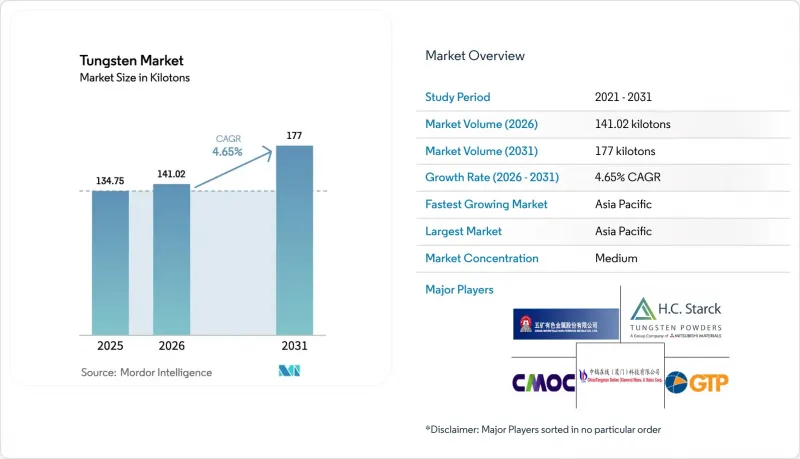
據 Mordor Intelligence 稱,2025 年鎢市場價值為 134.75 千噸,預計到 2031 年將從 2026 年的 141.02 千噸成長到 177 千噸,預測期(2026-2031 年)複合年成長率為 4.65%。
本報告按產品類型(箔、帶、線、管)、產品形態(碳化鎢、鎢合金、鎢軋延產品、鎢化學品)、終端應用產業(汽車、電氣電子、工具機設備等)及地區(亞太地區、北美地區、歐洲地區及世界其他地區)進行細分。市場預測以噸為單位。
全球鎢市場趨勢與洞察
汽車和航太產業對硬質合金切削刀具的需求激增。
在動力傳動系統和飛機機身部件的硬化鋼、鈦和鋁複合材料的加工中,硬質合金刀片仍然至關重要。隨著電動車的普及,電池外殼的公差要求日益嚴格,促使原始設備製造商 (OEM) 指定使用鈷粘合劑含量低於 6 wt% 的超細晶粒硬質合金刀片,以最大限度地減少電池周圍的磁干擾。領先的航太產業製造商正在採用類金剛石碳(DLC) 塗層端銑刀,可將碳纖維面板的切削速度提高 25%,並將每刃可加工的零件數量增加到 10,000 個以上。 ISO 513:2024 標準重新定義了刀具牌號命名規則,引發了刀具更新換代週期,並推動了強勁的刀具更新需求。德國和日本的一級供應商正在與整合製造商合作,共同開發刀具形狀和塗層,這一趨勢支撐了刀具的高階定價。
電子設備的微型化正在推動高密度互連的發展。
半導體製造商正在將通孔填充和接觸金屬化材料從鋁轉向鎢,尤其是在3奈米以下的製程節點上。英特爾的18A製程計畫於2025年下半年開始量產,每片300毫米晶圓大約需要15克六氟化鎢。台積電計畫在2024年將鎢CVD產能提高40%,以支持其2奈米製程的擴展。三星已提交12項與使用原子層沉積(ALD)技術製備WS2隔離層相關的專利,這表明2D鎢化合物的應用將進一步普及。隨著晶片組和3D堆疊等先進封裝技術的需求不斷成長,每個裝置的鎢用量也隨之增加,電子產業已成為鎢市場強勁的成長支柱。
以中國為中心的供應波動與出口配額
北京將於2024年推出的鎢粉、碳化物和合金出口許可規定,加劇了歐美買家的不確定性。由於歐洲消費者消耗庫存,越南冶煉廠擴大二次生產,鎢酸氨現貨價格在兩個月內上漲22%後趨於穩定。自2015年美國國內停止鎢礦開採以來,美國地質調查局(USGS)一直將鎢列為「高風險」資源,而國防庫存目前僅為核定水準的15%。到2028年,來自盧安達和韓國的替代供應僅能滿足歐洲不到8%的需求,供應風險仍然很高。
細分市場分析
到2025年,鎢絲將佔鎢市場佔有率的39.75%,預計到2031年將保持這一領先地位,因為電火花加工 (EDM) 加工商和爐窯製造商都依賴其獨特的高溫強度。雖然隨著LED的普及,通用燈絲的需求正在下降,但用於EDM和導管導引線的精密拉絲鎢絲的年成長率卻高達6%。 Plansee公司於2025年開發的添加氧化鑭的鎢絲,將把再結晶溫度提高到1800 度C,並將模具製造商的廢料減少12%。鎢管是成長最快的產品,年複合成長率達到5.10%,因為高超音速工具機專案和MRI製造商需要薄壁鎢錸熱電偶。目前只有四家公司擁有壁厚小於0.5毫米的旋轉鍛造技術,這構成了技術競爭優勢(技術護城河)。
鎢箔和鎢帶的市佔率相對較小。厚度不超過0.025毫米的鎢箔可用作X光源和空間電子設備的屏蔽材料,而鎢帶則用作薄膜沉積中的蒸發舟。由於能與鎢3422 度C熔點相匹配的替代品寥寥無幾,因此鎢的需求雖然小眾但穩定。總體而言,即使傳統照明應用有所下降,這些趨勢也為特種鎢製造商提供了持續成長的空間,從而有助於鎢市場保持均衡成長。
區域分析
到2025年,亞太地區將佔全球鎢產量的58.28%,預計到2031年將以5.02%的複合年成長率成長。中國國內供應75%的碳化鎢和90%的鎢酸氨,即使加上關稅,出口價格也比歐美低25%至35%。印度已於2024年將鎢列為重點礦產,並優先開發德加納礦,目標是2028年實現年產量1800噸。在日本,對超細晶粒碳化鎢的需求依然強勁,預計2024年工具機訂單將達到1.8兆日圓。在韓國,SK海力士和三星正在增加其3D NAND快閃記憶體工廠的層數,從而推動了碳化鎢化學氣相沉積(CVD)製程的消耗。
在北美,由於國內產量不足,對採礦業的依賴程度仍然很高。但根據《國防生產法》,2024年將撥款2億美元用於建造提煉和回收能力。加拿大阿爾蒙蒂公司計劃在其桑頓礦場於2027年投產後,向北美工具機製造商供應產品。在墨西哥,預計2024年汽車產業的外國直接投資將飆升至52億美元,這將推動近岸加工生產線對硬質合金刀具的需求成長。
在歐洲,德國生產商面臨來自中國的硬質合金進口產品,即使徵收了6.5%的反傾銷稅,這些產品的價格仍比德國產品便宜30%。 2024年頒布的《基本原料法》規定,到2030年,15%的鎢必須回收利用,這促使Umicoa公司投資4,500萬歐元對其位於霍博肯的工廠維修,使其每年能夠處理3,000噸廢鎢。由於制裁,俄羅斯的鎢精礦主要在國內消費,但盧安達一家新運作的工廠為歐洲的冶煉廠供應鎢精礦。除三大主要地區外,拉丁美洲、非洲和中東合計供應全球約8%的鎢產量,其中玻利維亞和盧安達的貢獻尤為顯著。
其他好處:
- Excel格式的市場預測(ME)表
- 3個月的分析師支持
目錄
第1章:引言
- 研究假設和市場定義
- 調查範圍
第2章:調查方法
第3章執行摘要
第4章 市場狀況
- 市場概覽
- 市場促進因素
- 汽車和航太產業對硬質合金切削刀具的需求激增。
- 電子產品的微型化正在推動高密度互連技術的發展。
- 國防部門採用動能彈頭(動能穿甲彈)
- 以二硫化鎢為負極的鋰離子電池和全固態電池
- 輻射屏蔽部件的積層製造
- 市場限制因素
- 供應波動主要集中在中國和出口配額方面
- 接觸碳化鎢粉塵的健康風險
- 以先進陶瓷和金屬陶瓷取代
- 價值鏈分析
- 波特五力模型
第5章 市場規模與成長預測
- 依產品類型
- 挫敗
- 絲帶
- 金屬絲
- 管子
- 按產品形式
- 碳化鎢
- 鎢合金
- 鎢加工產品
- 鎢化學品
- 按最終用途行業分類
- 車
- 航太
- 電氣和電子設備
- 工具機和設備
- 其他終端使用者(儲能和電池、醫學影像和腫瘤學)
- 按地區
- 亞太地區
- 中國
- 日本
- 印度
- 韓國
- 其他亞太國家
- 北美洲
- 美國
- 加拿大
- 墨西哥
- 歐洲
- 德國
- 英國
- 法國
- 義大利
- 俄羅斯
- 其他歐洲國家
- 世界其他地區
- 南美洲
- 中東和非洲
- 亞太地區
第6章 競爭情勢
- 市場集中度
- 策略趨勢
- 市佔率和排名分析
- 公司簡介
- ALMT Corp.
- Allegheny Technologies Inc.
- Avis Metal Industries Limited
- Betek GmbH and Co. KG
- Buffalo Tungsten Inc.
- China Minmetals Non-Ferrous Metals Co.
- China Molybdenum Co., Ltd.
- Chongyi Zhangyuan Tungsten Co.
- Elmet Technologies
- Global Tungsten and Powders
- Guangdong XiangLu Tungsten Co.
- HC Starck Tungsten GmbH
- International Metalworking Companies
- Jiangxi Tungsten Holding Group
- Jiangxi Yaosheng Tungsten
- Kennametal Inc.
- Nippon Tungsten Co., Ltd.
- Ormonde Mining plc
- Plansee SE
- QuesTek Innovations LLC
- Sandvik AB
- Treibacher Industrie AG
- Umicore NV
- Wolf Minerals Ltd.
- WOLFRAM Company JSC
- Xiamen Tungsten Co., Ltd.
第7章 市場機會與未來展望
According to Mordor Intelligence, the tungsten market size was valued at 134.75 kilotons in 2025 and is estimated to grow from 141.02 kilotons in 2026 to reach 177 kilotons by 2031, at a CAGR of 4.65% during the forecast period (2026-2031).
This report is Segmented by Product Type (Foils, Ribbons, Wires, and Tubes), Product Form (Tungsten Carbides, Tungsten Alloys, Tungsten Mill Products, and Tungsten Chemicals), End-Use Industry (Automotive, Electrical and Electronics, Machine Tools and Equipment, and More), and Geography (Asia-Pacific, North America, Europe, and Rest of the World). The Market Forecasts are Provided in Terms of Volume (Tons).
Global Tungsten Market Trends and Insights
Demand Surge From Cemented-Carbide Cutting Tools in Automotive and Aerospace
Cemented-carbide inserts remain indispensable for machining hardened steels, titanium, and aluminum composites in powertrain and airframe components. The shift to electric vehicles raises tolerance demands on battery housings, prompting OEMs to specify ultra-fine-grain carbide grades with cobalt binders below 6 wt% to minimize magnetic interference near cells. Aerospace primes are adopting diamond-like-carbon-coated carbide end mills that cut carbon-fiber panels 25% faster while extending life beyond 10,000 parts per edge. ISO 513:2024 reclassified grade nomenclature, triggering a tooling refresh cycle that keeps replacement demand buoyant. Tier-1 suppliers in Germany and Japan are consolidating purchases with integrated producers that co-engineer geometry and coatings, a dynamic that supports premium pricing.
Electronics Miniaturization Boosting High-Density Interconnects
Semiconductor manufacturers are shifting from aluminum to tungsten for via-fill and contact metallization at sub-3-nanometer nodes. Intel's 18A process, entering high-volume production in late 2025, consumes roughly 15 g of tungsten hexafluoride per 300 mm wafer. TSMC expanded tungsten-CVD capacity by 40% in 2024 to backstop its 2 nm ramp. Samsung filed a dozen patents on atomic-layer-deposited WS2 barriers, pointing to broader adoption of two-dimensional tungsten compounds. Advanced packaging needs-chiplets and 3D stacking-are multiplying tungsten usage per device, making electronics a resilient growth pillar for the tungsten market.
China-Centric Supply Volatility and Export Quotas
Beijing's 2024 export-licensing rule for tungsten powder, carbide, and alloys amplified uncertainty for Western buyers. Spot prices for ammonium paratungstate rose 22% in two months before easing as European consumers drew down stocks and Vietnamese smelters boosted secondary output. The US Geological Survey highlighted tungsten as high risk since domestic mining ended in 2015, and the National Defense Stockpile holds only 15% of the authorized level. Alternative supply from Rwanda and South Korea will cover less than 8% of European demand by 2028, leaving exposure elevated.
Other drivers and restraints analyzed in the detailed report include:
- Defense Adoption of Kinetic-Energy Penetrators
- Li-Ion and Solid-State Batteries Using Tungsten-Disulfide Anodes
- Health Risks of Tungsten-Carbide Dust Exposure
For complete list of drivers and restraints, kindly check the Table Of Contents.
Segment Analysis
Wire captured 39.75% of the Tungsten market share in 2025, a lead it retains through 2031 because EDM shops and furnace builders rely on its unique high-temperature strength. Commodity filament wire is tapering with LED adoption, but precision-drawn grades for EDM and guidewires are rising 6% annually. Plansee's 2025 lanthanum-oxide-doped wire raises recrystallization temperature to 1,800 °C, cutting scrap 12% for tool-and-die makers. Tubes are the fastest-growing product, clocking a 5.10% CAGR as hypersonic vehicle programs and MRI makers need thin-wall tungsten-rhenium thermocouples. Only four firms command rotary-swaging capabilities for sub-0.5 mm walls, creating a technological moat.
A smaller share belongs to foils and ribbons. Foils down to 0.025 mm shield X-ray sources and space electronics, while ribbons serve as evaporation boats in thin-film deposition. Demand is niche yet stable because few substitutes match tungsten's 3,422 °C melting point. Collectively, these trends embed durable upsides for specialty manufacturers even as legacy lighting uses recede, helping the tungsten market maintain a balanced growth profile.
Complete Report Scope:
- By Product Type
- Foils
- Ribbons
- Wires
- Tubes
- By Product Form
- Tungsten Carbides
- Tungsten Alloys
- Tungsten Mill Products
- Tungsten Chemicals
- By End-use Industry
- Automotive
- Aerospace
- Electrical and Electronics
- Machine Tools and Equipment
- Other End-users (Energy Storage and Batteries, Medical Imaging and Oncology)
- By Geography
- Asia-Pacific
- China
- Japan
- India
- South Korea
- Rest of Asia-Pacific
- North America
- United States
- Canada
- Mexico
- Europe
- Germany
- United Kingdom
- France
- Italy
- Russia
- Rest of Europe
- Rest of the World
- South America
- Middle East and Africa
- Asia-Pacific
Geography Analysis
Asia-Pacific controlled 58.28% of 2025 volume and is on a 5.02% CAGR path to 2031. China integrates 75% of carbide and 90% of ammonium-paratungstate refining, pricing exports 25-35% below Western levels even after tariffs. India labeled tungsten a critical mineral in 2024 and fast-tracked Degana, targeting 1,800 t yr-1 by 2028. Japan's JPY 1.8 trillion machine-tool orders in 2024 keep ultra-fine-grain carbide demand buoyant. South Korean memory fabs push tungsten-CVD consumption as SK Hynix and Samsung expand 3D-NAND layers.
North America's lack of domestic mine output keeps exposure high, but a USD 200 million Defense Production Act allocation in 2024 aims to seed refining and recycling capacity. Canada's Almonty will feed North American toolmakers when Sangdong starts in 2027. Mexico's USD 5.2 billion auto FDI boom in 2024 raises carbide-tool needs for nearshored machining lines.
In Europe, German producers face Chinese carbide imports priced 30% lower even after a 6.5% anti-dumping duty. The 2024 Critical Raw Material Act mandates 15% recycled tungsten by 2030, prompting Umicore's EUR 45 million Hoboken upgrade to process 3,000 t yr-1 of scrap. Russian concentrate stays mostly domestic due to sanctions, while Rwanda's newly commissioned concentrator feeds European smelters. Outside the big three regions, Latin America, Africa, and the Middle East jointly supplied around 8% of global volume, with Bolivia and Rwanda as notable contributors.
- A.L.M.T. Corp.
- Allegheny Technologies Inc.
- Avis Metal Industries Limited
- Betek GmbH and Co. KG
- Buffalo Tungsten Inc.
- China Minmetals Non-Ferrous Metals Co.
- China Molybdenum Co., Ltd.
- Chongyi Zhangyuan Tungsten Co.
- Elmet Technologies
- Global Tungsten and Powders
- Guangdong XiangLu Tungsten Co.
- H.C. Starck Tungsten GmbH
- International Metalworking Companies
- Jiangxi Tungsten Holding Group
- Jiangxi Yaosheng Tungsten
- Kennametal Inc.
- Nippon Tungsten Co., Ltd.
- Ormonde Mining plc
- Plansee SE
- QuesTek Innovations LLC
- Sandvik AB
- Treibacher Industrie AG
- Umicore N.V.
- Wolf Minerals Ltd.
- WOLFRAM Company JSC
- Xiamen Tungsten Co., Ltd.
Additional Benefits:
- The market estimate (ME) sheet in Excel format
- 3 months of analyst support
TABLE OF CONTENTS
1 Introduction
- 1.1 Study Assumptions and Market Definition
- 1.2 Scope of the Study
2 Research Methodology
3 Executive Summary
4 Market Landscape
- 4.1 Market Overview
- 4.2 Market Drivers
- 4.2.1 Demand surge from cemented-carbide cutting tools in auto and aero
- 4.2.2 Electronics miniaturisation boosting high-density interconnects
- 4.2.3 Defence adoption of kinetic-energy penetrators
- 4.2.4 Li-ion and solid-state batteries using tungsten disulfide anodes
- 4.2.5 Additive-manufacturing of radiation-shielding parts
- 4.3 Market Restraints
- 4.3.1 China-centric supply volatility and export quotas
- 4.3.2 Health risks of tungsten-carbide dust exposure
- 4.3.3 Substitution by advanced ceramics and cermets
- 4.4 Value Chain Analysis
- 4.5 Porter's Five Forces
- 4.5.1 Bargaining Power of Suppliers
- 4.5.2 Bargaining Power of Buyers
- 4.5.3 Threat of New Entrants
- 4.5.4 Threat of Substitutes
- 4.5.5 Degree of Competition
5 Market Size and Growth Forecasts (Volume)
- 5.1 By Product Type
- 5.1.1 Foils
- 5.1.2 Ribbons
- 5.1.3 Wires
- 5.1.4 Tubes
- 5.2 By Product Form
- 5.2.1 Tungsten Carbides
- 5.2.2 Tungsten Alloys
- 5.2.3 Tungsten Mill Products
- 5.2.4 Tungsten Chemicals
- 5.3 By End-use Industry
- 5.3.1 Automotive
- 5.3.2 Aerospace
- 5.3.3 Electrical and Electronics
- 5.3.4 Machine Tools and Equipment
- 5.3.5 Other End-users (Energy Storage and Batteries, Medical Imaging and Oncology)
- 5.4 By Geography
- 5.4.1 Asia-Pacific
- 5.4.1.1 China
- 5.4.1.2 Japan
- 5.4.1.3 India
- 5.4.1.4 South Korea
- 5.4.1.5 Rest of Asia-Pacific
- 5.4.2 North America
- 5.4.2.1 United States
- 5.4.2.2 Canada
- 5.4.2.3 Mexico
- 5.4.3 Europe
- 5.4.3.1 Germany
- 5.4.3.2 United Kingdom
- 5.4.3.3 France
- 5.4.3.4 Italy
- 5.4.3.5 Russia
- 5.4.3.6 Rest of Europe
- 5.4.4 Rest of the World
- 5.4.4.1 South America
- 5.4.4.2 Middle East and Africa
- 5.4.1 Asia-Pacific
6 Competitive Landscape
- 6.1 Market Concentration
- 6.2 Strategic Moves
- 6.3 Market Share(%)/Ranking Analysis
- 6.4 Company Profiles (includes Global level Overview, Market level overview, Core Segments, Financials as available, Strategic Information, Market Rank/Share for key companies, Products and Services, and Recent Developments)
- 6.4.1 A.L.M.T. Corp.
- 6.4.2 Allegheny Technologies Inc.
- 6.4.3 Avis Metal Industries Limited
- 6.4.4 Betek GmbH and Co. KG
- 6.4.5 Buffalo Tungsten Inc.
- 6.4.6 China Minmetals Non-Ferrous Metals Co.
- 6.4.7 China Molybdenum Co., Ltd.
- 6.4.8 Chongyi Zhangyuan Tungsten Co.
- 6.4.9 Elmet Technologies
- 6.4.10 Global Tungsten and Powders
- 6.4.11 Guangdong XiangLu Tungsten Co.
- 6.4.12 H.C. Starck Tungsten GmbH
- 6.4.13 International Metalworking Companies
- 6.4.14 Jiangxi Tungsten Holding Group
- 6.4.15 Jiangxi Yaosheng Tungsten
- 6.4.16 Kennametal Inc.
- 6.4.17 Nippon Tungsten Co., Ltd.
- 6.4.18 Ormonde Mining plc
- 6.4.19 Plansee SE
- 6.4.20 QuesTek Innovations LLC
- 6.4.21 Sandvik AB
- 6.4.22 Treibacher Industrie AG
- 6.4.23 Umicore N.V.
- 6.4.24 Wolf Minerals Ltd.
- 6.4.25 WOLFRAM Company JSC
- 6.4.26 Xiamen Tungsten Co., Ltd.
7 Market Opportunities and Future Outlook
- 7.1 White-space and Unmet-need Assessment
- 7.2 EU Critical Raw-Material Act driven recycling incentives

 全球鎢市場2026-2030
 火箭材料回收市場規模、佔有率和成長分析:按材料類型、回收製程、應用、最終用戶和地區分類-2026-2033年產業預測
 鎢市場-2026-2032年全球市場預測
 全球鎢市場:機會與策略展望(至2035年)2026年全球火箭材料回收市場報告
 全球頁岩市場規模、佔有率、趨勢和成長分析報告(2026-2034年)
 全球偏鎢酸銨市場(至2030年):依原料、形態、等級、應用、終端用戶產業及地區分類
 鎢酸鈉市場規模、佔有率及成長分析(按等級、應用及地區分類)-2026-2033年產業預測
 鎢市場機會、成長要素、產業趨勢分析及預測(2026年至2035年)鎢箔市場按產品類型、厚度、形狀、純度等級、最終用戶和分銷管道分類-2025-2030 年全球預測