


 |
市場調查報告書
商品編碼
2119552
策略與展會發展:市場佔有率分析、產業趨勢與統計、成長預測(2026-2031)Podcast Marketing Services - Market Share Analysis, Industry Trends & Statistics, Growth Forecasts (2026 - 2031) |
||||||

※ 本網頁內容可能與最新版本有所差異。詳細情況請與我們聯繫。
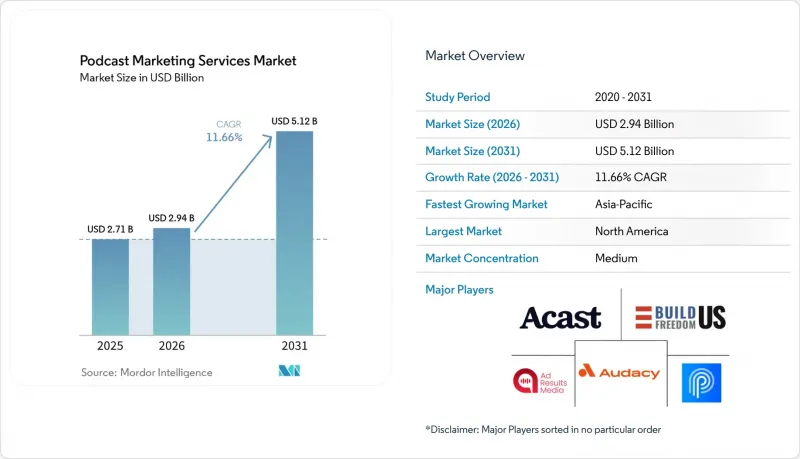
據 Mordor Intelligence 稱,2025 年戰略和節目開發市場價值為 27.1 億美元,預計到 2031 年將達到 51.2 億美元,而 2026 年為 29.4 億美元,2026 年至 2031 年預測期內的複合年成長率為 11.6%。
本報告按服務類型(策略和節目開發、製作和後製、發行和受眾獲取、贊助和主持人主導的廣告銷售、分析和歸因等)、收入模式(贊助管理等)、終端用戶行業(零售和電子商務、銀行、金融服務和保險等)以及地區進行細分。市場預測以美元計價。
全球策略與展會發展市場趨勢及洞察
對主持人主導的敘述和創作者主導的廣告的需求日益成長。
主持人代言廣告之所以能推動策略制定和節目開發市場的發展,是因為聽眾通常認為主持人代言與典型的商業訊息截然不同。這意味著品牌、主持人與目標受眾之間的關係成為宣傳活動設計的核心,而不是將每個廣告位視為可互換的庫存或標準媒體空間。廣告公司必須了解客戶的目標、主持人的說話風格、聽眾的關注點以及需要仔細考慮的宣傳內容。一個結構完善的整合需要明確的商業性目標、適合節目的呈現方式,以及主持人在錄製前有足夠的時間了解產品。因此,服務供應商必須評估主持人與廣告的契合度,制定清晰的簡報,協商使用條款,並保護代言的自然特性。這種模式還要求在存在商業性關係的情況下進行透明揭露,尤其是在受監管行業的客戶中。隨著品牌探索與主持人建立更大規模的合作關係,能夠在維護聽眾信任的同時管理宣傳活動活動運營的廣告公司擁有實際優勢,尤其是在需要在多個節目、主持人以及播出日期之間保持一致性投放的宣傳活動中。
拓展品牌播客在商業和企業行銷的應用
品牌推廣項目正在拓展策略和節目開發市場,使其不再局限於季節性廣告投放,而是涵蓋更長期的內容規劃。 2025年新進播客領域的廣告主在首月投入了39,231美元,並在接下來的六個月中平均每月投入64,616美元。相較之下,2024年新進播客領域的廣告主在首月投入了18,200美元,並在接下來的六個月中平均每月投入30,445美元。這種支出模式反映出,新參與企業在將播客作為持續溝通項目的一部分時,會投入更多資源。這也表明,節目上線後的最初幾個月通常用於建立製作流程、檢驗節目形式,並確定值得持續投入的受眾興趣。品牌推廣專案能夠支援經營團隊意識提升、客戶教育和主題對話,而無需僅依賴短期宣傳活動。這種方法也凸顯了在節目的整個生命週期中,編輯規劃、持續更新、嘉賓協調和交付支援的重要性。這意味著主題和嘉賓的選擇不僅是商業性決策,也是內容決策。金融服務和醫療保健行業的客戶尤其需要專注於資訊揭露和廣告標準,這可能有利於那些擁有相關合規經驗和完善審核流程的供應商,客戶可以在節目發布前對這些流程進行審核。
下載次數以外的衡量標準與歸因之間的差距
衡量指標的限制會阻礙策略制定和市場拓展,因為僅憑下載量和觀看次數無法全面反映宣傳活動的商業性影響。當行銷活動跨多個媒體平台投放時,這項挑戰尤其突出,因為每個平台都採用不同的報告方式,例如 RSS 來源、影片宣傳活動、社群媒體短片和付費媒體管道。 2026 年 6 月,Spotify 推出了新的「播放次數」標準,將播放超過 30 秒的節目計為一次播放,並擴展了創作者的分析功能。雖然此次更新提供了更一致的活動指標,但並未解決所有關於轉換率、收入或跨平台曝光的問題。服務供應商通常需要整合受眾數據、購買後調查、促銷代碼和客戶銷售數據,才能獲得更全面的整體情況。這增加了工作量,當客戶在投入大規模預算之前需要明確的證據時,可能會延誤決策。此外,宣傳活動報告應解釋每個指標的含義、局限性,以及如何將多個指標結合起來,為客戶呈現宣傳活動活動整體情況。
細分市場分析
到2025年,在對音訊和影像一體化輸出需求的推動下,製作和後製將佔市場佔有率的29.06%。品牌越來越需要能夠從規劃、剪輯到最終發行全程負責其節目製作的工作室、代理商和專業人士,並對創新核准、技術品質和發佈時間負有明確責任。無論目標是提升品牌知名度、客戶教育、內部溝通或增加贊助收入,製作工作都至關重要。高品質的錄製、影像呈現、剪輯和發行至關重要,因為觀眾會在多個平台上觀看同一節目,並根據所有版本的內容來評估客戶。其他服務類別,例如“策略與節目開發”、“發行與受眾拓展”、“贊助與主持人朗讀廣告銷售”和“內容再利用”,表明播客節目需要協作運營模式,而非孤立的製作支持。
「分析與歸因」預計到2031年將以12.31%的複合年成長率成長,成為策略和節目開發市場中成長最快的服務類別。隨著客戶需要向其高級行銷、財務和營運團隊解釋結果,這項活動的重要性日益凸顯。 Spotify於2026年6月推出的「播放標準」指標為創作者提供了一個通用的活動指標,用於衡量播放時間至少30秒的節目。雖然影片串流媒體進一步拓寬了研究範圍,但與純音訊行銷宣傳活動相比,它也使得以下載為中心的衡量標準不夠全面。能夠將平台報告與客戶資料、調查和促銷代碼整合的服務提供者可以提供更有用的宣傳活動分析。內容重複使用是這項工作的基礎,它允許從單一錄音創建社交媒體貼文、電子郵件內容和搜尋最佳化素材,但每個交付物仍然需要適當的報告和管治,才能將其活動與更廣泛的計劃聯繫起來。
區域分析
到2025年,北美將佔據策略和節目開發市場佔有率的48.23%,這得益於其成熟的廣告基礎設施、高聽眾參與度和完善的程序化採購工具。該地區擁有眾多網路、平台、製作公司、代理商和效果評估專家,既服務於成熟的音訊廣告商,也服務於正在嘗試視訊播客形式的新興品牌。如此多元化的參與者為客戶提供了多種市場進入途徑,而專家建議在比較平台服務條款、製作模式和宣傳活動報告時也至關重要。北美服務供應商還能滿足音訊和視訊結合的宣傳活動規劃需求。
預計到2031年,亞太地區將以12.44%的複合年成長率成長,成為策略和節目開發市場成長最快的地區。這一成長與印度和東南亞「行動優先」的收聽趨勢、日本企業對播客的日益依賴以及中國付費內容的興起密切相關。這種情況推動了對在地化製作、受眾拓展和分發支援的需求,同時,服務提供者也必須適應各個地區不同的平台偏好、商業慣例和監管要求。在此背景下,對本地市場有深刻理解並能夠為跨國客戶協調跨區域專案的機構將更有可能獲得競爭優勢。
在策略和節目開發市場中,歐洲、南美洲以及中東和非洲所佔區域佔有率相對較小。在歐洲,廣告法規較為完善,可能催生對在資訊揭露、版權和資料保護方面擁有經驗的供應商的需求。同時,南美的播客受眾主要集中在巴西和阿根廷,以行動裝置為中心的年輕受眾群體吸引了廣告商的目光。跨國版權問題和外匯波動可能會使區域性直接回應宣傳活動的規模化面臨挑戰。中東和非洲仍是發展中市場,跨國公司正在拓展其英語和阿拉伯語品牌內容業務,但各國的商業環境差異顯著。
其他好處:
- Excel格式的市場預測(ME)表
- 3個月的分析師支持
目錄
第1章:引言
- 研究假設和市場定義
- 調查範圍
第2章:調查方法
第3章執行摘要
第4章 市場狀況
- 市場概覽
- 市場促進因素
- 對真正由主持人主導和創作者主導的廣告的需求日益成長。
- 拓展品牌播客在商業和企業行銷的應用
- YouTube 及整個平台生態系統中的視訊播客觀看量持續成長。
- 改進音頻廣告庫存的程序化購買和受眾定向。
- 經濟學應用:將單一影片錄影重新用於完整的行銷漏斗內容包。
- 企業和個人播客的擴張正在增加廣告代理商的支出佔有率。
- 市場限制因素
- 下載次數以外的衡量標準與歸因之間的差距
- 建立和維護品牌播客的聽眾群體需要大量的持續投入。
- 由於對平台的依賴,內容發現正轉向 YouTube 和封閉式平台。
- 版權、音樂和跨境合規的複雜性正在減緩向多個市場的擴張速度。
- 產業價值鏈分析
- 監理情勢
- 技術展望
- 宏觀經濟因素對市場的影響
- 波特五力分析
第5章 市場規模與成長預測
- 按服務類型
- 策略與展覽發展
- 製作和後製
- 發行與受眾拓展
- 贊助銷售與託管式文字轉語音廣告
- 分析與歸因
- 內容重用
- 按收入模式
- 贊助管理
- 訂閱和會員策略
- 聯盟行銷
- 按最終用戶行業分類
- 零售與電子商務
- BFSI
- 醫療保健和生命科學
- 資訊科技/通訊
- 媒體與娛樂
- 其他終端用戶產業
- 按地區
- 北美洲
- 美國
- 加拿大
- 墨西哥
- 南美洲
- 巴西
- 阿根廷
- 智利
- 其他南美國家
- 歐洲
- 德國
- 英國
- 法國
- 義大利
- 西班牙
- 其他歐洲國家
- 亞太地區
- 中國
- 日本
- 印度
- 韓國
- 澳洲
- 其他亞太國家
- 中東
- 阿拉伯聯合大公國
- 沙烏地阿拉伯
- 卡達
- 其他中東國家
- 非洲
- 南非
- 埃及
- 奈及利亞
- 其他非洲國家
- 北美洲
第6章 競爭情勢
- 市場集中度
- 策略趨勢
- 市佔率分析
- 公司簡介
- Acast AB
- Ad Results Media LLC
- Audacy, Inc.
- Build Freedom LLC
- Podcasting Ltd
- Fresh Air Production Ltd
- JAR Podcast Solutions Inc.
- Lower Street Media Ltd
- Pacific Content Inc.
- Pod People LLC
- Podbean Tech Inc.
- Podfly Productions, LLC
- Podigy LLC
- Quill Inc.
- Resonate Recordings, LLC
- iHeartMedia, Inc.
- Sirius XM Holdings Inc.
- Studiopod Media LLC
- Sweet Fish Media, LLC
- True Native Media, LLC
第7章 市場機會與未來展望
According to Mordor Intelligence, the podcast marketing services market size was valued at USD 2.71 billion in 2025 and is estimated to grow from USD 2.94 billion in 2026 to reach USD 5.12 billion by 2031, at a CAGR of 11.66% during the forecast period 2026-2031.
This report is Segmented by Service Type (Strategy and Show Development, Production and Post-Production, Distribution and Audience Development, Sponsorship and Host-Read Ad Sales, Analytics and Attribution, and More), Revenue Model (Sponsorship Management, and More), End-User Industry (Retail and E-Commerce, BFSI, and More), and Geography. The Market Forecasts are Provided in Terms of Value (USD).
Global Podcast Marketing Services Market Trends and Insights
Rising Demand for Authentic Host-Read and Creator-Led Advertising
Host-read advertising supports the podcast marketing services market because listeners often view a host's recommendation differently from a standard commercial message. This makes the relationship between the brand, the host, and the intended audience central to campaign design, rather than treating each placement as interchangeable inventory or a standard media placement. The agency must understand the client's objectives, the host's voice, the audience's interests, and any claim that needs careful review. A well-developed integration needs a clear commercial purpose, language that suits the show, and enough time for the host to understand the product before recording. Service providers must therefore assess host fit, develop clear briefs, negotiate usage, and protect the natural character of an endorsement. The model also requires transparent disclosure where a commercial relationship exists, especially for clients in regulated categories. As brands seek host partnerships at greater scale, agencies that can preserve audience trust while managing campaign operations have a practical advantage, particularly when a campaign needs consistent delivery across multiple shows, hosts, and release dates.
Expansion of Branded Podcasts in Business and Enterprise Marketing
Branded programs are extending the podcast marketing services market beyond seasonal advertising purchases and into longer-term content planning. New podcast advertisers spent USD 39,231 in their first month in 2025 and USD 64,616 per month during the following 6 months, compared with USD 18,200 at launch and USD 30,445 per month during the following 6 months in 2024. The spending pattern reflects a larger commitment from new entrants once they begin using podcasts as part of an ongoing communication program. It also suggests that the first months of a program are often used to establish production routines, test formats, and identify the audience topics that merit continued investment. A branded show can support executive visibility, customer education, and subject-focused conversations without relying only on a short campaign window. This approach also raises the importance of editorial planning, consistent publishing, guest coordination, and distribution support across the full life of a program. It makes the choice of themes and guests both a commercial and a content decision. Financial services and healthcare clients require additional attention to disclosures and advertising standards, which can favor providers with relevant compliance experience and documented review processes that clients can apply before publishing an episode.
Measurement and Attribution Gaps Beyond Downloads
Measurement limitations can constrain the podcast marketing services market because a download or a view does not capture the full commercial impact of a campaign. The challenge is more pronounced when a campaign appears across RSS feeds, video platforms, social clips, and paid media channels, each using different reporting methods. Spotify introduced a new plays standard in June 2026 that counts an episode after at least 30 seconds of consumption, and it also expanded creator analytics. The update provides a more consistent activity signal, but it does not resolve every question about conversion, revenue, or cross-platform exposure. Service providers often need to combine audience data, post-purchase surveys, promo codes, and client sales data to form a fuller view. This creates additional operating work and can slow decisions when clients require clear evidence before committing larger budgets. It also means that campaign reports must explain what each measure can show, where its limits remain, and how several measures fit together in a practical account of campaign performance for the client.
Other drivers and restraints analyzed in the detailed report include:
- Growth of Video Podcast Consumption Across Platform Ecosystems
- Better Programmatic Buying and Audience Targeting for Audio Inventory
- High Ongoing Investment Needed to Build and Sustain Branded Podcast Audiences
For complete list of drivers and restraints, kindly check the Table Of Contents.
Segment Analysis
Production and Post-Production accounted for 29.06% of the market in 2025, supported by demand for coordinated audio and video output. Brands increasingly need studios, agencies, and specialists that can take a show from planning through editing and final distribution, with clear responsibilities for creative approval, technical quality, and publishing timing. Production work remains necessary whether the objective is brand awareness, customer education, internal communication, or sponsorship revenue. High-quality recording, visual presentation, editing, and publishing are important because audiences encounter the same show across multiple platforms and form opinions about the client from every version of the content. Strategy and Show Development, Distribution and Audience Development, Sponsorship and Host-Read Ad Sales, and Content Repurposing make up the other service categories, showing that a podcast program needs a connected operating model rather than isolated production support.
Analytics and Attribution is projected to grow at a 12.31% CAGR through 2031, making it the fastest-growing service category in the podcast marketing services market. This activity is gaining importance because clients need to explain results to senior marketing, finance, and operating teams. Spotify's June 2026 plays standard gives creators a common activity measure for episodes consumed for at least 30 seconds. Video distribution adds further reporting surfaces, and this makes download-centered measurement less complete than it was for audio-only campaigns. Providers that can join platform reporting with client data, surveys, and promotion codes can offer more useful campaign reviews. Content repurposing supports this work because 1 recording can inform social posts, email material, and search-focused assets, although each output still needs suitable reporting and governance that links activity to the wider program.
Complete Report Scope:
- By Service Type
- Strategy and Show Development
- Production and Post-Production
- Distribution and Audience Development
- Sponsorship and Host-Read Ad Sales
- Analytics and Attribution
- Content Repurposing
- By Revenue Model
- Sponsorship Management
- Subscription and Membership Strategy
- Affiliate Marketing
- By End-User Industry
- Retail and E-commerce
- BFSI
- Healthcare and Life Sciences
- IT and Telecommunications
- Media and Entertainment
- Other End-User Industries
- By Geography
- North America
- United States
- Canada
- Mexico
- South America
- Brazil
- Argentina
- Chile
- Rest of South America
- Europe
- Germany
- United Kingdom
- France
- Italy
- Spain
- Rest of Europe
- Asia-Pacific
- China
- Japan
- India
- South Korea
- Australia
- Rest of Asia-Pacific
- Middle East
- United Arab Emirates
- Saudi Arabia
- Qatar
- Rest of Middle East
- Africa
- South Africa
- Egypt
- Nigeria
- Rest of Africa
- North America
Geography Analysis
North America held 48.23% of the podcast marketing services market share in 2025, supported by a mature advertising infrastructure, high listener participation, and established programmatic buying tools. The region has a broad mix of networks, platforms, production companies, agencies, and measurement specialists, serving established audio buyers and newer brands testing video podcast formats. This range of participants offers clients several routes to market, but it also makes specialist advice useful when comparing platform terms, production models, and campaign reporting. North American service providers are also responding to the need for combined audio-and-video campaign planning.
Asia-Pacific is projected to grow at a 12.44% CAGR through 2031, making it the fastest-growing region in the podcast marketing services market. The region's expansion is linked to mobile-first listening in India and Southeast Asia, corporate adoption in Japan, and paid content activity in China. These conditions increase the need for local-language production, audience development, and distribution support, while providers must also account for differing platform preferences, commercial practices, and regulatory requirements across the region. Demand can favor agencies that combine local market understanding with the ability to coordinate regional programs for multinational clients.
Europe, South America, the Middle East, and Africa represent smaller regional segments of the podcast marketing services market. Europe has regulated advertising environments that can create demand for providers with experience in disclosure, rights, and data-protection requirements, while South America's larger podcast audiences are concentrated in Brazil and Argentina, where younger mobile-centered audiences can support advertiser interest. Cross-border rights issues and currency volatility can make regional direct-response campaigns harder to scale. The Middle East and Africa remain earlier-stage markets where branded content from multinational companies is building the supply of English- and Arabic-language programming, and operating conditions differ widely between countries.
- Acast AB
- Ad Results Media LLC
- Audacy, Inc.
- Build Freedom LLC
- Podcasting Ltd
- Fresh Air Production Ltd
- JAR Podcast Solutions Inc.
- Lower Street Media Ltd
- Pacific Content Inc.
- Pod People LLC
- Podbean Tech Inc.
- Podfly Productions, LLC
- Podigy LLC
- Quill Inc.
- Resonate Recordings, LLC
- iHeartMedia, Inc.
- Sirius XM Holdings Inc.
- Studiopod Media LLC
- Sweet Fish Media, LLC
- True Native Media, LLC
Additional Benefits:
- The market estimate (ME) sheet in Excel format
- 3 months of analyst support
TABLE OF CONTENTS
1 INTRODUCTION
- 1.1 Study Assumptions and Market Definition
- 1.2 Scope of the Study
2 RESEARCH METHODOLOGY
3 EXECUTIVE SUMMARY
4 MARKET LANDSCAPE
- 4.1 Market Overview
- 4.2 Market Drivers
- 4.2.1 Rising Demand for Authentic Host-Read and Creator-Led Advertising
- 4.2.2 Expansion of Branded Podcasts in Business and Enterprise Marketing
- 4.2.3 Growth of Video Podcast Consumption Across Youtube and Platform Ecosystems
- 4.2.4 Better Programmatic Buying and Audience Targeting for Audio Inventory
- 4.2.5 Repurposing Economics Turn One Recording Into Full-Funnel Content Packages
- 4.2.6 Corporate Internal and Private Podcasting Expands Agency Wallet Share
- 4.3 Market Restraints
- 4.3.1 Measurement and Attribution Gaps Beyond Downloads
- 4.3.2 High Ongoing Investment Needed to Build and Sustain Branded Podcast Audiences
- 4.3.3 Platform Dependency Shifts Discovery Power Toward Youtube and Walled Gardens
- 4.3.4 Rights, Music, and Cross-Border Compliance Complexity Slows Multi-Market Rollouts
- 4.4 Industry Value Chain Analysis
- 4.5 Regulatory Landscape
- 4.6 Technological Outlook
- 4.7 Impact of Macroeconomic Factors on the Market
- 4.8 Porter's Five Forces Analysis
- 4.8.1 Threat of New Entrants
- 4.8.2 Bargaining Power of Buyers
- 4.8.3 Bargaining Power of Suppliers
- 4.8.4 Threat of Substitutes
- 4.8.5 Industry Rivalry
5 MARKET SIZE AND GROWTH FORECASTS (VALUE)
- 5.1 By Service Type
- 5.1.1 Strategy and Show Development
- 5.1.2 Production and Post-Production
- 5.1.3 Distribution and Audience Development
- 5.1.4 Sponsorship and Host-Read Ad Sales
- 5.1.5 Analytics and Attribution
- 5.1.6 Content Repurposing
- 5.2 By Revenue Model
- 5.2.1 Sponsorship Management
- 5.2.2 Subscription and Membership Strategy
- 5.2.3 Affiliate Marketing
- 5.3 By End-User Industry
- 5.3.1 Retail and E-commerce
- 5.3.2 BFSI
- 5.3.3 Healthcare and Life Sciences
- 5.3.4 IT and Telecommunications
- 5.3.5 Media and Entertainment
- 5.3.6 Other End-User Industries
- 5.4 By Geography
- 5.4.1 North America
- 5.4.1.1 United States
- 5.4.1.2 Canada
- 5.4.1.3 Mexico
- 5.4.2 South America
- 5.4.2.1 Brazil
- 5.4.2.2 Argentina
- 5.4.2.3 Chile
- 5.4.2.4 Rest of South America
- 5.4.3 Europe
- 5.4.3.1 Germany
- 5.4.3.2 United Kingdom
- 5.4.3.3 France
- 5.4.3.4 Italy
- 5.4.3.5 Spain
- 5.4.3.6 Rest of Europe
- 5.4.4 Asia-Pacific
- 5.4.4.1 China
- 5.4.4.2 Japan
- 5.4.4.3 India
- 5.4.4.4 South Korea
- 5.4.4.5 Australia
- 5.4.4.6 Rest of Asia-Pacific
- 5.4.5 Middle East
- 5.4.5.1 United Arab Emirates
- 5.4.5.2 Saudi Arabia
- 5.4.5.3 Qatar
- 5.4.5.4 Rest of Middle East
- 5.4.6 Africa
- 5.4.6.1 South Africa
- 5.4.6.2 Egypt
- 5.4.6.3 Nigeria
- 5.4.6.4 Rest of Africa
- 5.4.1 North America
6 COMPETITIVE LANDSCAPE
- 6.1 Market Concentration
- 6.2 Strategic Moves
- 6.3 Market Share Analysis
- 6.4 Company Profiles (includes Global Level Overview, Market Level Overview, Core Segments, Financials as available, Strategic Information, Market Rank/Share, Products and Services, Recent Developments)
- 6.4.1 Acast AB
- 6.4.2 Ad Results Media LLC
- 6.4.3 Audacy, Inc.
- 6.4.4 Build Freedom LLC
- 6.4.5 Podcasting Ltd
- 6.4.6 Fresh Air Production Ltd
- 6.4.7 JAR Podcast Solutions Inc.
- 6.4.8 Lower Street Media Ltd
- 6.4.9 Pacific Content Inc.
- 6.4.10 Pod People LLC
- 6.4.11 Podbean Tech Inc.
- 6.4.12 Podfly Productions, LLC
- 6.4.13 Podigy LLC
- 6.4.14 Quill Inc.
- 6.4.15 Resonate Recordings, LLC
- 6.4.16 iHeartMedia, Inc.
- 6.4.17 Sirius XM Holdings Inc.
- 6.4.18 Studiopod Media LLC
- 6.4.19 Sweet Fish Media, LLC
- 6.4.20 True Native Media, LLC
7 MARKET OPPORTUNITIES AND FUTURE OUTLOOK
- 7.1 White-Space and Unmet-Need Assessment

 2026-2030年全球播客市場
 播客製作技術市場規模、佔有率和趨勢分析報告:按組件、部署方法、最終用途、地區和細分市場預測(2026-2033 年)
 播客市場機會、成長促進因素、產業趨勢分析及2026-2035年預測
 2026年全球教育科技領域播客市場報告
 播客市場:按類型、形式和地區分類2026年全球播客人工智慧(AI)市場報告2026年全球播客市場報告
 播客:市場佔有率分析、產業趨勢與統計、成長預測(2026-2031)
 播客市場分析及預測(至2035年):依類型、產品類型、服務、技術、組件、應用、設備、最終用戶及功能分類
 全球播客市場規模、佔有率、趨勢和成長分析報告(2026-2034)