


 |
市場調查報告書
商品編碼
2119374
中立主機專用網路:市場佔有率分析、產業趨勢與統計及成長預測(2026-2031 年)Neutral Host Private Networks - Market Share Analysis, Industry Trends & Statistics, Growth Forecasts (2026 - 2031) |
||||||

※ 本網頁內容可能與最新版本有所差異。詳細情況請與我們聯繫。
根據 Mordor Intelligence 預測,中立託管私有網路的市場規模預計將從 2025 年的 445.5 億美元成長到 2026 年的 501.6 億美元,到 2031 年達到 896.8 億美元,2026 年至 2031 年的年複合成長率(CAGR)為 12.32%。
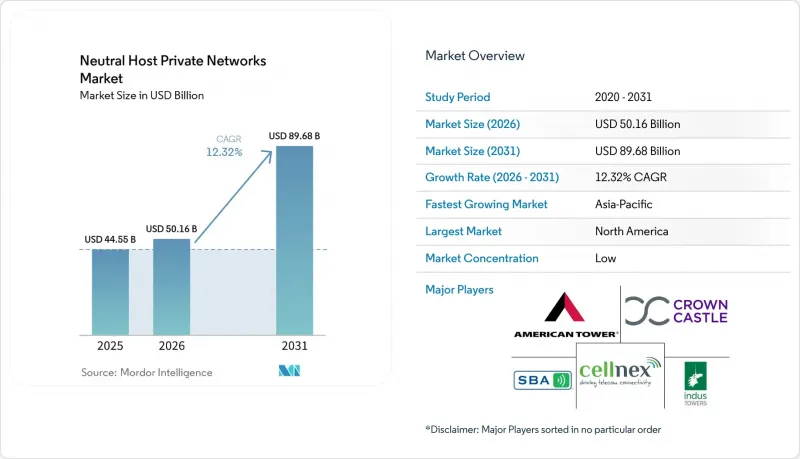
本報告按組件(基礎設施、服務、軟體)、技術(例如分散式天線系統)、頻段(例如授權頻段)、所有權模式(例如單一運營商模式)、部署模式(例如室內網路)、最終用戶行業(例如電信)和地區進行細分。市場預測以美元計價。
全球中立主機專用網路市場趨勢與洞察
部署專用 5G 和企業無線網路
私有5G網路的部署正從試點階段邁向更廣泛企業的全面運作。根據美國總務管理局(GSA)的記錄,截至2026年第一季,88個國家的2003家機構將部署符合認證標準的私人行動網路。自2022年以來宣布的部署項目中,超過一半採用了5G技術,這表明新計畫越來越重視5G功能而非私有LTE。這種轉變擴大了中立主機提供者的選擇範圍,尤其適用於那些需要同時具備覆蓋範圍、容量和共用存取的場所。開放介面也允許設施營運商單獨選擇無線、核心和管理供應商。因此,隨著企業開始將無線連接視為營運資產而非有限的先導計畫,中立主機私有網路市場將從中受益。
對高性能室內覆蓋的需求
室內覆蓋範圍仍然是部署共用蜂窩系統的關鍵原因。鋼骨、混凝土和隔熱玻璃會削弱室外蜂窩訊號,而行動營運商正在大力投資以擴大5G覆蓋範圍。因此,建築業主和營運商承擔了更多室內連接的責任。愛立信將其「Radio Dot」系統定位為傳統分散式天線系統(DAS)設計的緊湊型替代方案,用於室內5G覆蓋。小型基地台論壇預測,到2030年,28%的企業小型基地台將由中立主機運營,高於2023年的14%。這一趨勢正在推動需要可靠室內服務的場所(例如辦公室、醫院、飯店和交通樞紐)的專案建設。
高昂的實施和整合成本
大規模中立主機專案需要進行射頻規劃、施工、與營運商協調以及跨多個供應商的整合。如果建築物業主、營運商和系統整合商必須批准設計的每個部分,則安裝週期可能會延長。老舊建築可能由於現有同軸電纜、電力系統和設備間與主動數位架構不相容而產生額外成本。升級到光纖或6A類線纜可能需要土木工程,這會中斷營運並產生費用。建築規範、消防安全要求以及操作員之間的互通性測試增加了服務開通前的更多步驟。這些要求有利於那些擁有成熟資金籌措能力、安裝能力和運營商關係的運營商,這可能會限制中立主機專用網路市場的准入。
細分市場分析
截至2025年,基礎設施將佔中立託管專用網路市場規模的46.12%。這一比例反映了分散式天線系統(DAS)前端、小型基地台無線電、雲端網路硬體和室內連接設備的初始投資需求。長期特許經營協議允許將這些成本分攤到15至20年。服務業的重要性仍然很高,因為客戶通常會將網路設計、整合、監控、維護和日常營運外包。設施所有者通常不會設立內部射頻(RF)工程團隊。隨著營運商將覆蓋範圍擴展到建築物、站點、園區和交通設施,基礎設施將繼續發揮至關重要的作用。
軟體預計將成為成長最快的組件,到 2031 年的複合年成長率將達到 12.43%。管理、監控、安全編配、自動化和分析工具提升了已部署無線網路的價值。開放式無線接取網路 (Open RAN) 將硬體層和軟體層分離,使營運商能夠利用來自多個供應商的管理應用程式。這有助於持續的授權收入,而這在傳統的分散式天線系統 (DAS) 專案中並不常見。愛立信的「智慧自動化平台」已與康普的「OneCell」平台整合,並在 2025 年 AT&T 的 O-RAN DAS 專案中檢驗,這展示了軟體協作在多供應商部署中的重要作用。因此,中立託管的專用網路市場正在朝著物理覆蓋資產和管理這些資產的軟體之間的平衡方向發展。
截至2025年,小型基地台佔技術領域的34.16%。其數位架構支援在緊湊型部署環境中運作4G和5G服務、載波聚合、網路切片和專用5G網路。這些小型基地台常用於辦公室和中型場所,在這些場所,傳統的被動式分散式天線系統(DAS)設計並不適用。分散式天線系統(DAS)在大規模醫院、交通樞紐、體育場館和其他高容量場所繼續發揮至關重要的作用。雖然Wi-Fi在許多場所繼續作為額外的容量層,但在需要行動營運商接入的情況下,它並不能取代營運商級蜂窩服務。
預計到2031年,開放式無線接取網路(Open RAN)的複合年成長率將達到12.41%。 2026年3月,NTT東日本公司發布了一份聯合簡報報告,內容是關於在日本測試用於私有5G的多廠商O-RAN智慧控制器。共有26家公司參與了此次演示。這項舉措表明,供應商正在檢驗超越單一整合廠商協議互通性。開放式介面降低了對單一設備供應商的依賴,並提高了電信業者的採購柔軟性。此外,開放式介面也使得在不重新設計整個系統的情況下更換或升級組件變得更加容易。這種柔軟性將透過降低共用網路中的技術和採購門檻,使中立主機私人網路市場受益。
區域分析
2025年,北美地區佔區域市佔率的36.14%。美國擁有大量高價值設施,並透過CBRS提供共用頻譜選項。 2025年,Boldyn Networks和AT&T將其蜂巢式網路服務覆蓋範圍擴展至紐約地鐵4號線、5號線和G線的更多路段。此類交通項目表明,中立主機可以為號誌覆蓋較差地區的營運商提供共用基礎設施。 FirstNet的互通性需求也影響著公共部門和交通設施的選擇。因此,北美業者需要在同一專案中管理共用存取、頻段授權和公共安全義務。
亞太地區預計將成為成長最快的地區,到2031年年複合成長率(CAGR)將達到12.96%。中國正積極推動工業專用5G計劃,而日本則在建構系統的區域5G框架。 2026年6月,中國工業和資訊化部聯合其他四個部會發布通知,支持在原料、裝備製造、電子、能源、交通和國防等領域開展工業5G獨立組網(SAPM)試點計畫。 NTT Docomo Business於2026年3月推出5G切片服務,並在推出時報告稱,已有260個結合專用5G和網路切片技術的成功專案。在韓國、澳洲和印度,專用頻段、礦業和工業項目以及專用網路框架的需求正在不斷成長。這種多樣性正在為中立託管專用網路市場創造多種成長路徑,且因地區而異。
在歐洲,英國成熟的中立主機網路與德國工業級5G專用網路結合。 Boldin在倫敦地鐵的營運權為多運營商交通網路的覆蓋提供了長期參考模型。歐盟委員會正透過其「下一代5G機場」舉措支援下一代機場連接,該計畫包括在克羅埃西亞的機場部署專用5G獨立組網。南美洲、中東和非洲仍處於發展初期,因為頻段監管和電信業者的部署仍在不斷改進。巴西的專用網路頻率分配、卡達和阿拉伯聯合大公國對智慧交通的投資以及南非的早期部署正在奠定基礎。隨著監管模式和本地交付能力的成熟,這些地區預計在2026年以後發展成為更重要的市場。
其他好處:
- Excel格式的市場預測(ME)表
- 3個月的分析師支持
目錄
第1章:引言
- 研究假設和市場定義
- 調查範圍
第2章:調查方法
第3章執行摘要
第4章 市場狀況
- 市場概覽
- 宏觀經濟因素對市場的影響
- 市場促進因素
- 部署專用 5G 和企業無線網路
- 對高性能室內覆蓋的需求
- 透過基礎設施共用提高成本效益
- 智慧交通與高密度設施之間的連接
- 面向公共用戶和關鍵任務用戶的醫療保健雙網路架構
- CBRS、本地頻譜以及多家營運商的擴展接入
- 市場限制因素
- 高昂的實施和整合成本
- 頻率、許可和公共安全方面的法規碎片化
- 多個行動通訊業者(MNO)之間商業性合作的複雜性
- 現有建築物中光纖、電力和回程傳輸的限制
- 產業價值鏈分析
- 監理情勢
- 技術展望
- 波特五力分析
第5章 市場規模與成長預測
- 按組件
- 基礎設施
- 分散式天線系統(DAS)基礎設施
- 小型基地台基礎設施
- 無線網路硬體
- 基於雲端的網路基礎設施
- 室內連接基礎設施
- 服務
- 網路安裝服務
- 託管連線服務
- 網路設計與規劃服務
- 整合和安裝服務
- 維護和支援服務
- 軟體
- 網路管理軟體
- 網路監控軟體
- 安全管理軟體
- 雲端網路編配軟體
- 數據分析與最佳化軟體
- 基礎設施
- 透過技術
- 分散式天線系統
- 小型基地台
- Wireless Fidelity
- 開放式無線接取網
- 其他技術
- 按頻段
- 授權頻段
- 共用頻譜
- 免執照頻段
- 自有車型
- 單操作員模型
- 多操作員模型
- 部署模式
- 室內網路
- 戶外網路
- 室內/室外混合網路
- 按最終用途行業分類
- 電訊
- 運輸/物流
- 醫療機構
- 飯店和零售業
- 工業和製造業
- 教育和高等教育
- 政府/公共安全
- 商業地產和辦公大樓
- 按地區
- 北美洲
- 美國
- 加拿大
- 墨西哥
- 南美洲
- 巴西
- 阿根廷
- 其他南美國家
- 歐洲
- 英國
- 德國
- 法國
- 義大利
- 俄羅斯
- 其他歐洲國家
- 亞太地區
- 中國
- 日本
- 印度
- 韓國
- 澳洲
- 其他亞太國家
- 中東
- 沙烏地阿拉伯
- 阿拉伯聯合大公國
- 卡達
- 以色列
- 其他中東國家
- 非洲
- 南非
- 埃及
- 摩洛哥
- 其他非洲國家
- 北美洲
第6章 競爭情勢
- 市場集中度
- 策略趨勢
- 市佔率分析
- 公司簡介
- Boldyn Networks
- American Tower Corporation
- Crown Castle Inc.
- Cellnex Telecom, SA
- Verizon Communications Inc.
- Boingo Wireless, Inc.
- ExteNet Systems, Inc.
- CommScope Holding Company, Inc.
- Nokia Corporation
- Ericsson AB
- Huawei Investment & Holding Co., Ltd.
- Cisco Systems, Inc.
- Celona, Inc.
- Betacom Incorporated
- BAI Communications Pty Ltd
- Freshwave Group Limited
- JMA Wireless
- Airspan Networks Holdings Inc.
- Wireless Infrastructure Group Limited
- Shared Access Limited
- Mobilitie LLC
第7章 市場機會與未來展望
According to Mordor Intelligence, the neutral host private networks market size is projected to expand from USD 44.55 billion in 2025 to USD 50.16 billion in 2026, and to USD 89.68 billion by 2031, registering a CAGR of 12.32% between 2026 and 2031.
This report is Segmented by Component (Infrastructure, Services, and Software), Technology (Distributed Antenna System, and More), Spectrum (Licensed Spectrum, and More), Ownership Model (Single-Operator Model, and More), Deployment Mode (Indoor Networks, and More), End-Use Industry (Telecommunications, and More), and Geography. The Market Forecasts are Provided in Terms of Value (USD).
Global Neutral Host Private Networks Market Trends and Insights
Adoption of Private 5G and Enterprise Wireless Networks
Private 5G deployment is moving from trials to operational use across a wider set of enterprises. The GSA recorded 2,003 organizations deploying qualifying private mobile networks in 88 countries by the end of Q1 2026. More than half of the deployments announced since 2022 have used 5G, indicating that newer projects increasingly favor 5G capabilities over private LTE. This change gives neutral host providers a larger pool of sites where coverage, capacity, and shared access are needed together. Open interfaces also allow a venue operator to choose radio, core, and management suppliers separately. The Neutral Host Private Networks Market therefore benefits when enterprises treat wireless connectivity as an operational asset rather than a limited pilot project.
Demand for High-Performance Indoor Coverage
Indoor coverage remains an important reason for deploying shared cellular systems. Steel, concrete, and insulated glass reduce outdoor cellular signals, while mobile operators have focused much of their spending on broader 5G coverage. Building owners and operators are consequently taking greater responsibility for indoor connectivity. Ericsson has positioned its Radio Dot system as a compact alternative to traditional distributed antenna system designs for indoor 5G coverage. The Small Cell Forum expects neutral hosts to operate 28% of enterprise small cells by 2030, compared with 14% in 2023. These conditions support projects in offices, hospitals, hotels, transit stations, and other sites where reliable indoor service is necessary.
High Deployment and Integration Costs
Large neutral host projects require radio-frequency planning, construction work, carrier coordination, and integration across multiple suppliers. The installation period can be extended when building owners, carriers, and system integrators must approve different parts of the design. Older buildings can add further cost because existing coaxial cable, power systems, and equipment rooms may not support active digital architectures. Fiber and Category 6A upgrades can require civil work that is disruptive and expensive. Building codes, fire safety requirements, and carrier interoperability testing add further steps before service begins. These requirements favor operators with established financing, installation capability, and carrier relationships, which can limit entry into the Neutral Host Private Networks Market.
Other drivers and restraints analyzed in the detailed report include:
- Shared Infrastructure Cost Efficiency
- Smart Transportation and High-Density Venue Connectivity
- Spectrum, Licensing, and Public-Safety Regulatory Fragmentation
For complete list of drivers and restraints, kindly check the Table Of Contents.
Segment Analysis
Infrastructure accounted for 46.12% of the Neutral Host Private Networks Market size in 2025. This position reflects the upfront requirements for distributed antenna system headends, small-cell radios, cloud-based network hardware, and indoor connectivity equipment. Long concessions can spread these costs across 15 to 20 years. Services remain important because customers often outsource network design, integration, monitoring, maintenance, and day-to-day operations. Venue owners typically do not maintain internal teams for radio-frequency engineering. Infrastructure will remain necessary as operators add coverage to buildings, stations, campus sites, and transport facilities.
Software is projected to be the fastest-growing component, at a 12.43% CAGR through 2031. Management, monitoring, security orchestration, automation, and analytics tools increase the value derived from the installed radio network. Open RAN separates the hardware and software layers, allowing operators to use management applications from multiple suppliers. This supports recurring license revenue that was less common in traditional DAS projects. Ericsson's Intelligent Automation Platform was integrated with CommScope's OneCell platform and validated with AT&T's O-RAN DAS work in 2025, showing the role of software coordination in multi-vendor deployments. The Neutral Host Private Networks Market industry is therefore moving toward a balance between physical coverage assets and software that manages them.
Small cells held 34.16% of the technology segment in 2025. Their digital architecture supports 4G and 5G service, carrier aggregation, network slicing, and private 5G activation in compact installations. They are often used in offices and medium-sized venues where a traditional passive DAS design is less suitable. Distributed antenna systems continue to play a role in large hospitals, transit stations, stadiums, and other high-capacity sites. Wi-Fi remains an additional capacity layer in many locations, but it does not replace carrier-grade cellular service where mobile operator access is needed.
Open RAN is forecast to grow at a 12.41% CAGR through 2031. NTT EAST released a joint demonstration report in March 2026 covering a multi-vendor O-RAN RAN Intelligent Controller test for private 5G in Japan, with 26 participating companies. This work shows that suppliers are testing interoperability beyond a single integrated vendor stack. Open interfaces can reduce dependence on a single equipment provider and offer operators greater sourcing flexibility. They can also make it easier to replace or upgrade elements without redesigning an entire system. The Neutral Host Private Networks Market benefits when this flexibility lowers technology and procurement barriers for shared networks.
Complete Report Scope:
- By Component
- Infrastructure
- Distributed Antenna System Infrastructure
- Small Cell Infrastructure
- Wireless Network Hardware
- Cloud-Based Network Infrastructure
- In-Building Connectivity Infrastructure
- Services
- Network Deployment Services
- Managed Connectivity Services
- Network Design and Planning Services
- Integration and Installation Services
- Maintenance and Support Services
- Software
- Network Management Software
- Network Monitoring Software
- Security Management Software
- Cloud Network Orchestration Software
- Data Analytics and Optimization Software
- Infrastructure
- By Technology
- Distributed Antenna System
- Small Cells
- Wireless Fidelity
- Open Radio Access Network
- Other Technologies
- By Spectrum
- Licensed Spectrum
- Shared Spectrum
- Unlicensed Spectrum
- By Ownership Model
- Single-Operator Model
- Multi-Operator Model
- By Deployment Mode
- Indoor Networks
- Outdoor Networks
- Hybrid Indoor-Outdoor Networks
- By End-Use Industry
- Telecommunications
- Transportation and Logistics
- Healthcare Facilities
- Hospitality and Retail
- Industrial and Manufacturing
- Education and Higher Education
- Government and Public Safety
- Commercial Real Estate and Offices
- By Geography
- North America
- United States
- Canada
- Mexico
- South America
- Brazil
- Argentina
- Rest of South America
- Europe
- United Kingdom
- Germany
- France
- Italy
- Russia
- Rest of Europe
- Asia-Pacific
- China
- Japan
- India
- South Korea
- Australia
- Rest of Asia-Pacific
- Middle East
- Saudi Arabia
- United Arab Emirates
- Qatar
- Israel
- Rest of Middle East
- Africa
- South Africa
- Egypt
- Morocco
- Rest of Africa
- North America
Geography Analysis
North America accounted for 36.14% of the regional segment in 2025. The United States has a large base of high-value venues and a shared-spectrum option through CBRS. Boldyn Networks and AT&T extended cellular service in 2025 across additional sections of New York City subway tunnels on the 4, 5, and G lines. This kind of transit program demonstrates how a neutral host can provide shared infrastructure for carriers in challenging coverage areas. FirstNet interoperability requirements also influence choices for public-sector and transit venues. North American operators, therefore, need to manage shared access, licensed spectrum, and public-safety obligations within the same project.
Asia-Pacific is forecast to be the fastest-growing geography at a 12.96% CAGR through 2031. China is increasing industrial private 5G activity, while Japan has developed a structured local 5G framework. In June 2026, China's Ministry of Industry and Information Technology and 4 other ministries issued a notice supporting industrial 5G standalone private network pilots across raw materials, equipment manufacturing, electronics, energy, transportation, and defense. NTT DOCOMO Business launched its 5G Slicing service in March 2026 and reported 260 combined private 5G and network slicing project references at launch. South Korea, Australia, and India add demand through dedicated spectrum, mining and industrial projects, and captive private network frameworks. This diversity gives the Neutral Host Private Networks Market several regional routes to growth.
Europe combines mature neutral host activity in the United Kingdom with industrial private 5G activity in Germany. Boldyn's London Underground concession offers a long-term reference model for multi-operator transit coverage. The European Commission has supported next-generation airport connectivity through its NextGen 5G Airports initiative, including dedicated 5G standalone private networks at Croatian airports. South America, the Middle East, and Africa remain earlier-stage opportunities as spectrum rules and operator footprints evolve. Brazil's private network spectrum allocation, smart transportation investments in Qatar and the United Arab Emirates, and South Africa's early deployments provide an initial foundation. These regions can become more material after 2026 as regulatory models and local delivery capabilities mature.
- Boldyn Networks
- American Tower Corporation
- Crown Castle Inc.
- Cellnex Telecom, S.A.
- Verizon Communications Inc.
- Boingo Wireless, Inc.
- ExteNet Systems, Inc.
- CommScope Holding Company, Inc.
- Nokia Corporation
- Ericsson AB
- Huawei Investment & Holding Co., Ltd.
- Cisco Systems, Inc.
- Celona, Inc.
- Betacom Incorporated
- BAI Communications Pty Ltd
- Freshwave Group Limited
- JMA Wireless
- Airspan Networks Holdings Inc.
- Wireless Infrastructure Group Limited
- Shared Access Limited
- Mobilitie LLC
Additional Benefits:
- The market estimate (ME) sheet in Excel format
- 3 months of analyst support
TABLE OF CONTENTS
1 INTRODUCTION
- 1.1 Study Assumptions and Market Definition
- 1.2 Scope of the Study
2 RESEARCH METHODOLOGY
3 EXECUTIVE SUMMARY
4 MARKET LANDSCAPE
- 4.1 Market Overview
- 4.2 Impact of Macroeconomic Factors on the Market
- 4.3 Market Drivers
- 4.3.1 Adoption of Private 5G and Enterprise Wireless Networks
- 4.3.2 Demand for High-Performance Indoor Coverage
- 4.3.3 Shared Infrastructure Cost Efficiency
- 4.3.4 Smart Transportation and High-Density Venue Connectivity
- 4.3.5 Healthcare Dual-Network Architecture for Public and Mission-Critical Users
- 4.3.6 CBRS, Local-Spectrum, and Multi-Operator Access Expansion
- 4.4 Market Restraints
- 4.4.1 High Deployment and Integration Costs
- 4.4.2 Spectrum, Licensing, and Public-Safety Regulatory Fragmentation
- 4.4.3 Multi-MNO Commercial Alignment Complexity
- 4.4.4 Fiber, Power, and Backhaul Constraints in Existing Buildings
- 4.5 Industry Value Chain Analysis
- 4.6 Regulatory Landscape
- 4.7 Technological Outlook
- 4.8 Porter's Five Forces Analysis
- 4.8.1 Bargaining Power of Suppliers
- 4.8.2 Bargaining Power of Buyers
- 4.8.3 Threat of New Entrants
- 4.8.4 Threat of Substitutes
- 4.8.5 Intensity of Competitive Rivalry
5 MARKET SIZE AND GROWTH FORECASTS (VALUE)
- 5.1 By Component
- 5.1.1 Infrastructure
- 5.1.1.1 Distributed Antenna System Infrastructure
- 5.1.1.2 Small Cell Infrastructure
- 5.1.1.3 Wireless Network Hardware
- 5.1.1.4 Cloud-Based Network Infrastructure
- 5.1.1.5 In-Building Connectivity Infrastructure
- 5.1.2 Services
- 5.1.2.1 Network Deployment Services
- 5.1.2.2 Managed Connectivity Services
- 5.1.2.3 Network Design and Planning Services
- 5.1.2.4 Integration and Installation Services
- 5.1.2.5 Maintenance and Support Services
- 5.1.3 Software
- 5.1.3.1 Network Management Software
- 5.1.3.2 Network Monitoring Software
- 5.1.3.3 Security Management Software
- 5.1.3.4 Cloud Network Orchestration Software
- 5.1.3.5 Data Analytics and Optimization Software
- 5.1.1 Infrastructure
- 5.2 By Technology
- 5.2.1 Distributed Antenna System
- 5.2.2 Small Cells
- 5.2.3 Wireless Fidelity
- 5.2.4 Open Radio Access Network
- 5.2.5 Other Technologies
- 5.3 By Spectrum
- 5.3.1 Licensed Spectrum
- 5.3.2 Shared Spectrum
- 5.3.3 Unlicensed Spectrum
- 5.4 By Ownership Model
- 5.4.1 Single-Operator Model
- 5.4.2 Multi-Operator Model
- 5.5 By Deployment Mode
- 5.5.1 Indoor Networks
- 5.5.2 Outdoor Networks
- 5.5.3 Hybrid Indoor-Outdoor Networks
- 5.6 By End-Use Industry
- 5.6.1 Telecommunications
- 5.6.2 Transportation and Logistics
- 5.6.3 Healthcare Facilities
- 5.6.4 Hospitality and Retail
- 5.6.5 Industrial and Manufacturing
- 5.6.6 Education and Higher Education
- 5.6.7 Government and Public Safety
- 5.6.8 Commercial Real Estate and Offices
- 5.7 By Geography
- 5.7.1 North America
- 5.7.1.1 United States
- 5.7.1.2 Canada
- 5.7.1.3 Mexico
- 5.7.2 South America
- 5.7.2.1 Brazil
- 5.7.2.2 Argentina
- 5.7.2.3 Rest of South America
- 5.7.3 Europe
- 5.7.3.1 United Kingdom
- 5.7.3.2 Germany
- 5.7.3.3 France
- 5.7.3.4 Italy
- 5.7.3.5 Russia
- 5.7.3.6 Rest of Europe
- 5.7.4 Asia-Pacific
- 5.7.4.1 China
- 5.7.4.2 Japan
- 5.7.4.3 India
- 5.7.4.4 South Korea
- 5.7.4.5 Australia
- 5.7.4.6 Rest of Asia-Pacific
- 5.7.5 Middle East
- 5.7.5.1 Saudi Arabia
- 5.7.5.2 United Arab Emirates
- 5.7.5.3 Qatar
- 5.7.5.4 Israel
- 5.7.5.5 Rest of Middle East
- 5.7.6 Africa
- 5.7.6.1 South Africa
- 5.7.6.2 Egypt
- 5.7.6.3 Morocco
- 5.7.6.4 Rest of Africa
- 5.7.1 North America
6 COMPETITIVE LANDSCAPE
- 6.1 Market Concentration
- 6.2 Strategic Moves
- 6.3 Market Share Analysis
- 6.4 Company Profiles (includes Global Level Overview, Market Level Overview, Core Segments, Financials as available, Strategic Information, Market Rank/Share, Products and Services, Recent Developments)
- 6.4.1 Boldyn Networks
- 6.4.2 American Tower Corporation
- 6.4.3 Crown Castle Inc.
- 6.4.4 Cellnex Telecom, S.A.
- 6.4.5 Verizon Communications Inc.
- 6.4.6 Boingo Wireless, Inc.
- 6.4.7 ExteNet Systems, Inc.
- 6.4.8 CommScope Holding Company, Inc.
- 6.4.9 Nokia Corporation
- 6.4.10 Ericsson AB
- 6.4.11 Huawei Investment & Holding Co., Ltd.
- 6.4.12 Cisco Systems, Inc.
- 6.4.13 Celona, Inc.
- 6.4.14 Betacom Incorporated
- 6.4.15 BAI Communications Pty Ltd
- 6.4.16 Freshwave Group Limited
- 6.4.17 JMA Wireless
- 6.4.18 Airspan Networks Holdings Inc.
- 6.4.19 Wireless Infrastructure Group Limited
- 6.4.20 Shared Access Limited
- 6.4.21 Mobilitie LLC
7 MARKET OPPORTUNITIES AND FUTURE OUTLOOK
- 7.1 White-Space and Unmet-Need Assessment

 Databus 市場 – 2026-2032 年全球市場預測
 電信基礎設施市場預測至2034年-按基礎設施類型、網路技術、組件、部署模式、所有權模式、最終用戶和地區分類的全球分析
 2026年全球中立主機網路市場報告通訊基礎設施管理市場預測至2034年-全球分析(按組件、基礎設施類型、網路技術、網路類型、應用、最終用戶和地區分類)雲端原生通訊基礎設施市場預測至2034年-按元件、基礎設施類型、部署模型、雲端服務模型、應用、最終用戶和區域分類的全球分析
 通訊基礎設施的最小有效規模中立主機網路市場預測至2034年-按類型、服務供應商、技術、最終用戶和地區分類的全球分析
 智慧音訊和閘道器市場報告:虛擬助理、解決方案和區域細分(2026-2034 年)ISOBUS市場:2026-2032年全球市場預測(依產品類型、裝置類型、傳輸方式、應用程式及最終用戶分類)2026年全球橋接器、閘道器和路由器市場報告