


 |
市場調查報告書
商品編碼
2119371
金屬有機框架(MOFs):市場佔有率分析、產業趨勢與統計數據、成長預測(2026-2031)Metal-Organic Frameworks (MOFs) - Market Share Analysis, Industry Trends & Statistics, Growth Forecasts (2026 - 2031) |
||||||

※ 本網頁內容可能與最新版本有所差異。詳細情況請與我們聯繫。
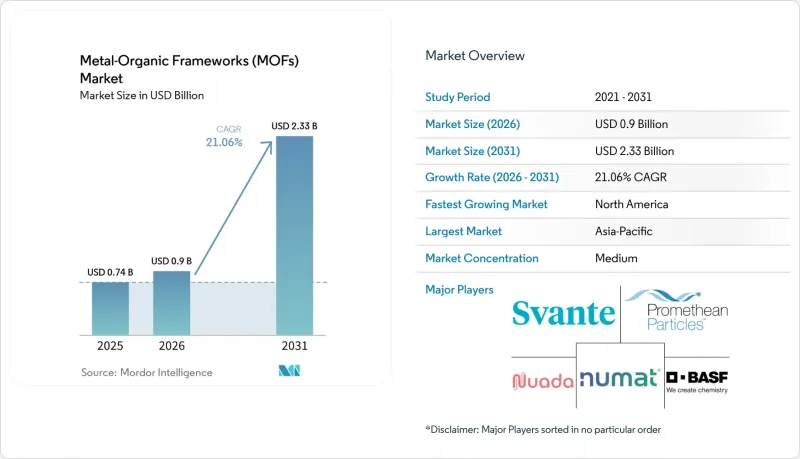
根據 Mordor Intelligence 預測,金屬有機框架 (MOF) 市場規模預計在 2025 年達到 7.4 億美元,從 2026 年的 9 億美元成長到 2031 年的 23.3 億美元,在預測期(2026-2031 年)內,預計複合年成長率為 21.06%。
本報告按產品類型(例如,銅基金屬有機框架材料)、形態(例如,粉末、顆粒/球狀物)、合成方法(例如,溶劑熱法/水熱法)、應用(例如,氣體儲存/分離、碳回收)和地區(例如,亞太地區、北美地區、歐洲地區、南美地區、中東和非洲地區)進行細分。市場預測以美元計價。
全球金屬有機框架(MOF)市場趨勢與洞察
工業領域碳捕獲與脫碳技術的發展
碳定價、淨零排放承諾以及吸附劑經濟性的提升正在推動金屬有機框架(MOF)市場的需求成長。與使用液態胺的替代技術相比,採用MOF的固體吸附劑系統再生所需的能量較少,且無需對濕廢氣進行除濕預處理。因此,預計它們將應用於水泥窯、鍋爐和乙醇發酵槽。 Svante Technologies公司位於加拿大不列顛哥倫比亞省伯納比市的Redwood工廠於2025年5月運作。該廠的過濾器年二氧化碳捕集。神戶製鋼、Atomis和Nagase & Co.於2026年4月完成了日本首個使用MOF二氧化碳捕集的實用規模示範試驗,日捕集量為30公斤,併計劃在2026會計年度進行噸級規模的試驗。這些項目正在改變MOF市場的採購重點,使其從材料測試轉向可靠的過濾器供應和卓越的運作性能。
節能型氣體分離與淨化
金屬有機框架(MOF)市場正受惠於氣體分離和純化領域降低能耗的需求。多元鋁基框架材料克服了傳統多孔固體固體的局限性,展現出對二氧化碳的吸附能力和對甲烷的選擇性。 2026年的一項研究展示了一種近乎純的ZIF-67膜的連續卷對卷製造程序,該膜的金屬有機骨架體積佔比超過90%。這種薄膜實現了對丙烯和丙烷、乙烯和乙烷以及二氧化碳和氮氣的分離性能。銅基材料(例如HKUST-1)已證實對二氧化碳和氮氣具有選擇性,但這種性能需要在含有微量雜質的潮濕氣流中保持。 Numat Technologies公司已成功展示了一種用於超高純度特殊氣體的真空供氣系統,表明該應用在金屬有機框架(MOF)市場中具有商業性意義。
連接劑、溶劑和精密加工相關的高成本。
高昂的材料和加工成本持續阻礙金屬有機框架(MOFs)在市場上的廣泛應用。羧酸配體和含氮雜環化合物佔據了高性能材料合成成本的很大一部分。此外,諸如二甲基甲醯胺之類的高沸點溶劑也帶來了廢棄物處理的難題。 AirJoule和BASF在降低成本方面的成就表明,工業工程可以改善特定框架的經濟性。然而,由於特種連接劑的價格仍然居高不下,這種經驗尚未應用於大多數框架組合物。因此,在建立大規模採購夥伴關係關係之前,採購研究級原料的新參與企業在成本方面處於劣勢。
細分市場分析
2025年,銅基金屬有機框架(MOF)的銷售額佔比達38.42%。這一地位反映了其成熟的合成方法、易於獲取的銅鹽原料以及對二氧化碳和氮氣以及二氧化碳和甲烷的選擇性。銅(II)的開放金屬位點提供路易斯酸鍵,從而支持對二氧化碳的選擇性吸附。雖然這種機制在晶體學層面是可靠的,但在二氧化碳捕集相關的潮濕工業環境中,其性能可能會下降。這些性能要求會影響工業系統中產品的選擇。
在金屬有機框架(MOF)市場中,鋅基MOF預計到2031年將以22.34%的複合年成長率成長。這一成長與BASF為Svante Technologies的二氧化碳捕集項目所生產的CALF-20密切相關。 CALF-20的推出使鋅基材料的地位從學術參考材料轉變為工業採購的基準。鐵基MOF提供低成本的原料,並在光化學反應和芬頓型反應中表現出觸媒活性。鋯基MOF在嚴苛的工業環境中具有耐濕耐熱性能,當法規要求需要進行性能檢驗時,其可靠性足以彌補較高的初始材料成本。
到2025年,粉末將佔銷售額的61.08%。粉末將繼續在實驗室合成、製程開發和填充床吸附系統中發揮核心作用。然而,粉末難以操作,可能導致不可控的壓力降或引發職業安全問題。這些限制促使人們尋求更實用的產品形態。顆粒和球狀物為填充床吸附劑提供了直接的途徑。
在金屬有機框架(MOF)市場,膜和薄膜預計到2031年將以24.83%的複合年成長率成長。半純ZIF-67薄膜的連續卷對卷生產已展現出工業化組件生產的潛在途徑。該製程在丙烯和丙烷、乙烯和乙烷以及二氧化碳和氮氣的分離性能方面達到了標竿水平。採用環保粘合劑進行造粒,可在千噸顆粒批次中維持90%以上的氣體吸附容量,同時將Brunauer-Emmett- 櫃員 (BET)比表面積降低高達50%。粘合劑和製造流程的改進正在縮小粉末和可用形式之間的性能差距。
區域分析
2025年,亞太地區佔總銷售額的35.04%。中國的綜合化工基地涵蓋金屬鹽、有機交聯劑、氣體分離和催化應用等領域。韓國、日本和台灣地區構成了一個密集的半導體製造地網路。神戶製鋼、Atomis和Nagase & Co.於2026年4月完成了日本首個日處理量30公斤的實用規模二氧化碳捕集示範實驗,併計劃在2026會計年度進行噸級規模的試驗。印度的製藥和水處理產業正成為新的需求來源。
在北美,受碳捕獲投資和半導體需求的推動,金屬有機框架(MOF)市場預計到2031年將以22.81%的複合年成長率成長。 Svante位於雷德伍德的工廠是其在北美生產金屬有機框架塗層過濾器的基地。 AirJoule Technologies於2026年6月發布了「AirJoule Prime」產品,並於2026年7月在位於紐約州尼斯卡尤納的GE Vernova前沿園區部署了「AirJoule Core」產品。加拿大自然資源部於2026年資助Svante公司檢驗過濾器的耐久性。政府支持有助於降低早期商業項目的風險資本。
在歐洲,德國憑藉其工業化學基礎和成熟的脫碳需求,在國內市場佔據了穩固地位。 2025年4月,novoMOF公司獲得440萬瑞士法郎(約490萬美元)的資金,用於一項工業二氧化碳捕集專案;同年11月,Promethean Particles公司向一家歐洲天然氣儲存業者交付了4噸產品。南美洲、中東和非洲市場規模仍然小規模,但預計乾旱地區對大氣水回收的需求將會增加,這與二氧化碳捕集和半導體應用領域的需求有所不同。
其他好處:
- Excel格式的市場預測(ME)表
- 3個月的分析師支持
目錄
第1章:引言
- 研究假設和市場定義
- 調查範圍
第2章:調查方法
第3章執行摘要
第4章 市場狀況
- 市場概覽
- 市場促進因素
- 工業領域碳捕獲與脫碳的實施
- 節能型氣體分離與淨化
- 氫氣和替代氣體儲存認證
- 半導體中有毒氣體的安全性和產量要求
- 人工智慧驅動的發現和特定應用的MOF設計
- 由於水資源短缺和能源消耗低,從大氣中回收水分。
- 市場限制因素
- 連接劑、溶劑和嚴格的加工步驟都會產生高成本。
- 在潮濕和惡劣條件下穩定性存在不足
- 粉末成型及性能維持方面的困難
- 證明合格、合規性和規模化的負擔。
- 價值鏈分析
- 波特五力分析
第5章 市場規模與成長預測
- 依產品類型
- 銅金屬有機框架
- 鋅基金屬有機框架
- 鐵基框架
- 鋯基金屬有機框架
- 其他產品類型
- 按形式
- 粉末
- 顆粒和丸劑
- 薄膜和薄膜
- 其他形式
- 透過合成方法
- 溶劑法和水熱法
- 機械化學
- 微波輔助法
- 超音波化學
- 其他合成方法
- 透過使用
- 氣體儲存和分離
- 碳回收
- 催化劑
- 水處理
- 其他用途
- 按地區
- 亞太地區
- 中國
- 印度
- 日本
- 韓國
- 東南亞國協
- 其他亞太國家
- 北美洲
- 美國
- 加拿大
- 墨西哥
- 歐洲
- 德國
- 英國
- 法國
- 義大利
- 北歐國家
- 其他歐洲國家
- 南美洲
- 巴西
- 阿根廷
- 其他南美國家
- 中東和非洲
- 沙烏地阿拉伯
- 南非
- 其他中東和非洲國家
- 亞太地區
第6章 競爭情勢
- 市場集中度
- 策略趨勢
- 市佔率和排名分析
- 公司簡介
- ACSYNAM
- AirJoule LLC
- BASF
- framergy, Inc.
- Immaterial Ltd.
- Merck KGaA
- MOF Technologies Ltd.
- MOFapps AS
- Nanorh
- novoMOF
- NUMAT TECHNOLOGIES, INC.
- Promethean Particles
- Svante Technologies Inc.
- UniSieve Ltd
第7章 市場機會與未來展望
According to Mordor Intelligence, the metal-Organic frameworks (MOFs) market was valued at USD 0.74 billion in 2025 and is estimated to grow from USD 0.90 billion in 2026 to reach USD 2.33 billion by 2031, at a CAGR of 21.06% during the forecast period (2026-2031).
This report is Segmented by Product Type (Copper-Based MOFs, and More), Form (Powder, Granules and Pellets, and More), Synthesis Method (Solvothermal and Hydrothermal, and More), Application (Gas Storage and Separation, Carbon Capture, and More), and Geography (Asia-Pacific, North America, Europe, South America, and Middle-East and Africa). The Market Forecasts are Provided in Terms of Value (USD).
Global Metal-Organic Frameworks (MOFs) Market Trends and Insights
Carbon Capture and Industrial Decarbonization Deployment
Carbon pricing, net-zero commitments, and improving sorbent economics are supporting demand for the metal-organic frameworks (MOFs) market. Metal-organic framework solid-sorbent systems can require less regeneration energy than liquid amine alternatives and can avoid moisture-removal pretreatment for a wet flue-gas stream. This makes them relevant to cement kilns, boilers, and ethanol fermenters. Svante Technologies commissioned its Redwood facility in Burnaby, British Columbia, in May 2025, with the capacity to supply filters supporting 10 million metric tons of annual carbon dioxide capture. Kobe Steel, Atomis, and Nagase & Co. completed Japan's first practical-scale metal-organic framework carbon dioxide capture demonstration at 30 kilograms per day in April 2026 and are planning a metric-ton-scale test in fiscal 2026. These projects are shifting procurement attention from materials testing toward dependable filter supply and operating performance within the metal-organic frameworks (MOFs) market.
Energy-Efficient Gas Separation and Purification
The metal-organic frameworks (MOFs) market benefits from the need to reduce energy use in gas separation and purification. Multivariate aluminum-based frameworks demonstrated both carbon dioxide capacity and methane selectivity, addressing a constraint for earlier porous solids. A 2026 study demonstrated continuous roll-to-roll manufacture of quasi-pure ZIF-67 membranes containing more than 90% metal-organic framework by volume. The membranes achieved separation performance across propylene and propane, ethylene and ethane, and carbon dioxide and nitrogen. Copper-based materials such as HKUST-1 have established carbon dioxide and nitrogen selectivity, but they must maintain this performance in humid gas streams with trace contaminants. Numat Technologies has demonstrated sub-atmospheric gas delivery systems for ultra-high-purity specialty gases, showing that this use case has commercial relevance within the metal-organic frameworks (MOFs) market.
High Cost of Linkers, Solvents, and Controlled Processing
High material and processing costs continue to limit wider adoption in the metal-organic frameworks (MOFs) market. Carboxylate-based ligands and nitrogen-heterocycle compounds account for a major share of the synthesis cost for high-performance materials. High-boiling solvents such as dimethylformamide also create waste-treatment requirements. The cost reduction achieved by AirJoule and BASF shows that industrial engineering can improve economics for selected frameworks. That experience does not yet apply across most framework compositions, where specialty linker prices remain high. New entrants buying research-grade inputs, therefore, face a cost disadvantage until they secure larger procurement partnerships.
Other drivers and restraints analyzed in the detailed report include:
- Hydrogen and Alternative Gas Storage Qualification
- AI-Assisted Discovery and Application-Specific MOF Design
- Moisture and Harsh-Condition Stability Gaps
For complete list of drivers and restraints, kindly check the Table Of Contents.
Segment Analysis
Copper-Based MOFs held 38.42% of revenue in 2025. Their position reflected well-characterized synthesis protocols, accessible copper-salt feedstocks, and selectivity across carbon dioxide and nitrogen and carbon dioxide and methane. Copper(II) open-metal sites provide Lewis acid binding that supports selective carbon dioxide uptake. The mechanism remains reliable at the crystallographic level but can decline in wet industrial conditions relevant to carbon capture. These performance conditions influence product selection for industrial systems.
Zinc-Based MOFs are projected to advance at a 22.34% CAGR through 2031 within the metal-organic frameworks (MOFs) market. Their growth is linked to CALF-20, which BASF produced for Svante Technologies' carbon capture program. This deployment moved zinc-based materials from an academic reference to an industrial procurement benchmark. Iron-Based MOFs offer lower-cost feedstocks and catalytic activity in photochemical and Fenton-type reactions. Zirconium-Based variants provide moisture and thermal resilience for harsh industrial settings, and their reliability can outweigh higher initial material costs where regulations require validated performance.
Powder held 61.08% of revenue in 2025. It remained central to laboratory synthesis, process development, and packed-bed adsorption systems. Powder can be difficult to handle, can create uncontrolled pressure drop, and can raise occupational safety concerns. These limitations support demand for more practical formats. Granules and pellets offer a direct route to packed-bed adsorbents.
Membranes and thin films are projected to advance at a 24.83% CAGR through 2031 in the metal-organic frameworks (MOFs) market. Continuous roll-to-roll fabrication of quasi-pure ZIF-67 membranes demonstrated a potential route to industrial module production. The process delivered benchmark separation across propylene and propane, ethylene and ethane, and carbon dioxide and nitrogen. Pelletization can reduce Brunauer-Emmett-Teller surface area by up to 50%, while green binders retained more than 90% of gas uptake in kilogram-scale pellet batches. Improvements in binders and fabrication methods are narrowing the performance gap between powder and deployable forms.
Complete Report Scope:
- By Product Type
- Copper-Based MOFs
- Zinc-Based MOFs
- Iron-Based MOFs
- Zirconium-Based MOFs
- Other Product Types
- By Form
- Powder
- Granules and Pellets
- Membranes and Thin Films
- Other Forms
- By Synthesis Method
- Solvothermal and Hydrothermal
- Mechanochemical
- Microwave-Assisted
- Sonochemical
- Other Synthesis Methods
- By Application
- Gas Storage and Separation
- Carbon Capture
- Catalysis
- Water Treatment
- Other Applications
- By Geography
- Asia-Pacific
- China
- India
- Japan
- South Korea
- ASEAN Countries
- Rest of Asia-Pacific
- North America
- United States
- Canada
- Mexico
- Europe
- Germany
- United Kingdom
- France
- Italy
- NORDIC Countries
- Rest of Europe
- South America
- Brazil
- Argentina
- Rest of South America
- Middle-East and Africa
- Saudi Arabia
- South Africa
- Rest of Middle-East and Africa
- Asia-Pacific
Geography Analysis
Asia-Pacific held 35.04% of revenue in 2025. China's integrated chemical base extends from metal salts and organic linkers to gas separation and catalysis applications. South Korea, Japan, and Taiwan add a dense semiconductor manufacturing base. Kobe Steel, Atomis, and Nagase & Co. completed Japan's first practical-scale carbon dioxide capture demonstration at 30 kilograms per day in April 2026 and are planning a metric-ton-scale test in fiscal 2026. India's pharmaceutical and water-treatment sectors provide an additional, developing source of demand.
North America is projected to advance at a 22.81% CAGR through 2031 in the metal-organic frameworks (MOFs) market, supported by carbon capture investment and semiconductor demand. Svante's Redwood facility serves as a North American production anchor for metal-organic framework-coated filters. AirJoule Technologies unveiled AirJoule Prime in June 2026 and deployed AirJoule Core at GE Vernova's Frontier Campus in Niskayuna, New York, in July 2026. Natural Resources Canada provided funding to Svante in 2026 to validate filter durability. Government support can reduce the capital at risk for early commercial projects.
In Europe, Germany held a strong national position because of its industrial chemistry base and mature decarbonization requirements. novoMOF secured CHF 4.4 million, equivalent to USD 4.9 million, in April 2025 for industrial carbon dioxide capture projects, while Promethean Particles shipped 4 metric tons to a European gas-storage customer in November 2025. South America, and Middle-East and Africa remain smaller markets, although arid areas can support atmospheric water harvesting demand that is separate from carbon capture and semiconductor applications.
- ACSYNAM
- AirJoule LLC
- BASF
- framergy, Inc.
- Immaterial Ltd.
- Merck KGaA
- MOF Technologies Ltd.
- MOFapps AS
- Nanorh
- novoMOF
- NUMAT TECHNOLOGIES, INC.
- Promethean Particles
- Svante Technologies Inc.
- UniSieve Ltd
Additional Benefits:
- The market estimate (ME) sheet in Excel format
- 3 months of analyst support
TABLE OF CONTENTS
1 Introduction
- 1.1 Study Assumptions and Market Definition
- 1.2 Scope of the Study
2 Research Methodology
3 Executive Summary
4 Market Landscape
- 4.1 Market Overview
- 4.2 Market Drivers
- 4.2.1 Carbon Capture and Industrial Decarbonization Deployment
- 4.2.2 Energy-Efficient Gas Separation and Purification
- 4.2.3 Hydrogen and Alternative Gas Storage Qualification
- 4.2.4 Semiconductor Toxic-Gas Safety and Yield Requirements
- 4.2.5 AI-Assisted Discovery and Application-Specific MOF Design
- 4.2.6 Water Scarcity and Low-Energy Atmospheric Water Harvesting
- 4.3 Market Restraints
- 4.3.1 High Cost of Linkers, Solvents, and Controlled Processing
- 4.3.2 Moisture and Harsh-Condition Stability Gaps
- 4.3.3 Powder Forming and Performance-Retention Difficulty
- 4.3.4 Qualification, Compliance, and Scale-Up Proof Burden
- 4.4 Value Chain Analysis
- 4.5 Porter's Five Forces Analysis
- 4.5.1 Threat of New Entrants
- 4.5.2 Bargaining Power of Suppliers
- 4.5.3 Bargaining Power of Buyers
- 4.5.4 Threat of Substitutes
- 4.5.5 Competitive Rivalry
5 Market Size and Growth Forecasts (Value)
- 5.1 By Product Type
- 5.1.1 Copper-Based MOFs
- 5.1.2 Zinc-Based MOFs
- 5.1.3 Iron-Based MOFs
- 5.1.4 Zirconium-Based MOFs
- 5.1.5 Other Product Types
- 5.2 By Form
- 5.2.1 Powder
- 5.2.2 Granules and Pellets
- 5.2.3 Membranes and Thin Films
- 5.2.4 Other Forms
- 5.3 By Synthesis Method
- 5.3.1 Solvothermal and Hydrothermal
- 5.3.2 Mechanochemical
- 5.3.3 Microwave-Assisted
- 5.3.4 Sonochemical
- 5.3.5 Other Synthesis Methods
- 5.4 By Application
- 5.4.1 Gas Storage and Separation
- 5.4.2 Carbon Capture
- 5.4.3 Catalysis
- 5.4.4 Water Treatment
- 5.4.5 Other Applications
- 5.5 By Geography
- 5.5.1 Asia-Pacific
- 5.5.1.1 China
- 5.5.1.2 India
- 5.5.1.3 Japan
- 5.5.1.4 South Korea
- 5.5.1.5 ASEAN Countries
- 5.5.1.6 Rest of Asia-Pacific
- 5.5.2 North America
- 5.5.2.1 United States
- 5.5.2.2 Canada
- 5.5.2.3 Mexico
- 5.5.3 Europe
- 5.5.3.1 Germany
- 5.5.3.2 United Kingdom
- 5.5.3.3 France
- 5.5.3.4 Italy
- 5.5.3.5 NORDIC Countries
- 5.5.3.6 Rest of Europe
- 5.5.4 South America
- 5.5.4.1 Brazil
- 5.5.4.2 Argentina
- 5.5.4.3 Rest of South America
- 5.5.5 Middle-East and Africa
- 5.5.5.1 Saudi Arabia
- 5.5.5.2 South Africa
- 5.5.5.3 Rest of Middle-East and Africa
- 5.5.1 Asia-Pacific
6 Competitive Landscape
- 6.1 Market Concentration
- 6.2 Strategic Moves
- 6.3 Market Share (%)/Ranking Analysis
- 6.4 Company Profiles (includes Global Overview, Market Overview, Core Segments, Financials as available, Strategic Information, Products and Services, and Recent Developments)
- 6.4.1 ACSYNAM
- 6.4.2 AirJoule LLC
- 6.4.3 BASF
- 6.4.4 framergy, Inc.
- 6.4.5 Immaterial Ltd.
- 6.4.6 Merck KGaA
- 6.4.7 MOF Technologies Ltd.
- 6.4.8 MOFapps AS
- 6.4.9 Nanorh
- 6.4.10 novoMOF
- 6.4.11 NUMAT TECHNOLOGIES, INC.
- 6.4.12 Promethean Particles
- 6.4.13 Svante Technologies Inc.
- 6.4.14 UniSieve Ltd
7 Market Opportunities and Future Outlook
- 7.1 White-Space and Unmet-Need Assessment

 金屬有機框架(MOFs)和氣體儲存材料市場預測至2034年:按氣體類型、材料類型、應用、最終用戶和地區分類的全球分析
 金屬有機框架(MOF)材料市場:全球市場預測,2026-2032年
 有機金屬還原劑市場規模、佔有率和成長分析:按化學類型、形態、應用、最終用途產業、等級和地區分類-2026-2033年產業預測
 有機金屬試劑市場規模、佔有率和成長分析:按試劑類型、等級、應用、最終用戶、形態和地區分類-2026-2033年產業預測
 全球金屬有機框架(MOF)市場(至2031年):按類型(鋅基、銅基、鐵基、鋁基、鉻基)、合成方法(溶劑熱/水熱合成、微波輔助合成、機械化學合成)和地區分類
 有機金屬化合物市場規模、佔有率和成長分析:按類型、形態、終端用戶產業、金屬類型、分銷管道和地區分類-2026-2033年產業預測
 金屬有機框架(MOFs):市場機會、成長要素、產業趨勢分析及2026-2035年預測
 全球金屬有機結構市場規模、佔有率、趨勢和成長分析報告(2026-2034)金屬有機結構市場:依材料類型、製造方法、產品形式、孔隙率、骨架結構、應用和最終用途產業分類-全球預測,2026-2032年
 2026年全球金屬有機框架市場報告