


 |
市場調查報告書
商品編碼
2119358
錨碇繩:市場佔有率分析、產業趨勢與統計、成長預測(2026-2031)Mooring Ropes - Market Share Analysis, Industry Trends & Statistics, Growth Forecasts (2026 - 2031) |
||||||

※ 本網頁內容可能與最新版本有所差異。詳細情況請與我們聯繫。
據 Mordor Intelligence 稱,2025 年錨碇繩市場規模估計為 14.8 億美元,預計在預測期(2026-2031 年)內將以 4.87% 的複合年成長率成長,從 2026 年的 15.5 億美元成長到 2031 年的 19.61 億美元。
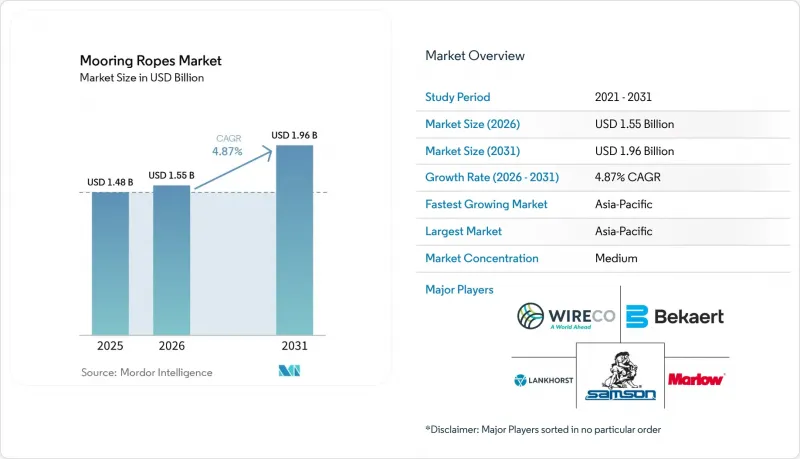
本報告按資料類型(尼龍、聚酯纖維等)、撚度(4捻或以下、4-10捻、其他)、應用領域(船舶錨碇、海上錨碇等)及地區(亞太地區、北美地區、歐洲地區、南美地區、中東和非洲地區)進行細分。市場預測以美元計價。
全球錨碇繩市場趨勢及洞察
海上貿易擴張與港口現代化
港口擴建持續推動新建泊位、碼頭維修、船隊升級以及相關係錨碇繩索的需求。隨著碼頭營運商為應對更大的貨櫃船和超大型原油運輸船(VLCC)做好準備,錨碇繩索市場也從中受益。這是因為系柱負荷的增加需要更高斷裂強度的繩子。這支撐了對高規格合成纖維產品以及4-10股或更多股繩索的需求。新加坡港務集團(PSA Singapore)旗下的圖阿斯港自投產以來,吞吐量已超過2500萬標準箱(TEU),並已決定在2027年前將其泊位擴建至18個,這將加速繫錨碇設備的升級週期。桑托斯港在2025年創下了590萬標準箱的吞吐量紀錄,並計劃在2026年超過600萬標準箱,這也支撐了對新型和升級型船舶設備的需求。墨西哥曼薩尼約和拉薩羅卡德納斯的擴建計畫也增加了需求,這表明合成繩索的使用還有進一步的成長潛力。
深海和超深海海上油氣探勘
深海探勘正在推動用於浮體式生產儲卸油船 (FPSO) 和半潛式平台的高性能繩索的需求。印度國家石油公司 (ONGC) 於 2026 年發布的價值 180 億至 200 億美元的安達曼海和印度東部近海深海鑽井鑽機競標,反映了這家國有石油公司在前沿盆地的持續活動。錨碇繩市場往往受專案進度安排的影響,因為海上產業的資本投資和最終投資決策可能逐年波動,即使對深海基礎設施的潛在需求持續存在,也可能導致個別訂單的延遲交付。擁有成熟海上生產能力的製造商可以從早期項目訂單和累積訂單受益。巴西鹽層下盆地、西非前沿油田和東南亞開發區仍是海上繫錨碇需求的關鍵中心。
原物料價格波動
原物料價格波動是錨碇繩市場獲利能力的最迫切阻礙因素。受霍爾木茲海峽石化產品運輸中斷的影響,2026年2月下旬至4月期間,大連商品交易所的聚丙烯和聚乙烯價格分別上漲了38%和37%。同期,苯、己內醯胺等尼龍中間體以及聚酯纖維在亞洲主要市場的價格也出現上漲。普通級繩索供應商往往難以將這些成本轉嫁給簽訂長期供應合約的買家。如果原物料價格持續上漲,目前集中在擁有強大避險能力的大型生產商手中的高階高密度聚乙烯(HMPE)產品的相對獲利能力可能會有所提高。垂直整合或已建立避險機制的纖維生產商更有能力應對這些價格波動。
細分市場分析
到2025年,尼龍將佔據錨碇繩市場41.23%的佔有率,這反映了其在商船繫停泊設施中確立的穩固地位。由於尼龍的斷裂伸長率通常在15%至40%之間,因此能夠吸收船舶操作過程中的衝擊載荷,並在兼顧性能和成本的標準船舶錨碇應用中繼續廣泛應用。對於商船繫錨碇,尼龍繩通常採用4至10股的結構。聚酯繩佔據著重要的第二位,因為它即使在潮濕條件下也能保持強度,並且與尼龍相比蠕變性更低。這些特性使得聚酯船舶系纜適用於海上石油接收站單點繫錨碇(SPM)以及其他需要長期穩定載重的應用。
受深海能源和浮動式風力發電項目成長的推動,高密度聚乙烯(HMPE)錨碇繩市場規模預計到2031年將以5.34%的複合年成長率成長。 EN ISO 10325:2026標準透過定義HMPE繩索的結構和性能要求,降低了規範的不確定性。研究證實,聚對苯二甲酸乙二醇酯(PET)和HMPE在浮動式風力發電錨碇中具有很高的耐磨性,但HMPE在超過最小斷裂載荷15%的載荷下發生的蠕變仍然是設計中需要考慮的因素。其他類別包括醯胺纖維、混合複合材料和鋼絲,以滿足特殊的高負荷和耐火需求。 Garware Technical Fibers公司報告稱,其在2026年投資了HMPE加工和混煉能力,這反映了印度供應商致力於向高附加價值應用領域轉型的努力。
區域分析
亞太地區預計在2025年佔據43.07%的錨碇繩市場佔有率,並預計到2031年將以5.28%的複合年成長率成長。該地區集中了眾多貨櫃港口、造船廠和海上能源資產。 2026年5月,中國安裝了16兆瓦的三峽凌航浮動式風力發電平台,該平台採用聚酯繫錨碇繩。川崎重工將MOMOSEA(一種用於錨碇的繫泊繩張力監測系統)商業化,支持日本致力於透過整合感測器來加強錨碇安全措施。印度石油天然氣公司(ONGC)的深海鑽井競標顯示印度未來對海上作業的需求。 2025年7月,Garware Technical Fibers收購了兩家挪威公司,以增強其海上工程和專案管理能力。
歐洲和北美是錨碇繩市場第二大收入來源。歐洲的地位得益於離岸風力發電的活性化和成熟的單點繫錨碇(SPM)油輪碼頭基礎設施。在法國實施的EolMed先導計畫將於2026年4月投入運作,並將為地中海浮動式風力發電的錨碇規範樹立標準。北美的需求主要集中在美國墨西哥灣的深水生產和不列顛哥倫比亞省的液化天然氣(LNG)碼頭運作。 Bekaat Bexco為殼牌公司在墨西哥灣的斯巴達開發案提供了DeepRope錨碇泊繩。在北歐國家,海上油氣資產、水產養殖業務以及早期浮體式海上風發電工程相結合,使該地區成為高品質繩索和全生命週期服務能力的重要市場。
南美洲、中東和非洲雖然規模較小,但在錨碇繩市場中持續成長。巴西桑托斯港的目標是到2026年吞吐量超過600萬標準箱(TEU),該國鹽層下浮體式生產儲貨運設施裝置(FPSO)管道將支撐航運和海上應用整體的需求。阿根廷海上油田權益的授予以及巴西石油公司(Petrobras)的Morpho-1深水探勘項目,都增強了海上活動的長期前景。沙烏地阿拉伯海上油田的擴建以及在南非奧蘭治盆地的探勘表明,未來對更先進繫錨碇規格的需求將持續成長。亞歷山大港在2025/26會計年度處理了創紀錄的8,200萬噸貨物。摩洛哥、奈及利亞和肯亞的投資也透過升級現有設施和建設新設施,推動了需求的成長。
其他好處:
- Excel格式的市場預測(ME)表
- 3個月的分析師支持
目錄
第1章:引言
- 研究假設和市場定義
- 調查範圍
第2章:調查方法
第3章執行摘要
第4章 市場狀況
- 市場概覽
- 市場促進因素
- 海上貿易擴張與港口現代化
- 深海和超深海海上油氣探勘
- 浮體式海上風力發電和海洋可再生能源的介紹
- 使用輕質高強度的合成繩。
- 利用感測器監測繫錨碇狀態
- 生物基和可回收繩索的採購要求
- 市場限制因素
- 原物料價格波動
- 實施和認證先進繫錨碇系統。
- 錨碇設備的檢查和更換方面做法不一致。
- 關於浮動式風力發電中長壽命纖維繩的性能數據有限。
- 價值和供應鏈分析
- 波特五力分析
第5章 市場規模與成長預測
- 材料類型
- 尼龍
- 聚酯纖維
- 聚丙烯(PP)
- 高模量聚乙烯(HMPE)
- 其他材質(醯胺纖維、混合及複合繩索、鋼絲繩)
- 按股數
- 4股或更少
- 4-10股
- 10股或更多股
- 透過使用
- 船舶錨碇
- 海上繫錨碇
- 港口和碼頭運營
- 其他(浮體式可再生能源系統、水產養殖和其他海洋應用)
- 按地區
- 亞太地區
- 中國
- 印度
- 日本
- 韓國
- 東南亞國協
- 其他亞太國家
- 北美洲
- 美國
- 加拿大
- 墨西哥
- 歐洲
- 德國
- 英國
- 法國
- 義大利
- 北歐國家
- 其他歐洲國家
- 南美洲
- 巴西
- 阿根廷
- 其他南美國家
- 中東和非洲
- 沙烏地阿拉伯
- 南非
- 其他中東和非洲國家
- 亞太地區
第6章 競爭情勢
- 市場集中度
- 策略趨勢
- 市佔率和排名分析
- 公司簡介
- Bekaert
- Bexco nv-sa
- Cortland Company
- Dynamica Ropes
- FOLCH ROPES SA
- Garware Technical Fibres Ltd.
- Jimmy Green Marine
- Katradis Marine Ropes Ind. SA
- Lankhorst Ropes
- Marlow Ropes
- Samson Rope Technologies
- Southern Ropes
- Teufelberger
- Usha Martin
- van Beelen Group BV
- WireCo
- Yale Cordage
第7章 市場機會與未來展望
According to Mordor Intelligence, the mooring ropes market size is estimated at USD 1.48 billion in 2025 and is estimated to grow from USD 1.55 billion in 2026 to USD 1.96 billion by 2031, at a CAGR of 4.87% during the forecast period (2026-2031).
This report is Segmented by Material Type (Nylon, Polyester, and More), Number of Strands (Up To 4 Strands, 4 To 10 Strands, and More), Application (Ship Mooring, Offshore Mooring, and More), and Geography (Asia-Pacific, North America, Europe, South America, and Middle-East and Africa). The Market Forecasts are Provided in Terms of Value (USD).
Global Mooring Ropes Market Trends and Insights
Growing Maritime Trade and Port Modernization
Port expansion is creating steady demand for new berths, terminal upgrades, fleet replacements, and associated mooring rope sets. The mooring ropes market benefits when terminal operators prepare to handle larger container ships and very large crude carriers, as higher bollard loads require ropes with greater breaking strength. This supports demand for higher-specification synthetic products and for 4- to 10-strand or above-10-strand constructions. PSA Singapore's Tuas Port has surpassed 25 million Twenty-foot Equivalent Units (TEUs) handled since commissioning and has confirmed an expansion to 18 berths by 2027, driving replacement cycles for mooring equipment. The Port of Santos targeted more than 6 million TEUs in 2026 after handling a record 5.9 million TEUs in 2025, supporting demand for new and replacement marine equipment. Expansion projects at Manzanillo and Lazaro Cardenas in Mexico are also increasing demand, with synthetic rope use having room to grow.
Offshore Oil and Gas Exploration in Deep and Ultra-Deep Waters
Deepwater exploration supports demand for high-performance ropes used by floating production, storage, and offloading vessels and semi-submersible platforms. Oil and Natural Gas Corporation's (ONGC's) 2026 tender for USD 18-20 billion of deepwater drilling rigs for the Andaman ultra-deepwater block and eastern offshore India reflects continued national oil company activity in frontier basins. The mooring ropes market is exposed to project timing because offshore capital spending and final investment decisions can shift between years, delaying individual orders even when the underlying need for deepwater infrastructure persists. Manufacturers with established offshore production capacity can benefit from earlier project awards and larger order books. Brazil's pre-salt basins, West African frontier acreage, and Southeast Asian developments remain relevant locations for offshore mooring demand.
Raw Material Price Volatility
Feedstock exposure is the most immediate constraint on margins in the mooring ropes market. Polypropylene and polyethylene prices on the Dalian Commodity Exchange rose 38% and 37%, respectively, between late February and April 2026, following disruptions to petrochemical flows through the Strait of Hormuz. Nylon intermediates, including benzene and caprolactam, as well as polyester fiber prices, also rose in key Asian markets during the same period. Standard-grade rope suppliers often find it difficult to pass these costs on to buyers under long-term supply agreements. Sustained feedstock inflation can improve the relative economics of premium HMPE products, whose supply is concentrated among larger producers with greater hedging capacity. Fiber producers with backward integration or established hedging programs are better positioned to absorb such volatility.
Other drivers and restraints analyzed in the detailed report include:
- Floating Offshore Wind and Marine Renewable Energy Deployment
- Adoption of Lightweight, High-Strength Synthetic Ropes
- High Installation and Certification Costs for Advanced Mooring Systems
For complete list of drivers and restraints, kindly check the Table Of Contents.
Segment Analysis
Nylon held 41.23% of the mooring ropes market share in 2025, reflecting its established role in commercial ship berths. Its typical 15-40% elongation before breaking supports shock-load absorption during vessel handling, and it remains widely used in standard ship mooring applications where both performance and cost are considerations. The 4-to-10-strand construction is commonly used with nylon in commercial ship mooring. Polyester holds an important secondary position due to its retained strength in wet conditions and lower creep than nylon. These properties make polyester suitable for Single Point Mooring (SPM) hawsers at offshore oil terminals and other applications requiring stable long-term loading.
The mooring ropes market size for HMPE is projected to expand at a 5.34% CAGR through 2031, driven by growth in deepwater energy and floating wind activity. EN ISO 10325:2026 reduces specification uncertainty by defining HMPE rope constructions and performance requirements. Research has identified strong wear resistance in Polyethylene Terephthalate (PET) and HMPE for floating wind mooring, although HMPE creep at loads above 15% of the minimum breaking load remains a design consideration. The other category includes aramid fiber, hybrid composites, and steel wire for specialized high-load or fire-resistant requirements. Garware Technical Fibers reported investment in HMPE processing and compounding capabilities in FY26, reflecting efforts by Indian suppliers to move toward higher-value applications.
Complete Report Scope:
- By Material Type
- Nylon
- Polyester
- Polypropylene (PP)
- High Modulus Polyethylene (HMPE)
- Others (Aramid Fibers, Hybrid and Composite Ropes, Steel Wire Ropes)
- By Number of Strands
- Up to 4 Strands
- 4 to 10 Strands
- Above 10 Strands
- By Application
- Ship Mooring
- Offshore Mooring
- Port and Terminal Operations
- Others (Floating Renewable Energy Systems, Aquaculture, Other Marine Applications)
- By Geography
- Asia-Pacific
- China
- India
- Japan
- South Korea
- ASEAN Countries
- Rest of Asia-Pacific
- North America
- United States
- Canada
- Mexico
- Europe
- Germany
- United Kingdom
- France
- Italy
- NORDIC Countries
- Rest of Europe
- South America
- Brazil
- Argentina
- Rest of South America
- Middle-East and Africa
- Saudi Arabia
- South Africa
- Rest of Middle-East and Africa
- Asia-Pacific
Geography Analysis
Asia-Pacific accounted for 43.07% of the Mooring Ropes Market share in 2025 and is forecast to grow at a 5.28% CAGR through 2031. The region has a high concentration of container ports, shipyards, and offshore energy assets. China installed the 16 MW Sanxia Linghang floating wind platform in May 2026, using polyester mooring lines. Kawasaki Heavy Industries commercialized its MOMOSEA rope tension monitoring system for ship berthing, supporting Japan's focus on sensor-integrated mooring safety. Oil and Natural Gas Corporation (ONGC)'s deepwater drilling tender points to India's future offshore requirements. Garware Technical Fibers expanded its offshore engineering and project management capabilities through its July 2025 acquisitions of two Norwegian businesses.
Europe and North America form the second-largest revenue pool in the Mooring Ropes Market. Europe's position is supported by offshore wind activity and established Single Point Mooring (SPM) tanker terminal infrastructure. The EolMed pilot in France was energized in April 2026 and serves as a reference point for mooring specifications in Mediterranean floating wind. North American demand is centered on deepwater production in the U.S. Gulf of Mexico and Liquefied Natural Gas (LNG) terminal activity in British Columbia. Bekaert-BEXCO supplied DeepRope synthetic mooring lines for Shell's Sparta development in the Gulf of Mexico. Nordic countries combine offshore oil and gas assets, fish farming operations, and early floating wind projects, making the region important for premium rope grades and lifecycle service capabilities.
South America, the Middle-East, and Africa represent smaller but expanding parts of the Mooring Ropes Market. Brazil's Port of Santos targeted more than 6 million Twenty-foot Equivalent Units (TEUs) in 2026, while its pre-salt Floating Production Storage and Offloading (FPSO) pipeline supported demand across ship and offshore applications. Argentina's offshore block awards and Petrobras's Morpho-1 deepwater prospect add longer-term visibility for offshore activity. Saudi offshore field expansions and exploration in South Africa's Orange Basin point to future demand for upgraded mooring specifications. Alexandria Port handled a record 82 million tons of cargo in FY2025/26. Investments in Morocco, Nigeria, and Kenya also support incremental replacement and new-equipment demand.
- Bekaert
- Bexco nv-sa
- Cortland Company
- Dynamica Ropes
- FOLCH ROPES S.A.
- Garware Technical Fibres Ltd.
- Jimmy Green Marine
- Katradis Marine Ropes Ind. S.A.
- Lankhorst Ropes
- Marlow Ropes
- Samson Rope Technologies
- Southern Ropes
- Teufelberger
- Usha Martin
- van Beelen Group BV
- WireCo
- Yale Cordage
Additional Benefits:
- The market estimate (ME) sheet in Excel format
- 3 months of analyst support
TABLE OF CONTENTS
1 Introduction
- 1.1 Study Assumptions and Market Definition
- 1.2 Scope of the Study
2 Research Methodology
3 Executive Summary
4 Market Landscape
- 4.1 Market Overview
- 4.2 Market Drivers
- 4.2.1 Growing Maritime Trade and Port Modernization
- 4.2.2 Offshore Oil and Gas Exploration in Deep and Ultra-Deep Waters
- 4.2.3 Floating Offshore Wind and Marine Renewable Energy Deployment
- 4.2.4 Adoption of Lightweight, High-Strength Synthetic Ropes
- 4.2.5 Sensor-Enabled Mooring Condition Monitoring
- 4.2.6 Bio-Based and Recyclable Rope Procurement Requirements
- 4.3 Market Restraints
- 4.3.1 Raw Material Price Volatility
- 4.3.2 High Installation and Certification Costs for Advanced Mooring Systems
- 4.3.3 Inconsistent Mooring Inspection and Replacement Practices
- 4.3.4 Limited Performance Data for Long-Life Fiber Ropes in Floating Wind
- 4.4 Value and Supply-Chain Analysis
- 4.5 Porter's Five Forces Analysis
- 4.5.1 Bargaining Power of Suppliers
- 4.5.2 Bargaining Power of Buyers
- 4.5.3 Threat of New Entrants
- 4.5.4 Threat of Substitutes
- 4.5.5 Competitive Rivalry
5 Market Size and Growth Forecasts (Value)
- 5.1 By Material Type
- 5.1.1 Nylon
- 5.1.2 Polyester
- 5.1.3 Polypropylene (PP)
- 5.1.4 High Modulus Polyethylene (HMPE)
- 5.1.5 Others (Aramid Fibers, Hybrid and Composite Ropes, Steel Wire Ropes)
- 5.2 By Number of Strands
- 5.2.1 Up to 4 Strands
- 5.2.2 4 to 10 Strands
- 5.2.3 Above 10 Strands
- 5.3 By Application
- 5.3.1 Ship Mooring
- 5.3.2 Offshore Mooring
- 5.3.3 Port and Terminal Operations
- 5.3.4 Others (Floating Renewable Energy Systems, Aquaculture, Other Marine Applications)
- 5.4 By Geography
- 5.4.1 Asia-Pacific
- 5.4.1.1 China
- 5.4.1.2 India
- 5.4.1.3 Japan
- 5.4.1.4 South Korea
- 5.4.1.5 ASEAN Countries
- 5.4.1.6 Rest of Asia-Pacific
- 5.4.2 North America
- 5.4.2.1 United States
- 5.4.2.2 Canada
- 5.4.2.3 Mexico
- 5.4.3 Europe
- 5.4.3.1 Germany
- 5.4.3.2 United Kingdom
- 5.4.3.3 France
- 5.4.3.4 Italy
- 5.4.3.5 NORDIC Countries
- 5.4.3.6 Rest of Europe
- 5.4.4 South America
- 5.4.4.1 Brazil
- 5.4.4.2 Argentina
- 5.4.4.3 Rest of South America
- 5.4.5 Middle-East and Africa
- 5.4.5.1 Saudi Arabia
- 5.4.5.2 South Africa
- 5.4.5.3 Rest of Middle-East and Africa
- 5.4.1 Asia-Pacific
6 Competitive Landscape
- 6.1 Market Concentration
- 6.2 Strategic Moves
- 6.3 Market Share (%)/Ranking Analysis
- 6.4 Company Profiles (includes Global Overview, Market Overview, Core Segments, Financials as available, Strategic Information, Products and Services, and Recent Developments)
- 6.4.1 Bekaert
- 6.4.2 Bexco nv-sa
- 6.4.3 Cortland Company
- 6.4.4 Dynamica Ropes
- 6.4.5 FOLCH ROPES S.A.
- 6.4.6 Garware Technical Fibres Ltd.
- 6.4.7 Jimmy Green Marine
- 6.4.8 Katradis Marine Ropes Ind. S.A.
- 6.4.9 Lankhorst Ropes
- 6.4.10 Marlow Ropes
- 6.4.11 Samson Rope Technologies
- 6.4.12 Southern Ropes
- 6.4.13 Teufelberger
- 6.4.14 Usha Martin
- 6.4.15 van Beelen Group BV
- 6.4.16 WireCo
- 6.4.17 Yale Cordage
7 Market Opportunities and Future Outlook
- 7.1 White-Space and Unmet-Need Assessment

 超高分子量聚乙烯(UHMWPE)繩索市場:按產品類型、應用和地區分類
 2026-2030年全球繩索市場
 繫泊繩市場規模、佔有率、成長及全球產業分析:依類型、應用和地區劃分的洞察與預測(2026-2034)
 住宅電梯鋼絲繩市場:依鋼絲繩材質、鋼絲繩類型、捻向、安裝方式及應用分類-全球預測(2026-2032)商用電梯鋼絲繩市場(依電梯類型、結構類型、材質、安裝類型、鋼絲繩塗層和最終用戶產業分類)-2026-2032年全球預測林業繩索市場按材料類型、應用、最終用戶和分銷管道分類-2026-2032年全球預測船用繩索市場:按繩索類型、材料、結構和最終用戶分類,全球預測(2026-2032年)速度調節器專用繩索市場:按繩索類型、材料、安裝類型、最終用途和分銷管道分類的全球預測(2026-2032 年)
 錨碇繩市場規模、佔有率及成長分析(按類型、應用、最終用戶和地區分類)-產業預測(2026-2033 年)
 繩索市場規模、佔有率及成長分析(按產品類型、最終用戶和地區分類)-2026-2033年產業預測