


 |
市場調查報告書
商品編碼
2119356
起司蠟:市場佔有率分析、產業趨勢與統計、成長預測(2026-2031)Cheese Wax - Market Share Analysis, Industry Trends & Statistics, Growth Forecasts (2026 - 2031) |
||||||

※ 本網頁內容可能與最新版本有所差異。詳細情況請與我們聯繫。
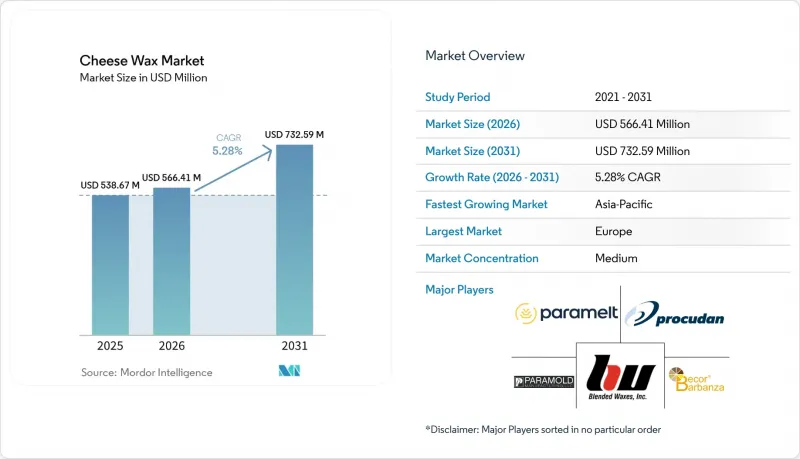
據 Mordor Intelligence 稱,起司蠟市場在 2025 年的估值為 5.3867 億美元,預計在預測期(2026-2031 年)內將以 5.28% 的複合年成長率成長,從 2026 年的 5.6641 億美元成長到 2031 年的 7.395 年。
本報告按產品類型(石蠟基起司蠟、結晶質起司蠟等)、應用領域(防潮保鮮、防黴保護和表面保護等)以及地區(亞太地區、北美地區、歐洲地區、南美地區、中東和非洲地區)進行細分。市場預測以美元計價。
全球乳酪蠟市場趨勢與洞察
擴大陳年起司、特色起司和手工起司的生產。
特色乳酪生產因其較長的成熟期和多樣化的產品形態,對保護性塗層的需求日益成長。根據美國農業部國家農業統計局(NASS)的數據,威斯康辛州的特色乳酪產量預計將在2025年達到創紀錄的10.3億英鎊,比上年成長1.1%,佔該州起司總產量的28.2%。這項生產基礎為輪狀乳酪和其他需要表面保護的乳酪生產商提供了穩定的乳酪蠟市場。此外,歐洲保護性起司品種的生產商必須滿足產品和外觀規格要求,這也促使起司蠟需要進行統一的外表面處理。與通常採用薄膜或真空包裝的大規模加工起士相比,這種需求的依賴性相對較低。
成熟過程中保持水分和防止黴菌滋生的需求。
蠟塗層能夠抑制乳酪在成熟過程中的表面脫水,並起到阻隔外部污染的作用。對於需要長時間熟成且必須保持重量和表面狀態穩定的硬質和半硬質乳酪而言,這一作用尤其重要。由於即使是輕微的水分流失也會影響產品的市場產量,因此塗層的一致性是乳製品加工商關注的關鍵因素。食品接觸相關法規也為經批准的塗層材料提供了明確的合規途徑,從而降低了乳酪生產商現有產品的准入門檻。因此,即使其他類型產品的包裝薄膜已經普及,起司蠟市場仍扮演著重要的角色。
來自聚合物薄膜、真空包裝和天然護膚領域的競爭對手。
高阻隔薄膜和真空包裝系統在切片、分裝和加工起士領域與蠟封競爭。真空緊縮包裝可以延長保存期限,改善零售外觀,尤其是在包裝起司需求旺盛的市場。對於某些手工乳酪而言,天然外皮處理仍然至關重要,因為盡量減少表面處理是其產品特色的一部分。這些替代方案正在縮小某些起司類別中傳統塗層的市場佔有率。蠟封仍然適用於陳年硬質和半硬質環狀乳酪,因為表面保護和傳統外觀對產品至關重要。因此,與整塊特色起司相比,工業化包裝形式的起司蠟封市場更容易受到競爭的影響。
細分市場分析
到2025年,石蠟基起司蠟將佔該產品細分市場的44.14%,成為起司蠟市場中最大的類別。這一地位反映了其具有成本競爭力的供應、穩定的熔化性能以及與手動浸塗和現有自動化設備的兼容性。多年來,生產商已在各種類型的乳酪和不同生產規模的生產中使用石蠟基產品。結晶質乳酪蠟因其柔軟性和抗破損性而發揮更專業的作用。這些特性對於產氣乳酪尤其重要,因為產氣乳酪需要一種能夠適應成熟過程中乳酪皮變化的塗層。 Paramelt公司表示,其植物來源產品系列Paradip Nowax由於其良好的透氣性控制性能,特別適合用於產氣乳酪的塗層。
混合型乳酪蠟是成長最快的產品類型,預計2026年至2031年將以6.85%的複合年成長率成長。這些產品滿足了乳製品加工商的需求,他們希望在石蠟的成本效益和更優異的機械性能及監管性能之間取得平衡。有些混合型產品含有食品級植物蠟成分,有助於控制滲透性,以配合特定的水分含量。 2025年,轉碼器委員會舉辦了一場關於食品中礦物基碳氫化合物的活動,強調了就這些污染物進行統一討論的必要性。這一趨勢推動了人們對能夠滿足不斷變化的客戶需求,而無需即時切換到全新塗層系統的產品的興趣。天然和生物基配方也在不斷發展,儘管目前基數小規模,但供應商正在提供石油基蠟的替代品。
區域分析
2025年,歐洲佔據了起司蠟市場最大的區域佔有率,達到38.62%。該地區集中了大量陳年乳酪和特色乳酪生產商,形成了大規模的生態系統,其中包括受保護原產地名稱(PDO)體系。這種生產結構支撐了對能夠保護乳酪整體並保持其預期外觀的塗層的需求。此外,歐洲在短期內擁有針對礦物油基食品接觸材料的最活躍的法規環境。歐盟於2026年5月13日批准的措施正在加速區域蠟生產商及其乳製品行業客戶改變配方的決策。
北美在全球起司蠟市場佔據第二大佔有率,這主要得益於美國特色起司和手工起司的生產。根據美國農業部國家農業統計局(NASS)的數據,預計到2025年,威斯康辛州特色乳酪的產量將達到10.3億英鎊,擁有53家運作中工廠。加拿大和墨西哥的生產商也對該地區的需求有所貢獻,儘管規模較小。南美洲的市場佔有率雖小但穩定,這主要得益於當地的硬質乳酪生產和區域貿易。中東和非洲的市場規模仍然小規模,因為進口起司和加工起司佔據了當地起司消費的大部分。
亞太地區預計將成為所有地區中成長最快的地區,2026年至2031年的複合年成長率將達到6.26%。在中國,隨著餐飲服務業、烘焙業和調理食品管道對起司消費的推動,大規模的乳製品加工基地正在建設中。美國農業部海外農業局(FAS)預測,中國起司消費量將從2025年的21.9萬噸增加到2026年的22.3萬噸。經合組織-糧農組織指出,新興市場透過披薩、漢堡和調理食品等管道,是全球起司消費快速成長的主要驅動力。在印度,隨著都市區餐飲服務業和特色食品零售商的擴張,預計將出現長期發展機會。同時,在日本和韓國,完善的冷鏈體系支撐著對高階進口起司的需求。
其他好處:
- Excel格式的市場預測(ME)表
- 3個月的分析師支持
目錄
第1章:引言
- 研究假設和市場定義
- 調查範圍
第2章:調查方法
第3章執行摘要
第4章 市場狀況
- 市場概覽
- 市場促進因素
- 擴大陳年起司、特色起司和手工起司的生產。
- 成熟過程中保持水分和防止黴菌滋生的需求
- 透過顏色、光澤和品牌差異化優質化。
- 採用非生物燃料或石化燃料。
- 高級蠟等級與自動化塗層生產線的兼容性
- 市場限制因素
- 透過聚合物薄膜、真空包裝和天然皮革加工等方式展開競爭。
- 對礦物油基烴類和食品接觸材料的監管
- 乳酪在成熟過程中水分含量、產氣量和塗層性能的變化。
- 價值鏈分析
- 波特五力分析
第5章 市場規模與成長預測
- 依產品類型
- 石蠟基乳酪蠟
- 微晶乳酪蠟
- 混合起司蠟
- 其他(天然和生物衍生、合成和聚合物改性奶酪蠟)
- 透過使用
- 水分控制及延長保存期限
- 防黴和表面保護
- 品牌和產品標識
- 其他(標籤密封、運輸保護、表面處理)
- 按地區
- 亞太地區
- 中國
- 印度
- 日本
- 韓國
- 東南亞國協
- 其他亞太國家
- 北美洲
- 美國
- 加拿大
- 墨西哥
- 歐洲
- 德國
- 英國
- 法國
- 義大利
- 北歐國家
- 俄羅斯
- 其他歐洲國家
- 南美洲
- 巴西
- 阿根廷
- 其他南美國家
- 中東和非洲
- 沙烏地阿拉伯
- 南非
- 其他中東和非洲國家
- 亞太地區
第6章 競爭情勢
- 市場集中度
- 策略趨勢
- 市佔率和排名分析
- 公司簡介
- BECOR BARBANZA SL
- Blended Waxes Inc.
- Ivarson Inc.
- Kahl GmbH & Co. KG
- Koster Keunen
- Paramelt
- Paramold Manufacturing LLC
- Procudan
- Roger A Reed Inc
- Safic-Alcan
- Serowar
- Siwax Group
- Sonneborn LLC
- SouthWest Wax
- The International Group, Inc.
第7章 市場機會與未來展望
According to Mordor Intelligence, the cheese wax market size is estimated at USD 538.67 million in 2025 and is estimated to grow from USD 566.41 million in 2026 to USD 732.59 million by 2031, at a CAGR of 5.28% during the forecast period (2026-2031).
This report is Segmented by Product Type (Paraffin-Based Cheese Wax, Microcrystalline Cheese Wax, and More), Application (Moisture and Shelf-Life Protection, Mold Prevention and Surface Protection, and More), and Geography (Asia-Pacific, North America, Europe, South America, and Middle-East and Africa). The Market Forecasts are Provided in Terms of Value (USD).
Global Cheese Wax Market Trends and Insights
Expansion of Aged, Specialty, and Artisan Cheese Production
Specialty cheese production supports demand for protective coatings because it involves longer aging cycles and differentiated product formats. Wisconsin produced a record 1.03 billion pounds of specialty cheese in 2025, up 1.1% from the prior year and accounting for 28.2% of the state's total cheese production, according to USDA National Agricultural Statistics Service (NASS) data. This production base provides the cheese wax market with a stable outlet among producers of wheels and other formats that require surface protection. Protected designation cheese varieties in Europe also require producers to meet product and presentation specifications, which supports consistent treatment of outer surfaces. This demand is less dependent on high-output processed cheese formats that typically use films or vacuum packaging.
Demand for Moisture Retention and Mold Protection During Aging
Wax coatings help limit surface dehydration during maturation and provide a barrier against external contamination. This role is most relevant for hard and semi-hard cheeses that mature over extended periods and must retain consistent weight and surface condition. Small changes in moisture loss can affect salable yield, making coating consistency important for dairy processors. Food-contact regulations also provide established compliance pathways for approved coating materials, reducing barriers for products already in use by cheese makers. The cheese wax market therefore retains a functional role even where packaging films are available for other formats.
Competition From Polymer Films, Vacuum Packaging, and Natural Rind Treatments
High-barrier films and vacuum systems compete with wax in pre-sliced, portioned, and processed cheese formats. Vacuum skin packaging can extend shelf life and provide a clean retail appearance, particularly in markets with strong demand for packaged cheese. Natural rind treatments also remain relevant for certain artisan cheeses, where minimal surface intervention is part of the product identity. These alternatives reduce the addressable market for conventional coatings in specific cheese categories. Wax remains suitable for aged hard and semi-hard wheels, where a protective surface and traditional appearance are important to the product. The cheese wax market is consequently more exposed to competition in industrial formats than in whole-wheel specialty cheese.
Other drivers and restraints analyzed in the detailed report include:
- Premiumization Through Color, Gloss, and Brand Differentiation
- Adoption of Bio-Based and Fossil-Free Cheese Coatings
- Regulatory Scrutiny of Mineral Oil Hydrocarbons and Food-Contact Materials
For complete list of drivers and restraints, kindly check the Table Of Contents.
Segment Analysis
Paraffin-based cheese wax accounted for 44.14% of the product segment in 2025, making it the largest category in the cheese wax market. Its position reflects cost-competitive supply, consistent melting behavior, and compatibility with both manual dipping and established automated equipment. Producers have used paraffin-based grades for many years across cheese types and production scales. Microcrystalline cheese wax serves a more specialized role, offering flexibility and fracture resistance. This characteristic is relevant to gas-forming cheeses, where the coating must accommodate rind changes during aging. Paramelt states that its Paradip Nowax vegetable-based range is especially suitable for coating gas-forming cheeses due to its permeability-control properties.
Blended cheese wax is the fastest-growing product type, with a forecast CAGR of 6.85% from 2026 to 2031. These products address dairy processors seeking a balance between paraffin's cost profile and improved mechanical or regulatory properties. Some blends include food-grade vegetable wax fractions, which can help control permeability for specific moisture profiles. The Codex Alimentarius Commission hosted a 2025 event on mineral oil hydrocarbons in food, addressing the need for harmonized discussion of these contaminants. This development raises interest in products that can meet changing customer requirements without requiring immediate conversion to an entirely new coating system. Natural and bio-based formulations also continue to expand from a smaller base as suppliers provide alternatives to petroleum-derived waxes.
Complete Report Scope:
- By Product Type
- Paraffin-Based Cheese Wax
- Microcrystalline Cheese Wax
- Blended Cheese Wax
- Others (Natural and Bio-Based, Synthetic and Polymer-Modified Cheese Wax)
- By Application
- Moisture and Shelf-Life Protection
- Mold Prevention and Surface Protection
- Branding and Product Identification
- Others (Label Sealing, Transport Protection, Surface Finish)
- By Geography
- Asia-Pacific
- China
- India
- Japan
- South Korea
- ASEAN Countries
- Rest of Asia-Pacific
- North America
- United States
- Canada
- Mexico
- Europe
- Germany
- United Kingdom
- France
- Italy
- NORDIC Countries
- Russia
- Rest of Europe
- South America
- Brazil
- Argentina
- Rest of South America
- Middle-East and Africa
- Saudi Arabia
- South Africa
- Rest of Middle-East and Africa
- Asia-Pacific
Geography Analysis
Europe held the largest regional share of the cheese wax market at 38.62% in 2025. The region has a dense base of aged and specialty cheese producers and a large ecosystem of protected designations. This production structure supports demand for coatings that protect whole cheeses and help maintain their intended appearance. Europe also has the most active near-term regulatory environment for mineral-oil-based food-contact materials. The EU action endorsed on May 13, 2026, has accelerated reformulation decisions by regional wax producers and their dairy customers.
North America holds the second-largest regional share of the cheese wax market, supported by specialty and artisan cheese production in the United States. USDA National Agricultural Statistics Service (NASS) data recorded Wisconsin specialty cheese production at 1.03 billion pounds in 2025, with 53 active plants. Canadian and Mexican producers also contribute to regional demand, although at lower levels. South America plays a smaller but stable role linked to domestic hard cheese production and regional trade. The Middle-East and Africa remain smaller markets, as imported and processed formats account for much of local cheese consumption.
Asia-Pacific is forecast to grow at the highest regional rate, at a CAGR of 6.26% from 2026 to 2031. China is building a larger dairy processing base as cheese consumption expands through foodservice, bakery, and ready-meal formats. USDA Foreign Agricultural Service (FAS) forecasts Chinese cheese consumption at 223 thousand metric tons in 2026, compared with 219 thousand metric tons in 2025. OECD-FAO identifies emerging markets as the primary source of faster global cheese consumption growth, including through pizza, burger, and ready-meal channels. India offers a longer-term opportunity as urban foodservice and specialty food retail expand, while Japan and South Korea support demand for premium imported varieties through established cold chains.
- BECOR BARBANZA SL
- Blended Waxes Inc.
- Ivarson Inc.
- Kahl GmbH & Co. KG
- Koster Keunen
- Paramelt
- Paramold Manufacturing LLC
- Procudan
- Roger A Reed Inc
- Safic-Alcan
- Serowar
- Siwax Group
- Sonneborn LLC
- SouthWest Wax
- The International Group, Inc.
Additional Benefits:
- The market estimate (ME) sheet in Excel format
- 3 months of analyst support
TABLE OF CONTENTS
1 Introduction
- 1.1 Study Assumptions and Market Definition
- 1.2 Scope of the Study
2 Research Methodology
3 Executive Summary
4 Market Landscape
- 4.1 Market Overview
- 4.2 Market Drivers
- 4.2.1 Expansion of Aged, Specialty and Artisan Cheese Production
- 4.2.2 Demand for Moisture Retention and Mold Protection During Aging
- 4.2.3 Premiumization Through Color, Gloss and Brand Differentiation
- 4.2.4 Adoption of Bio-Based and Fossil-Free Cheese Coatings
- 4.2.5 Compatibility of Advanced Wax Grades With Automated Coating Lines
- 4.3 Market Restraints
- 4.3.1 Competition From Polymer Films, Vacuum Packaging and Natural Rind Treatments
- 4.3.2 Regulatory Scrutiny of Mineral Oil Hydrocarbons and Food-Contact Materials
- 4.3.3 Inconsistent Coating Performance Across Cheese Moisture, Gas Formation and Aging Profiles
- 4.4 Value Chain Analysis
- 4.5 Porter's Five Forces Analysis
- 4.5.1 Threat of New Entrants
- 4.5.2 Bargaining Power of Suppliers
- 4.5.3 Bargaining Power of Buyers
- 4.5.4 Threat of Substitutes
- 4.5.5 Competitive Rivalry
5 Market Size and Growth Forecasts (Value)
- 5.1 By Product Type
- 5.1.1 Paraffin-Based Cheese Wax
- 5.1.2 Microcrystalline Cheese Wax
- 5.1.3 Blended Cheese Wax
- 5.1.4 Others (Natural and Bio-Based, Synthetic and Polymer-Modified Cheese Wax)
- 5.2 By Application
- 5.2.1 Moisture and Shelf-Life Protection
- 5.2.2 Mold Prevention and Surface Protection
- 5.2.3 Branding and Product Identification
- 5.2.4 Others (Label Sealing, Transport Protection, Surface Finish)
- 5.3 By Geography
- 5.3.1 Asia-Pacific
- 5.3.1.1 China
- 5.3.1.2 India
- 5.3.1.3 Japan
- 5.3.1.4 South Korea
- 5.3.1.5 ASEAN Countries
- 5.3.1.6 Rest of Asia-Pacific
- 5.3.2 North America
- 5.3.2.1 United States
- 5.3.2.2 Canada
- 5.3.2.3 Mexico
- 5.3.3 Europe
- 5.3.3.1 Germany
- 5.3.3.2 United Kingdom
- 5.3.3.3 France
- 5.3.3.4 Italy
- 5.3.3.5 NORDIC Countries
- 5.3.3.6 Russia
- 5.3.3.7 Rest of Europe
- 5.3.4 South America
- 5.3.4.1 Brazil
- 5.3.4.2 Argentina
- 5.3.4.3 Rest of South America
- 5.3.5 Middle-East and Africa
- 5.3.5.1 Saudi Arabia
- 5.3.5.2 South Africa
- 5.3.5.3 Rest of Middle-East and Africa
- 5.3.1 Asia-Pacific
6 Competitive Landscape
- 6.1 Market Concentration
- 6.2 Strategic Moves
- 6.3 Market Share (%)/Ranking Analysis
- 6.4 Company Profiles (includes Global Overview, Market Overview, Core Segments, Financials as available, Strategic Information, Products and Services, and Recent Developments)
- 6.4.1 BECOR BARBANZA SL
- 6.4.2 Blended Waxes Inc.
- 6.4.3 Ivarson Inc.
- 6.4.4 Kahl GmbH & Co. KG
- 6.4.5 Koster Keunen
- 6.4.6 Paramelt
- 6.4.7 Paramold Manufacturing LLC
- 6.4.8 Procudan
- 6.4.9 Roger A Reed Inc
- 6.4.10 Safic-Alcan
- 6.4.11 Serowar
- 6.4.12 Siwax Group
- 6.4.13 Sonneborn LLC
- 6.4.14 SouthWest Wax
- 6.4.15 The International Group, Inc.
7 Market Opportunities and Future Outlook
- 7.1 White-Space and Unmet-Need Assessment
