


 |
市場調查報告書
商品編碼
2119343
通訊網路現代化決策者調查:市場佔有率分析、產業趨勢與統計及成長預測(2026-2031 年)Telecom Network Modernization Decision-Maker Survey - Market Share Analysis, Industry Trends & Statistics, Growth Forecasts (2026 - 2031) |
||||||

※ 本網頁內容可能與最新版本有所差異。詳細情況請與我們聯繫。
根據 Mordor Intelligence 預測,電信網路現代化決策者調查市場在 2025 年的價值將達到 3.1245 億美元,從 2026 年的 3.5124 億美元成長到 2031 年的 6.3391 億美元,在 2026 年至 2031 年的 6.3391 億美元,在 2026 年至 2031 年成長率
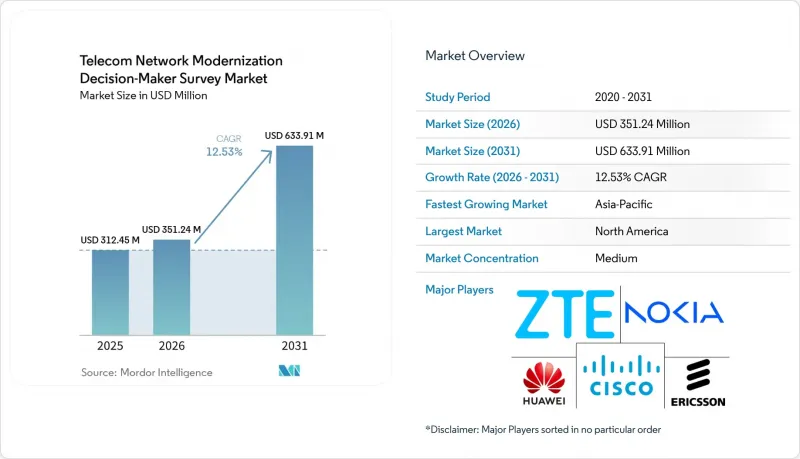
本報告按組件(例如,調查設計和問卷程式設計)、網路域(例如,無線接取網路、核心網路)、部署模式(本地部署、雲端部署、混合部署)、組織類型(例如,一級行動網路營運商)和地區進行細分。市場預測以貨幣價值(美元)表示。
全球電信網路現代化決策者調查:市場趨勢與洞察
5G獨立組網與5G-Advanced的投資決策
商用5G獨立組網(SA)服務的部署正在推動電信網路現代化決策者研究市場的發展,因為每個專案都帶來了新的技術和供應商挑戰。根據美國總務署(GSA)的記錄,截至2026年3月,全球已推出392項商用5G服務,其中95項為5G獨立網路(SA)服務,另有35家業者正在投資5G-Advanced。採購負責人需要了解同業在核心網路升級、自動化、頻段利用和供應商評估方面的進展順序。 2026年3月,AT&T宣布了一項為期五年、投資2,500億美元的美國基礎設施投資計劃,涵蓋光纖、5G和人工智慧驅動的營運。這項支出將持續為研究機構帶來可追溯的採購決策。目前的研究小組需要區分正式的服務發布與後續的核心網路遷移、營運利用和合約供應商工作。
降低多廠商網路的複雜性和營運成本
多廠商網路使得對採購、介面、營運成本以及跨網路域的責任分類進行研究變得尤為必要。電信業者必須權衡廠商多樣性與整合設備、軟體和管理系統所需的工作量。 AT&T報告稱,透過實施人工智慧,每年可節省超過10億美元的營運成本,凸顯了自動化方案相關證據的重要性。研究應綜合考慮無線存取網(RAN)、核心網、營運支撐系統/業務支撐系統(OSS/BSS)以及營運優先級,而不是孤立地審視每個決策。與高階主管進行多次訪談有助於了解在實施問題出現後,該策略是否仍保持穩定。電信網路現代化決策者調查只有在能夠清楚區分既定計畫和以實際數據為支撐的營運模式時,才能發揮最大效用。
遺留OSS/BSS技術債務與遷移風險
傳統的OSS/BSS環境會延緩現代化決策,因為電信團隊必須管理分散的系統和成本高昂的遷移。這種限制使得受訪者難以在多個技術項目中確定企業優先事項。根據愛立信和IDC預測,2025年至2028年間,與OSS/BSS相關的資本支出可能達到2,110億美元,其中66%的受訪者表示需要對數據系統進行額外投資。這種壓力可能導致受訪者的回答反映的是尚未解決的預算衝突,而非明確的技術選擇。此外,當對特定功能的需求取決於資料或整合專案的延遲時,調查結果的解讀也會變得複雜。調查需要區分計劃中的架構變更和因遷移風險而推遲的決策。
細分市場分析
到2025年,資料收集和樣本組管理將佔電信網路現代化決策者調查市場31.12%的佔有率,這反映了它們在獲取相關高階決策者回饋方面的重要作用。一個可靠的樣本組需要合適的受訪者職位、涵蓋整個組織的廣泛範圍以及對個人回答的仔細檢驗。這些因素至關重要,因為一級電信業者的技術領導者提供的資訊可能與匿名線上參與者的資訊有本質差異。調查設計和調查問卷開發與樣本組管理密切相關,因為問題必須反映供應商和網路領域選擇的演變。電信網路現代化決策者調查市場依賴這項工作來確保調查結果準確反映實際的決策流程,而不是泛泛的技術利益。
預計到2031年,儀錶板、基準測試和諮詢服務產出將以12.61%的複合年成長率成長,在所有組成部分中增速最高。客戶越來越希望透過同業比較來輔助採購、投資規劃和供應商談判。與定期報告中的孤立結果相比,目前的儀表板可以提供特定電信業者群體的持續觀點。當調查涵蓋不同規模、地理和發展階段的營運商時,資料處理、加權和匯總的重要性也隨之增加。電信網路現代化決策者調查市場可以透過應用高度透明的方法,並在不誇大受訪者有限證據的情況下提供可比較的成果,來滿足這一需求。
2025年,無線接取網路(RAN)在通訊網路現代化決策者調查市場中佔據38.14%的佔有率。 RAN專案涉及廣泛的決策,包括天線配置、開放式去程傳輸規性、無線平台和AI-RAN藍圖。這些選擇對許多5G投資計畫仍然至關重要,因為它們會影響覆蓋範圍、容量和供應商關係。愛立信宣布計劃在2026年底推出160款支援Open-RAN的成熟無線模組,這反映了相容RAN選項的重要性日益成長。通訊網路現代化決策者調查市場可以幫助客戶比較哪些RAN需求已納入正式採購標準,哪些仍在考慮中。
預計到2031年,OSS/BSS和服務編配將以12.73%的複合年成長率成長,成為網路領域成長最快的領域。隨著5G獨立組網和人工智慧相關應用場景加速營運決策,營運商需要更強大的服務管理和編配能力。向5G獨立組網的過渡影響核心網規劃,而傳輸決策則著眼於日益成長的資料中心連接需求。 KDDI已承諾在三個會計年度內投入1.2兆日圓(約74.4億美元)用於其「Power-to-Connect 2028」計劃,該計劃涵蓋低延遲傳輸、人工智慧資料中心基礎設施和衛星地面站。邊緣網路、專用無線網路和非地面電波網路領域的活動,使得企業用戶也成為該研究計畫必須關注的現代化決策者群體。
區域分析
2025年,北美在電信網路現代化決策者調查市場中佔據34.12%的佔有率。該地區聚集了許多一級運營商,他們擁有充足的資源和積極的現代化計畫。 2026年3月,AT&T宣布了一項為期五年、總額達2,500億美元的投資計劃,用於光纖、5G和人工智慧驅動的營運。這些項目正在影響架構、供應商、軟體和營運模式等方面的決策。因此,北美地區對調查的需求主要源於營運商的大量投入,以及他們需要將進展與同行進行比較。
預計到2031年,亞太地區的複合年成長率將達到13.14%,在所有地區中成長最高。日本、韓國、印度和中國的投資模式和決策環境各不相同。 NTT Docomo已設定2026會計年度資本支出目標為8,570億日圓(約53.7億美元),並於2026年7月開始商用部署愛立信的新一代無線接取網路(RAN)運算平台。 KDDI決定在三個會計年度內投資1.2兆日圓(約74.4億美元),用於低延遲傳輸、人工智慧資料中心和衛星地面站建置。在電信網路現代化決策者調查市場中,由於該地區的技術普及程度、語言和供應商格局存在顯著差異,因此需要進行針對特定國家的小組調查。
2025年,歐洲佔了相當大的市場佔有率,其研發需求受到供應商多元化、產業重組和資料主權等因素的影響。 2026年2月,MasOrange與愛立信簽署了一份為期六年的契約,將四個IMS平台和兩個傳統5G核心網整合到一個統一的5G獨立組網架構中。英國維持了2030年35%的開放式無線接取網路(Open RAN)流量目標,並在2026年修訂了其通訊安全法規。南美洲、中東和非洲的採購活動規模較小,但呈現成長趨勢。 2025年,愛立信與阿拉伯聯合大公國電信(e&UAE)達成協議,將利用雲端原生技術對該業者的5G核心網路進行現代化改造。
其他好處:
- Excel格式的市場預測(ME)表
- 3個月的分析師支持
目錄
第1章:引言
- 研究假設和市場定義
- 調查範圍
第2章:調查方法
第3章執行摘要
第4章 市場狀況
- 市場概覽
- 市場促進因素
- 5G獨立組網與5G-Advanced的投資決策
- 降低多廠商網路的複雜性和營運成本 (OPEX)
- 核心系統和邊緣系統的雲端原生現代化
- 人工智慧驅動的封閉回路型網路運行
- 開放式無線接取網路和供應商多元化的要求
- AI RAN 和即時網路資料的要求
- 市場限制因素
- 遺留OSS/BSS技術債務與遷移風險
- 互通性和整合複雜性
- 網路安全、資料主權和人工智慧管治相關的風險
- 缺乏雲端原生通訊技術的技能
- 宏觀經濟因素對市場的影響
- 產業價值鏈分析
- 科技趨勢
- 監理情勢
- 波特五力分析
第5章 市場規模與成長預測
- 按組件
- 調查設計和調查問卷編制
- 資料收集和樣本管理
- 資料處理、加權和聚合
- 儀錶板、基準測試和諮詢服務成果
- 透過網路域
- 無線接取網路
- 核心網路
- 傳輸網路和光纖網路
- OSS/BSS 和服務編配
- 邊緣網路、專用無線電網路和非地面電波網路
- 部署模式
- 現場
- 雲
- 混合
- 按組織類型
- 一級行動網路營運商
- 二線和三線行動網路營運商
- 固定線路運營商和融合運營商
- 中立主機提供商
- 私有網路的所有者
- 按地區
- 北美洲
- 美國
- 加拿大
- 墨西哥
- 南美洲
- 巴西
- 阿根廷
- 智利
- 其他南美國家
- 歐洲
- 德國
- 英國
- 法國
- 義大利
- 西班牙
- 其他歐洲國家
- 亞太地區
- 中國
- 日本
- 印度
- 韓國
- 澳洲
- 其他亞太國家
- 中東
- 阿拉伯聯合大公國
- 沙烏地阿拉伯
- 卡達
- 其他中東國家
- 非洲
- 南非
- 埃及
- 奈及利亞
- 其他非洲國家
- 北美洲
第6章 競爭情勢
- 市場集中度
- 策略趨勢
- 市佔率分析
- 公司簡介
- Huawei Technologies Co., Ltd.
- Telefonaktiebolaget LM Ericsson
- Nokia Corporation
- ZTE Corporation
- Samsung Electronics Co., Ltd.
- Cisco Systems, Inc.
- Ciena Corporation
- NEC Corporation
- Fujitsu Limited
- Juniper Networks, Inc.
- ADTRAN Holdings, Inc.
- Ribbon Communications Inc.
- Aviat Networks, Inc.
- Airspan Networks Inc.
- Mavenir Systems, Inc.
- Parallel Wireless, Inc.
- Baicells Technologies Co., Ltd.
- Sercomm Corporation
- Cambium Networks Corporation
- DZS Inc.
- HFCL Limited
- Radisys Corporation
- Ekinops SA
- Ribbon Communications Inc.
- Sterlite Technologies Limited
第7章 市場機會與未來展望
According to Mordor Intelligence, the telecom network modernization decision-Maker survey market size was valued at USD 312.45 million in 2025 and is estimated to grow from USD 351.24 million in 2026 to reach USD 633.91 million by 2031, at a CAGR of 12.53% during the forecast period (2026-2031).
This report is Segmented by Component (Survey Design and Questionnaire Programming, and More), Network Domain (Radio Access Network, Core Network, and More), Deployment Model (On-Premises, Cloud, and Hybrid), Organization Type (Tier-1 Mobile Network Operators, and More), and Geography. The Market Forecasts are Provided in Terms of Value (USD).
Global Telecom Network Modernization Decision-Maker Survey Market Trends and Insights
5G Standalone and 5G-Advanced Investment Decisions
Commercial 5G Standalone activity supports the Telecom Network Modernization Decision-Maker Survey Market, as each program introduces new technology and supplier questions. GSA recorded 392 commercial 5G launches worldwide by March 2026, including 95 5G Standalone launches and 35 operators investing in 5G-Advanced. Buyers need to understand how peers sequence core upgrades, automation, spectrum use, and vendor evaluations. AT&T announced a USD 250 billion, 5-year U.S. infrastructure investment plan in March 2026 covering fiber, 5G, and AI-enabled operations. This spending creates a continuing flow of procurement decisions that survey providers can track. Current panels must distinguish a formal launch from subsequent core migration, operational use, and contracted supplier work.
Multi-Vendor Network Complexity and Operating Cost Reduction
Multi-vendor networks create research demand around sourcing, interfaces, operating costs, and accountability across network domains. Operators must weigh supplier diversity against the effort required to integrate equipment, software, and management systems. AT&T reported more than USD 1 billion in annualized operating cost savings from AI deployment, reinforcing the need for evidence on automation choices. Research must connect RAN, core, OSS/BSS, and operational priorities rather than consider each decision separately. Repeated interviews with senior respondents can show whether a strategy remains stable after implementation issues emerge. The Telecom Network Modernization Decision-Maker Survey Market is most useful when it distinguishes stated plans from operating models supported by performance evidence.
Legacy OSS/BSS Technical Debt and Migration Risk
Legacy OSS/BSS environments slow modernization decisions because operator teams must manage fragmented systems and costly migrations. The constraint can make it harder for respondents to identify a firm's priorities across multiple technology programs. Ericsson and IDC reported that OSS/BSS-related capital expenditure could reach USD 211 billion between 2025 and 2028, and 66% of respondents cited a need for additional data-system investment. This pressure can produce responses that reflect unresolved budget conflicts rather than committed technology choices. It also complicates survey interpretation when interest in a capability depends on a delayed data or integration project. Research must separate planned architectural changes from decisions deferred due to migration risk.
Other drivers and restraints analyzed in the detailed report include:
- Cloud-Native Core and Edge Modernization
- AI-Enabled Closed-Loop Network Operations
- Interoperability and Integration Complexity
For complete list of drivers and restraints, kindly check the Table Of Contents.
Segment Analysis
Data Collection and Panel Management held 31.12% of the Telecom Network Modernization Decision-Maker Survey Market share in 2025, reflecting its role in obtaining responses from relevant senior decision-makers. A reliable panel requires suitable respondent seniority, broad organization coverage, and careful validation of individual responses. These factors remain important because a Tier-1 operator technology leader can provide materially different evidence from that of an anonymous online participant. Survey Design and questionnaire programming remain closely connected to panel management because questions must reflect evolving choices across suppliers and network domains. The Telecom Network Modernization Decision-Maker Survey Market depends on this work to ensure that findings describe actual decision processes rather than broad technology interest.
Dashboard, Benchmarking, and Advisory Outputs are forecast to grow at a 12.61% CAGR through 2031, the fastest rate among components. Clients increasingly require peer comparisons for use in procurement, investment planning, and supplier discussions. Current dashboards can provide repeated views of a defined group of operators, rather than isolated results from periodic reports. Data Processing, Weighting, and Tabulation also become more important when research includes differing operator sizes, geographies, and maturity levels. The Telecom Network Modernization Decision-Maker Survey Market can serve this need by applying transparent methods and presenting comparable outputs without overstating the limited evidence from respondents.
Radio Access Network held 38.14% of the Telecom Network Modernization Decision-Maker Survey Market share in 2025. RAN programs generate a wide range of decisions involving antenna configurations, Open Fronthaul compliance, radio platforms, and AI-RAN roadmaps. These choices remain central to many 5G investment plans because they affect coverage, capacity, and supplier relationships. Ericsson stated that it targeted 160 Open-RAN-proven radio models by the end of 2026, reflecting the continuing importance of compatible RAN options. The Telecom Network Modernization Decision-Maker Survey Market can help clients compare which RAN requirements have entered formal procurement criteria and which remain exploratory.
OSS/BSS and Service Orchestration are forecast to grow at a 12.73% CAGR through 2031, making it the fastest-growing network domain. Operators need service management and orchestration capabilities as 5G Standalone and AI-related use cases increase the pace of operational decisions. The move to 5G Standalone also shapes Core Network programs, while transport decisions respond to growing data-center connectivity needs. KDDI committed JPY 1.2 trillion (USD 7.44 billion) over 3 fiscal years to its Power-to-Connect 2028 plan, covering low-latency transport, AI data center infrastructure, and satellite ground stations. Edge, private wireless, and non-terrestrial network activity adds enterprise users to the set of modernization decision-makers that research programs must address.
Complete Report Scope:
- By Component
- Survey Design and Questionnaire Programming
- Data Collection and Panel Management
- Data Processing, Weighting, and Tabulation
- Dashboard, Benchmarking, and Advisory Outputs
- By Network Domain
- Radio Access Network
- Core Network
- Transport and Optical Network
- OSS/BSS and Service Orchestration
- Edge, Private Wireless, and Non-Terrestrial Networks
- By Deployment Model
- On-Premises
- Cloud
- Hybrid
- By Organization Type
- Tier-1 Mobile Network Operators
- Tier-2 and Tier-3 Mobile Network Operators
- Fixed and Converged Operators
- Neutral Host Providers
- Private Network Owners
- By Geography
- North America
- United States
- Canada
- Mexico
- South America
- Brazil
- Argentina
- Chile
- Rest of South America
- Europe
- Germany
- United Kingdom
- France
- Italy
- Spain
- Rest of Europe
- Asia-Pacific
- China
- Japan
- India
- South Korea
- Australia
- Rest of Asia-Pacific
- Middle East
- United Arab Emirates
- Saudi Arabia
- Qatar
- Rest of Middle East
- Africa
- South Africa
- Egypt
- Nigeria
- Rest of Africa
- North America
Geography Analysis
North America held 34.12% of the Telecom Network Modernization Decision-Maker Survey Market share in 2025. The region has a high concentration of well-funded Tier-1 operators with active modernization plans. AT&T announced a USD 250 billion, 5-year investment plan in March 2026 for fiber, 5G, and AI-enabled operations. These programs create decisions across architecture, suppliers, software, and operating models. North American survey demand is therefore supported by the depth of operator spending and the need to compare progress against peers.
Asia-Pacific is forecast to grow at a 13.14% CAGR through 2031, the fastest regional rate. Japan, South Korea, India, and China each contribute different investment patterns and decision contexts. NTT DOCOMO targeted JPY 857 billion (USD 5.37 billion) in capital expenditure for FY2026 and began commercial deployment of Ericsson's next-generation RAN Compute platform in July 2026. KDDI committed JPY 1.2 trillion (USD 7.44 billion) across 3 fiscal years for low-latency transport, AI data centers, and satellite ground stations. The Telecom Network Modernization Decision-Maker Survey Market needs country-specific panels in this region because technology deployment, language, and vendor conditions vary substantially.
Europe held a significant share in 2025, with research demand shaped by supplier diversification, consolidation, and data sovereignty. MasOrange signed a 6-year agreement with Ericsson in February 2026 to consolidate 4 IMS platforms and 2 legacy 5G cores into a unified 5G Standalone architecture. The United Kingdom retained a 35% Open RAN traffic target for 2030 and updated its telecommunications security code in 2026. South America, the Middle East, and Africa are smaller but expanding areas for procurement activity. Ericsson and e& UAE agreed in 2025 to modernize the operator's 5G Core with cloud-native technologies.
- Huawei Technologies Co., Ltd.
- Telefonaktiebolaget LM Ericsson
- Nokia Corporation
- ZTE Corporation
- Samsung Electronics Co., Ltd.
- Cisco Systems, Inc.
- Ciena Corporation
- NEC Corporation
- Fujitsu Limited
- Juniper Networks, Inc.
- ADTRAN Holdings, Inc.
- Ribbon Communications Inc.
- Aviat Networks, Inc.
- Airspan Networks Inc.
- Mavenir Systems, Inc.
- Parallel Wireless, Inc.
- Baicells Technologies Co., Ltd.
- Sercomm Corporation
- Cambium Networks Corporation
- DZS Inc.
- HFCL Limited
- Radisys Corporation
- Ekinops S.A.
- Ribbon Communications Inc.
- Sterlite Technologies Limited
Additional Benefits:
- The market estimate (ME) sheet in Excel format
- 3 months of analyst support
TABLE OF CONTENTS
1 INTRODUCTION
- 1.1 Study Assumptions and Market Definition
- 1.2 Scope of the Study
2 RESEARCH METHODOLOGY
3 EXECUTIVE SUMMARY
4 MARKET LANDSCAPE
- 4.1 Market Overview
- 4.2 Market Drivers
- 4.2.1 5G Standalone and 5G-Advanced Investment Decisions
- 4.2.2 Multi-Vendor Network Complexity and Opex Reduction
- 4.2.3 Cloud-Native Core and Edge Modernization
- 4.2.4 AI-Enabled Closed-Loop Network Operations
- 4.2.5 Open RAN and Supplier Diversification Mandates
- 4.2.6 AI RAN and Real-Time Network Data Requirements
- 4.3 Market Restraints
- 4.3.1 Legacy OSS/BSS Technical Debt and Migration Risk
- 4.3.2 Interoperability and Integration Complexity
- 4.3.3 Cybersecurity, Data Sovereignty, and AI Governance Exposure
- 4.3.4 Shortage of Cloud-Native Telecom Skills
- 4.4 Impact of Macroeconomic Factors on the Market
- 4.5 Industry Value-Chain Analysis
- 4.6 Technology Outlook
- 4.7 Regulatory Landscape
- 4.8 Porter's Five Forces Analysis
- 4.8.1 Threat of New Entrants
- 4.8.2 Bargaining Power of Suppliers
- 4.8.3 Bargaining Power of Buyers
- 4.8.4 Threat of Substitutes
- 4.8.5 Intensity of Competitive Rivalry
5 MARKET SIZE AND GROWTH FORECASTS (VALUE)
- 5.1 By Component
- 5.1.1 Survey Design and Questionnaire Programming
- 5.1.2 Data Collection and Panel Management
- 5.1.3 Data Processing, Weighting, and Tabulation
- 5.1.4 Dashboard, Benchmarking, and Advisory Outputs
- 5.2 By Network Domain
- 5.2.1 Radio Access Network
- 5.2.2 Core Network
- 5.2.3 Transport and Optical Network
- 5.2.4 OSS/BSS and Service Orchestration
- 5.2.5 Edge, Private Wireless, and Non-Terrestrial Networks
- 5.3 By Deployment Model
- 5.3.1 On-Premises
- 5.3.2 Cloud
- 5.3.3 Hybrid
- 5.4 By Organization Type
- 5.4.1 Tier-1 Mobile Network Operators
- 5.4.2 Tier-2 and Tier-3 Mobile Network Operators
- 5.4.3 Fixed and Converged Operators
- 5.4.4 Neutral Host Providers
- 5.4.5 Private Network Owners
- 5.5 By Geography
- 5.5.1 North America
- 5.5.1.1 United States
- 5.5.1.2 Canada
- 5.5.1.3 Mexico
- 5.5.2 South America
- 5.5.2.1 Brazil
- 5.5.2.2 Argentina
- 5.5.2.3 Chile
- 5.5.2.4 Rest of South America
- 5.5.3 Europe
- 5.5.3.1 Germany
- 5.5.3.2 United Kingdom
- 5.5.3.3 France
- 5.5.3.4 Italy
- 5.5.3.5 Spain
- 5.5.3.6 Rest of Europe
- 5.5.4 Asia-Pacific
- 5.5.4.1 China
- 5.5.4.2 Japan
- 5.5.4.3 India
- 5.5.4.4 South Korea
- 5.5.4.5 Australia
- 5.5.4.6 Rest of Asia-Pacific
- 5.5.5 Middle East
- 5.5.5.1 United Arab Emirates
- 5.5.5.2 Saudi Arabia
- 5.5.5.3 Qatar
- 5.5.5.4 Rest of Middle East
- 5.5.6 Africa
- 5.5.6.1 South Africa
- 5.5.6.2 Egypt
- 5.5.6.3 Nigeria
- 5.5.6.4 Rest of Africa
- 5.5.1 North America
6 COMPETITIVE LANDSCAPE
- 6.1 Market Concentration
- 6.2 Strategic Moves
- 6.3 Market Share Analysis
- 6.4 Company Profiles (includes Global Level Overview, Market Level Overview, Core Segments, Financials as available, Strategic Information, Market Rank/Share, Products and Services, Recent Developments)
- 6.4.1 Huawei Technologies Co., Ltd.
- 6.4.2 Telefonaktiebolaget LM Ericsson
- 6.4.3 Nokia Corporation
- 6.4.4 ZTE Corporation
- 6.4.5 Samsung Electronics Co., Ltd.
- 6.4.6 Cisco Systems, Inc.
- 6.4.7 Ciena Corporation
- 6.4.8 NEC Corporation
- 6.4.9 Fujitsu Limited
- 6.4.10 Juniper Networks, Inc.
- 6.4.11 ADTRAN Holdings, Inc.
- 6.4.12 Ribbon Communications Inc.
- 6.4.13 Aviat Networks, Inc.
- 6.4.14 Airspan Networks Inc.
- 6.4.15 Mavenir Systems, Inc.
- 6.4.16 Parallel Wireless, Inc.
- 6.4.17 Baicells Technologies Co., Ltd.
- 6.4.18 Sercomm Corporation
- 6.4.19 Cambium Networks Corporation
- 6.4.20 DZS Inc.
- 6.4.21 HFCL Limited
- 6.4.22 Radisys Corporation
- 6.4.23 Ekinops S.A.
- 6.4.24 Ribbon Communications Inc.
- 6.4.25 Sterlite Technologies Limited
7 MARKET OPPORTUNITIES AND FUTURE OUTLOOK
- 7.1 White-Space and Unmet-Need Assessment

 應用現代化服務市場:全球預測,2026-2032年
 應用現代化服務市場:按部署類型、服務類型、企業規模、產業、國家和地區分類-產業分析、市場規模、市場佔有率和預測(2026-2033 年)
 應用現代化服務市場 - 全球產業規模、佔有率、趨勢、機會、預測(按服務、產業垂直領域、部署類型、地區和競爭格局分類,2021-2031 年)
 2026年全球應用開發與現代化市場報告
 全球應用現代化服務市場規模、佔有率、趨勢和成長分析報告(2026-2034)2026年全球大型主機現代化市場報告2026年全球舊有應用程式現代化市場報告2026年全球應用現代化服務市場報告
 應用現代化系統整合商市場規模、佔有率和成長分析:按現代化類型、部署模式、組織規模、最終用戶和地區分類 - 2026-2033 年行業預測
 2026-2030年全球應用現代化服務市場