


 |
市場調查報告書
商品編碼
2119337
能源產業行銷服務:市場佔有率分析、產業趨勢與統計、成長預測(2026-2031 年)Energy Sector Marketing Services - Market Share Analysis, Industry Trends & Statistics, Growth Forecasts (2026 - 2031) |
||||||

※ 本網頁內容可能與最新版本有所差異。詳細情況請與我們聯繫。
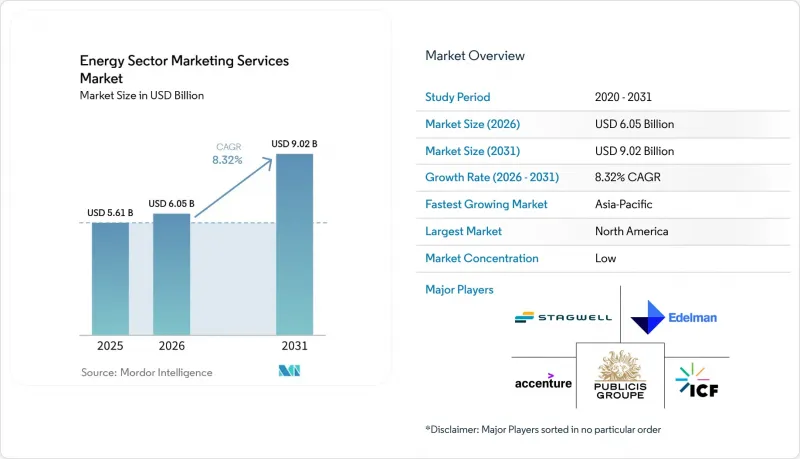
據 Mordor Intelligence 稱,2025 年能源產業行銷服務的市場規模為 56.1 億美元,預計將從 2026 年的 60.5 億美元成長到 2031 年的 90.2 億美元。
預計 2026 年至 2031 年的預測期內複合年成長率為 8.32%。
本報告按服務類型(品牌策略與定位、創新內容製作、電子郵件生命週期行銷、活動與體驗式行銷、公共關係與傳播、社群媒體行銷、相關人員與社群互動)和地區(北美、南美及其他地區)進行分類。市場預測以美元計價。
全球能源產業行銷服務市場的趨勢與洞察。
電網現代化和能源轉型支出增加正在推動對專業故事敘述的需求。
隨著對電網和能源轉型方面的投資不斷增加,溝通已成為公共產業公司和開發商營運中更為核心的需求。淨零排放聯盟的成員公共產業已宣布計劃在未來幾年內調動大規模轉型投資,其重點將更多地放在電網和儲能而非可再生能源發電上。這種轉變導致需要解釋成本、進度、可靠性、社區影響和預期客戶收益的專案數量不斷增加。能源溝通的範圍也從一般消費者擴展到監管機構、政策制定者、土地所有者、投資者和當地社區。隨著有關授權、定價合理性和輸電走廊的溝通從單一項目轉向多年期項目,能源產業的行銷服務市場將從中受益。
隨著公共產業不斷改變其客戶體驗,對以客戶體驗主導的互動計畫的需求也日益成長。
隨著公共產業日益將數位化互動視為監管和服務績效的一項挑戰,而非僅僅是輔助性的客戶服務功能,能源產業的行銷服務市場正在蓬勃發展。隨著家庭能源成本的不斷上漲,客戶對公用事業公司在基礎設施規劃、服務可靠性、支付支援以及專案資金來源等方面的解釋也越來越挑剔。公共產業需要以簡單易懂的語言解釋投資項目,闡明客戶的潛在行動,並幫助家庭了解現有服務。利用數位化管道可以將停電資訊、支付支援、能源效率、電氣化專案和帳戶指導整合到一致的客戶體驗流程中,避免各公共產業內部不同團隊傳遞無關訊息。這種需求推動了能源產業行銷服務市場的發展,因為公共產業通常需要協助協調客戶數據、內容、媒體、客服中心資訊和多通路推廣活動,同時也要確保訊息的準確性。了解公共產業核准流程的服務提供者可以將他們的專案溝通與參與率和滿意度指標掛鉤,這些指標在監管程序中至關重要。這使得他們的努力比一次性的促銷宣傳活動更具永續性。
綠色清洗將增加審查成本和批准聲明所需的時間。
能源產業行銷服務市場面臨更多挑戰,因為包含環境聲明的宣傳活動在發布前需要進一步的法律審查並提交證據。歐盟指令2024/825要求歐盟成員國在2026年3月前將相關規定納入本國法律,並於2026年9月全面生效。由於該指令限制了未經公認檢驗的績效支持的一般性環境聲明,因此各機構必須考慮措辭、支持性記錄以及主要讀者的背景是否合理。歐盟委員會於2026年5月更新了相關指南,增加了與企業對企業(B2B)溝通相關的解釋。如果證據不完整、審查責任不明確或聲明需要在後續流程中修改,這些規定可能會導致核准週期延長、文件工作量增加以及宣傳活動啟動延遲。雖然客戶推遲或縮減宣傳活動可能會對能源產業行銷服務市場構成限制,但也提升了擁有正式檢驗流程和完善的核准管理方法的供應商的價值。
細分市場分析
到2025年,品牌策略和定位將佔據能源產業行銷服務市場27.61%的佔有率。這一定位反映了能源公司需要向監管機構、機構投資者、社區和客戶傳達一致的訊息,即使每個相關利益者關注的是同一投資計劃的不同方面。基礎設施計畫可能包括擴大電價計算標準、選擇離岸風力發電和輸電項目的位置,或延長核能發電廠的營運許可證。在每種情況下,利害關係人對成本、時間安排、可靠性、社區影響和預期收益都有不同的關注點。服務提供者需要使其對外解釋的項目與監管文件、投資者資料、客戶溝通、社區參與計劃和技術資訊保持一致,以支持其主張。因此,品牌策略與投資計劃的可信度以及公司解釋所涉及的實際權衡取捨而不造成跨管道不一致的能力密切相關。在能源產業的行銷服務領域,品牌策略遠不止於視覺呈現和廣告;它為宣傳活動、內容創作、公共關係和相關人員參與活動奠定了基礎。
社群媒體行銷預計將在2026年至2031年間以9.22%的複合年成長率成長,成為所列服務中成長最快的領域。能源產業對這項服務的市場規模成長主要源於其對快速回應公眾輿論、並透過及時、易懂且相關的平台專屬內容觸達特定客戶群的需求。公共產業可以利用社交管道與電動車車主、需量反應目標客戶以及尋求支援資訊的家庭進行溝通,同時還能解答在專案和服務活動期間或公眾高度關注時期出現的問題。雖然以技術為中心的內容能夠幫助能源公司用簡單易懂的語言解釋複雜的項目,但與其他任何宣傳活動材料一樣,平台上的內容也需接受有關環境方面的審查,因此必須有證據支持。創新與內容製作部門透過為監管機構提供詳細文件和為數位用戶製作簡短內容來支持這項計劃;而公共關係與傳播部門、相關人員與社區參與部門、電子郵件與生命週期行銷部門以及活動與體驗式行銷部門則為授權、客戶旅程、投資者簡報和行業活動提供支持。在能源產業的行銷服務領域,一種日益成長的趨勢是圍繞相互關聯的方法而非單一的宣傳活動管道來組織服務,因為客戶和相關人員在形成對公司和專案的看法之前,通常會從多個資訊來源收集資訊。
區域分析
到2025年,北美將佔據全球能源產業行銷服務市場的46.80%。美國透過持續推動電網現代化、需求面管理專案以及需要與多個相關人員進行清晰溝通的客戶體驗提升計劃,保持著這一領先地位。在預測期內,私營電力公司預計將在電網現代化方面投入大量資金。第一能源公司宣布了一項重大資本計劃,其中包括對其電網的大規模投資。此類資本計畫帶來了對客戶資料、電網公共關係、專案參與活動以及與監管機構、土地所有者和投資者合作的持續需求。在加拿大,離岸風力發電的公共關係需求也隨之增加;而在墨西哥,分散式太陽能發電和電氣化專案的行銷也發揮著重要作用。
歐洲是能源產業行銷服務市場第二大區域,並受到最嚴格的環境聲明要求約束。將於2026年9月生效的「賦權消費者」法規,使得證據審查在永續性相關宣傳活動規劃中至關重要。 2026年7月,歐盟委員會發布了一套工具包,旨在幫助成員國促進公民參與可再生能源項目,並更加重視社區參與項目規劃和授權。德國電網擴建計畫和英國離岸風力發電計畫凸顯了與社區和投資者溝通的必要性,而巴西和智利則為南美開發人員提供了相關的第一代品牌推廣服務。
預計到2031年,亞太地區將以9.31%的複合年成長率成長,成為能源產業行銷服務市場成長最快的地區。印度計劃在2030年實現500吉瓦的非石化燃料發電裝置容量,這使得跨邦和跨語言群體的溝通變得特別重要。同時,該地區龐大的數位用戶群體為專案宣傳、意識提升活動和品牌建立提供了支持。一項針對東亞和亞太地區10個國家和地區的2026年調查顯示,社群媒體參與正在影響住宅的能源使用行為。在日本和韓國,隨著綜合能源公司重組其傳統的石化燃料資產組合,投資人溝通變得特別重要。另一方面,中東和非洲在能源多元化和參與獨立發電工程仍處於起步階段。
其他好處:
- Excel格式的市場預測(ME)表
- 3個月的分析師支持
目錄
第1章:引言
- 研究假設和市場定義
- 調查範圍
第2章:調查方法
第3章執行摘要
第4章 市場狀況
- 市場概覽
- 市場促進因素
- 電網現代化和能源轉型支出增加,使得對專業故事敘述的需求日益成長。
- 公共產業對客戶體驗的根本性重新思考,正在推動對以旅程主導的互動項目的需求。
- 隨著需量反應和參與電氣化項目的增加,效果行銷和宣傳活動將成為必要之舉。
- 講述永續發展和轉型的故事是與投資者和當地社區建立信任的核心。
- 生成式搜尋可見性正成為能源品牌新的採購安全隔離網閘。
- 獲得許可所需的時間越來越取決於建立社區信任的機制以及傳播有關益處的信息。
- 市場限制因素
- 為打擊「綠色清洗」行為而製定的更嚴格的法規增加了審查成本和批准聲明所需的時間。
- 銷售週期延長以及採購委員會中多個相關人員的參與,正在延緩分銷商實現利潤。
- 公共產業部門表現不佳和數位基礎設施不足,正在降低個人化投資的回報。
- 當地民眾的反對以及訴訟風險可能會阻礙目前正在訴訟中的項目的相關宣傳活動。
- 產業價值鏈分析
- 監理情勢
- 宏觀經濟因素對市場的影響
- 技術展望
- 波特五力分析
第5章 市場規模與成長預測
- 按服務類型
- 品牌策略與定位
- 創新和內容創作
- 電子郵件和生命週期行銷
- 活動和體驗式行銷
- 公共關係與傳播
- 社群媒體行銷
- 與相關人員和社區的互動
- 按地區
- 北美洲
- 美國
- 加拿大
- 墨西哥
- 南美洲
- 巴西
- 阿根廷
- 智利
- 哥倫比亞
- 其他南美國家
- 歐洲
- 英國
- 德國
- 法國
- 義大利
- 西班牙
- 北歐的
- 俄羅斯
- 其他歐洲國家
- 亞太地區
- 中國
- 日本
- 印度
- 澳洲
- 韓國
- 東南亞
- 其他亞太國家
- 中東
- 沙烏地阿拉伯
- 阿拉伯聯合大公國
- 卡達
- 以色列
- 土耳其
- 其他中東國家
- 非洲
- 南非
- 奈及利亞
- 埃及
- 其他非洲國家
- 北美洲
第6章 競爭情勢
- 市場集中度
- 策略趨勢
- 市佔率分析
- 公司簡介
- Accenture plc
- ICF International, Inc.
- Publicis Groupe SA
- Stagwell Inc.
- Edelman, Inc.
- APCO Worldwide LLC
- FTI Consulting, Inc.
- Brunswick Group LLP
- Borshoff, LLC
- Communications Strategy Group, Inc.
- Lee Andrews Group, Inc.
- Copper Consultancy Ltd
- Freshfield Communications Ltd
- Motion Marketing Ltd
- Tamarindo Group
- KEEWest Associates
- Silverline Communications
- 97th Floor LLC
第7章 市場機會與未來展望
According to Mordor Intelligence, the energy sector marketing services market size was valued at USD 5.61 billion in 2025 and estimated to expand from USD 6.05 billion in 2026 to reach USD 9.02 billion by 2031, at a CAGR of 8.32% during the forecast period 2026-2031.
This report is Segmented by Service Type (Brand Strategy and Positioning, Creative and Content Production, Email and Lifecycle Marketing, Events and Experiential Marketing, Public Relations and Communications, Social Media Marketing, and Stakeholder and Community Engagement) and Geography (North America, South America, and More). The Market Forecasts are Provided in Terms of Value (USD).
Global Energy Sector Marketing Services Market Trends and Insights
Grid Modernization and Energy Transition Spending Expands Need for Specialized Narratives
Grid and energy transition spending is making communications a more central operating requirement for utilities and developers. Utilities for the Net Zero Alliance members announced plans to mobilize substantial transition investment over the coming years. Their planned spending places greater emphasis on grids and storage than on renewable generation. The change increases the number of projects that require an explanation of costs, timing, reliability, local effects, and expected customer benefits. It also broadens the audience for energy communications beyond retail customers to include regulators, policymakers, landowners, investors, and local communities. The Energy Sector Marketing Services Market benefits when permitting, rate-case support, and transmission-corridor communication shift from isolated projects to multi-year programs.
Utilities' Customer Experience Overhaul Raises Demand for Journey-Led Engagement Programs
The Energy Sector Marketing Services Market is supported as utilities are treating digital engagement as a regulatory and service-performance issue rather than a secondary customer service feature. Rising household energy costs have increased customer scrutiny of infrastructure plans, service reliability, payment support, and utility explanations of why a program is being funded. Organizations need communication that explains investment programs in plain language, identifies the customer action that may be required, and helps households understand the services already available to them. Digital channels also provide a way to connect outage information, payment support, energy efficiency, electrification programs, and account guidance within a consistent customer journey instead of delivering unrelated messages from separate utility teams. This need supports the Energy Sector Marketing Services Market because utilities often require help coordinating customer data, content, media, call-center information, and outreach across several channels while maintaining an approved message. Providers that understand utility approval processes can link program communications to participation and satisfaction measures that matter in regulatory proceedings, which makes the work more durable than a single promotional campaign.
Tightening Anti-Greenwashing Rules Raise Review Costs and Claim Approval Times
The Energy Sector Marketing Services Market faces added friction because campaigns that include environmental claims require more legal review and evidence before publication. Directive 2024/825 requires EU member states to transpose the rules by March 2026, and the requirements apply fully from September 2026. The directive restricts generic environmental claims when they are not supported by recognized, verifiable performance, so agencies must consider whether the wording, supporting record, and audience context are all defensible. The European Commission updated its guidance in May 2026, including clarification relevant to business-to-business communications. These rules can extend approval cycles, create more documentation work, and delay campaign launches when evidence is incomplete, review responsibilities are unclear, or claims need to be revised late in the process. They restrain the Energy Sector Marketing Services Market when clients defer or reduce campaigns, although they also increase the value of providers with formal verification processes and an established way to manage approvals.
Other drivers and restraints analyzed in the detailed report include:
- Rising Demand Response and Electrification Program Enrollment Requires Performance Marketing and Education
- Sustainability and Transition Storytelling Becomes Core to Investor and Community Trust
- Long Sales Cycles and Multi-Stakeholder Buying Committees Slow Revenue Realization for Agencies
For complete list of drivers and restraints, kindly check the Table Of Contents.
Segment Analysis
Brand Strategy and Positioning held 27.61% of the Energy Sector Marketing Services Market share in 2025. Its position reflects the need for energy companies to present consistent messages to regulators, institutional investors, communities, and customers, even when those groups focus on different elements of the same investment plan. Infrastructure plans can involve rate-base expansion, offshore wind siting, transmission projects, or nuclear license extensions, and each setting brings audiences with different concerns about costs, timing, reliability, community effects, and expected benefits. Providers must align the public explanation of a project with its regulatory record, investor materials, customer communications, community engagement plans, and the technical information that supports the claims being made. Brand work is therefore tied to the credibility of an investment plan and the company's ability to explain the practical tradeoffs involved without creating inconsistencies across channels. In the Energy Sector Marketing Services industry, it provides a foundation for campaign, content, public relations, and stakeholder engagement work, rather than acting only as a visual or advertising exercise.
Social Media Marketing is projected to expand at a 9.22% CAGR from 2026 to 2031, the fastest rate among the listed services. The Energy Sector Marketing Services Market size for this service is supported by the need to respond quickly to public discussion and reach customers through platform-native content that is timely, understandable, and relevant to a specific customer group. Utilities can use social channels to communicate with electric vehicle owners, customers eligible for demand response, and households seeking assistance information, while also addressing questions that emerge during a project, a service event, or a period of public attention. Technology-specific content gives energy companies a way to explain complex projects in accessible terms, but it must be supported by evidence because platform content can face the same environmental-claim scrutiny as other campaign materials. Creative and Content Production supports this work through detailed material for regulatory audiences and short-form content for digital audiences, while Public Relations and Communications, Stakeholder and Community Engagement, Email and Lifecycle Marketing, and Events and Experiential Marketing support permitting, customer journeys, investor meetings, and industry events. The Energy Sector Marketing Services industry is increasingly organized around connected services rather than a single campaign channel, because customers and stakeholders often receive information from several sources before they form a view of a company or project.
Complete Report Scope:
- By Service Type
- Brand Strategy and Positioning
- Creative and Content Production
- Email and Lifecycle Marketing
- Events and Experiential Marketing
- Public Relations and Communications
- Social Media Marketing
- Stakeholder and Community Engagement
- By Geography
- North America
- United States
- Canada
- Mexico
- South America
- Brazil
- Argentina
- Chile
- Colombia
- Rest of South America
- Europe
- United Kingdom
- Germany
- France
- Italy
- Spain
- Nordics
- Russia
- Rest of Europe
- Asia-Pacific
- China
- Japan
- India
- Australia
- South Korea
- Southeast Asia
- Rest of Asia-Pacific
- Middle East
- Saudi Arabia
- United Arab Emirates
- Qatar
- Israel
- Turkey
- Rest of Middle East
- Africa
- South Africa
- Nigeria
- Egypt
- Rest of Africa
- North America
Geography Analysis
North America held 46.80% of the global Energy Sector Marketing Services Market share in 2025. The United States supports this position through continued grid modernization, demand-side management programs, and customer experience initiatives that require clear explanation to several stakeholder groups. Investor-owned utilities were projected to make substantial investments in grid modernization during the forecast period. FirstEnergy announced a major capital plan, including significant transmission investment. Such capital programs create ongoing needs for customer materials, grid communications, program enrollment work, and engagement with regulators, landowners, and investors. Canada adds offshore wind communication needs, while Mexico contributes to distributed solar and electrification program marketing.
Europe was the second-largest geography and operated under the most demanding environmental claim requirements in the Energy Sector Marketing Services Market. The September 2026 application of the Empowering Consumers rules has made evidence review central to sustainability-related campaign planning. The European Commission published a July 2026 toolbox to help member states increase public participation in renewable energy projects, making community involvement more central to project planning and permitting. Germany's grid expansion and the United Kingdom's offshore wind pipeline sustain community and investor communications needs, while Brazil and Chile are creating related first-generation brand-building work for developers in South America.
Asia-Pacific is projected to expand at a 9.31% CAGR through 2031, making it the fastest-growing regional part of the Energy Sector Marketing Services Market. India's target of 500 GW of non-fossil capacity by 2030 creates communications needs across states and language groups, while the region's digital audiences support project communication, education, and brand building. A 2026 study of 10 East Asia and Pacific economies found that social media engagement influenced residential energy behavior. Japan and South Korea need investor communication as integrated energy companies reposition legacy fossil portfolios, while the Middle East and Africa remain earlier-stage areas for diversification and independent power project engagement.
- Accenture plc
- ICF International, Inc.
- Publicis Groupe S.A.
- Stagwell Inc.
- Edelman, Inc.
- APCO Worldwide LLC
- FTI Consulting, Inc.
- Brunswick Group LLP
- Borshoff, LLC
- Communications Strategy Group, Inc.
- Lee Andrews Group, Inc.
- Copper Consultancy Ltd
- Freshfield Communications Ltd
- Motion Marketing Ltd
- Tamarindo Group
- KEEWest Associates
- Silverline Communications
- 97th Floor LLC
Additional Benefits:
- The market estimate (ME) sheet in Excel format
- 3 months of analyst support
TABLE OF CONTENTS
1 INTRODUCTION
- 1.1 Study Assumptions and Market Definition
- 1.2 Scope of the Study
2 RESEARCH METHODOLOGY
3 EXECUTIVE SUMMARY
4 MARKET LANDSCAPE
- 4.1 Market Overview
- 4.2 Market Drivers
- 4.2.1 Grid Modernization and Energy Transition Spending Expands Need for Specialized Narratives
- 4.2.2 Utilities' Customer Experience Overhaul Raises Demand for Journey-Led Engagement Programs
- 4.2.3 Rising Demand Response and Electrification Program Enrollment Requires Performance Marketing and Education
- 4.2.4 Sustainability and Transition Storytelling Becomes Core to Investor and Community Trust
- 4.2.5 Generative Search Visibility Becomes a New Procurement Gatekeeper for Energy Brands
- 4.2.6 Permitting Timelines Depend Increasingly on Community Trust Architecture and Benefits Communication
- 4.3 Market Restraints
- 4.3.1 Tightening Anti-Greenwashing Rules Raise Review Costs and Claim Approval Times
- 4.3.2 Long Sales Cycles and Multi-Stakeholder Buying Committees Slow Revenue Realization for Agencies
- 4.3.3 Weak Utility Data and Digital Foundations Reduce Personalization Return on Investment
- 4.3.4 Local Opposition and Litigation Risk Can Freeze Campaigns Around Contested Projects
- 4.4 Industry Value Chain Analysis
- 4.5 Regulatory Landscape
- 4.6 Impact of Macroeconomic Factors on the Market
- 4.7 Technological Outlook
- 4.8 Porter's Five Forces Analysis
- 4.8.1 Threat of New Entrants
- 4.8.2 Bargaining Power of Buyers
- 4.8.3 Bargaining Power of Suppliers
- 4.8.4 Threat of Substitutes
- 4.8.5 Industry Rivalry
5 MARKET SIZE AND GROWTH FORECASTS (VALUE)
- 5.1 By Service Type
- 5.1.1 Brand Strategy and Positioning
- 5.1.2 Creative and Content Production
- 5.1.3 Email and Lifecycle Marketing
- 5.1.4 Events and Experiential Marketing
- 5.1.5 Public Relations and Communications
- 5.1.6 Social Media Marketing
- 5.1.7 Stakeholder and Community Engagement
- 5.2 By Geography
- 5.2.1 North America
- 5.2.1.1 United States
- 5.2.1.2 Canada
- 5.2.1.3 Mexico
- 5.2.2 South America
- 5.2.2.1 Brazil
- 5.2.2.2 Argentina
- 5.2.2.3 Chile
- 5.2.2.4 Colombia
- 5.2.2.5 Rest of South America
- 5.2.3 Europe
- 5.2.3.1 United Kingdom
- 5.2.3.2 Germany
- 5.2.3.3 France
- 5.2.3.4 Italy
- 5.2.3.5 Spain
- 5.2.3.6 Nordics
- 5.2.3.7 Russia
- 5.2.3.8 Rest of Europe
- 5.2.4 Asia-Pacific
- 5.2.4.1 China
- 5.2.4.2 Japan
- 5.2.4.3 India
- 5.2.4.4 Australia
- 5.2.4.5 South Korea
- 5.2.4.6 Southeast Asia
- 5.2.4.7 Rest of Asia-Pacific
- 5.2.5 Middle East
- 5.2.5.1 Saudi Arabia
- 5.2.5.2 United Arab Emirates
- 5.2.5.3 Qatar
- 5.2.5.4 Israel
- 5.2.5.5 Turkey
- 5.2.5.6 Rest of Middle East
- 5.2.6 Africa
- 5.2.6.1 South Africa
- 5.2.6.2 Nigeria
- 5.2.6.3 Egypt
- 5.2.6.4 Rest of Africa
- 5.2.1 North America
6 COMPETITIVE LANDSCAPE
- 6.1 Market Concentration
- 6.2 Strategic Moves
- 6.3 Market Share Analysis
- 6.4 Company Profiles (includes Global Level Overview, Market Level Overview, Core Segments, Financials as available, Strategic Information, Market Rank/Share, Products and Services, Recent Developments)
- 6.4.1 Accenture plc
- 6.4.2 ICF International, Inc.
- 6.4.3 Publicis Groupe S.A.
- 6.4.4 Stagwell Inc.
- 6.4.5 Edelman, Inc.
- 6.4.6 APCO Worldwide LLC
- 6.4.7 FTI Consulting, Inc.
- 6.4.8 Brunswick Group LLP
- 6.4.9 Borshoff, LLC
- 6.4.10 Communications Strategy Group, Inc.
- 6.4.11 Lee Andrews Group, Inc.
- 6.4.12 Copper Consultancy Ltd
- 6.4.13 Freshfield Communications Ltd
- 6.4.14 Motion Marketing Ltd
- 6.4.15 Tamarindo Group
- 6.4.16 KEEWest Associates
- 6.4.17 Silverline Communications
- 6.4.18 97th Floor LLC
7 MARKET OPPORTUNITIES AND FUTURE OUTLOOK
- 7.1 White-space and Unmet-Need Assessment


