


 |
市場調查報告書
商品編碼
2119328
葡萄糖酸鈉:市場佔有率分析、產業趨勢與統計、成長預測(2026-2031)Sodium Gluconate - Market Share Analysis, Industry Trends & Statistics, Growth Forecasts (2026 - 2031) |
||||||

※ 本網頁內容可能與最新版本有所差異。詳細情況請與我們聯繫。
據 Mordor Intelligence 稱,2025 年葡萄糖酸鈉市值為 6.1734 億美元,預計到 2031 年將達到 7.9536 億美元,而 2026 年為 6.4284 億美元,預測期(2026-2031 年)的複合成長率為 4.35%。
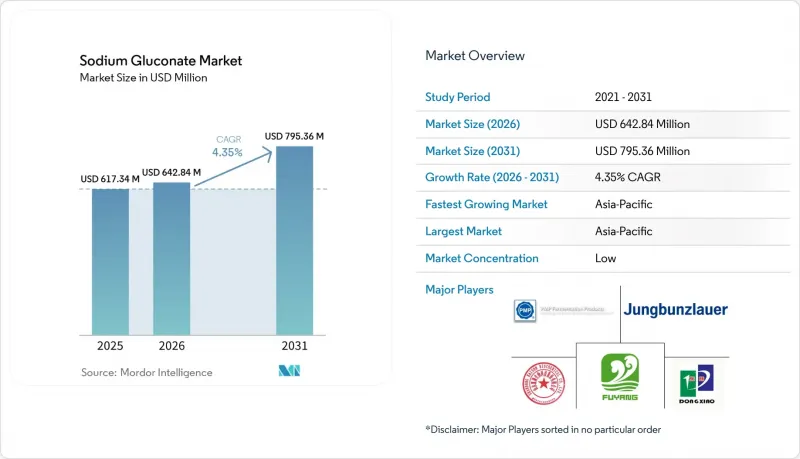
本報告按等級(工業級、食品級、醫藥級、技術級)、形態(粉末、液體、顆粒)、應用(混凝土外加劑、清潔劑/清潔劑、水處理等)和地區(亞太地區、北美地區、歐洲地區、南美地區、中東和非洲地區)進行細分。市場預測以美元計價。
全球葡萄糖酸鈉市場趨勢及洞察
建設活動及混凝土外加劑需求
建設活動仍然是葡萄糖酸鈉市場最大的驅動力,因為葡萄糖酸鈉被用作預拌混凝土和預製混凝土的緩凝劑和減水劑。這些功能延長了高溫澆築過程中的操作時間,使生產商能夠在保證所需抗壓強度的前提下降低水灰比。公共產業、交通走廊和其他公共基礎設施的土木工程項目也支撐著對混凝土外加劑的持續需求。超高性能混凝土需要比許多磺酸鹽磺酸緩凝劑更精確的計量控制。這種需求促使那些對混凝土性能和施工時間有嚴格控制的項目對規格級葡萄糖酸鈉的需求不斷成長。
用於洗滌和水處理中可生物分解螯合劑的替代品。
隨著工業和商用產品開發商在清潔和水處理應用中用葡萄糖酸鈉取代持久性螯合劑,葡萄糖酸鈉市場正從中受益。葡萄糖酸鈉可在兩天內達到98%的生物分解率。在pH值為12-13的強鹼性清潔條件下,其銅螯合能力是乙二胺四乙酸(EDTA)的4.5倍。由於其不含磷的特性,葡萄糖酸鈉適用於冷卻水和逆滲透(RO)系統,因為在這些系統中,廢水標準會影響配方選擇。此外,葡萄糖酸鈉可以幫助需要可生物分解成分的產品獲得歐盟生態標籤和COSMOS認證。這些特性增強了其在鹼性性能至關重要的腐蝕性清潔和瓶子清潔應用中的作用。
玉米來源的葡萄糖和能量成本的變化
玉米衍生葡萄糖和能源成本的波動可能會透過擠壓發酵利潤率來限制葡萄糖酸鈉市場。玉米澱粉佔生產成本的55%至70%,能源成本佔15%至25%。如果原物料價格波動超出合約價格範圍,沒有自有一體化葡萄糖供應鏈的生產商將面臨更大的風險。由於濕磨和酵素水解需要大量能源,電價上漲可能會縮小發酵衍生產品的成本優勢。對於從外部供應商採購葡萄糖的中國非一體化生產商而言,這種風險尤其顯著。玉米供應狀況和生質燃料政策的變化也可能使小規模企業更難制定未來的成本計劃。
細分市場分析
2025年,工業級葡萄糖酸鈉的市佔率達到45.40%。這主要得益於其在混凝土外加劑、紡織加工、金屬表面處理和工業清洗等領域的應用。此等級產品是針對那些較注重濃度和功能性能而非藥典檢驗的客戶。食品級葡萄糖酸鈉用於包裝食品和飲料中的螯合、甜菊糖類甜味劑產品的調味以及乳製品和發酵食品加工中的pH值調節。技術級葡萄糖酸鈉用於金屬清洗、除鏽和電鍍槽的維護。預計到2031年,藥用級葡萄糖酸鈉的年複合成長率將達到5.09%,並有望成為葡萄糖酸鈉產業中成長最快的等級。這一成長主要得益於其在葡萄糖酸鈣注射液、靜脈電解質製劑和細胞治療緩衝液等化學應用領域的應用。藥用級葡萄糖酸鈉的價格通常比工業級葡萄糖酸鈉高出12%至15%。因此,葡萄糖酸鈉市場正朝著對品管和文件要求更為嚴格的等級發展。
各國的食品、藥品和工業標準對等級要求各不相同。中國國家藥品監督管理局和不斷發展的食品純度標準正日益敦促國內生產商提高重金屬和微生物控制水平。與垂直整合的供應商相比,山東省的小規模企業在為精煉設施的資金籌措方面可能面臨更大的困難。 Jungbunzlauer Suisse AG 將其食品級葡萄糖酸鈉定位為符合《食品化學品轉碼器》和歐盟委員會第 231/2012 號法規要求的產品。該公司還提供符合美國藥典 (USP) 和個人護理等級的產品,用於製藥和化妝品領域。這些要求正在擴大符合標準的醫藥原料和通用工業原料之間的品質差距。葡萄糖酸鈉產業受益於這種差異,因為經過審核的等級品質有助於客戶認證和溢價。
區域分析
到2025年,亞太地區將佔全球葡萄糖酸鈉市場規模的46.80%,預計2031年將以4.70%的複合年成長率成長。該地區既是葡萄糖酸鈉的主要供應基地,也是最大的消費市場。中國集中的產能支撐了其對東南亞、中東和歐洲的出口。印度、越南、印尼和泰國則透過基礎建設、水處理和工業清洗等領域滿足了區域需求。
2025年12月,古吉拉突邦布賈出口公司(Gujarat Ambhuja Exports)位於卡納塔克邦哈布利(Hubley)的年產能3萬噸的工廠開始商業化生產,目標是在2028年達到年產能12萬噸。此次產能提升為印度市場提供了中國以外的另一種供應選擇。北美和歐洲是成熟的市場,監管合規性和品質等級是推動需求的主要因素。美國國際貿易委員會(ITC)在其2024年日落審查中,維持了對中國相關進口產品213.15%的反傾銷稅和194.67%的反補貼稅。 2025年11月,榮布恩茨勞爾公司(Jungbunzlauer)完成了對位於伊利諾州湯姆森(Thomson)的生產設施的收購,從而改善了其在北美市場的供應管道。
南美洲、中東和非洲地區對葡萄糖酸鈉的需求仍然相對較小。儘管巴西對混凝土外加劑的需求依然強勁,但預計其他南美市場將在水處理和工業清洗領域迎來發展機會。波灣合作理事會成員國的公共產業和交通基礎設施項目正在推動沙烏地阿拉伯和阿拉伯聯合大公國對工業級葡萄糖酸鈉的需求。南非海水淡化廠的擴建、城市供水系統的維修以及製藥廠的製造地,也推動了可生物分解阻垢劑和醫藥級原料的需求。
其他好處:
- Excel格式的市場預測(ME)表
- 3個月的分析師支持
目錄
第1章:引言
- 研究假設和市場定義
- 調查範圍
第2章:調查方法
第3章執行摘要
第4章 市場狀況
- 市場概覽
- 市場促進因素
- 建設活動及混凝土外加劑需求
- 用於清潔和水處理領域的可生物分解螯合劑的替代品。
- 藥品和營養保健品產業的成長
- 對「潔淨標示」和發酵衍生成分的需求日益成長。
- 生物製程和細胞治療工作流程中對高純度葡萄糖酸鈉的需求
- 為混凝土外加劑生產商訂製液態葡萄糖酸鈉
- 市場限制因素
- 玉米衍生葡萄糖和能量成本的波動
- 檸檬酸鹽、磷酸鹽、磺酸鹽、GLDA 和 MGDA 的替代
- 發酵污水和環境合規成本
- 中國生產群集與出口物流領域的風險集中
- 價值和供應鏈分析
- 波特五力分析
第5章 市場規模與成長預測
- 按年級
- 工業級
- 食品級
- 醫藥級
- 技術級
- 按形式
- 粉末
- 液體
- 顆粒
- 透過使用
- 混凝土外加劑
- 清潔劑和清潔劑
- 水處理
- 食品和藥品
- 其他應用領域(紡織加工、金屬加工、個人護理、農業、生物加工)
- 按地區
- 亞太地區
- 中國
- 印度
- 日本
- 韓國
- 東南亞國協
- 其他亞太國家
- 北美洲
- 美國
- 加拿大
- 墨西哥
- 歐洲
- 德國
- 英國
- 法國
- 義大利
- 北歐國家
- 其他歐洲國家
- 南美洲
- 巴西
- 阿根廷
- 其他南美國家
- 中東和非洲
- 沙烏地阿拉伯
- 南非
- 其他中東和非洲國家
- 亞太地區
第6章 競爭情勢
- 市場集中度
- 策略趨勢
- 市佔率和排名分析
- 公司簡介
- Anil Bioplus Limited
- Dong Xiao Biotechnology Co., Ltd.
- FUSO CHEMICAL CO., LTD.
- Henan Kingsun Chemical Co., Ltd.
- Jungbunzlauer Suisse AG
- PMP FERMENTATION PRODUCTS, INC.
- Qingdao Kehai Biochemistry Co., Ltd.
- Roquette Freres
- SHANDONG FUYANG BIO-TECH. CO. LTD.
- Shandong Kaison Biochemical Co., Ltd.
- Shandong Parkson Biotechnology Co. Ltd.
- Shandong Qilu Biotechnology Group Co., Ltd.
- Shandong Xinhong Pharmaceutical Co., Ltd
- Weifang Honghai chemical .,Co Ltd
- Weifang Jianbao Biotechnology Co., Ltd.
- XIWANG GROUP CO. LTD.
第7章 市場機會與未來展望
According to Mordor Intelligence, the sodium gluconate market size was valued at USD 617.34 million in 2025 and is estimated to grow from USD 642.84 million in 2026 to reach USD 795.36 million by 2031, at a CAGR of 4.35% during the forecast period (2026-2031).
This report is Segmented by Grade (Industrial Grade, Food Grade, Pharmaceutical Grade and Technical Grade), Form (Powder, Liquid, and Granules), Application (Concrete Admixtures, Cleaning Agents and Detergents, Water Treatment, and More), and Geography (Asia-Pacific, North America, Europe, South America, and Middle-East and Africa). The Market Forecasts are Provided in Terms of Value (USD).
Global Sodium Gluconate Market Trends and Insights
Construction Activity and Concrete Admixture Demand
Construction activity remains the strongest driver for the sodium gluconate market because ready-mix and precast concrete use the compound as a set retarder and water reducer. These functions extend workable time in hot-weather pours and help producers lower water-to-cement ratios while meeting required compressive strength. Civil engineering work in utilities, transport corridors, and other public infrastructure supports recurring demand for concrete admixtures. Ultra-high-performance concrete requires more controlled dosing than many lignosulfonate-based retarders can provide. This requirement supports demand for specification grade sodium gluconate in projects where concrete performance and timing are tightly managed.
Biodegradable Chelant Substitution in Cleaning and Water Treatment
The sodium gluconate market benefits when industrial and institutional formulators replace persistent chelants in cleaning and water treatment applications. Sodium gluconate achieved 98% biodegradation within 2 days. It also showed copper-sequestration capacity 4.5 times higher than that of ethylenediaminetetraacetic acid in strongly alkaline cleaning conditions at pH 12-13. Its phosphorus-free profile supports applications in cooling water and reverse-osmosis systems where discharge requirements influence formulation choices. Sodium gluconate can also support European Union Ecolabel and COSMOS certification pathways for products that require biodegradable ingredients. These attributes strengthen its role in caustic cleaning and bottle-washing uses where alkaline performance is important.
Corn-Derived Glucose and Energy Cost Volatility
Corn-derived glucose and energy cost volatility can constrain the sodium gluconate market by putting pressure on fermentation margins. The corn starch represents 55-70% of production cost, and energy represented a further 15-25%. Producers without an integrated glucose supply are more exposed when feedstock prices move beyond contract pricing windows. Wet milling and enzymatic hydrolysis require substantial energy, so higher electricity prices can narrow the cost advantage of fermentation-derived products. This exposure is particularly relevant to non-integrated producers in China that buy glucose from outside suppliers. Changes in corn availability and biofuel policy can also make forward cost planning more difficult for smaller operators.
Other drivers and restraints analyzed in the detailed report include:
- Growth in Pharmaceutical and Nutraceutical Formulations
- Rising Clean-Label and Fermentation-Derived Ingredient Demand
- Substitution by Citric Acid, Phosphates, Lignosulfonates, GLDA and MGDA
For complete list of drivers and restraints, kindly check the Table Of Contents.
Segment Analysis
Industrial grade held 45.40% of the sodium gluconate market share in 2025, supported by its use in concrete admixtures, textile processing, metal surface treatment, and industrial cleaning. This grade serves customers whose specifications focus on concentration and functional performance rather than pharmacopeial verification. Food grade is used for chelation in packaged foods and beverages, flavor adjustment in stevia-sweetened products, and pH control in dairy and fermented food processing. Technical grade supports metal cleaning, rust removal, and electroplating bath maintenance. Pharmaceutical grade is projected to expand at a 5.09% CAGR through 2031, making it the fastest-growing grade in the sodium gluconate industry. Calcium gluconate injectables, intravenous electrolyte ingredients, and cell-therapy buffer chemistry support this growth. Pharmaceutical grade pricing is typically 12-15% higher per metric ton than industrial grade. The sodium gluconate market is therefore shifting toward grades with stronger quality controls and documentation requirements.
Grade requirements differ across national food, pharmaceutical, and industrial standards. China's National Medical Products Administration and changing food purity standards have raised pressure on domestic producers to improve heavy-metal and microbial controls. Smaller operators in Shandong can face greater difficulty funding purification upgrades than vertically integrated suppliers. Jungbunzlauer Suisse AG positions its food grade sodium gluconate against Food Chemicals Codex and European Union Commission Regulation No. 231/2012 requirements. The company also offers U.S. Pharmacopeia and personal care grades for pharmaceutical and cosmetic uses. These requirements widen the quality gap between compliant pharmaceutical material and commodity industrial material. The sodium gluconate industry benefits from this distinction because audited grade quality supports customer qualification and premium pricing.
Complete Report Scope:
- By Grade
- Industrial Grade
- Food Grade
- Pharmaceutical Grade
- Technical Grade
- By Form
- Powder
- Liquid
- Granules
- By Application
- Concrete Admixtures
- Cleaning Agents and Detergents
- Water Treatment
- Food and Pharmaceutical
- Other Applications (Textile Processing, Metal Treatment, Personal Care, Agriculture, Bioprocessing)
- By Geography
- Asia-Pacific
- China
- India
- Japan
- South Korea
- ASEAN Countries
- Rest of Asia-Pacific
- North America
- United States
- Canada
- Mexico
- Europe
- Germany
- United Kingdom
- France
- Italy
- NORDIC Countries
- Rest of Europe
- South America
- Brazil
- Argentina
- Rest of South America
- Middle-East and Africa
- Saudi Arabia
- South Africa
- Rest of Middle-East and Africa
- Asia-Pacific
Geography Analysis
Asia-Pacific held 46.80% of the sodium gluconate market size in 2025 and is forecast to grow at a 4.70% CAGR through 2031. The region is both the main supply base and the largest consumption area for the sodium gluconate market. Chinese capacity concentration has supported exports to Southeast Asia, the Middle-East, and Europe. India, Vietnam, Indonesia, and Thailand support regional demand through infrastructure, water treatment, and industrial cleaning.
In December 2025, Gujarat Ambuja Exports Limited began commercial production at its Hubli, Karnataka facility with 30,000 tons per annum (TPA) of installed capacity and targeted 120,000 TPA by 2028. This addition provides an Indian supply option besides Chinese production. North America and Europe are mature markets where compliance and grade quality shape demand. The U.S. International Trade Commission upheld antidumping duties of 213.15% and countervailing duties of 194.67% on relevant imports from China in its 2024 sunset review. Jungbunzlauer completed its acquisition of a Thomson, Illinois, production site in November 2025, improving proximity to North American customers.
South America and Middle-East, and Africa remain smaller demand areas for the sodium gluconate market. Brazil supports concrete admixture demand, while other South American markets offer water treatment and industrial cleaning opportunities. Gulf Cooperation Council utility and transport programs support industrial grade demand in Saudi Arabia and the United Arab Emirates. Desalination expansion, municipal water upgrades, and South Africa's pharmaceutical manufacturing base support demand for biodegradable scale inhibitors and pharmaceutical grade material.
- Anil Bioplus Limited
- Dong Xiao Biotechnology Co., Ltd.
- FUSO CHEMICAL CO., LTD.
- Henan Kingsun Chemical Co., Ltd.
- Jungbunzlauer Suisse AG
- PMP FERMENTATION PRODUCTS, INC.
- Qingdao Kehai Biochemistry Co., Ltd.
- Roquette Freres
- SHANDONG FUYANG BIO-TECH. CO. LTD.
- Shandong Kaison Biochemical Co., Ltd.
- Shandong Parkson Biotechnology Co. Ltd.
- Shandong Qilu Biotechnology Group Co., Ltd.
- Shandong Xinhong Pharmaceutical Co., Ltd
- Weifang Honghai chemical .,Co Ltd
- Weifang Jianbao Biotechnology Co., Ltd.
- XIWANG GROUP CO. LTD.
Additional Benefits:
- The market estimate (ME) sheet in Excel format
- 3 months of analyst support
TABLE OF CONTENTS
1 Introduction
- 1.1 Study Assumptions and Market Definition
- 1.2 Scope of the Study
2 Research Methodology
3 Executive Summary
4 Market Landscape
- 4.1 Market Overview
- 4.2 Market Drivers
- 4.2.1 Construction Activity and Concrete Admixture Demand
- 4.2.2 Biodegradable Chelant Substitution in Cleaning and Water Treatment
- 4.2.3 Growth in Pharmaceutical and Nutraceutical Formulations
- 4.2.4 Rising Clean-Label and Fermentation-Derived Ingredient Demand
- 4.2.5 High-Purity Sodium Gluconate Demand in Bioprocessing and Cell-Therapy Workflows
- 4.2.6 Liquid Sodium Gluconate Customization for Concrete Admixture Producers
- 4.3 Market Restraints
- 4.3.1 Corn-Derived Glucose and Energy Cost Volatility
- 4.3.2 Substitution by Citric Acid, Phosphates, Lignosulfonates, GLDA and MGDA
- 4.3.3 Fermentation Wastewater and Environmental Compliance Costs
- 4.3.4 Concentration Risk in Chinese Production Clusters and Export Logistics
- 4.4 Value and Supply-Chain Analysis
- 4.5 Porter's Five Forces Analysis
- 4.5.1 Bargaining Power of Suppliers
- 4.5.2 Bargaining Power of Buyers
- 4.5.3 Threat of New Entrants
- 4.5.4 Threat of Substitutes
- 4.5.5 Competitive Rivalry
5 Market Size and Growth Forecasts (Value)
- 5.1 By Grade
- 5.1.1 Industrial Grade
- 5.1.2 Food Grade
- 5.1.3 Pharmaceutical Grade
- 5.1.4 Technical Grade
- 5.2 By Form
- 5.2.1 Powder
- 5.2.2 Liquid
- 5.2.3 Granules
- 5.3 By Application
- 5.3.1 Concrete Admixtures
- 5.3.2 Cleaning Agents and Detergents
- 5.3.3 Water Treatment
- 5.3.4 Food and Pharmaceutical
- 5.3.5 Other Applications (Textile Processing, Metal Treatment, Personal Care, Agriculture, Bioprocessing)
- 5.4 By Geography
- 5.4.1 Asia-Pacific
- 5.4.1.1 China
- 5.4.1.2 India
- 5.4.1.3 Japan
- 5.4.1.4 South Korea
- 5.4.1.5 ASEAN Countries
- 5.4.1.6 Rest of Asia-Pacific
- 5.4.2 North America
- 5.4.2.1 United States
- 5.4.2.2 Canada
- 5.4.2.3 Mexico
- 5.4.3 Europe
- 5.4.3.1 Germany
- 5.4.3.2 United Kingdom
- 5.4.3.3 France
- 5.4.3.4 Italy
- 5.4.3.5 NORDIC Countries
- 5.4.3.6 Rest of Europe
- 5.4.4 South America
- 5.4.4.1 Brazil
- 5.4.4.2 Argentina
- 5.4.4.3 Rest of South America
- 5.4.5 Middle-East and Africa
- 5.4.5.1 Saudi Arabia
- 5.4.5.2 South Africa
- 5.4.5.3 Rest of Middle-East and Africa
- 5.4.1 Asia-Pacific
6 Competitive Landscape
- 6.1 Market Concentration
- 6.2 Strategic Moves
- 6.3 Market Share (%)/Ranking Analysis
- 6.4 Company Profiles (includes Global Overview, Market Overview, Core Segments, Financials as available, Strategic Information, Products and Services, and Recent Developments)
- 6.4.1 Anil Bioplus Limited
- 6.4.2 Dong Xiao Biotechnology Co., Ltd.
- 6.4.3 FUSO CHEMICAL CO., LTD.
- 6.4.4 Henan Kingsun Chemical Co., Ltd.
- 6.4.5 Jungbunzlauer Suisse AG
- 6.4.6 PMP FERMENTATION PRODUCTS, INC.
- 6.4.7 Qingdao Kehai Biochemistry Co., Ltd.
- 6.4.8 Roquette Freres
- 6.4.9 SHANDONG FUYANG BIO-TECH. CO. LTD.
- 6.4.10 Shandong Kaison Biochemical Co., Ltd.
- 6.4.11 Shandong Parkson Biotechnology Co. Ltd.
- 6.4.12 Shandong Qilu Biotechnology Group Co., Ltd.
- 6.4.13 Shandong Xinhong Pharmaceutical Co., Ltd
- 6.4.14 Weifang Honghai chemical .,Co Ltd
- 6.4.15 Weifang Jianbao Biotechnology Co., Ltd.
- 6.4.16 XIWANG GROUP CO. LTD.
7 Market Opportunities and Future Outlook
- 7.1 White-Space and Unmet-Need Assessment

 2026-2034年全球偏氧化鈉市場規模、佔有率、趨勢和成長分析報告
 肌苷酸二鈉市場-2026-2032年全球市場預測法羅培南鈉市場:按劑型、包裝規格、治療應用、分銷管道和最終用戶分類的全球市場預測 – 2026–2032
 檸檬酸鈉二水合物市場規模、佔有率和成長分析:按產品類型、應用、終端用戶產業、通路和地區分類-2026-2033年產業預測
 葡萄糖酸鈉市場規模、佔有率和成長分析:按產品類型、劑型、應用、終端用戶產業、分銷管道、原料和地區分類-2026-2033年產業預測
 肌苷酸二鈉市場規模、佔有率和成長分析:依產品等級、劑型、最終用途產業、通路和地區分類-2026-2033年產業預測
 硼砂市場-全球產業規模、佔有率、趨勢、機會與預測:按應用、銷售管道、地區和競爭格局分類,2021-2031年
 丙酸鈉市場:按應用和地區分類
 重鉻酸鈉市場商機、成長要素、產業趨勢分析及2026-2035年預測亞硒酸鈉市場:按適應症、分銷管道和地區分類