


 |
市場調查報告書
商品編碼
2119317
通訊詐騙情報平台:市場佔有率分析、行業趨勢和統計數據、成長預測(2026-2031 年)Telecom Fraud Intelligence Platforms - Market Share Analysis, Industry Trends & Statistics, Growth Forecasts (2026 - 2031) |
||||||

※ 本網頁內容可能與最新版本有所差異。詳細情況請與我們聯繫。
根據 Mordor Intelligence 預測,詐騙情報平台的市場規模預計將從 2025 年的 12.5 億美元成長到 2026 年的 14.4 億美元,到 2031 年達到 28.7 億美元,2026 年至 2031 年的年複合成長率(CAGR)%為 14.79%。
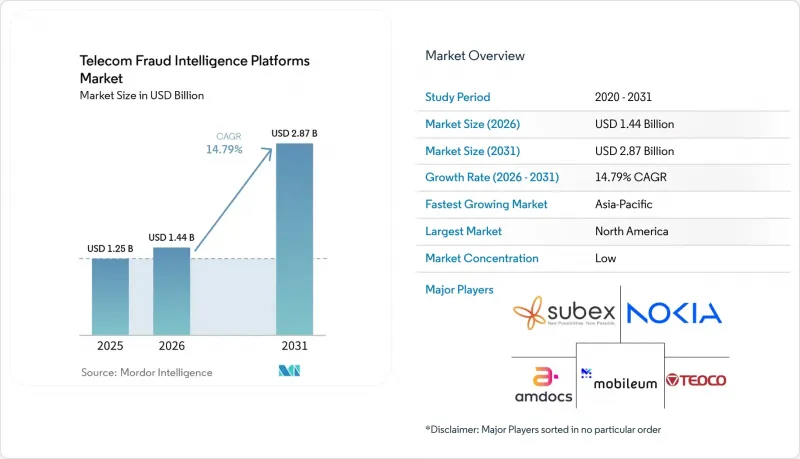
本報告按元件(軟體、服務)、部署模式(雲端部署、其他)、應用程式(收益保護、身分驗證、其他)、最終用戶(行動網路營運商、其他)、組織規模(大型企業、其他)、技術(自然語言處理、其他)和地區進行細分。市場預測以美元計價。
全球通訊詐騙情報平台市場趨勢及洞察。
利用 5G、物聯網和雲端原生技術擴展訊號格局。
從單體核心網轉向 5G 獨立組網(SA)服務架構的轉變,改變了營運商評估詐欺風險的方式。 HTTP/2 和 REST API 連線核心功能,所產生的詐騙模式與傳統的 SS7 攻擊和舊式訊號防火牆控制有所不同。這些介面需要一個能夠評估 REST 語義、JSON 有效負載、OAuth 流程、呼叫詳細記錄 (CDR)、訊號事件以及核心網路功能之間不斷演變的關係的平台。營運商正在整合封包核心網路、服務架構和 RAN 遙測技術,以建立 5G 網路詐欺偵測的基準,並將正常活動與新興的詐欺形式進行比較。電信詐欺偵測平台市場正受益於營運商能夠在更接近網路功能的位置偵測欺詐,而不是僅依賴只能在流量發生後識別問題的收費記錄。這推動了對能夠規範化各種遙測資料、關聯相關事件並識別異常情況的系統的需求,而無需像批次工具那樣耗費數天時間。
合約詐騙、身分驗證詐騙和帳戶劫持詐騙日益增多
根據CFCA的記錄,到2025年,與合約相關的詐欺造成的損失將達到53.1億美元,帳戶盜用造成的損失將達到47.3億美元。 Cifas的紀錄顯示,2024年將發生近3,000起詐欺性SIM卡交換事件,增幅高達1055%。行動帳戶佔帳戶盜用案例的48%。行動身分一旦被盜用,就會影響銀行帳戶、雙因素認證系統、醫療保健入口網站以及其他依賴電話號碼進行帳戶恢復的服務。這使得與SIM卡交換相關的責任範圍不僅限於電信業者的直接業務收益,也使得快速檢驗對下游機構而言更加重要。 GSMA正在透過「開放式閘道」(Open Gateway)和「CAMARA」框架推廣用於SIM卡交換偵測、來電傳輸監控和詐騙情報的標準化詐騙防制API。電信業者使用的詐欺偵測平台市場可以透過提供用戶ID情報作為企業級API產品而受益,該產品允許營運商清晰地管理資料的存取和使用。
遺留資料孤島以及CDR和訊號資料品質不一致
對許多電信業者而言,主要障礙並非缺乏詐欺偵測演算法,而是資料片段化。通話詳細記錄 (CDR)、訊號事件、配置資料、收費交易和客戶帳戶更新資訊通常分散在為不同營運目的而建構的獨立 OSS 和 BSS 環境中。這種結構使得建立機器學習模型所需的跨域行為特徵變得困難,並可能延遲對疑似詐欺事件的確認。 2025 年 GLF 報告強調了國際收入分成詐騙的普遍風險,以及利用近即時數據自動攔截路由的能力有限。在串流媒體層整合來自不同中介系統的記錄可以減少營運團隊識別、評估和回報可疑活動所需的時間。電信詐騙情報平台市場的引進週期往往較長,尤其是在多供應商現代化專案尚未啟動或資料所有權仍分散在各個部門的情況下。
細分市場分析
2025年,軟體將佔通訊詐欺情報平台市場68.38%的佔有率。這反映了一種採購模式,該模式將檢測邏輯、行為評分、案例工作流程和報告管理功能整合到單一的營運平台中。供應商正在其軟體中添加自主調查工具、即時評分、可解釋人工智慧功能和規則管治功能。這些功能減少了對外部服務在模型調優、閾值、案例管理和日常分析師審查方面的依賴。它們還使電信業者能夠輕鬆地將新的檢測邏輯應用於多種詐欺用例。因此,通訊詐欺情報平台市場正在從一次性專案轉向支援持續營運的產品。這是因為電信業者需要能夠更新的系統,以跟上不斷變化的詐欺模式、網路服務、監管預期和內部調查實踐。
預計到2031年,服務市場將以15.68%的複合年成長率成長。對於人工智慧和安全專業知識有限的電信營運商而言,託管式詐欺預防服務、威脅情報來源、模型適配服務、部署支援和專家分析師支援仍然至關重要。根據CFCA的一項調查,到2025年,84%的受訪者將把自己的人工智慧知識和經驗評為「初級」或「中級」。這種技能差距為能夠幫助營運商解讀警報並在部署後完善控制措施的服務提供者創造了機會。針對設備詐騙、訂閱濫用和國際收入分成詐騙的模組化平台正在數位原生行動虛擬網路營運商(MVNO)中越來越受歡迎。 Subex在2025年部署了“FraudZap”,使設備詐騙預防的部署時間從數月縮短至數天。這表明,對於那些無法承受等待大規模平台建造的營運商而言,能夠減輕部署負擔的服務備受關注。
到2025年,雲端採用率將佔市場佔有率的58.14%。靈活的處理能力、持續的模型更新、基礎設施投資的減少以及營運商間的智慧聚合是推動雲端採用的主要因素。雲端平台也使電信業者能夠隨著流量、事件類型和網路能力的提升而擴展其分析能力。這種模式使反詐騙團隊能夠利用最先進的偵測功能,而無需維持同等級的本地運算能力。隨著5G和物聯網服務產生的網路資料量不斷成長,通訊詐欺偵測智慧平台市場正受益於這種柔軟性。然而,由於區域隱私法規可能會限制用戶資料在區域雲端環境內的流動,因此在建立資料流之前,採用雲端的決策通常需要網路、安全、隱私和法律團隊進行詳細考慮。
預計到2031年,混合部署將以16.32%的複合年成長率成長。此模式旨在解決歐洲、印度、中國和海灣合作理事會(GCC)市場中雲規模分析與資料主權要求之間的衝突。電信業者在決定通訊人工智慧工作負載的部署位置時,會評估資料主權、延遲、資料重力以及營運準備。對於受監管的一級運營商和信令功能而言,本地部署仍然發揮著重要作用,因為在這些應用中,廣域網路延遲是不可接受的。混合系統允許在邊緣進行事件評分,同時將匿名訊息發送到雲端,以進行更廣泛的威脅情報關聯分析。這種方法使營運商能夠在更嚴格地管理敏感用戶記錄的同時,保持對可擴展處理資源的存取。此外,它還允許將需要即時本地回應的功能與可以在雲端環境中運行的分析工作負載分開。
區域分析
到2025年,北美將佔據通訊詐欺情報平台市場34.12%的佔有率。該地區雲端原生詐欺情報供應商集中,通訊業支出龐大,且監管執法嚴格。 2026年5月,美國聯邦通訊委員會(FCC)通過了「了解您的上游提供者」(Know Your Upstream Provider)的強化規則和STIR/SHAKEN認證標準。此外,2026年3月1日是語音自動電話反制資料庫年度重新認證的截止日期,這將合規要求擴展到小規模的語音服務供應商。在加拿大和墨西哥,互聯安全和消費者保護框架正在推動區域需求的成長。
歐洲,主導是德國、英國、法國、義大利和西班牙,佔了第二大區域。根據Cifas預測,到2025年,身分詐騙和設備劫持將佔成員機構報告事件的72%,其中電信業者被認為是行動產品相關帳戶劫持的主要目標。在斯堪地那維亞市場,隨著SEPP的引進以及5G獨立網路API的開放,對人工智慧驅動的訊號防火牆的升級投資正在穩步推進。 NIS2正在加強包括電信業者在內的關鍵服務供應商的網路安全義務,而GDPR則支援符合歐洲資料居住要求的部署模式。
亞太地區預計將在2026年至2031年間以16.92%的複合年成長率成長,成為成長最快的地區。該地區擁有超過37億行動用戶,中國、印度、韓國和日本的大規模5G項目加劇了詐騙風險。中國的《網路安全法》強制要求用戶進行身分驗證和資料保護,而印度則對垃圾簡訊採取零容忍政策。南美、中東和非洲仍然是高潛力地區,詐欺損失的成長速度超過了平台普及率的成長速度。在南非,預計到2025年,網路犯罪造成的損失將超過53億蘭特(約2.9億美元),海灣地區的電信業者正在投資5G轉型計畫。
其他好處:
- Excel格式的市場預測(ME)表
- 3個月的分析師支持
目錄
第1章:引言
- 研究假設和市場定義
- 調查範圍
第2章:調查方法
第3章執行摘要
第4章 市場狀況
- 市場概覽
- 市場促進因素
- 利用 5G、物聯網和雲端原生技術擴展訊號表面。
- 持續不斷的訂閱、身分和帳戶劫持詐騙
- 即時收入保障的需求日益成長
- 關於互聯互通繞過和通訊詐騙的資訊收集缺口。
- 針對可程式網路和API漏洞的詐欺偵測訊息
- 電信公司對自主且可解釋的詐欺調查的需求。
- 市場限制因素
- 傳統資料孤島以及CDR和訊號資料品質的差異
- 電信業者的採購和整合週期越來越長。
- 隱私、資料儲存位置和跨境資料收集限制
- 對抗性適應與假陽性疲勞
- 宏觀經濟因素對市場的影響
- 產業價值鏈分析
- 科技趨勢
- 監理情勢
- 波特五力分析
第5章 市場規模與成長預測
- 按組件
- 軟體
- 服務
- 部署模式
- 雲
- 現場
- 混合
- 透過使用
- 利潤保護
- 身份驗證
- 支付安全
- 網路和訊號監測
- 監理合規
- 其他用途
- 最終用戶
- 行動電信商
- 固網和寬頻供應商
- 網際服務供應商
- 行動虛擬網路營運商
- 批發電力營運商和互聯樞紐
- 其他最終用戶
- 按組織規模
- 大公司
- 小型企業
- 透過技術
- 機器學習和深度學習
- 自然語言處理
- 巨量資料分析
- 其他技術
- 按地區
- 北美洲
- 美國
- 加拿大
- 墨西哥
- 南美洲
- 巴西
- 阿根廷
- 智利
- 其他南美國家
- 歐洲
- 德國
- 英國
- 法國
- 義大利
- 西班牙
- 其他歐洲國家
- 亞太地區
- 中國
- 日本
- 印度
- 韓國
- 澳洲
- 其他亞太國家
- 中東
- 阿拉伯聯合大公國
- 沙烏地阿拉伯
- 卡達
- 其他中東國家
- 非洲
- 南非
- 埃及
- 奈及利亞
- 其他非洲國家
- 北美洲
第6章 競爭情勢
- 市場集中度
- 策略趨勢
- 市佔率分析
- 公司簡介
- Subex Limited
- Mobileum, Inc.
- Araxxe SAS
- TEOCO Corporation
- Telarix, Inc.
- Heksagon Technologies Ltd.
- Cellusys Limited
- upCOM Labs LLC
- Amdocs Limited.
- TransNexus, Inc.
- Tollring Limited
- Nokia Corporation
- Calltic NV
- Mobik doo
- SecurityGen Cyber Security Solutions PTE. LTD.
- Enea AB
- Belgacom International Carrier Services SA
- Zumigo, Inc.
- Syntelligence AI Inc.
- Tango Telecom Limited
- Latro Services, Inc.
- Comviva Technologies Limited
- Vonage Holdings Corp.
- Socure Inc.
第7章 市場機會與未來展望
According to Mordor Intelligence, the telecom fraud intelligence platforms market size is projected to expand from USD 1.25 billion in 2025 to USD 1.44 billion in 2026, and to USD 2.87 billion by 2031, registering a CAGR of 14.79% between 2026 and 2031.
This report is Segmented by Component (Software, and Services), Deployment Mode (Cloud, and More), Application (Revenue Protection, Identity Verification, and More), End User (Mobile Network Operators, and More), Organization Size (Large Enterprises, and More), Technology (Natural Language Processing, and More), and Geography. The Market Forecasts are Provided in Terms of Value (USD).
Global Telecom Fraud Intelligence Platforms Market Trends and Insights
Expansion of 5G, IoT, and Cloud-Native Signaling Surfaces
The move from monolithic cores to a 5G standalone, service-based architecture has changed how operators assess fraud exposure. HTTP/2 and REST APIs connect core functions and create abuse patterns that differ from traditional SS7 attacks and legacy signaling firewall controls. These interfaces require platforms that can assess REST semantics, JSON payloads, OAuth flows, call detail records, signaling events, and changing relationships between core network functions. Operators are incorporating packet-core, service-based architecture, and RAN telemetry as they build fraud-detection baselines for 5G networks and compare normal activity with new forms of abuse. The Telecom Fraud Intelligence Platforms Market benefits as operators place detection closer to network functions, rather than relying solely on billing records that may identify issues only after traffic has occurred. This supports demand for systems that normalize diverse telemetry, correlate related events, and identify anomalies without the multi-day delays associated with batch-processing tools.
Rising Subscription, Identity, and Account Takeover Fraud
The CFCA recorded USD 5.31 billion in subscription fraud losses and USD 4.73 billion in account takeover losses in 2025. Cifas recorded nearly 3,000 unauthorized SIM swaps in 2024, an increase of 1,055%, with mobile accounts accounting for 48% of account takeover cases. A compromised mobile identity can also affect bank accounts, two-factor authentication systems, healthcare portals, and other services that rely on a phone number for account recovery. This broadens the liability associated with a SIM swap beyond an operator's direct service revenue, making prompt verification more important for downstream organizations. The GSMA is promoting standardized fraud-prevention APIs for SIM swap detection, call-forwarding monitoring, and scam intelligence through the Open Gateway and CAMARA frameworks. The Telecom Fraud Intelligence Platforms Market can benefit when operators offer subscriber identity intelligence as an enterprise API product with clear controls over data access and use.
Legacy Data Silos and Inconsistent CDR and Signaling Data Quality
The main obstacle for many operators is fragmented data, rather than a lack of fraud algorithms. Call detail records, signaling events, provisioning data, billing transactions, and customer account updates often remain in separate OSS and BSS environments, each built for different operational purposes. That structure makes it harder to build the cross-domain behavioral profiles that machine learning models require, and it can delay the confirmation of a suspected fraud event. The 2025 GLF report described widespread international revenue-share fraud exposure and a limited ability to automate route blocks using near-real-time data. Unifying records from separate mediation systems in a streaming layer can reduce the time needed to identify, assess, and escalate suspicious activity across operational teams. The Telecom Fraud Intelligence Platforms Market faces longer adoption cycles, particularly when multi-vendor modernization programs have not yet started or when data ownership remains divided across departments.
Other drivers and restraints analyzed in the detailed report include:
- Increasing Real-Time Revenue Protection Requirements
- Interconnect Bypass and Messaging Fraud Intelligence Gaps
- Privacy, Data Residency, and Cross-Border Intelligence Constraints
For complete list of drivers and restraints, kindly check the Table Of Contents.
Segment Analysis
Software held 68.38% of the Telecom Fraud Intelligence Platforms Market share in 2025. This position reflects procurement models that integrate detection logic, behavioral scoring, case workflows, and reporting controls into a single operating platform. Vendors are adding autonomous investigation tools, real-time scoring, explainable AI functions, and rule governance features to their software. These features can reduce dependence on external services for model tuning, threshold setting, case management, and routine analyst review. They also make it easier for operators to apply new detection logic across multiple fraud use cases. The Telecom Fraud Intelligence Platforms Market is therefore moving toward products that support continuous operational use rather than isolated projects, because operators need systems that can be updated as fraud patterns, network services, regulatory expectations, and internal investigation practices evolve.
Services are projected to expand at a 15.68% CAGR through 2031. Managed fraud operations, threat intelligence feeds, model adaptation services, implementation support, and specialist analyst support remain important for operators with limited AI and security expertise. The CFCA found that 84% of respondents described their AI knowledge and experience as beginner or intermediate in 2025. This skills gap creates a role for providers that can help operators interpret alerts and refine controls after deployment. Modular platforms for handset fraud, subscription abuse, and international revenue-share fraud are gaining traction among digital-native mobile virtual network operators. Subex introduced FraudZap in 2025 to enable handset fraud deployment in days rather than months, illustrating interest in offerings that reduce the delivery burden for operators who cannot wait for extensive platform configuration.
Cloud deployment held 58.14% of the market share in 2025. Elastic processing, continuous model updates, lower infrastructure investment, and cross-operator intelligence aggregation support cloud adoption. Cloud platforms also allow operators to scale analysis as traffic volumes, event types, and network functions increase. This model can give fraud teams access to current detection capabilities without requiring them to maintain the same level of local computing capacity. The Telecom Fraud Intelligence Platforms Market benefits from this flexibility as 5G and IoT services generate more network data. However, local privacy rules can limit the movement of subscriber data within regional cloud environments, so cloud implementation decisions often require detailed review by network, security, privacy, and legal teams before data flows are established.
Hybrid deployment is projected to expand at a 16.32% CAGR through 2031. The model addresses the tension between cloud-scale analytics and data sovereignty requirements in Europe, India, China, and Gulf Cooperation Council markets. Operators assess data sovereignty, latency, data gravity, and operational readiness when deciding where to place telecom AI workloads. On-premises installations remain relevant for regulated tier-1 operators and signaling functions that cannot tolerate wide-area network latency. Hybrid systems can score events at the edge while sending anonymized intelligence to the cloud for broader threat correlation. This approach gives operators greater control over sensitive subscriber records while retaining access to scalable processing resources, and it lets them separate functions that require immediate local action from analytical workloads that can run in a cloud environment.
Complete Report Scope:
- By Component
- Software
- Services
- By Deployment Mode
- Cloud
- On-Premises
- Hybrid
- By Application
- Revenue Protection
- Identity Verification
- Payment Security
- Network and Signaling Monitoring
- Regulatory Compliance
- Other Applications
- By End User
- Mobile Network Operators
- Fixed-Line and Broadband Providers
- Internet Service Providers
- Mobile Virtual Network Operators
- Wholesale Carriers and Interconnect Hubs
- Other End Users
- By Organization Size
- Large Enterprises
- Small and Medium Enterprises
- By Technology
- Machine Learning and Deep Learning
- Natural Language Processing
- Big Data Analytics
- Other Technologies
- By Geography
- North America
- United States
- Canada
- Mexico
- South America
- Brazil
- Argentina
- Chile
- Rest of South America
- Europe
- Germany
- United Kingdom
- France
- Italy
- Spain
- Rest of Europe
- Asia-Pacific
- China
- Japan
- India
- South Korea
- Australia
- Rest of Asia-Pacific
- Middle East
- United Arab Emirates
- Saudi Arabia
- Qatar
- Rest of Middle East
- Africa
- South Africa
- Egypt
- Nigeria
- Rest of Africa
- North America
Geography Analysis
North America held 34.12% of the Telecom Fraud Intelligence Platforms Market share in 2025. The region has a high concentration of cloud-native fraud intelligence vendors, substantial telecom spending, and strong regulatory enforcement. The FCC adopted enhanced Know Your Upstream Provider rules and STIR/SHAKEN attestation standards in May 2026. The Robocall Mitigation Database annual recertification deadline of March 1, 2026, also extended compliance requirements to smaller voice service providers. Canada and Mexico add regional demand through interconnect security and consumer-protection frameworks.
Europe was the second-largest regional position, led by Germany, the United Kingdom, France, Italy, and Spain. Cifas reported that identity fraud and facility takeover accounted for 72% of cases filed by members in 2025, and identified telecoms as the main target for account takeover involving mobile products. Scandinavian markets are investing in AI-driven signaling firewall upgrades as 5G standalone networks introduce SEPP and API exposure. NIS2 raises network-security obligations for essential service providers, including telecom operators, while GDPR supports deployment models that meet European data residency needs.
Asia-Pacific is projected to expand at a 16.92% CAGR from 2026 to 2031, making it the fastest-growing region. Its mobile subscriber base exceeded 3.7 billion, and large 5G programs in China, India, South Korea, and Japan increase the scale of fraud exposure. China's Cybersecurity Law requires subscriber identity verification and data protection, while India has applied zero-tolerance SMS spam policies. South America, the Middle East, and Africa remain high-potential regions where fraud losses are rising faster than platform adoption. South Africa lost more than ZAR 5.3 billion, USD 290 million, to cybercrime in 2025, and Gulf operators are investing as part of 5G transformation programs.
- Subex Limited
- Mobileum, Inc.
- Araxxe SAS
- TEOCO Corporation
- Telarix, Inc.
- Heksagon Technologies Ltd.
- Cellusys Limited
- upCOM Labs LLC
- Amdocs Limited.
- TransNexus, Inc.
- Tollring Limited
- Nokia Corporation
- Calltic NV
- Mobik d.o.o.
- SecurityGen Cyber Security Solutions PTE. LTD.
- Enea AB
- Belgacom International Carrier Services SA
- Zumigo, Inc.
- Syntelligence AI Inc.
- Tango Telecom Limited
- Latro Services, Inc.
- Comviva Technologies Limited
- Vonage Holdings Corp.
- Socure Inc.
Additional Benefits:
- The market estimate (ME) sheet in Excel format
- 3 months of analyst support
TABLE OF CONTENTS
1 INTRODUCTION
- 1.1 Study Assumptions and Market Definition
- 1.2 Scope of the Study
2 RESEARCH METHODOLOGY
3 EXECUTIVE SUMMARY
4 MARKET LANDSCAPE
- 4.1 Market Overview
- 4.2 Market Drivers
- 4.2.1 Expansion of 5G, IoT, and Cloud-Native Signaling Surfaces
- 4.2.2 Rising Subscription, Identity, and Account-Takeover Fraud
- 4.2.3 Increasing Real-Time Revenue Protection Requirements
- 4.2.4 Interconnect Bypass and Messaging Fraud Intelligence Gaps
- 4.2.5 Fraud Intelligence for Programmable Networks and API Exposure
- 4.2.6 Operator Demand for Autonomous, Explainable Fraud Investigation
- 4.3 Market Restraints
- 4.3.1 Legacy Data Silos and Inconsistent CDR and Signaling Data Quality
- 4.3.2 Long Telco Procurement and Integration Cycles
- 4.3.3 Privacy, Data-Residency, and Cross-Border Intelligence Constraints
- 4.3.4 Adversarial Adaptation and False-Positive Fatigue
- 4.4 Impact of Macroeconomic Factors on the Market
- 4.5 Industry Value-Chain Analysis
- 4.6 Technology Outlook
- 4.7 Regulatory Landscape
- 4.8 Porter's Five Forces Analysis
- 4.8.1 Threat of New Entrants
- 4.8.2 Bargaining Power of Suppliers
- 4.8.3 Bargaining Power of Buyers
- 4.8.4 Threat of Substitutes
- 4.8.5 Intensity of Competitive Rivalry
5 MARKET SIZE AND GROWTH FORECASTS (VALUE)
- 5.1 By Component
- 5.1.1 Software
- 5.1.2 Services
- 5.2 By Deployment Mode
- 5.2.1 Cloud
- 5.2.2 On-Premises
- 5.2.3 Hybrid
- 5.3 By Application
- 5.3.1 Revenue Protection
- 5.3.2 Identity Verification
- 5.3.3 Payment Security
- 5.3.4 Network and Signaling Monitoring
- 5.3.5 Regulatory Compliance
- 5.3.6 Other Applications
- 5.4 By End User
- 5.4.1 Mobile Network Operators
- 5.4.2 Fixed-Line and Broadband Providers
- 5.4.3 Internet Service Providers
- 5.4.4 Mobile Virtual Network Operators
- 5.4.5 Wholesale Carriers and Interconnect Hubs
- 5.4.6 Other End Users
- 5.5 By Organization Size
- 5.5.1 Large Enterprises
- 5.5.2 Small and Medium Enterprises
- 5.6 By Technology
- 5.6.1 Machine Learning and Deep Learning
- 5.6.2 Natural Language Processing
- 5.6.3 Big Data Analytics
- 5.6.4 Other Technologies
- 5.7 By Geography
- 5.7.1 North America
- 5.7.1.1 United States
- 5.7.1.2 Canada
- 5.7.1.3 Mexico
- 5.7.2 South America
- 5.7.2.1 Brazil
- 5.7.2.2 Argentina
- 5.7.2.3 Chile
- 5.7.2.4 Rest of South America
- 5.7.3 Europe
- 5.7.3.1 Germany
- 5.7.3.2 United Kingdom
- 5.7.3.3 France
- 5.7.3.4 Italy
- 5.7.3.5 Spain
- 5.7.3.6 Rest of Europe
- 5.7.4 Asia-Pacific
- 5.7.4.1 China
- 5.7.4.2 Japan
- 5.7.4.3 India
- 5.7.4.4 South Korea
- 5.7.4.5 Australia
- 5.7.4.6 Rest of Asia-Pacific
- 5.7.5 Middle East
- 5.7.5.1 United Arab Emirates
- 5.7.5.2 Saudi Arabia
- 5.7.5.3 Qatar
- 5.7.5.4 Rest of Middle East
- 5.7.6 Africa
- 5.7.6.1 South Africa
- 5.7.6.2 Egypt
- 5.7.6.3 Nigeria
- 5.7.6.4 Rest of Africa
- 5.7.1 North America
6 COMPETITIVE LANDSCAPE
- 6.1 Market Concentration
- 6.2 Strategic Moves
- 6.3 Market Share Analysis
- 6.4 Company Profiles (includes Global Level Overview, Market Level Overview, Core Segments, Financials as available, Strategic Information, Market Rank/Share, Products and Services, Recent Developments)
- 6.4.1 Subex Limited
- 6.4.2 Mobileum, Inc.
- 6.4.3 Araxxe SAS
- 6.4.4 TEOCO Corporation
- 6.4.5 Telarix, Inc.
- 6.4.6 Heksagon Technologies Ltd.
- 6.4.7 Cellusys Limited
- 6.4.8 upCOM Labs LLC
- 6.4.9 Amdocs Limited.
- 6.4.10 TransNexus, Inc.
- 6.4.11 Tollring Limited
- 6.4.12 Nokia Corporation
- 6.4.13 Calltic NV
- 6.4.14 Mobik d.o.o.
- 6.4.15 SecurityGen Cyber Security Solutions PTE. LTD.
- 6.4.16 Enea AB
- 6.4.17 Belgacom International Carrier Services SA
- 6.4.18 Zumigo, Inc.
- 6.4.19 Syntelligence AI Inc.
- 6.4.20 Tango Telecom Limited
- 6.4.21 Latro Services, Inc.
- 6.4.22 Comviva Technologies Limited
- 6.4.23 Vonage Holdings Corp.
- 6.4.24 Socure Inc.
7 MARKET OPPORTUNITIES AND FUTURE OUTLOOK
- 7.1 White-Space and Unmet-Need Assessment

 內部檢舉軟體市場:依部署類型、公司規模、最終用戶、最終用戶產業和地區分類
 2026年全球詐欺偵測市場報告
 人工智慧驅動的詐欺偵測和風險分析平台市場預測至2034年:按組件、平台類型、詐欺類型、技術、應用、最終用戶和地區分類的全球分析
 航空詐欺偵測市場:按組件、部署、詐欺類型、技術、應用、最終用戶和地區分類-市場規模、產業動態、機會分析和預測(2026-2035 年)釣魚模擬器市場:按部署模式、最終用戶、組織規模、功能和地區分類以金融服務為導向的AI驅動型詐騙偵測市場:預測(至2034年)-按組件、詐欺類型、技術、部署方式、應用、最終用戶和地區進行分析詐欺偵測市場:按組件、解決方案類型和地區分類
 反釣魚市場:依解決方案類型、組織規模、部署方式和產業分類-2026-2032年全球市場預測
 人工智慧市場分析及2035年欺詐管理預測:類型、產品類型、服務、技術、組件、應用、部署模式、最終用戶、解決方案、交付模式廣告詐欺偵測工具市場分析及預測(至2035年):類型、產品類型、技術、組件、應用、部署模式、最終用戶、功能、解決方案