


 |
市場調查報告書
商品編碼
2119310
廢氣洗滌器污水處理系統:市場佔有率分析、產業趨勢與統計、成長預測(2026-2031 年)Flue Gas Scrubber Wastewater Treatment Systems - Market Share Analysis, Industry Trends & Statistics, Growth Forecasts (2026 - 2031) |
||||||

※ 本網頁內容可能與最新版本有所差異。詳細情況請與我們聯繫。
據 Mordor Intelligence 稱,2025 年廢氣洗滌器污水處理系統市值為 19.4 億美元,預計到 2031 年將從 2026 年的 20.4 億美元成長至 26.9 億美元,預測期(2026-2031 年)複合年成長率為 5.71%。
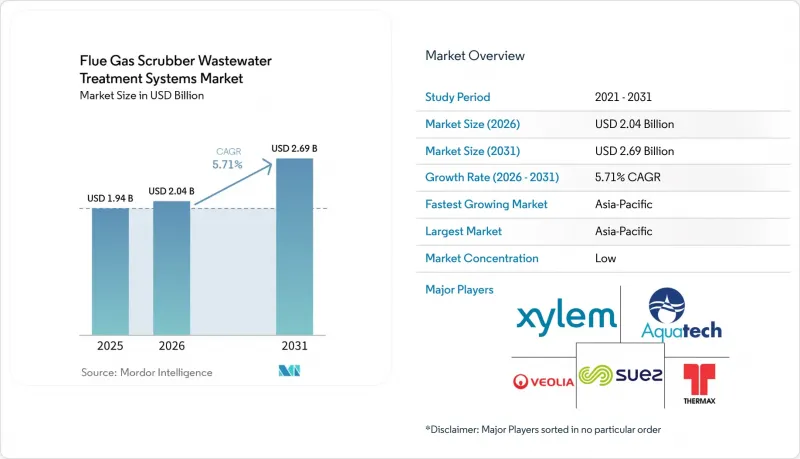
本報告按洗滌器類型(例如,半乾式洗滌器系統)、處理技術(例如,物理處理和化學處理)、污染物類型(例如,氯化物和硫酸鹽)、終端用戶產業(例如,燃煤發電廠)和地區(例如,亞太地區、北美地區、歐洲地區)進行細分。市場預測以美元計價。
全球廢氣洗滌器污水處理系統市場趨勢及洞察
零排放,並對有害金屬實施更嚴格的排放標準。
美國環保署 (EPA) 於 2024 年 7 月 8 日生效的 2024 年最終規則強制要求透過薄膜過濾、噴霧乾燥蒸發或熱處理等方法徹底去除煙氣脫硫 (FGD)污水中的污染物。此規則規定硒的 30 天平均值為 29 µg/L,汞的 30 天平均值為 34 ng/L。這些基準值使得傳統的化學沉澱方法無法滿足許多設施的需求,從而增加了對多層級處理的需求。 EPA 於 2025 年 12 月將合規期限延長至 2034 年 12 月 31 日,並將即時進行資本投資的要求改為更長的專案規劃期。中國現行標準也對零排放脫硫污水處理系統提出了類似的設計和驗收要求。這些要求共同縮小了可接受技術的範圍,並增加了煙氣洗滌器污水處理系統市場對成熟供應商的需求。
擴建專用煙氣脫硫污水處理設施
煙氣脫硫(FGD)排放水中含有20,000至60,000毫克/公升的氯化物、超過13,000毫克/公升的懸浮物以及重金屬,具體含量取決於煤源。這些污染物可能不足以滿足電廠中央廢水處理系統的要求,因此需要引入專用處理設施。喬治亞電力公司已在鮑恩電廠建造專用的FGD廢水處理系統,並計畫於2025年9月前完成最佳化。此計畫結合了物理和化學方法去除砷和汞,以及生物方法去除硒和硝酸鹽/亞硝酸鹽。史坦泰克公司在維尼亞電廠的項目包括一座佔地20萬平方英尺的兩層設施,內設超濾、化學品儲存、加藥系統和壓濾機。此類設施即使在發電裝置關閉後仍能繼續承擔環境責任,從而促成更長期的運營和維護契約,並為煙氣洗滌器污水處理系統市場帶來持續的收入。
高熱蒸發能耗與生命週期成本
包括濃縮鹽水裝置、強制循環結晶器和噴霧乾燥蒸發器在內的熱力零液體排放系統,每處理一立方米煙氣脫硫污水需消耗7至12千瓦時(kWh)的能源。膜式零液體排放系統每處理一立方公尺煙氣脫硫污水僅需消耗3至6千瓦時(kWh)的能源,因此具有能源成本優勢。在電價和碳排放成本較高的地區,這種差異尤其顯著。自2016年以來,全套零液體排放系統的資本投資增加了48%,這給小規模設施和市政垃圾焚化發電發電廠帶來了沉重的經濟負擔。雖然餘熱回收可以緩解這項負擔,但並不能消除根本的能源需求。這種成本限制正在減緩煙氣洗滌器污水處理系統市場的普及,尤其是在排放法規較為寬鬆或專案預算有限的地區。
細分市場分析
2025年,濕式排煙脫硫(FGD)系統佔據了煙氣洗滌器污水處理系統市場65.42%的佔有率。這些裝置包括長期運作的石灰石和石膏系統,在正常運作條件下持續排放污水。 2025年,濕式運作被認為是公用事業規模煙道氣體處理技術的標準,供應商包括Andritz、Dusan Lentges、Babcock & Wilcox、三菱重工和GEA。因此,濕式系統的市場規模主要由新裝置和現有設施的升級改造共同驅動。
預計到2031年,乾式脫硫系統將以6.34%的複合年成長率達到最高成長。對於100兆瓦以下的發電單元,濕式煙氣脫硫裝置的資本投資成本高達1,330美元/千瓦,使得乾式脫硫方案更具吸引力,其重要性也日益凸顯。雖然乾式系統產生的是固態產品,且無需專門的污水處理設施,但半乾式和多污染物脫硫系統在歐洲和日本仍扮演著重要角色。儘管濕式煙氣脫硫裝置在短期內仍佔據主導地位,但從長遠來看,乾式脫硫裝置的普及應用可能會縮小污水處理的需求基礎。
至2025年,物理和化學處理將佔廢氣洗滌器污水處理系統市場佔有率的36.87%。石灰軟化、鐵共沉澱和膠凝作用是常用的固態和某些可溶性污染物的初級處理方法。這些方法的營業成本為每噸4-6美元,對於不受零排放要求約束的業者來說,是個易於採用的選擇。此外,這些方法在大規模膜處理和熱處理過程中仍然是重要的預處理步驟。
預計到2031年,蒸發和結晶系統將以6.12%的複合年成長率成長。零排放法規要求業者對部分處理後的殘餘濃鹽水進行管理,這推動了對該類技術的需求。一份2025年的調查報告顯示,混合式逆滲透和強制循環結晶系統的水回收率高達94%,而正滲透和膜蒸餾系統的水回收率達89%,離子去除率達99.7%。 Aquatech公司的泰安專案實現了近100%的水回收率,並將營運成本降低了20%以上。同時,膜處理和生物處理系統有助於預濃縮以及硒和硝酸鹽的去除。
區域分析
預計到2025年,亞太地區將佔據廢氣洗滌器污水處理系統市場43.18%的佔有率,並在2031年之前以6.47%的複合年成長率成長。中國的零排放標準規定了火力發電廠廢水處理系統的設計和驗收要求。該框架支持了該地區對旨在實現廢水再利用、鹽水管理和固化的系統的需求。韓國繼續保持其作為大規模處理項目最尖端科技市場的地位。 Aquatech公司為6.1吉瓦泰安電廠安裝的60立方公尺/小時零液體排放系統實現了近100%的商業水回收率。
北美是第二大區域市場,這主要受美國127座配備濕式排煙脫硫(FGD)設施的燃煤發電廠的監管合規要求所驅動。鮑恩電廠已於2025年9月前最佳化了其專用FGD污水處理系統。佔地20萬平方英尺的維尼爾設施清晰地展現了該地區專用處理基礎設施的規模。美國環保署(EPA)的延期政策已將短期合規週期轉變為持續到2034年的長期資本投資計畫。根據美國能源資訊署(EIA)的報告,儘管計畫在2025年初退役8.5吉瓦的燃煤發電廠,但實際退役的僅有2.6吉瓦。
在歐洲,受分階段淘汰燃煤發電計畫和《工業排放指令》要求的推動,廢水處理需求維持穩定。德國的2038年目標要求營運中的發電廠遵守許可證和廢棄物管理規定,而波蘭和捷克共和國仍在繼續投入與合規相關的運作中。威立雅為沙烏地阿美道達爾煉油和石化公司(SATORP)位於朱拜勒的綜合設施簽訂的價值5億美元的工業用水契約,清晰地展現了中東地區工業用水投資的規模。巴西的垃圾焚化發電計畫和南非的燃煤發電結構為廢氣洗滌器污水處理系統市場帶來了特定的商機。
其他好處:
- Excel格式的市場預測(ME)表
- 3個月的分析師支持
目錄
第1章:引言
- 研究假設和市場定義
- 調查範圍
第2章:調查方法
第3章執行摘要
第4章 市場狀況
- 市場概覽
- 市場促進因素
- 零排放,並對有害金屬實施更嚴格的排放標準。
- 擴建煙氣脫硫專用污水處理設施
- 老舊燃煤電廠設施的維修
- 面臨缺水困境的發電叢集迫切需要水資源再利用
- 模組化生物去除硒和硝酸鹽
- 棕地改造,包括灰塘改造和現有污水處理設施的淨化。
- 市場限制因素
- 高熱蒸發能耗與生命週期成本
- 腐蝕、結垢和高氯化物環境下的可靠性風險
- 燃煤發電廠除役和排煙脫硫設施的擱淺資產風險。
- 缺乏各地點可行性數據以及熟練操作人員短缺。
- 價值鏈分析
- 波特五力分析
第5章 市場規模與成長預測
- 按洗滌器類型
- 濕式廢氣脫硫系統
- 半乾式洗滌器系統
- 乾式洗滌器系統
- 其他(高污染洗滌系統)
- 透過加工技術
- 物理和化學處理
- 薄膜過濾系統
- 蒸發結晶系統
- 生物加工系統
- 其他(零液體排放系統)
- 按污染物類型
- 重金屬(汞、硒、砷)
- 氯化物和硫酸鹽
- 總懸浮固體(TSS)
- 其他(硝酸鹽、氨、混合污染物)
- 按最終用戶行業分類
- 燃煤發電廠
- 垃圾焚化發電發電廠
- 水泥廠
- 金屬和採礦
- 其他應用(化學、石油化工和船舶洗滌器應用)
- 按地區
- 亞太地區
- 中國
- 印度
- 日本
- 韓國
- 其他亞太國家
- 北美洲
- 美國
- 加拿大
- 墨西哥
- 歐洲
- 德國
- 英國
- 法國
- 義大利
- 其他歐洲國家
- 南美洲
- 巴西
- 阿根廷
- 其他南美國家
- 中東和非洲
- 沙烏地阿拉伯
- 南非
- 其他中東和非洲國家
- 亞太地區
第6章 競爭情勢
- 市場集中度
- 策略趨勢
- 市佔率和排名分析
- 公司簡介
- Andritz
- Aquatech
- Babcock and Wilcox Enterprises, Inc.
- CECO ENVIRONMENTAL
- Chiyoda Corporation
- Doosan Enerbility
- Ducon Infratechnologies Ltd.
- GEA Group Aktiengesellschaft
- Hitachi Zosen Inova AG
- Kurita Water Industries Ltd.
- MITSUBISHI HEAVY INDUSTRIES, LTD.
- SUEZ
- Thermax Limited
- Veolia
- Xylem
第7章 市場機會與未來展望
According to Mordor Intelligence, the flue gas scrubber wastewater treatment systems market size was valued at USD 1.94 billion in 2025 and is estimated to grow from USD 2.04 billion in 2026 to reach USD 2.69 billion by 2031, at a CAGR of 5.71% during the forecast period (2026-2031).
This report is Segmented by Scrubber Type (Semi-Dry Scrubber Systems and More), Treatment Technology (Physical and Chemical Treatment and More), Contaminant Type (Chlorides and Sulfates and More), End-User Industry (Coal-Fired Power Plants and More), and Geography (Asia-Pacific, North America, Europe, and More). The Market Forecasts are Provided in Terms of Value (USD).
Global Flue Gas Scrubber Wastewater Treatment Systems Market Trends and Insights
Tightening Zero-Discharge and Toxic-Metal Limits
The U.S. EPA's 2024 Final Rule, which took effect on July 8, 2024, requires complete pollutant elimination from FGD wastewater through membrane filtration, spray-dry evaporation, or thermal treatment. The rule sets limits of 29 µg/L for selenium and 34 ng/L for mercury as a 30-day average. These limits make conventional chemical precipitation inadequate for many sites and increase demand for multi-stage treatment. The EPA's December 2025 extension moved the compliance deadline to December 31, 2034, replacing an immediate capital requirement with a longer project planning period. China's current standard establishes parallel design and acceptance requirements for zero-discharge desulfurization wastewater systems. Together, these requirements narrow the range of acceptable technologies and support demand for established vendors in the flue gas scrubber wastewater treatment systems market.
Expansion of Dedicated FGD Wastewater Treatment Facilities
FGD blowdown contains 20,000-60,000 mg/L of chlorides, suspended solids above 13,000 mg/L, and heavy metals that vary with coal source. These conditions can overwhelm a central plant wastewater system and prompt the use of purpose-built treatment facilities. Georgia Power completed construction of a dedicated FGD wastewater system at Plant Bowen, with optimization underway by September 2025. The project combines physical and chemical treatment for arsenic and mercury with biological treatment for selenium and nitrate-nitrite removal. Stantec's Winyah Generating Station project included a 200,000-square-foot, two-story facility with ultrafiltration, chemical storage, dosing systems, and filter presses. Such facilities can generate longer operations and maintenance contracts because environmental liabilities remain after a unit closes, supporting recurring revenue in the flue gas scrubber wastewater treatment systems market.
High Thermal-Evaporation Energy and Lifecycle Cost
Thermal zero-liquid-discharge systems, including brine concentrators, forced-circulation crystallizers, and spray-dry evaporators, consume 7 kWh/m3 to 12 kWh/m3 of treated FGD wastewater. Membrane-based zero-liquid-discharge systems consume 3 kWh/m3 to 6 kWh/m3, giving membrane-based configurations an energy-cost advantage. This difference is significant in regions with high electricity prices or carbon costs. Full zero-liquid-discharge capital expenditure has increased by 48% since 2016, limiting affordability for smaller facilities and municipal waste-to-energy sites. Waste-heat integration can reduce this burden but does not eliminate the underlying energy requirement. This cost constraint slows adoption in the flue gas scrubber wastewater treatment systems market, particularly where discharge requirements are less strict or project budgets are limited.
Other drivers and restraints analyzed in the detailed report include:
- Retrofitting of Aging Coal-Fired Units
- Water Reuse Pressure in Water-Stressed Power Clusters
- Corrosion, Scaling, and High-Chloride Reliability Risk
For complete list of drivers and restraints, kindly check the Table Of Contents.
Segment Analysis
Wet flue gas desulfurization (FGD) systems held 65.42% of the flue gas scrubber wastewater treatment systems market share in 2025. Their installed base consists of long-running limestone-gypsum systems that produce continuous wastewater blowdown under normal operating conditions. Wet FGD was the reference utility-scale flue gas treatment technology in 2025, with Andritz, Doosan Lentjes, Babcock & Wilcox, Mitsubishi Heavy Industries, and GEA among its suppliers. The market size associated with wet systems is therefore linked mainly to upgrades of an existing fleet, rather than to new installations alone.
Dry scrubber systems are forecast to record the highest growth at a 6.34% CAGR through 2031. They are gaining relevance at units below 100 MW, where wet FGD capital costs of USD 1,330/kW can make dry alternatives more attractive. Dry systems produce a solid byproduct and do not require a dedicated wastewater treatment facility, while semi-dry and multi-pollutant systems continue to play a role in Europe and Japan. Wider dry adoption could reduce the long-term wastewater treatment base, even though wet FGD continues to determine near-term demand.
Physical and chemical treatment captured 36.87% of the flue gas scrubber wastewater treatment systems market share in 2025. Lime softening, iron co-precipitation, and coagulation-flocculation provide common first-stage treatment for solids and selected dissolved contaminants. Their USD 4/ton to USD 6/ton operating cost supports use where operators do not face zero-discharge requirements. These methods also remain important upstream steps in larger membrane and thermal treatment trains.
Evaporation and crystallization systems are forecast to grow at a 6.12% CAGR through 2031. Zero-discharge rules require operators to manage the residual brine after partial treatment, thereby supporting this technology category. A 2025 review reported up to 94% water recovery for hybrid reverse-osmosis and forced-circulation crystallizer systems, and 89% recovery with 99.7% ion removal for forward-osmosis and membrane-distillation systems. Aquatech's Taean project achieved near-100% water recovery and reduced operating expenditure by more than 20%, while membrane and biological systems support pre-concentration and the removal of selenium or nitrate.
Complete Report Scope:
- By Scrubber Type
- Wet Flue Gas Desulfurization Systems
- Semi-Dry Scrubber Systems
- Dry Scrubber Systems
- Others (Multi-Pollutant Scrubber Systems)
- By Treatment Technology
- Physical and Chemical Treatment
- Membrane Filtration Systems
- Evaporation and Crystallization Systems
- Biological Treatment Systems
- Others (Zero Liquid Discharge Systems)
- By Contaminant Type
- Heavy Metals (Mercury, Selenium, Arsenic)
- Chlorides and Sulfates
- Total Suspended Solids (TSS)
- Others (Nitrates, Ammonia, Mixed Contaminants)
- By End-User Industry
- Coal-Fired Power Plants
- Waste-to-Energy Plants
- Cement Plants
- Metals and Mining
- Others (Chemicals, Petrochemicals and Marine Scrubber Applications)
- By Geography
- Asia-Pacific
- China
- India
- Japan
- South Korea
- Rest of Asia-Pacific
- North America
- United States
- Canada
- Mexico
- Europe
- Germany
- United Kingdom
- France
- Italy
- Rest of Europe
- South America
- Brazil
- Argentina
- Rest of South America
- Middle-East and Africa
- Saudi Arabia
- South Africa
- Rest of Middle-East and Africa
- Asia-Pacific
Geography Analysis
Asia-Pacific held 43.18% of the flue gas scrubber wastewater treatment systems market share in 2025 and is forecast to grow at a 6.47% CAGR through 2031. China's zero-discharge standard defines treatment-system design and acceptance requirements across thermal power plants. This framework supports regional demand for systems designed for reuse, brine management, and solidification. South Korea remains a premium technology market for large treatment projects. Aquatech's 60 m3/h zero-liquid-discharge system at the 6.1 GW Taean station achieved near-100% commercial water recovery.
North America is the second-largest regional market, supported by compliance requirements at more than 127 wet-flue-gas-desulfurization (FGD)-equipped U.S. coal units. Plant Bowen optimized its dedicated FGD wastewater system by September 2025. The 200,000-square-foot Winyah facility illustrates the scale of the region's dedicated treatment infrastructure. The EPA's extension converts a short compliance cycle into a longer capital program through 2034. The EIA reported that only 2.6 GW of coal capacity retired in 2025, despite 8.5 GW planned at the beginning of that year.
Europe maintains stable treatment demand, driven by phased coal exit plans and requirements under the Industrial Emissions Directive. Germany's 2038 target leaves operating units subject to permit and waste-management conditions, while Poland and the Czech Republic sustain compliance spending. Veolia's USD 500 million industrial-water contract for the Saudi Aramco Total Refining and Petrochemical Company (SATORP) complex in Jubail reflects the scale of industrial-water investment in the Middle-East. Brazil's waste-to-energy pipeline and South Africa's coal-heavy generation fleet offer selective opportunities in the flue gas scrubber wastewater treatment systems market.
- Andritz
- Aquatech
- Babcock and Wilcox Enterprises, Inc.
- CECO ENVIRONMENTAL
- Chiyoda Corporation
- Doosan Enerbility
- Ducon Infratechnologies Ltd.
- GEA Group Aktiengesellschaft
- Hitachi Zosen Inova AG
- Kurita Water Industries Ltd.
- MITSUBISHI HEAVY INDUSTRIES, LTD.
- SUEZ
- Thermax Limited
- Veolia
- Xylem
Additional Benefits:
- The market estimate (ME) sheet in Excel format
- 3 months of analyst support
TABLE OF CONTENTS
1 Introduction
- 1.1 Study Assumptions and Market Definition
- 1.2 Scope of the Study
2 Research Methodology
3 Executive Summary
4 Market Landscape
- 4.1 Market Overview
- 4.2 Market Drivers
- 4.2.1 Tightening Zero-Discharge and Toxic-Metal Limits
- 4.2.2 Expansion of Dedicated FGD Wastewater Treatment Facilities
- 4.2.3 Retrofitting of Aging Coal-Fired Units
- 4.2.4 Water Reuse Pressure in Water-Stressed Power Clusters
- 4.2.5 Modular Biological Removal of Selenium and Nitrates
- 4.2.6 Brownfield Integration With Ash-Pond and Legacy-Wastewater Remediation
- 4.3 Market Restraints
- 4.3.1 High Thermal-Evaporation Energy and Lifecycle Cost
- 4.3.2 Corrosion, Scaling, and High-Chloride Reliability Risk
- 4.3.3 Coal-Fleet Retirement and FGD Stranded-Asset Risk
- 4.3.4 Shortage of Site-Specific Treatability Data and Skilled Operators
- 4.4 Value Chain Analysis
- 4.5 Porter's Five Forces Analysis
- 4.5.1 Threat of New Entrants
- 4.5.2 Bargaining Power of Suppliers
- 4.5.3 Bargaining Power of Buyers
- 4.5.4 Threat of Substitutes
- 4.5.5 Competitive Rivalry
5 Market Size and Growth Forecasts (Value)
- 5.1 By Scrubber Type
- 5.1.1 Wet Flue Gas Desulfurization Systems
- 5.1.2 Semi-Dry Scrubber Systems
- 5.1.3 Dry Scrubber Systems
- 5.1.4 Others (Multi-Pollutant Scrubber Systems)
- 5.2 By Treatment Technology
- 5.2.1 Physical and Chemical Treatment
- 5.2.2 Membrane Filtration Systems
- 5.2.3 Evaporation and Crystallization Systems
- 5.2.4 Biological Treatment Systems
- 5.2.5 Others (Zero Liquid Discharge Systems)
- 5.3 By Contaminant Type
- 5.3.1 Heavy Metals (Mercury, Selenium, Arsenic)
- 5.3.2 Chlorides and Sulfates
- 5.3.3 Total Suspended Solids (TSS)
- 5.3.4 Others (Nitrates, Ammonia, Mixed Contaminants)
- 5.4 By End-User Industry
- 5.4.1 Coal-Fired Power Plants
- 5.4.2 Waste-to-Energy Plants
- 5.4.3 Cement Plants
- 5.4.4 Metals and Mining
- 5.4.5 Others (Chemicals, Petrochemicals and Marine Scrubber Applications)
- 5.5 By Geography
- 5.5.1 Asia-Pacific
- 5.5.1.1 China
- 5.5.1.2 India
- 5.5.1.3 Japan
- 5.5.1.4 South Korea
- 5.5.1.5 Rest of Asia-Pacific
- 5.5.2 North America
- 5.5.2.1 United States
- 5.5.2.2 Canada
- 5.5.2.3 Mexico
- 5.5.3 Europe
- 5.5.3.1 Germany
- 5.5.3.2 United Kingdom
- 5.5.3.3 France
- 5.5.3.4 Italy
- 5.5.3.5 Rest of Europe
- 5.5.4 South America
- 5.5.4.1 Brazil
- 5.5.4.2 Argentina
- 5.5.4.3 Rest of South America
- 5.5.5 Middle-East and Africa
- 5.5.5.1 Saudi Arabia
- 5.5.5.2 South Africa
- 5.5.5.3 Rest of Middle-East and Africa
- 5.5.1 Asia-Pacific
6 Competitive Landscape
- 6.1 Market Concentration
- 6.2 Strategic Moves
- 6.3 Market Share (%)/Ranking Analysis
- 6.4 Company Profiles (includes Global Overview, Market Overview, Core Segments, Financials as available, Strategic Information, Products and Services, and Recent Developments)
- 6.4.1 Andritz
- 6.4.2 Aquatech
- 6.4.3 Babcock and Wilcox Enterprises, Inc.
- 6.4.4 CECO ENVIRONMENTAL
- 6.4.5 Chiyoda Corporation
- 6.4.6 Doosan Enerbility
- 6.4.7 Ducon Infratechnologies Ltd.
- 6.4.8 GEA Group Aktiengesellschaft
- 6.4.9 Hitachi Zosen Inova AG
- 6.4.10 Kurita Water Industries Ltd.
- 6.4.11 MITSUBISHI HEAVY INDUSTRIES, LTD.
- 6.4.12 SUEZ
- 6.4.13 Thermax Limited
- 6.4.14 Veolia
- 6.4.15 Xylem
7 Market Opportunities and Future Outlook
- 7.1 White-Space and Unmet-Need Assessment

 蓄熱式熱氧化設備市場規模、佔有率和成長分析:按類型、系統配置、最終用途產業和地區分類-2026-2033年產業預測
 2026年全球工業廢氣處理系統市場報告
 航太密封劑清除工具市場規模、佔有率和成長分析:按工具類型、材料成分、應用、維護等級和地區分類-2026-2033年產業預測
 工業脫氮系統及服務市場:依技術、服務類型、燃料類型及最終用途產業分類-2026-2032年全球市場預測廢氣處理系統市場:依技術、應用、最終用戶和銷售管道分類-2026-2032年全球市場預測廢氣處理系統市場:依技術、設備類型、污染物類型、處理能力及終端用戶產業分類,全球預測(2026-2032年)2026年全球工業消毒系統和服務市場報告2026年全球廢氣處理系統市場報告
 廢氣處理系統市場-全球產業規模、佔有率、趨勢、機會和預測:按產業類型、污染物控制系統、最終用戶、地區和競爭格局分類,2021-2031年廢氣處理系統解決方案市場按處理技術、系統類型、污染物類型、應用領域和最終用戶產業分類-全球預測(2026-2032 年)