


 |
市場調查報告書
商品編碼
2119278
人工智慧在自主機器中的應用:市場佔有率分析、產業趨勢與統計數據及成長預測(2026-2031)AI For Autonomous Machines - Market Share Analysis, Industry Trends & Statistics, Growth Forecasts (2026 - 2031) |
||||||

※ 本網頁內容可能與最新版本有所差異。詳細情況請與我們聯繫。
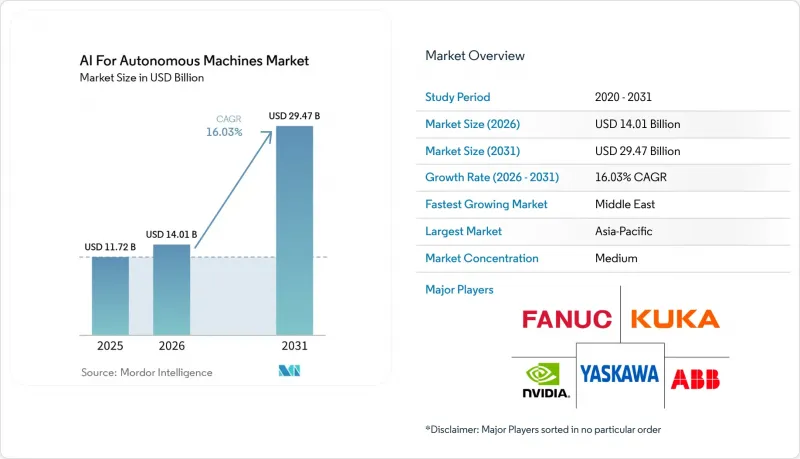
根據 Mordor Intelligence 預測,自主機器的 AI 市場規模將從 2025 年的 117.2 億美元和 2026 年的 140.1 億美元成長到 2031 年的 294.7 億美元,2026 年至 2031 年的年複合成長率(CAGR)為 16.03%。
本報告按組件(硬體、軟體、服務)、自主機器類型(無人地面車輛、無人飛行器、無人船等)、技術(機器學習、深度學習等)、終端用戶行業(汽車、電子和半導體等)以及地區進行細分。市場預測以美元計價。
全球人工智慧市場趨勢及自主機器洞察
電子商務履約自動化
隨著訂單量不斷成長,以及消費者對更短配送時間的期望日益提高,倉儲自動化已成為大型物流業者的核心投資重點。亞馬遜計畫在2025年在其履約網路中部署超過75萬台機器人,這充分展現了機器人系統如今在日常運作中所扮演的強大角色。 2026年6月,亞馬遜也宣布將投資100億歐元(約116億美元)用於其歐洲履約網路,並引進新型人工智慧設備。在大規模網路中,揀貨、路線規劃、搬運和異常管理等環節都會產生營運數據,這些數據有助於改善後續的軟體模型。這種數據優勢提高了獨立供應商的進入門檻,因為他們無法進入許可權同等的實際營運環境資訊。此外,隨著中型物流業者擴大尋求將支出與配送結果和處理能力掛鉤的「機器人即服務」(RaaS)契約,自主機器的人工智慧市場也從中受益。
用於即時自動駕駛的邊緣人工智慧運算
透過在機器邊緣實現更高效能的運算,自主系統無需等待遠端雲端的回應即可做出決策。 2026年1月,NVIDIA發布了Jetson T4000模組,該模組採用70瓦設計,擁有1200 FP4 TFLOPS的性能,售價為每千台1999美元。 NVIDIA也為人形機器人、農業機器人和手術機器人提供Jetson AGX Thor,將高效能本地處理擴展到更多類型的機器。低延遲支援機器必須對運動、障礙物或不斷變化的物理環境做出即時反應的應用。 ABB表示,其RobotStudio HyperReality與NVIDIA Omniverse結合使用,可將部署成本降低高達40%,並將上市時間縮短高達50%。這一趨勢透過使模擬和本地推理在小規模部署專案中更加實用,從而推動了自主機器人工智慧市場的發展。
分散的安全與責任框架
各國在安全、課責和責任方面的法規差異會導致供應商跨境部署同一平台時成本增加和延誤。歐盟人工智慧法將於2026年8月全面實施,該法規定了高風險系統的義務,包括人工監督、事件記錄和基本權利評估。歐盟產品責任指令對人工智慧驅動的軟體適用嚴格責任制,並必須在2026年12月9日前納入各國法律。歐盟人工智慧責任指令草案於2025年初撤回,使得歐盟層級基於過失的民事責任問題仍未解決。 IEC 61508和ISO 13849等標準是有用的指南,但供應商仍需在不同的法律體制內應用這些標準。在人工智慧自主機器市場,那些已經擁有安全流程、認證記錄和完善的系統管理架構的公司可能更具優勢。
細分市場分析
2025年,硬體在人工智慧自主機器市場中佔據57.48%的佔有率(按組件分類)。邊緣運算模組、LiDAR單元、攝影機、力矩感測器和致動器仍然是機器感知和運行於物理環境的關鍵組件。這些採購支撐了倉庫機器人、工業單元、車輛和現場設備的硬體需求。本地運算硬體提升了機器在應用現場處理資料的能力。 NVIDIA的Jetson產品廣泛應用於人形機器人、農業機器人和手術機器人等各種應用情境。服務子領域包括安裝、維護、模型重訓練和車隊管理支援。雖然服務在絕對值上小於硬體和軟體,但隨著部署機器數量的增加,其市場佔有率也在成長。服務供應商還幫助營運商滿足特定場所的安全和系統整合需求。這些活動表明,服務在人工智慧自主機器市場的迭代部署中發揮著至關重要的作用。
軟體預計將成為成長最快的產業,到2031年複合年成長率將達到18.53%。市場需求主要集中在世界基礎模型、車隊編配平台、電腦視覺和模擬工具等方面,這些工具能夠縮短開發週期。軟體使營運商能夠在多種機器類型和位置部署單一的控制方法,這在企業需要變更任務而無需重建機器系統時非常有用。人工智慧在自主機器領域的軟體市場規模成長主要得益於專有模型資產、營運數據以及連接這些資產和車隊的介面的普及。 NVIDIA 的 Cosmos 平台旨在將合成世界生成、視覺推理和行為仿真相結合,用於物理人工智慧的開發。軟體公司可以透過模型更新、分析和遠端車隊支援來獲得持續的收入。硬體製造商正在透過在其產品中添加軟體、模擬和生命週期服務來響應這一趨勢。軟體的價值仍然取決於與感測器、運算模組和實體安全系統的安全整合。
2025年,工業機器人和協作機器人將佔自主機械領域40.87%的佔有率。這些應用支援精密組裝、物料搬運、焊接、檢測和機器操作。半導體製造和物流是關鍵的需求來源,因為它們對誤差的容忍度低,且需要可重複的加工流程。協作機器人的應用範圍正從傳統的汽車組裝擴展到更廣泛的生產環境。由於工業機器人和協作機器人擁有廣泛的應用記錄,且對高度自適應控制的需求日益成長,它們仍然是自主機械人工智慧市場的核心。對半導體製造、電子組裝和履約設施的投資進一步鞏固了這些機器的短期作用。成功的部署仍然取決於整合技能、工人培訓以及明確的人機互動安全措施。
預計到2031年,無人海上作業平台將成為成長最快的機械類型,年複合成長率將達到17.92%。海軍應用、海上能源設施巡檢和氣候監測作業正在推動對能夠執行更長時間任務的機器的需求。人工智慧輔助導航有助於操作人員適應不斷變化的海況並降低人身風險。美國海軍在其規劃中優先發展大型無人水面載具和超大型無人水下載具。無人機繼續應用於物流、基礎設施巡查和國防偵察。無人地面車輛在港口、礦業物流和軍事行動的應用日益廣泛。服務機器人、配送機器人、自主重型機械、農業機械和人形機器人也正在拓展自主機械的人工智慧市場。每類設備在安全、感知、環境和維護方面都有不同的要求。這種多樣性為跨實體系統以及專用平台運作的通用人工智慧層創造了空間。
區域分析
到2025年,亞太地區將佔據全球人工智慧(AI)自主機器市場42.47%的佔有率。該地區擁有大規模的製造能力、政府對自動化的支持以及電子產品生產的持續需求。在日本,2025年國內機器人訂單218,987台,較去年同期成長20%。相關訂單金額成長25.7%,達到1.05兆日圓(約68.8億美元)。預計到2026年,日本的訂單金額將成長16.7%,達到1.22兆日圓(約80.3億美元)。日本的「社會5.0」政策框架和中國的機器人認證標準可能會促進認證流程的縮短和在地採購。在印度,自主移動機器人在履約和電子產品製造領域的應用正在不斷擴展。在越南、泰國和馬來西亞,協作機器人的引進正隨著電子產品生產的擴張而穩步推進。
北美和歐洲構成了第二個主要區域叢集,儘管其需求推動要素有所不同。北美地區的部署主要集中在物流、汽車和國防領域,這主要得益於私人投資對無人系統和履約基礎設施的採購。亞馬遜預計到2026年,其資本支出將超過2,000億美元,而自主履約基礎設施是其關鍵投資領域之一。加拿大和墨西哥正受益於汽車供應鏈的整合和近岸外包。然而,歐洲的前景更為複雜,因為汽車產業的低迷正在影響一些機器人投資。德國2024年的機器人部署量為2.7萬台,較去年同期下降5%。歐洲的法規正在催生對經過認證和記錄的平台的需求,這可能有利於經驗豐富的供應商。雖然這種情況有利於受監管的系統,但也對進入人工智慧自主機器市場的新供應商提出了更高的行政要求。
預計中東將成為成長最快的地區,到2031年複合年成長率將達到16.84%。成長主要集中在阿拉伯聯合大公國(阿拉伯聯合大公國)和沙烏地阿拉伯,這兩個國家的產業多元化和智慧城市計畫正在推動自主物流、建築檢測和醫療機器人的應用。沙烏地阿拉伯食品藥物管理局正在製定醫療設備的註冊要求,為醫院自動化設備的監管路徑奠定基礎。杜拜、吉達和達曼的物流中心正在擴大自動駕駛車輛的營運規模,領先周邊幾個地區。非洲和南美洲的自主機械人工智慧市場仍處於起步階段。這些地區的自主機械人工智慧市場將取決於基礎設施、服務取得和當地的營運條件。在巴西,精密農業和自動化物料搬運領域的應用正在開發中。南非的深層採礦作業催生了對檢測和搬運系統的需求,以降低地下環境中的暴露風險。
其他好處:
- Excel格式的市場預測(ME)表
- 3個月的分析師支持
目錄
第1章:引言
- 研究假設和市場定義
- 調查範圍
第2章:調查方法
第3章執行摘要
第4章 市場狀況
- 市場概覽
- 市場促進因素
- 電子商務履約自動化
- 用於即時自動駕駛的邊緣人工智慧運算
- 人手不足和人事費用壓力
- 工業4.0和彈性自動化的實施
- 基於跨站點機器人數據的艦隊學習
- 能夠解決法律責任問題的模擬和數位孿生技術
- 市場限制因素
- 分散的安全和責任框架
- 初期整合和維修成本高。
- 缺乏針對特定任務的訓練極端情況
- 網實整合
- 產業價值鏈分析
- 監理情勢
- 技術展望
- 波特五力分析
第5章 市場規模與成長預測
- 按組件
- 硬體
- 軟體
- 服務
- 自主機器的類型
- 無人地面車輛
- 無人機
- 無人水面航行器
- 工業機器人與協作機器人
- 其他自主機器(服務和配送機器人、自主重型機械和農業機械、人形機器人和通用機器人)
- 透過技術
- 機器學習和深度學習
- 電腦視覺
- LiDAR和基於雷達的感知
- 感測器融合
- 其他技術
- 按最終用戶行業分類
- 車
- 電子和半導體
- 零售與電子商務
- 衛生保健
- 食品/飲料
- 航太/國防
- 其他終端用戶產業(農業和採礦業、能源和公共產業)
- 按地區
- 北美洲
- 美國
- 加拿大
- 墨西哥
- 南美洲
- 巴西
- 阿根廷
- 其他南美國家
- 歐洲
- 德國
- 英國
- 法國
- 義大利
- 西班牙
- 俄羅斯
- 其他歐洲國家
- 亞太地區
- 中國
- 日本
- 韓國
- 印度
- ASEAN
- 其他亞太國家
- 中東
- 沙烏地阿拉伯
- 阿拉伯聯合大公國
- 土耳其
- 以色列
- 其他中東國家
- 非洲
- 南非
- 埃及
- 奈及利亞
- 其他非洲國家
- 北美洲
第6章 競爭情勢
- 市場集中度
- 策略趨勢
- 市佔率分析
- 公司簡介
- NVIDIA Corporation
- ABB Ltd.
- FANUC Corporation
- KUKA AG
- Yaskawa Electric Corporation
- Siemens AG
- Microsoft Corporation
- IBM Corporation
- Alphabet Inc.
- Amazon.com, Inc.
- Mobile Industrial Robots A/S
- Zebra Technologies Corporation
- Locus Robotics Corporation
- Geek+Technology Co., Ltd.
- Boston Dynamics, Inc.
- SoftBank Robotics Group Corp.
- OMRON Corporation
- Honeywell International Inc.
- Caterpillar Inc.
- Deere & Company
- Qualcomm Technologies, Inc.
- Mobileye Global Inc.
第7章 市場機會與未來展望
According to Mordor Intelligence, the AI for autonomous machines market size is projected to expand from USD 11.72 billion in 2025 and USD 14.01 billion in 2026 to USD 29.47 billion by 2031, registering a CAGR of 16.03% between 2026 to 2031.
This report is Segmented by Component (Hardware, Software, and Services), Autonomous-Machine Type (Unmanned Ground Vehicles, Unmanned Aerial Vehicles, Unmanned Marine Vehicles, and More), Technology (Machine Learning and Deep Learning, and More), End-User Industry (Automotive, Electronics and Semiconductors, and More), and Geography. The Market Forecasts are Provided in Terms of Value (USD).
Global AI For Autonomous Machines Market Trends and Insights
E-Commerce Fulfillment Automation
Rising order volumes and shorter delivery expectations have made warehouse automation a core investment priority for large logistics operators. Amazon had deployed more than 750,000 robots in its fulfillment network by 2025, showing the scale at which robotic systems now support daily operations. In June 2026, Amazon also announced a EUR 10 billion (USD 11.6 billion) investment in its European fulfillment network, alongside new AI-enabled equipment. Large networks generate operating data from picking, routing, handling, and exception management, which can improve later software models. This data advantage raises the threshold for independent providers that lack comparable access to real operating environments. The AI for autonomous machines market also benefits as mid-sized logistics providers seek robotics-as-a-service contracts that link spending to delivery and throughput outcomes.
Edge-AI Compute for Real-Time Autonomy
More capable computing at the machine edge lets autonomous systems make decisions without waiting for a remote cloud response. NVIDIA released the Jetson T4000 module in January 2026 with 1,200 FP4 TFLOPS in a 70-watt design and a USD 1,999 price at 1,000-unit volume. NVIDIA also made Jetson AGX Thor available for humanoid, agricultural, and surgical robotics, extending high-performance local processing to more machine categories. Lower latency supports applications where a machine must respond immediately to movement, obstacles, or changing physical conditions. ABB stated that its RobotStudio HyperReality, working with NVIDIA Omniverse, can reduce deployment costs by up to 40% and shorten time to market by up to 50%. This pattern supports the AI for autonomous machines market by making simulation and local inference more practical for smaller deployment programs.
Fragmented Safety and Liability Frameworks
Different national rules on safety, accountability, and liability add cost and delay when providers deploy the same platform across borders. The EU AI Act entered full applicability in August 2026 and sets out obligations for high-risk systems, including human oversight, incident records, and fundamental rights assessments. The EU Product Liability Directive extends strict liability to AI-driven software and must be transposed into national law by December 9, 2026. The withdrawal of the proposed EU AI Liability Directive in early 2025 left fault-based civil liability unresolved at the EU level. Standards such as IEC 61508 and ISO 13849 provide useful reference points, but providers still need to apply them across separate legal settings. The AI for autonomous machines market may favor firms that already have safety processes, certification experience, and documented system controls.
Other drivers and restraints analyzed in the detailed report include:
- Labor Shortages and Workforce Cost Pressure
- Industry 4.0 and Flexible Automation Adoption
- High Upfront Integration and Retrofit Costs
For complete list of drivers and restraints, kindly check the Table Of Contents.
Segment Analysis
Hardware held 57.48% of the AI for autonomous machines market share by component in 2025. Edge computing modules, LiDAR units, cameras, force-torque sensors, and actuators remained necessary for machines to sense and act in physical settings. These purchases supported hardware demand across warehouse robots, industrial cells, vehicles, and field equipment. Local computing hardware has improved the ability of machines to process data at the point of use. NVIDIA's Jetson products are used for this purpose across humanoid, agricultural, and surgical robotics. The services sub-segment includes installation, maintenance, model retraining, and fleet-management support. It remains smaller than hardware and software in absolute terms, but it grows with the installed machine base. Service providers also help operators address site-specific safety and systems integration requirements. These activities make services important for repeat deployments within the AI for autonomous machines market.
Software is projected to be the fastest-growing component, with a CAGR of 18.53% through 2031. Demand centers on world foundation models, fleet-orchestration platforms, computer vision, and simulation tools that shorten development cycles. Software helps operators deploy one control approach across several machine types and sites. This is useful when a business needs to modify tasks without rebuilding mechanical systems. The AI for autonomous machines market size for software is supported by a shift toward proprietary model assets, operating data, and interfaces that connect them to fleets. NVIDIA's Cosmos platform is designed to combine synthetic world generation, vision reasoning, and action simulation for physical AI development. Software firms can build recurring revenue through model updates, analytics, and remote fleet support. Hardware manufacturers are responding by adding software, simulation, and lifecycle services to their offerings. The value of software still depends on reliable integration with sensors, compute modules, and physical safety systems.
Industrial robots and cobots accounted for 40.87% of the autonomous-machine-type segment in 2025. Their installed base supports precision assembly, material movement, welding, inspection, and machine tending. Semiconductor manufacturing and logistics are important sources of demand because each requires repeatable handling with limited tolerance for errors. Collaborative robots have expanded beyond traditional automotive assembly into more varied production environments. Industrial robots and cobots remain central to the AI for autonomous machines market because they combine a broad installed base with growing demand for adaptable control. Their near-term role is strengthened by investment in chip fabrication, electronics assembly, and fulfillment facilities. Adoption still depends on integration skills, worker training, and clear safeguards around human-machine interaction.
Unmanned marine vehicles are projected to be the fastest-growing machine type, with a 17.92% CAGR through 2031. Naval use, offshore energy inspection, and climate monitoring work create demand for machines that can remain on missions for longer periods. AI-guided navigation helps operators manage changing sea conditions and reduce direct human exposure. The United States Navy has emphasized large unmanned surface vehicles and extra-large unmanned undersea vehicles in its planning. Unmanned aerial vehicles continue to serve logistics, infrastructure inspection, and defense reconnaissance. Unmanned ground vehicles are gaining use in ports, mining logistics, and military operations. Service robots, delivery robots, autonomous heavy equipment, farm machinery, and humanoid machines are also broadening the AI for autonomous machines market. Each category has different safety, sensing, environmental, and maintenance requirements. This diversity creates room for specialized platforms as well as common AI layers that can work across physical systems.
Complete Report Scope:
- By Component
- Hardware
- Software
- Services
- By Autonomous-Machine Type
- Unmanned Ground Vehicles
- Unmanned Aerial Vehicles
- Unmanned Marine Vehicles
- Industrial Robots and Cobots
- Other Autonomous-Machine Types (Service and Delivery Robots, Autonomous Heavy Equipment and Farm Machinery, Humanoid and General-Purpose Robots)
- By Technology
- Machine Learning and Deep Learning
- Computer Vision
- LiDAR and Radar Perception
- Sensor Fusion
- Other Technologies
- By End-User Industry
- Automotive
- Electronics and Semiconductors
- Retail and E-commerce
- Healthcare
- Food and Beverage
- Aerospace and Defense
- Other End-User Industries (Agriculture and Mining, Energy and Utilities)
- By Geography
- North America
- United States
- Canada
- Mexico
- South America
- Brazil
- Argentina
- Rest of South America
- Europe
- Germany
- United Kingdom
- France
- Italy
- Spain
- Russia
- Rest of Europe
- Asia-Pacific
- China
- Japan
- South Korea
- India
- ASEAN
- Rest of Asia-Pacific
- Middle East
- Saudi Arabia
- United Arab Emirates
- Turkey
- Israel
- Rest of Middle East
- Africa
- South Africa
- Egypt
- Nigeria
- Rest of Africa
- North America
Geography Analysis
Asia-Pacific held 42.47% of the AI for autonomous machines market in 2025. The region combines large manufacturing capacity, government support for automation, and sustained demand from electronics production. Japan reported domestic robot orders of 218,987 units in 2025, up 20% from the prior year. The related order value rose 25.7% to JPY 1.05 trillion, equivalent to USD 6.88 billion. Japan's 2026 outlook calls for a 16.7% increase in order revenue to JPY 1.22 trillion, equivalent to USD 8.03 billion. Japan's Society 5.0 policy framework and China's robotics certification standards can shorten certification processes and support local procurement. India is expanding the use of autonomous mobile robots in e-commerce fulfillment and electronics manufacturing. Vietnam, Thailand, and Malaysia are also increasing the adoption of collaborative robots as electronics production grows.
North America and Europe form the second major regional cluster, although their demand drivers differ. North American adoption is concentrated in logistics, automotive, and defense, supported by procurement for unmanned systems and private investment in fulfillment infrastructure. Amazon forecast capital expenditure above USD 200 billion in 2026, with autonomous fulfillment infrastructure among its major investment areas. Canada and Mexico benefit from automotive supply chain integration and nearshoring. Europe has a more mixed outlook because weak automotive conditions affected some robot investment. Germany recorded 27,000 robot installations in 2024, a 5% decline from the prior year. European regulations create demand for certified, documented platforms, which can favor experienced providers. This setting supports compliant systems but increases administrative requirements for newer vendors in the AI market for autonomous machines.
The Middle East is projected to be the fastest-growing geography, with a CAGR of 16.84% through 2031. Growth is concentrated in the United Arab Emirates and Saudi Arabia, where industrial diversification and smart-city programs support autonomous logistics, construction inspection, and healthcare robotics. The Saudi Food and Drug Authority has issued requirements for medical-device registration that shape the regulatory path for hospital automation equipment. Logistics hubs in Dubai, Jeddah, and Dammam are scaling autonomous fleet operations ahead of several neighboring locations. Africa and South America remain earlier-stage regions for the AI for autonomous machines market. The AI for autonomous machines market in these regions depends on infrastructure, access to services, and local operating conditions. Brazil offers applications for precision agriculture and automated material handling. South Africa's deep-mining operations create demand for inspection and handling systems that reduce exposure in underground settings.
- NVIDIA Corporation
- ABB Ltd.
- FANUC Corporation
- KUKA AG
- Yaskawa Electric Corporation
- Siemens AG
- Microsoft Corporation
- IBM Corporation
- Alphabet Inc.
- Amazon.com, Inc.
- Mobile Industrial Robots A/S
- Zebra Technologies Corporation
- Locus Robotics Corporation
- Geek+ Technology Co., Ltd.
- Boston Dynamics, Inc.
- SoftBank Robotics Group Corp.
- OMRON Corporation
- Honeywell International Inc.
- Caterpillar Inc.
- Deere & Company
- Qualcomm Technologies, Inc.
- Mobileye Global Inc.
Additional Benefits:
- The market estimate (ME) sheet in Excel format
- 3 months of analyst support
TABLE OF CONTENTS
1 INTRODUCTION
- 1.1 Study Assumptions and Market Definition
- 1.2 Scope of the Study
2 RESEARCH METHODOLOGY
3 EXECUTIVE SUMMARY
4 MARKET LANDSCAPE
- 4.1 Market Overview
- 4.2 Market Drivers
- 4.2.1 E-commerce Fulfillment Automation
- 4.2.2 Edge-AI Compute for Real-Time Autonomy
- 4.2.3 Labor Shortages and Workforce Cost Pressure
- 4.2.4 Industry 4.0 and Flexible Automation Adoption
- 4.2.5 Fleet Learning From Cross-Site Robot Data
- 4.2.6 Liability-Ready Simulation and Digital Twins
- 4.3 Market Restraints
- 4.3.1 Fragmented Safety and Liability Frameworks
- 4.3.2 High Upfront Integration and Retrofit Costs
- 4.3.3 Scarcity of Task-Specific Edge Cases for Training
- 4.3.4 Cyber-Physical Attack Surface in Connected Fleets
- 4.4 Industry Value-Chain Analysis
- 4.5 Regulatory Landscape
- 4.6 Technological Outlook
- 4.7 Porter's Five Forces Analysis
- 4.7.1 Threat of New Entrants
- 4.7.2 Bargaining Power of Suppliers
- 4.7.3 Bargaining Power of Buyers
- 4.7.4 Threat of Substitutes
- 4.7.5 Intensity of Competitive Rivalry
5 MARKET SIZE AND GROWTH FORECASTS (VALUE)
- 5.1 By Component
- 5.1.1 Hardware
- 5.1.2 Software
- 5.1.3 Services
- 5.2 By Autonomous-Machine Type
- 5.2.1 Unmanned Ground Vehicles
- 5.2.2 Unmanned Aerial Vehicles
- 5.2.3 Unmanned Marine Vehicles
- 5.2.4 Industrial Robots and Cobots
- 5.2.5 Other Autonomous-Machine Types (Service and Delivery Robots, Autonomous Heavy Equipment and Farm Machinery, Humanoid and General-Purpose Robots)
- 5.3 By Technology
- 5.3.1 Machine Learning and Deep Learning
- 5.3.2 Computer Vision
- 5.3.3 LiDAR and Radar Perception
- 5.3.4 Sensor Fusion
- 5.3.5 Other Technologies
- 5.4 By End-User Industry
- 5.4.1 Automotive
- 5.4.2 Electronics and Semiconductors
- 5.4.3 Retail and E-commerce
- 5.4.4 Healthcare
- 5.4.5 Food and Beverage
- 5.4.6 Aerospace and Defense
- 5.4.7 Other End-User Industries (Agriculture and Mining, Energy and Utilities)
- 5.5 By Geography
- 5.5.1 North America
- 5.5.1.1 United States
- 5.5.1.2 Canada
- 5.5.1.3 Mexico
- 5.5.2 South America
- 5.5.2.1 Brazil
- 5.5.2.2 Argentina
- 5.5.2.3 Rest of South America
- 5.5.3 Europe
- 5.5.3.1 Germany
- 5.5.3.2 United Kingdom
- 5.5.3.3 France
- 5.5.3.4 Italy
- 5.5.3.5 Spain
- 5.5.3.6 Russia
- 5.5.3.7 Rest of Europe
- 5.5.4 Asia-Pacific
- 5.5.4.1 China
- 5.5.4.2 Japan
- 5.5.4.3 South Korea
- 5.5.4.4 India
- 5.5.4.5 ASEAN
- 5.5.4.6 Rest of Asia-Pacific
- 5.5.5 Middle East
- 5.5.5.1 Saudi Arabia
- 5.5.5.2 United Arab Emirates
- 5.5.5.3 Turkey
- 5.5.5.4 Israel
- 5.5.5.5 Rest of Middle East
- 5.5.6 Africa
- 5.5.6.1 South Africa
- 5.5.6.2 Egypt
- 5.5.6.3 Nigeria
- 5.5.6.4 Rest of Africa
- 5.5.1 North America
6 COMPETITIVE LANDSCAPE
- 6.1 Market Concentration
- 6.2 Strategic Moves
- 6.3 Market Share Analysis
- 6.4 Company Profiles (includes Global Level Overview, Market Level Overview, Core Segments, Financials as available, Strategic Information, Market Rank/Share, Products and Services, Recent Developments)
- 6.4.1 NVIDIA Corporation
- 6.4.2 ABB Ltd.
- 6.4.3 FANUC Corporation
- 6.4.4 KUKA AG
- 6.4.5 Yaskawa Electric Corporation
- 6.4.6 Siemens AG
- 6.4.7 Microsoft Corporation
- 6.4.8 IBM Corporation
- 6.4.9 Alphabet Inc.
- 6.4.10 Amazon.com, Inc.
- 6.4.11 Mobile Industrial Robots A/S
- 6.4.12 Zebra Technologies Corporation
- 6.4.13 Locus Robotics Corporation
- 6.4.14 Geek+ Technology Co., Ltd.
- 6.4.15 Boston Dynamics, Inc.
- 6.4.16 SoftBank Robotics Group Corp.
- 6.4.17 OMRON Corporation
- 6.4.18 Honeywell International Inc.
- 6.4.19 Caterpillar Inc.
- 6.4.20 Deere & Company
- 6.4.21 Qualcomm Technologies, Inc.
- 6.4.22 Mobileye Global Inc.
7 MARKET OPPORTUNITIES AND FUTURE OUTLOOK
- 7.1 White-Space and Unmet-Need Assessment

 自主系統市場(2026-2032):按基礎設施(機場和港口、控制系統、計算和資料中心)、組件、機器和車輛類型、部署模式和用例分類
 2026年全球自動導引車(AGV)調度系統市場報告
 2026-2030年全球自動導引車(AGV)軟體市場
 2034年自主工業運輸系統市場預測-全球導航、車輛類型、組件、軟體類型、技術、應用、最終用戶和區域分析
 自主海洋無人機市場規模、佔有率、成長、全球產業分析、區域趨勢及2026年至2034年預測自主飛行系統市場預測至2034年-按系統類型、自主等級、平台、應用、最終使用者和地區分類的全球分析
 2026-2030年全球自主海上監視系統市場2026年全球自主水面船舶市場報告自主工業系統市場預測至2034年-按組件、系統類型、技術、應用、最終用戶和地區分類的全球分析
 全球海事自主系統市場(按組件、自主等級、推進類型、船舶類型、應用和最終用戶分類)預測(2026-2032年)