


 |
市場調查報告書
商品編碼
2119254
水電解堆材料及組件:市場佔有率分析、產業趨勢及統計數據及成長預測(2026-2031)Water Electrolyzer Stack Materials and Components - Market Share Analysis, Industry Trends & Statistics, Growth Forecasts (2026 - 2031) |
||||||

※ 本網頁內容可能與最新版本有所差異。詳細情況請與我們聯繫。
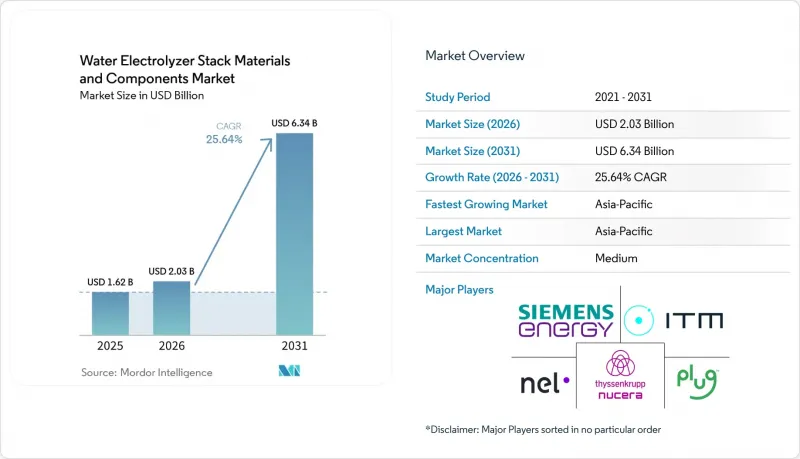
據 Mordor Intelligence 稱,2025 年水電電解堆材料和組件的市場規模估計為 16.2 億美元,預計從 2026 年的 20.3 億美元成長到 2031 年的 63.4 億美元,預測期(2026-2031 年)的複合年成長率為 25.64%。
本報告按技術(例如,鹼性電解槽)、組件類型(例如,雙極板)、材料類型(例如,鉑族金屬)、終端用戶行業(例如,儲能)和地區(亞太地區、北美地區、歐洲地區、南美地區以及中東和非洲地區)進行細分。市場預測以美元計價。
全球水電電解堆材料及組件市場趨勢及洞察。
氨、石油煉製和鋼鐵業的工業脫碳
氨、煉油和鋼鐵業的脫碳壓力,使得大型電解槽材料的需求持續成長。這些產業的氫氣消耗量遠超過交通運輸和分散式能源應用領域。 2026年1月,雷普索爾公司宣布將在其位於西班牙的Petronol煉油廠安裝第二座100兆瓦鹼性電解槽。該項目投資2.92億歐元(約3.3639億美元),計劃於2029年運作。該項目旨在每年生產高達1.5萬噸可再生氫氣。此類煉油廠專案需要穩定的薄膜、電極和其他堆疊材料的供應,而這些材料均來自水電解堆材料和組件市場。
2026年3月,蒂森克虜伯Nucera公司獲得一份契約,將為西班牙Møve公司承建的300兆瓦Onuba項目供應15套標準化的20兆瓦鹼性電解槽。該訂單表明,大規模工業電廠正在為水電電解堆材料和組件市場的供應商創造領先的採購需求。直接還原煉鋼需要高運轉率,這對分離器和電極的耐久性提出了極高的要求。能夠證明產品具有長運作的供應商將在持續高負荷運作的專案中擁有顯著優勢。
吉瓦級電解槽裝置
從兆瓦級以下的示範計畫向50兆瓦和200兆瓦級電站的過渡,正在改變各類電堆組件供應商的要求。 2026年5月,Nel ASA公司宣布推出其下一代加壓鹼性電解平台,目標是使25兆瓦電站的承包成本低於1,450美元/千瓦。該公司為此平台獲得了歐盟創新基金1.35億歐元(約1.5552億美元)的津貼,涵蓋了目標產業化成本的60%。此外,Nel公司於2025年12月最終決定投資擴建位於赫羅亞的工廠,使其年產能達到4吉瓦。這些投資反映了標準化製造在水電電解堆材料和組件市場中日益成長的重要性。
中國OEM廠商正在擴大裝置規模和工廠產能。隆基氫能的年產能為5.0吉瓦。雙樑公司宣布,到2024年底,其鹼性電解槽的能耗為4.532千瓦時/標準立方米氫氣,產能為5000標準立方公尺/小時。在水電電解堆材料和組件市場,大規模工廠更傾向於選擇能夠連續供應大面積薄膜片和雙極板材料的供應商。這項要求提高了認證標準,並可能導致長期供應合約集中在少數幾家技術合格的生產商手中。
銥、鉑、鈦和磺酸鹽磺酸(PFSA)的供應受到限制
銥的供應量與質子交換膜(PEM)的預期需求量之間的差距仍然是擴大PEM組件規模的主要阻礙因素。由於銥是鉑礦開採的副產品,因此快速擴大供應量十分困難。一項2026年的研究估計,全球銥的年產量為7-10噸,在淨零排放情境下,PEM水電電解可能需要消耗全球年銥產量的30%。如果部署規模在沒有進一步減少負載的情況下擴大,到2028年可能會出現供不應求。
鈦雙極板和鉑包覆多孔傳輸層面臨類似的成本壓力。在大規模生產中,鈦部件的加工成本仍比石墨和不銹鋼等替代材料高出4到5倍。此外,由於歐洲持續實施全氟烷基物質(PFAS)法規,PFSA膜供應商也面臨不確定性。水電電解堆材料和零件市場中新型薄膜、塗層和催化劑的化學成分在投入工業應用之前,需要經過漫長的檢驗過程。即使實驗室結果顯示材料用量減少且性能提高,這種認證風險也可能延緩其應用。
細分市場分析
到2025年,鹼性電解槽將佔據水電電解堆材料和組件市場54.40%的佔有率。這一地位得益於鎳、不銹鋼和鈦等材料的成熟供應鏈,以及在中國和歐洲100兆瓦級專案部署中累積的經驗。較低的材料成本正在推動鹼性電解系統在運作條件允許的情況下廣泛應用,這項技術在大型工業氫氣專案中繼續發揮核心作用。
預計從2026年到2031年,PEM電解槽的複合年成長率將達到28.52%,成為成長最快的技術領域。 PEM系統因其工作壓力、氣體純度和動態響應能力,在可再生能源併網和分散式應用中備受青睞。 AEM和SOEC技術的研究和開發投入仍在持續。 Enapter公司宣布將於2026年推出適用於100兆瓦以上混合電站的「AEM Stack 250」產品,而Topsoe公司也於2026年3月在丹麥赫寧開設了一家SOEC製造工廠。美國能源局提出的降低銥負載量和膜厚的目標,已成為PEM元件供應商衡量效能和成本的關鍵基準。
到2025年,膜和隔膜將佔市場佔有率的32.71%,並將應用於PEM、鹼性膜和AEM膜結構中。其中,PFSA膜將用於PEM系統,氧化鋯複合隔膜將用於鹼性膜系統,而具有陰離子交換功能的聚合物膜將用於AEM系統。
催化劑層和電極預計將成為成長最快的組件類別,到2031年年複合成長率(CAGR)將達到29.66%,這主要得益於AEM電堆銥負載量的降低以及非貴金屬雙功能催化劑的採用。雙極板佔PEM電堆成本的53%。 2026年發表在《Langmuir》雜誌上的一項研究報告稱,採用3D列印技術製備的、在鉻中階上塗覆鉑塗層的多孔不銹鋼傳輸層,其表面積增加了50倍,腐蝕率降低了96%。 2025年發表在《Nano-Micro Letters》雜誌上的一項研究說明了一種具有高孔隙率的層級構造多孔傳輸層,可改善氧氣傳輸。由於高溫固體氧化物電解池(SOEC)系統和不含PFAS的AEM系統需要特殊材料,因此墊片和密封件的專利申請仍然活躍。
區域分析
預計到2025年,亞太地區將佔據水電電解堆材料及組件市場37.46%的佔有率,並將在2031年之前維持29.05%的複合年成長率,成為該地區成長最快的市場。中國的製造規模、印度的本土化計畫以及韓國的氫能相關措施都在支撐該地區的需求。中國的產能和製造地使其在鹼性電池堆生產方面具有成本優勢。隆基氫能的年產能為5.0吉瓦。印度也正成為水電電解堆材料及組件的重要本土化市場。
蒂森克虜伯努塞拉公司(ThyssenKrupp Nusella)與印度重型電氣有限公司(BHEL)於2026年7月簽署戰略合作協議,旨在印度本地化生產鹼性水電電解模組。日本和韓國將提供薄膜化學和精密電極塗層技術。澳洲是綠色鐵和氨計畫的重要需求中心。 2025年8月,Progressive Green Solutions公司選擇蒂森克虜伯努塞拉公司作為其在澳洲開展的1.4吉瓦電解槽計畫的首選供應商。此舉旨在滿足水力發電電解堆材料和組件市場對大型鹼性電堆組件的區域需求。
歐洲在水電電解堆材料和組件的市佔率位居第二。德國、西班牙和荷蘭是歐盟氫能銀行支持的關鍵部署中心。歐盟委員會的氫能競標流程透過其創新基金支持可再生氫能計畫。 John Cockerail 於 2026 年 7 月組裝了法國首個 5 兆瓦鹼性電解堆。 Sunfire 的加壓系統在 2025 年於歐洲工業設施中的累積運作時間超過 85,000 小時。儘管北美面臨著與第 45V 條款相關的不確定性,但南美和中東地區擁有豐富的可再生能源和氨生產資源,蘊藏著巨大的機會。 NEOM 計畫的 2.2 吉瓦電解槽容量和 4.0 吉瓦配套可再生能源清楚地表明了沿岸地區供應商認證要求的規模。
其他好處:
- Excel格式的市場預測(ME)表
- 3個月的分析師支持
目錄
第1章:引言
- 研究假設和市場定義
- 調查範圍
第2章:調查方法
第3章執行摘要
第4章 市場狀況
- 市場概覽
- 市場促進因素
- 氨、煉油和鋼鐵業的脫碳
- 吉瓦級電解槽的引入
- 可再生能源併網及儲能
- 催化劑用量減少及各組分成本曲線
- 促進該地區製造業本地化的激勵措施
- 堆疊標準化和模組化製造
- 市場限制因素
- 銥、鉑、鈦和全氟磺酸的供應受到限制
- 與化石燃料製氫相比,綠色氫氣的高成本。
- 專案取消、資金籌措短缺和合約轉換延誤。
- 新型薄膜、塗料和催化化學的合格風險
- 價值鏈分析
- 波特五力模型
第5章 市場規模與成長預測
- 透過技術
- 質子交換膜(PEM)電解裝置
- 鹼性電解裝置
- 其他(AEM 和 SOEC)
- 依組件類型
- 膜和分離器
- 催化劑層和電極
- 雙極板
- 多孔傳輸層(PTL)/氣體擴散層(GDL)
- 其他(墊片、密封件、端板、MEA)
- 依材料類型
- 鉑族金屬(PGMs)
- 鎳、不鏽鋼、鈦
- 聚合物材料(PFSA、碳氫化合物、AEM)
- 石墨和碳複合材料
- 其他(陶瓷和新興材料)
- 按最終用戶行業分類
- 綠色氫氣生產
- Power-to-X 應用領域
- 工業應用(煉油、氨、鋼鐵)
- 儲能
- 其他(移動出行和氫燃料加註)
- 按地區
- 亞太地區
- 中國
- 印度
- 日本
- 韓國
- 其他亞太國家
- 北美洲
- 美國
- 加拿大
- 墨西哥
- 歐洲
- 德國
- 英國
- 法國
- 義大利
- 其他歐洲國家
- 南美洲
- 巴西
- 阿根廷
- 其他南美國家
- 中東和非洲
- 沙烏地阿拉伯
- 南非
- 其他中東和非洲國家
- 亞太地區
第6章 競爭情勢
- 市場集中度
- 策略趨勢
- 市佔率和排名分析
- 公司簡介
- Asahi Kasei Corporation
- Bloom Energy
- Cummins Inc.
- Enapter
- HydrogenPro
- ITM Power plc
- John Cockerill
- LONGi
- Nel ASA
- Plug Power Inc.
- Siemens Energy
- Sunfire SE
- SUNGROW
- thyssenkrupp nucera AG & Co. KGaA
- Topsoe A/S
第7章 市場機會與未來展望
According to Mordor Intelligence, the water electrolyzer stack materials and components market size was estimated at USD 1.62 billion in 2025 and is estimated to grow from USD 2.03 billion in 2026 to USD 6.34 billion by 2031, at a CAGR of 25.64% during the forecast period (2026-2031).
This report is Segmented by Technology (Alkaline Electrolyzers and More), Component Type (Bipolar Plates and More), Material Type (Platinum Group Metals (PGMs) and More), End-User Industry (Energy Storage and More), and Geography (Asia-Pacific, North America, Europe, South America, and Middle-East and Africa). The Market Forecasts are Provided in Terms of Value (USD).
Global Water Electrolyzer Stack Materials and Components Market Trends and Insights
Industrial Decarbonization of Ammonia, Refining, and Steel
Decarbonization pressure in the ammonia, refining, and steel industries is creating sustained demand for large-format electrolyzer stack materials. These sectors consume hydrogen at volumes that exceed those of mobility and distributed energy applications. In January 2026, Repsol announced a second 100 MW alkaline electrolyzer at its Petronor refinery in Spain, supported by EUR 292 million (~USD 336.39 million) in investment and planned for commissioning in 2029. The project is intended to produce up to 15,000 tons of renewable hydrogen per year. Such refinery projects require a reliable supply of membranes, electrodes, and other stack materials in the water electrolyzer stack materials and components market.
In March 2026, thyssenkrupp nucera received a contract to supply 15 standardized 20 MW alkaline units for Moeve's 300 MW Onuba project in Spain. The order illustrates how larger industrial plants are creating forward procurement requirements for component suppliers in the water electrolyzer stack materials and components market. Direct-reduced steel production requires high capacity-factor operation, which places particular demands on the durability of separators and electrodes. Suppliers that can validate long operating lifetimes may be better positioned for projects with sustained operating loads.
Gigawatt-Scale Electrolyzer Deployment
The shift from sub-megawatt demonstrations to 50-MW and 200-MW plants is changing supplier requirements across stack-component categories. In May 2026, Nel ASA launched its next-generation pressurized alkaline platform, targeting a turnkey cost below USD 1,450/kW for a 25 MW plant. The company supported the platform with a EUR 135 million (~USD 155.52 million) EU Innovation Fund grant covering 60% of eligible industrialization costs. Nel also reached a final investment decision in December 2025 to scale Heroya production to 4 GW per year. These investments reflect the growing importance of standardized manufacturing in the water electrolyzer stack materials and components market.
Chinese original equipment manufacturers are increasing both unit size and factory capacity. LONGi Hydrogen has 5.0 GW of annual manufacturing capacity. By the end of 2024, Shuangliang presented a 5,000 Nm3/h alkaline electrolyzer with energy consumption of 4.532 kWh/Nm3 H2. Larger plants in the water electrolyzer stack materials and components market favor suppliers that can provide membrane and bipolar plate material in continuous, large-area formats. This requirement raises qualification barriers and can concentrate long-term supply agreements among technically approved producers.
Iridium, Platinum, Titanium, and Perfluorosulfonic Acid (PFSA) Supply Constraints
The gap between iridium supply and projected Proton Exchange Membrane (PEM) demand remains a major constraint on scaling PEM components. Iridium is produced as a by-product of platinum mining, which limits the ability to increase supply quickly. A 2026 study estimates annual global iridium production at 7-10 tons and indicates that PEM water electrolysis could require up to 30% of annual global iridium production under net-zero scenarios. Supply shortfalls could arise by 2028 if deployment expands without further reductions in loading.
Titanium bipolar plates and platinum-coated porous transport layers face related cost pressure. At scale, machining costs for titanium components remain four to five times higher than those for graphite or stainless steel alternatives. PFSA membrane suppliers also face uncertainty due to ongoing European Per- and Polyfluoroalkyl Substances (PFAS) restriction efforts. New membranes, coatings, and catalyst chemistries in the Water Electrolyzer Stack Materials and Components Market require long validation periods before industrial use. This qualification risk can delay adoption, even when laboratory results indicate lower material use or improved performance.
Other drivers and restraints analyzed in the detailed report include:
- Renewable Power Integration and Energy Storage
- Falling Catalyst Loadings and Component Cost Curves
- High Cost of Green Hydrogen Versus Fossil-Based Hydrogen
For complete list of drivers and restraints, kindly check the Table Of Contents.
Segment Analysis
Alkaline electrolyzers held 54.40% of the water electrolyzer stack materials and components market share in 2025. Their position rests on an established supply chain for nickel, stainless steel, and titanium, along with accumulated experience in 100 MW-scale deployments in China and Europe. Lower material costs support alkaline systems where operating conditions permit, keeping this technology central to large industrial hydrogen projects.
PEM electrolyzers are projected to be the fastest-growing technology segment at a 28.52% CAGR from 2026 to 2031. Renewable-coupled and distributed applications favor PEM systems for their operating pressure, gas purity, and dynamic response. AEM and SOEC technologies continue to receive research and development investment. Enapter introduced its AEM Stack 250 in 2026 for hybrid plants above 100 MW, and Topsoe opened an SOEC manufacturing facility in Herning, Denmark, in March 2026. U.S. Department of Energy targets for reduced iridium loading and membrane thickness define a key performance and cost boundary for PEM component suppliers.
Membranes and separators held 32.71% of the market share in 2025, serving PEM, alkaline, and AEM architectures. PEM systems use PFSA membranes, alkaline systems use zirconia-composite diaphragms, and AEM systems rely on polymer membranes with anion-exchange functionality.
Catalyst layers and electrodes are forecast to be the fastest-growing component category, with a 29.66% CAGR through 2031, supported by lower iridium loadings and non-precious bifunctional catalysts for AEM stacks. Bipolar plates account for 53% of the PEM stack cost. A 2026 Langmuir study reported 3D-printed stainless-steel porous transport layers with chromium-interlayer platinum coatings that achieved a 50-fold increase in surface area and a 96% reduction in corrosion rate. A 2025 Nano-Micro Letters study described triple-layer porous transport layers with high porosity for improved oxygen transport. Gaskets and seals continue to attract patent activity, as high-temperature SOEC systems and PFAS-free AEM systems require specialized materials
Complete Report Scope:
- By Technology
- Proton Exchange Membrane (PEM) Electrolyzers
- Alkaline Electrolyzers
- Others (AEM and SOEC)
- By Component Type
- Membranes and Separators
- Catalyst Layers and Electrodes
- Bipolar Plates
- Porous Transport Layers (PTL)/Gas Diffusion Layers (GDL)
- Others (Gaskets, Seals, End Plates, MEAs)
- By Material Type
- Platinum Group Metals (PGMs)
- Nickel, Stainless Steel and Titanium
- Polymer Materials (PFSA, Hydrocarbon, AEM)
- Graphite and Carbon Composites
- Others (Ceramics and Emerging Materials)
- By End-User Industry
- Green Hydrogen Production
- Power-to-X Applications
- Industrial Applications (Refining, Ammonia, Steel)
- Energy Storage
- Others (Mobility and Hydrogen Refueling)
- By Geography
- Asia-Pacific
- China
- India
- Japan
- South Korea
- Rest of Asia-Pacific
- North America
- United States
- Canada
- Mexico
- Europe
- Germany
- United Kingdom
- France
- Italy
- Rest of Europe
- South America
- Brazil
- Argentina
- Rest of South America
- Middle-East and Africa
- Saudi Arabia
- South Africa
- Rest of Middle-East and Africa
- Asia-Pacific
Geography Analysis
Asia-Pacific held 37.46% of the water electrolyzer stack materials and components market share in 2025 and is projected to record the fastest regional CAGR of 29.05% through 2031. China's manufacturing scale, India's localization plans, and South Korea's hydrogen commitments are supporting regional demand. China's installed capacity and manufacturing footprint provide a cost advantage in alkaline stack production. LONGi Hydrogen has 5.0 GW of annual manufacturing capacity. India is also becoming an important localization market for water electrolyzer stack materials and components.
Thyssenkrupp Nucera and BHEL signed a Strategic Collaboration Agreement in July 2026 to localize the fabrication of alkaline water electrolyzer modules in India. Japan and South Korea contribute membrane chemistry and precision electrode coating capabilities. Australia is a demand center for green iron and ammonia projects. Progressive Green Solutions selected Thyssenkrupp Nucera as a preferred supplier for a 1.4 GW electrolyzer project in Australia in August 2025. This activity supports regional demand for large alkaline stack components in the water electrolyzer stack materials and components market.
Europe held the second-largest regional position in the water electrolyzer stack materials and components market. Germany, Spain, and the Netherlands are key deployment centers supported by the EU Hydrogen Bank. The European Commission's hydrogen auction process supports renewable hydrogen projects through the Innovation Fund. John Cockerill assembled its first 5 MW alkaline stack in France in July 2026. Sunfire's pressurized systems exceeded 85,000 cumulative operating hours at European industrial sites in 2025. North America faces uncertainty around Section 45V, while South America and the Middle-East have opportunities tied to favorable renewable resources and ammonia production. The NEOM project's 2.2 GW electrolyzer capacity and 4.0 GW of co-located renewables illustrate the scale of Gulf supplier qualification requirements.
- Asahi Kasei Corporation
- Bloom Energy
- Cummins Inc.
- Enapter
- HydrogenPro
- ITM Power plc
- John Cockerill
- LONGi
- Nel ASA
- Plug Power Inc.
- Siemens Energy
- Sunfire SE
- SUNGROW
- thyssenkrupp nucera AG & Co. KGaA
- Topsoe A/S
Additional Benefits:
- The market estimate (ME) sheet in Excel format
- 3 months of analyst support
TABLE OF CONTENTS
1 Introduction
- 1.1 Study Assumptions and Market Definition
- 1.2 Scope of the Study
2 Research Methodology
3 Executive Summary
4 Market Landscape
- 4.1 Market Overview
- 4.2 Market Drivers
- 4.2.1 Industrial Decarbonization of Ammonia, Refining, and Steel
- 4.2.2 Gigawatt-Scale Electrolyzer Deployment
- 4.2.3 Renewable Power Integration and Energy Storage
- 4.2.4 Falling Catalyst Loadings and Component Cost Curves
- 4.2.5 Regional Manufacturing Localization Incentives
- 4.2.6 Stack Standardization and Modular Manufacturing
- 4.3 Market Restraints
- 4.3.1 Iridium, Platinum, Titanium, and PFSA Supply Constraints
- 4.3.2 High Cost of Green Hydrogen Versus Fossil-Based Hydrogen
- 4.3.3 Project Cancellations, Financing Gaps, and Slow Offtake Conversion
- 4.3.4 Qualification Risk for New Membranes, Coatings, and Catalyst Chemistries
- 4.4 Value Chain Analysis
- 4.5 Porter's Five Forces
- 4.5.1 Bargaining Power of Suppliers
- 4.5.2 Bargaining Power of Buyers
- 4.5.3 Threat of New Entrants
- 4.5.4 Threat of Substitutes
- 4.5.5 Competitive Rivalry
5 Market Size and Growth Forecasts (Value)
- 5.1 By Technology
- 5.1.1 Proton Exchange Membrane (PEM) Electrolyzers
- 5.1.2 Alkaline Electrolyzers
- 5.1.3 Others (AEM and SOEC)
- 5.2 By Component Type
- 5.2.1 Membranes and Separators
- 5.2.2 Catalyst Layers and Electrodes
- 5.2.3 Bipolar Plates
- 5.2.4 Porous Transport Layers (PTL)/Gas Diffusion Layers (GDL)
- 5.2.5 Others (Gaskets, Seals, End Plates, MEAs)
- 5.3 By Material Type
- 5.3.1 Platinum Group Metals (PGMs)
- 5.3.2 Nickel, Stainless Steel and Titanium
- 5.3.3 Polymer Materials (PFSA, Hydrocarbon, AEM)
- 5.3.4 Graphite and Carbon Composites
- 5.3.5 Others (Ceramics and Emerging Materials)
- 5.4 By End-User Industry
- 5.4.1 Green Hydrogen Production
- 5.4.2 Power-to-X Applications
- 5.4.3 Industrial Applications (Refining, Ammonia, Steel)
- 5.4.4 Energy Storage
- 5.4.5 Others (Mobility and Hydrogen Refueling)
- 5.5 By Geography
- 5.5.1 Asia-Pacific
- 5.5.1.1 China
- 5.5.1.2 India
- 5.5.1.3 Japan
- 5.5.1.4 South Korea
- 5.5.1.5 Rest of Asia-Pacific
- 5.5.2 North America
- 5.5.2.1 United States
- 5.5.2.2 Canada
- 5.5.2.3 Mexico
- 5.5.3 Europe
- 5.5.3.1 Germany
- 5.5.3.2 United Kingdom
- 5.5.3.3 France
- 5.5.3.4 Italy
- 5.5.3.5 Rest of Europe
- 5.5.4 South America
- 5.5.4.1 Brazil
- 5.5.4.2 Argentina
- 5.5.4.3 Rest of South America
- 5.5.5 Middle-East and Africa
- 5.5.5.1 Saudi Arabia
- 5.5.5.2 South Africa
- 5.5.5.3 Rest of Middle-East and Africa
- 5.5.1 Asia-Pacific
6 Competitive Landscape
- 6.1 Market Concentration
- 6.2 Strategic Moves
- 6.3 Market Share (%)/Ranking Analysis
- 6.4 Company Profiles (includes Global Overview, Market Overview, Core Segments, Financials as available, Strategic Information, Products and Services, and Recent Developments)
- 6.4.1 Asahi Kasei Corporation
- 6.4.2 Bloom Energy
- 6.4.3 Cummins Inc.
- 6.4.4 Enapter
- 6.4.5 HydrogenPro
- 6.4.6 ITM Power plc
- 6.4.7 John Cockerill
- 6.4.8 LONGi
- 6.4.9 Nel ASA
- 6.4.10 Plug Power Inc.
- 6.4.11 Siemens Energy
- 6.4.12 Sunfire SE
- 6.4.13 SUNGROW
- 6.4.14 thyssenkrupp nucera AG & Co. KGaA
- 6.4.15 Topsoe A/S
7 Market Opportunities and Future Outlook
- 7.1 White-Space and Unmet-Need Assessment

 全球電解設備市場規模、佔有率、趨勢和成長分析報告(2026-2034)
 鹼性電解市場預測至2034年-全球產能、組件、電解液、應用、終端用戶及地區分析
 電解設備市場:全球市場預測(2026-2032年)
 電解槽市場報告:按產品、產能、應用和地區分類(2026-2034 年)綠氫電解市場:電解類型、組件、工作壓力、水源類型、氫氣生產能力、應用、最終用途-2026-2032年全球市場預測
 全球電解槽市場(2024-2039 年)模組化AEM電解槽市場(按電解槽類型、壓力範圍、應用和終端用戶產業分類),全球預測(2026-2032年)2026-2034年全球PEM微型電解市場規模、佔有率、趨勢與成長分析報告
 2026年全球電解設備市場報告
 電解槽廠配套設備市場(水處理系統與電力電子)-全球機會分析與產業預測(2026-2036)