


 |
市場調查報告書
商品編碼
2119252
電池電極黏合劑材料:市場佔有率分析、行業趨勢和統計數據、成長預測(2026-2031)Battery Electrode Binder Materials - Market Share Analysis, Industry Trends & Statistics, Growth Forecasts (2026 - 2031) |
||||||

※ 本網頁內容可能與最新版本有所差異。詳細情況請與我們聯繫。
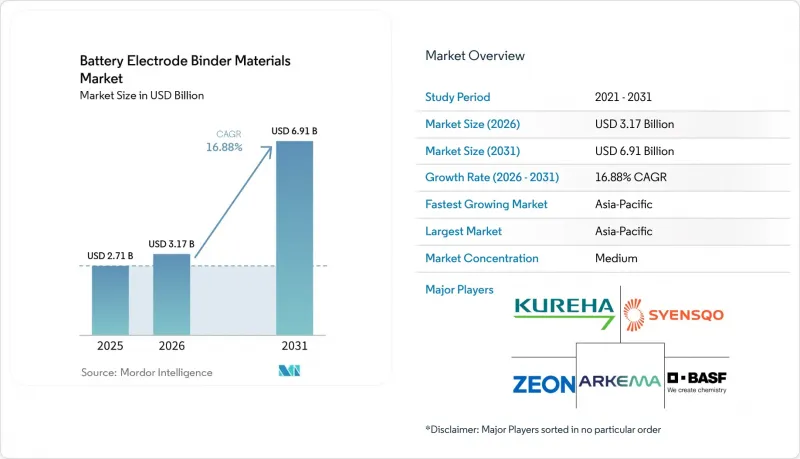
根據 Mordor Intelligence 預測,電池電極黏合劑材料市場規模預計將在 2025 年達到 27.1 億美元,2026 年達到 31.7 億美元,到 2031 年達到 69.1 億美元,在預測期(2026-2031 年)內複合年成長率為 16.88%。
本報告按化學成分(聚聚二氟亞乙烯(PVDF)、SBR/CMC 及其他)、電極類型(陰極黏結劑、陽極黏結劑)、電池化學成分(NMC/NCA 電池及其他)、應用領域(電動車及其他)和地區(亞太地區、北美地區、歐洲地區、南美地區、中東和非洲地區)進行細分。市場預測以美元 (USD) 為單位。
全球電池電極黏合劑材料市場趨勢及洞察
擴大電動車和超級工廠的產能
電池工廠產能的持續擴張為電池電極黏合劑市場提供了明確的需求基礎。每條新的生產線都需要一條經過認證的黏合劑供應鏈,才能開始商業化的電池生產。美國開發商計劃在2026年新增24吉瓦的公用事業規模電池儲能項目,此前在2025年已新增15吉瓦,這將增加固定式儲能的需求,同時也促進電動車電池的生產。為了支持北美電池產能的擴張,阿科瑪公司於2026年6月將位於肯塔基州卡爾弗特市的PVDF產能提高了15%。在某些地區,經過認證的黏合劑供應量仍然低於已公佈的電池產能。在目前的認證週期中,這種缺口支撐了對本地生產和認證的黏合劑的需求。
引進電網級電池儲能系統
電網級儲能系統正在電池電極黏結劑材料市場形成獨特的需求基礎。這些系統需要較長的使用壽命和成本控制,而水性CMC/SBR黏結劑配置在許多磷酸鋰鐵(LFP)電池中備受青睞。預計到2031年,電池儲能系統將以19.05%的複合年成長率成長。營運商通常優先考慮循環壽命、加工能力和材料成本,而非能量密度和快速充電性能。發表在《自然通訊》上的一項研究表明,與基於NMP的製程相比,採用共聚水性製程可將正極材料的製造和營運成本降低23%,相關資本成本降低95%。隨著儲能系統部署的擴展,這種製造方法有望進一步擴大水性製程的應用範圍。
含氟聚合物原料集中供應
電池級聚偏二氟乙烯(PVDF)的供應仍然集中在少數幾家獲得認證的製造商手中。上游製程對R142b的依賴可能導致PVDF基黏合劑體系的採購週期性波動。歐洲化學品管理局計劃於2026年向歐盟委員會提交關於全氟烷基和多氟烷基物質(PFAS)提案法規的最終意見。目前的提案包括根據《化學品註冊、評估、授權和限制》(REACH)法規,對能源領域的電池黏合劑應用給予13.5年的豁免。此次監管審查促使歐洲電池製造商考慮使用無氟正極黏合劑。KUREHA正在將其位於磐城的工廠的產能擴大8000噸/年,預計2026會計年度開始商業運營。
細分市場分析
截至2025年,依化學成分分類,PVDF在電池電極黏結劑材料市場佔有42.08%的佔有率。這一地位反映了其在鋰離子電池領域長期穩定的合格記錄,以及高鎳正極材料對穩定性的嚴格要求。在需要正極材料具備成熟電化學性能的應用中,PVDF持續發揮至關重要的作用。阿科瑪的「Kynar HSV 1200」和「HSV 1400」產品針對磷酸鐵鋰(LFP)正極材料,旨在提高黏合力並降低黏結劑用量。這種方法使供應商能夠針對新的正極設計最佳化現有化學成分。在電池電極黏結劑材料產業中,PVDF仍是許多認證正極平台的重要材料。
預計到2031年,SBR/CMC的複合年成長率將達到18.21%。這一成長反映了陽極製程向水系製程的轉變以及石墨與矽-石墨陽極的兼容性。BASF的生產設施為亞洲和歐洲/北美地區的電池製造商提供供應支援。 PTFE因其在機械剪切作用下會發生纖維化,在乾電極的試驗計畫中備受關注。 PAA基黏結劑也為高鎳正極材料的水系製程提供了一條途徑。發表在《自然通訊》上的一項研究表明,採用共生水系製程製備的幾種NMC正極材料,與NMP基製程相比,在保持相當循環壽命的同時,材料成本降低了96%。
到2025年,正極黏結劑將佔據電池電極黏結劑材料市場59.67%的佔有率。材料負載量的增加以及PVDF基體系的經濟優勢鞏固了其主導地位。此外,電池製造商與正極配方認證供應商之間已建立了耐久性認證關係。高鎳電池是推動正極黏結劑市場規模成長的主要因素,這類電池即使在嚴苛的電壓條件下也需要穩定的性能。 PVDF-接枝-PAA黏結劑網路的研究表明,該黏結劑能夠改善NMC811正極的韌性、彈性和鋰離子傳輸性能。這些研究成果可能會影響下一代正極的認證標準。
預計到2031年,負極黏合劑市場將以18.33%的複合年成長率成長。矽的應用和鈉離子電池規模的擴大推動了對更專業化的負極配方的需求成長。 2024年4月,Primearth EV Energy在其豐田混合動力汽車電池中採用了Resonac公司的聚醯胺-醯亞胺黏合劑「POLYSOL LB」。該材料在保持電極完整性的同時,可容納高達30%的矽活性物質含量。 UBE也發布了一種用於矽基負極的水溶性聚醯亞胺黏合劑。這些產品的出現標誌著負極黏合劑領域正在從傳統的僅由石墨組成的標準材料轉向更多樣化的概念。
區域分析
預計到2025年,亞太地區將佔據電池電極黏結劑市場47.25%的佔有率,並在2031年之前以18.17%的複合年成長率成長。位於Delta和Delta的中國生產群集是PVDF和SBR/CMC的主要消費中心。 KurehaKUREHA,中國單一電池製造商的PVDF年消耗量在1.5萬噸至2萬噸之間。韓國和日本在製定NMC811和矽-石墨黏結劑系統的認證要求方面發揮了重要作用。
2026年3月,阿科瑪宣布將位於中國常熟的PVDF產能擴大20%,預計2028年運作。印度正透過與生產連結獎勵計畫計畫擴大電池製造規模。東協市場也正吸引著與電動車政策相關的早期電池組裝活動。在北美和歐洲,當地產能正在提升,以滿足本地化和合規要求。 2026年6月,阿科瑪完成了位於加州卡爾弗特市的PVDF產能擴建項目,投資額達2,000萬美元。 2025年3月,BASF在賓州莫納卡和田納西州查塔努加分別建立了「Licity」負極黏結劑的生產基地。
歐盟電池法規將於2025年2月起強制實施電池實質審查政策,並於2026年起提出電池護照要求。這些法規將影響歐洲供應鏈的認證和可追溯性實踐。 Syensqo與Orbia合作,計劃在南卡羅來納州奧古斯塔市建造PVDF生產基地,以滿足西方國家的需求。目前,南美洲、中東和非洲的需求規模相對小規模。巴西、阿根廷、南非和沙烏地阿拉伯將透過對電池供應鏈規劃、礦產資源和儲能的投資,在長期發展中發揮重要作用。雖然這些地區為早期認證提供了機會,但預計在2031年之前不會對全球格局產生重大影響。
其他好處
- Excel格式的市場預測(ME)表
- 3個月的分析師支持
目錄
第1章:引言
- 研究假設和市場定義
- 調查範圍
第2章:調查方法
第3章執行摘要
第4章 市場狀況
- 市場概覽
- 市場促進因素
- 擴大電動車和超級工廠的產能
- 引進電網級電池儲能系統
- 富矽負極的認證要求
- 採用水系電極製造技術
- 乾電極製程的商業化
- 高壓、高鎳陰極穩定性的需求
- 市場限制因素
- 保管員認證和轉換成本高昂
- 含氟聚合物原料集中供應
- 新興黏合劑系統的性能權衡
- 乾電極生產線批量生產的時間存在不確定性。
- 價值鏈分析
- 波特五力分析
第5章 市場規模與成長預測
- 按化學成分
- 聚二氟亞乙烯(PVDF)
- SBR/CMC
- PTFE
- 聚丙烯酸(PAA)
- 其他化學成分(藻酸鹽、生物衍生及其他無氟黏合劑)
- 按電極類型
- 正極黏合劑
- 負極黏合劑
- 電池化學成分
- NMC/NCA電池
- LFP/LMFP電池
- 鈉離子電池
- 全固態電池
- 其他電池化學成分(LCO、LMO、鉛酸電池、新興化學成分)
- 透過使用
- 電動車
- 電池儲能系統
- 家用電子產品
- 工業應用
- 其他用途
- 按地區
- 亞太地區
- 中國
- 印度
- 日本
- 韓國
- 東南亞國協
- 其他亞太國家
- 北美洲
- 美國
- 加拿大
- 墨西哥
- 歐洲
- 德國
- 英國
- 法國
- 義大利
- 北歐國家
- 俄羅斯
- 其他歐洲國家
- 南美洲
- 巴西
- 阿根廷
- 其他南美國家
- 中東和非洲
- 沙烏地阿拉伯
- 南非
- 其他中東和非洲國家
- 亞太地區
第6章 競爭情勢
- 市場集中度
- 策略趨勢
- 市佔率和排名分析
- 公司簡介
- Arkema
- Ashland
- BASF
- DAIKIN INDUSTRIES, Ltd.
- ENEOS Materials Corporation
- KUREHA CORPORATION
- LG Chem
- Resonac Holdings Corporation
- SUMITOMO SEIKA CHEMICALS CO.,LTD.
- Syensqo
- Synthomer plc
- The Chemours Company
- UBE Corporation
- ZEON CORPORATION
第7章 市場機會與未來展望
According to Mordor Intelligence, the battery electrode binder materials market was valued at USD 2.71 billion in 2025 and is estimated to grow from USD 3.17 billion in 2026 to reach USD 6.91 billion by 2031, at a CAGR of 16.88% during the forecast period (2026-2031).
This report is Segmented by Chemistry (Polyvinylidene Fluoride (PVDF), SBR/CMC, and More), Electrode Type (Cathode Binders and Anode Binders), Battery Chemistry (NMC/NCA Batteries, and More), Application (Electric Vehicles, and More), and Geography (Asia-Pacific, North America, Europe, South America, and Middle-East and Africa). The Market Forecasts are Provided in Terms of Value (USD).
Global Battery Electrode Binder Materials Market Trends and Insights
Electric Vehicle and Gigafactory Capacity Expansion
Committed cell-factory capacity additions continue to provide a clear demand base for the battery electrode binder materials market. Each new production line needs qualified binder supply arrangements before commercial cell output begins. U.S. developers plan to add 24 GW of utility-scale battery storage in 2026 after adding 15 GW in 2025, adding stationary demand alongside electric-vehicle cell manufacturing. Arkema completed a 15% PVDF capacity expansion at Calvert City, Kentucky, in June 2026 to support the North American battery ramp. Regional qualified supply still trails announced cell capacity in some locations. This gap supports demand for locally produced and approved binder grades during the current qualification cycle.
Grid-Scale Battery Energy Storage Deployment
Grid-scale storage is creating a separate demand base within the battery electrode binder materials market. These systems require long service life and cost discipline, which favors aqueous CMC/SBR binder configurations for many lithium iron phosphate (LFP) cells. Battery energy storage systems are projected to grow at a 19.05% CAGR through 2031. Operators commonly prioritize cycle life, throughput, and material cost rather than energy density or fast-charge performance. A study in Nature Communications reported that a kosmotropic aqueous process could reduce cathode manufacturing operating costs by 23% and related capital costs by 95% compared with NMP-based processing. This manufacturing path can widen the role of water-based processing as storage deployments expand.
Fluoropolymer Feedstock and Supply Concentration
Battery-grade PVDF supply remains concentrated among a limited group of qualified manufacturers. Upstream dependence on R142b can lead to periodic procurement pressure for PVDF-based binder systems. The European Chemicals Agency is due to provide final committee opinions on the proposed per- and polyfluoroalkyl substances (PFAS) restriction to the European Commission in 2026. The current proposal includes a 13.5-year derogation for energy-sector battery-binder uses under Registration, Evaluation, Authorization, and Restriction of Chemicals (REACH). This regulatory review is encouraging European cell producers to consider fluorine-free cathode-binder options. Kureha is expanding Iwaki Factory capacity by 8,000 metric tons per year, with commercial operation scheduled for fiscal 2026.
Other drivers and restraints analyzed in the detailed report include:
- Silicon-Rich Anode Qualification Requirements
- Dry-Electrode Process Commercialization
- High Binder Qualification and Switching Costs
For complete list of drivers and restraints, kindly check the Table Of Contents.
Segment Analysis
PVDF held 42.08% of the battery electrode binder materials market share by chemistry in 2025. Its position reflects a long qualification history in lithium-ion cells and the stability requirements of high-nickel cathodes. PVDF remains particularly relevant where cathode formulations require proven electrochemical performance. Arkema's Kynar HSV 1200 and HSV 1400 products target LFP cathodes with improved adhesion and lower binder loading. This approach allows suppliers to improve established chemistry for newer cathode designs. The battery electrode binder materials industry continues to rely on PVDF for many qualified cathode platforms.
SBR/CMC is forecast to grow at an 18.21% CAGR through 2031. Its growth reflects the transition toward water-based anode processing and compatibility with graphite and silicon-graphite anodes. BASF's production footprint supports supply to both Asian and Western cell producers. PTFE is gaining attention in dry-electrode pilot programs because it fibrillates under mechanical shear. PAA-based binders also offer a route to aqueous processing for high-nickel cathodes. The Nature Communications study reported comparable cycle life for several NMC cathodes using a kosmotropic aqueous process, with 96% lower material cost than NMP-based processing.
Cathode binders accounted for 59.67% of the battery electrode binder materials market revenue share in 2025. Higher material loading and the premium economics of PVDF-based systems supported this leading position. Cathode formulations also involve durable qualification relationships between cell producers and approved suppliers. The battery electrode binder materials market size for cathode binders is supported by high-nickel cells that require stable performance at demanding voltages. Research on PVDF-graft-PAA binder networks points to improvements in toughness, elasticity, and lithium-ion transport for NMC811 cathodes. These results can influence the criteria for next-generation cathode qualification.
Anode binders are projected to grow at an 18.33% CAGR through 2031. Silicon adoption and sodium-ion scale-up are increasing the demand for more specialized anode formulations. Primearth EV Energy adopted Resonac's POLYSOL LB polyamide-imide binder for Toyota hybrid-vehicle batteries in April 2024. The material can tolerate up to 30% silicon active-material content while maintaining electrode integrity. UBE has also presented a water-soluble polyimide binder for silicon-based anodes. These products show a shift away from treating anode binders as standard graphite-only materials.
Complete Report Scope:
- By Chemistry
- Polyvinylidene Fluoride (PVDF)
- SBR/CMC
- PTFE
- Polyacrylic Acid (PAA)
- Other Chemistries (Alginate, Bio-based, Other Fluorine-Free Binders)
- By Electrode Type
- Cathode Binders
- Anode Binders
- By Battery Chemistry
- NMC/NCA Batteries
- LFP/LMFP Batteries
- Sodium-Ion Batteries
- Solid-State Batteries
- Other Battery Chemistries (LCO, LMO, Lead-Acid and Emerging Chemistries)
- By Application
- Electric Vehicles
- Battery Energy Storage Systems
- Consumer Electronics
- Industrial Applications
- Other Applications
- By Geography
- Asia-Pacific
- China
- India
- Japan
- South Korea
- ASEAN Countries
- Rest of Asia-Pacific
- North America
- United States
- Canada
- Mexico
- Europe
- Germany
- United Kingdom
- France
- Italy
- NORDIC Countries
- Russia
- Rest of Europe
- South America
- Brazil
- Argentina
- Rest of South America
- Middle-East and Africa
- Saudi Arabia
- South Africa
- Rest of Middle-East and Africa
- Asia-Pacific
Geography Analysis
Asia-Pacific held 47.25% of the battery electrode binder materials market revenue share in 2025 and is forecast to grow at an 18.17% CAGR through 2031. Chinese production clusters in the Yangtze River Delta and Pearl River Delta are important consumption centers for PVDF and SBR/CMC. Kureha has cited annual PVDF consumption of 15,000 to 20,000 metric tons for individual Chinese battery manufacturers. South Korea and Japan play an important role in setting qualification requirements for NMC811 and silicon-graphite binder systems.
Arkema announced a 20% PVDF capacity expansion at Changshu, China, in March 2026, with startup planned for 2028. India is scaling battery manufacturing through production-linked incentive programs. ASEAN markets are also attracting early battery-assembly activity linked to electric-vehicle policies. North America and Europe are adding local production capacity to address localization and compliance requirements. Arkema completed its USD 20 million Calvert City PVDF expansion in June 2026. BASF established Licity anode-binder production capability in Monaca, Pennsylvania, and Chattanooga, Tennessee, in March 2025.
The EU Batteries Regulation requires battery due-diligence policies from February 2025 and introduces battery passport requirements from 2026. These rules affect qualification and traceability practices in European supply chains. Syensqo is developing an Augusta, South Carolina PVDF site with Orbia to supply Western demand. South America, and Middle-East and Africa currently represent smaller demand centers. Brazil, Argentina, South Africa, and Saudi Arabia have longer-term relevance through battery supply-chain plans, mineral resources, and energy-storage investment. These areas offer early qualification opportunities but are not expected to change the global balance through 2031.
- Arkema
- Ashland
- BASF
- DAIKIN INDUSTRIES, Ltd.
- ENEOS Materials Corporation
- KUREHA CORPORATION
- LG Chem
- Resonac Holdings Corporation
- SUMITOMO SEIKA CHEMICALS CO.,LTD.
- Syensqo
- Synthomer plc
- The Chemours Company
- UBE Corporation
- ZEON CORPORATION
Additional Benefits:
- The market estimate (ME) sheet in Excel format
- 3 months of analyst support
TABLE OF CONTENTS
1 Introduction
- 1.1 Study Assumptions and Market Definition
- 1.2 Scope of the Study
2 Research Methodology
3 Executive Summary
4 Market Landscape
- 4.1 Market Overview
- 4.2 Market Drivers
- 4.2.1 Electric Vehicle and Gigafactory Capacity Expansion
- 4.2.2 Grid-Scale Battery Energy Storage Deployment
- 4.2.3 Silicon-Rich Anode Qualification Requirements
- 4.2.4 Water-Based Electrode Manufacturing Adoption
- 4.2.5 Dry-Electrode Process Commercialization
- 4.2.6 Demand for High-Voltage and High-Nickel Cathode Stability
- 4.3 Market Restraints
- 4.3.1 High Binder Qualification and Switching Costs
- 4.3.2 Fluoropolymer Feedstock and Supply Concentration
- 4.3.3 Performance Trade-Offs in Emerging Binder Systems
- 4.3.4 Uncertain Scale-Up Timing for Dry-Electrode Lines
- 4.4 Value Chain Analysis
- 4.5 Porter's Five Forces Analysis
- 4.5.1 Threat of New Entrants
- 4.5.2 Bargaining Power of Suppliers
- 4.5.3 Bargaining Power of Buyers
- 4.5.4 Threat of Substitutes
- 4.5.5 Competitive Rivalry
5 Market Size and Growth Forecasts (Value)
- 5.1 By Chemistry
- 5.1.1 Polyvinylidene Fluoride (PVDF)
- 5.1.2 SBR/CMC
- 5.1.3 PTFE
- 5.1.4 Polyacrylic Acid (PAA)
- 5.1.5 Other Chemistries (Alginate, Bio-based, Other Fluorine-Free Binders)
- 5.2 By Electrode Type
- 5.2.1 Cathode Binders
- 5.2.2 Anode Binders
- 5.3 By Battery Chemistry
- 5.3.1 NMC/NCA Batteries
- 5.3.2 LFP/LMFP Batteries
- 5.3.3 Sodium-Ion Batteries
- 5.3.4 Solid-State Batteries
- 5.3.5 Other Battery Chemistries (LCO, LMO, Lead-Acid and Emerging Chemistries)
- 5.4 By Application
- 5.4.1 Electric Vehicles
- 5.4.2 Battery Energy Storage Systems
- 5.4.3 Consumer Electronics
- 5.4.4 Industrial Applications
- 5.4.5 Other Applications
- 5.5 By Geography
- 5.5.1 Asia-Pacific
- 5.5.1.1 China
- 5.5.1.2 India
- 5.5.1.3 Japan
- 5.5.1.4 South Korea
- 5.5.1.5 ASEAN Countries
- 5.5.1.6 Rest of Asia-Pacific
- 5.5.2 North America
- 5.5.2.1 United States
- 5.5.2.2 Canada
- 5.5.2.3 Mexico
- 5.5.3 Europe
- 5.5.3.1 Germany
- 5.5.3.2 United Kingdom
- 5.5.3.3 France
- 5.5.3.4 Italy
- 5.5.3.5 NORDIC Countries
- 5.5.3.6 Russia
- 5.5.3.7 Rest of Europe
- 5.5.4 South America
- 5.5.4.1 Brazil
- 5.5.4.2 Argentina
- 5.5.4.3 Rest of South America
- 5.5.5 Middle-East and Africa
- 5.5.5.1 Saudi Arabia
- 5.5.5.2 South Africa
- 5.5.5.3 Rest of Middle-East and Africa
- 5.5.1 Asia-Pacific
6 Competitive Landscape
- 6.1 Market Concentration
- 6.2 Strategic Moves
- 6.3 Market Share (%)/Ranking Analysis
- 6.4 Company Profiles (includes Global Overview, Market Overview, Core Segments, Financials as available, Strategic Information, Products and Services, and Recent Developments)
- 6.4.1 Arkema
- 6.4.2 Ashland
- 6.4.3 BASF
- 6.4.4 DAIKIN INDUSTRIES, Ltd.
- 6.4.5 ENEOS Materials Corporation
- 6.4.6 KUREHA CORPORATION
- 6.4.7 LG Chem
- 6.4.8 Resonac Holdings Corporation
- 6.4.9 SUMITOMO SEIKA CHEMICALS CO.,LTD.
- 6.4.10 Syensqo
- 6.4.11 Synthomer plc
- 6.4.12 The Chemours Company
- 6.4.13 UBE Corporation
- 6.4.14 ZEON CORPORATION
7 Market Opportunities and Future Outlook
- 7.1 White-Space and Unmet-Need Assessment

 電池黏合劑材料市場預測至2034年-全球分析(按黏合劑化學成分、電極類型、電池化學成分、配方、應用、最終用途和地區分類)
 鋰離子電池黏合劑市場規模、佔有率和成長分析:按電極類型、材料、電池化學成分、應用和地區分類-2026-2033年產業預測
 PAA陽極黏結劑-2026-2032年全球市佔率及排名、總收入及需求預測
 電池黏合劑市場:按類型、功能、製程類型、溶劑製程、應用和最終用戶分類-2026-2032年全球市場預測鋰電池正極黏合劑市場:按黏合劑類型、電池化學成分、應用、製造方法和終端用戶產業分類-全球預測,2026-2032年
 鋰離子電池黏合劑市場分析與預測(至2035年):類型、產品、應用、材料類型、技術、組件、最終用戶、形式、製程、功能鋰離子電池黏合劑市場:按黏合劑類型、電池規格和應用分類的全球預測,2026-2032年
 全球電池黏合劑市場
 電池黏合劑材料市場機會、成長動力、產業趨勢分析及2025-2034年預測全球陽極黏合劑市場