


 |
市場調查報告書
商品編碼
2119250
鈉離子電池級硬碳:市場佔有率分析、產業趨勢與統計、成長預測(2026-2031)Sodium-Ion Battery-Grade Hard Carbon - Market Share Analysis, Industry Trends & Statistics, Growth Forecasts (2026 - 2031) |
||||||

※ 本網頁內容可能與最新版本有所差異。詳細情況請與我們聯繫。
據 Mordor Intelligence 稱,2025 年鈉離子電池級硬碳市場價值為 8,187 萬美元,預計到 2031 年將達到 4.405 億美元,而 2026 年為 1.0762 億美元,預測期(2026-2031 年)的複合成長率為 32.56%。
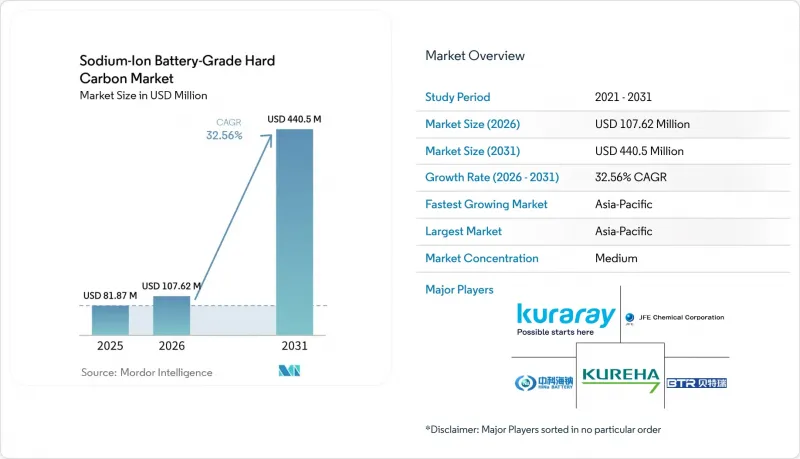
本報告按原料(生質能衍生、其他)、製程類型(碳化/熱解、其他)、等級(能源級、其他)、應用(能源儲存系統、其他)和地區(亞太、北美、歐洲、南美、中東和非洲)進行細分。市場預測以美元計價。
全球鈉離子電池級硬碳市場趨勢及洞察
鈉離子電池的商業化
鈉離子電池的商業化是推動鈉離子電池級硬碳市場需求的直接因素。國際能源總署(IEA)雖然注意到鈉離子電池發展勢頭強勁,但也承認該技術在製造和性能方面仍面臨挑戰。寧德時代(CATL)於2025年4月發布了第二代「Naxtra」電池,提高了人們對批次間品質更穩定、倍率性能更優的材料的期望。電芯製造商越來越要求硬碳供應商在材料投入認證生產線之前滿足更嚴格的規格要求。獲得主要電芯製造商的認可可以縮短與其他買家的採購談判時間,因為供應商已經證明了其在嚴苛條件下的性能。隨著鈉離子電池從先導計畫走向大規模的汽車和固定式儲能系統,市場對硬碳的需求預計將大幅成長。
對低成本固定式儲能的需求
由於鋰價格和供應風險,買家尋求替代方案,固定式儲能正在推動鈉離子電池級硬碳市場的需求成長。鈉離子技術為需要長期運作資產並希望減少對關鍵礦物依賴的儲能開發商提供了一種供應鏈選擇。 Peak Energy宣布與公用事業公司和獨立電力生產商(IPP)合作夥伴開展商業合作,其中包括於2025年7月在美國交付一套電網級鈉離子電池儲能系統。儲能項目對陽極材料的性能要求因預期輸出調節模式和運作壽命而異。能量級硬碳適用於以容量為先的應用,而長循環級硬碳則適用於需要頻繁充放電的應用。這種差異使得針對特定應用的硬碳材料規格在硬碳採購中變得越來越重要。
初始庫侖效率低且需要預先進行蘇打處理
初始庫侖效率仍是鈉離子電池級硬碳材料市場面臨的一大限制因素。早期商用硬碳材料的初始庫侖效率僅17%,但界面改質方法已將其實驗室性能提升至82%。使用芳基鈉進行預鈉化的研究表明,該方法可在60秒內將初始庫侖效率提高至接近100%,但在工業規模的生產中保持精確的預鈉化仍然是一項挑戰。化學氣相沉積、預鈉化和雜原子摻雜等方法可以提高性能,但也增加了對製程控制的要求。這些製程會推高製造成本,從而可能削弱鈉離子電池化學的部分價格優勢。雖然在對成本敏感的應用中,略低的效率或許可以接受,但對儲能和汽車應用要求極高的優質材料則需要具有卓越首圈性能的高級材料。
細分市場分析
預計到2025年,生質能衍生硬碳將佔鈉離子電池級硬碳市場佔有率的40.56%,並將在2031年之前以34.27%的複合年成長率成長。竹子、椰子殼、稻殼和農作物殘渣等原料來源分佈廣泛,且在農業殘渣已大規模收集的地區,這些原料可以支持在地採購。雖然這些原料符合旨在減少整個生命週期碳排放的採購計劃,但它們的成分要求對生產過程進行嚴格的控制。 2026年發表在《綠色化學》雜誌上的一項研究表明,透過碳化和石墨化製備的纖維素硬碳具有320.38 mAh/g的可逆容量,並且在高電流密度下經過1000次充放電循環後仍能保持88.15%的容量。這些結果表明,如果對前體的加工和處理進行適當控制,生質能衍生材料可以滿足嚴格的性能要求。
瀝青基材料具有更高的微觀結構一致性,而樹脂基製程則能獲得較高的碳化產率和適用於自動化電極塗覆的顆粒形貌。中國生產商最初依賴進口椰殼,但由於僅靠熱帶生質能無法滿足所需的規模,他們目前正在探索國內替代方案。 2025年發表於《中國科學:化學》的一項研究表明,最佳化的酚醛樹脂基硬碳的初始庫侖效率達到92.2%,可逆容量達到324.4 mAh/g。石油焦、生物炭和混合前驅體複合材料目前仍屬於小規模生產路線,但如果工業供應更加穩定,它們將成為更可行的選擇。由於不同生產路線在供應穩定性、品質和碳性能方面存在差異,鈉離子電池級硬碳市場尚未形成單一的通用前驅體。
到2025年,碳化和熱解將佔據鈉離子電池級硬碳市場56.41%的佔有率。這一地位歸功於其完善的工業基礎設施以及將有機前驅體轉化為紊層碳的相對簡單的工藝流程。此製程通常在1000 度C至1500 度C之間進行,孔結構和層間距受加熱速率、保溫時間和環境條件的影響。這些參數決定了鈉的儲存性能,而活化處理則可產生額外的表面活性位點,適用於那些優先考慮放電速率而非容量的應用。由於該工藝能夠處理多種前驅體材料,因此仍然是生產的核心。
預計到2031年,表面改質製程將以33.51%的複合年成長率成長,成為鈉離子電池級硬碳市場中成長最快的製程領域。塗層、摻雜和預鹼處理能夠提高初始庫侖效率並降低不可逆容量損失。 2025年發表於《RSC Advances》期刊的一項研究表明,採用氨改性碳化法製備的氮摻雜硬碳的初始庫侖效率達到81.81%,首圈放電容量為373.3 mAh/g。該研究也說明了鈉離子透過吸附、嵌入和孔隙填充等方式的儲存機制。當電池製造商對材料性能有特定要求時,改質材料的售價可能高於標準碳化級材料。
區域分析
預計到2025年,亞太地區將佔據鈉離子電池級硬碳市場47.34%的佔有率,並在2031年之前以34.11%的複合年成長率成長。在中國,電池製造、碳化能力、前驅體加工和電芯組裝已整合到單一供應鏈中。這種結構得益於物流成本的降低、與供應商的快速協作以及來自固定式儲能和對成本敏感的電動車應用領域的強勁需求。日本憑藉其技術優勢,確保了微觀結構品質的穩定性,並與電芯製造商建立了認證合作關係。韓國也積極發展其材料基礎,以滿足鈉離子電池領域的商業機會。
亞太地區的優點在於其能夠利用生質能、煤基材料和合成樹脂等原料。該地區的鈉離子電池級硬碳市場受益於完善的電池基礎設施和對區域供應鏈的政策支援。印度擁有稻殼、秸稈和竹子等農業廢棄物,可滿足國內對前驅體的需求。與石墨相比,較低的加工溫度是其顯著優勢,尤其是在能源成本影響負極材料經濟性的情況下。原料的可取得性、材料的穩定性以及認證能力將決定該地區新供應商的規模化速度。
北美和歐洲目前的產量較低,但如果能夠確保可追溯性,它們有潛力發展成為尋求低碳硬碳的高價值市場。 Peak Energy公司交付於2025年在美國交付一套電網級系統,這顯示市場對鈉離子儲能技術表現出濃厚的商業性興趣。歐洲買家面臨碳足跡揭露的要求,因此,有關前驅物原料來源和生命週期的相關數據至關重要。南美洲、中東和非洲的需求仍處於起步階段,但農業殘餘物、可再生能源的普及以及能源轉型計劃可能為未來的固定式儲能應用提供支援。
其他好處
- Excel格式的市場預測(ME)表
- 3個月的分析師支持
目錄
第1章:引言
- 研究假設和市場定義
- 調查範圍
第2章:調查方法
第3章執行摘要
第4章 市場狀況
- 市場概覽
- 市場促進因素
- 鈉離子電池的商業化
- 對低成本固定式儲能的需求
- 鈉離子電池擁有豐富多元的供應鏈
- 注重成本效益的電動車的成長
- 減少負極材料供應鏈中的碳足跡
- 憑藉穩定的硬碳批次質量,獲得認證優勢。
- 市場限制因素
- 初始庫侖效率低且需要預先進行蘇打處理
- 生質能衍生硬碳原料的變化
- 缺乏商業規模的認證能力
- 鋰離子電池負極材料性能提升帶來的競爭
- 價值鏈分析
- 波特五力分析
第5章 市場規模與成長預測
- 按原料
- 生質能衍生
- 音調系統
- 樹脂基
- 其他
- 依工藝類型
- 碳化/熱解
- 啟用設定
- 表面改質(塗層、摻雜、預鹼處理)
- 其他
- 按年級
- 能源級
- 高功率量級
- 長循環等級
- 其他(低溫和特殊等級)
- 透過使用
- 能源儲存系統
- 電動車(包括二輪車、三輪車和低速電動車)
- 消費性電池和工業電池
- UPS和通訊
- 其他
- 按地區
- 亞太地區
- 中國
- 印度
- 日本
- 韓國
- 東南亞國協
- 其他亞太國家
- 北美洲
- 美國
- 加拿大
- 墨西哥
- 歐洲
- 德國
- 英國
- 法國
- 義大利
- 北歐國家
- 其他歐洲國家
- 南美洲
- 巴西
- 阿根廷
- 其他南美國家
- 中東和非洲
- 沙烏地阿拉伯
- 南非
- 其他中東和非洲國家
- 亞太地區
第6章 競爭情勢
- 市場集中度
- 策略趨勢
- 市佔率和排名分析
- 公司簡介
- Aekyung Chemical Co., Ltd.
- BTR New Material Group Co., Ltd.
- Fujian Yuanli Active Carbon Co., Ltd.
- HiNa Battery Technology Co., Ltd
- Hunan Zhongke Shinzoom Technology Co., Ltd.
- JFE Chemical Corporation
- Jiangxi Zeto New Energy Technology Co., Ltd.
- KURARAY CO., LTD.
- KUREHA CORPORATION
- Ningbo Ronbay New Energy Technology Co., Ltd.
- Putailai New Materials Technology Co., Ltd.
- Shanghai PTL New Energy Technology Co.,Ltd.
- SHENGQUAN GROUP
- Shenzhen XFH Technology Co., Ltd.
- Sumitomo Bakelite Co., Ltd.
第7章 市場機會與未來展望
According to Mordor Intelligence, the sodium-ion battery-grade hard carbon market size was valued at USD 81.87 million in 2025 and is estimated to grow from USD 107.62 million in 2026 to reach USD 440.50 million by 2031, at a CAGR of 32.56% during the forecast period (2026-2031).
This report is Segmented by Feedstock (Biomass-Based and More), Process Type (Carbonization/Pyrolysis and More), Grade (Energy-Oriented Grade and More), Application (Energy Storage Systems and More), and Geography (Asia-Pacific, North America, Europe, South America, and Middle-East and Africa). The Market Forecasts are Provided in Terms of Value (USD).
Global Sodium-Ion Battery-Grade Hard Carbon Market Trends and Insights
Commercialization of Sodium-Ion Batteries
The commercialization of sodium-ion batteries is a direct driver of demand for the sodium-ion battery-grade hard carbon market. The International Energy Agency has identified growing momentum in sodium-ion batteries, while noting that the technology still faces manufacturing and performance challenges. CATL introduced its second-generation Naxtra battery in April 2025, raising expectations for materials with more consistent batch quality and improved rate capability. Cell producers increasingly require hard carbon suppliers to meet tighter specifications before material can enter qualified production lines. Approval by a large cell manufacturer can shorten procurement discussions with other buyers, as the supplier has already demonstrated performance under demanding conditions. As sodium-ion batteries move from pilot projects to larger vehicle and stationary storage deployments, the market will require a substantial increase in hard carbon output.
Demand for Lower-Cost Stationary Energy Storage
Stationary energy storage supports demand in the sodium-ion battery-grade hard carbon market, as buyers seek alternatives amid lithium-related price and supply risks. Sodium-ion technology can provide a supply chain option for storage developers that need long-duration assets and want to reduce reliance on critical minerals. Peak Energy delivered a grid-scale sodium-ion battery storage system in the United States in July 2025 and announced commercial activity with utility and independent power producer partners. Storage projects require different anode performance levels depending on expected dispatch patterns and operating life. Energy-oriented grades suit applications that prioritize capacity, while long-cycle grades suit frequent cycling requirements. This distinction is expanding the role of application-specific specifications within hard carbon procurement.
Low Initial Coulombic Efficiency and Pre-Sodiation Requirements
Initial Coulombic efficiency remains a material constraint for the sodium-ion battery-grade hard carbon market. Early commercial hard carbon materials showed initial Coulombic efficiency as low as 17%, while interface modification methods have raised performance to 82% in laboratory work. Research on aryl-sodium pre-sodiation has reported pathways toward near-100% initial Coulombic efficiency within 60 seconds, but maintaining accurate pre-sodiation at industrial throughput remains difficult. Chemical vapor deposition, pre-sodiation, and heteroatom doping can improve performance but increase process control requirements. These steps can raise manufacturing costs and reduce part of the price advantage available from sodium-ion chemistry. Cost-focused applications may accept lower efficiency, while demanding storage and vehicle applications require premium grades with stronger first-cycle performance.
Other drivers and restraints analyzed in the detailed report include:
- Growth of Cost-Sensitive Electric Mobility
- Abundant and Diversified Sodium-Ion Battery Supply Chains
- Feedstock Variability in Biomass-Derived Hard Carbon
For complete list of drivers and restraints, kindly check the Table Of Contents.
Segment Analysis
Biomass-based hard carbon held 40.56% of the sodium-ion battery-grade hard carbon market share in 2025 and is forecast to grow at a 34.27% CAGR through 2031. Bamboo, coconut shells, rice husks, and crop residues offer geographically distributed precursor options and can support localized sourcing where agricultural residues are already collected at scale. These feedstocks align with procurement programs aimed at reducing life-cycle carbon emissions, although their composition requires careful process management. A 2026 Green Chemistry study reported that cellulose-based hard carbon produced via carbonization and graphitization exhibited a reversible capacity of 320.38 mAh/g and retained 88.15% of its capacity after 1,000 cycles at high current density. These results indicate that biomass-derived materials can meet demanding performance requirements when precursor treatment and processing are controlled.
Pitch-based materials offer tighter microstructural consistency, while resin-based routes can provide high carbonization yields and particle shapes suited to automated electrode coating. Chinese producers initially relied on imported coconut shells but have since considered domestic alternatives, as tropical biomass alone cannot meet the required scale. A 2025 Science China Chemistry study found that optimized phenolic resin hard carbon achieved 92.2% initial coulombic efficiency and a reversible capacity of 324.4 mAh/g. Petroleum coke, biochar, and mixed-precursor composites remain smaller routes but offer additional options where industrial supply is more reliable. The sodium-ion battery-grade hard carbon market is not moving toward a single universal precursor, as supply security, quality, and carbon characteristics vary by route.
Carbonization and pyrolysis accounted for 56.41% of the sodium-ion battery-grade hard carbon market share in 2025. This position reflects established industrial infrastructure and the relative simplicity of converting organic precursors into turbostratic carbon. Processing generally occurs between 1,000°C and 1,500°C, with heating rate, dwell time, and atmosphere influencing pore structure and interlayer spacing. These parameters govern sodium storage behavior, while activation creates additional surface sites for applications that prioritize discharge rate over capacity. The process remains central to production because it accommodates a broad range of precursor materials.
Surface modification is forecast to grow at a 33.51% CAGR through 2031, making it the fastest-growing process segment in the sodium-ion battery-grade hard carbon market. Coating, doping, and pre-sodiation-compatible processing address higher initial coulombic efficiency and lower irreversible capacity loss. A 2025 RSC Advances study reported that nitrogen-doped hard carbon produced via ammonia-modified carbonization achieved an initial coulombic efficiency of 81.81% and a first-cycle discharge capacity of 373.3 mAh/g. The study described sodium storage through adsorption, intercalation, and pore filling. Modified material can command premiums over standard carbonized grades when cell makers require specific performance profiles.
Complete Report Scope:
- By Feedstock
- Biomass-Based
- Pitch-Based
- Resin-Based
- Others
- By Process Type
- Carbonization/Pyrolysis
- Activation
- Surface Modification (Coating, Doping, Pre-sodiation Compatible Processing)
- Others
- By Grade
- Energy-Oriented Grade
- Power-Oriented Grade
- Long-Cycle Grade
- Others (Low-Temperature and Specialty Grades)
- By Application
- Energy Storage Systems
- Electric Vehicles (Including Two-/Three-Wheelers and Low-Speed EVs)
- Consumer and Industrial Batteries
- UPS and Telecom
- Others
- By Geography
- Asia-Pacific
- China
- India
- Japan
- South Korea
- ASEAN Countries
- Rest of Asia-Pacific
- North America
- United States
- Canada
- Mexico
- Europe
- Germany
- United Kingdom
- France
- Italy
- NORDIC Countries
- Rest of Europe
- South America
- Brazil
- Argentina
- Rest of South America
- Middle-East and Africa
- Saudi Arabia
- South Africa
- Rest of Middle-East and Africa
- Asia-Pacific
Geography Analysis
Asia-Pacific held 47.34% of the sodium-ion battery-grade hard carbon market share in 2025 and is forecast to grow at a 34.11% CAGR through 2031. China integrates battery manufacturing, carbonization capacity, precursor processing, and cell assembly within a single supply chain. This structure supports lower logistics costs, faster supplier collaboration, and strong demand from stationary storage and cost-sensitive electric mobility applications. Japan contributes technical capability in consistent microstructural quality and established qualification relationships with cell manufacturers. South Korea is also developing its materials base to address sodium-ion battery opportunities.
Asia-Pacific's position is supported by its ability to utilize biomass, coal-derived materials, and synthetic resins as feedstocks. The sodium-ion battery-grade hard carbon market in the region benefits from established battery infrastructure and policy support for local supply chains. India holds agricultural residues, including rice husks, crop stubble, and bamboo, that could help meet domestic demand for precursors. Lower processing temperatures compared to graphite are relevant where energy costs affect anode economics. Feedstock collection, material consistency, and qualification capacity will determine how quickly new regional suppliers can scale.
North America and Europe currently represent lower output but may develop into higher-value markets for traceable and lower-carbon hard carbon. Peak Energy's 2025 delivery of grid-scale systems in the United States demonstrated commercial interest in sodium-ion storage. European buyers face carbon-footprint disclosure requirements that favor documented data on precursor origins and lifecycles. South America, the Middle-East, and Africa represent early-stage demand, though agricultural residues, renewable energy deployment, and energy-transition programs could support future stationary-storage applications.
- Aekyung Chemical Co., Ltd.
- BTR New Material Group Co., Ltd.
- Fujian Yuanli Active Carbon Co., Ltd.
- HiNa Battery Technology Co., Ltd
- Hunan Zhongke Shinzoom Technology Co., Ltd.
- JFE Chemical Corporation
- Jiangxi Zeto New Energy Technology Co., Ltd.
- KURARAY CO., LTD.
- KUREHA CORPORATION
- Ningbo Ronbay New Energy Technology Co., Ltd.
- Putailai New Materials Technology Co., Ltd.
- Shanghai PTL New Energy Technology Co.,Ltd.
- SHENGQUAN GROUP
- Shenzhen XFH Technology Co., Ltd.
- Sumitomo Bakelite Co., Ltd.
Additional Benefits:
- The market estimate (ME) sheet in Excel format
- 3 months of analyst support
TABLE OF CONTENTS
1 Introduction
- 1.1 Study Assumptions and Market Definition
- 1.2 Scope of the Study
2 Research Methodology
3 Executive Summary
4 Market Landscape
- 4.1 Market Overview
- 4.2 Market Drivers
- 4.2.1 Commercialization of Sodium-Ion Batteries
- 4.2.2 Demand for Lower-Cost Stationary Energy Storage
- 4.2.3 Abundant and Diversified Sodium-Ion Battery Supply Chains
- 4.2.4 Growth of Cost-Sensitive Electric Mobility
- 4.2.5 Carbon-Footprint Reduction in Anode Material Supply Chains
- 4.2.6 Qualification Advantage of Consistent Hard Carbon Batch Quality
- 4.3 Market Restraints
- 4.3.1 Low Initial Coulombic Efficiency and Pre-Sodiation Requirements
- 4.3.2 Feedstock Variability in Biomass-Derived Hard Carbon
- 4.3.3 Limited Commercial-Scale Qualification Capacity
- 4.3.4 Competition from Improving Lithium-Ion Anode Materials
- 4.4 Value Chain Analysis
- 4.5 Porter's Five Forces
- 4.5.1 Bargaining Power of Suppliers
- 4.5.2 Bargaining Power of Buyers
- 4.5.3 Threat of New Entrants
- 4.5.4 Threat of Substitutes
- 4.5.5 Competitive Rivalry
5 Market Size and Growth Forecasts (Value)
- 5.1 By Feedstock
- 5.1.1 Biomass-Based
- 5.1.2 Pitch-Based
- 5.1.3 Resin-Based
- 5.1.4 Others
- 5.2 By Process Type
- 5.2.1 Carbonization/Pyrolysis
- 5.2.2 Activation
- 5.2.3 Surface Modification (Coating, Doping, Pre-sodiation Compatible Processing)
- 5.2.4 Others
- 5.3 By Grade
- 5.3.1 Energy-Oriented Grade
- 5.3.2 Power-Oriented Grade
- 5.3.3 Long-Cycle Grade
- 5.3.4 Others (Low-Temperature and Specialty Grades)
- 5.4 By Application
- 5.4.1 Energy Storage Systems
- 5.4.2 Electric Vehicles (Including Two-/Three-Wheelers and Low-Speed EVs)
- 5.4.3 Consumer and Industrial Batteries
- 5.4.4 UPS and Telecom
- 5.4.5 Others
- 5.5 By Geography
- 5.5.1 Asia-Pacific
- 5.5.1.1 China
- 5.5.1.2 India
- 5.5.1.3 Japan
- 5.5.1.4 South Korea
- 5.5.1.5 ASEAN Countries
- 5.5.1.6 Rest of Asia-Pacific
- 5.5.2 North America
- 5.5.2.1 United States
- 5.5.2.2 Canada
- 5.5.2.3 Mexico
- 5.5.3 Europe
- 5.5.3.1 Germany
- 5.5.3.2 United Kingdom
- 5.5.3.3 France
- 5.5.3.4 Italy
- 5.5.3.5 NORDIC Countries
- 5.5.3.6 Rest of Europe
- 5.5.4 South America
- 5.5.4.1 Brazil
- 5.5.4.2 Argentina
- 5.5.4.3 Rest of South America
- 5.5.5 Middle-East and Africa
- 5.5.5.1 Saudi Arabia
- 5.5.5.2 South Africa
- 5.5.5.3 Rest of Middle-East and Africa
- 5.5.1 Asia-Pacific
6 Competitive Landscape
- 6.1 Market Concentration
- 6.2 Strategic Moves
- 6.3 Market Share (%)/Ranking Analysis
- 6.4 Company Profiles (includes Global Overview, Market Overview, Core Segments, Financials as available, Strategic Information, Products and Services, Recent Developments)
- 6.4.1 Aekyung Chemical Co., Ltd.
- 6.4.2 BTR New Material Group Co., Ltd.
- 6.4.3 Fujian Yuanli Active Carbon Co., Ltd.
- 6.4.4 HiNa Battery Technology Co., Ltd
- 6.4.5 Hunan Zhongke Shinzoom Technology Co., Ltd.
- 6.4.6 JFE Chemical Corporation
- 6.4.7 Jiangxi Zeto New Energy Technology Co., Ltd.
- 6.4.8 KURARAY CO., LTD.
- 6.4.9 KUREHA CORPORATION
- 6.4.10 Ningbo Ronbay New Energy Technology Co., Ltd.
- 6.4.11 Putailai New Materials Technology Co., Ltd.
- 6.4.12 Shanghai PTL New Energy Technology Co.,Ltd.
- 6.4.13 SHENGQUAN GROUP
- 6.4.14 Shenzhen XFH Technology Co., Ltd.
- 6.4.15 Sumitomo Bakelite Co., Ltd.
7 Market Opportunities and Future Outlook
- 7.1 White-Space and Unmet-Need Assessment

 2034年eVTOL結構材料市場預測-全球分析(依材料類型、飛機結構、製造流程、材料特性、平台類型、推進方式、最終用戶及地區分類)
 二硫化碳市場-2026-2032年全球市場預測
 碳檢驗市場:依檢驗類型、服務類型、最終用途、國家及地區分類-產業分析、市場規模、市場佔有率及2026年至2033年預測碳去除檢驗市場預測至2034年—按服務類型、去除管道、標準、技術、最終用戶和地區分類的全球分析
 二硫化碳市場規模、佔有率和成長分析:按等級、應用、終端用戶產業、通路和地區分類-2026-2033年產業預測下一代航太結構材料市場預測至2034年-按材料類型、性能、應用、製造流程、最終用戶和地區分類的全球分析
 碳檢驗市場:按行業和地區分類
 2026-2032年全球生質柴油產業及中國生質柴油產業調查分析報告:第十五個五年計畫玻璃碳市場:材料類型、產品、等級、製造流程、牌號和應用分類-2026-2032年全球市場預測
 全球及中國超微孔碳塊產業研究及第十五個五年規劃分析報告