


 |
市場調查報告書
商品編碼
2119249
電池電解添加劑:市場佔有率分析、行業趨勢和統計數據、成長預測(2026-2031)Battery Electrolyte Additives - Market Share Analysis, Industry Trends & Statistics, Growth Forecasts (2026 - 2031) |
||||||

※ 本網頁內容可能與最新版本有所差異。詳細情況請與我們聯繫。
據 Mordor Intelligence 稱,電池電解添加劑市場預計在 2025 年達到 18.7 億美元,並預計將從 2026 年的 21.1 億美元成長到 2031 年的 39.2 億美元,在預測期(2026-2031 年)內複合成長率為 13.18%。
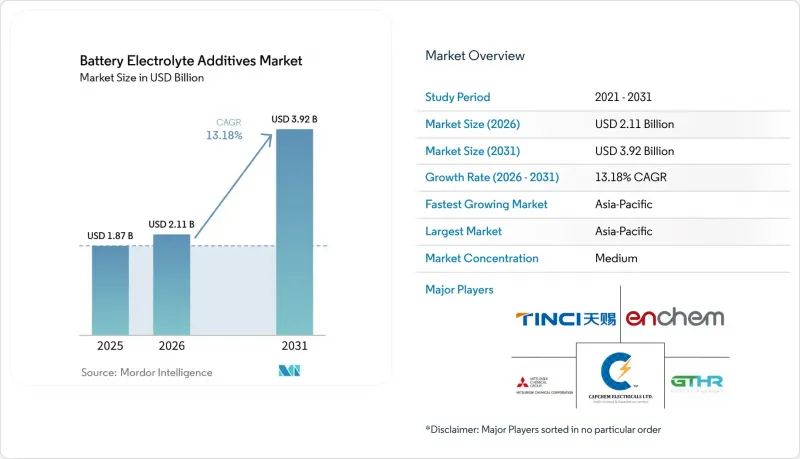
本報告按化學成分(碳酸乙烯酯及其他)、電池類型(鋰離子電池及其他)、應用領域(電動車及其他)、終端用戶產業(電池製造商及其他)和地區(亞太地區、北美地區、歐洲地區、南美地區、中東和非洲)進行細分。市場預測以美元計價。
全球電池電解添加劑市場趨勢及洞察
擴大電動車電池的生產
電動汽車電池生產的擴張推動了整體主要電池化學成分對電解添加劑的需求成長。根據國際能源總署(IEA)預測,到2025年,全球電動車產量將達到約2,200萬輛,其中中國約佔全球產量的四分之三。該機構也預測,到2026年,全球整體電動車產量將達到2,300萬輛。這一成長對電池電解添加劑市場而言是一個利好因素,因為每個地區新建的超級工廠都需要為其電池專案獲得材料認證。因此,供應商不僅可以從材料供應量的成長中獲益,還可以從持續的添加劑檢驗工作中獲益。此外,北美地區的合格越來越依賴對外國企業(FEOC)的要求,這會影響材料採購獲得聯邦稅額扣抵抵免的資格。
電網級能源儲存系統系統的擴展
電網級儲能系統正從最初的有限需量反應工具發展成為電網的核心資產。美國能源資訊署 (EIA) 預測,2025 年新增裝置容量將達到創紀錄的 15 吉瓦,2026 年公用事業級電池儲能裝置容量將達到 24 吉瓦。這項擴張正在推動電池電解添加劑市場的發展,因為固定式電池優先考慮 15-20 年的使用壽命和深迴圈性能。這些應用需要使用磺內酯和硼酸鹽添加劑,例如 LiBOB 和 LiDFOB,而不是主要用於快速充電的材料。由此產生的化學要求與許多電動車 (EV) 項目的要求有所不同。能源儲存系統整合商在設定電解性能要求方面也發揮越來越直接的作用。
認證成本高昂,電池檢驗週期長
新型電解添加劑在獲得汽車應用許可前,必須經過多個電池等級的認證步驟。這些步驟包括初步電解篩檢、各種溫度條件下的長期循環測試、氣體生成測試、嚴苛條件安全測試以及原始設備製造商 (OEM) 的整合測試。在汽車專案中,整個流程可能需要 2 到 4 年才能完成。單一添加劑候選產品的檢驗服務費用為每個項目 20 萬至 80 萬美元不等。因此,即使競爭對手聲稱其性能更優,現有配方在檢驗的項目中仍可保持 2 到 4 年的優勢。如果添加劑發生變更,則可能需要根據聯合國 38.3 運輸法規或 OEM 設計變更程序增加額外的測試要求。
細分市場分析
2025年,碳酸亞乙烯酯(VC)佔據了電池電解添加劑市場的34.67%。它在陽極表面的還原作用可形成緻密的界面層,該界面層能夠傳導鋰離子並抑制溶劑共滲。這項特性降低了石墨負極鋰離子電池的初始容量損失。因此,碳酸亞乙烯酯在市售鋰離子電池配方中仍保持著標準成膜材料的地位。石墨負極電池的持續普及也支撐了此類化學成分電池電解添加劑的市場規模。此外,其完善的認證系統也為電池製造商在選擇添加劑時提供了一個熟悉的參考標準。
氟代碳酸碳酸伸乙酯(FEC) 是成長最快的化學成分,預計到 2031 年的複合年成長率將達到 13.84%。 FEC 適用於富矽負極,因為矽的反覆膨脹和收縮必須確保界面不受損壞。硼酸鹽添加劑,包括雙草酸硼酸鋰 (LiBOB) 和二氟草酸硼酸鋰 (LiDFOB),可在高壓系統中提供正極保護,並且是 VC 的補充而非替代。磺酸鹽和磺內酯,包括 1,3-丙磺內酯和丙烯,可用作正極鈍化劑和過充抑制劑。磷酸鹽基材料,例如磷酸三(三甲基矽基)酯,可增強阻燃性並保護高鎳電池中的鋁集電器。這些材料的使用體現了在單一配方中平衡界面穩定性、正極保護、安全性和循環壽命的需求。
到2025年,鋰離子電池將佔據電池電解添加劑市場的70.35%。由於其大規模的生產規模,VC是傳統電池生產中最廣泛使用的添加劑。磷酸鋰鐵(LFP)和磷酸錳鐵鋰(LMFP)電池的配方設計旨在實現長壽命和高循環次數,而非最大能量密度。這項需求推動了電網級儲能應用中對專用磺內酯和硼酸鹽封裝的需求。在整個預測期內,鋰離子電池仍將是生產量的主要來源,而維持其生產規模則確保了嚴格的認證和穩定的純度至關重要。
預計到2031年,下一代平台將以13.93%的複合年成長率成長。這些平台包括富矽負極、鈉離子電池和鋰金屬電池。由於在常見的溶劑系統中,鈉的配位方式與鋰的配位方式不同,因此每種平台都需要不同的添加劑方法;此外,鋰金屬電池還需要抑制枝晶生長。 Group14 Technologies公司SCC55的商業化生產表明,矽負極材料正從試驗階段走向商業化供應。根據國際能源總署(IEA)的預測,到2030年,全固態電池的應用預計將僅限於高階產品和國防領域。出光興產公司於2026年最終決定投資興建全固體電解質先導工廠(計畫於2027年完工),顯示未來市場需求可能會轉變。
區域分析
預計到2025年,亞太地區將佔據電池電解添加劑市場的47.02%佔有率,並在2031年之前以14.05%的複合年成長率成長。到2025年,中國將佔全球電池產能的80%以上,並且該地區擁有大規模的採購和製造基礎設施。在這種採購環境下,沒有中國製造地或技術服務體系的供應商可能會處於劣勢。韓國的Enchem、Soulbrain、Chunbo和Dongwha Electrolyte等公司為韓國主要的電池製造商供貨,同時也在中國的能源儲存系統(ESS)市場競爭。日本的三菱化學透過MU Ionic Solutions公司保持其市場地位,而宇部興產株式會社則憑藉其豐富的知識產權(IP)和自主研發的添加劑專利,繼續保持其作為一家成熟企業的地位。
在北美和歐洲,隨著國內對電池製造投資的增加,市場正從低點擴張。在美國,能源資訊署 (EIA) 預測,到 2026 年,新增公用事業規模儲能容量將達到 24 吉瓦,這將支撐該地區對電池材料的需求。包括 Ultium Cells、三星 SDI 以及本田與 LG Energy Solution 合資企業在內的區域電池生產,正在推動對本地配方和進口添加劑的需求。在歐洲,由於可回收性要求以及與全氟烷基和多氟烷基物質 (PFAS) 相關的法規,需求趨勢有所不同,這些因素會影響化學成分的選擇。因此,歐洲電池電解添加劑市場可能需要與全球標準產品不同的配方。隨著每個製造地建立起自己的已通過核准供應商體系,實現區域超級工廠認證的在地化過程預計將變得越來越重要。
南美洲、中東和非洲雖然仍處於起步階段,但在電池電解添加劑市場的重要性日益凸顯。在巴西和阿根廷,由於中國汽車製造商的擴張,電動車組裝活動蓬勃發展,這將催生對進口添加劑的初期需求,並有望在電池製造完成後支撐當地的供應基礎。 2026年7月,非洲開發銀行批准向摩洛哥國泰電力公司(Gotion Power Morocco)的磷酸鋰鐵(LFP)超級工廠提供1億歐元(約1.137億美元)貸款。該計畫第一期目標是生產10吉瓦時(GWh)的電池,全面運作後產能將達到100吉瓦時。沙烏地阿拉伯的石化產業基礎也為碳酸酯類溶劑的供應提供了潛在基地。儘管到2028-2029年,這些地區不太可能在全球市場佔有率中產生實質變化,但對於那些儘早在此建立生產體系的公司而言,它們被視為重要的供應鏈選擇。
其他好處
- Excel格式的市場預測(ME)表
- 3個月的分析師支持
目錄
第1章:引言
- 研究假設和市場定義
- 調查範圍
第2章:調查方法
第3章執行摘要
第4章 市場狀況
- 市場概覽
- 市場促進因素
- 擴大電動車電池的生產
- 電網級能源儲存系統系統的擴展
- 高壓、長壽命電池的需求
- 富矽陽極和高鎳陰極的商業化
- 針對區域超級工廠認證的配方本地化。
- 結合電池製造數據系統對添加劑進行聯合最佳化。
- 市場限制因素
- 認證成本高昂,電池檢驗週期長
- 原物料價格波動和高純度產品供不應求
- 添加劑用量與能量密度之間的權衡
- 對 PFAS 法規的遵守情況以及含氟化學替代品的風險不確定性。
- 價值鏈分析
- 波特五力分析
第5章 市場規模與成長預測
- 按化學成分
- 碳酸亞乙烯酯
- 氟代碳酸碳酸伸乙酯
- 硼酸鹽基添加劑(LiBOB、LiDFOB)
- 磺酸鹽和磺內酯
- 磷酸鹽基添加劑
- 其他
- 依電池類型
- 鋰離子電池
- LFP 和 LMFP 電池
- 新一代電池(富矽負極、鈉離子、鋰金屬)
- 全固態電池
- 其他
- 透過使用
- 電動車
- 能源儲存系統
- 家用電子產品
- 工業應用
- 其他
- 按最終用戶行業分類
- 電池製造商
- 電解配方製造商
- 電動車(EV)製造商
- 能源儲存系統系統整合商
- 其他
- 按地區
- 亞太地區
- 中國
- 印度
- 日本
- 韓國
- 東南亞國協
- 其他亞太國家
- 北美洲
- 美國
- 加拿大
- 墨西哥
- 歐洲
- 德國
- 英國
- 法國
- 義大利
- 西班牙
- 北歐國家
- 俄羅斯
- 其他歐洲國家
- 南美洲
- 巴西
- 阿根廷
- 其他南美國家
- 中東和非洲
- 沙烏地阿拉伯
- 南非
- 其他中東和非洲國家
- 亞太地區
第6章 競爭情勢
- 市場集中度
- 策略趨勢
- 市佔率和排名分析
- 公司簡介
- 3M
- Asahi Kasei Corporation
- BASF
- Capchem Electricals Limited
- Central Glass Co., Ltd.
- Chunbo Co., Ltd.
- Dongwha Group
- ENCHEM Co., Ltd.
- Guangzhou Tinci Materials Technology Co., Ltd.
- Idemitsu Kosan Co.,Ltd.
- LG Chem
- Mitsubishi Chemical Corporation
- NEI Corporation
- Solvay
- Soulbrain Co., Ltd.
- UBE Corporation
- Zhangjiagang Guotai Huarong New Chemical Materials Co.,Ltd.
- Zhejiang Yongtai Technology Co., Ltd.
第7章 市場機會與未來展望
According to Mordor Intelligence, the battery electrolyte additives market size was estimated at USD 1.87 billion in 2025 and is estimated to grow from USD 2.11 billion in 2026 to USD 3.92 billion by 2031, at a CAGR of 13.18% during the forecast period (2026-2031).
This report is Segmented by Chemistry (Vinylene Carbonate and More), Battery Types (Lithium-Ion Batteries and More), Application (Electric Vehicles and More), End-User Industry (Battery Cell Manufacturers and More), and Geography (Asia-Pacific, North America, Europe, South America, and Middle-East and Africa). The Market Forecasts are Provided in Terms of Value (USD).
Global Battery Electrolyte Additives Market Trends and Insights
Electric Vehicle Battery Production Growth
Electric vehicle battery production is increasing the demand for electrolyte additives across major cell chemistries. The International Energy Agency reported nearly 22 million electric cars produced in 2025, with China accounting for around three-quarters of global output. The agency projects 23 million electric cars globally in 2026. The battery electrolyte additives market benefits from this growth because new regional gigafactories must qualify materials for their own cell programs. A supplier can therefore gain from material quantities and from recurring work needed to validate additives. North American qualification is also increasingly shaped by Foreign Entity of Concern requirements that affect material-sourcing eligibility for federal tax credits.
Expansion of Grid-Scale Energy Storage Systems
Grid-scale storage is becoming a core grid asset rather than a limited demand-response tool. The U.S. Energy Information Administration projected 24 GW of utility-scale battery storage additions in 2026, following a record 15 GW added in 2025. This expansion supports the battery electrolyte additives market because stationary batteries prioritize 15-20 years of calendar life and deep-cycle performance. These applications require sultone-based and borate-based additives, including LiBOB and LiDFOB, over materials designed mainly for fast charging. The resulting chemistry requirement is distinct from that of many electric vehicle programs. Energy storage integrators are also taking a more direct role in setting electrolyte performance requirements.
High Qualification Costs and Long Cell-Validation Cycles
A new electrolyte additive must pass several cell-level qualification steps before it is approved for automotive use. These steps include initial electrolyte screening, extended cycling at various temperatures, gas evolution tests, safety abuse tests, and Original Equipment Manufacturer (OEM) integration tests. Automotive programs can take 2-4 years to complete this process. Validation service fees for a single additive candidate range from USD 200,000 to USD 800,000 per program. Existing formulations can therefore retain a 2-4-year advantage in a validated program, even when competing molecules claim better performance. UN 38.3 transport compliance and OEM engineering-change procedures can add further testing requirements when an additive is changed.
Other drivers and restraints analyzed in the detailed report include:
- Demand for Higher Voltage and Longer-Life Cells
- Commercialization of Silicon-Rich Anodes and High-Nickel Cathodes
- Raw-Material Price Volatility and Limited High-Purity Supply
For complete list of drivers and restraints, kindly check the Table Of Contents.
Segment Analysis
Vinylene carbonate (VC) held 34.67% of the battery electrolyte additives market share in 2025. Its reduction behavior at the anode surface forms a dense interphase that conducts lithium ions and limits solvent co-intercalation. This function reduces initial capacity loss in graphite-anode lithium-ion cells. As a result, vinylene carbonate has remained a standard film-forming material in commercial lithium-ion formulations. The battery electrolyte additives market size for this chemistry is supported by the continued scale of graphite-anode cells. Its established qualification history also gives cell makers a familiar starting point for additive packages.
Fluoroethylene carbonate (FEC) is the fastest-growing chemistry, with a forecast CAGR of 13.84% through 2031. FEC is suited to silicon-rich anodes because the interphase must remain intact through repeated silicon expansion and contraction. Borate-based additives, including lithium bis(oxalato)borate (LiBOB) and lithium difluoro(oxalate)borate (LiDFOB), provide cathode protection in high-voltage systems and can complement VC rather than replace it. Sulfones and sultones, including 1,3-propane sultone and propene sultone, act as cathode passivators and overcharge protectors. Phosphate-based materials, such as tris(trimethylsilyl)phosphate, enhance flame retardancy and protect aluminum current collectors in high-nickel cells. The use of these material families reflects the need to balance interphase stability, cathode protection, safety, and cycle life in a single formulation.
Lithium-ion batteries accounted for 70.35% of the battery electrolyte additives market share in 2025. Their large installed manufacturing base keeps VC the highest-tonnage additive across conventional cell production. Lithium iron phosphate (LFP) and lithium manganese iron phosphate (LMFP) batteries require formulations designed for long calendar life and high cycle counts rather than maximum energy density. This requirement supports demand for specialized sultone and borate packages in grid storage applications. Lithium-ion batteries will remain the output foundation across the forecast period, and their continuing scale preserves the importance of robust qualification and consistent purity.
Next-generation platforms are forecast to grow at a 13.93% CAGR through 2031. These platforms include silicon-rich anode, sodium-ion, and lithium-metal batteries. Each platform requires a different additive approach because sodium coordination differs from lithium coordination in common solvent systems, and lithium-metal cells impose dendrite-suppression requirements. Group14 Technologies' commercial SCC55 production illustrates the movement of silicon anode materials from pilot activity toward commercial supply. Solid-state batteries remain limited to premium and defense applications through 2030, according to the International Energy Agency. Idemitsu Kosan's 2026 final investment decision for a solid-electrolyte pilot plant, targeted for completion in 2027, points to a possible later shift in demand.
Complete Report Scope:
- By Chemistry
- Vinylene Carbonate
- Fluoroethylene Carbonate
- Borate-Based Additives (LiBOB, LiDFOB)
- Sulfones and Sultones
- Phosphate-Based Additives
- Others
- By Battery Types
- Lithium-Ion Batteries
- LFP and LMFP Batteries
- Next-Generation Batteries (Silicon-Rich Anode, Sodium-Ion, Lithium-Metal)
- Solid-State Batteries
- Others
- By Application
- Electric Vehicles
- Energy Storage Systems
- Consumer Electronics
- Industrial Applications
- Others
- By End-User Industry
- Battery Cell Manufacturers
- Electrolyte Formulators
- Electric Vehicle OEMs
- Energy Storage Integrators
- Others
- By Geography
- Asia-Pacific
- China
- India
- Japan
- South Korea
- ASEAN Countries
- Rest of Asia-Pacific
- North America
- United States
- Canada
- Mexico
- Europe
- Germany
- United Kingdom
- France
- Italy
- Spain
- NORDIC Countries
- Russia
- Rest of Europe
- South America
- Brazil
- Argentina
- Rest of South America
- Middle-East and Africa
- Saudi Arabia
- South Africa
- Rest of Middle-East and Africa
- Asia-Pacific
Geography Analysis
Asia-Pacific held 47.02% of the battery electrolyte additives market share in 2025 and is forecast to grow at a 14.05% CAGR through 2031. China accounted for more than 80% of global battery cell production capacity in 2025, giving the region a large base for procurement and manufacturing. Suppliers without China-based manufacturing or technical service capabilities may be at a disadvantage in this procurement environment. South Korean companies such as Enchem, Soulbrain, Chunbo, and Dongwha Electrolyte supply major Korean cell makers and compete in China's energy storage system (ESS) market. Japan's Mitsubishi Chemical, through MU Ionic Solutions, and UBE Corporation retain positions as IP-rich incumbents with original additive patents.
North America and Europe are growing from lower bases as domestic cell manufacturing investment increases. In the United States, the U.S. Energy Information Administration (EIA) projects 24 GW of new utility-scale storage capacity in 2026, supporting regional demand for battery materials. Regional cell production, including Ultium Cells, Samsung SDI facilities, and Honda-LG Energy Solution joint ventures, is increasing the need for locally blended and imported additives. Europe presents a different demand profile, as recyclability requirements and per- and polyfluoroalkyl substances (PFAS)-related regulations can affect the selection of chemistry. As a result, the battery electrolyte additives market in Europe may require formulations that differ from globally standard products. Localization for regional gigafactory qualifications is likely to become more important as each manufacturing hub develops its own approved supply base.
South America, the Middle-East, and Africa remain early-stage regions but are becoming more relevant to the battery electrolyte additives market. Brazil and Argentina have seen growing electric vehicle assembly activity linked to Chinese OEM expansion, creating initial demand for imported additives and potentially supporting local supply as cell manufacturing follows. In July 2026, the African Development Bank approved a EUR 100 million loan (~USD 113.7 million) for Gotion Power Morocco's integrated lithium iron phosphate (LFP) gigafactory. The project targets 10 GWh in Phase 1 and 100 GWh at full build-out. Saudi Arabia's petrochemical base also provides a potential foundation for supplying carbonate solvents. These regions are unlikely to materially shift global market shares before 2028-2029, but they offer supply chain options for firms that establish regional capabilities early.
- 3M
- Asahi Kasei Corporation
- BASF
- Capchem Electricals Limited
- Central Glass Co., Ltd.
- Chunbo Co., Ltd.
- Dongwha Group
- ENCHEM Co., Ltd.
- Guangzhou Tinci Materials Technology Co., Ltd.
- Idemitsu Kosan Co.,Ltd.
- LG Chem
- Mitsubishi Chemical Corporation
- NEI Corporation
- Solvay
- Soulbrain Co., Ltd.
- UBE Corporation
- Zhangjiagang Guotai Huarong New Chemical Materials Co.,Ltd.
- Zhejiang Yongtai Technology Co., Ltd.
Additional Benefits:
- The market estimate (ME) sheet in Excel format
- 3 months of analyst support
TABLE OF CONTENTS
1 Introduction
- 1.1 Study Assumptions and Market Definition
- 1.2 Scope of the Study
2 Research Methodology
3 Executive Summary
4 Market Landscape
- 4.1 Market Overview
- 4.2 Market Drivers
- 4.2.1 Electric Vehicle Battery Production Growth
- 4.2.2 Expansion of Grid-Scale Energy Storage Systems
- 4.2.3 Demand for Higher-Voltage and Longer-Life Cells
- 4.2.4 Commercialization of Silicon-Rich Anodes and High-Nickel Cathodes
- 4.2.5 Formulation Localization for Regional Gigafactory Qualification
- 4.2.6 Additive Co-Optimization with Battery Manufacturing Data Systems
- 4.3 Market Restraints
- 4.3.1 High Qualification Costs and Long Cell-Validation Cycles
- 4.3.2 Raw-Material Price Volatility and Limited High-Purity Supply
- 4.3.3 Additive Loading Trade-Offs with Energy Density
- 4.3.4 PFAS Compliance Uncertainty and Fluorinated Chemistry Substitution Risk
- 4.4 Value Chain Analysis
- 4.5 Porter's Five Forces Analysis
- 4.5.1 Threat of New Entrants
- 4.5.2 Bargaining Power of Suppliers
- 4.5.3 Bargaining Power of Buyers
- 4.5.4 Threat of Substitutes
- 4.5.5 Competitive Rivalry
5 Market Size and Growth Forecasts (Value)
- 5.1 By Chemistry
- 5.1.1 Vinylene Carbonate
- 5.1.2 Fluoroethylene Carbonate
- 5.1.3 Borate-Based Additives (LiBOB, LiDFOB)
- 5.1.4 Sulfones and Sultones
- 5.1.5 Phosphate-Based Additives
- 5.1.6 Others
- 5.2 By Battery Types
- 5.2.1 Lithium-Ion Batteries
- 5.2.2 LFP and LMFP Batteries
- 5.2.3 Next-Generation Batteries (Silicon-Rich Anode, Sodium-Ion, Lithium-Metal)
- 5.2.4 Solid-State Batteries
- 5.2.5 Others
- 5.3 By Application
- 5.3.1 Electric Vehicles
- 5.3.2 Energy Storage Systems
- 5.3.3 Consumer Electronics
- 5.3.4 Industrial Applications
- 5.3.5 Others
- 5.4 By End-User Industry
- 5.4.1 Battery Cell Manufacturers
- 5.4.2 Electrolyte Formulators
- 5.4.3 Electric Vehicle OEMs
- 5.4.4 Energy Storage Integrators
- 5.4.5 Others
- 5.5 By Geography
- 5.5.1 Asia-Pacific
- 5.5.1.1 China
- 5.5.1.2 India
- 5.5.1.3 Japan
- 5.5.1.4 South Korea
- 5.5.1.5 ASEAN Countries
- 5.5.1.6 Rest of Asia-Pacific
- 5.5.2 North America
- 5.5.2.1 United States
- 5.5.2.2 Canada
- 5.5.2.3 Mexico
- 5.5.3 Europe
- 5.5.3.1 Germany
- 5.5.3.2 United Kingdom
- 5.5.3.3 France
- 5.5.3.4 Italy
- 5.5.3.5 Spain
- 5.5.3.6 NORDIC Countries
- 5.5.3.7 Russia
- 5.5.3.8 Rest of Europe
- 5.5.4 South America
- 5.5.4.1 Brazil
- 5.5.4.2 Argentina
- 5.5.4.3 Rest of South America
- 5.5.5 Middle-East and Africa
- 5.5.5.1 Saudi Arabia
- 5.5.5.2 South Africa
- 5.5.5.3 Rest of Middle-East and Africa
- 5.5.1 Asia-Pacific
6 Competitive Landscape
- 6.1 Market Concentration
- 6.2 Strategic Moves
- 6.3 Market Share (%)/Ranking Analysis
- 6.4 Company Profiles (includes Global Overview, Market Overview, Core Segments, Financials as available, Strategic Information, Products and Services, Recent Developments)
- 6.4.1 3M
- 6.4.2 Asahi Kasei Corporation
- 6.4.3 BASF
- 6.4.4 Capchem Electricals Limited
- 6.4.5 Central Glass Co., Ltd.
- 6.4.6 Chunbo Co., Ltd.
- 6.4.7 Dongwha Group
- 6.4.8 ENCHEM Co., Ltd.
- 6.4.9 Guangzhou Tinci Materials Technology Co., Ltd.
- 6.4.10 Idemitsu Kosan Co.,Ltd.
- 6.4.11 LG Chem
- 6.4.12 Mitsubishi Chemical Corporation
- 6.4.13 NEI Corporation
- 6.4.14 Solvay
- 6.4.15 Soulbrain Co., Ltd.
- 6.4.16 UBE Corporation
- 6.4.17 Zhangjiagang Guotai Huarong New Chemical Materials Co.,Ltd.
- 6.4.18 Zhejiang Yongtai Technology Co., Ltd.
7 Market Opportunities and Future Outlook
- 7.1 White-Space and Unmet-Need Assessment

 電池電解液添加劑:全球市場
 2026-2034年鋰電池用礦物全球市場規模、佔有率、趨勢和成長分析報告
 電池電解添加劑市場預測(2034 年)—按產品類型、電池化學成分、功能、電解類型、最終用戶和地區分類的全球分析
 鈦酸鋰電池市場:按電池容量、外形尺寸、應用和最終用戶分類-2026-2032年全球預測倉庫機器人電池市場:按電池類型、電池容量、電壓、應用、最終用途、分銷管道分類,全球預測(2026-2032年)冠狀縫合器市場:按產品類型、操作類型、分銷管道和最終用戶分類,全球預測,2026-2032年鋰電池冠狀釘槍市場:按電池容量、價格範圍、產品類型、應用、分銷管道、最終用戶分類,全球預測(2026-2032年)
 鈦酸鋰 (LTO) 電池市場分析及預測(至 2035 年):按類型、產品、應用、技術、組件、最終用戶、功能、安裝類型、設備和解決方案分類
 2026年全球鋰電池冠狀釘槍市場報告2026年全球電池驅動冠狀縫合器市場報告