


 |
市場調查報告書
商品編碼
2119220
數位公共基礎設施平台:市場佔有率分析、產業趨勢與統計及成長預測(2026-2031 年)Digital Public Infrastructure Platforms - Market Share Analysis, Industry Trends & Statistics, Growth Forecasts (2026 - 2031) |
||||||

※ 本網頁內容可能與最新版本有所差異。詳細情況請與我們聯繫。
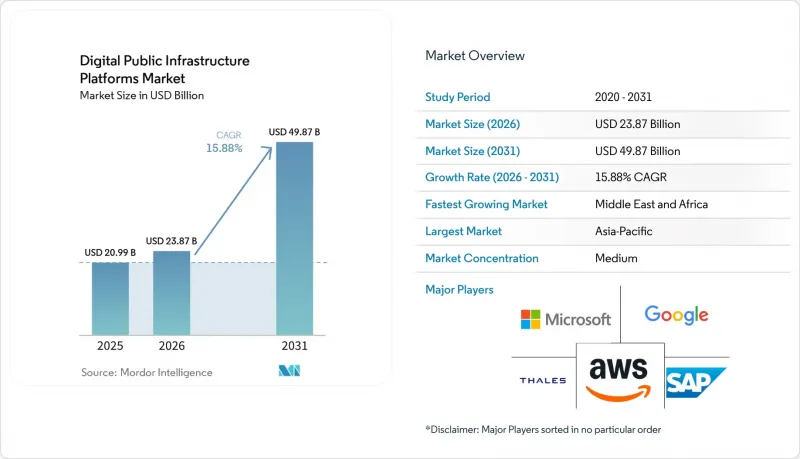
根據 Mordor Intelligence 預測,數位公共基礎設施平台的市場規模預計將從 2025 年的 210 億美元和 2026 年的 239 億美元成長到 2031 年的 499 億美元,2026 年至 2031 年的複合年成長率為 15.88%。
本報告按平台類型(數位身分、數位支付、資料交換與授權、數位通知與通訊、其他)、部署模式(雲端、本地部署、混合部署)、最終用戶(政府和公共部門、金融機構、醫療保健提供者、電信業者、運輸機構、其他)以及地區(北美、南美、歐洲、亞太、其他)進行細分。市場預測以美元計價。
全球數位公共基礎設施平台市場趨勢與洞察
各國數位身分的擴展
數位身分認證計畫正在取代紙本身份驗證,並應用於更廣泛的公共服務領域。到2025年,在接受調查的33個經合組織成員國中,88%的國家將運行互通性框架,18個國家的公民將能夠透過安全的數位身分存取至少75%的公共服務。北歐國家和荷蘭的數位身分普及率超過90%。歐盟第2024/1183號條例規定,歐盟成員國必須在2026年底前為公民和居住者提供至少一個歐盟數位身分錢包。在菲律賓,PhilSys已註冊了8,000萬人,佔目標人口的87%。這次註冊也促成了800萬個新銀行帳戶的開設。這些成就使得數位公共基礎設施平台市場對於負責提供福利、資金取得和國家服務的機構至關重要。
政府提供的即時支付基礎設施和補貼分配
政府對個人的支付正成為國家數位基礎設施的核心應用場景。根據印度政府引用的數據顯示,印度的統一支付介面(UPI)在2024年處理了全球49%的即時支付交易,每日平均交易量達7.43億筆。巴西的「gov.br」預計到2026年3月將擁有1.75億註冊用戶,「Conecta gov.br」在2025年完成了超過11億筆資料交換交易。在美國,FedNow在2025年處理了8,534億美元的支付,並在2026年第一季處理了2,713億美元的支付。超過1600家金融機構參與了FedNow,財政部透過其「數位支付計畫」向聯邦機構提供這項服務。隨著支付、身份驗證和數據功能的日益整合,數位公共基礎設施平台市場正朝著金融管理的方向邁進。
資料主權和隱私責任
資料在地化法規會使跨境平台的設計更具挑戰性。歐洲和印度的隱私框架要求對個人資料(包括生物識別資訊)進行嚴格控制。服務提供者可能需要為每個司法管轄區配備獨立的、主權雲端環境、身分驗證流程和營運團隊。 2025 年的一項數位主權評估指出,資料隱私、安全風險以及對國際技術的依賴是影響人們對國家數位基礎設施信任的主要障礙。如果一個平台用於驗證福利、醫療記錄和金融服務,那麼安全故障可能會影響同一底層系統中的多個服務。這可能導致採購週期延長,更有可能採用混合和多供應商架構,並可能阻礙數位公共基礎設施平台市場的收入集中。
細分市場分析
預計到2025年,數位身分平台將佔據數位公共基礎設施平台市場的36.78%。這一市場地位反映了檢驗身分作為下游公共服務認證層的重要角色。到2025年,預計至少有64個國家將運行類似數位公共基礎設施(DPI)的數位身分系統。此外,歐洲數位身分錢包的要求正在為整個歐盟制定明確的合規時間表。即使在採用率較低的國家,隨著基本註冊和憑證的擴展,國家身分計畫預計仍將保持重要性。這些因素預計將推動註冊、認證、錢包和憑證管理系統的持續採購。
預計到2031年,數據交換和同意平台將以16.43%的複合年成長率成長。這一成長與隱私法規和可互通的公共數據系統的需求密切相關。 ISO/IEC TS 27560:2023正成為機器可讀同意記錄的關鍵標準。付款管道將繼續發揮至關重要的作用,因為福利支付和即時支付系統依賴可靠的身份驗證和資料連結。通知和通訊工具還可以透過告知公民專案狀態和法規更新來支援服務的連續性。其他平台類型包括數位化居民登記、電子採購和環境數據系統,這些反映了對國家公共基礎設施的更廣泛理解。
區域分析
預計到2025年,亞太地區將佔全球收入的31.21%,成為全球最大的數位公共基礎設施平台市場。在印度,預計到2025年,Aadhaar的註冊用戶將達到14億,電子認證次數將達到1,250億次。此外,政府福利項目預計將透過直接支付發放4,500億美元。預計到2026年2月,印度將與24個國家簽署數位公共基礎設施(DPI)合作備忘錄。馬來西亞的「MyDigital ID」預計到2026年6月將擁有1,200萬用戶,並與114項線上政府服務整合。菲律賓的識別計畫也展現了其在基本註冊和資金取得方面的重要性。
在北美和歐洲,現有大型公共系統現代化改造的需求正在推動成長。預計到2026年第一季,FedNow將透過超過1600家參與的金融機構處理2713億美元的支付。美國聯邦政府預計到2025年將在資訊科技(IT)方面每年支出超過1000億美元。據美國政府責任署(GAO)稱,其中80%的支出將用於維護現有系統。歐洲對數位身分錢包的需求持續為身分識別提供者創造合規主導的商業機會。在巴西,透過gov.br和Conecta gov.br,南美地區的業務活動顯著增加。
預計到2031年,中東和非洲的經濟將以17.32%的複合年成長率成長。非洲聯盟(非盟)預計於2025年2月通過《非洲大陸自由貿易協定》(AfCFTA)數位貿易議定書的八項附件。 《科托努宣言》承諾西非和中非各國政府將在15個國家實現支付互通性,並將跨境數位匯款成本降低40%。根據聯合國開發計畫署(UNDP)的報告,預計到2026年,55個非洲聯盟成員國中的31個國家將運作即時支付系統。雖然已有36個國家引入了數位身份,但據報道,仍有超過5.5億非洲人缺乏官方身份證明。這種覆蓋率上的差距凸顯了全部區域長期投資的必要性。
其他好處
- Excel格式的市場預測(ME)表
- 3個月的分析師支持
目錄
第1章:引言
- 研究假設和市場定義
- 調查範圍
第2章:調查方法
第3章執行摘要
第4章 市場狀況
- 市場概覽
- 市場促進因素
- 各國數位身分的擴展
- 政府提供的即時支付基礎設施和補貼分配
- 可互通的資料交換與同意框架
- 採用開放標準和模組化開放原始碼
- 人工智慧賦能的公共服務架構
- 跨境數位服務的可移植性
- 市場限制因素
- 關於資料主權和隱私的法律責任
- 管治碎片化與職責不明確
- 舊有系統整合與人才短缺
- 永續資金籌措和生命週期管理面臨的壓力
- 價值鏈分析
- 監理情勢
- 技術展望
- 波特五力分析
第5章 市場規模與成長預測
- 依平台類型
- 數位身分平台
- 數位付款管道
- 資料交換與同意平台
- 數位通知和通訊平台
- 其他平台類型
- 部署模式
- 基於雲端的
- 現場
- 混合
- 最終用戶
- 政府/公共部門
- 金融機構
- 醫療服務提供方
- 電信營運商
- 交通運輸及旅遊組織
- 公共產業和能源公司
- 其他最終用戶
- 按地區
- 北美洲
- 美國
- 加拿大
- 墨西哥
- 南美洲
- 巴西
- 阿根廷
- 其他南美國家
- 歐洲
- 英國
- 德國
- 法國
- 義大利
- 其他歐洲國家
- 亞太地區
- 中國
- 日本
- 印度
- 韓國
- 其他亞洲國家
- 中東和非洲
- 中東
- 沙烏地阿拉伯
- 阿拉伯聯合大公國
- 其他中東國家
- 非洲
- 南非
- 埃及
- 其他非洲國家
- 中東
- 北美洲
第6章 競爭情勢
- 市場集中度
- 策略趨勢
- 市佔率分析
- 公司簡介
- Microsoft Corporation
- International Business Machines Corporation
- Thales Group
- NEC Corporation
- Oracle Corporation
- Entrust Corporation
- Ping Identity Corporation
- IDEMIA Group
- Signicat AS
- Mitek Systems, Inc.
- Jumio Corporation
- Okta, Inc.
- SAP SE
- Amazon Web Services, Inc.
- Google LLC
- Veridos GmbH
第7章 市場機會與未來展望
According to Mordor Intelligence, the digital public infrastructure platforms market size is projected to expand from USD 21.0 billion in 2025 and USD 23.9 billion in 2026 to USD 49.9 billion by 2031, registering a CAGR of 15.88% between 2026 to 2031.
This report is Segmented by Platform Type (Digital Identity, Payments, Data Exchange, Notifications, and More), Deployment Mode (Cloud-Based, On-Premises, and Hybrid), End User (Government, Financial Institutions, Healthcare, Telecom, Transport, and More), and Geography (North America, South America, Europe, Asia-Pacific, and More). The Market Forecasts are Provided in Terms of Value (USD).
Global Digital Public Infrastructure Platforms Market Trends and Insights
National Digital Identity Expansion
Digital identity programs are replacing paper-based verification across a broader range of public services. In 2025, 88% of the 33 surveyed OECD countries had active interoperability frameworks, while 18 countries gave citizens access to at least 75% of public services through secure digital identity. The Nordic countries and the Netherlands reported identity adoption rates above 90% of their populations. Regulation (EU) 2024/1183 requires European Union member states to provide citizens and residents with at least 1 EU Digital Identity Wallet by the end of 2026. In the Philippines, PhilSys enrolled 80 million people, equal to 87% of the eligible population, and enrollment was associated with 8 million new bank accounts. These outcomes make the digital public infrastructure platforms market relevant to agencies responsible for benefits, financial access, and national service delivery.
Real-Time Government Payment Rails and Benefit Delivery
Government-to-person payments are becoming a core use case for national digital infrastructure. India's UPI handled 49% of global real-time payment transaction volume in 2024 and processed 743 million transactions a day, according to data cited by the Government of India. Brazil's gov.br had reached 175 million registered users by March 2026, and Conecta gov.br completed more than 1.1 billion data-exchange transactions in 2025. In the United States, FedNow processed USD 853.4 billion in payment value during 2025 and USD 271.3 billion in the first quarter of 2026. More than 1,600 financial institutions participated in FedNow, and the Treasury made the service available to federal agencies through its Digital Payout Program. These developments bring the digital public infrastructure platforms market closer to fiscal administration, as payment, identity, and data functions become connected.
Data Sovereignty and Privacy Liability
Data localization rules can make cross-border platform design more difficult. Privacy frameworks in Europe and India require strong controls over personal data, including biometric information. Providers may need separate sovereign-cloud environments, certification processes, and operational teams for individual jurisdictions. A 2025 review of digital sovereignty identified data privacy, security exposure, and dependence on international technology as major barriers to trust in national digital infrastructure. As platforms authenticate welfare payments, health records, and financial services, a security failure can affect several services through the same foundational system. This can lengthen procurement, favor hybrid and multi-vendor architectures, and limit revenue concentration in the digital public infrastructure platforms market.
Other drivers and restraints analyzed in the detailed report include:
- Interoperable Data Exchange and Consent Frameworks
- Open Standards and Modular Open-Source Adoption
- Fragmented Governance and Institutional Ownership
For complete list of drivers and restraints, kindly check the Table Of Contents.
Segment Analysis
Digital identity platforms are expected to hold 36.78% of the digital public infrastructure platforms market share in 2025. This position reflects the role of verified identity as the authentication layer for downstream public services. At least 64 countries are expected to operate DPI-like digital identity systems in 2025. The European Digital Identity Wallet requirement is also establishing a defined compliance timeline across the European Union. National identity programs are likely to remain important as late-adopting countries expand basic registration and credentialing. These factors are expected to support continued procurement of enrollment, authentication, wallet, and credential-management systems.
Data exchange and consent platforms are projected to register a CAGR of 16.43% through 2031. Their growth is linked to privacy regulations and the need for interoperable public data systems. ISO/IEC TS 27560:2023 is emerging as a relevant reference for machine-readable consent records. Payment platforms remain important because benefit delivery and real-time payment systems depend on trusted identity and data links. Notification and messaging tools can also support service continuity by keeping citizens informed about program status and regulatory updates. Other platform types include civil registry digitization, e-procurement, and environmental data systems, reflecting a broader interpretation of national public infrastructure.
Complete Report Scope:
- By Platform Type
- Digital Identity Platforms
- Digital Payments Platforms
- Data Exchange and Consent Platforms
- Digital Notifications and Messaging Platforms
- Other Platform Type
- By Deployment Mode
- Cloud-Based
- On-Premise
- Hybrid
- By End User
- Government and Public Sector
- Financial Institutions
- Healthcare Providers
- Telecommunications Operators
- Transport and Mobility Agencies
- Utilities and Energy Operators
- Other End Users
- By Geography
- North America
- United States
- Canada
- Mexico
- South America
- Brazil
- Argentina
- Rest of South America
- Europe
- United Kingdom
- Germany
- France
- Italy
- Rest of Europe
- Asia-Pacific
- China
- Japan
- India
- South Korea
- Rest of Asia
- Middle East and Africa
- Middle East
- Saudi Arabia
- United Arab Emirates
- Rest of Middle East
- Africa
- South Africa
- Egypt
- Rest of Africa
- Middle East
- North America
Geography Analysis
Asia-Pacific is expected to account for 31.21% of revenue in 2025, making it the largest digital public infrastructure platforms market by geography. India is expected to record 1.4 billion Aadhaar enrollments and 125 billion e-authentications by 2025. Government welfare programs are also expected to disburse USD 450 billion through direct benefit transfers. India is expected to sign DPI cooperation memoranda with 24 countries by February 2026. Malaysia's MyDigital ID is expected to reach 12 million users and integrate with 114 online government services by June 2026. The Philippines' identity program also shows the link between foundational registration and financial access.
Modernization needs across large existing public systems support growth in North America and Europe. FedNow is expected to process USD 271.3 billion during the first quarter of 2026 across more than 1,600 participating institutions. The US federal government is expected to spend more than USD 100 billion annually on information technology in 2025. The GAO stated that 80% of that spending goes toward maintaining existing systems. European wallet requirements continue to create a compliance-led pipeline for identity providers. Brazil adds significant activity in South America through gov.br and Conecta gov.br.
The Middle East and Africa are projected to expand at a CAGR of 17.32% through 2031. The African Union is expected to adopt eight annexes to the AfCFTA Digital Trade Protocol in February 2025. The Cotonou Declaration committed West and Central African governments to interoperable payments across 15 countries and a 40% reduction in digital cross-border transfer costs. UNDP reported that instant payment systems are expected to operate in 31 of 55 African Union member states in 2026. It also reported that 36 countries had deployed digital identity, while more than 550 million Africans still lacked official identification. This coverage gap supports a long-term investment need across the region.
- Microsoft Corporation
- International Business Machines Corporation
- Thales Group
- NEC Corporation
- Oracle Corporation
- Entrust Corporation
- Ping Identity Corporation
- IDEMIA Group
- Signicat AS
- Mitek Systems, Inc.
- Jumio Corporation
- Okta, Inc.
- SAP SE
- Amazon Web Services, Inc.
- Google LLC
- Veridos GmbH
Additional Benefits:
- The market estimate (ME) sheet in Excel format
- 3 months of analyst support
TABLE OF CONTENTS
1 INTRODUCTION
- 1.1 Study Assumptions and Market Definition
- 1.2 Scope of the Study
2 RESEARCH METHODOLOGY
3 EXECUTIVE SUMMARY
4 MARKET LANDSCAPE
- 4.1 Market Overview
- 4.2 Market Drivers
- 4.2.1 National Digital Identity Expansion
- 4.2.2 Real-Time Government Payment Rails and Benefit Delivery
- 4.2.3 Interoperable Data Exchange and Consent Frameworks
- 4.2.4 Open Standards and Modular Open Source Adoption
- 4.2.5 AI-Ready Public Service Architecture
- 4.2.6 Cross-Border Digital Service Portability
- 4.3 Market Restraints
- 4.3.1 Data Sovereignty and Privacy Liability
- 4.3.2 Fragmented Governance and Institutional Ownership
- 4.3.3 Legacy System Integration and Talent Scarcity
- 4.3.4 Sustainable Funding and Lifecycle Operations Pressure
- 4.4 Value Chain Analysis
- 4.5 Regulatory Landscape
- 4.6 Technological Outlook
- 4.7 Porter's Five Forces Analysis
- 4.7.1 Threat of New Entrants
- 4.7.2 Bargaining Power of Buyers
- 4.7.3 Bargaining Power of Suppliers
- 4.7.4 Threat of Substitutes
- 4.7.5 Industry Rivalry
5 MARKET SIZE AND GROWTH FORECASTS (VALUE)
- 5.1 By Platform Type
- 5.1.1 Digital Identity Platforms
- 5.1.2 Digital Payments Platforms
- 5.1.3 Data Exchange and Consent Platforms
- 5.1.4 Digital Notifications and Messaging Platforms
- 5.1.5 Other Platform Type
- 5.2 By Deployment Mode
- 5.2.1 Cloud-Based
- 5.2.2 On-Premise
- 5.2.3 Hybrid
- 5.3 By End User
- 5.3.1 Government and Public Sector
- 5.3.2 Financial Institutions
- 5.3.3 Healthcare Providers
- 5.3.4 Telecommunications Operators
- 5.3.5 Transport and Mobility Agencies
- 5.3.6 Utilities and Energy Operators
- 5.3.7 Other End Users
- 5.4 By Geography
- 5.4.1 North America
- 5.4.1.1 United States
- 5.4.1.2 Canada
- 5.4.1.3 Mexico
- 5.4.2 South America
- 5.4.2.1 Brazil
- 5.4.2.2 Argentina
- 5.4.2.3 Rest of South America
- 5.4.3 Europe
- 5.4.3.1 United Kingdom
- 5.4.3.2 Germany
- 5.4.3.3 France
- 5.4.3.4 Italy
- 5.4.3.5 Rest of Europe
- 5.4.4 Asia-Pacific
- 5.4.4.1 China
- 5.4.4.2 Japan
- 5.4.4.3 India
- 5.4.4.4 South Korea
- 5.4.4.5 Rest of Asia
- 5.4.5 Middle East and Africa
- 5.4.5.1 Middle East
- 5.4.5.1.1 Saudi Arabia
- 5.4.5.1.2 United Arab Emirates
- 5.4.5.1.3 Rest of Middle East
- 5.4.5.2 Africa
- 5.4.5.2.1 South Africa
- 5.4.5.2.2 Egypt
- 5.4.5.2.3 Rest of Africa
- 5.4.5.1 Middle East
- 5.4.1 North America
6 COMPETITIVE LANDSCAPE
- 6.1 Market Concentration
- 6.2 Strategic Moves
- 6.3 Market Share Analysis
- 6.4 Company Profiles (includes Global Level Overview, Market Level Overview, Core Segments, Financials as available, Strategic Information, Market Rank/Share, Products and Services, Recent Developments)
- 6.4.1 Microsoft Corporation
- 6.4.2 International Business Machines Corporation
- 6.4.3 Thales Group
- 6.4.4 NEC Corporation
- 6.4.5 Oracle Corporation
- 6.4.6 Entrust Corporation
- 6.4.7 Ping Identity Corporation
- 6.4.8 IDEMIA Group
- 6.4.9 Signicat AS
- 6.4.10 Mitek Systems, Inc.
- 6.4.11 Jumio Corporation
- 6.4.12 Okta, Inc.
- 6.4.13 SAP SE
- 6.4.14 Amazon Web Services, Inc.
- 6.4.15 Google LLC
- 6.4.16 Veridos GmbH
7 MARKET OPPORTUNITIES AND FUTURE OUTLOOK
- 7.1 White Space and Unmet Need Assessment


