


 |
市場調查報告書
商品編碼
2119216
氫氣加註站:市場佔有率分析、產業趨勢與統計、成長預測(2026-2031)Hydrogen Fueling Station - Market Share Analysis, Industry Trends & Statistics, Growth Forecasts (2026 - 2031) |
||||||

※ 本網頁內容可能與最新版本有所差異。詳細情況請與我們聯繫。
根據 Mordor Intelligence 預測,氫氣加註站市場預計將從 2025 年的 18.1 億美元成長到 2026 年的 20.1 億美元,到 2031 年達到 48.9 億美元,2026 年至 2031 年的複合年預計成長率為 19.46%。
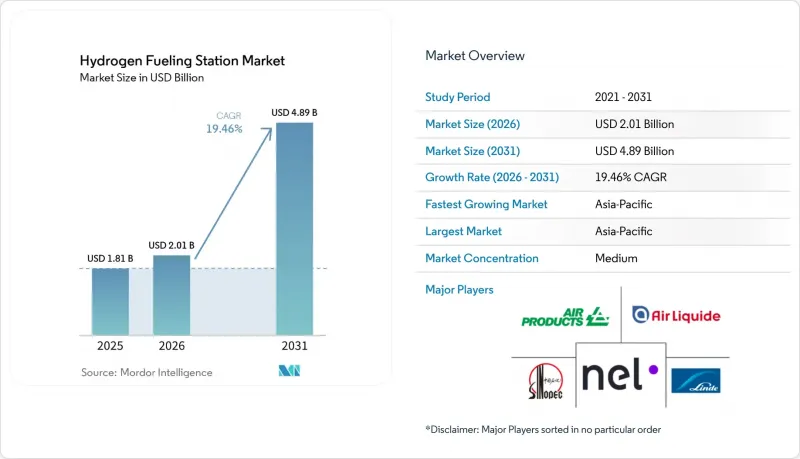
本報告按加氫站類型(固定式、移動式)、氫氣生產來源(綠氫、藍氫、灰氫及其他低碳氫化合物)、終端用途(乘用車、商用車、公車、重型卡車、鐵路、船舶、工業車輛及其他)和地區(北美、歐洲、亞太、南美以及中東和非洲)進行細分。市場預測以美元計價。
全球氫氣加註站市場趨勢與洞察
重型貨運走廊中由車隊主導的氫氣需求
氫燃料加註站市場最強勁的需求來自物流營運商,他們需要在特定貨運走廊沿線獲得可靠的燃料供應。 2026年1月,德國啟動了一項2.2億歐元的計劃,旨在支持在泛歐交通網路(TEN-T)核心線路沿線建設多達40座加氫站和400輛燃料電池卡車。截至2026年6月截止日期,該計畫已收到526份申請,總申請金額達4.55億歐元,是可用資金的兩倍多。在韓國,連接首爾和釜山、首爾和光州以及仁川和忠清北道的貨運走廊正在開發中。這些計劃優先考慮將車輛與特定地點連接起來的車隊契約,並提高加氫站的預期處理能力。當加氫站和貨運走廊沿線的需求可預測時,加氫站市場將從中受益,因為這種需求模式允許在形成更廣泛的客戶群之前收回營運成本。
強制推廣零排放車輛(ZEV)和為氫能基礎設施提供資金
公眾支持正從示範計畫轉向商業氫能基礎設施。加州已根據GFO-25-607號撥款,在2026年撥款4,500萬美元用於輕型、中型和重型車輛的加氫基礎設施建設。該州還透過其「零排放車輛基礎設施藍圖2.0」計劃,撥款4000萬美元用於中型和重型車輛的應用。韓國累計7,218億美元(相當於5.3億美元)用於燃料電池汽車購置補貼,並將氫燃料公車的補貼提高到每公斤5,000美元。 AFIR要求在指定期限內,在泛歐交通網路(TEN-T)核心走廊沿線建造可供公眾使用的加氫站。這些要求使得授權和安全距離核准變得更加關鍵,因為核准延誤可能會導致工程無法加入最初的走廊叢集。在加氫站市場,隨著資金籌措與車輛部署和走廊准入掛鉤,需求路徑正變得越來越清晰。
初期階段資本成本高,利用率低
由於車輛數量少且燃料銷售不穩定,加氫站的獲利能力仍面臨挑戰。 2026 年發表在《國際氫能期刊》(International Journal of Hydrogen Energy)上的研究指出,利用率和折現率是大型加氫站的關鍵成本因素。研究發現,在使用率較低的情況下,小規模加氫站的氫氣均衡成本可能超過每公斤 50 歐元。加州先前的評估也指出,網路運作問題與維護和氫氣品質有關。在這種情況下,加氫站更容易受到供應中斷和產品品質波動的影響。德國的一項計畫透過將加氫站的資金與燃料電池卡車掛鉤來應對這一風險,從一開始就提高了加氫站的運轉率。在車輛保有量穩定成長之前,加氫站市場可能仍將受到資金籌措成本的影響。
細分市場分析
截至2025年,固定式加氫站佔加氫站市場91.1%的佔有率。這一主導地位反映了成熟商業路線和大規模車輛基地對高處理能力的需求。固定式加氫站非常適合車輛可以重複加氫的走廊地帶,以及開發商能夠證明安裝壓縮、儲存和加氫設備合理性的地區。加氫站產業依賴這些基地來建立可靠的網路基礎。移動式加氫站到2025年佔總裝置容量的8.9%,但它們在車輛部署初期階段的燃料供應中扮演著不同的角色。根據所提供的數據,截至2024年底,亞太地區共有849座加氫站,其中許多集中在中國、韓國和日本。
預計2026年至2031年間,移動式加氫站的複合年成長率將達22.3%。由於其初始投資較低,開發商可以更輕鬆地根據車隊需求檢驗部署大規模加氫站的可行性。在氫氣加氫站市場,這些設施可用於公共汽車、卡車、港口設施以及正在建造的臨時應用。拖車式系統還能縮短車輛交付到加氫所需的時間。標準化加氫流程對於滿足不同製造商車輛的需求至關重要。結合使用固定式和移動式加氫站可以降低在需求出現之前建造永久性設施的風險。
區域分析
預計到2025年,亞太地區將佔全球氫燃料加註站市場佔有率的45.3%,並在2031年之前以29.7%的複合年成長率成長。中國、韓國和日本仍然是該地區的主要樞紐。在車輛補貼的支持下,韓國的加氫站數量從2022年的170座增加到2025年的400座。在日本,與政府的目標相比,運作中的加氫站網路仍然小規模,這凸顯了維持消費者主導的加氫需求所面臨的挑戰。
歐洲是全球第二大氫能區域,目前已建立一套將加氫站規劃與貨運走廊相銜接的框架。一項德國資金籌措活動旨在支持沿著泛歐交通運輸網路(TEN-T)走廊建造卡車和加氫站的協同佈局。 TEAL Mobility計畫在2025年底在五個歐洲國家營運17座加氫站。歐洲加氫站市場也受惠於鹿特丹「ELYgator」等大規模供氫計畫。 2026年,立陶宛首個面向船舶、卡車和港口作業的綠色氫能設施在克萊佩達港投入營運。
儘管規模較小,但在北美、南美以及中東和非洲,氫能發展路徑已初見端倪。加州2026年的資金計畫重點在於不同重量級車輛的氫燃料加註。在北美,連網走廊專案比分散的位置更具可行性。巴西蘇阿佩港已宣布計劃擴建其綠色氫能樞紐,目標是在2030年運作,投資額達158億雷亞爾(約合30.9億美元),但南美的氫燃料加註基礎設施仍然有限。在中東,雖然正在建造用於出口的綠色氫氣生產能力,但國內氫燃料加註仍處於起步階段。這些地區可以透過將生產發展與港口、物流中心和早期車輛部署計劃相結合而受益。
其他好處
- Excel格式的市場預測(ME)表
- 3個月的分析師支持
目錄
第1章:引言
- 研究假設和市場定義
- 調查範圍
第2章:調查方法
第3章執行摘要
第4章 市場狀況
- 市場概覽
- 市場促進因素
- 重型貨運走廊中由車隊主導的氫氣需求
- 強制推廣零排放車輛並為氫能基礎設施建設提供資金
- 擴大固定路線公車和車輛段車隊
- 綠色氫能與現場電解設備的整合
- 港口、機場和物流樞紐的脫碳
- 透過模組化和行動部署最佳化站點組合。
- 市場限制因素
- 初期階段資本成本高,利用率低
- 氫氣供應和分配網路短缺
- 氫氣品質和供應可靠性對加氫站運作時間的影響
- 不同司法管轄區在授權、安全距離和批准方面存在摩擦
- 供應鏈分析
- 技術展望
- 監理情勢
- 波特五力分析
第5章 市場規模與成長預測
- 依站點類型
- 固定式氫氣加註站
- 移動式氫氣加註站
- 透過氫氣生產源
- 綠氫能
- 藍氫
- 灰氫
- 其他低碳氫化合物
- 按最終用途
- 搭乘用車
- 商用車輛
- 公車線路
- 大型卡車
- 鐵路
- 船
- 工業車輛(堆高機、礦山設備、港口設備)
- 其他
- 按地區
- 北美洲
- 美國
- 加拿大
- 墨西哥
- 歐洲
- 德國
- 法國
- 義大利
- 西班牙
- 英國
- 波蘭
- 俄羅斯
- 其他歐洲國家
- 亞太地區
- 中國
- 印度
- 日本
- 韓國
- 澳洲
- 印尼
- 越南
- 泰國
- 其他亞太國家
- 南美洲
- 巴西
- 阿根廷
- 智利
- 其他南美國家
- 中東和非洲
- 沙烏地阿拉伯
- 阿拉伯聯合大公國
- 埃及
- 南非
- 摩洛哥
- 其他中東和非洲國家
- 北美洲
第6章 競爭情勢
- 市場集中度
- 策略趨勢
- 市佔率分析
- 公司簡介
- Air Products and Chemicals, Inc.
- Atawey SAS
- Chart Industries, Inc.
- China Petroleum and Chemical Corporation
- ENEOS Corporation
- FirstElement Fuel, Inc.
- H2 MOBILITY Deutschland GmbH & Co. KG
- Hydrogen Refueling Solutions SA
- ITM Power plc
- Iwatani Corporation
- Korea Gas Corporation
- L'Air Liquide SA
- Linde plc
- Maximator Hydrogen GmbH
- Nel ASA
- PDC Machines, Inc.
- Plug Power Inc.
- Shell plc
- TotalEnergies SE
第7章 市場機會與未來展望
According to Mordor Intelligence, the hydrogen fueling station market size is expected to increase from USD 1.81 billion in 2025 to USD 2.01 billion in 2026 and reach USD 4.89 billion by 2031, growing at a CAGR of 19.46% over 2026-2031.
This report is Segmented by Station Type (Fixed, Mobile), Hydrogen Production Source (Green, Blue, Gray, Other Low-Carbon), End-Use (Passenger Vehicles, Commercial Vehicles, Transit Buses, Heavy-Duty Trucks, Railways, Marine, Industrial Vehicles), and Geography (North America, Europe, Asia-Pacific, South America, and Middle East and Africa). The Market Forecasts are Provided in Terms of Value (USD).
Global Hydrogen Fueling Station Market Trends and Insights
Fleet-Led Hydrogen Demand From Heavy-Duty Freight Corridors
The strongest demand signal in the hydrogen fueling station market comes from logistics operators that need reliable fuel access on defined freight routes. Germany launched a EUR 220 million program in January 2026 to support up to 40 hydrogen stations and 400 fuel cell trucks on TEN-T core network routes. By the June 2026 deadline, the program had received 526 applications seeking EUR 455 million, more than twice the available funding. South Korea has established freight corridors between Seoul and Busan, Seoul and Gwangju, and Incheon and Chungbuk. These programs favor fleet contracts that connect vehicles to specific locations and raise expected station throughput. The hydrogen fueling station market benefits when a depot or corridor has predictable demand, because that pattern supports operating cost recovery before a broader retail customer base develops.
Zero-Emission Vehicle Mandates and Hydrogen Infrastructure Funding
Public support is moving from demonstration projects toward commercial hydrogen infrastructure. California made USD 45 million available in 2026 under GFO-25-607 for hydrogen refueling infrastructure serving light-duty, medium-duty, and heavy-duty vehicles. The state also provided USD 40 million through its ZEV Infrastructure Blueprints 2.0 program for medium-duty and heavy-duty applications. South Korea allocated KRW 721.8 billion, equivalent to USD 530 million, in 2025 for fuel cell vehicle purchase subsidies and raised the hydrogen bus fuel subsidy to KRW 5,000 per kilogram. AFIR requires publicly accessible hydrogen refueling points on TEN-T core network corridors by stated deadlines. These requirements make permitting and safety-distance approvals more important, since delayed approvals can prevent a project from joining an early corridor cluster. The hydrogen fueling station market has a clearer route to demand where funding is tied to vehicle deployment and corridor access.
High Capital Cost and Low Early Utilization
Station economics remain difficult when vehicle numbers are low, and fuel sales are uncertain. A 2026 study in the International Journal of Hydrogen Energy identified utilization and discount rate as the leading cost drivers for heavy-duty hydrogen refueling stations. The study found that low-use cases can push levelized hydrogen costs beyond EUR 50 per kilogram at smaller configurations. California's earlier assessment also documented network uptime challenges connected to maintenance and hydrogen quality. These conditions make a station more exposed when supply deliveries are disrupted or product quality varies. The German program addresses this risk by linking funding for stations with fuel cell trucks, which can improve utilization from the start. The hydrogen fueling station market will remain sensitive to financing costs until demand is anchored by committed fleets.
Other drivers and restraints analyzed in the detailed report include:
- Green Hydrogen and On-Site Electrolyzer Integration
- Station Portfolio Optimization Through Modular and Mobile Deployment
- Limited Hydrogen Supply and Distribution Networks
For complete list of drivers and restraints, kindly check the Table Of Contents.
Segment Analysis
Fixed stations held 91.1% of the hydrogen fueling station market in 2025. Their lead reflects the need for high throughput on established commercial routes and at large fleet sites. Fixed facilities are suited to corridors where vehicles can refuel repeatedly and where the developer can justify compression, storage, and dispensing equipment. The hydrogen fueling station industry relies on these sites to provide the backbone of a dependable network. Mobile formats had 8.9% of installed capacity in 2025, but they fulfill a different role by bringing fuel to early fleet deployments. Asia-Pacific had 849 stations at the end of 2024, according to the supplied source material, with a large concentration in China, South Korea, and Japan.
Mobile stations are forecast to grow at a 22.3% CAGR between 2026 and 2031. Their smaller initial commitment helps a developer test whether fleet demand justifies a larger site. The hydrogen fueling station market can use these facilities for buses, trucks, port equipment, and temporary applications during construction. Trailer-mounted systems also reduce the time between a fleet's vehicle delivery and the availability of fuel. Standard-compliant dispensing remains important for serving vehicles from different manufacturers. A mixed portfolio of fixed and mobile assets can limit the risk of building permanent capacity ahead of demand.
Complete Report Scope:
- By Station Type
- Fixed Hydrogen Fueling Stations
- Mobile Hydrogen Fueling Stations
- By Hydrogen Production Source
- Green Hydrogen
- Blue Hydrogen
- Gray Hydrogen
- Other Low-carbon Hydrogen
- By End-use
- Passenger Vehicles
- Commercial Vehicles
- Transit Buses
- Heavy-duty Trucks
- Railways
- Marine
- Industrial Vehicles (Forklifts, Mining, Ports)
- Others
- By Geography
- North America
- United States
- Canada
- Mexico
- Europe
- Germany
- France
- Italy
- Spain
- United Kingdom
- Poland
- Russia
- Rest of Europe
- Asia-Pacific
- China
- India
- Japan
- South Korea
- Australia
- Indonesia
- Vietnam
- Thailand
- Rest of Asia-Pacific
- South America
- Brazil
- Argentina
- Chile
- Rest of South America
- Middle East and Africa
- Saudi Arabia
- United Arab Emirates
- Egypt
- South Africa
- Morocco
- Rest of Middle East and Africa
- North America
Geography Analysis
Asia-Pacific held 45.3% of the hydrogen fueling station market in 2025 and is forecast to grow at a 29.7% CAGR through 2031. China, South Korea, and Japan remain the region's main deployment centers. South Korea expanded its station count from 170 in 2022 to 400 in 2025, supported by vehicle subsidies. Japan has a smaller operating network than its government target, which shows the difficulty of sustaining passenger-led refueling demand.
Europe is the second-largest region and has a policy framework that connects station planning to freight routes. Germany's funding call seeks to support combined truck and station deployment on TEN-T corridors. TEAL Mobility operated 17 stations in 5 European countries by the end of 2025. The hydrogen fueling station market in Europe also benefits from larger-scale supply projects such as ELYgator in Rotterdam. The Port of Klaipeda opened Lithuania's first green hydrogen facility in 2026 for vessels, trucks, and port operations.
North America, South America, and the Middle East and Africa have smaller positions but have identifiable development routes. California's 2026 funding focuses on hydrogen refueling for vehicles across several weight classes. In North America, networked corridor projects are more likely to be viable than isolated locations. Brazil's Suape Port has announced a BRL 15.8 billion (~USD 3.09 billion) green hydrogen hub expansion plan for 2030 commissioning, although refueling infrastructure in South America remains limited. The Middle East is building green hydrogen production capacity for export, while domestic refueling remains at an early stage. These regions can gain from linking production development with ports, logistics centers, and initial fleet commitments.
- Air Products and Chemicals, Inc.
- Atawey SAS
- Chart Industries, Inc.
- China Petroleum and Chemical Corporation
- ENEOS Corporation
- FirstElement Fuel, Inc.
- H2 MOBILITY Deutschland GmbH & Co. KG
- Hydrogen Refueling Solutions SA
- ITM Power plc
- Iwatani Corporation
- Korea Gas Corporation
- L'Air Liquide S.A.
- Linde plc
- Maximator Hydrogen GmbH
- Nel ASA
- PDC Machines, Inc.
- Plug Power Inc.
- Shell plc
- TotalEnergies SE
Additional Benefits:
- The market estimate (ME) sheet in Excel format
- 3 months of analyst support
TABLE OF CONTENTS
1 INTRODUCTION
- 1.1 Study Assumptions and Market Definition
- 1.2 Scope of the Study
2 RESEARCH METHODOLOGY
3 EXECUTIVE SUMMARY
4 MARKET LANDSCAPE
- 4.1 Market Overview
- 4.2 Market Drivers
- 4.2.1 Fleet-Led Hydrogen Demand From Heavy-Duty Freight Corridors
- 4.2.2 Zero-Emission Vehicle Mandates and Hydrogen Infrastructure Funding
- 4.2.3 Growth of Fixed-Route Bus and Depot Fleets
- 4.2.4 Green Hydrogen and On-Site Electrolyzer Integration
- 4.2.5 Port, Airport and Logistics-Hub Decarbonization
- 4.2.6 Station Portfolio Optimization Through Modular and Mobile Deployment
- 4.3 Market Restraints
- 4.3.1 High Capital Cost and Low Early Utilization
- 4.3.2 Limited Hydrogen Supply and Distribution Networks
- 4.3.3 Station Uptime Exposure to Hydrogen Quality and Delivery Reliability
- 4.3.4 Permitting, Safety-Distance and Cross-Jurisdiction Approval Friction
- 4.4 Supply-Chain Analysis
- 4.5 Technology Outlook
- 4.6 Regulatory Landscape
- 4.7 Porter's Five Forces Analysis
- 4.7.1 Bargaining Power of Suppliers
- 4.7.2 Bargaining Power of Buyers
- 4.7.3 Threat of New Entrants
- 4.7.4 Threat of Substitutes
- 4.7.5 Competitive Rivalry
5 MARKET SIZE AND GROWTH FORECASTS
- 5.1 By Station Type
- 5.1.1 Fixed Hydrogen Fueling Stations
- 5.1.2 Mobile Hydrogen Fueling Stations
- 5.2 By Hydrogen Production Source
- 5.2.1 Green Hydrogen
- 5.2.2 Blue Hydrogen
- 5.2.3 Gray Hydrogen
- 5.2.4 Other Low-carbon Hydrogen
- 5.3 By End-use
- 5.3.1 Passenger Vehicles
- 5.3.2 Commercial Vehicles
- 5.3.3 Transit Buses
- 5.3.4 Heavy-duty Trucks
- 5.3.5 Railways
- 5.3.6 Marine
- 5.3.7 Industrial Vehicles (Forklifts, Mining, Ports)
- 5.3.8 Others
- 5.4 By Geography
- 5.4.1 North America
- 5.4.1.1 United States
- 5.4.1.2 Canada
- 5.4.1.3 Mexico
- 5.4.2 Europe
- 5.4.2.1 Germany
- 5.4.2.2 France
- 5.4.2.3 Italy
- 5.4.2.4 Spain
- 5.4.2.5 United Kingdom
- 5.4.2.6 Poland
- 5.4.2.7 Russia
- 5.4.2.8 Rest of Europe
- 5.4.3 Asia-Pacific
- 5.4.3.1 China
- 5.4.3.2 India
- 5.4.3.3 Japan
- 5.4.3.4 South Korea
- 5.4.3.5 Australia
- 5.4.3.6 Indonesia
- 5.4.3.7 Vietnam
- 5.4.3.8 Thailand
- 5.4.3.9 Rest of Asia-Pacific
- 5.4.4 South America
- 5.4.4.1 Brazil
- 5.4.4.2 Argentina
- 5.4.4.3 Chile
- 5.4.4.4 Rest of South America
- 5.4.5 Middle East and Africa
- 5.4.5.1 Saudi Arabia
- 5.4.5.2 United Arab Emirates
- 5.4.5.3 Egypt
- 5.4.5.4 South Africa
- 5.4.5.5 Morocco
- 5.4.5.6 Rest of Middle East and Africa
- 5.4.1 North America
6 COMPETITIVE LANDSCAPE
- 6.1 Market Concentration
- 6.2 Strategic Moves
- 6.3 Market Share Analysis
- 6.4 Company Profiles (includes Global Level Overview, Market Level Overview, Core Segments, Financials as available, Strategic Information, Market Rank/Share, Products and Services, Recent Developments)
- 6.4.1 Air Products and Chemicals, Inc.
- 6.4.2 Atawey SAS
- 6.4.3 Chart Industries, Inc.
- 6.4.4 China Petroleum and Chemical Corporation
- 6.4.5 ENEOS Corporation
- 6.4.6 FirstElement Fuel, Inc.
- 6.4.7 H2 MOBILITY Deutschland GmbH & Co. KG
- 6.4.8 Hydrogen Refueling Solutions SA
- 6.4.9 ITM Power plc
- 6.4.10 Iwatani Corporation
- 6.4.11 Korea Gas Corporation
- 6.4.12 L'Air Liquide S.A.
- 6.4.13 Linde plc
- 6.4.14 Maximator Hydrogen GmbH
- 6.4.15 Nel ASA
- 6.4.16 PDC Machines, Inc.
- 6.4.17 Plug Power Inc.
- 6.4.18 Shell plc
- 6.4.19 TotalEnergies SE
7 MARKET OPPORTUNITIES AND FUTURE OUTLOOK
- 7.1 White-Space and Unmet-Need Assessment

 氫氣加注站市場—全球及區域分析:按應用、產品與國家分類-分析與預測(2026-2035年)
 2026-2030年全球氫燃料加註站市場
 全球氫氣加註站市場規模、佔有率、趨勢和成長分析報告(2026-2034年)
 對 2035 年前商業氫燃料加註站市場進行分析和預測:按類型、產品、服務、技術、組件、應用、形式、最終用戶、安裝類型和設備分類。
 2034年氫氣加註站市場預測-按加註站類型、供氫方式、壓力等級、車輛相容性、最終用戶和地區分類的全球分析氫氣加註站市場預測至2034年-全球分析(按加註站類型、規模、供氫方式、壓力等級、解決方案、配置、應用、最終用戶和地區分類)
 氫燃料加註站市場:全球預測,2026-2032年模組化氫燃料站市場分析及至2035年的預測:類型、產品類型、服務、技術、組件、應用、部署、最終用戶、安裝類型、設備氫氣混合天然氣市場預測至2034年-按混合比例、供應方式、技術、應用、最終用戶和地區分類的全球分析
 2026年全球移動式氫氣金屬切碎機機市場報告