


 |
市場調查報告書
商品編碼
2119165
建築材料:市場佔有率分析、產業趨勢與統計、成長預測(2026-2031)Construction Materials - Market Share Analysis, Industry Trends & Statistics, Growth Forecasts (2026 - 2031) |
||||||

※ 本網頁內容可能與最新版本有所差異。詳細情況請與我們聯繫。
根據 Mordor Intelligence 估計,2025 年建築材料市場價值為 1.53 兆美元,預計在預測期(2026-2031 年)內將以 5.05% 的複合年成長率成長,從 2026 年的 1.61 兆美元成長到 2031 年的 2.061 兆美元。
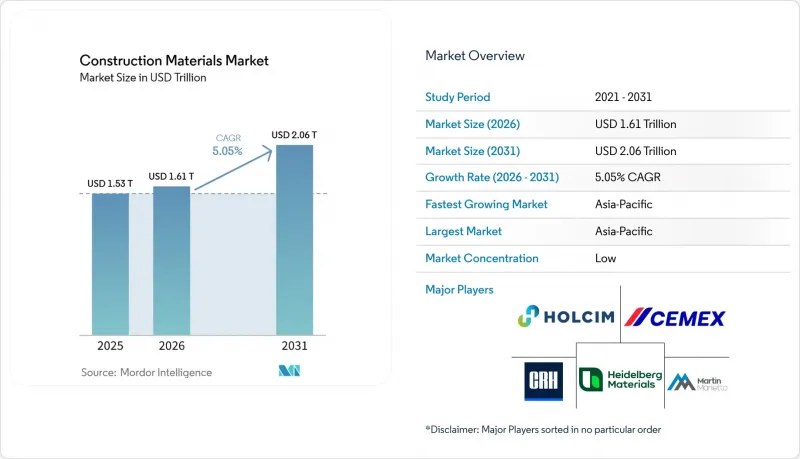
本報告按材料類型(骨材、水泥等)、施工類型(新建、維修/維修)、最終用戶行業(住宅、基礎設施等)和地區(亞太、北美、歐洲、南美、中東和非洲)進行細分。市場預測以美元計價。
全球建築材料市場趨勢及洞察
維修和維修活動增加
在2023年至2024年的市場萎縮期,維修是歐洲唯一保持正成長的建築領域。這一趨勢表明,維修已成為結構性需求來源,而非經濟週期末期的臨時活動。歐盟透過復甦與韌性基金提供2,750億歐元(約3,136.7億美元)的資金支持,旨在到2030年將年度翻新率翻倍。這項支援將為隔熱材料、石膏板、屋頂防水卷材和結構固定裝置創造多年需求基礎。建築材料市場正受益於翻新活動,因為翻新活動通常使用更薄、更專業的材料,這些材料比大宗材料具有更高的附加價值。
基礎設施建設主導核心材料需求。
政府基礎設施發展計畫持續推動對骨材、結構鋼、水泥和預製混凝土構件的需求。美國兩黨基礎設施法案撥款1.2兆美元用於基礎建設投資,其中1,100億美元用於公路和橋樑建設,660億美元用於客運和貨運鐵路。這些支出被納入多個財政年度的建設項目計劃中,從而支持了除單一私人項目之外的材料生產。資料中心和電網電氣化專案也惠及建築材料市場。這些項目需要高強度鋼筋、預製設備基礎和特殊塗料。由於這些產品對性能有更嚴格的要求,其價格高於標準土木工程材料。基礎設施規劃也為能夠以統一規格大量供應產品的生產商提供了清晰的需求預測。
能源和運輸成本波動很大
2026年,能源和物流成本將對建築材料製造商和建築商的利潤率構成迫在眉睫的風險。水泥、鋼鐵和鋁的生產需要大量能源,且極易受到燃料和運輸成本波動的影響。根據美國總承包商協會(AGC)統計,截至2026年2月,軋延鋁價格年增39.1%,鋼鐵產品價格年增20.9%,柴油價格在2026年1月上漲20.3%。這些價格上漲是由於中東能源供應中斷所致。此類價格波動使得建築商難以簽訂固定價格契約,並可能導致競標中標。此外,授權流程的延誤和回收材料取得的困難也給專案帶來了額外的壓力,導致開工延期,並限制了部分低碳材料的取得。
細分市場分析
預計金屬將成為建築材料中成長最快的材料類型,到2031年複合年成長率將達到5.82%。金屬需求與基礎設施電氣化、資料中心建設、可再生能源基礎設施以及電網現代化密切相關。這些應用需要結構產品滿足遠超過標準碳鋼等級的嚴格技術規格。到2025年,骨材將佔建築材料市場的37.82%,這反映了其在整體建設活動中混凝土、路基和排水系統中發揮的關鍵作用。此外,該領域還受益於已獲許可的採石場蘊藏量,新進入者難以複製這些儲量,且耗時費力。
水泥仍是以金額為準第二大的水泥品類,但混合水泥和配套水泥產品正在蠶食標準矽酸鹽水泥的市佔率。歐洲基於生命週期的全球暖化潛勢(GWP)要求正在推動這種向低水泥熟料含量混合料的轉變。磚塊和砌塊在住宅和歷史建築維修中仍然發揮著至關重要的作用,但預製板在異地建設活動活躍的市場中正在擴大市場佔有率。 「其他」類別包括隔熱材料、特殊塗料、密封劑和先進複合材料,隨著性能要求在採購決策中變得越來越重要,該類別提供了更大的差異化空間。
區域分析
預計到2025年,亞太地區將佔據全球建築材料市場46.82%的佔有率,並在2031年之前以6.02%的複合年成長率成長。中國、印度和東南亞地區擁有大規模的建築產出和持續的都市化。雖然印度的需求更多是受到基礎建設而非住宅房地產的驅動,但越南、印尼和菲律賓正在崛起為新的成長中心。
在北美,不同最終用途的前景各不相同。基礎設施和資料中心專案消耗大量結構鋼、預製混凝土和特殊塗料。住宅仍受到住宅購買力的限制。美國的基礎設施建設資金用於支持需要大量骨材的交通和水利工程。截至2026年4月,受金屬和燃料價格上漲的影響,投入成本已上漲6.2%。墨西哥正受益於北部製造業走廊近岸外包相關的工業建設。
在經歷了兩年的萎縮之後,歐洲正逐步復甦,這得益於愛爾蘭、西班牙、葡萄牙和英國土木工程活動的活性化以及市場趨於穩定。德國、法國和義大利的需求依然疲軟,原因在於建築成本上升、家庭支出謹慎以及監管複雜性。歐洲的採購活動正日益受到生命週期全球暖化潛勢(GWP)法規以及計畫實施的排放交易體系二期(ETS2)的影響。南美洲、中東和非洲佔據了剩餘的市場佔有率。巴西仍然是拉丁美洲最大的建築市場,海灣國家也持續推動大規模基礎建設和重大計畫。
其他好處:
- Excel格式的市場預測(ME)表
- 3個月的分析師支持
目錄
第1章:引言
- 研究假設和市場定義
- 調查範圍
第2章:調查方法
第3章執行摘要
第4章 市場狀況
- 市場概覽
- 市場促進因素
- 翻新和維修活動增加
- 基礎設施建設主導對基本材料的需求。
- 都市區住宅短缺推高了對新建房屋的需求。
- 脫碳壓力正在加速低碳材料的應用。
- 預製和模組化施工方法的廣泛應用,導致了建築材料的標準化。
- 透過數位化專案規劃提高材料需求的可見性
- 市場限制因素
- 能源成本和運費波動劇烈
- 碳排放法規導致生產成本增加
- 核准流程的延誤延緩了該工程的開工。
- 特定等級再生材料的供應限制
- 價值鏈分析
- 波特五力分析
第5章 市場規模與成長預測
- 材料類型
- 骨材的
- 水泥
- 磚塊
- 金屬
- 其他材料類型
- 依建築類型
- 新建工程
- 維修和維修
- 按最終用戶行業分類
- 住宅
- 基礎設施
- 商業的
- 產業
- 按地區
- 亞太地區
- 中國
- 印度
- 日本
- 韓國
- 其他亞太國家
- 北美洲
- 美國
- 加拿大
- 墨西哥
- 歐洲
- 德國
- 英國
- 法國
- 義大利
- 俄羅斯
- 其他歐洲國家
- 南美洲
- 巴西
- 阿根廷
- 其他南美國家
- 中東和非洲
- 沙烏地阿拉伯
- 南非
- 其他中東和非洲國家
- 亞太地區
第6章 競爭情勢
- 市場集中度
- 策略趨勢
- 市佔率和排名分析
- 公司簡介
- Buzzi SpA
- Cemex SAB DE CV
- CRH
- CSR Limited
- Heidelberg Materials AG
- HOLCIM
- Kingspan
- Martin Marietta
- Owens Corning
- Saint-Gobain
- Taiheiyo Materials Corporation
- TATA Steel Limited
- Titan Cement International SA
- Vicat SA
- Vulcan Materials Company
第7章 市場機會與未來展望
According to Mordor Intelligence, the construction materials market size was estimated at USD 1.53 trillion in 2025 and is estimated to grow from USD 1.61 trillion in 2026 to USD 2.06 trillion by 2031, at a CAGR of 5.05% during the forecast period (2026-2031).
This report is Segmented by Material Type (Aggregates, Cement, and More), Construction Type (New Construction and Renovation and Repairs), End-User Industry (Residential, Infrastructure, and More), and Geography (Asia-Pacific, North America, Europe, South America, and Middle-East and Africa). The Market Forecasts are Provided in Terms of Value (USD).
Global Construction Materials Market Trends and Insights
Rising Renovation and Repair Activity
Renovation was the only construction segment to maintain positive output in Europe during the 2023 to 2024 contraction. This pattern established renovation as a structural source of demand rather than a late-cycle activity. The EU Renovation Wave, supported by EUR 275 billion (~USD 313.67 billion) through the Recovery and Resilience Facility, seeks to double the annual renovation rate by 2030. This support creates a multi-year demand base for insulation, drywall, roofing membranes, and structural fixings. The construction materials market benefits from renovation activity, which typically uses thinner, specialized products that deliver higher value than bulk materials.
Infrastructure-Led Demand for Core Materials
Government infrastructure programs are creating durable demand for aggregates, structural steel, cement, and precast concrete elements. The US Bipartisan Infrastructure Law allocated USD 1.2 trillion for infrastructure investment, including USD 110 billion for roads and bridges and USD 66 billion for passenger and freight rail. These outlays enter construction pipelines over several fiscal years and support material output beyond individual private projects. The construction materials market also benefits from data centers and grid electrification projects, which require high-strength rebar, prefabricated equipment pads, and specialist coatings. Such products carry a premium over standard civil-engineering grades due to more specific performance requirements. Infrastructure programs also strengthen demand visibility for producers capable of supplying large quantities with consistent specifications.
Volatile Energy and Freight Costs
Energy and logistics costs represent an immediate margin risk for construction materials producers and contractors in 2026. Cement, steel, and aluminum production require substantial energy and are exposed to fluctuations in fuel and freight costs. The Associated General Contractors of America reported that aluminum mill shapes increased 39.1% year over year to February 2026, steel mill products rose 20.9%, and diesel prices increased 20.3% during January 2026. These increases followed disruptions to Middle-East energy supplies. This volatility makes it harder for contractors to price fixed-price contracts and can lead to bid withdrawals. Permitting delays and limited recycled-material availability add further pressure by slowing project starts and restricting access to some lower-carbon material grades.
Other drivers and restraints analyzed in the detailed report include:
- Urban Housing Shortages Supporting New Construction
- Decarbonization Pressure Accelerating Low-Carbon Material Adoption
- Carbon Compliance Increasing Production Cost
For complete list of drivers and restraints, kindly check the Table Of Contents.
Segment Analysis
Metals are forecast to record the fastest growth among material types at a 5.82% CAGR through 2031. Demand is linked to infrastructure electrification, data center construction, renewable energy infrastructure, and grid modernization. These applications require structural products that meet more demanding technical specifications than standard carbon-steel grades. Aggregates accounted for 37.82% of the construction materials market in 2025, reflecting their essential role in concrete, roadbeds, and drainage systems across construction activity. The segment also benefits from permitted quarry reserves, which are difficult and time-consuming for new suppliers to replicate.
Cement remains the second-largest category by value, while blended and supplementary cementitious products are gaining specification share from standard Portland cement. Lifecycle global-warming-potential requirements in Europe are supporting this shift toward lower-clinker formulations. Bricks and blocks remain relevant in residential construction and heritage renovation, although prefabricated panels are gaining market share in markets with strong off-site construction activity. The other category, which includes insulation, specialty coatings, sealants, and advanced composites, offers greater scope for differentiation, as performance requirements carry greater weight in procurement decisions.
Complete Report Scope:
- By Material Type
- Aggregates
- Cement
- Bricks and Blocks
- Metals
- Others by Material Type
- By Construction Type
- New Construction
- Renovation and Repairs
- By End-User Industry
- Residential
- Infrastructure
- Commercial
- Industrial
- By Geography
- Asia-Pacific
- China
- India
- Japan
- South Korea
- Rest of Asia-Pacific
- North America
- United States
- Canada
- Mexico
- Europe
- Germany
- United Kingdom
- France
- Italy
- Russia
- Rest of Europe
- South America
- Brazil
- Argentina
- Rest of South America
- Middle-East and Africa
- Saudi Arabia
- South Africa
- Rest of Middle-East and Africa
- Asia-Pacific
Geography Analysis
Asia-Pacific held 46.82% of the construction materials market share in 2025 and is forecast to grow at a 6.02% CAGR through 2031. China, India, and Southeast Asia combine large construction output with ongoing urbanization. India's demand is driven more by infrastructure than by residential property, while Vietnam, Indonesia, and the Philippines are emerging as secondary growth centers.
North America presents a mixed outlook across end uses. Infrastructure and data center projects are consuming large quantities of structural steel, precast concrete, and specialty coatings. Residential activity remains constrained by affordability conditions. US infrastructure funding supports transportation and water projects that require significant aggregate quantities. Input prices rose 6.2% year to date as of April 2026, driven by metals and fuel. Mexico benefits from nearshoring-related industrial construction in its northern manufacturing corridor.
Europe is recovering gradually after two years of contraction, supported by civil engineering activity and market stabilization in Ireland, Spain, Portugal, and the UK. Germany, France, and Italy continue to face weaker demand due to high construction costs, cautious households, and regulatory complexity. European procurement is increasingly shaped by lifecycle global warming potential rules and the planned rollout of Emissions Trading System 2 (ETS2). South America, the Middle-East, and Africa account for the remaining market share. Brazil remains Latin America's largest construction market, and the Gulf states continue to pursue major infrastructure and large-scale project programs.
- Buzzi S.p.A.
- Cemex S.A.B DE C.V.
- CRH
- CSR Limited
- Heidelberg Materials AG
- HOLCIM
- Kingspan
- Martin Marietta
- Owens Corning
- Saint-Gobain
- Taiheiyo Materials Corporation
- TATA Steel Limited
- Titan Cement International S.A.
- Vicat S.A.
- Vulcan Materials Company
Additional Benefits:
- The market estimate (ME) sheet in Excel format
- 3 months of analyst support
TABLE OF CONTENTS
1 Introduction
- 1.1 Study Assumptions and Market Definition
- 1.2 Scope of the Study
2 Research Methodology
3 Executive Summary
4 Market Landscape
- 4.1 Market Overview
- 4.2 Market Drivers
- 4.2.1 Rising Renovation and Repair Activity
- 4.2.2 Infrastructure-Led Demand for Core Materials
- 4.2.3 Urban Housing Shortages Supporting New Construction
- 4.2.4 Decarbonization Pressure Accelerating Low-Carbon Material Adoption
- 4.2.5 Prefabrication and Modular Construction Increasing Material Standardization
- 4.2.6 Digital Project Planning Improving Material Demand Visibility
- 4.3 Market Restraints
- 4.3.1 Volatile Energy and Freight Costs
- 4.3.2 Carbon Compliance Increasing Production Cost
- 4.3.3 Permitting Delays Slowing Project Starts
- 4.3.4 Recycled Material Supply Constraints in Certain Grades
- 4.4 Value Chain Analysis
- 4.5 Porter's Five Forces Analysis
- 4.5.1 Threat of New Entrants
- 4.5.2 Bargaining Power of Suppliers
- 4.5.3 Bargaining Power of Buyers
- 4.5.4 Threat of Substitutes
- 4.5.5 Competitive Rivalry
5 Market Size and Growth Forecasts (Value)
- 5.1 By Material Type
- 5.1.1 Aggregates
- 5.1.2 Cement
- 5.1.3 Bricks and Blocks
- 5.1.4 Metals
- 5.1.5 Others by Material Type
- 5.2 By Construction Type
- 5.2.1 New Construction
- 5.2.2 Renovation and Repairs
- 5.3 By End-User Industry
- 5.3.1 Residential
- 5.3.2 Infrastructure
- 5.3.3 Commercial
- 5.3.4 Industrial
- 5.4 By Geography
- 5.4.1 Asia-Pacific
- 5.4.1.1 China
- 5.4.1.2 India
- 5.4.1.3 Japan
- 5.4.1.4 South Korea
- 5.4.1.5 Rest of Asia-Pacific
- 5.4.2 North America
- 5.4.2.1 United States
- 5.4.2.2 Canada
- 5.4.2.3 Mexico
- 5.4.3 Europe
- 5.4.3.1 Germany
- 5.4.3.2 United Kingdom
- 5.4.3.3 France
- 5.4.3.4 Italy
- 5.4.3.5 Russia
- 5.4.3.6 Rest of Europe
- 5.4.4 South America
- 5.4.4.1 Brazil
- 5.4.4.2 Argentina
- 5.4.4.3 Rest of South America
- 5.4.5 Middle-East and Africa
- 5.4.5.1 Saudi Arabia
- 5.4.5.2 South Africa
- 5.4.5.3 Rest of Middle-East and Africa
- 5.4.1 Asia-Pacific
6 Competitive Landscape
- 6.1 Market Concentration
- 6.2 Strategic Moves
- 6.3 Market Share (%)/Ranking Analysis
- 6.4 Company Profiles (includes Global Overview, Market Overview, Core Segments, Financials as available, Strategic Information, Products and Services, and Recent Developments)
- 6.4.1 Buzzi S.p.A.
- 6.4.2 Cemex S.A.B DE C.V.
- 6.4.3 CRH
- 6.4.4 CSR Limited
- 6.4.5 Heidelberg Materials AG
- 6.4.6 HOLCIM
- 6.4.7 Kingspan
- 6.4.8 Martin Marietta
- 6.4.9 Owens Corning
- 6.4.10 Saint-Gobain
- 6.4.11 Taiheiyo Materials Corporation
- 6.4.12 TATA Steel Limited
- 6.4.13 Titan Cement International S.A.
- 6.4.14 Vicat S.A.
- 6.4.15 Vulcan Materials Company
7 Market Opportunities and Future Outlook
- 7.1 White-Space and Unmet-Need Assessment

 新型都市化建設市場規模、佔有率及成長分析:按建築類型、專案類型、施工方法、最終用戶和地區分類-產業預測(2026-2033 年)
 生物分解建築網市場分析及預測(至2035年):類型、產品、技術、應用、材料類型、製造流程、最終用戶、功能、安裝方式
 建築材料回收市場預測至2034年:按材料類型、來源、加工方法、通路、最終用戶和地區分類的全球分析
 木結構建築連接件市場-2026-2032年全球市場預測循環經濟下材料市場預測(至2034年):按材料類型、原料、加工方法、應用、最終用戶和地區分類的全球分析循環資源交易市場預測至2034年-按平台類型、資源類型、技術、應用、最終用戶和地區分類的全球分析循環建材維修平台市場預測至2034年-全球循環建材、維修平台與解決方案分析循環材料認證與標準平台市場預測至2034年-全球材料認證平台、標準與合規平台以及數位化檢驗與追溯平台分析製造業循環材料市場預測至2034年—全球材料類型、製造流程整合、循環策略、應用、最終用戶與區域分析
 木工連接件市場規模、佔有率和成長分析:按產品類型、材料類型、應用、連接件類型、最終用戶、分銷管道和地區分類-2026-2033年產業預測