


 |
市場調查報告書
商品編碼
2119162
高強度鋼:市場佔有率分析、產業趨勢與統計、成長預測(2026-2031)Advanced High Strength Steel - Market Share Analysis, Industry Trends & Statistics, Growth Forecasts (2026 - 2031) |
||||||

※ 本網頁內容可能與最新版本有所差異。詳細情況請與我們聯繫。
根據 Mordor Intelligence 估計,2025 年先進高抗張強度鋼的市場規模為 242.6 億美元,預計在預測期(2026-2031 年)內將以 8.28% 的複合年成長率成長,從 2026 年的 259.8 億美元成長到 2031 億美元的 386.7 億美元。
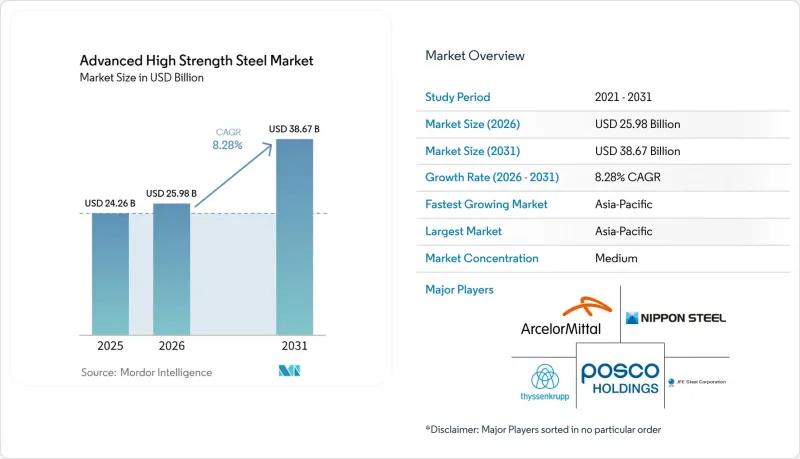
本報告按鋼材等級(雙相鋼、馬氏體鋼等)、抗張強度(400-600 MPa、600-800 MPa等)、應用領域(汽車、建築等)和地區(亞太地區、北美、歐洲、南美、中東和非洲)進行細分。市場預測以美元計價。
全球先進高強度鋼市場趨勢及洞察
為了提高燃油效率和續航里程,市場對輕型車輛的需求日益成長。
隨著電動車平台如今整合了笨重的電池組,減輕車輛重量已成為核心設計要求。降低車輛結構的重量可以在無需額外電池的情況下延長續航里程。據美國能源局稱,與傳統鋼材相比,先進高抗張強度鋼可將車輛結構重量減輕15%至25%。他們也指出,到2030年,如果美國四分之一的車輛使用輕量化零件,每年可節省超過50億加侖的燃料。第三代鋼材已在雪佛蘭Blazer EV和豐田bZ4X等車型的B柱和車門環等部件中得到大規模應用,從而有助於以更薄的鈑金滿足碰撞安全標準。針對重型車輛底盤的研究表明,與冷壓先進高抗張強度鋼相比,使用熱壓硬化材料可將底盤重量減輕高達34%,同時將全球暖化潛勢降低21%至32%。
對車輛安全、燃油效率和排放氣體。
隨著安全法規的日益嚴格,側面碰撞、車頂碰撞和迎面而來的側面防護區域對高強度鋼的需求不斷成長。 Euro NCAP 2026 協議修訂版將評估系統化,分為四個安全階段,並且從 2028 年起,五星評級的要求將有所提高。在未來的協議中,每個階段的得分必須至少達到 80% 才能獲得五星評級。這將鼓勵在車輛重量指定的情況下,使用高抗張強度熱壓鋼來確保碰撞保護性能。聯合國歐洲經濟委員會 (UNECE) 的 R94 和 R95 法規也加強了正面和側面碰撞乘員保護的要求。由於歐洲汽車二氧化碳排放目標和美國平均燃油經濟性 (CAFE) 框架的要求,降低車輛重量的壓力越來越大,先進高抗張強度鋼市場正在為安全和排放氣體目標做出貢獻。
加工先進高抗張強度鋼需要投入高昂的製造成本和模具成本。
加工強度超過 980 MPa 的鋼材需要專用模具和對成形條件的嚴格控制。熱沖壓生產線在成形前將坯料加熱至 900 度C,對設備和操作提出了更高的要求。此外,模具需要高硬度模具鋼和精確的幾何形狀來補償回彈。一項針對 DP450–DP1000 鋼材的 2025 年研究表明,解決高強度鋼材的回彈問題需要將模具幾何形狀最佳化到小於 10°,以確保尺寸精度。反覆修改模具會增加大規模專案的成本,使小規模沖壓機營運商難以進入市場。這種情況可能導致採購集中在認證供應商,並減緩價格敏感產業對先進高抗張強度鋼的接受度。
細分市場分析
到2025年,雙相鋼將佔先進高抗張強度鋼市場佔有率的25.18%,成為最大的鋼種類別。其廣泛應用體現在車身本體白板、地板橫樑和車門防撞樑等領域。 TRIP鋼用於前橫樑和保險桿系統的碰撞能量吸收,而馬氏體相鋼和復合相鋼則用於座椅導軌和門檻加強筋等高應力部件。高強度低合金鋼(HSLA)在那些每兆帕成本比最大限度減輕更重要的應用中仍然發揮著重要作用。 TWIP鋼適用於某些防撞應用,但其焊接性能的限制使其應用範圍更加廣泛。
預計到2031年,熱壓硬化鋼的複合年成長率將達到9.35%,在先進高抗張強度鋼市場所有鋼種中成長率最高。這種鋼材使製造商能夠在900 度C下成型複雜形狀,並在大規模生產中實現高達2000 MPa的成品零件強度。到2025年,電動車(EV)平台將佔車身本體重量的38%。日本製鐵向馬自達提供的2.0 GPa高彎曲強度鋼種表明,這種材料的應用範圍正從局部衝擊部件轉向大規模的結構設計。這些趨勢促使生產商不僅需要在產量上,更需要在鋼材性能上實現差異化。
區域分析
預計到2025年,亞太地區將佔區域銷售額的49.37%,並在2031年之前以9.32%的複合年成長率成長。中國憑藉其鋼鐵產能、汽車製造地和電動車生產能力,支撐著這一市場地位。 GB/T 3273-2026於2026年3月頒布,並於2026年10月實施,修訂了汽車車架用軋延鋼板和鋼帶的要求。日本和韓國繼續供應高附加價值的汽車用鋼材。 2026年2月,JFE鋼鐵以其高成形性先進高強度鋼系列「JEFORMA」榮獲第72屆大河內紀念技術獎。
在歐洲和北美,安全法規、車輛排放氣體標準和低碳採購要求對市場的影響日益直接。 Euro NCAP 2026協議的修訂進一步提升了高抗張強度鋼在車輛碰撞保護區域的重要性。 BMW集團的目標是到2030年,其歐洲工廠40%以上的鋼材需求來自低碳供應商。 SSAB和沃爾沃汽車於2025年6月簽署協議,將大規模生產「SSAB Zero」鋼材。這些措施使得低碳供應成為汽車材料採購中更直接的考量。
南美洲、中東和非洲是小規模但技術先進的高抗張強度鋼市場,需求模式各異。巴西憑藉其汽車組裝廠和基礎建設活動,推動了南美洲的高強度鋼需求。沙烏地阿拉伯的「2030願景」計畫促進了建築框架、工業園區、能源相關資產和新建住宅項目對高抗張強度鋼的需求。然而,全部區域對高等級鋼材進口的依賴以及國內熱沖壓能力的不足,仍限制了高強度鋼的普及應用。
其他好處:
- Excel格式的市場預測(ME)表
- 3個月的分析師支持
目錄
第1章:引言
- 研究假設和市場定義
- 調查範圍
第2章:調查方法
第3章執行摘要
第4章 市場狀況
- 市場概覽
- 市場促進因素
- 為了提高燃油效率和續航里程,市場對輕型車輛的需求日益成長。
- 對車輛安全、燃油效率和排放氣體。
- 對低碳和永續鋼鐵解決方案的需求日益成長
- 擴大熱壓硬化鋼在汽車車身結構和安全部件中的應用。
- 採購範圍 3 和低碳鋼的壓力
- 市場限制因素
- 加工先進高抗張強度鋼需要投入高昂的製造成本和模具成本。
- 與成形性、回彈性、焊接性和可修復性相關的技術挑戰。
- 優質再生鋼材原料供應有限,但品質穩定。
- 價值鏈分析
- 波特五力分析
第5章 市場規模與成長預測
- 按年級
- 雙相(DP)鋼
- 變形誘導塑性(TRIP)鋼
- 孿晶誘導塑性(TWIP)鋼
- 馬氏體鋼
- 高強度低合金(HSLA)鋼
- 複合相(CP)鋼
- 壓鑄硬化鋼(PHS)
- 按抗張強度
- 400~600 MPa
- 600~800 MPa
- 800~1000 MPa
- 1000~1200 MPa
- 1200 兆帕或更高
- 透過使用
- 車
- 建造
- 能源
- 重型機械和運輸設備
- 航太/國防
- 按地區
- 亞太地區
- 中國
- 印度
- 日本
- 韓國
- 其他亞太國家
- 北美洲
- 美國
- 加拿大
- 墨西哥
- 歐洲
- 德國
- 英國
- 法國
- 義大利
- 俄羅斯
- 其他歐洲國家
- 南美洲
- 巴西
- 阿根廷
- 其他南美國家
- 中東和非洲
- 沙烏地阿拉伯
- 南非
- 其他中東和非洲國家
- 亞太地區
第6章 競爭情勢
- 市場集中度
- 策略趨勢
- 市佔率和排名分析
- 公司簡介
- Acerinox SA
- ARCELORMITTAL
- China Baowu Steel Group Corperation Limited
- China Steel Corporation(CSC)
- Cleveland-Cliffs Inc.
- Hyundai Steel Co., Ltd.
- JFE Steel Corporation
- JSW Steel Limited
- NIPPON STEEL CORPORATION
- Nucor Corporation
- Outokumpu Oyj
- POSCO HOLDINGS
- SSAB AB
- Tata Steel Limited
- thyssenkrupp AG
- United States Steel Corporation
- voestalpine AG
第7章 市場機會與未來展望
According to Mordor Intelligence, the advanced high strength steel market size was estimated at USD 24.26 billion in 2025 and is estimated to grow from USD 25.98 billion in 2026 to USD 38.67 billion by 2031, at a CAGR of 8.28% during the forecast period (2026-2031).
This report is Segmented by Grade (Dual Phase (DP) Steel, Martensitic Steel, and More), Tensile Strength (400-600 MPa, 600-800 MPa, and More), Application (Automotive, Construction, and More), and Geography (Asia-Pacific, North America, Europe, South America, and Middle-East and Africa). The Market Forecasts are Provided in Terms of Value (USD).
Global Advanced High Strength Steel Market Trends and Insights
Increasing Demand for Lightweight Vehicles to Improve Fuel Efficiency and Driving Range
Vehicle lightweighting has become a core design requirement as electric vehicle platforms carry heavier battery packs. Removing weight from the body structure can extend driving range without requiring additional battery cells. The Department of Energy states that advanced high-strength steel can reduce a vehicle's structural weight by 15-25% compared with conventional steel. It also states that lightweight components used in one-quarter of the US vehicle fleet could save more than 5 billion gallons of fuel each year by 2030. Third-generation grades are in serial production for B-pillars and door rings in the Chevrolet Blazer EV and Toyota bZ4X, helping meet crash targets with thinner gauges. Research on heavy-duty vehicle chassis found that press-hardened material can reduce chassis weight by up to 34% compared with cold-stamped advanced high-strength steel, while reducing global warming potential by 21-32%.
Stringent Vehicle Safety, Fuel Economy, and Emission Regulations
Safety regulations are increasing the need for stronger steel in side-impact, roof-crush, and far-side protection areas. Euro NCAP's 2026 protocol revision organizes assessment around four safety stages and raises the requirements for a 5-star rating from 2028. A vehicle must achieve at least 80% in each stage for that rating under the future protocol. This supports the use of ultra-high-strength, hot-stamped steel when crash protection needs to fit within a defined vehicle weight. United Nations Economic Commission for Europe (UNECE) Regulations R94 and R95 also reinforce occupant protection requirements for frontal and side impacts. European fleet CO2 targets and the US Corporate Average Fuel Economy (CAFE) framework add pressure to reduce vehicle mass, so the advanced high-strength steel market serves both safety and emissions objectives.
High Manufacturing and Tooling Costs for Advanced High Strength Steel Processing
Processing grades above 980 MPa requires specialized tooling and careful control of forming conditions. Hot-stamping lines heat blanks to 900°C before forming, which raises equipment and operating requirements. Tooling also requires hard-die steels and precise geometries to compensate for springback. A 2025 study on DP450 to DP1000 steels found that springback in higher-strength grades can require mold geometry optimized to below 10° for dimensional accuracy. Repeated die revisions add cost to large-scale programs and make entry harder for smaller press shops. These conditions can concentrate sourcing among qualified suppliers and slow adoption in price-sensitive segments of the advanced high-strength steel market.
Other drivers and restraints analyzed in the detailed report include:
- Expanding Adoption of Press Hardened Steel in Automotive Body Structures
- Scope 3 and Low-Carbon Steel Procurement Pressure
- Technical Processing and Recycled Feedstock Constraints
For complete list of drivers and restraints, kindly check the Table Of Contents.
Segment Analysis
Dual-phase steel held 25.18% of the advanced high-strength steel market share in 2025, making it the largest grade category. Its broad use reflects deployment in body-in-white outer panels, floor cross-members, and door intrusion beams. TRIP steel supports crash-energy absorption in front rails and bumper systems, while Martensitic and Complex Phase grades serve high-stress parts such as seat tracks and sill reinforcements. HSLA steel remains relevant where cost per MPa is more important than maximum weight reduction. TWIP steel is suitable for selected anti-intrusion applications, but its welding compatibility limits wider deployment.
Press Hardened Steel is forecast to grow at a 9.35% CAGR through 2031, the highest rate among grades in the advanced high-strength steel market. It allows manufacturers to form complex geometries at 900°C and achieve finished component strength of up to 2,000 MPa at scale. Electric vehicle platforms reached up to 38% of body-in-white weight by 2025. Nippon Steel's 2.0 GPa high-bending grade for Mazda demonstrates how the material is moving from localized crash parts into larger structural designs. These developments increase the need for producers to differentiate through grade performance rather than solely on output.
Complete Report Scope:
- By Grade
- Dual Phase (DP) Steel
- Transformation-Induced Plasticity (TRIP) Steel
- Twinning-Induced Plasticity (TWIP) Steel
- Martensitic Steel
- High-Strength Low-Alloy (HSLA) Steel
- Complex Phase (CP) Steel
- Press Hardened Steel (PHS)
- By Tensile Strength
- 400-600 MPa
- 600-800 MPa
- 800-1000 MPa
- 1000-1200 MPa
- Over 1200 MPa
- By Application
- Automotive
- Construction
- Energy
- Heavy Equipment and Transportation
- Aerospace and Defense
- By Geography
- Asia-Pacific
- China
- India
- Japan
- South Korea
- Rest of Asia-Pacific
- North America
- United States
- Canada
- Mexico
- Europe
- Germany
- United Kingdom
- France
- Italy
- Russia
- Rest of Europe
- South America
- Brazil
- Argentina
- Rest of South America
- Middle-East and Africa
- Saudi Arabia
- South Africa
- Rest of Middle-East and Africa
- Asia-Pacific
Geography Analysis
Asia-Pacific accounted for 49.37% of regional revenue in 2025 and is forecast to grow at a 9.32% CAGR through 2031. China supports this position through its steel capacity, automotive manufacturing base, and electric vehicle production. GB/T 3273-2026, published in March 2026 and effective in October 2026, updates requirements for hot-rolled steel sheet and strip for automobile frames. Japan and South Korea continue to supply high-value automotive grades. JFE Steel won the 72nd Okochi Memorial Technical Prize in February 2026 for its JEFORMA high-formability AHSS series.
Europe and North America are shaped more directly by safety regulations, fleet emissions standards, and low-carbon procurement requirements. Euro NCAP's 2026 protocol revision increases the relevance of high-strength steel in vehicle crash-protection zones. The BMW Group aims to source more than 40% of its European plant steel demand from low-carbon suppliers by 2030. SSAB and Volvo Cars established a serial-production agreement for SSAB Zero steel in June 2025. These commitments make low-carbon supply a more direct consideration in vehicle material procurement.
South America, the Middle-East, and Africa represent smaller advanced high-strength steel markets with varying demand conditions. Brazil leads South American demand through its vehicle assembly base and infrastructure activity. Saudi Arabia's Vision 2030 program supports demand for high-strength steel in building frames, industrial zones, energy assets, and new residential development. Reliance on imports for premium grades and limited domestic hot-stamping capacity continue to constrain broader regional adoption.
- Acerinox S.A.
- ARCELORMITTAL
- China Baowu Steel Group Corperation Limited
- China Steel Corporation (CSC)
- Cleveland-Cliffs Inc.
- Hyundai Steel Co., Ltd.
- JFE Steel Corporation
- JSW Steel Limited
- NIPPON STEEL CORPORATION
- Nucor Corporation
- Outokumpu Oyj
- POSCO HOLDINGS
- SSAB AB
- Tata Steel Limited
- thyssenkrupp AG
- United States Steel Corporation
- voestalpine AG
Additional Benefits:
- The market estimate (ME) sheet in Excel format
- 3 months of analyst support
TABLE OF CONTENTS
1 Introduction
- 1.1 Study Assumptions and Market Definition
- 1.2 Scope of the Study
2 Research Methodology
3 Executive Summary
4 Market Landscape
- 4.1 Market Overview
- 4.2 Market Drivers
- 4.2.1 Increasing Demand for Lightweight Vehicles to Improve Fuel Efficiency and Driving Range
- 4.2.2 Stringent Vehicle Safety, Fuel Economy, and Emission Regulations
- 4.2.3 Increasing Demand for Low-Carbon and Sustainable Steel Solutions
- 4.2.4 Expanding Adoption of Press Hardened Steel in Automotive Body Structures and Safety Components
- 4.2.5 Scope 3 and Low-Carbon Steel Procurement Pressure
- 4.3 Market Restraints
- 4.3.1 High Manufacturing and Tooling Costs for Advanced High Strength Steel Processing
- 4.3.2 Technical Challenges Related to Formability, Springback, Welding, and Repairability
- 4.3.3 Limited Availability and Quality Consistency of High-Grade Recycled Steel Feedstock
- 4.4 Value Chain Analysis
- 4.5 Porter's Five Forces Analysis
- 4.5.1 Threat of New Entrants
- 4.5.2 Bargaining Power of Suppliers
- 4.5.3 Bargaining Power of Buyers
- 4.5.4 Threat of Substitutes
- 4.5.5 Competitive Rivalry
5 Market Size and Growth Forecasts (Value)
- 5.1 By Grade
- 5.1.1 Dual Phase (DP) Steel
- 5.1.2 Transformation-Induced Plasticity (TRIP) Steel
- 5.1.3 Twinning-Induced Plasticity (TWIP) Steel
- 5.1.4 Martensitic Steel
- 5.1.5 High-Strength Low-Alloy (HSLA) Steel
- 5.1.6 Complex Phase (CP) Steel
- 5.1.7 Press Hardened Steel (PHS)
- 5.2 By Tensile Strength
- 5.2.1 400-600 MPa
- 5.2.2 600-800 MPa
- 5.2.3 800-1000 MPa
- 5.2.4 1000-1200 MPa
- 5.2.5 Over 1200 MPa
- 5.3 By Application
- 5.3.1 Automotive
- 5.3.2 Construction
- 5.3.3 Energy
- 5.3.4 Heavy Equipment and Transportation
- 5.3.5 Aerospace and Defense
- 5.4 By Geography
- 5.4.1 Asia-Pacific
- 5.4.1.1 China
- 5.4.1.2 India
- 5.4.1.3 Japan
- 5.4.1.4 South Korea
- 5.4.1.5 Rest of Asia-Pacific
- 5.4.2 North America
- 5.4.2.1 United States
- 5.4.2.2 Canada
- 5.4.2.3 Mexico
- 5.4.3 Europe
- 5.4.3.1 Germany
- 5.4.3.2 United Kingdom
- 5.4.3.3 France
- 5.4.3.4 Italy
- 5.4.3.5 Russia
- 5.4.3.6 Rest of Europe
- 5.4.4 South America
- 5.4.4.1 Brazil
- 5.4.4.2 Argentina
- 5.4.4.3 Rest of South America
- 5.4.5 Middle-East and Africa
- 5.4.5.1 Saudi Arabia
- 5.4.5.2 South Africa
- 5.4.5.3 Rest of Middle-East and Africa
- 5.4.1 Asia-Pacific
6 Competitive Landscape
- 6.1 Market Concentration
- 6.2 Strategic Moves
- 6.3 Market Share (%)/Ranking Analysis
- 6.4 Company Profiles (includes Global Overview, Market Overview, Core Segments, Financials as available, Strategic Information, Products and Services, and Recent Developments)
- 6.4.1 Acerinox S.A.
- 6.4.2 ARCELORMITTAL
- 6.4.3 China Baowu Steel Group Corperation Limited
- 6.4.4 China Steel Corporation (CSC)
- 6.4.5 Cleveland-Cliffs Inc.
- 6.4.6 Hyundai Steel Co., Ltd.
- 6.4.7 JFE Steel Corporation
- 6.4.8 JSW Steel Limited
- 6.4.9 NIPPON STEEL CORPORATION
- 6.4.10 Nucor Corporation
- 6.4.11 Outokumpu Oyj
- 6.4.12 POSCO HOLDINGS
- 6.4.13 SSAB AB
- 6.4.14 Tata Steel Limited
- 6.4.15 thyssenkrupp AG
- 6.4.16 United States Steel Corporation
- 6.4.17 voestalpine AG
7 Market Opportunities and Future Outlook
- 7.1 White-Space and Unmet-Need Assessment

 先進高抗張強度鋼(AHSS)市場分析及預測(至2035年):依類型、產品、技術、應用、形狀、材料種類、製程、最終用戶及功能分類
 全球先進高抗張強度鋼(AHSS)市場展望、詳細分析及至2032年預測
 先進鋼材和高強度合金市場預測至2034年-按產品類型、製造流程、應用、最終用戶和地區分類的全球分析高強度纖維材料市場:預測至2034年-按纖維類型、形狀、製造流程、應用、最終用戶和地區分類的全球分析
 先進高抗張強度鋼市場:按形狀、加工流程、等級、塗層類型、應用和分銷管道分類-2026-2032年全球市場預測
 造船用鋼市場規模、佔有率和成長分析:按鋼材產品類型、材質等級/規格、船舶應用、供應厚度和地區分類-2026-2033年產業預測
 高抗張強度鋼:市場佔有率分析、產業趨勢與統計、成長預測(2026-2031 年)
 全球高強度鋼市場:市場規模、佔有率和趨勢分析(按類型、應用和地區分類),細分市場預測(2026-2033 年)高強度鋼市場:依鋼種、塗層類型及終端用戶產業分類,全球預測(2026-2032年)高強度竹複合材料市場分析與預測(至2035年):類型、產品、應用、技術、材料類型、最終用戶、形式、製程、安裝類型、解決方案