


 |
市場調查報告書
商品編碼
2119156
電動汽車絕緣材料:市場佔有率分析、產業趨勢與統計及成長預測(2026-2031)Electric Vehicle Insulation - Market Share Analysis, Industry Trends & Statistics, Growth Forecasts (2026 - 2031) |
||||||

※ 本網頁內容可能與最新版本有所差異。詳細情況請與我們聯繫。
根據 Mordor Intelligence 預測,電動車隔熱材料市場規模預計將在 2025 年達到 24.8 億美元,2026 年達到 28.4 億美元,到 2031 年達到 56.3 億美元,在預測期(2026-2031 年)內複合年成長率為 14.67%。
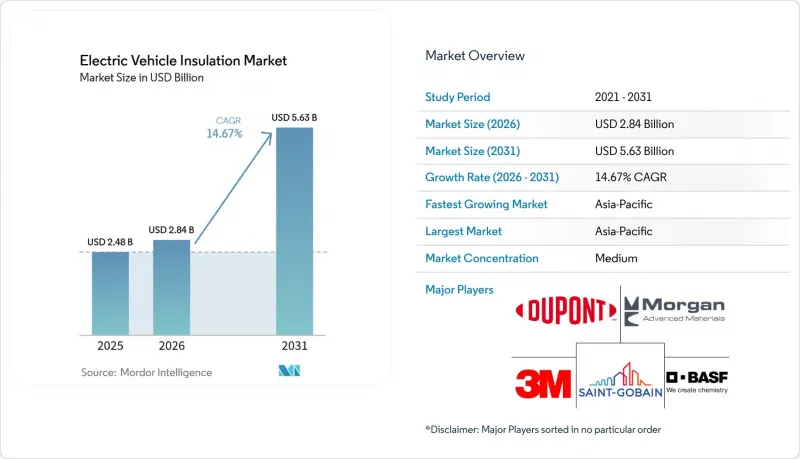
本報告按材料類型(例如,聚氨酯泡棉、聚醯亞胺)、車輛驅動系統(例如,電池式電動車(BEV))、車輛類型(例如,乘用車)、應用(例如,電池組和電池外殼、電動馬達)以及地區(例如,亞太地區、北美地區、歐洲地區)進行細分。市場預測以美元 (USD) 為單位。
全球電動車隔熱材料市場趨勢及洞察
對更高電池能量密度和更快充電能力的需求日益成長。
最新鎳錳鈷 (NMC) 和磷酸鋰鐵(LFP) 電池能量密度的不斷提高,加劇了電池組內部熱事件的嚴重性。美國汽車工程師協會 (SAE) 2026 年的一項研究表明,更厚、能量密度更高的電池組,在相同能量容量下,所需的絕緣電阻將增加 50% 至 60%。這使得絕緣性能與電池的能量額定值更加密切相關。 800V 充電系統的普及進一步增加了對匯流排、連接器、電池組機殼、電池斷路器以及高壓聯鎖迴路等組件的需求。 IEC 62196-1:2025 標準規定了充電插頭和連接器在高達 1500V 直流和 800A 電流下的性能要求。因此,電動車絕緣材料市場正轉向即使在高倍率充放電循環中也具有穩定熱性能和介電性能的多層材料。
嚴格的熱失控保護和高壓安全規程
中國標準GB 38031-2025於2026年7月1日生效,規定電池系統在單一電池發生熱失控後,必須至少維持120分鐘的防火防爆效能。該標準還禁止煙霧進入車輛內部。這些更嚴格的密封要求增加了對電池單元之間以及電池組周圍特殊設計的隔離屏障的需求。歐洲採用UNECE R100.3標準對耐火外殼和系統隔離進行要求,而北美測試則包括從單節電池到完整安裝狀態的UL 9540A評估。擁有跨多個監管框架測試經驗的供應商在支援全球汽車專案方面具有優勢。因此,在電動車絕緣材料市場,認證性能的重要性正超過初始材料成本。
氣凝膠、陶瓷和聚醯亞胺等先進隔熱材料高成本。
氣凝膠、陶瓷纖維和聚醯亞胺薄膜具有優異的熱性能和介電性能,但價格高於傳統發泡材料。此外,它們的加工方法需要專門的生產能力,這可能會限制供應擴張。 Aspen Aerogels公司於2025年2月取消了在喬治亞的建設計畫,這表明透過大規模固定投資擴大氣凝膠產能存在困難。中國新的電池安全法規預計將使每輛車的電池組成本增加15-20%。對於成本敏感型車輛的原始設備製造商(OEM)而言,採用高性能絕緣解決方案可能較為謹慎。在電動車絕緣材料市場,兼具熱性能和電氣性能的材料仍有需求,因為它們可以減少電池系統中使用的組件數量。
細分市場分析
預計到2025年,聚氨酯泡棉將佔據最大的市場佔有率,達到22.73%。這得益於其成熟的供應基礎以及在隔熱和減震方面的應用。據報道,其在電池組組件中的導熱係數為0.020–0.030 W/m·K。矽橡膠在熱循環條件下仍可用於軟性密封應用。聚醯亞胺薄膜在電池間隔膜中具有高介電強度,而雲母複合材料則用於對阻燃性要求較高的場合。陶瓷纖維、玻璃纖維、聚酯薄膜和聚乙烯繼續用於特定的隔熱和襯裡應用。氣凝膠的應用可能會在電池組設計中擴展,屆時一種經過認證的複合材料將取代多種單一功能材料。
預計到2031年,氣凝膠市場將以18.83%的複合年成長率成長。氣凝膠厚度範圍為0.5至3毫米,可透過抑制熱傳遞來節省電池組空間。一項2025年的研究表明,在峰值溫度達到600至800度C的電池燃燒事件中,2毫米厚的氣凝膠薄片可使溫度降低200至400度C。此性能滿足中國電池標準規定的120分鐘熱失控控制要求。電動車(EV)隔熱材料市場對先進隔熱材料的需求主要來自電池設計,因為這些設計需要在密集排列的電池之間提供直接保護。
到2025年,電池式電動車(BEV)將佔電動車絕緣材料需求的66.71%,預計到2031年,該市場將以16.71%的複合年成長率成長。純電動車電池系統需要在整個系統中絕緣,包括電芯、模組、電池組、高壓線路和充電連接。隨著電池組容量和能量密度的提高,每輛車所需的隔熱和介電材料用量也在增加。向800V純電動車平台的過渡要求關鍵電氣介面之間更長的爬電距離和更高的絕緣電阻。電動車絕緣材料市場與純電動汽車電池和電力系統日益成長的複雜性直接相關。
由於混合動力汽車(HEV)的電池組容量相對較小,因此其絕緣材料主要應用於馬達和電力電子設備周圍。插電式混合動力車(PHEV)的電池組容量為20-40千瓦時,需要一個中等容量的絕緣解決方案。即使在這些車輛中,仍需要能夠在有限的封裝空間內有效散熱、承受電壓應力並隔離組件的材料。燃料電池電動車(FCEV)由於其高壓燃料電池堆、氫氣儲存系統和電力電子設備的組合,對絕緣材料的需求有所不同。韓國和日本分別透過現代和豐田的燃料電池汽車項目,仍然是燃料電池汽車領域的重要中心。雖然電動車絕緣材料市場受益於這種多樣化的動力系統組合,但純電動車(BEV)仍然是材料需求的主要來源。
區域分析
預計到2025年,亞太地區將佔全球需求的51.83%,並在2031年之前以15.69%的複合年成長率成長。中國、韓國、日本和印度是該地區電動車生產和電池製造的關鍵中心。中國的GB 38031-2025標準正在加強對國內銷售電池系統的絕緣要求。中國汽車零件供應商正在採用隔熱設計和耐熱隔膜。根據印度儲能聯盟統計,2025-2026會計年度印度電動車銷量255萬輛。該地區電動車絕緣材料的市場佔有率反映了其高產量和更嚴格的電池組安全標準。
印度電動車滲透率從2025會計年度上半年的8%上升至2026會計年度上半年的11.43%。 2026會計年度上半年銷售達154萬輛,支撐了對二輪車、三輪車和乘用車的需求。日本和韓國仍然是重要的高階市場。電池保護、耐久性和高壓性能在兩國的車輛項目中至關重要。此外,中國的電池標準正在影響國內汽車市場以外的供應鏈,因為中國製造商出口整車和電池系統。隨著這些系統被推廣到其他地區,電動車絕緣市場對滿足中國電池安全要求的重要性日益凸顯。
儘管監管環境有所不同,歐洲和北美仍然是重要的需求中心。在歐洲,聯合國歐洲經濟委員會R100.3標準對耐火電池外殼的要求,並推動了新型車輛專案中絕緣材料的使用。在北美,本土電池工廠和整車製造商(OEM)專案支撐著對絕緣材料的基本需求。預計800V系統的引進將進一步提升該地區對高介電常數材料的需求。南美洲以及中東和非洲正在成為新興的需求中心。隨著中國汽車出口,符合中國規格的電池組及相關的絕緣要求正被引入這些發展中市場。預計在這些地區,電動車絕緣材料市場將透過車隊項目、電動巴士採購以及充電基礎設施的擴建而成長。
其他好處:
- Excel格式的市場預測(ME)表
- 3個月的分析師支持
目錄
第1章:引言
- 研究假設和市場定義
- 調查範圍
第2章:調查方法
第3章執行摘要
第4章 市場狀況
- 市場概覽
- 市場促進因素
- 對更高電池能量密度和更快充電能力的需求日益成長。
- 嚴格的熱失控預防措施和高壓安全規程
- 商用車、公車和重型卡車的電氣化進程
- 為了提高車輛續航里程,對輕質隔熱材料的需求日益成長。
- 擴大電芯到電池包一體化和結構化電池架構的應用
- 市場限制因素
- 氣凝膠、陶瓷和聚醯亞胺等先進絕緣材料高成本。
- 高壓隔離和充電系統缺乏標準化
- 多層隔熱材料的回收和再利用面臨的挑戰。
- 價值鏈分析
- 波特五力分析
- 監理情勢
第5章 市場規模與成長預測
- 材料類型
- 聚氨酯泡棉
- 聚醯亞胺
- 矽橡膠
- 陶瓷纖維
- 玻璃纖維
- 聚酯薄膜
- 聚乙烯
- 氣凝膠
- 雲母和雲母複合材料
- 其他材料類型
- 車輛推進類型
- 電池式電動車(BEV)
- 混合動力電動車(HEV)
- 插電式混合動力車(PHEV)
- 燃料電池電動車(FCEV)
- 車輛類型
- 搭乘用車
- 商用車輛
- 摩托車
- 大型車輛
- 電動巴士
- 其他車輛類型
- 透過使用
- 電池組和電池外殼
- 電池單體和模組
- 電動機
- 電力電子
- 充電系統
- 高壓電纜和線束
- 其他用途
- 按地區
- 亞太地區
- 中國
- 印度
- 日本
- 韓國
- 其他亞太國家
- 北美洲
- 美國
- 加拿大
- 墨西哥
- 歐洲
- 德國
- 英國
- 法國
- 義大利
- 俄羅斯
- 其他歐洲國家
- 南美洲
- 巴西
- 阿根廷
- 其他南美國家
- 中東和非洲
- 沙烏地阿拉伯
- 南非
- 其他中東和非洲國家
- 亞太地區
第6章 競爭情勢
- 市場集中度
- 策略趨勢
- 市佔率和排名分析
- 公司簡介
- 3M
- Adler Pelzer Holding GmbH
- Aspen Aerogels, Inc.
- Autoneum
- BASF
- DuPont
- Elmelin Ltd.
- Freudenberg Group
- Henkel AG & Co. KGaA
- Isovolta AG
- Morgan Advanced Materials plc
- Rogers Corporation
- Saint-Gobain
- Shin-Etsu Chemical Co., Ltd
- Tecman Holdings Ltd,
第7章 市場機會與未來展望
According to Mordor Intelligence, the electric vehicle insulation market was valued at USD 2.48 billion in 2025 and is estimated to grow from USD 2.84 billion in 2026 to reach USD 5.63 billion by 2031, at a CAGR of 14.67% during the forecast period (2026-2031).
This report is Segmented by Material Type (Polyurethane Foam, Polyimide, and More), Vehicle Propulsion (Battery Electric Vehicles (BEVs), and More), Vehicle Type (Passenger Vehicles, and More), Application (Battery Pack and Battery Housing, Electric Motor, and More), and Geography (Asia-Pacific, North America, Europe, and More). The Market Forecasts are Provided in Terms of Value (USD).
Global Electric Vehicle Insulation Market Trends and Insights
Increasing Battery Energy Density and Demand for Fast-Charging Capabilities
Higher energy density in modern Nickel Manganese Cobalt (NMC) and Lithium Iron Phosphate (LFP) cells increases the severity of thermal events within battery packs. Society of Automotive Engineers (SAE) research published in 2026 stated that thicker and more energetic cells require 50%-60% more insulation resistance per pack with equivalent energy capacity. This makes insulation performance more closely tied to the energy rating of the cell. The spread of 800 V charging systems adds further demands across busbars, connectors, pack enclosures, battery disconnect units, and high-voltage interlock loops. IEC 62196-1:2025 sets performance requirements for charging plugs and connectors at up to 1,500 V DC and 800 A. The Electric Vehicle Insulation Market is consequently moving toward multi-layer materials with thermal and dielectric properties that remain stable during high-rate charging and discharge cycles.
Stringent Thermal Runaway Protection and High-Voltage Safety Regulations
China's GB 38031-2025 took effect on July 1, 2026, and requires battery systems to prevent fire and explosion for at least 120 minutes after thermal runaway in a single cell. The rule also prohibits smoke from entering the vehicle cabin. This extended containment requirement has increased the need for purpose-designed barriers between cells and around the pack. Europe uses UNECE R100.3 requirements for fireproof housing and system separation, while North American testing includes UL 9540A evaluation from cell to full installation level. Suppliers with test records across multiple regulatory systems are better positioned to support global vehicle programs. The electric vehicle insulation market is therefore placing greater weight on certified performance rather than low initial material cost.
High Cost of Advanced Insulation Materials such as Aerogels, Ceramics, and Polyimides
Aerogels, ceramic fiber, and polyimide films offer strong thermal and dielectric performance, but they have higher costs than conventional foam materials. Their processing methods require specialized production capacity and can limit supply expansion. The cancellation of Aspen Aerogels' planned Georgia facility in February 2025 showed the difficulty of scaling aerogel capacity through large, fixed investments. China's new battery safety rules are expected to increase power battery system costs by 15%-20% per vehicle pack. Original Equipment Manufacturers (OEMs) in cost-sensitive vehicle categories may be slower to adopt premium insulation solutions. The electric vehicle insulation market still has room for materials that combine thermal and electrical functions, because they can reduce the number of components used in a battery system.
Other drivers and restraints analyzed in the detailed report include:
- Growing Electrification of Commercial Vehicles, Buses, and Heavy-Duty Trucks
- Rising Demand for Lightweight Insulation Materials to Improve Vehicle Range
- Lack of Standardization in High-Voltage Insulation and Charging Systems
For complete list of drivers and restraints, kindly check the Table Of Contents.
Segment Analysis
Polyurethane foam held the largest share at 22.73% in 2025, supported by its established supply base and its use in thermal insulation and vibration damping. Its thermal conductivity was reported at 0.020-0.030 W/m*K in battery pack assemblies. Silicone rubber remains useful for flexible sealing under thermal cycling. Polyimide films support high dielectric strength in cell-to-cell barriers, while mica composites are used where flame resistance is critical. Ceramic fiber, fiberglass, polyester film, and polyethylene continue to serve defined thermal or liner applications. Aerogel adoption can grow where one certified composite replaces several single-function materials in pack designs.
Aerogel is projected to grow at an 18.83% CAGR through 2031. It contains heat transfer at thicknesses of 0.5-3 mm, which helps preserve battery pack space. A 2025 study reported that a 2 mm aerogel sheet created a 200-400°C temperature drop during cell combustion events that peaked at 600-800°C. Such performance supports the 120-minute thermal-runaway containment requirement under China's battery standard. The electric vehicle insulation market size for advanced thermal barriers is supported by battery designs that need direct protection between closely packed cells.
Battery Electric Vehicles (BEVs) held 66.71% of the electric vehicle insulation demand in 2025 and are forecast to grow at a 16.71% CAGR through 2031. Their battery systems require insulation across cells, modules, packs, high-voltage wiring, and charging connections. Larger and more energy-dense packs increase the amount of thermal and dielectric material used per vehicle. The move to 800 V BEV platforms requires greater creepage distances and higher insulation resistance across key electrical interfaces. The electric vehicle insulation market has a direct connection to the growing complexity of BEV batteries and power systems.
Hybrid Electric Vehicles (HEVs) use insulation mainly around motors and power electronics because their battery packs are smaller. Plug-in Hybrid Electric Vehicles need intermediate-level solutions for their 20-40 kWh battery packs. These vehicles still require materials that manage heat, resist voltage stress, and isolate components inside a limited package space. Fuel-cell electric vehicles have different insulation needs because they combine high-voltage fuel-cell stacks, hydrogen storage systems, and power electronics. South Korea and Japan remain important locations for fuel-cell vehicle activity through Hyundai and Toyota programs. The electric vehicle insulation market benefits from this varied propulsion mix, although BEVs remain the leading source of material demand.
Complete Report Scope:
- By Material Type
- Polyurethane Foam
- Polyimide
- Silicone Rubber
- Ceramic Fiber
- Fiberglass
- Polyester Film
- Polyethylene
- Aerogel
- Mica and Mica Composites
- Other Material Types
- By Vehicle Propulsion
- Battery Electric Vehicles (BEVs)
- Hybrid Electric Vehicles (HEVs)
- Plug-in Hybrid Electric Vehicles (PHEVs)
- Fuel Cell Electric Vehicles (FCEVs)
- By Vehicle Type
- Passenger Vehicles
- Commercial Vehicles
- Two-Wheelers
- Heavy-Duty Vehicles
- Electric Buses
- Other Vehicle Types
- By Application
- Battery Pack and Battery Housing
- Battery Cell and Module
- Electric Motor
- Power Electronics
- Charging System
- High-Voltage Cables and Wiring Harnesses
- Other Applications
- By Geography
- Asia-Pacific
- China
- India
- Japan
- South Korea
- Rest of Asia-Pacific
- North America
- United States
- Canada
- Mexico
- Europe
- Germany
- United Kingdom
- France
- Italy
- Russia
- Rest of Europe
- South America
- Brazil
- Argentina
- Rest of South America
- Middle-East and Africa
- Saudi Arabia
- South Africa
- Rest of Middle-East and Africa
- Asia-Pacific
Geography Analysis
Asia-Pacific held 51.83% of global demand in 2025 and is forecast to grow at a 15.69% CAGR through 2031. China, South Korea, Japan, and India provide the region's core electric vehicle production and battery manufacturing base. China's GB 38031-2025 standard is increasing insulation requirements for battery systems sold in the country. China's vehicle suppliers are incorporating non-thermal-propagation designs and high-temperature-resistant diaphragms. India recorded 2.55 million electric vehicle sales in FY2025-26, according to the India Energy Storage Alliance. The region's electric vehicle insulation market share reflects both high production volumes and stronger safety specifications for battery packs.
India's electric vehicle penetration reached 11.43% in the first half of 2026, compared with 8% in the first half of 2025. Sales reached 1.54 million units in the first half of 2026, supporting demand in two-wheelers, three-wheelers, and passenger vehicles. Japan and South Korea remain important premium-specification markets. Their vehicle programs place significant importance on battery protection, durability, and high-voltage performance. China's battery standard also influences supply chains beyond its domestic vehicle market because Chinese producers export complete vehicles and battery systems. The electric vehicle insulation market is becoming more connected to Chinese battery-safety requirements as these systems move into other regions.
Europe and North America remain important demand centers with different regulatory conditions. Europe's requirements for fireproof battery housing under UNECE R100.3 are increasing insulation content in new vehicle programs. In North America, domestic battery plants and OEM programs maintain baseline demand for insulation materials. The expected adoption of 800 V systems supports high-dielectric materials in the region. South America, and Middle-East, and Africa represent emerging demand centers. Chinese vehicle exports bring China-specified battery packs and associated insulation requirements into these developing markets. The electric vehicle insulation market is expected to develop in these regions through fleet programs, electric bus procurement, and broader charging infrastructure.
- 3M
- Adler Pelzer Holding GmbH
- Aspen Aerogels, Inc.
- Autoneum
- BASF
- DuPont
- Elmelin Ltd.
- Freudenberg Group
- Henkel AG & Co. KGaA
- Isovolta AG
- Morgan Advanced Materials plc
- Rogers Corporation
- Saint-Gobain
- Shin-Etsu Chemical Co., Ltd
- Tecman Holdings Ltd,
Additional Benefits:
- The market estimate (ME) sheet in Excel format
- 3 months of analyst support
TABLE OF CONTENTS
1 Introduction
- 1.1 Study Assumptions and Market Definition
- 1.2 Scope of the Study
2 Research Methodology
3 Executive Summary
4 Market Landscape
- 4.1 Market Overview
- 4.2 Market Drivers
- 4.2.1 Increasing Battery Energy Density and Demand for Fast-Charging Capabilities
- 4.2.2 Stringent Thermal Runaway Protection and High-Voltage Safety Regulations
- 4.2.3 Growing Electrification of Commercial Vehicles, Buses, and Heavy-Duty Trucks
- 4.2.4 Rising Demand for Lightweight Insulation Materials to Improve Vehicle Range
- 4.2.5 Increasing Adoption of Cell-to-Pack and Structural Battery Architectures
- 4.3 Market Restraints
- 4.3.1 High Cost of Advanced Insulation Materials such as Aerogels, Ceramics, and Polyimides
- 4.3.2 Lack of Standardization in High-Voltage Insulation and Charging Systems
- 4.3.3 Recycling and End-of-Life Challenges for Multi-Layer Insulation Materials
- 4.4 Value Chain Analysis
- 4.5 Porter's Five Forces Analysis
- 4.5.1 Threat of New Entrants
- 4.5.2 Bargaining Power of Suppliers
- 4.5.3 Bargaining Power of Buyers
- 4.5.4 Threat of Substitutes
- 4.5.5 Competitive Rivalry
- 4.6 Regulatory Landscape
5 Market Size and Growth Forecasts (Value)
- 5.1 By Material Type
- 5.1.1 Polyurethane Foam
- 5.1.2 Polyimide
- 5.1.3 Silicone Rubber
- 5.1.4 Ceramic Fiber
- 5.1.5 Fiberglass
- 5.1.6 Polyester Film
- 5.1.7 Polyethylene
- 5.1.8 Aerogel
- 5.1.9 Mica and Mica Composites
- 5.1.10 Other Material Types
- 5.2 By Vehicle Propulsion
- 5.2.1 Battery Electric Vehicles (BEVs)
- 5.2.2 Hybrid Electric Vehicles (HEVs)
- 5.2.3 Plug-in Hybrid Electric Vehicles (PHEVs)
- 5.2.4 Fuel Cell Electric Vehicles (FCEVs)
- 5.3 By Vehicle Type
- 5.3.1 Passenger Vehicles
- 5.3.2 Commercial Vehicles
- 5.3.3 Two-Wheelers
- 5.3.4 Heavy-Duty Vehicles
- 5.3.5 Electric Buses
- 5.3.6 Other Vehicle Types
- 5.4 By Application
- 5.4.1 Battery Pack and Battery Housing
- 5.4.2 Battery Cell and Module
- 5.4.3 Electric Motor
- 5.4.4 Power Electronics
- 5.4.5 Charging System
- 5.4.6 High-Voltage Cables and Wiring Harnesses
- 5.4.7 Other Applications
- 5.5 By Geography
- 5.5.1 Asia-Pacific
- 5.5.1.1 China
- 5.5.1.2 India
- 5.5.1.3 Japan
- 5.5.1.4 South Korea
- 5.5.1.5 Rest of Asia-Pacific
- 5.5.2 North America
- 5.5.2.1 United States
- 5.5.2.2 Canada
- 5.5.2.3 Mexico
- 5.5.3 Europe
- 5.5.3.1 Germany
- 5.5.3.2 United Kingdom
- 5.5.3.3 France
- 5.5.3.4 Italy
- 5.5.3.5 Russia
- 5.5.3.6 Rest of Europe
- 5.5.4 South America
- 5.5.4.1 Brazil
- 5.5.4.2 Argentina
- 5.5.4.3 Rest of South America
- 5.5.5 Middle-East and Africa
- 5.5.5.1 Saudi Arabia
- 5.5.5.2 South Africa
- 5.5.5.3 Rest of Middle-East and Africa
- 5.5.1 Asia-Pacific
6 Competitive Landscape
- 6.1 Market Concentration
- 6.2 Strategic Moves
- 6.3 Market Share (%)/Ranking Analysis
- 6.4 Company Profiles (includes Global Overview, Market Overview, Core Segments, Financials as available, Strategic Information, Products and Services, and Recent Developments)
- 6.4.1 3M
- 6.4.2 Adler Pelzer Holding GmbH
- 6.4.3 Aspen Aerogels, Inc.
- 6.4.4 Autoneum
- 6.4.5 BASF
- 6.4.6 DuPont
- 6.4.7 Elmelin Ltd.
- 6.4.8 Freudenberg Group
- 6.4.9 Henkel AG & Co. KGaA
- 6.4.10 Isovolta AG
- 6.4.11 Morgan Advanced Materials plc
- 6.4.12 Rogers Corporation
- 6.4.13 Saint-Gobain
- 6.4.14 Shin-Etsu Chemical Co., Ltd
- 6.4.15 Tecman Holdings Ltd,
7 Market Opportunities and Future Outlook
- 7.1 White-Space and Unmet-Need Assessment

 電動車絕緣市場-全球及區域分析:按產品、應用和國家分類-分析與預測(2026-2035年)
 汽車隔熱材料市場報告:趨勢、預測及競爭分析(至2035年)
 2026年全球汽車隔音組件市場報告
 電動車絕緣市場:按材料、車輛類型、絕緣類型、塗層類型和應用分類-2026-2032年全球市場預測引擎隔音墊市場:依材質類型、厚度、應用和銷售管道-2026-2032年全球預測
 全球電動汽車絕緣材料市場規模、佔有率、趨勢和成長分析報告(2026-2034年)引擎室隔熱墊市場按材料、厚度、車輛類型和分銷管道分類,全球預測(2026-2032年)汽車聲學密封市場材料類型、產品形式、車輛類型和安裝類型分類,全球預測(2026-2032年)汽車門板隔音材料市場:依材料類型、材料技術、車輛類型、厚度和應用分類-全球預測,2026-2032年
 汽車隔熱材料市場規模、佔有率和成長分析(按材料類型、車輛類型、應用、零件、分銷管道和地區分類)-2026-2033年產業預測