


 |
市場調查報告書
商品編碼
2119118
特種聚醯胺:市場佔有率分析、產業趨勢與統計、成長預測(2026-2031)Specialty Polyamides - Market Share Analysis, Industry Trends & Statistics, Growth Forecasts (2026 - 2031) |
||||||

※ 本網頁內容可能與最新版本有所差異。詳細情況請與我們聯繫。
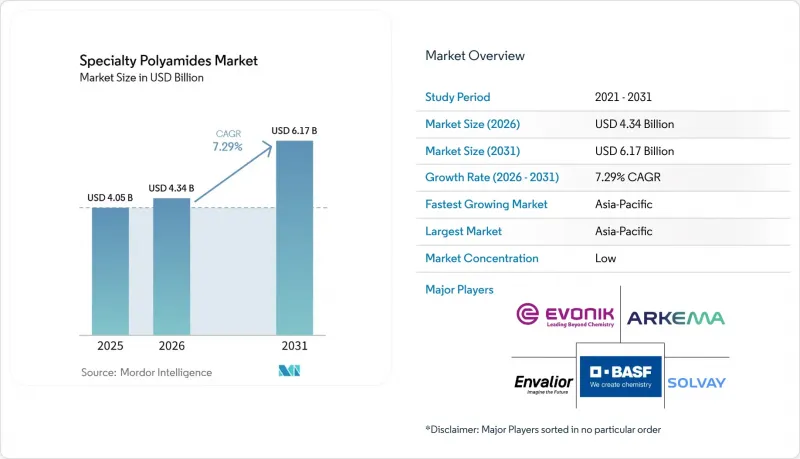
據 Mordor Intelligence 稱,2025 年特種聚醯胺市值為 40.5 億美元,預計到 2031 年將達到 61.7 億美元,而 2026 年為 43.4 億美元,預測期(2026-2031 年)複合年成長率為 7.29%。
本報告按產品類型(耐熱特種聚醯胺、MXD6 和 PARA 等)、形態(樹脂和顆粒、粉末等)、終端用戶產業(汽車和運輸、電氣和電子等)以及地區(亞太地區、北美地區、歐洲地區、南美地區、中東和非洲地區)進行細分。市場預測以美元計價。
全球特種聚醯胺市場趨勢與洞察
汽車和運輸業對輕質特種聚醯胺的應用日益廣泛
特種聚醯胺如今不僅應用於引擎室內的外圍零件,也應用於電動動力傳動系統設計的承載零件。玻璃纖維增強的PA66/6T複合材料被用於電池模組支架和電力電子機殼。與金屬替代品相比,這些材料可減輕零件重量20%至50%,有助於提高車輛續航里程。隨著電動車系統向800V過渡,連接器和外殼需要從標準PA66重新認證為聚鄰苯二甲醯胺( 目的地 )等級。BASF提供50多種用於高壓汽車應用的「Ultramid Advanced N」複合等級材料,以滿足OEM廠商對800V系統日益嚴格的材料需求。預計到2025年,全球電動車產量將超過2,200萬輛,這將推動特種聚醯胺市場的整體採購需求。
電動車對高性能隔熱和電絕緣材料的需求日益成長。
電池式電動車需要能夠在150 度C以上的高溫下,甚至在高濕度工作條件下保持性能的材料。這項要求使得許多傳統的工程塑膠無法滿足高壓元件的規格要求。 2025年6月,BASF推出了“Ultramid Advanced N3U42G6”,這是一種PA9T牌號,其熱變形溫度為265 度C,壁厚為0.25毫米時達到UL 94 V-0防護等級。科斯塔爾已在其KS22 Class 4高電流高壓連接器模組中採用了該牌號。歐洲的無鹵素要求限制了阻燃添加劑的使用,因為這些添加劑可能會導致金屬接點發生電偶腐蝕。據旭化成稱,其「Leona PN」系列產品的相對追蹤指數為600V,這使得高壓電感器可以採用更短的爬電距離。這些要求提高了進入特種聚醯胺市場的供應商的技術門檻。
特種單體和原物料價格波動
己二酸、己內醯胺、ω-月桂內醯胺和11-氨基十一酸是生產特殊聚醯胺的關鍵原料。每種前體都有其自身的供應風險,這會影響混煉商和加工商的材料成本。 PA12供應鏈面臨集中風險,因為贏創的馬爾化學園區擁有最大的月桂內醯胺生產群集。該園區的供應中斷可能會影響汽車和石油天然氣產業所需的PA12供應。蓖麻油是PA11的原料,其主要產地集中在印度、中國和巴西,作物產量的波動會影響該原料的供應。在固定價格合約中,如果在合約重新談判之前原物料成本發生波動,下游混煉商和OEM合作夥伴將面臨風險。
細分市場分析
截至2025年,長鏈特種聚醯胺將佔特種聚醯胺市場47.74%的佔有率,預計到2031年將以8.15%的複合年成長率成長。此細分市場已應用於流體處理、汽車管路、積層製造以及電動車溫度控管等領域。 PA11和PA12是該類別中領先的商業牌號。阿科瑪的「Rilsan」和贏創的「VESTAMID」平台在這些長鏈應用領域佔據了穩固的地位。 PA12具有低吸濕性和優異的尺寸穩定性,因此適用於電動車的氫燃料管路和冷卻液通道。當部件承受壓力循環和溫度變化時,這些特性至關重要。在標準尼龍材料穩定性不足的特殊聚醯胺市場中,這些牌號被廣泛應用。
2025年11月,贏創位於上海的第二座聚醯胺反應釜完成了試產。該項目使該公司在亞洲的長鏈聚醯胺產能加倍。全面投產於2025年12月,主要針對新能源汽車及運動用品領域。耐熱特種聚醯胺,包括PA9T、PA6T、PA4T及相關PPA牌號,市佔率雖小但正在持續成長。這些材料應用於5G連接器組件、高壓汽車零件和半導體封裝。KURARAY CO. LTD.的「GENESTAR PA9T」面向先進電池和連接器應用。 MXD6和PARA牌號用於阻隔封裝和結構光學應用,而COPOLYAMIDES、透明牌號和PEBA彈性體則應用於家用電子電器、醫療設備和高性能鞋類。
區域分析
預計到2025年,亞太地區將佔特種聚醯胺市場佔有率的45.87%,並在2031年之前以8.11%的複合年成長率成長。中國是該地區最大的需求中心,也是電動車生產和電子產品製造中心。到2025年,中國將佔全球電動車銷量的60%。中國汽車製造商正在推進特種聚醯胺複合材料的認證,以提高不同汽車平臺的材料效率。採用PA12、PA46和半芳香族聚醯胺的高階應用正在連接器和電池結構件領域興起。
贏創計畫於2025年通過上海工廠的第二個反應器項目,使其長鏈聚醯胺產能翻倍。日本和韓國透過精密連接器和半導體的生產支撐著市場需求。東南亞電動車銷量預計在2025年將成長一倍以上,市佔率接近20%。這擴大了材料需求基礎,但其規模仍未達到長期潛力。亞太地區一體化的供應鏈使其成為特種聚醯胺的核心市場。
北美和歐洲分別是第二和第三大區域市場,並呈現獨特的市場需求模式。北美市場的需求主要受石油和天然氣基礎設施軟性管道用PA11材料的需求驅動,而這又得益於輕量化汽車的發展趨勢。 2026年第一季,由於政策不確定性,美國電動車銷量成長乏力,而同期歐洲電動車銷量較去年同期成長近30%。在歐洲,供應鏈的要求,包括無鹵、可追溯性、物料平衡和再生材料等,是供應商選擇的關鍵因素。德國、法國和義大利仍然是歐洲的核心市場,這主要得益於汽車產業的採購活動以及化學產品的一體化生產。
南美洲、中東和非洲是特種聚醯胺市場中規模雖小但成長迅速的地區。巴西透過在地採購汽車組裝和工程塑膠,推動了南美洲的需求成長。在中東和非洲,沙烏地阿拉伯的「2030願景」石化產業多元化計畫有望鞏固其未來在高價值聚合物衍生物領域的地位。南非的採礦設備和工業製造業對特種聚醯胺的需求有限。所有這些地區都將受益於電纜護套、流體處理系統和本地化汽車供應鍊等基礎設施需求的成長,為特種聚醯胺市場在主要製造區域之外的發展奠定基礎。
其他好處:
- Excel格式的市場預測(ME)表
- 3個月的分析師支持
目錄
第1章:引言
- 研究假設和市場定義
- 調查範圍
第2章:調查方法
第3章執行摘要
第4章 市場狀況
- 市場概覽
- 市場促進因素
- 市場促進因素
- 汽車和運輸業對輕質特種聚醯胺的應用日益廣泛
- 電動車對高性能隔熱和絕緣材料的需求日益成長。
- 電子設備的微型化以及對耐熱元件日益成長的需求
- 擴大生物基和永續特種聚醯胺的使用
- 半導體、連接器和電池組件等製造業領域的需求增加。
- 市場限制因素
- 特種單體和原物料價格波動
- 先進加工製程的複雜性和產品認證的成本。
- 缺乏增強型和多材料特種聚醯胺的回收基礎設施
- 價值鏈分析
- 波特五力分析
第5章 市場規模與成長預測
- 依產品類型
- 耐熱特種聚醯胺
- 長鏈特種聚醯胺
- MXD6 和 PARA
- 其他特種聚醯胺
- 按形式
- 樹脂和顆粒
- 複合材料和增強材料等級
- 粉末
- 薄膜和半成品
- 按最終用戶行業分類
- 汽車和運輸業
- 電氣和電子設備
- 工業製造
- 航太/國防
- 消費品
- 能源
- 醫療保健
- 包裝
- 其他終端用戶產業
- 按地區
- 亞太地區
- 中國
- 印度
- 日本
- 韓國
- 其他亞太國家
- 北美洲
- 美國
- 加拿大
- 墨西哥
- 歐洲
- 德國
- 英國
- 法國
- 義大利
- 俄羅斯
- 其他歐洲國家
- 南美洲
- 巴西
- 阿根廷
- 其他南美國家
- 中東和非洲
- 沙烏地阿拉伯
- 南非
- 其他中東和非洲國家
- 亞太地區
第6章 競爭情勢
- 市場集中度
- 策略趨勢
- 市佔率和排名分析
- 公司簡介
- Arkema
- Asahi Kasei Corporation
- BASF
- Celanese Corporation
- DOMO Chemicals
- EMS-CHEMIE HOLDING AG
- Envalior
- Eurostar Engineering Plastics
- Evonik Industries AG
- INVISTA
- Kuraray Co., Ltd.
- Mitsubishi Chemical Group Corporation
- Radici Novacips SpA
- ShanDong DongChen Engineering Plastic Co., Ltd.
- Solvay
- Syensqo
- UBE Corporation
第7章 市場機會與未來展望
According to Mordor Intelligence, the specialty polyamides market size was valued at USD 4.05 billion in 2025 and is estimated to grow from USD 4.34 billion in 2026 to reach USD 6.17 billion by 2031, at a CAGR of 7.29% during the forecast period (2026-2031).
This report is Segmented by Product Type (High Temperature Specialty Polyamides, MXD6 and PARA, and More), Form (Resin and Pellets, Powders, and More), End-User Industry (Automotive and Transportation, Electrical and Electronics, and More), and Geography (Asia-Pacific, North America, Europe, South America, and Middle-East and Africa). The Market Forecasts are Provided in Terms of Value (USD).
Global Specialty Polyamides Market Trends and Insights
Increasing Adoption of Lightweight Specialty Polyamides in Automotive and Transportation
Specialty polyamides now support load-bearing functions in electrified powertrain designs, rather than only peripheral under-hood applications. Glass-fiber-reinforced PA66/6T compounds are used in battery module carriers and power electronics enclosures. These materials can reduce component weight by 20-50% compared with metallic alternatives, supporting vehicle range. The shift toward 800 V electric vehicle systems has increased the need to requalify connectors and housings from standard PA66 to polyphthalamide (PPA) grades. BASF offers more than 50 compounded Ultramid Advanced N grades for high-voltage automotive applications, reflecting the depth of original equipment manufacturer (OEM) material requirements for 800 V systems. Global electric car production exceeded 22 million units in 2025, supporting procurement demand across the specialty polyamides market.
Rising Demand for High-Performance Thermal and Electrical Insulation in Electrified Vehicles
Battery-electric vehicles require materials that maintain performance above 150°C in humid operating conditions. This combination excludes many conventional engineering plastics from high-voltage component specifications. BASF launched Ultramid Advanced N3U42G6, a PA9T grade, in June 2025 with a heat distortion temperature of 265°C and UL 94 V-0 performance at a 0.25 mm wall thickness. KOSTAL adopted the grade for its KS22 Class 4 high-current high-voltage connector module. European halide-free requirements limit the use of flame-retardant additives that may cause electrocorrosion of metal contacts. Asahi Kasei states that its Leona PN series has a comparative tracking index of 600 V, which can permit shorter creepage distances in high-voltage inductors. These requirements raise the technical threshold for suppliers entering the specialty polyamides market.
Volatility in Specialty Monomer and Raw Material Prices
Specialty polyamide production relies on adipic acid, caprolactam, ω-laurolactam, and 11-aminoundecanoic acid. Each precursor carries distinct supply risks that can affect material costs for compounders and processors. The PA12 supply chain faces concentration risk, as Evonik's Marl Chemical Park hosts the largest laurolactam production cluster. A disruption at this site could affect PA12 supply for automotive and oil-and-gas applications. Castor oil feedstock for PA11 is concentrated in India, China, and Brazil, adding crop-yield variability to the material's supply conditions. Fixed-price agreements leave downstream compounders and OEM partners exposed when feedstock costs change before contracts can be renegotiated.
Other drivers and restraints analyzed in the detailed report include:
- Growing Miniaturization of Electronic Devices and Demand for High-Temperature Components
- Expanding Adoption of Bio-Based and Sustainable Specialty Polyamides
- High Processing Complexity and Product Qualification Costs
For complete list of drivers and restraints, kindly check the Table Of Contents.
Segment Analysis
Long-chain specialty polyamides accounted for 47.74% of the specialty polyamides market in 2025 and are forecast to grow at a 8.15% CAGR through 2031. The segment is established in fluid handling, automotive tubing, additive manufacturing, and electric vehicle thermal management. PA11 and PA12 are the major commercial grades within this group. Arkema's Rilsan and Evonik's VESTAMID platforms hold positions in these long-chain applications. PA12 has low moisture absorption and stable dimensions, making it suitable for hydrogen fuel lines and electric coolant channels. These characteristics are important when components experience pressure cycling and thermal change. These grades are used in the specialty polyamides market, where standard nylon materials do not provide adequate stability.
Evonik completed trial production at a second polyamide reactor in Shanghai in November 2025. The project doubled the company's long-chain polyamide production capacity in Asia. Commercial operations began in December 2025, targeting new energy vehicles and sports products. High-temperature specialty polyamides, including PA9T, PA6T, PA4T, and related PPA grades, occupy a smaller but expanding share of demand. These materials are used in 5G connector assemblies, high-voltage automotive components, and semiconductor packaging. Kuraray's GENESTAR PA9T targets advanced battery and connector applications. MXD6 and PARA grades serve barrier packaging and structural optical uses, while copolyamides, transparent grades, and PEBA elastomers address consumer electronics, medical devices, and performance footwear.
Complete Report Scope:
- By Product Type
- High Temperature Specialty Polyamides
- Long Chain Specialty Polyamides
- MXD6 and PARA
- Other Specialty Polyamides
- By Form
- Resin and Pellets
- Compounds and Reinforced Grades
- Powders
- Films and Semi-Finished Shapes
- By End-User Industry
- Automotive and Transportation
- Electrical and Electronics
- Industrial Manufacturing
- Aerospace and Defense
- Consumer Goods
- Energy
- Healthcare and Medical
- Packaging
- Other End-User Industries
- By Geography
- Asia-Pacific
- China
- India
- Japan
- South Korea
- Rest of Asia-Pacific
- North America
- United States
- Canada
- Mexico
- Europe
- Germany
- United Kingdom
- France
- Italy
- Russia
- Rest of Europe
- South America
- Brazil
- Argentina
- Rest of South America
- Middle-East and Africa
- Saudi Arabia
- South Africa
- Rest of Middle-East and Africa
- Asia-Pacific
Geography Analysis
Asia-Pacific accounted for 45.87% of the specialty polyamides market in 2025 and is forecast to grow at an 8.11% CAGR through 2031. China is the largest demand center in the region due to its electric vehicle production and electronics manufacturing base. China accounted for 60% of global electric car sales in 2025. Chinese vehicle manufacturers are qualifying specialty polyamide composites to improve material efficiency across vehicle platforms. High-end applications for PA12, PA46, and semi-aromatic polyamides are emerging in connectors and battery structural components.
Evonik doubled capacity for long-chain polyamides at its Shanghai site through a second reactor project in 2025. Japan and South Korea support demand through precision connector manufacturing and semiconductor fabrication. Southeast Asian electric vehicle sales more than doubled in 2025 and approached 20% market share, creating an expanding material demand base that remains below its longer-term potential. Asia-Pacific's integrated supply chains make the region central to the specialty polyamides market.
North America and Europe are the second- and third-largest regional markets, with distinct demand patterns. North America is supported by automotive lightweighting, domestic semiconductor investment, and PA11 demand for flexible pipes in oil and gas infrastructure. U.S. electric vehicle sales were subdued in the first quarter of 2026 amid policy uncertainty, while European electric vehicle sales rose nearly 30% year on year during the same period. Europe's requirements for halogen-free, traceable, mass-balanced, and recycled-content supply chains are important factors in supplier selection. Germany, France, and Italy remain core European markets due to automotive procurement and integrated chemical production.
South America, the Middle-East, and Africa represent smaller but growing areas within the specialty polyamides market. Brazil leads South American demand through automotive assembly and local sourcing of engineering plastics. In the Middle-East and Africa, Saudi Arabia's Vision 2030 petrochemical diversification program could support a future role in higher-value polymer derivatives. South Africa has selective demand from mining equipment and industrial manufacturing. Both regions stand to benefit from infrastructure demand for cable sheathing, fluid-handling systems, and localized automotive supply chains, providing a foundation for the specialty polyamides market beyond the major manufacturing regions.
- Arkema
- Asahi Kasei Corporation
- BASF
- Celanese Corporation
- DOMO Chemicals
- EMS-CHEMIE HOLDING AG
- Envalior
- Eurostar Engineering Plastics
- Evonik Industries AG
- INVISTA
- Kuraray Co., Ltd.
- Mitsubishi Chemical Group Corporation
- Radici Novacips SpA
- ShanDong DongChen Engineering Plastic Co., Ltd.
- Solvay
- Syensqo
- UBE Corporation
Additional Benefits:
- The market estimate (ME) sheet in Excel format
- 3 months of analyst support
TABLE OF CONTENTS
1 Introduction
- 1.1 Study Assumptions and Market Definition
- 1.2 Scope of the Study
2 Research Methodology
3 Executive Summary
4 Market Landscape
- 4.1 Market Overview
- 4.2 Market Drivers
- 4.3 Market Drivers
- 4.3.1 Increasing Adoption of Lightweight Specialty Polyamides in Automotive and Transportation
- 4.3.2 Rising Demand for High-Performance Thermal and Electrical Insulation in Electrified Vehicles
- 4.3.3 Growing Miniaturization of Electronic Devices and Demand for High-Temperature Components
- 4.3.4 Expanding Adoption of Bio-Based and Sustainable Specialty Polyamides
- 4.3.5 Increasing Demand from Semiconductor, Connector, and Battery Component Manufacturing
- 4.4 Market Restraints
- 4.4.1 Volatility in Specialty Monomer and Raw Material Prices
- 4.4.2 High Processing Complexity and Product Qualification Costs
- 4.4.3 Limited Recycling Infrastructure for Reinforced and Multi-Material Specialty Polyamides
- 4.5 Value Chain Analysis
- 4.6 Porter's Five Forces Analysis
- 4.6.1 Threat of New Entrants
- 4.6.2 Bargaining Power of Suppliers
- 4.6.3 Bargaining Power of Buyers
- 4.6.4 Threat of Substitutes
- 4.6.5 Competitive Rivalry
5 Market Size and Growth Forecasts (Value)
- 5.1 By Product Type
- 5.1.1 High Temperature Specialty Polyamides
- 5.1.2 Long Chain Specialty Polyamides
- 5.1.3 MXD6 and PARA
- 5.1.4 Other Specialty Polyamides
- 5.2 By Form
- 5.2.1 Resin and Pellets
- 5.2.2 Compounds and Reinforced Grades
- 5.2.3 Powders
- 5.2.4 Films and Semi-Finished Shapes
- 5.3 By End-User Industry
- 5.3.1 Automotive and Transportation
- 5.3.2 Electrical and Electronics
- 5.3.3 Industrial Manufacturing
- 5.3.4 Aerospace and Defense
- 5.3.5 Consumer Goods
- 5.3.6 Energy
- 5.3.7 Healthcare and Medical
- 5.3.8 Packaging
- 5.3.9 Other End-User Industries
- 5.4 By Geography
- 5.4.1 Asia-Pacific
- 5.4.1.1 China
- 5.4.1.2 India
- 5.4.1.3 Japan
- 5.4.1.4 South Korea
- 5.4.1.5 Rest of Asia-Pacific
- 5.4.2 North America
- 5.4.2.1 United States
- 5.4.2.2 Canada
- 5.4.2.3 Mexico
- 5.4.3 Europe
- 5.4.3.1 Germany
- 5.4.3.2 United Kingdom
- 5.4.3.3 France
- 5.4.3.4 Italy
- 5.4.3.5 Russia
- 5.4.3.6 Rest of Europe
- 5.4.4 South America
- 5.4.4.1 Brazil
- 5.4.4.2 Argentina
- 5.4.4.3 Rest of South America
- 5.4.5 Middle-East and Africa
- 5.4.5.1 Saudi Arabia
- 5.4.5.2 South Africa
- 5.4.5.3 Rest of Middle-East and Africa
- 5.4.1 Asia-Pacific
6 Competitive Landscape
- 6.1 Market Concentration
- 6.2 Strategic Moves
- 6.3 Market Share (%)/Ranking Analysis
- 6.4 Company Profiles (includes Global Overview, Market Overview, Core Segments, Financials as available, Strategic Information, Products and Services, and Recent Developments)
- 6.4.1 Arkema
- 6.4.2 Asahi Kasei Corporation
- 6.4.3 BASF
- 6.4.4 Celanese Corporation
- 6.4.5 DOMO Chemicals
- 6.4.6 EMS-CHEMIE HOLDING AG
- 6.4.7 Envalior
- 6.4.8 Eurostar Engineering Plastics
- 6.4.9 Evonik Industries AG
- 6.4.10 INVISTA
- 6.4.11 Kuraray Co., Ltd.
- 6.4.12 Mitsubishi Chemical Group Corporation
- 6.4.13 Radici Novacips SpA
- 6.4.14 ShanDong DongChen Engineering Plastic Co., Ltd.
- 6.4.15 Solvay
- 6.4.16 Syensqo
- 6.4.17 UBE Corporation
7 Market Opportunities and Future Outlook
- 7.1 White-Space and Unmet-Need Assessment

 水性聚醯胺酸市場:全球市場預測(2026-2032年)聚醯胺市場-2026-2032年全球市場預測
 2026-2034年全球特種聚醯胺市場規模、佔有率、趨勢和成長分析報告
 聚醯胺市場報告:按類型、應用、終端用戶產業和地區分類(2026-2034 年)電子保護裝置(EPD)用聚醯胺市場:按產品、應用和地區分類(2026-2034 年)
 聚醯胺腳輪市場規模、佔有率和成長分析:按腳輪類型、承載能力、材質、終端用戶產業、地區和產業預測分類,2026-2033年
 3D 聚醯胺(PA)市場規模、佔有率和成長分析:按聚醯胺類型、3D 列印方法、配方、應用和地區分類-2026-2033 年產業預測
 聚醯胺12市場:依最終用途產業和地區分類
 聚醯胺市場分析及預測(至2035年):類型、產品、應用、技術、終端用戶、形式、材料類型、製程及功能全球再生聚醯胺纖維市場依形態、來源、技術、聚醯胺類型和最終用途分類,預測至2026-2032年