


 |
市場調查報告書
商品編碼
2119111
地工織物管:市場佔有率分析、產業趨勢與統計、成長預測(2026-2031)Geotextile Tubes - Market Share Analysis, Industry Trends & Statistics, Growth Forecasts (2026 - 2031) |
||||||

※ 本網頁內容可能與最新版本有所差異。詳細情況請與我們聯繫。
根據 Mordor Intelligence 估計,2025 年地工織物管市場價值為 33.8 億美元,預計到 2031 年將從 2026 年的 36.8 億美元成長至 57 億美元,預測期(2026-2031 年)的複合年成長率為 9.15%。
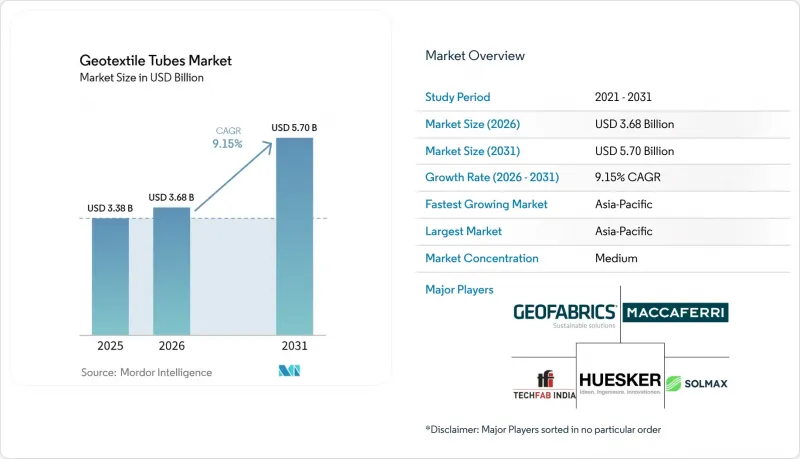
本報告按類型(機織地工織物管和不織布地工織物布管)、終端應用行業(海洋和水電、環境工程、農業工程、建築及其他終端應用行業)和地區(亞太地區、北美、歐洲、南美以及中東和非洲)進行細分。市場預測以美元計價。
全球地工織物管材市場趨勢及洞察
防止海岸侵蝕、風暴潮和海平面上升
海平面上升正推動地工織物管市場對短期沿海基礎設施採購的需求不斷成長。根據世界氣候研究計畫(WCRP)的預測,2024年全球海平面預計將上升5.9毫米,這意味著2014年至2023年間年均上升4.7毫米。政府間氣候變遷專門委員會(IPCC)報告稱,到2050年,全球13.6%至15.2%的海灘可能面臨嚴重侵蝕;在高排放情境下,到2100年,這一比例可能擴大至35.7%至49.5%。同一份評估報告指出,海平面上升20至40公分可能使許多低窪地區百年一遇的沿海洪水變成每年都會發生的災害。這種情況可能會縮短固定式海岸防護結構的實際施工時間。地工織物管適用於熱帶和季風沿海地區,因為它們可以在現場填充,無需像岩石結構那樣進行採石和運輸過程。
污水和污泥脫水基礎設施的擴建
都市污水處理廠處理能力的不斷提升,推動了地工織物管被動式污泥脫水技術在市場上的需求成長。這類系統利用織物層排出水分,同時保留經聚合物處理的污泥,避免了離心機和帶式壓濾機所需的能源消耗和維護成本。根據國際地工合成材料會議的資料,地工織物管脫水後污泥體積減少了8.5倍。污泥體積的減少使得土地和預算有限的市政業者能夠降低運輸和處置成本。對於沿海地區而言,從一開始就採用管式系統的新建污水處理廠,可以透過反覆的注水和排水作業來創造需求,而無需一次性建設和購買。此外,研究證實,聚合物的選擇和用量在提高混凝效果方面起著至關重要的作用,從而拓展了被動式紡織系統可處理的污泥類型。
聚丙烯和聚酯原料價格波動
聚丙烯和聚酯價格的波動仍然是地工織物佈管市場面臨的直接成本風險。 2026年上游丙烯供應中斷導致石化原料供應趨緊,加劇了聚丙烯價格的壓力。地工織物管市場的供應商通常透過競爭激烈的政府競標進行銷售,這可能限制了他們將不斷上漲的材料成本轉嫁給買家的能力。能源成本的上漲可能會進一步加劇聚合物擠出和製作流程的壓力。更高的原料價格可能會促使製造商設計大直徑管材,從而降低每立方公尺加工材料的聚合物用量。擁有自有聚合物供應或長期採購合約的製造商可以保持相對於獨立製造商的成本優勢。這種成本差異可能會推動標準級供應商之間的整合。
細分市場分析
截至2025年,編織地工織物管將佔據地工織物管市場68.45%的佔有率,預計到2031年將以10.61%的複合年成長率成長。其高抗張強度使其能夠在沿海和工業設施中承受高填充壓力、實現大周長和延長使用壽命。根據2024年的一份工程期刊,編織地工織物的抗張強度範圍為36 kN/m至201 kN/m,而作為對比的不織布材料的抗張強度約為50 kN/m。這種強度特性使其適用於疏浚沉積物的盛裝以及用於暴露在外的沿海結構。新澤西州交通部在一項航道修復計畫中使用了Solmax GEOTUBE GT500編織容器來盛裝和脫水超過11萬立方碼的疏浚沉積物。該項目也符合新澤西州的水質排放標準。印度的認證體系優先考慮能夠提供產品品質和過往業績證明的成熟供應商。編織結構為專案工程師提供了一種材料選擇,尤其適用於那些對接縫完整性和持續荷載要求極高的應用情境。供應商也可以將性能文件作為技術提案的一部分提交。因此,在受監管的沿海工程、疏浚工程和圍堰工程中,編織結構的需求最為迫切。
不織布管適用於那些透水性和排水性能比最大抗張強度更重要的項目。常見應用包括水處理污泥、小規模湖泊修復工程和臨時圍堰工程。 2026 年的一項研究探討了利用不織布管結構,結合生物基聚合物和高效管內流體混合技術,對湖底沉積物進行脫水處理。此方法對細粒沉積物和有機物含量高的沉積物有效。 Huesker 公司也正在擴展其天然纖維和高容量織物產品線,這反映了人們對材料選擇和加工性能日益成長的關注。在這個領域,不同應用之間的差異正變得越來越清晰。雖然編織管仍然適用於大規模結構應用,但不織布管正透過強調過濾和永續性的發展而拓展其應用範圍。當工程條件需要快速排放濾液時,其排水性能尤其重要。因此,材料的選擇取決於固態的性質、所需的截留率和預期的使用條件。這種特殊性使得兩種類型的管材之間難以直接互換。
區域分析
預計到2025年,亞太地區將佔據地工織物管市場38.63%的佔有率,並在2031年之前以10.15%的複合年成長率成長。該地區地勢低窪,沿海地區眾多,掩埋計畫活躍,並開展了公共地工合成材料材料計畫。亞洲開發銀行向馬哈拉斯特拉邦提供的4,200萬美元貸款,反映了多邊融資在提升海岸韌性方面的重要角色。在馬來西亞,GEOTUBE Marine的產品在斯里丹絨檳榔二期B計畫中構成外圍堤壩,有效抑制了泥沙擴散。 EuroGeo8在2025年的研究發現,新加坡的海洋樣本(安裝六年後)仍能維持18%至80%的抗張強度,具體數值取決於紫外線照射方向。
北美和歐洲的需求主要受基礎設施更新、環境修復和監管要求的污泥管理所驅動。在英國,政府基礎建設投資總額在2024年達到289億英鎊(約385.4億美元)。美國的港口維護持續推動疏浚沉積物脫水的需求。歐洲的CE認證、EN 13249標準以及建築產品法規要求,都提高了生產控制和設計文件的重要性。
南美洲和中東/非洲市場擁有各自獨特的市場需求促進因素。在巴西,處理採礦事故造成的污染沉積物的經驗正擴展到沿海和港口應用領域。與沙烏地阿拉伯「2030願景」相關的沿海計畫以及南非的採礦業都對近海防護和尾礦控制提出了更高的要求。這些市場的成長取決於資金籌措、技術能力以及對地工織物管設計的更深入理解。
其他好處:
- Excel格式的市場預測(ME)表
- 3個月的分析師支持
目錄
第1章:引言
- 研究假設和市場定義
- 調查範圍
第2章:調查方法
第3章執行摘要
第4章 市場狀況
- 市場概覽
- 市場促進因素
- 防止海岸侵蝕、風暴潮和海平面上升的措施
- 擴大污水和污泥脫水基礎設施
- 對港口、道路、橋樑和垃圾掩埋場等基礎設施進行投資。
- 受污染沉積物和採礦廢棄物的處置要求
- 添加聚合物和改進大容量管的設計
- 脫水沉澱物的回收再利用及生物基纖維的開發
- 市場限制因素
- 聚丙烯和聚酯原料價格波動
- 產品認證、設計責任和品管要求
- 與濾液、聚合物和殘留固態相關的特定場所合規風險。
- 長壽命設備中紫外線輻射、磨損和微塑膠釋放的風險
- 價值鏈分析
- 波特五力分析
第5章 市場規模與成長預測
- 按類型
- 編織地工織物布管
- 不織布地工織物管
- 按最終用途行業分類
- 船舶和液壓系統
- 環境工程
- 農業工程
- 建造
- 其他終端用戶產業(包括污水處理、採礦和礦物加工、紙漿和造紙廠以及水產養殖)
- 按地區
- 亞太地區
- 中國
- 印度
- 日本
- 韓國
- 東南亞國協
- 其他亞太國家
- 北美洲
- 美國
- 加拿大
- 墨西哥
- 歐洲
- 德國
- 英國
- 法國
- 義大利
- 北歐國家
- 俄羅斯
- 其他歐洲國家
- 南美洲
- 巴西
- 阿根廷
- 其他南美國家
- 中東和非洲
- 沙烏地阿拉伯
- 南非
- 其他中東和非洲國家
- 亞太地區
第6章 競爭情勢
- 市場集中度
- 策略趨勢
- 市佔率和排名分析
- 公司簡介
- Ace Geosynthetics
- CeTeau
- FlexiTuff Ventures International Ltd
- Flint Technical Geosolutions(FTG).
- Geofabrics Australasia Pty Ltd.
- Geo-Synthetics Systems LLC(GSI)
- Global Synthetics Pty Ltd
- HUESKER International
- Naue GmbH & Co. KG
- Officine Maccaferri Spa
- Solmax
- TECHFABINDIA
- Thrace Group
- Titan Environmental
第7章 市場機會與未來展望
According to Mordor Intelligence, the geotextile tubes market was valued at USD 3.38 billion in 2025 and is estimated to grow from USD 3.68 billion in 2026 to reach USD 5.70 billion by 2031, at a CAGR of 9.15% during the forecast period (2026-2031).
This report is Segmented by Type (Woven Geotextile Tubes and Nonwoven Geotextile Tubes), End-Use Industry (Marine and Hydraulic, Environmental Engineering, Agricultural Engineering, Construction, and Other End-Use Industries), and Geography (Asia-Pacific, North America, Europe, South America, and Middle-East and Africa). The Market Forecasts are Provided in Terms of Value (USD).
Global Geotextile Tubes Market Trends and Insights
Coastal Erosion, Storm Surge, and Sea-Level-Rise Protection
Sea-level rise is increasingly triggering near-term coastal infrastructure procurement in the geotextile tubes market. The World Climate Research Programme reported a 5.9 mm global sea-level increase in 2024, while the annual rate was 4.7 mm from 2014 to 2023. The Intergovernmental Panel on Climate Change (IPCC) reported that 13.6% to 15.2% of global sandy beaches could face severe erosion by 2050, with the range increasing to 35.7% to 49.5% by 2100 under high-emissions pathways. The same assessment stated that 20 cm to 40 cm of sea-level rise can turn a 1-in-100-year coastal flood into an annual event at many low-lying locations. These conditions can shorten the practical construction period for fixed coastal defenses. Geotextile tubes can be filled on site without the quarrying and transport process required for rock-based structures, which supports their use in tropical and monsoonal coastal settings.
Expansion of Wastewater and Sludge-Dewatering Infrastructure
Municipal wastewater capacity additions are strengthening demand for passive sludge dewatering in the geotextile tubes market. These systems retain polymer-conditioned sludge while water drains through the textile, avoiding the energy use and maintenance needs of centrifuges and belt presses. International Geosynthetics Society conference material reported an 8.5-times reduction in sludge volume after dewatering in geotextile tubes. This reduction can lower transport and disposal costs for municipal operators with constrained land and budgets. New treatment plants that specify tube systems at the outset can create repeated fill-and-drain demand rather than a single coastal construction purchase. Research also supports the role of polymer selection and dosing in improving consolidation, which broadens the range of sludges that passive textile systems can process.
Polypropylene and Polyester Feedstock Price Volatility
Polypropylene and polyester price changes remain a direct cost risk for the geotextile tubes market. Upstream propylene supply disruptions in 2026 tightened petrochemical feedstock availability and increased pressure on polypropylene pricing. Geotextile tubes market suppliers often sell through competitive government tenders and may have limited ability to pass higher material costs to buyers. Energy cost inflation can add further pressure during polymer extrusion and fabrication. Higher material prices can encourage larger-diameter tube designs that use less polymer per cubic meter of treated material. Producers with integrated polymer supply or long-term sourcing contracts can retain a landed-cost advantage over independent manufacturers. This gap may support consolidation among standard-grade suppliers.
Other drivers and restraints analyzed in the detailed report include:
- Infrastructure Investment in Ports, Roads, Bridges, and Land Reclamation
- Polymer-Dosing and High-Capacity Tube Design Improvements
- Product Accreditation, Design Liability, and Quality-Control Requirements
For complete list of drivers and restraints, kindly check the Table Of Contents.
Segment Analysis
Woven geotextile tubes held 68.45% of the geotextile tubes market share in 2025 and are projected to grow at a 10.61% CAGR through 2031. Their tensile strength supports high fill pressures, large circumferences, and long service life in coastal and industrial installations. A 2024 engineering publication reported woven geotextile tensile strengths of 36 kN/m to 201 kN/m, compared with values near 50 kN/m for nonwoven material in the cited comparison. This strength profile supports their use in dredged-material containment and exposed coastal works. The New Jersey Department of Transportation used Solmax GEOTUBE GT500 woven containers to contain and dewater more than 110,000 cubic yards of dredged material during channel restoration. The project also met New Jersey water-quality discharge requirements. India's certification framework further favors established suppliers that can demonstrate product quality and documented performance. Woven construction gives project engineers a material option for applications where seam integrity and sustained loading are central design concerns. It also allows suppliers to position performance documentation as part of their technical offer. The resulting preference is strongest in regulated coastal, dredging, and containment projects.
Nonwoven tubes serve projects where permeability and drainage are more important than the highest tensile strength. Water treatment sludge, small lake remediation projects, and temporary containment works are common uses. A 2026 study examined biobased polymer application and high-efficiency pipe-flow mixing for lake-sediment dewatering in nonwoven tube configurations. The approach is relevant for fine-grained and high-organic sediments. HUESKER has also expanded its natural-fiber and high-capacity fabric offering, reflecting interest in material selection and processing performance. The category is moving toward a clearer division. Woven tubes remain suited to large structural applications, while nonwoven tubes are extending their role through filtration and sustainability-oriented development. Their drainage properties can be useful where project conditions favor rapid filtrate release. Material selection, therefore, depends on the solids profile, required retention, and expected service conditions. This specialization reduces direct substitution between the two tube types.
Complete Report Scope:
- By Type
- Woven Geotextile Tubes
- Nonwoven Geotextile Tubes
- By End-Use Industry
- Marine and Hydraulic
- Environmental Engineering
- Agricultural Engineering
- Construction
- Other End-Use Industries (including Wastewater Treatment, Mining and Mineral Processing, Pulp and Paper Mills, and Aquaculture)
- By Geography
- Asia-Pacific
- China
- India
- Japan
- South Korea
- ASEAN Countries
- Rest of Asia-Pacific
- North America
- United States
- Canada
- Mexico
- Europe
- Germany
- United Kingdom
- France
- Italy
- NORDIC Countries
- Russia
- Rest of Europe
- South America
- Brazil
- Argentina
- Rest of South America
- Middle-East and Africa
- Saudi Arabia
- South Africa
- Rest of Middle-East and Africa
- Asia-Pacific
Geography Analysis
Asia-Pacific held 38.63% of the geotextile tubes market share in 2025 and is forecast to grow at a 10.15% CAGR through 2031. The region combines low-elevation coastal exposure, active land reclamation, and public geosynthetics programs. The Asian Development Bank's USD 42 million Maharashtra loan shows the role of multilateral financing in coastal resilience. In Malaysia, GEOTUBE Marine units formed a perimeter dike at Seri Tanjung Pinang Phase 2B and limited sediment plumes. A 2025 EuroGeo8 study found retained tensile strength of 18% to 80% in 6-year-old Singapore marine samples, depending on UV exposure direction.
Demand in North America and Europe is supported by infrastructure renewal, environmental remediation, and regulated sludge management. The United Kingdom recorded GBP 28.9 billion (approximately USD 38.54 billion) in general government infrastructure investment in 2024. United States harbor maintenance creates recurring dewatering demand for dredged sediment. European CE marking, EN 13249, and Construction Products Regulation obligations increase the value of manufacturing control and design documentation.
South America, and the Middle-East and Africa are markets with distinctive demand drivers. Brazil's contaminated-sediment experience following mining incidents is transferring to coastal and port applications. Saudi Arabia's Vision 2030 coastal projects and South African mining needs support for offshore protection and tailings containment. Their growth depends on financing, engineering capability, and wider familiarity with geotextile tube design.
- Ace Geosynthetics
- CeTeau
- FlexiTuff Ventures International Ltd
- Flint Technical Geosolutions (FTG).
- Geofabrics Australasia Pty Ltd.
- Geo-Synthetics Systems LLC (GSI)
- Global Synthetics Pty Ltd
- HUESKER International
- Naue GmbH & Co. KG
- Officine Maccaferri Spa
- Solmax
- TECHFABINDIA
- Thrace Group
- Titan Environmental
Additional Benefits:
- The market estimate (ME) sheet in Excel format
- 3 months of analyst support
TABLE OF CONTENTS
1 Introduction
- 1.1 Study Assumptions and Market Definition
- 1.2 Scope of the Study
2 Research Methodology
3 Executive Summary
4 Market Landscape
- 4.1 Market Overview
- 4.2 Market Drivers
- 4.2.1 Coastal Erosion, Storm Surge, and Sea-Level-Rise Protection
- 4.2.2 Expansion of Wastewater and Sludge-Dewatering Infrastructure
- 4.2.3 Infrastructure Investment in Ports, Roads, Bridges, and Land Reclamation
- 4.2.4 Contaminated Sediment and Mining-Waste Containment Requirements
- 4.2.5 Polymer-Dosing and High-Capacity Tube Design Improvements
- 4.2.6 Circular Reuse of Dewatered Sediment and Bio-Based Textile Development
- 4.3 Market Restraints
- 4.3.1 Polypropylene and Polyester Feedstock Price Volatility
- 4.3.2 Product Accreditation, Design Liability, and Quality-Control Requirements
- 4.3.3 Site-Specific Filtrate, Polymer, and Residual-Solids Compliance Risk
- 4.3.4 UV, Abrasion, and Microplastic-Release Risk in Long-Life Installations
- 4.4 Value Chain Analysis
- 4.5 Porter's Five Forces Analysis
- 4.5.1 Threat of New Entrants
- 4.5.2 Bargaining Power of Suppliers
- 4.5.3 Bargaining Power of Buyers
- 4.5.4 Threat of Substitutes
- 4.5.5 Rivalry Among Existing Competitors
5 Market Size and Growth Forecasts (Value)
- 5.1 By Type
- 5.1.1 Woven Geotextile Tubes
- 5.1.2 Nonwoven Geotextile Tubes
- 5.2 By End-Use Industry
- 5.2.1 Marine and Hydraulic
- 5.2.2 Environmental Engineering
- 5.2.3 Agricultural Engineering
- 5.2.4 Construction
- 5.2.5 Other End-Use Industries (including Wastewater Treatment, Mining and Mineral Processing, Pulp and Paper Mills, and Aquaculture)
- 5.3 By Geography
- 5.3.1 Asia-Pacific
- 5.3.1.1 China
- 5.3.1.2 India
- 5.3.1.3 Japan
- 5.3.1.4 South Korea
- 5.3.1.5 ASEAN Countries
- 5.3.1.6 Rest of Asia-Pacific
- 5.3.2 North America
- 5.3.2.1 United States
- 5.3.2.2 Canada
- 5.3.2.3 Mexico
- 5.3.3 Europe
- 5.3.3.1 Germany
- 5.3.3.2 United Kingdom
- 5.3.3.3 France
- 5.3.3.4 Italy
- 5.3.3.5 NORDIC Countries
- 5.3.3.6 Russia
- 5.3.3.7 Rest of Europe
- 5.3.4 South America
- 5.3.4.1 Brazil
- 5.3.4.2 Argentina
- 5.3.4.3 Rest of South America
- 5.3.5 Middle-East and Africa
- 5.3.5.1 Saudi Arabia
- 5.3.5.2 South Africa
- 5.3.5.3 Rest of Middle-East and Africa
- 5.3.1 Asia-Pacific
6 Competitive Landscape
- 6.1 Market Concentration
- 6.2 Strategic Moves
- 6.3 Market Share (%)/Ranking Analysis
- 6.4 Company Profiles (includes Global Overview, Market Overview, Core Segments, Financials as available, Strategic Information, Products and Services, and Recent Developments)
- 6.4.1 Ace Geosynthetics
- 6.4.2 CeTeau
- 6.4.3 FlexiTuff Ventures International Ltd
- 6.4.4 Flint Technical Geosolutions (FTG).
- 6.4.5 Geofabrics Australasia Pty Ltd.
- 6.4.6 Geo-Synthetics Systems LLC (GSI)
- 6.4.7 Global Synthetics Pty Ltd
- 6.4.8 HUESKER International
- 6.4.9 Naue GmbH & Co. KG
- 6.4.10 Officine Maccaferri Spa
- 6.4.11 Solmax
- 6.4.12 TECHFABINDIA
- 6.4.13 Thrace Group
- 6.4.14 Titan Environmental
7 Market Opportunities and Future Outlook
- 7.1 White-Space and Unmet-Need Assessment

 地工織物管市場:全球預測,2026-2032年
 全球地工織物管市場規模、佔有率、趨勢和成長分析報告(2026-2034年)
 地工織物管市場報告:按類型、終端用途產業和地區分類(2026-2034 年)
 2026年全球地工織物管市場報告