


 |
市場調查報告書
商品編碼
2119109
地工複合物:市場佔有率分析、產業趨勢與統計、成長預測(2026-2031)Geocomposites - Market Share Analysis, Industry Trends & Statistics, Growth Forecasts (2026 - 2031) |
||||||

※ 本網頁內容可能與最新版本有所差異。詳細情況請與我們聯繫。
據 Mordor Intelligence 稱,2025 年地工複合物市場價值將達到 5.1373 億美元,預計到 2031 年將達到 7.4995 億美元,而 2026 年為 5.4532 億美元,預測期(2026-2031 年)的複合年成長率為 6.6.58%。
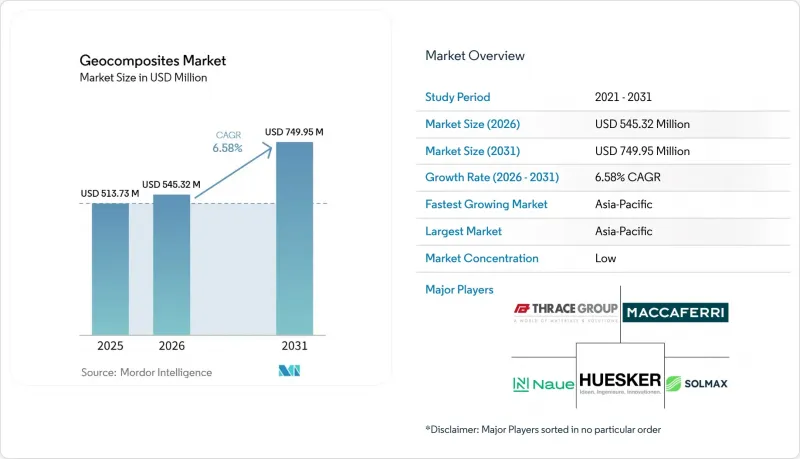
本報告按產品類型(例如,地工織物/地工織網複合材料、地工織物/地工止水膜複合材料)、應用領域(水和廢水處理、道路和高速公路、掩埋和採礦、地基加固及其他應用)和地區(亞太地區、北美地區、歐洲地區、南美地區以及中東和非洲地區)進行細分。市場預測以美元(USD)計價。
全球地工複合物市場趨勢與洞察
基礎設施現代化以及對公路和鐵路的投資
公路和鐵路建設計畫正在為地工複合物市場創造可預測且龐大的採購需求。這是因為排水、過濾、隔離和加固層擴大被納入專案設計標準。印度公路管理部門和日本國際協力機構(JICA)已發布指南,要求各機構在詳細專案準備階段評估地工合成材料在邊坡防護和路堤工程的應用。這使得材料評估成為專案流程的正式組成部分。旨在建造超過26,000公里國家公路的「印度公路網計畫」(Bharatmala Paliyojana)為地工織物地工織網和地工織物地工格網複合材料提供了多年需求基礎,這些需求涵蓋多個獨立項目包,而非單一項目週期。中國高速公路和高鐵的擴建也同樣支撐著持續的需求,尤其是在國家材料標準修訂導致性能文件需求增加的地區。維修工程也十分重要,因為路基薄弱的老舊道路通常需要比新建道路更高規格的罩面層。這提高了技術成熟市場中產品的價值。
強制性污水處理、掩埋和圍堵基礎設施
遵守環境法規使得不透水基礎設施成為地工複合物市場的核心需求來源。這是因為操作員必須滿足特定的襯裡、排水和監測要求。美國市政固態廢棄物設施的法規強制要求使用複合襯裡系統,而危險廢棄物設施的法規要求在某些設施中安裝雙層複合襯裡和洩漏檢測系統。這些要求降低了市場對短期建設活動的依賴,因為掩埋的維修、污水儲存的更新和土壤修復項目都是按照合規計畫實施的。獲得相關環境法規認證的製造商更容易參與採購項目,因為在這些項目中,技術文件是供貨的先決條件,而材料缺陷會導致長期的法律責任。
合成聚合物和樹脂價格波動
聚丙烯、聚酯和聚乙烯等原料價格的波動會立即對整個地工複合物市場的利潤率造成壓力,因為幾乎所有產品都包含聚合物成本。聚丙烯價格在2025年中期上漲後趨於穩定,聚乙烯價格也呈現類似的走勢,促使一些供應商提高價格或在競標中加入與聚合物指數掛鉤的價格調整條款。擁有自有聚合物擠出能力的製造商即使在原物料價格飆升的情況下,也能更好地控制材料採購、加工成本和定價。而那些沒有垂直整合能力的加工商則被迫在利潤率下降、要求重新審查訂單條款以及承擔因競標調整而失去訂單的風險之間做出選擇。這種差異正在推動現有製造商進一步進行垂直整合,並提高了高階產品類型的進入門檻,因為這些類別需要穩定的樹脂品質和可靠的供應。
細分市場分析
2025年地工複合物市場中,地工織物和地工織網複合材料佔了31.75%的市場佔有率,成為市場主導產品。這主要歸功於它們在掩埋滲濾液收集、地下道路排水和基礎牆排水等領域的廣泛應用。其雙層和三層高密度聚乙烯(HDPE)地工織網芯材既能提供良好的排水通道,也比傳統的骨材系統更輕。同時,由於產品易於替代以及海外生產能力的提升,通用型市政排水產品面臨價格壓力。預計2026年至2031年,地工織物和地工止水膜複合材料的複合年成長率將達到7.43%。它們透過在污水儲存、水庫襯砌和礦山廢料堆放等項目中結合不透水屏障和保護性紡織層,能夠簡化施工流程並提高施工品質。這種設計在專案核准中尤其重要,因為其對圍護性能、洩漏控制和可靠文件的要求非常高。
地工織物和地工格網複合材料用於支撐路基、堤防和擋土牆結構,其需求與亞太地區公路和鐵路投資趨勢密切相關。這些複合材料將隔離、過濾、穩定和加固功能整合於單一路基中。同時,排水芯地工織物複合材料用於建築物、屋頂綠化和體育複合材料的路基,這些應用對材料的厚度和抗壓性有較高要求。地工止水膜、地工織網和地工止水膜地工格網複合材料用於支撐蓋層系統和污水處理池襯裡,但由於技術要求,這些應用中替代材料的使用受到限制。中國已於2026年發布了竹編地工地工格網國家標準。這標誌著生醫材料在相關加固應用領域的發展尚處於早期階段,但在性能達到等效水平之前,其收益可能暫時有限。
區域分析
到2025年,亞太地區將佔地工複合物市場規模的41.03%,預計到2031年將以7.77%的複合年成長率(CAGR)實現最高成長。中國高速公路和高鐵的建設推動了大規模採購,而印度2024年頒布的品管指令進一步提升了認證產品在基礎設施競標中的重要性。日本、韓國和東南亞國協對污染物控制、海岸防護和污水處理的投資也帶動了市場需求的成長。越南、印尼和菲律賓的污水處理計畫也促進了市場需求。 Geofabrics Australasia公司利用回收的PET地工複合物生產連續長絲聚對苯二甲酸乙二醇酯(PET)地工織物織物複合材料,滿足了區域採購中的永續性要求。
在北美和歐洲,人們越來越依賴更新週期、技術升級以及封存和修復工作,而不是新建設的規模。美國D類法規強制要求在新建城市固態廢棄物掩埋和橫向擴建工程中使用複合襯裡。歐洲的掩埋要求、氣候變遷調適工作以及環境產品文件都會影響公共工程項目合格供應商的選擇。採購機構越來越重視經過檢驗的生命週期數據,這可能會縮小合格供應商的範圍。
在南美洲,需求主要受安地斯走廊尾礦儲存維修和礦業開發案的推動。在中東和非洲,需求主要受水安全基礎設施、水庫襯砌、管道、採礦和走廊道路項目等項目的推動。沙烏地阿拉伯是該地區的主要買家,代表其參與水安全投資計畫。 Naue GmbH & Co. KG 於 2025 年 6 月與 TeMa South Africa 建立了銷售合作夥伴關係,旨在探索南非及撒哈拉以南非洲地區的專案相關業務機會。南非的礦業基礎以及東非和西非的道路投資將構成與圍堰、分離和排水相關的需求的初始基礎。
其他好處:
- Excel格式的市場預測(ME)表
- 3個月的分析師支持
目錄
第1章:引言
- 研究假設和市場定義
- 調查範圍
第2章:調查方法
第3章執行摘要
第4章 市場狀況
- 市場概覽
- 市場促進因素
- 基礎設施現代化以及對公路和鐵路的投資
- 必要的廢水處理、掩埋和圍堵基礎設施
- 對採礦廢棄物、堆場覆蓋範圍和邊坡穩定化的需求。
- 與傳統排水和堤防系統相比,具有生命週期成本優勢。
- 嵌入式監測和智慧地工複合物的實施
- 再生和生物地工複合物複合材料的技術規範
- 市場限制因素
- 合成聚合物和樹脂的價格波動
- 標準、測試和承包商認證方面存在差異。
- 對微塑膠、報廢產品和長期責任的審查
- 缺乏安裝技能和設計責任風險
- 價值鏈分析
- 波特五力分析
第5章 市場規模與成長預測
- 依產品類型
- 地工織物及地工織網複合材料
- 地工織物及地工止水膜複合材料
- 地工織物和地工格網複合材料
- 排水芯/地工織物複合材料
- 其他產品類型(地工止水膜-地工織網複合材料及地工止水膜-地工格網複合材料)
- 透過使用
- 供水和廢水處理
- 普通公路和高速公路
- 土地掩埋與採礦
- 地基加固
- 其他用途(隧道、建築地基、農業和景觀美化)
- 按地區
- 亞太地區
- 中國
- 印度
- 日本
- 韓國
- 東南亞國協
- 其他亞太國家
- 北美洲
- 美國
- 加拿大
- 墨西哥
- 歐洲
- 德國
- 英國
- 法國
- 義大利
- 西班牙
- 北歐國家
- 俄羅斯
- 其他歐洲國家
- 南美洲
- 巴西
- 阿根廷
- 其他南美國家
- 中東和非洲
- 沙烏地阿拉伯
- 南非
- 其他中東和非洲國家
- 亞太地區
第6章 競爭情勢
- 市場集中度
- 策略趨勢
- 市佔率和排名分析
- 公司簡介
- ABG Limited
- agru Kunststofftechnik GmbH
- CETCO
- CLIMAX SYNTHETICS PVT. LTD.
- Freudenberg Performance Materials
- Geofabrics Australasia Pty Ltd
- GEOfabrics Ltd
- HUESKER International
- Leggett & Platt, Incorporated
- Naue GmbH & Co. KG
- Officine Maccaferri Spa
- SKAPS Industries
- Solmax
- Strata Geosystems
- TENAX SPA
- Tensar, A Division of CMC
- Terram Geosynthetics Pvt. Ltd.
- Thrace Group
第7章 市場機會與未來展望
According to Mordor Intelligence, the geocomposites market was valued at USD 513.73 million in 2025 and is estimated to grow from USD 545.32 million in 2026 to reach USD 749.95 million by 2031, at a CAGR of 6.58% during the forecast period (2026-2031).
This report is Segmented by Product Type (Geotextile-Geonet Composites, Geotextile-Geomembrane Composites, and More), Application (Water and Wastewater Treatment, Roadway and Highway, Landfill and Mining, Soil Reinforcement, and Other Applications), and Geography (Asia-Pacific, North America, Europe, South America, and Middle-East and Africa). The Market Forecasts are Provided in Terms of Value (USD).
Global Geocomposites Market Trends and Insights
Infrastructure Modernization and Road-Railway Investment
Road and rail programs are creating predictable, high-volume procurement for the geocomposites market because drainage, filtration, separation, and reinforcement layers are increasingly included in project design standards. India's road authorities and the Japan International Cooperation Agency issued guidance that requires agencies to evaluate geosynthetic integration for slope protection and embankment works during detailed project preparation, making material evaluation part of the formal project process. Bharatmala Pariyojana, which targets the development of more than 26,000 km of national highways, provides a multiyear demand base for geotextile-geonet and geotextile-geogrid composites across many individual packages rather than a single project cycle. China's expressway and high-speed rail expansion similarly supports recurring demand, especially where revisions to national material specifications increase the need for documented performance. Rehabilitation is also important because aging roads on weak subgrades often need higher-specification overlays than new construction, raising product value in technically maturing markets.
Mandatory Wastewater, Landfill, and Containment Infrastructure
Environmental compliance is making containment infrastructure a core source of demand in the geocomposites market because owners must meet defined liner, drainage, and monitoring requirements. U.S. rules for municipal solid-waste facilities require composite liner systems, while hazardous-waste rules require double-composite liners and leak-detection systems in defined facilities. These requirements make demand less dependent on short-term construction activity because landfill upgrades, wastewater lagoon replacement, and remediation programs follow compliance schedules. Manufacturers that align certifications with applicable environmental rules can participate more easily in procurement where technical documentation is a precondition for supply and where material failure creates lasting liability.
Synthetic Polymer and Resin Price Volatility
Polypropylene, polyester, and polyethylene feedstock movements create immediate margin pressure across the geocomposites market because polymer cost is embedded in almost every product configuration. Polypropylene prices rose during mid-2025 and later stabilized, while polyethylene followed a similar pattern, leading some suppliers to raise prices or add polymer-index escalation clauses to bids. Producers with captive polymer extrusion capacity can retain more control over material availability, conversion cost, and pricing during feedstock increases. Non-integrated fabricators must either absorb margin compression, seek contract revisions, or risk losing work when bid prices are adjusted. This difference supports further vertical integration among established producers and raises the entry barrier in premium product categories that need consistent resin quality and assured supply.
Other drivers and restraints analyzed in the detailed report include:
- Mining Tailings, Heap-Leach, and Slope-Stabilization Demand
- Lifecycle-Cost Advantage Versus Conventional Drainage and Fill Systems
- Fragmented Standards, Testing, and Contractor Qualification
For complete list of drivers and restraints, kindly check the Table Of Contents.
Segment Analysis
Geotextile-geonet composites led with 31.75% of the geocomposites market size in 2025 because they support landfill leachate collection, subsurface road drainage, and foundation-wall drainage. Their biplanar and triplanar HDPE geonet cores provide flow channels at lower material weight than conventional aggregate systems, while commodity-grade civil-drainage versions face price pressure where products are easily substituted and offshore fabrication capacity is available. Geotextile-geomembrane composites are forecast to grow at a 7.43% CAGR from 2026 to 2031. They combine an impermeable barrier with a protective textile layer in wastewater lagoons, reservoir lining, and mining tailings works, reducing installation steps and simplifying construction quality assurance. This design is especially relevant where containment performance, leakage control, and reliable documentation are central to project approval.
Geotextile-geogrid composites support road subgrades, embankments, and retaining structures, so their demand follows road and rail investment in the Asia-Pacific. They combine separation, filtration, stabilization, and reinforcement functions in one installed layer, while drainage core-geotextile composites serve buildings, green roofs, and sports-facility sub-bases that require low profiles and compression resistance. Geomembrane-geonet and geomembrane-geogrid composites support cap-cover systems and process-pond liners, where technical requirements limit substitution. China released a national standard for bamboo-woven geogrids in 2026, an early step for bio-material development in related reinforcement applications, though near-term revenue remains limited until performance equivalence is established.
Complete Report Scope:
- By Product Type
- Geotextile-Geonet Composites
- Geotextile-Geomembrane Composites
- Geotextile-Geogrid Composites
- Drainage CoreGeotextile Composites
- Other Product Types (Geomembrane-Geonet Composites, and Geomembrane-Geogrid Composites)
- By Application
- Water and Wastewater Treatment
- Roadway and Highway
- Landfill and Mining
- Soil reinforcement
- Other Applications (Tunnels, Building Foundations, and Agriculture and Landscaping)
- By Geography
- Asia-Pacific
- China
- India
- Japan
- South Korea
- ASEAN Countries
- Rest of Asia-Pacific
- North America
- United States
- Canada
- Mexico
- Europe
- Germany
- United Kingdom
- France
- Italy
- Spain
- NORDIC Countries
- Russia
- Rest of Europe
- South America
- Brazil
- Argentina
- Rest of South America
- Middle-East and Africa
- Saudi Arabia
- South Africa
- Rest of Middle-East and Africa
- Asia-Pacific
Geography Analysis
Asia-Pacific held 41.03% of the geocomposites market size in 2025 and is projected to record the fastest regional CAGR of 7.77% through 2031. China's expressway and high-speed rail construction supports high-volume procurement, while India's 2024 Quality Control Orders increased the focus on certified products in infrastructure tenders. Japan, South Korea, and ASEAN countries add demand through containment, coastal protection, and wastewater investment. Vietnam, Indonesia, and the Philippines contribute through wastewater treatment programs. Geofabrics Australasia produces continuous-filament polyethylene terephthalate (PET) geotextile geocomposites from recycled PET feedstock, supporting sustainability requirements in regional procurement.
North America and Europe rely more on replacement cycles, technical upgrades, and containment remediation than on new-build volumes. U.S. Subtitle D rules require composite liners for new municipal solid-waste landfills and lateral expansions. European landfill requirements, climate-adaptation work, and environmental-product documentation affect which suppliers qualify for public projects. Procurement agencies increasingly favor verified lifecycle data, which can narrow the qualified supplier pool.
South America is supported by tailings-storage upgrades and mining development in the Andes corridor. The Middle-East and Africa are supported by water-security infrastructure, reservoir lining, pipelines, mining, and corridor-road projects. Saudi Arabia is a leading regional buyer under water-security investment programs. Naue GmbH & Co. KG formed a distribution partnership with TeMa South Africa in June 2025 for South Africa and project-related opportunities across Sub-Saharan Africa. South Africa's mining base and road investments in East and West Africa provide an initial base for containment, separation, and drainage demand.
- ABG Limited
- agru Kunststofftechnik GmbH
- CETCO
- CLIMAX SYNTHETICS PVT. LTD.
- Freudenberg Performance Materials
- Geofabrics Australasia Pty Ltd
- GEOfabrics Ltd
- HUESKER International
- Leggett & Platt, Incorporated
- Naue GmbH & Co. KG
- Officine Maccaferri Spa
- SKAPS Industries
- Solmax
- Strata Geosystems
- TENAX SPA
- Tensar, A Division of CMC
- Terram Geosynthetics Pvt. Ltd.
- Thrace Group
Additional Benefits:
- The market estimate (ME) sheet in Excel format
- 3 months of analyst support
TABLE OF CONTENTS
1 Introduction
- 1.1 Study Assumptions and Market Definition
- 1.2 Scope of the Study
2 Research Methodology
3 Executive Summary
4 Market Landscape
- 4.1 Market Overview
- 4.2 Market Drivers
- 4.2.1 Infrastructure Modernization and Road-Railway Investment
- 4.2.2 Mandatory Wastewater, Landfill, and Containment Infrastructure
- 4.2.3 Mining Tailings, Heap-Leach, and Slope-Stabilization Demand
- 4.2.4 Lifecycle-Cost Advantage Versus Conventional Drainage and Fill Systems
- 4.2.5 Embedded Monitoring and Smart Geocomposite Adoption
- 4.2.6 Recycled and Bio-Based Geocomposite Specifications
- 4.3 Market Restraints
- 4.3.1 Synthetic Polymer and Resin Price Volatility
- 4.3.2 Fragmented Standards, Testing, and Contractor Qualification
- 4.3.3 Microplastic, End-of-Life, and Long-Term Liability Scrutiny
- 4.3.4 Installation Skill Gaps and Design-Responsibility Risk
- 4.4 Value Chain Analysis
- 4.5 Porter's Five Forces Analysis
- 4.5.1 Threat of New Entrants
- 4.5.2 Bargaining Power of Suppliers
- 4.5.3 Bargaining Power of Buyers
- 4.5.4 Threat of Substitutes
- 4.5.5 Competitive Rivalry
5 Market Size and Growth Forecasts (Value)
- 5.1 By Product Type
- 5.1.1 Geotextile-Geonet Composites
- 5.1.2 Geotextile-Geomembrane Composites
- 5.1.3 Geotextile-Geogrid Composites
- 5.1.4 Drainage CoreGeotextile Composites
- 5.1.5 Other Product Types (Geomembrane-Geonet Composites, and Geomembrane-Geogrid Composites)
- 5.2 By Application
- 5.2.1 Water and Wastewater Treatment
- 5.2.2 Roadway and Highway
- 5.2.3 Landfill and Mining
- 5.2.4 Soil reinforcement
- 5.2.5 Other Applications (Tunnels, Building Foundations, and Agriculture and Landscaping)
- 5.3 By Geography
- 5.3.1 Asia-Pacific
- 5.3.1.1 China
- 5.3.1.2 India
- 5.3.1.3 Japan
- 5.3.1.4 South Korea
- 5.3.1.5 ASEAN Countries
- 5.3.1.6 Rest of Asia-Pacific
- 5.3.2 North America
- 5.3.2.1 United States
- 5.3.2.2 Canada
- 5.3.2.3 Mexico
- 5.3.3 Europe
- 5.3.3.1 Germany
- 5.3.3.2 United Kingdom
- 5.3.3.3 France
- 5.3.3.4 Italy
- 5.3.3.5 Spain
- 5.3.3.6 NORDIC Countries
- 5.3.3.7 Russia
- 5.3.3.8 Rest of Europe
- 5.3.4 South America
- 5.3.4.1 Brazil
- 5.3.4.2 Argentina
- 5.3.4.3 Rest of South America
- 5.3.5 Middle-East and Africa
- 5.3.5.1 Saudi Arabia
- 5.3.5.2 South Africa
- 5.3.5.3 Rest of Middle-East and Africa
- 5.3.1 Asia-Pacific
6 Competitive Landscape
- 6.1 Market Concentration
- 6.2 Strategic Moves
- 6.3 Market Share (%)/Ranking Analysis
- 6.4 Company Profiles (includes Global Overview, Market Overview, Core Segments, Financials as available, Strategic Information, Products and Services, and Recent Developments)
- 6.4.1 ABG Limited
- 6.4.2 agru Kunststofftechnik GmbH
- 6.4.3 CETCO
- 6.4.4 CLIMAX SYNTHETICS PVT. LTD.
- 6.4.5 Freudenberg Performance Materials
- 6.4.6 Geofabrics Australasia Pty Ltd
- 6.4.7 GEOfabrics Ltd
- 6.4.8 HUESKER International
- 6.4.9 Leggett & Platt, Incorporated
- 6.4.10 Naue GmbH & Co. KG
- 6.4.11 Officine Maccaferri Spa
- 6.4.12 SKAPS Industries
- 6.4.13 Solmax
- 6.4.14 Strata Geosystems
- 6.4.15 TENAX SPA
- 6.4.16 Tensar, A Division of CMC
- 6.4.17 Terram Geosynthetics Pvt. Ltd.
- 6.4.18 Thrace Group
7 Market Opportunities and Future Outlook
- 7.1 White-Space and Unmet-Need Assessment

 地工複合物市場規模、佔有率和成長分析:按類型、材料、應用、最終用途和地區分類-2026-2033年產業預測
 全球地工複合物市場
 全球地工複合物市場規模、佔有率、趨勢和成長分析報告(2026-2034)
 地工複合物市場:依產品類型、應用、功能及原料分類-2026-2032年全球市場預測地工複合物市場規模、佔有率、成長及全球產業分析:按類型和應用分類,區域洞察及2026-2034年預測
 2032 年地工複合物市場預測:按產品、材料、功能、應用、最終用戶和地區進行的全球分析
 地工複合物市場規模、佔有率、趨勢分析報告:按功能、應用、地區、細分市場預測,2025-2030 年地工複合物的全球市場規模:各產品,各功能,各用途,地區範圍,預測