


 |
市場調查報告書
商品編碼
2119098
OTT訂閱管理:市場佔有率分析、產業趨勢與統計、成長預測(2026-2031年)OTT Subscription Management - Market Share Analysis, Industry Trends & Statistics, Growth Forecasts (2026 - 2031) |
||||||

※ 本網頁內容可能與最新版本有所差異。詳細情況請與我們聯繫。
根據 Mordor Intelligence 預測,OTT 訂閱管理市場規模將從 2025 年的 15.7 億美元和 2026 年的 17.8 億美元成長到 2031 年的 29.7 億美元,2026 年至 2031 年的複合年成長率為 10.80%。
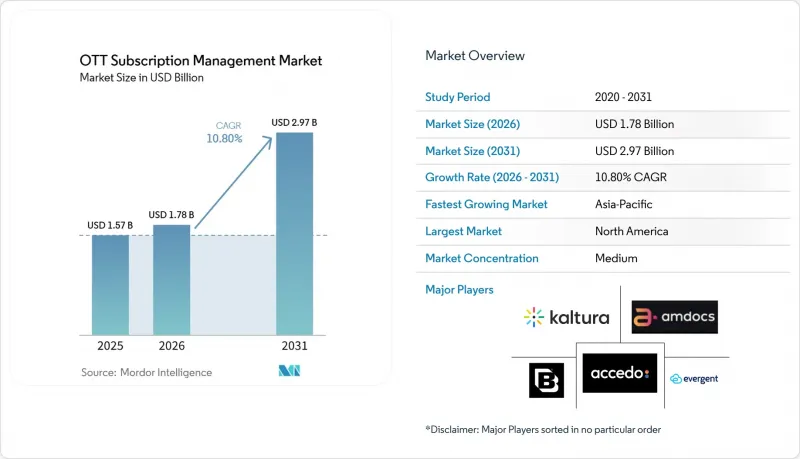
本報告按收費模式(固定費率、定期訂閱、按使用量計費、混合模式和一次性/附加元件)、應用領域(影片、直播、音訊、互動和活動串流)、最終用戶(純OTT/DTC用戶、廣播公司/工作室、電信業者/付費電視/網路服務供應商以及音訊/數位媒體)和地區(北美等)進行細分。市場預測以美元計價。
全球OTT訂閱管理市場趨勢與洞察
直接面對消費者(DTC)串流服務的擴展
直接面對消費者 (DTC) 的串流媒體服務擴張仍然是訂閱生命週期工具需求的最大來源。這是因為每項新服務都需要開設帳戶、收取費用並維護跨多個管道的觀看權限。預計到 2025 年底,Netflix 的付費用戶將超過 3.25 億,年收入將達到 452 億美元,這充分展現了其龐大的用戶系統規模,而該系統必須支援各種套餐類型和地區的用戶。隨著 FIFA 世界盃的興起,Fox One 的新服務需求激增,在 2026 年 6 月新增了約 300 萬用戶,這用戶管理能力提出了嚴峻考驗。如此激增的需求要求快速建立帳戶、授權付款、啟動觀看權限以及與客戶溝通,同時也要避免影響現有用戶。 OTT 訂閱管理市場也受到以下預期的影響:新服務需要支援區域定價、應用程式商店匹配、收款以及從上線之初就提供清晰的取消流程。即使是小規模平台,隨著基本客群的擴大、促銷宣傳活動的加強以及存取權限規則的多樣化,也可能面臨功能上的限制。
引入混合訂閱和廣告變現模式
混合服務需要一個系統來管理同一客戶記錄中的付費存取和廣告支援觀看資格。廣告支援套餐已成為主流串流平台的重要入門選項,改變了套餐選擇、促銷資格和用戶訪問的規則。管理平台必須同時確定套餐價格、廣告狀態、優惠條款、觀看權限和續訂條件,並在行動裝置、智慧電視、網路應用程式和其他交付終端上一致地應用這些規則。 OTT訂閱管理市場受益於經營商業統一的客戶記錄取代單獨的收費和廣告工作流程,這些統一的用戶記錄無需人工核對即可更新。維護僅針對付費影片訂閱設計的系統的供應商可能會發現,難以服務正在轉向混合盈利模式和更頻繁價格變動的營運商。
傳統收費和進入許可權管理系統的遷移風險
對於串流媒體運營商而言,替換舊式收費系統可能是最具挑戰性的營運變革之一,因為他們必須在過渡期間保持收費資料、支付記錄和存取權限的準確性。這個過程可能涉及多個地區、舊合約條款、付款閘道、過往促銷活動以及跨眾多裝置的存取規則。 Accedo 指出,收費連續性、播放權限錯誤和支付轉移是 OTT 平台遷移的關鍵風險。擁有過時系統的營運商最需要現代化的基礎設施,但他們在系統變更期間面臨的風險也最大,尤其是在營運多個應用程式和分發合作夥伴的情況下。這可能導致採購決策延遲,並導致他們繼續依賴舊供應商,即使現有系統不再適用於新的服務模式。在 OTT 訂閱管理市場,支援並行營運、分階段遷移、安全遷移用戶資料以及在全面遷移前進行清晰測試流程的供應商將更具優勢。
細分市場分析
預計到2025年,定期訂閱收費將佔總收入的40.18%,反映出主流串流媒體服務商持續採用月度訂閱模式。在OTT訂閱管理市場,這種模式為服務提供者提供可預測的現金流,並為用戶提供熟悉的續訂流程。它還支援既定的收款、使用者流失追蹤和客戶維繫流程。訂閱收費尤其適合擁有龐大內容庫和穩定用戶觀看習慣的營運商。固定費率收費在銷售年度訪問合約的教育和企業媒體服務中仍然發揮著重要作用。
在OTT訂閱管理市場,基於使用量的收費預計將在2026年至2031年間以11.37%的複合年成長率成長。這種收費模式支援單場體育賽事的按次付費觀看、企業應用程式介面(API)的使用,以及不適合納入綜合訂閱的劇集內容。混合收費模式將核心訂閱計劃與基於使用量的購買相結合,這對於那些在行動套餐中包含基本串流媒體存取權限,同時單獨銷售高級體育通行證的營運商來說非常有用。收費計費和附加元件收費禮品訂閱、存取碼和應用程式內升級。在2026年的WWDC大會上,蘋果公司討論了iOS 26.5中將推出的包含12個月合約選項的月度訂閱模式,這要求平台提供者調整其定價和使用權規則以適應這種結構。
區域分析
2025年,北美地區佔據了OTT訂閱管理市場42.11%的佔有率。該地區擁有眾多成熟的串流媒體服務,這些服務管理著多種費率方案、應用商店管道和促銷活動,因此對進入許可權管理和收費控制提出了很高的營運要求。廣告支援型訂閱計畫的日益普及,也使得將廣告合格與支付和存取記錄關聯起來的需求更加迫切。谷歌於2026年6月調整了政策,將自動續訂訂閱的基本服務費降低至10%,並允許在美國使用外部支付管道。
歐洲是OTT訂閱管理市場第二大地區,同時也面臨最活躍的法規環境。關於終止權、數位報告要求以及人工智慧相關規則的裁決,要求供應商必須具備強大的合規能力。儘管德國、英國和法國擁有大量的訂閱契約,但南歐和東歐的變現系統仍處於起步階段。在巴西,與競爭監管機構CADE達成和解後,iOS支付通道於2026年6月18日正式開幕。這項變更為南美洲的外部支付和本地支付連接開闢了新的途徑。
預計亞太地區在2026年至2031年間將以11.34%的複合年成長率成長,成為成長最快的地區。尤其是在印度,行動優先和價格敏感型用戶群不斷成長,這增加了對擴充性套餐和支付管理的需求。日本的訂閱視訊點播(SVOD)市場預計在2025年成長14.3%,達到6,017億日圓(約39.6億美元)。這推動了對自動套餐遷移和價格調整的需求。在東南亞,串流媒體用戶數量的成長提升了本地支付方式和便利註冊流程的重要性。此外,中國網路電視收費要求使得技術合規性成為服務供應商必須考慮的關鍵因素。中東和非洲仍處於發展初期,這些地區的市場滲透率將取決於當地的支付方式和數位服務稅收框架。
其他好處:
- Excel格式的市場預測(ME)表
- 3個月的分析師支持
目錄
第1章:引言
- 研究假設和市場定義
- 調查範圍
第2章:調查方法
第3章執行摘要
第4章 市場狀況
- 市場概覽
- 市場促進因素
- 擴大直接面向發送服務
- 引入混合訂閱模式和廣告獲利模式。
- 雲端原生擴充和多設備支援要求
- 人工智慧驅動的客戶流失預測與收入最佳化
- App Store 與本地支付的互通性是提高轉換率的手段
- 即時直播與活動串流媒體的使用權管理
- 市場限制因素
- 從舊的收費和存取控制系統遷移所帶來的風險
- 資料隱私、數位課稅和跨境合規的複雜性。
- 主要內容擁有者的垂直整合
- 訂閱疲勞、達到 ARPU 目標的壓力以及短暫的溝通方式而導致的注意力分散。
- 產業價值鏈分析
- 監理情勢
- 宏觀經濟因素對市場的影響
- 技術展望
- 波特五力分析
第5章 市場規模與成長預測
- 按收費模式
- 收費
- 定期訂閱式收費
- 按使用收費
- 混合收費
- 一次性收費和附加元件收費
- 透過使用
- 影片串流
- 直播
- 音訊串流
- 互動和活動直播
- 最終用戶
- PurePlay OTT 和直接面對消費者的串流媒體平台
- 廣播公司、媒體網路、製作公司、內容擁有者
- 電信業者、付費電視業者、網路服務供應商
- 音訊和其他數位媒體串流提供商
- 按地區
- 北美洲
- 美國
- 加拿大
- 墨西哥
- 南美洲
- 巴西
- 阿根廷
- 其他南美國家
- 歐洲
- 德國
- 英國
- 法國
- 義大利
- 西班牙
- 俄羅斯
- 其他歐洲國家
- 亞太地區
- 中國
- 日本
- 印度
- 韓國
- 澳洲
- 東南亞
- 其他亞太國家
- 中東
- 沙烏地阿拉伯
- 阿拉伯聯合大公國
- 土耳其
- 其他中東國家
- 非洲
- 南非
- 奈及利亞
- 其他非洲國家
- 北美洲
第6章 競爭情勢
- 市場集中度
- 策略趨勢
- Market Positioning Analysis
- 公司簡介
- Amdocs Limited
- Accedo Broadband AB
- Aria Systems, Inc.
- Evergent Technologies
- Brightcove Inc.
- Chargebee Inc.
- Cleeng BV
- CRM.COM Software Ltd.
- Dacast US, Inc.
- Deltatre SpA
- Endeavor Streaming, Inc.
- InPlayer Ltd.
- Kaltura, Inc.
- Muvi Technology Pvt. Ltd.
- Quickplay Media Inc.
- Recurly, Inc.
- Synamedia Limited
- Uscreen, Inc.
- Vimeo, Inc.
- Zuora, Inc.
第7章 市場機會與未來展望
According to Mordor Intelligence, the OTT subscription management market size is projected to expand from USD 1.57 billion in 2025 and USD 1.78 billion in 2026 to USD 2.97 billion by 2031, registering a CAGR of 10.80% between 2026 to 2031.
This report is Segmented by Billing Model (Flat-Rate, Recurring Subscription, Usage-Based, Hybrid, and One-Time and Add-On), Application (Video, Live, Audio, and Interactive and Event Streaming), End User (Pure-Play OTT/DTC, Broadcasters/Studios, Telecom/Pay-TV/ISPs, and Audio and Digital Media), and Geography (North America, and More). The Market Forecasts are Provided in Terms of Value (USD).
Global OTT Subscription Management Market Trends and Insights
Expansion of Direct-to-Consumer Streaming Services
Direct-to-consumer streaming expansion remains the largest source of demand for subscription lifecycle tools because every new service must establish accounts, collect payments, and maintain viewing rights across several channels. Netflix ended 2025 with more than 325 million paid memberships and USD 45.2 billion in annual revenue, demonstrating the scale that subscriber systems must support across plan types and territories. Fox One added nearly 3 million subscribers during June 2026 as FIFA World Cup viewing increased demand for its new service and tested the readiness of its subscriber operations. Such surges require rapid account creation, payment authorization, rights activation, and customer communication without disrupting existing subscribers. The OTT subscription management market is also shaped by the expectation that new services will support local pricing, app-store reconciliation, payment recovery, and clear cancellation processes from launch. Smaller platforms can reach a capability limit as their customer base grows, their promotional campaigns broaden, and their entitlement rules become more varied.
Adoption of Hybrid Subscription and Advertising Monetization
Hybrid services require systems to manage paid access and advertising eligibility within the same customer record. Ad-supported tiers have become an important entry option for large streaming platforms, changing the rules that govern plan selection, promotional eligibility, and subscriber access. A management platform must determine the plan price, ad status, offer terms, viewing rights, and renewal conditions at the same time. It must then apply those rules consistently on mobile devices, connected televisions, web applications, and other distribution endpoints. The OTT subscription management market benefits when operators replace separate billing and advertising workflows with unified subscriber records that can be updated without manual reconciliation. Providers that retain systems designed only for paid video subscriptions may find it difficult to serve operators moving toward mixed monetization models and more frequent price changes.
Legacy Billing and Entitlement Migration Risk
Replacing a legacy billing system can be one of the most difficult operational changes for a streaming operator because billing data, payment records, and access rights must remain accurate during the transition. The process can involve several territories, older contract terms, payment gateways, historical promotions, and access rules across many devices. Accedo identifies billing continuity, playback entitlement errors, and payment handoffs as central risks in an OTT platform migration. Operators with outdated systems may need modern infrastructure most, but they can also face the greatest risk when changing it, especially when they operate several applications or distribution partners. This delays purchasing decisions and can preserve dependence on established providers even when the existing system no longer fits new service models. The OTT subscription management market gives an advantage to vendors that support parallel operations, staged migrations, reliable transfers of subscriber data, and clear testing processes before a full changeover.
Other drivers and restraints analyzed in the detailed report include:
- Cloud-Native Scaling and Multi-Device Delivery Requirements
- AI-Driven Churn Prediction and Revenue Optimization
- Data Privacy, Digital Tax, and Cross-Border Compliance Complexity
For complete list of drivers and restraints, kindly check the Table Of Contents.
Segment Analysis
Recurring subscription billing held 40.18% of revenue in 2025, reflecting the continued use of monthly access fees by major streaming services. In the OTT subscription management market, this model gives providers predictable cash flow and a familiar renewal process for subscribers. It also supports established workflows for payment recovery, cancellation tracking, and customer retention. Recurring billing is especially suitable for operators with broad content libraries and steady viewing patterns. Flat-rate billing remains relevant for educational and enterprise media services that sell annual access arrangements.
Usage-based billing is projected to grow at an 11.37% CAGR from 2026 to 2031 within the OTT subscription management market. It supports pay-per-event sports, enterprise application programming interface consumption, and episodic content that does not fit an all-inclusive subscription. Hybrid billing combines a core recurring plan with usage-based purchases, which is useful when telecom providers include base streaming access in mobile plans but sell premium sports passes separately. One-time and add-on billing supports gift subscriptions, access codes, and in-application upgrades. Apple described monthly subscriptions with 12-month commitment options for iOS 26.5 at WWDC 2026, creating a structure that platforms must accommodate in their pricing and entitlement rules.
Complete Report Scope:
- By Billing Model
- Flat-Rate Billing
- Recurring Subscription Billing
- Usage-Based Billing
- Hybrid Billing
- One-Time and Add-On Billing
- By Application
- Video Streaming
- Live Streaming
- Audio Streaming
- Interactive and Event Streaming
- By End User
- Pure-Play OTT and Direct-to-Consumer Streaming Platforms
- Broadcasters, Media Networks, Studios, and Content Owners
- Telecom, Pay-TV, and Internet Service Providers
- Audio and Other Digital Media Streaming Providers
- By Geography
- North America
- United States
- Canada
- Mexico
- South America
- Brazil
- Argentina
- Rest of South America
- Europe
- Germany
- United Kingdom
- France
- Italy
- Spain
- Russia
- Rest of Europe
- Asia-Pacific
- China
- Japan
- India
- South Korea
- Australia
- Southeast Asia
- Rest of Asia-Pacific
- Middle East
- Saudi Arabia
- United Arab Emirates
- Turkey
- Rest of Middle East
- Africa
- South Africa
- Nigeria
- Rest of Africa
- North America
Geography Analysis
North America accounted for 42.11% of the OTT subscription management market size in 2025. The region has a large number of established streaming services that manage several tiers, app-store channels, and promotional offers, creating substantial operational requirements for entitlement management and billing controls. Ad-supported plan adoption has increased the need to connect advertising eligibility with payment and access records. Google's June 2026 policy changes reduced the base service fee for auto-renewing subscriptions to 10% and allowed external payment routing in the United States.
Europe is the second-largest regional setting for the OTT subscription management market and faces the most active regulatory environment. The withdrawal-rights ruling, digital reporting requirements, and AI-related rules require vendors to maintain strong compliance functions. Germany, the United Kingdom, and France have high subscription volumes, while Southern and Eastern Europe have earlier-stage monetization systems. Brazil opened iOS payment pathways on June 18, 2026, following a settlement with its competition regulator CADE. The change created a new route for external checkout and local payment connections in South America.
Asia-Pacific is projected to grow at an 11.34% CAGR from 2026 to 2031 and is the fastest-growing geography, with India's mobile-first and price-sensitive customer base increasing the need for scalable plan and payment management. Japan's subscription video-on-demand market grew 14.3% in 2025 to JPY 601.7 billion (USD 3.96 billion), which supports demand for tier migration and pricing-change automation. Southeast Asia's growing streaming accounts increase the importance of local payment methods and low-friction onboarding. China's internet television billing requirements also make technical compliance a relevant consideration for service providers. Middle East and Africa remain earlier-stage areas, where adoption depends on local payments and digital-service tax frameworks.
- Amdocs Limited
- Accedo Broadband AB
- Aria Systems, Inc.
- Evergent Technologies
- Brightcove Inc.
- Chargebee Inc.
- Cleeng B.V.
- CRM.COM Software Ltd.
- Dacast US, Inc.
- Deltatre S.p.A.
- Endeavor Streaming, Inc.
- InPlayer Ltd.
- Kaltura, Inc.
- Muvi Technology Pvt. Ltd.
- Quickplay Media Inc.
- Recurly, Inc.
- Synamedia Limited
- Uscreen, Inc.
- Vimeo, Inc.
- Zuora, Inc.
Additional Benefits:
- The market estimate (ME) sheet in Excel format
- 3 months of analyst support
TABLE OF CONTENTS
1 INTRODUCTION
- 1.1 Study Assumptions and Market Definition
- 1.2 Scope of the Study
2 RESEARCH METHODOLOGY
3 EXECUTIVE SUMMARY
4 MARKET LANDSCAPE
- 4.1 Market Overview
- 4.2 Market Drivers
- 4.2.1 Expansion of Direct-to-Consumer Streaming Services
- 4.2.2 Adoption of Hybrid Subscription and Advertising Monetization
- 4.2.3 Cloud-Native Scaling and Multi-Device Delivery Requirements
- 4.2.4 AI-Driven Churn Prediction and Revenue Optimization
- 4.2.5 App-Store and Local Payment Interoperability as a Conversion Lever
- 4.2.6 Real-Time Entitlement Orchestration for Live and Event Streaming
- 4.3 Market Restraints
- 4.3.1 Legacy Billing and Entitlement Migration Risk
- 4.3.2 Data Privacy, Digital Tax, and Cross-Border Compliance Complexity
- 4.3.3 Vertical Integration by Large Content Owners
- 4.3.4 Subscription Fatigue, ARPU Pressure, and Short-Form Attention Fragmentation
- 4.4 Industry Value Chain Analysis
- 4.5 Regulatory Landscape
- 4.6 Impact of Macroeconomic Factors on the Market
- 4.7 Technological Outlook
- 4.8 Porter's Five Forces Analysis
- 4.8.1 Threat of New Entrants
- 4.8.2 Bargaining Power of Suppliers
- 4.8.3 Bargaining Power of Buyers
- 4.8.4 Threat of Substitutes
- 4.8.5 Intensity of Competitive Rivalry
5 MARKET SIZE AND GROWTH FORECASTS (VALUE)
- 5.1 By Billing Model
- 5.1.1 Flat-Rate Billing
- 5.1.2 Recurring Subscription Billing
- 5.1.3 Usage-Based Billing
- 5.1.4 Hybrid Billing
- 5.1.5 One-Time and Add-On Billing
- 5.2 By Application
- 5.2.1 Video Streaming
- 5.2.2 Live Streaming
- 5.2.3 Audio Streaming
- 5.2.4 Interactive and Event Streaming
- 5.3 By End User
- 5.3.1 Pure-Play OTT and Direct-to-Consumer Streaming Platforms
- 5.3.2 Broadcasters, Media Networks, Studios, and Content Owners
- 5.3.3 Telecom, Pay-TV, and Internet Service Providers
- 5.3.4 Audio and Other Digital Media Streaming Providers
- 5.4 By Geography
- 5.4.1 North America
- 5.4.1.1 United States
- 5.4.1.2 Canada
- 5.4.1.3 Mexico
- 5.4.2 South America
- 5.4.2.1 Brazil
- 5.4.2.2 Argentina
- 5.4.2.3 Rest of South America
- 5.4.3 Europe
- 5.4.3.1 Germany
- 5.4.3.2 United Kingdom
- 5.4.3.3 France
- 5.4.3.4 Italy
- 5.4.3.5 Spain
- 5.4.3.6 Russia
- 5.4.3.7 Rest of Europe
- 5.4.4 Asia-Pacific
- 5.4.4.1 China
- 5.4.4.2 Japan
- 5.4.4.3 India
- 5.4.4.4 South Korea
- 5.4.4.5 Australia
- 5.4.4.6 Southeast Asia
- 5.4.4.7 Rest of Asia-Pacific
- 5.4.5 Middle East
- 5.4.5.1 Saudi Arabia
- 5.4.5.2 United Arab Emirates
- 5.4.5.3 Turkey
- 5.4.5.4 Rest of Middle East
- 5.4.6 Africa
- 5.4.6.1 South Africa
- 5.4.6.2 Nigeria
- 5.4.6.3 Rest of Africa
- 5.4.1 North America
6 COMPETITIVE LANDSCAPE
- 6.1 Market Concentration
- 6.2 Strategic Moves
- 6.3 Market Positioning Analysis
- 6.4 Company Profiles (includes Global Level Overview, Market Level Overview, Core Segments, Financials as available, Strategic Information, Market Rank/Share, Products and Services, Recent Developments)
- 6.4.1 Amdocs Limited
- 6.4.2 Accedo Broadband AB
- 6.4.3 Aria Systems, Inc.
- 6.4.4 Evergent Technologies
- 6.4.5 Brightcove Inc.
- 6.4.6 Chargebee Inc.
- 6.4.7 Cleeng B.V.
- 6.4.8 CRM.COM Software Ltd.
- 6.4.9 Dacast US, Inc.
- 6.4.10 Deltatre S.p.A.
- 6.4.11 Endeavor Streaming, Inc.
- 6.4.12 InPlayer Ltd.
- 6.4.13 Kaltura, Inc.
- 6.4.14 Muvi Technology Pvt. Ltd.
- 6.4.15 Quickplay Media Inc.
- 6.4.16 Recurly, Inc.
- 6.4.17 Synamedia Limited
- 6.4.18 Uscreen, Inc.
- 6.4.19 Vimeo, Inc.
- 6.4.20 Zuora, Inc.
7 MARKET OPPORTUNITIES AND FUTURE OUTLOOK
- 7.1 White-Space and Unmet-Need Assessment

 2026年全球定價軟體市場報告2026年全球零售定價軟體市場報告
 全球公用事業收費帳單管理系統市場規模、佔有率、趨勢和成長分析報告(2026-2034年)
 公用事業收費計費管理系統市場 - 全球產業規模、佔有率、趨勢、機會及預測(按組件、最終用戶、應用、地區和競爭格局分類),2021-2031年
 全球出貨單和帳單驗證機器人市場:預測至 2032 年 - 按組件、部署方法、驗證類型、應用程式、最終用戶和地區進行分析
 收益確認軟體市場按應用、收益確認類型、部署類型、組織規模和最終用戶行業分類 - 全球預測 2025-2030
 全球公用事業收費管理系統市場全球定價軟體市場計費和收益管理 (BRM) 軟體市場 - 按類型、垂直、地區和預測的全球市場規模
 2031 年亞太定價軟體市場預測 - 區域分析 - 按類型、企業規模和垂直產業