


 |
市場調查報告書
商品編碼
2119095
行銷採購服務:市場佔有率分析、產業趨勢與統計、成長預測(2026-2031)Marketing Procurement Services Market - Market Share Analysis, Industry Trends & Statistics, Growth Forecasts (2026 - 2031) |
||||||

※ 本網頁內容可能與最新版本有所差異。詳細情況請與我們聯繫。
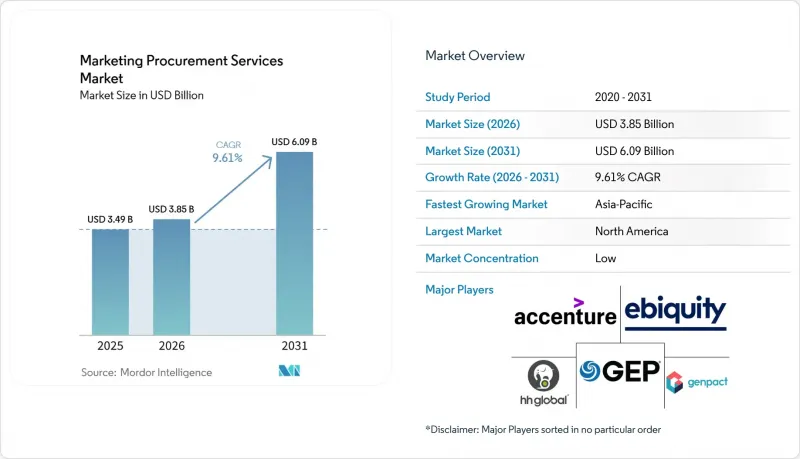
根據 Mordor Intelligence 預測,行銷採購服務市場規模將從 2025 年的 34.9 億美元成長到 2026 年的 38.5 億美元,到 2031 年將進一步成長到 60.9 億美元,2026 年至 2031 年的年複合成長率(CAGR)為 9.61%。
本報告按服務類型(策略採購、供應商管理、合約管理等)、行銷支出類別(廣告採購等)、公司規模(大型企業、中小企業)、終端用戶產業(零售/電子商務、消費品等)和地區進行細分。市場預測以美元計價。
全球行銷採購服務市場趨勢與洞察
對可衡量的行銷投資報酬率和支出最佳化的需求日益成長。
預算壓力促使企業更嚴格地檢視其行銷支出。對於那些需要在不影響宣傳活動執行的前提下削減成本的企業而言,行銷採購服務市場是一項寶貴的資源。因此,採購團隊除了考慮價格和供應商條件外,還需要考慮廣告支出回報率 (ROAS) 和行銷效率等指標。這使得採購部門的角色從單純的單價談判轉變為制定影響行銷績效的決策。能夠解讀媒體數據並將其用於商業性決策的團隊的價值也在不斷提升。行銷採購服務市場仍有進一步成長的空間,尤其是在如何透過這些措施改善財務管理和預算分配決策方面。
拓展多通路數位廣告宣傳
數位廣告催生了更廣泛的供應商群體,涵蓋程式化媒體、連網電視、零售媒體、社群電商和內容創作平台。這使得單一的商業模式難以應用於所有類型的宣傳活動。預計到2026年,德國線上廣告市場規模將達到356億歐元(388億美元),超過傳統媒體275億歐元(316.9億美元)的投資額。行銷團隊通常掌握通路績效,而採購團隊則精通合約和供應商管理。隨著企業尋求能夠將這兩種觀點整合到單一管治流程中的顧問,行銷採購服務市場正在不斷擴大。這些需求正在推動諮詢和轉型工作,企業正在重塑採購慣例,以適應更廣泛的數位媒體組合。
行銷團隊和採購專員之間存在著強烈的阻力和文化摩擦。
最持久的限制往往是組織層面的,而非財務層面的。 2026年4月,APS集團報告稱,84%的行銷團隊面臨協作挑戰,影響了執行的速度和清晰度。行銷團隊可能將採購部門的參與視為快速決策和與代理商建立信任的障礙。同時,當創新交付成果難以比較時,採購團隊可能難以證明其價值僅限於成本節約。 Setup在2025年的一項調查顯示,牢固的客戶-代理商關係取決於雙方對績效的通用預期和商業性透明度。如果企業不賦予行銷部門和採購部門在規劃和供應商管治同等重要的角色,行銷採購服務市場的成長可能會放緩。
細分市場分析
到2025年,策略採購將佔據行銷採購服務市場30.12%的佔有率。這通常是企業為管治行銷支出而設立的首個正式職能部門。企業利用策略採購來整合代理商名錄、規範提案流程(RFP)並對供應商進行分類。這些活動為更有效地管理薪酬、合約條款和績效預期奠定了基礎。由於全球廣告商需要一種統一的方式來管理與市場上各代理商的關係,因此策略採購仍然至關重要。此外,它還能讓採購團隊更清楚地了解行銷資金的流向。
預計2026年至2031年,採購諮詢和轉型市場將以10.67%的複合年成長率成長。這項需求反映了人工智慧、績效薪酬、數據所有權和行銷技術授權等方面的轉變。企業不僅需要協助進行合約談判,還需要重新設計其採購營運模式。隨著代理商生態系統從單一大型機構擴展到包含專業合作夥伴的體系,供應商管理的重要性日益凸顯。合約管理、支出分析和數據分析也在不斷發展,相關工具能夠識別代理機構薪酬報表中的條款和缺陷。行銷採購服務市場包括平台服務,這些服務為沒有專門採購團隊的公司提供管理式採購入口網站、自動化工作流程工具和專家諮詢服務。
區域分析
到2025年,北美將佔據區域行銷採購服務市場37.18%的佔有率。該地區受益於美國集中了大量的全球廣告商、廣告代理商控股公司和採購技術提供者。美國廣告主協會(ANA)、美國廣告代理商協會(4As)和互動廣告局(IAB)於2026年成立了人工智慧領導委員會,旨在製定零售媒體、效果衡量和人才方面的通用方法。這標誌著人工智慧驅動的行銷採購方式將更加系統化。該地區深厚的廣告生態系統為商業性監測服務創造了龐大的目標基本客群。加拿大和墨西哥正在將成熟的北美採購慣例推廣到區域營運。
歐洲擁有獨特的優勢,其監管環境和媒體審計經驗在廣告公司的管治中發揮越來越重要的作用。預計到2026年,德國的網路廣告市場規模將達到356億歐元(388億美元),超過傳統媒體275億歐元(316.5億美元)的投資額。根據德國資訊科技協會(Bitkom)2026年2月的調查,在受調查的180家德國公司中,84%的公司認為人工智慧是到2027年最具影響力的行銷趨勢。歐盟的人工智慧法律、數位服務法律以及《一般資料保護規範》(GDPR)正在加強有關人工智慧資訊揭露、資料安全和消費者保護的合約要求。這推動了英國、法國和比荷盧經濟聯盟地區對專家諮詢服務的需求成長。
預計2026年至2031年,亞太地區的複合年成長率將達到11.21%。數位廣告和零售媒體在全部區域蓬勃發展。這種情況促使企業建立正式的數位行銷支出管治機制。中國的數據本地化法規為商業性採購決策帶來了合規性方面的挑戰。在南美,主要日常消費品(FMCG)和零售廣告商的早期採用正在推動市場擴張。在中東和非洲地區,阿拉伯聯合大公國和沙烏地阿拉伯發揮主導作用。
其他好處:
- Excel格式的市場預測(ME)表
- 3個月的分析師支持
目錄
第1章:引言
- 研究假設和市場定義
- 調查範圍
第2章:調查方法
第3章執行摘要
第4章 市場狀況
- 市場概覽
- 市場促進因素
- 拓展多通路數位廣告宣傳
- 對可衡量的行銷投資報酬率和最佳化支出的需求日益成長。
- 程序化和即時競價採購技術的快速普及。
- 企業在環境、社會及公司治理(ESG)和永續採購方面的要求日益嚴格。
- 引入「代理關係資本」作為募款指標。
- 生成式人工智慧的興起使得合約評估和收費系統。
- 市場限制因素
- 行銷團隊和採購負責人。
- 缺乏評估無形創新成果的標準化指標
- 不透明的程序化媒體採購網路中存在嚴重的資料不對稱和隱藏的加價成本。
- 採購惰性問題源自於多年期的傳統「備案機構」註冊協議。
- 宏觀經濟因素對市場的影響
- 產業價值鏈分析
- 科技趨勢
- 監理情勢
- 波特五力分析
第5章 市場規模與成長預測
- 按服務類型
- 策略採購
- 供應商管理
- 合約管理
- 支出分析
- 採購諮詢與轉型
- 其他服務類型
- 按類別分類的行銷支出
- 廣告採購
- 媒體採購
- 數位行銷採購
- 市場研究採購
- 活動採購
- 其他行銷支出類別
- 按公司規模
- 大公司
- 小型企業
- 按最終用戶行業分類
- 零售與電子商務
- 媒體與娛樂
- 醫療保健和生命科學
- 旅遊與飯店
- 消費品
- 其他終端用戶產業(銀行、金融服務與保險、教育、汽車、IT/電信等)
- 按地區
- 北美洲
- 美國
- 加拿大
- 墨西哥
- 南美洲
- 巴西
- 阿根廷
- 智利
- 其他南美國家
- 歐洲
- 德國
- 英國
- 法國
- 義大利
- 西班牙
- 其他歐洲國家
- 亞太地區
- 中國
- 日本
- 印度
- 韓國
- 澳洲
- 其他亞太國家
- 中東
- 阿拉伯聯合大公國
- 沙烏地阿拉伯
- 卡達
- 其他中東國家
- 非洲
- 南非
- 埃及
- 奈及利亞
- 其他非洲國家
- 北美洲
第6章 競爭情勢
- 市場集中度
- 策略趨勢
- 市佔率分析
- 公司簡介
- HH Global Group Limited
- Accenture plc
- WPP plc
- Publicis Groupe SA
- Omnicom Group Inc.
- The Interpublic Group of Companies, Inc.
- Dentsu Group Inc.
- Genpact Limited
- Infosys BPM Limited
- WNS(Holdings)Limited
- Capgemini SE
- Cognizant Technology Solutions Corporation
- GEP Worldwide, LLC
- Corcentric, Inc.
- Ebiquity plc
- MediaSense Limited
- ID Comms Group Limited
- Flock Associates Limited
- TrinityP3 Pty Ltd
- Agency Mania Solutions, LLC
- RightSpend Limited
- SpotSource, Inc.
第7章 市場機會與未來展望
According to Mordor Intelligence, the marketing procurement services market size is projected to expand from USD 3.49 billion in 2025 to USD 3.85 billion in 2026, and to USD 6.09 billion by 2031, registering a CAGR of 9.61% between 2026 and 2031.
This report is Segmented by Service Type (Strategic Sourcing, Supplier Management, Contract Management, and More), Marketing Spend Category (Advertising Procurement, and More), Enterprise Size (Large Enterprises, and Small and Medium Enterprises), End User Industry (Retail and E-Commerce, Consumer Goods, and More), and Geography. The Market Forecasts are Provided in Terms of Value (USD).
Global Marketing Procurement Services Market Trends and Insights
Growing Need for Measurable Marketing ROI and Spend Optimization
Budget pressure is encouraging companies to review marketing spend with greater discipline. The marketing procurement services market benefits when organizations need savings without weakening campaign delivery. Procurement teams are therefore being asked to consider measures such as return on ad spend and marketing efficiency alongside price and supplier terms. This changes the role of procurement from rate negotiation toward decisions that affect marketing performance. It also increases the value of teams that can interpret media data and apply it to commercial decisions. The Marketing Procurement Services Market has room to expand, particularly as this work improves both financial oversight and allocation decisions.
Expansion of Multi-Channel Digital Advertising Campaigns
Digital advertising has created a broader supplier base across programmatic media, connected television, retail media, social commerce, and creator platforms. This makes it harder to use one commercial model across all campaign types. Germany's online advertising volume reached EUR 35.6 billion (USD 38.8 billion) in 2026, exceeding EUR 27.5 billion (USD 31.69 billion) in traditional media investment. Marketing teams often understand channel performance, while procurement teams bring contract and supplier expertise. The marketing procurement services market grows as organizations seek advisers who can apply both perspectives to a single governance process. This need supports consulting and transformation work as companies update their sourcing practices to accommodate a broader digital media mix.
Heavy Resistance and Cultural Friction Between Marketing Teams and Sourcing Professionals
The most persistent constraint is often organizational rather than financial. In April 2026, the APS Group reported that 84% of marketing teams faced collaboration challenges that affected execution speed and clarity. Marketing teams can view procurement involvement as a barrier to quick decisions and trusted agency relationships. Procurement teams may struggle to show value beyond savings when creative work is difficult to compare. A 2025 survey from Setup found that strong client-agency relationships depend on shared performance expectations and commercial transparency. The marketing procurement services market may grow more slowly when organizations do not give marketing and procurement equal roles in planning and supplier governance.
Other drivers and restraints analyzed in the detailed report include:
- Rapid Proliferation of Programmatic and Real-Time Bidding Sourcing Technologies
- Rise of Generative AI Contract Valuation and Fee Structure Auditing
- Severe Data Asymmetry and Hidden Markup Costs in Opaque Programmatic Media Sourcing Networks
For complete list of drivers and restraints, kindly check the Table Of Contents.
Segment Analysis
Strategic Sourcing held 30.12% of the Marketing Procurement Services Market share in 2025. It is commonly the first formal capability that organizations establish for marketing spend governance. Companies use it to consolidate agency rosters, standardize request-for-proposal processes, and classify suppliers. These activities create a base for stronger control over fees, terms, and delivery expectations. The category remains important because global advertisers need a consistent way to manage agency relationships across markets. It also gives procurement teams a clearer view of where marketing funds are being committed.
Procurement Consulting and Transformation is projected to grow at a 10.67% CAGR from 2026 to 2031. Demand reflects changes in artificial intelligence, outcome-based compensation, data ownership, and marketing technology licensing. Organizations increasingly need support to redesign their procurement operating models rather than simply negotiate contracts. Supplier Management is gaining attention as agency ecosystems expand beyond a single agency of record to include specialized partners. Contract Management, Spend Analysis, and Analytics are also advancing through tools that identify clauses and irregularities in agency fee statements. The Marketing Procurement Services Market includes platform-based services that offer managed sourcing portals, automated workflow tools, and focused advisory for companies without dedicated procurement teams.
Complete Report Scope:
- By Service Type
- Strategic Sourcing
- Supplier Management
- Contract Management
- Spend Analysis and Analytics
- Procurement Consulting and Transformation
- Other Service Types
- By Marketing Spend Category
- Advertising Procurement
- Media Procurement
- Digital Marketing Procurement
- Market Research Procurement
- Events Procurement
- Other Marketing Spend Categories
- By Enterprise Size
- Large Enterprises
- Small and Medium Enterprises
- By End User Industry
- Retail and E-commerce
- Media and Entertainment
- Healthcare and Life Sciences
- Travel and Hospitality
- Consumer Goods
- Other End User Industries (BFSI, Education, Automotive, and IT and Telecom amongst Others)
- By Geography
- North America
- United States
- Canada
- Mexico
- South America
- Brazil
- Argentina
- Chile
- Rest of South America
- Europe
- Germany
- United Kingdom
- France
- Italy
- Spain
- Rest of Europe
- Asia-Pacific
- China
- Japan
- India
- South Korea
- Australia
- Rest of Asia-Pacific
- Middle East
- United Arab Emirates
- Saudi Arabia
- Qatar
- Rest of Middle East
- Africa
- South Africa
- Egypt
- Nigeria
- Rest of Africa
- North America
Geography Analysis
North America held 37.18% of the regional Marketing Procurement Services Market in 2025. The region benefits from a large concentration of global advertisers, agency holding companies, and procurement technology providers in the United States. The ANA, 4As, and IAB formed an AI Leadership Council in 2026 to develop shared approaches for retail media, measurement, and talent. This signals a more organized approach to AI-enabled marketing sourcing. The depth of the region's advertising ecosystem creates a large addressable base for commercial oversight services. Canada and Mexico are extending established North American procurement practices into regional operations.
Europe has a distinct landscape because regulatory and media-auditing experience play a larger role in agency governance. Germany's online advertising volume reached EUR 35.6 billion (USD 38.8 billion) in 2026, exceeding EUR 27.5 billion (USD 31.65 billion) in traditional media investment. A February 2026 Bitkom study found that 84% of 180 German companies identified AI as the most influential marketing trend through 2027. The EU AI Act, Digital Services Act, and GDPR increase the contractual requirements around AI disclosure, data security, and consumer protection. This supports demand for specialist advisory services in the United Kingdom, France, and the Benelux region.
Asia-Pacific is projected to grow at an 11.21% CAGR from 2026 to 2031. Digital advertising and retail media are expanding across the region. These conditions encourage organizations to establish formal governance for digital marketing spending. China's data localization rules add a compliance issue to commercial sourcing decisions. South America is expanding through early adoption by large FMCG and retail advertisers. The UAE and Saudi Arabia lead the Middle East and Africa.
- HH Global Group Limited
- Accenture plc
- WPP plc
- Publicis Groupe S.A.
- Omnicom Group Inc.
- The Interpublic Group of Companies, Inc.
- Dentsu Group Inc.
- Genpact Limited
- Infosys BPM Limited
- WNS (Holdings) Limited
- Capgemini SE
- Cognizant Technology Solutions Corporation
- GEP Worldwide, LLC
- Corcentric, Inc.
- Ebiquity plc
- MediaSense Limited
- ID Comms Group Limited
- Flock Associates Limited
- TrinityP3 Pty Ltd
- Agency Mania Solutions, LLC
- RightSpend Limited
- SpotSource, Inc.
Additional Benefits:
- The market estimate (ME) sheet in Excel format
- 3 months of analyst support
TABLE OF CONTENTS
1 INTRODUCTION
- 1.1 Study Assumptions and Market Definition
- 1.2 Scope of the Study
2 RESEARCH METHODOLOGY
3 EXECUTIVE SUMMARY
4 MARKET LANDSCAPE
- 4.1 Market Overview
- 4.2 Market Drivers
- 4.2.1 Expansion of Multi-channel Digital Advertising Campaigns
- 4.2.2 Growing Need for Measurable Marketing ROI and Spend Optimization
- 4.2.3 Rapid Proliferation of Programmatic and Real-time Bidding Sourcing Technologies
- 4.2.4 Increasing Stringency of Corporate ESG and Sustainable Sourcing Mandates
- 4.2.5 Implementation of Agency Relationship Capital as a Sourcing Metric
- 4.2.6 Rise of Generative AI Contract Valuation and Fee Structure Auditing
- 4.3 Market Restraints
- 4.3.1 Heavy Resistance and Cultural Friction Between Marketing Teams and Sourcing Professionals
- 4.3.2 Lack of Standardized Metrics for Benchmarking Non-tangible Creative Deliverables
- 4.3.3 Severe Data Asymmetry and Hidden Markup Costs in Opaque Programmatic Media Sourcing Networks
- 4.3.4 Sourcing Inertia Caused by Multi-year Legacy Agency-of-record Roster Agreements
- 4.4 Impact of Macroeconomic Factors on the Market
- 4.5 Industry Value-Chain Analysis
- 4.6 Technology Outlook
- 4.7 Regulatory Landscape
- 4.8 Porter's Five Forces Analysis
- 4.8.1 Threat of New Entrants
- 4.8.2 Bargaining Power of Suppliers
- 4.8.3 Bargaining Power of Buyers
- 4.8.4 Threat of Substitutes
- 4.8.5 Intensity of Competitive Rivalry
5 MARKET SIZE AND GROWTH FORECASTS (VALUE)
- 5.1 By Service Type
- 5.1.1 Strategic Sourcing
- 5.1.2 Supplier Management
- 5.1.3 Contract Management
- 5.1.4 Spend Analysis and Analytics
- 5.1.5 Procurement Consulting and Transformation
- 5.1.6 Other Service Types
- 5.2 By Marketing Spend Category
- 5.2.1 Advertising Procurement
- 5.2.2 Media Procurement
- 5.2.3 Digital Marketing Procurement
- 5.2.4 Market Research Procurement
- 5.2.5 Events Procurement
- 5.2.6 Other Marketing Spend Categories
- 5.3 By Enterprise Size
- 5.3.1 Large Enterprises
- 5.3.2 Small and Medium Enterprises
- 5.4 By End User Industry
- 5.4.1 Retail and E-commerce
- 5.4.2 Media and Entertainment
- 5.4.3 Healthcare and Life Sciences
- 5.4.4 Travel and Hospitality
- 5.4.5 Consumer Goods
- 5.4.6 Other End User Industries (BFSI, Education, Automotive, and IT and Telecom amongst Others)
- 5.5 By Geography
- 5.5.1 North America
- 5.5.1.1 United States
- 5.5.1.2 Canada
- 5.5.1.3 Mexico
- 5.5.2 South America
- 5.5.2.1 Brazil
- 5.5.2.2 Argentina
- 5.5.2.3 Chile
- 5.5.2.4 Rest of South America
- 5.5.3 Europe
- 5.5.3.1 Germany
- 5.5.3.2 United Kingdom
- 5.5.3.3 France
- 5.5.3.4 Italy
- 5.5.3.5 Spain
- 5.5.3.6 Rest of Europe
- 5.5.4 Asia-Pacific
- 5.5.4.1 China
- 5.5.4.2 Japan
- 5.5.4.3 India
- 5.5.4.4 South Korea
- 5.5.4.5 Australia
- 5.5.4.6 Rest of Asia-Pacific
- 5.5.5 Middle East
- 5.5.5.1 United Arab Emirates
- 5.5.5.2 Saudi Arabia
- 5.5.5.3 Qatar
- 5.5.5.4 Rest of Middle East
- 5.5.6 Africa
- 5.5.6.1 South Africa
- 5.5.6.2 Egypt
- 5.5.6.3 Nigeria
- 5.5.6.4 Rest of Africa
- 5.5.1 North America
6 COMPETITIVE LANDSCAPE
- 6.1 Market Concentration
- 6.2 Strategic Moves
- 6.3 Market Share Analysis
- 6.4 Company Profiles (includes Global Level Overview, Market Level Overview, Core Segments, Financials as available, Strategic Information, Market Rank/Share, Products and Services, Recent Developments)
- 6.4.1 HH Global Group Limited
- 6.4.2 Accenture plc
- 6.4.3 WPP plc
- 6.4.4 Publicis Groupe S.A.
- 6.4.5 Omnicom Group Inc.
- 6.4.6 The Interpublic Group of Companies, Inc.
- 6.4.7 Dentsu Group Inc.
- 6.4.8 Genpact Limited
- 6.4.9 Infosys BPM Limited
- 6.4.10 WNS (Holdings) Limited
- 6.4.11 Capgemini SE
- 6.4.12 Cognizant Technology Solutions Corporation
- 6.4.13 GEP Worldwide, LLC
- 6.4.14 Corcentric, Inc.
- 6.4.15 Ebiquity plc
- 6.4.16 MediaSense Limited
- 6.4.17 ID Comms Group Limited
- 6.4.18 Flock Associates Limited
- 6.4.19 TrinityP3 Pty Ltd
- 6.4.20 Agency Mania Solutions, LLC
- 6.4.21 RightSpend Limited
- 6.4.22 SpotSource, Inc.
7 MARKET OPPORTUNITIES AND FUTURE OUTLOOK
- 7.1 White-Space and Unmet-Need Assessment

 2026年全球政府採購工具市場報告
 政府採購工具市場規模、佔有率和成長分析:按交付類型、部署類型、組織規模、政府層級、最終用戶和地區分類-2026-2033年產業預測2026年全球採購管理系統市場報告2026年全球採購訂單軟體市場報告
 循環採購編配市場預測至2034年-按採購功能、平台功能、部署類型、產業、最終用戶和地區分類的全球分析2026年全球採購外包市場報告
 採購外包市場-全球產業規模、佔有率、趨勢、機會、預測:按組件、部署方式、組織規模、產業、地區和競爭對手分類,2021-2031年
 採購代理服務市場按服務類型、合作模式、交付方式、計費方式、最終用戶和最終用戶規模分類,全球預測,2026-2032年採購最佳化服務市場:全球預測(2026-2032 年),按服務類型、部署類型、組織規模、技術和最終用戶產業分類管理採購服務市場:按組件、部署模式、組織規模、採購類型和行業垂直領域分類,全球預測,2026-2032 年