


 |
市場調查報告書
商品編碼
2119083
超導性:市場佔有率分析、產業趨勢與統計、成長預測(2026-2031)Superconductors - Market Share Analysis, Industry Trends & Statistics, Growth Forecasts (2026 - 2031) |
||||||

※ 本網頁內容可能與最新版本有所差異。詳細情況請與我們聯繫。
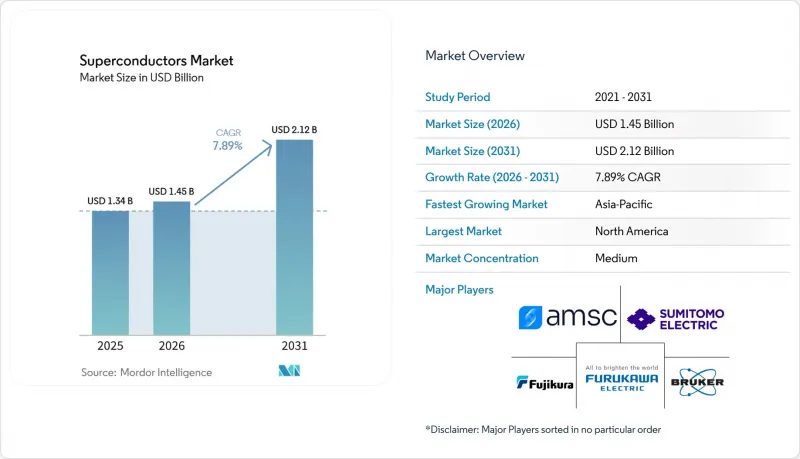
據 Mordor Intelligence 稱,2025 年超導性市值為 13.4 億美元,預計到 2031 年將達到 21.2 億美元,而 2026 年為 14.5 億美元,預測期(2026-2031 年)的複合年成長率為 7.89%。
本報告按類型(例如,低溫超導性(LTS))、材料(例如,氧化銅超導性)、應用(例如,醫學成像)、終端用戶行業(例如,醫療保健、能源和電力)以及地區(亞太地區、北美地區、歐洲地區、南美地區、中東和非洲)進行細分。市場預測以美元計價。
全球超導性市場趨勢與洞察
高場強磁振造影系統的需求不斷成長,以及升級老舊醫療影像基礎設施的必要性日益凸顯。
超導性市場正受惠於2000年至2010年間推出的1.5T和3.0T磁振造影(MRI)系統的更新換代。許多此類系統已接近使用壽命終點,這推動了對替換磁鐵及相關導體的需求。高場強磁振造影設備可提高功能性影像、癌症分期和神經血管評估中的訊號品質。 2026年1月,布魯克公司宣布與兩家全球醫療保健公司簽署總額達5億美元的多年期MRI超導性供應協議,其中包括一份為期七年的合約。布魯克公司還報告稱,其Ascend Evo 700和800磁鐵將氦氣消耗量降低了33%至40%,並將補充週期從180天延長至240天。這些需求將提升性能穩定的超導材料的重要性,從而為現有超導性供應商提供支援。
電網現代化和增加對高容量輸電網路的投資
超導性市場的發展也受到人口密集都市區電網容量限制的驅動。歐洲、北美和東亞的電力公司需要在難以擴建架空輸電線路的地區增加輸電容量。高溫超導性電纜的輸電能力是傳統交聯聚乙烯(XLPE)電纜的3到5倍,而且其安裝寬度僅為傳統電纜的十分之一。這使得升級地下輸電線路成為可能,而無需經歷新建架空輸電線路所需的漫長審核流程。發表在《超導科學與技術》期刊上的2026年技術藍圖檢驗了高功率超導電纜的研發及其在未來電力系統中的作用。這商機不僅在於供應電纜,還在於整合導體、低溫護套、電纜終端和故障電流保護裝置的整合系統。
低溫冷卻系統的複雜性和氦氣供應的限制。
對於許多超導性系統而言,低溫冷卻仍然是一項核心運作限制。大多數已安裝的臨床和物理磁體的工作溫度約為 4.2 K,並使用需要液態氦的低溫超導性。因此,服務的連續性取決於氦氣的儲存、補充和維護計劃。雖然透過設計降低氦氣消耗量可以減輕這種依賴性,但無法完全消除整個已安裝系統專用冷卻系統的需求。布魯克公司於 2025 年發布的磁鐵展示了在保持高磁場性能的同時降低氦氣用量的實際價值。雖然對於工作溫度高於 30 K 的高溫超導性系統可以採用其他冷卻方法,但向此類設備的廣泛過渡仍需時日。
細分市場分析
2025年,高溫超導性佔據了超導性市場佔有率的52.82%。預計在2026年至2031年間,該細分市場將以9.47%的複合年成長率成長,主要受核融合磁鐵、故障電流限制器和資料中心電纜等先導計畫的推動。稀土元素鋇銅氧化物(REBCO)導體適用於需要在強磁場下實現高電流密度的應用。其高溫運作能力降低了某些設計中對液態氦的依賴。隨著客戶對緊湊型、高容量電氣系統的需求不斷成長,市場正朝著這些應用發展。生產能力和導體均勻性將決定供應商能否滿足由此產生的需求。
低溫超導性在大多數磁振造影(MRI)、核磁共振(NMR)和粒子加速器裝置中仍然至關重要。儘管高溫超導性的替代品日益增多,但低溫超導體的成熟應用仍帶來了穩定的更換和維護需求。醫療系統的認證週期較長,這意味著已核准的導體設計可以長期使用。 IEC 61788系列標準持續影響醫療和研發領域的導線特性分析和採購決策。因此,該領域既擁有高溫超導性不斷成長的市場機遇,也具備低溫超導性穩固的現有應用基礎。這種平衡使得超導性市場即使在新應用不斷出現的情況下也能維持收入穩定。
截至2025年,銅氧化物超導性佔據了超導性市場55.71%的佔有率。這一地位反映了鉍鍶鈣銅氧化物(BSCCO)在臨床導線領域以及釔鋇銅氧化物(YBCO)或REBCO在磁體和閘極應用中的既有地位。這些材料已在嚴苛的應用領域累積了廣泛的認證,其性能要求是目前小規模或新型材料在工業規模上尚無法滿足的。塗層導體的製造工作仍在努力提高其性能和長長度生產的可靠性。鐵基基超導性的研發仍處於早期階段,因為大規模生產規模和均勻性的要求尚未解決。
預計2026年至2031年間,二硼化鎂超導性的年複合成長率將達到9.42%。這種材料可在20 K至39 K的溫度範圍內運行,支援基於低溫冷凍機的設計,而無需直接依賴液態氦。這簡化了在可接受這些溫度範圍內的應用所需的輔助設備。義大利國家核子物理研究所(INFN)宣布與ASG Superconductors公司合作進行「SURE」項目,該計畫旨在研發用於人工智慧資料中心供電的MgB2電纜。這種材料在特定電源應用中具有成本和運作優勢。其最終能否被廣泛採用,取決於最終用戶對系統檢驗、電纜設計和長期運作的信心。
區域分析
到2025年,北美將佔據超導性市場37.44%的佔有率。該地區受益於美國採購磁振造影(MRI)系統、高能量實體設施、海軍項目以及私營部門對核融合的投資。政府的核融合和量子技術計畫為專用設備的規劃週期提供了更長的期限。美國能源局於2025年發布了《核融合科學與技術藍圖》,概述了該領域的研究和開發重點。這些項目支撐了對導體、磁鐵及相關低溫系統的需求前景。北美的大學和國家實驗室也擁有超導性硬體的研究應用。
預計2026年至2031年,亞太地區超導市場將以9.27%的複合年成長率成長。日本擁有垂直整合的高溫超導生態系統,涵蓋超導帶材、磁鐵、馬達和醫療組件等領域。中國、日本和韓國在材料生產、研發和核融合開發方面各自發揮獨特的作用。該地區的製造商受益於其靠近電子、交通和電力設備主要供應鏈的優勢。亞太地區的超導性市場也可能受惠於國內材料研發能力和對高容量電力基礎設施的投資。成長將主要由認證產能的擴張以及能源和工業用戶的專案級需求所驅動。
歐洲在超導性市場也佔有重要地位,德國擁有工業研究叢集,法國則有ITER計畫。 ITER計畫持續將歐洲供應商與全球核融合磁鐵供應鏈連接起來。此外,歐洲也正在開發超導性電力電纜和電網技術。該地區的商業機會主要受能源轉型目標和都市區電力走廊建設限制的驅動。南美洲、中東和非洲在超導性市場所佔佔有率仍然相對小規模。這些地區的需求潛力取決於未來的工業電氣化、研究基礎設施、電力系統投資。
其他好處:
- Excel格式的市場預測(ME)表
- 3個月的分析師支持
目錄
第1章:引言
- 研究假設和市場定義
- 調查範圍
第2章:調查方法
第3章執行摘要
第4章 市場狀況
- 市場概覽
- 市場促進因素
- 高場強磁振造影系統的需求不斷成長,以及更換老舊醫療影像基礎設施的必要性。
- 電網現代化和加大對高容量電網的投資
- 擴大超導性磁鐵在核融合能源和粒子加速器計畫的應用
- 擴大高溫超導性(HTS)的生產能力並生產長帶材
- 人工智慧資料中心和高密度電力基礎設施中超導性電力元件的廣泛應用。
- 市場限制因素
- 低溫冷卻系統的複雜性和氦氣供應的限制。
- REBCO膠帶的產量、均勻性和長尺寸生產面臨的製造挑戰。
- 超導性系統專案開發週期長,認證週期也長。
- 價值鏈分析
- 波特五力分析
第5章 市場規模與成長預測
- 按類型
- 低溫超導性(LTS)
- 高溫超導性(HTS)
- 材料類型
- 氧化銅超導性
- 鐵基超導性
- 二硼化鎂(MgB2)超導性
- 透過使用
- 醫學影像診斷
- 電力傳輸和分配
- 核融合能源與粒子加速器
- 運輸
- 工業設備和電子設備
- 按最終用戶行業分類
- 衛生保健
- 能源與電力
- 科學研究
- 運輸
- 工業製造
- 電子和量子技術
- 按地區
- 亞太地區
- 中國
- 印度
- 日本
- 韓國
- 其他亞太國家
- 北美洲
- 美國
- 加拿大
- 墨西哥
- 歐洲
- 德國
- 英國
- 法國
- 義大利
- 俄羅斯
- 其他歐洲國家
- 南美洲
- 巴西
- 阿根廷
- 其他南美國家
- 中東和非洲
- 沙烏地阿拉伯
- 南非
- 其他中東和非洲國家
- 亞太地區
第6章 競爭情勢
- 市場集中度
- 策略趨勢
- 市佔率和排名分析
- 公司簡介
- American Superconductor Corporation
- ASG Superconductors SpA
- Bruker
- Cryomagnetics
- Fujikura Ltd.
- FURUKAWA ELECTRIC CO., LTD.
- JAPAN SUPERCONDUCTOR TECHNOLOGY, INC.
- Kiswire Advanced Technology Co., Ltd..
- Luvata
- NEXANS
- Sumitomo Electric Industries, Ltd.
- SuNAM Co., Ltd.
- THEVA Dunnschichttechnik GmbH
- Toshiba Corporation
- Western Superconducting Technologies Co., Ltd.
第7章 市場機會與未來展望
According to Mordor Intelligence, the superconductors market size was valued at USD 1.34 billion in 2025 and is estimated to grow from USD 1.45 billion in 2026 to reach USD 2.12 billion by 2031, at a CAGR of 7.89% during the forecast period (2026-2031).
This report is Segmented by Type (Low-Temperature Superconductors (LTS) and More), Material Type (Cuprate Superconductors and More), Application (Medical Imaging and More), End-User Industry (Healthcare, Energy and Power, and More), and Geography (Asia-Pacific, North America, Europe, South America, and Middle-East and Africa). The Market Forecasts are Provided in Terms of Value (USD).
Global Superconductors Market Trends and Insights
Rising Demand for High-Field MRI Systems and Replacement of Aging Medical Imaging Infrastructure
The superconductors market benefits from the replacement of 1.5 T and 3.0 T MRI systems installed between 2000 and 2010. Many of these systems are approaching the end of their operating lives, supporting demand for replacement magnets and related conductors. Higher-field equipment improves signal quality for functional imaging, cancer staging, and neurovascular assessment. In January 2026, Bruker announced USD 500 million in multi-year supply agreements with two global healthcare companies for MRI superconductors, including a seven-year agreement. Bruker also reported that its Ascend Evo 700 and 800 magnets reduced helium consumption by 33% to 40% and extended refill intervals to 180 to 240 days. These requirements increase the value of consistent wire performance and support established suppliers in the superconductors market.
Increasing Investments in Grid Modernization and High-Capacity Power Transmission Networks
The superconductors market is also supported by grid constraints in dense urban areas. Utilities in Europe, North America, and East Asia require additional capacity in corridors where overhead line expansion is difficult. High-temperature superconducting cables can carry 3 to 5 times the power of conventional cross-linked polyethylene (XLPE) cables while using corridors up to 10 times narrower. This provides an option for upgrading underground links without the extended approvals required for new overhead transmission routes. A 2026 technology roadmap from Superconductor Science and Technology reviewed the development of high-power superconducting cables and their role in future electricity systems. The opportunity depends on integrated systems that combine conductors, cryogenic envelopes, cable terminations, and fault-current protection, rather than wire supply alone.
Complexity of Cryogenic Cooling Systems and Limited Helium Availability
Cryogenic cooling remains a central operating constraint for many superconducting systems. Most installed clinical and physics magnets use low-temperature superconductors that operate near 4.2 K and require liquid helium. This makes service continuity dependent on helium storage, replenishment, and maintenance planning. Helium-saving designs can reduce exposure, but they do not eliminate the need for specialized cooling systems across the installed base. Bruker's 2025 magnet launch demonstrated the practical value of reducing helium use while maintaining high-field capability. High-temperature superconducting systems that operate above 30 K can use alternative cooling approaches, yet a broad transition to such equipment will take time.
Other drivers and restraints analyzed in the detailed report include:
- Growing Deployment of Superconducting Magnets in Fusion Energy and Particle Accelerator Projects
- Expansion of HTS Manufacturing Capacity and Long-Length Tape Production
- Manufacturing Challenges Related to REBCO Tape Yield, Uniformity, and Long-Length Production
For complete list of drivers and restraints, kindly check the Table Of Contents.
Segment Analysis
High-temperature superconductors captured 52.82% of the superconductors market share in 2025. The segment is forecast to grow at a 9.47% CAGR between 2026 and 2031, supported by fusion magnets, fault-current limiters, and data center cable pilots. Rare Earth Barium Copper Oxide (REBCO) conductors are suited to applications requiring high current density in strong magnetic fields. Their ability to operate at higher temperatures can reduce dependence on liquid helium in selected designs. The market has shifted toward these applications as customers seek compact, high-capacity electrical systems. Manufacturing capacity and conductor uniformity will determine whether suppliers can meet the resulting demand.
Low-temperature superconductors remain essential for much of the installed base of MRI, NMR, and particle accelerators. Their established use creates steady replacement and service demand even as high-temperature alternatives expand. Medical systems have long qualification cycles, which keep approved conductor designs in use for extended periods. The IEC 61788 series of standards continues to influence wire characterization and procurement decisions in medical and research settings. The type segment, therefore, combines a growing high-temperature opportunity with a durable low-temperature installed base. This balance helps the superconductors market maintain revenue stability while new applications develop.
Cuprate superconductors accounted for 55.71% of the superconductors market size in 2025. Their positions reflect the established roles of Bismuth Strontium Calcium Copper Oxide (BSCCO) in clinical wire and Yttrium Barium Copper Oxide (YBCO) or REBCO in magnet and grid applications. These materials have accumulated a large qualification base in demanding applications, supported by performance requirements that smaller or newer materials may not yet meet at an industrial scale. Work on coated-conductor manufacturing continues to focus on improving long-length performance and production reliability. Iron-based superconductors remain at an earlier stage, as production-scale and uniformity requirements remain unresolved.
Magnesium diboride superconductors are forecast to grow at a 9.42% CAGR from 2026 to 2031. The material can operate at 20 K to 39 K, which supports cryocooler-based designs rather than direct reliance on liquid helium. This can simplify supporting equipment in applications where those temperatures are acceptable. The Istituto Nazionale di Fisica Nucleare (INFN) reported work with ASG Superconductors on the SURE project for an MgB2 cable designed for AI data center power supply. The material offers cost and operational advantages in selected power applications. Its adoption will depend on system validation, cable design, and end-user confidence in long-term operation.
Complete Report Scope:
- By Type
- Low-Temperature Superconductors (LTS)
- High-Temperature Superconductors (HTS)
- By Material Type
- Cuprate Superconductors
- Iron-Based Superconductors
- Magnesium Diboride (MgB2) Superconductors
- By Application
- Medical Imaging
- Power Transmission and Grid
- Fusion Energy and Particle Accelerators
- Transportation
- Industrial Equipment and Electronics
- By End-User Industry
- Healthcare
- Energy and Power
- Scientific Research
- Transportation
- Industrial Manufacturing
- Electronics and Quantum Technology
- By Geography
- Asia-Pacific
- China
- India
- Japan
- South Korea
- Rest of Asia-Pacific
- North America
- United States
- Canada
- Mexico
- Europe
- Germany
- United Kingdom
- France
- Italy
- Russia
- Rest of Europe
- South America
- Brazil
- Argentina
- Rest of South America
- Middle-East and Africa
- Saudi Arabia
- South Africa
- Rest of Middle-East and Africa
- Asia-Pacific
Geography Analysis
North America held 37.44% of the superconductors market share in 2025. The region benefits from the procurement of magnetic resonance imaging (MRI) systems, high-energy physics facilities, naval programs, and private fusion investment in the United States. Government programs in fusion and quantum technology provide longer planning horizons for specialized equipment. The U.S. Department of Energy published its Fusion Science and Technology Roadmap in 2025, outlining research and development priorities for the field. These programs support demand visibility for conductors, magnets, and related cryogenic systems. North American universities and national laboratories also sustain research use of superconducting hardware.
Asia-Pacific is forecast to grow at a 9.27% CAGR from 2026 to 2031. Japan has a vertically integrated high-temperature superconducting ecosystem spanning tape, magnets, motors, and medical components. China, Japan, and South Korea each play different roles in materials production, research, and fusion development. The region's manufacturers benefit from proximity to major supply chains for electronics, transport, and power equipment. The superconductors market in Asia-Pacific may also benefit from investment in domestic material capability and high-capacity electricity infrastructure. Growth will depend on qualified production expansion and project-level demand from energy and industrial users.
Europe holds a position in the superconductors market, with Germany hosting industrial research clusters and France hosting the ITER project. The ITER program continues to connect European suppliers with a global fusion magnet supply chain. Europe is also developing superconducting power cables and grid technologies. The regional opportunity is supported by energy-transition objectives and constrained urban transmission corridors. South America, the Middle-East, and Africa retain smaller positions in the superconductors market. Their demand potential is tied to future industrial electrification, research infrastructure, and power system investment.
- American Superconductor Corporation
- ASG Superconductors S.p.A.
- Bruker
- Cryomagnetics
- Fujikura Ltd.
- FURUKAWA ELECTRIC CO., LTD.
- JAPAN SUPERCONDUCTOR TECHNOLOGY,INC.
- Kiswire Advanced Technology Co., Ltd..
- Luvata
- NEXANS
- Sumitomo Electric Industries, Ltd.
- SuNAM Co., Ltd.
- THEVA Dunnschichttechnik GmbH
- Toshiba Corporation
- Western Superconducting Technologies Co., Ltd.
Additional Benefits:
- The market estimate (ME) sheet in Excel format
- 3 months of analyst support
TABLE OF CONTENTS
1 Introduction
- 1.1 Study Assumptions and Market Definition
- 1.2 Scope of the Study
2 Research Methodology
3 Executive Summary
4 Market Landscape
- 4.1 Market Overview
- 4.2 Market Drivers
- 4.2.1 Rising Demand for High-Field MRI Systems and Replacement of Aging Medical Imaging Infrastructure
- 4.2.2 Increasing Investments in Grid Modernization and High-Capacity Power Transmission Networks
- 4.2.3 Growing Deployment of Superconducting Magnets in Fusion Energy and Particle Accelerator Projects
- 4.2.4 Expansion of High-Temperature Superconductor (HTS) Manufacturing Capacity and Long-Length Tape Production
- 4.2.5 Increasing Adoption of Superconducting Power Components for AI Data Centers and High-Density Electrical Infrastructure
- 4.3 Market Restraints
- 4.3.1 Complexity of Cryogenic Cooling Systems and Limited Helium Availability
- 4.3.2 Manufacturing Challenges Related to REBCO Tape Yield, Uniformity, and Long-Length Production
- 4.3.3 Long Project Development Timelines and Lengthy Qualification Cycles for Superconducting Systems
- 4.4 Value Chain Analysis
- 4.5 Porter's Five Forces Analysis
- 4.5.1 Threat of New Entrants
- 4.5.2 Bargaining Power of Suppliers
- 4.5.3 Bargaining Power of Buyers
- 4.5.4 Threat of Substitutes
- 4.5.5 Competitive Rivalry
5 Market Size and Growth Forecasts (Value)
- 5.1 By Type
- 5.1.1 Low-Temperature Superconductors (LTS)
- 5.1.2 High-Temperature Superconductors (HTS)
- 5.2 By Material Type
- 5.2.1 Cuprate Superconductors
- 5.2.2 Iron-Based Superconductors
- 5.2.3 Magnesium Diboride (MgB2) Superconductors
- 5.3 By Application
- 5.3.1 Medical Imaging
- 5.3.2 Power Transmission and Grid
- 5.3.3 Fusion Energy and Particle Accelerators
- 5.3.4 Transportation
- 5.3.5 Industrial Equipment and Electronics
- 5.4 By End-User Industry
- 5.4.1 Healthcare
- 5.4.2 Energy and Power
- 5.4.3 Scientific Research
- 5.4.4 Transportation
- 5.4.5 Industrial Manufacturing
- 5.4.6 Electronics and Quantum Technology
- 5.5 By Geography
- 5.5.1 Asia-Pacific
- 5.5.1.1 China
- 5.5.1.2 India
- 5.5.1.3 Japan
- 5.5.1.4 South Korea
- 5.5.1.5 Rest of Asia-Pacific
- 5.5.2 North America
- 5.5.2.1 United States
- 5.5.2.2 Canada
- 5.5.2.3 Mexico
- 5.5.3 Europe
- 5.5.3.1 Germany
- 5.5.3.2 United Kingdom
- 5.5.3.3 France
- 5.5.3.4 Italy
- 5.5.3.5 Russia
- 5.5.3.6 Rest of Europe
- 5.5.4 South America
- 5.5.4.1 Brazil
- 5.5.4.2 Argentina
- 5.5.4.3 Rest of South America
- 5.5.5 Middle-East and Africa
- 5.5.5.1 Saudi Arabia
- 5.5.5.2 South Africa
- 5.5.5.3 Rest of Middle-East and Africa
- 5.5.1 Asia-Pacific
6 Competitive Landscape
- 6.1 Market Concentration
- 6.2 Strategic Moves
- 6.3 Market Share (%)/Ranking Analysis
- 6.4 Company Profiles (includes Global Overview, Market Overview, Core Segments, Financials as available, Strategic Information, Products and Services, and Recent Developments)
- 6.4.1 American Superconductor Corporation
- 6.4.2 ASG Superconductors S.p.A.
- 6.4.3 Bruker
- 6.4.4 Cryomagnetics
- 6.4.5 Fujikura Ltd.
- 6.4.6 FURUKAWA ELECTRIC CO., LTD.
- 6.4.7 JAPAN SUPERCONDUCTOR TECHNOLOGY,INC.
- 6.4.8 Kiswire Advanced Technology Co., Ltd..
- 6.4.9 Luvata
- 6.4.10 NEXANS
- 6.4.11 Sumitomo Electric Industries, Ltd.
- 6.4.12 SuNAM Co., Ltd.
- 6.4.13 THEVA Dunnschichttechnik GmbH
- 6.4.14 Toshiba Corporation
- 6.4.15 Western Superconducting Technologies Co., Ltd.
7 Market Opportunities and Future Outlook
- 7.1 White-Space and Unmet-Need Assessment


