


 |
市場調查報告書
商品編碼
2119079
黏土:市場佔有率分析、產業趨勢與統計數據、成長預測(2026-2031 年)Clay - Market Share Analysis, Industry Trends & Statistics, Growth Forecasts (2026 - 2031) |
||||||

※ 本網頁內容可能與最新版本有所差異。詳細情況請與我們聯繫。
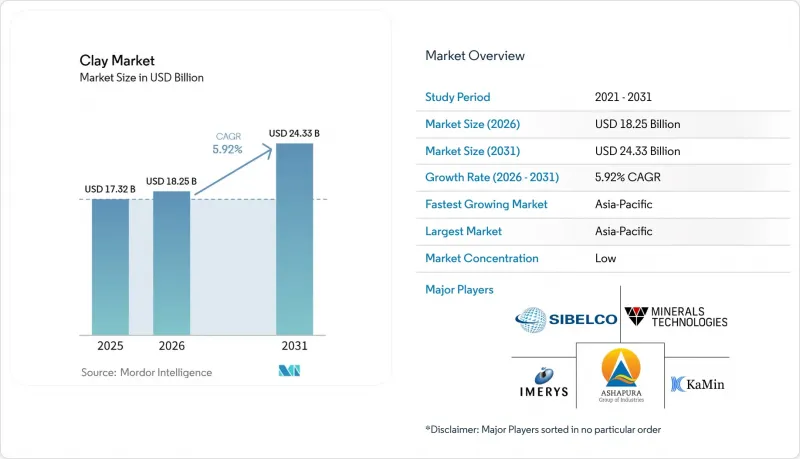
根據 Mordor Intelligence 估計,2025 年黏土市場價值為 173.2 億美元,預計在預測期(2026-2031 年)內將以 5.92% 的複合年成長率成長,從 2026 年的 182.5 億美元成長到 2031 年的 243.3 億美元。
本報告按形態(塊狀、粉狀等)、黏土類型(高嶺土(瓷土)、膨潤土等)、應用領域(陶器、陶瓷、建築材料等)和地區(亞太地區、北美地區、歐洲地區、南美地區、中東和非洲地區)進行細分。市場預測以美元計價。
全球黏土市場趨勢及洞察
陶瓷、衛浴設備和建築業的需求不斷成長。
建設產業仍然是住宅和商業項目及維修中粘土的主要需求來源,因為粘土被用於製造磚、瓦、衛浴設備及相關建材。高嶺土和球粘土因其良好的可塑性和燒製後所需的潔白度(符合衛浴設備的要求),在中等收入國家需求旺盛,這主要得益於住宅和維修的成長。燒製黏土在建築領域還有另一個用途,它不僅可以用於燒製陶瓷產品,還可以用於低碳水泥配方。石灰石燒製黏土水泥(LC3)方法以燒製黏土和石灰石取代50%的水泥熟料,可將水泥相關的碳排放量減少高達40%。 LC3的燒製溫度約為800 度C,而水泥熟料的燒製溫度約為1450 度C,凸顯了LC3在水泥脫碳方面的重要性。全球水泥與混凝土協會(GCCA)認為,在飛灰和碎高爐礦渣供應日益減少的情況下,燒結黏土仍是成熟的混凝土生產方法之一。截至2025年7月,莫林斯公司已在西班牙交付了超過12.2萬立方公尺的LC3級混凝土和砂漿。
黏土在紙包裝、塗料和功能性填充材。
儘管數位化降低了對印刷用高嶺土的需求,但包裝需求支撐了高嶺土在造紙領域的應用,使其在黏土市場中保持重要地位。高嶺土被用於塗佈包裝紙板、標籤和特殊紙,因為其亮度、不透明度、油墨保持性和表面外觀會影響最終產品的品質。電子商務推動了對塗佈包裝的需求,部分抵消了印刷用紙需求的下降。煅燒高嶺土因其加工後白度和流變性能的提升而被認為具有更高的附加價值。同時,汽車塑膠需要滿足更嚴格性能要求的表面改質填料。 2025年8月,伊梅里斯推出了用於永續包裝和紙張塗料的高嶺土產品,這反映出加工級高嶺土相對於未分化填料的價值日益成長。
嚴格的環境法規,涉及採礦、土地修復和水資源利用。
採礦修復要求增加了採礦企業的資本和技術負擔,對於那些未及早規劃停產成本的生產者而言,這些義務可能會擠壓利潤空間。在澳大利亞,採礦權擁有者必須在採礦造成土地改變後儘快開始修復工作,並實現礦區最終的預期土地用途。在佛羅裡達州,弗拉地球礦區的礦工需要在作業前後提供採礦意圖通知、已通過核准的修復計畫以及雨水排放許可證。合規成本可能會給現有生產商帶來壓力,並減緩新產能的擴張,但ISO 14001系統和國家相關的修復法律仍然是重要的營運考量。缺乏完善環境管理基礎設施的小規模本地生產商面臨更大的風險,黏土市場必須在生產連續性與土地、水資源和修復義務之間取得平衡。
細分市場分析
截至2025年,粉狀黏土將佔黏土市場佔有率的44.57%,並因其易於操作,在陶瓷、塗料和建築材料等廣泛應用領域仍將佔據主導地位。在亞洲許多以陶瓷為主的市場,乾混是標準工藝,這支撐了瓷磚和衛浴設備基材生產對粉狀粘土的需求。顆粒狀黏土的市佔率較小,但因其抑塵性和流動性,在農業和緩釋領域得到應用。
散裝黏土是加工程度最低的黏土形式,廣泛用於低價值應用,例如普通磚塊和輕質骨材。在這些應用中,運輸成本和當地供應通常是採購決策的主要因素。預計到2031年,泥漿狀黏土的年複合成長率將達到6.18%,成為成長最快的黏土形式。造紙和塗料製造商對泥漿狀黏土的需求主要來自他們,他們更傾向於使用預分散、高固態含量的原料。製備泥漿狀黏土便於在出貨前控制粒徑分佈和表面化學性質。這種形式的黏土需要配套的製備和泵送基礎設施,這對於整合了礦物加工的企業來說可能是一個優勢。
區域分析
亞太地區預計在2025年將佔全球市場收入的46.87%,並預計到2031年將以6.43%的複合年成長率成長,成為規模最大且成長最快的區域市場。該地區的粘土市場受益於大規模陶瓷生產、活躍的建設活動以及對多種粘土等級需求旺盛的工業基本客群。中國仍然是全球最大的陶瓷生產國和主要的造紙市場,推動了對建築和加工用高嶺土產品的需求。印度是重要的成長中心,其需求源自於建設活動、向沿岸地區油田服務供應商出口膨潤土以及製藥應用。 Ashapura Mainchem Limited報告稱,其在印度的業務在2026會計年度上半年成長超過25%,這反映了不斷擴大的國內和出口市場的商業性重要性。
日本和韓國從美國和澳洲進口高純度高嶺土,用於電子產品、陶瓷和特殊塗料產業。在這些行業中,品質要求是採購決策的主要考慮因素,而非價格。北美是第二大區域市場,其需求主要來自造紙、環境修復、寵物照護和油田服務等產業。這些行業對黏土的需求各不相同。預計到2025年,美國黏土產量將達2,600萬噸,產值達18億美元,約有120家公司在38個州開展業務。 2025年,美國出口黏土產品330萬噸,其中包括64萬噸膨潤土和160萬噸高嶺土。墨西哥是該地區第二大高嶺土產地,年產量為210萬噸,也是美國膨潤土的主要出口目的地。
歐洲和其他地區的發展階段各不相同,需求受產業政策、當地礦產資源、建設計畫以及油氣相關活動等因素驅動。捷克共和國2024年生產了240萬噸高嶺土,而歐洲生產商不僅供應用於製磚的低價值普通粘土,還供應用於水泥和塗料的高品質煅燒粘土。歐洲的脫碳政策正在促進煅燒粘土和水泥混合物的使用。南美市場圍繞著巴西的高嶺土蘊藏量展開,而中東和非洲則受益於沙烏地阿拉伯和沿岸地區的建築、陶瓷、採礦和鑽探活動。這些地區也受惠於當地的建築需求,印度和土耳其的出口商繼續為油田供應膨潤土。
其他好處:
- Excel格式的市場預測(ME)表
- 3個月的分析師支持
目錄
第1章:引言
- 市場分析與定義的前提條件
- 分析範圍
第2章 分析方法
第3章執行摘要
第4章 市場狀況
- 市場概覽
- 市場促進因素
- 對陶瓷、衛浴設備和建築產品的需求不斷成長。
- 黏土在紙包裝、塗料和功能性填料中的應用日益廣泛。
- 膨潤土在鑽井液、鑄造應用和土木工程的消耗量增加。
- 透過整合人工智慧驅動的製程控制來提高產品品質和生產效率。
- 為了提高資源利用率,人們越來越關注礦物選礦和採礦廢棄物。
- 市場限制因素
- 嚴格的環境法規,涉及採礦、土地修復和水資源利用。
- 來自碳酸鈣、滑石粉、二氧化矽和合成功能填料等替代材料的競爭。
- 取得優質黏土礦床的難度越來越大,對原料規格的要求也越來越高。
- 價值鏈分析
- 波特五力分析
第5章:預測市場規模與成長率
- 按形狀
- 凹凸不平
- 粉末
- 顆粒
- 泥
- 依黏土類型
- 高嶺土(瓷土)
- 膨潤土
- 球粘土
- 耐火粘土
- 富勒氏土壤(酸性白色黏土)
- 通用黏土
- 伊利石
- 其他類型的粘土
- 透過使用
- 陶器
- 建築材料
- 石油和天然氣鑽井液
- 紙
- 油漆和塗料
- 橡膠和塑膠
- 化妝品和個人護理
- 製藥
- 農業
- 在水處理和環境領域的應用
- 其他用途
- 按地區
- 亞太地區
- 中國
- 印度
- 日本
- 韓國
- 其他亞太國家
- 北美洲
- 美國
- 加拿大
- 墨西哥
- 歐洲
- 德國
- 英國
- 法國
- 義大利
- 俄羅斯
- 其他歐洲國家
- 南美洲
- 巴西
- 阿根廷
- 其他南美國家
- 中東和非洲
- 沙烏地阿拉伯
- 南非
- 其他中東和非洲國家
- 亞太地區
第6章 競爭情勢
- 市場集中度
- 策略趨勢
- 市佔率和排名分析
- 公司簡介
- 20 Microns
- Ashapura Minechem Ltd.
- BASF
- Bentonite Performance Minerals LLC
- EICL
- Eurobent Sp. z oo
- Imerys SA
- KaMin LLC
- Kunimine Industries Co., Ltd.
- LKAB Minerals
- Minerals Technologies Inc.
- Sibelco
- Thiele Kaolin Company
- WA Kaolin Limited
- Wyo-Ben, Inc.
第7章 市場機會與未來展望
According to Mordor Intelligence, the clay market size was estimated at USD 17.32 billion in 2025 and is estimated to grow from USD 18.25 billion in 2026 to USD 24.33 billion by 2031, at a CAGR of 5.92% during the forecast period (2026-2031).
This report is Segmented by Form (Lump, Powder, and More), Clay Type (Kaolin (China Clay), Bentonite, and More), Application (Ceramics and Pottery, Construction Materials, and More), and Geography (Asia-Pacific, North America, Europe, South America, and Middle-East and Africa). The Market Forecasts are Provided in Terms of Value (USD).
Global Clay Market Trends and Insights
Expansion of Ceramic, Sanitaryware, and Construction Demand
Construction remains a major demand base for the clay market, as clay is used in bricks, tiles, sanitaryware, and related building materials across housing, commercial projects, and renovation work. Kaolin and ball clay provide the forming plasticity and post-firing whiteness required in sanitaryware, making housing completions and renovation spending in middle-income economies relevant to demand. Calcined clay represents a separate construction application, as it can be used in lower-carbon cement formulations rather than only in fired ceramic products. The Limestone Calcined Clay Cement (LC3) approach can reduce cement-related carbon dioxide emissions by up to 40% when 50% of clinker is replaced by calcined clay and limestone. LC3 is calcined at around 800°C, compared to around 1,450°C for clinker, and this lower temperature supports its relevance to cement decarbonization. The Global Cement and Concrete Association identifies calcined clays as an established route as the availability of fly ash and ground granulated blast-furnace slag declines. Molins had delivered more than 122,000 m3 of LC3 concrete and mortar in Spain by July 2025.
Increasing Use of Clay in Paper Packaging, Coatings, and Functional Fillers
Digitalization has reduced demand for graphical printing grades, but packaging demand has supported kaolin consumption in paper applications and retained an important role for the clay market. Coated packaging boards, labels, and specialty papers use kaolin because brightness, opacity, ink holdout, and surface appearance affect the finished product. E-commerce supports demand for coated packaging and partly offsets the decline in graphics-focused paper demand. Calcined kaolin commands greater value because processing improves its whiteness and rheological properties, while automotive plastics require surface-engineered fillers that meet tighter performance requirements. Imerys launched kaolin products for sustainable packaging and paper coatings in August 2025, reflecting the value placed on processed grades over undifferentiated filler material.
Stringent Environmental Regulations Governing Mining, Land Rehabilitation, and Water Usage
Mine rehabilitation requirements raise the capital and technical demands of extraction, and these obligations can compress margins for producers that do not plan for closure costs early. In Australia, mining lease holders must begin rehabilitation as soon as reasonably practicable after disturbance and deliver the intended final land use for the mining area. In Florida, fuller's earth operators require notices of intent to mine, approved reclamation plans, and stormwater permits before and during operations. Compliance costs can pressure existing producers and delay new capacity, while ISO 14001 systems and national rehabilitation laws remain important operating considerations. Smaller regional producers face greater risk where they lack environmental management infrastructure, leaving the clay market to balance production continuity with land, water, and rehabilitation obligations.
Other drivers and restraints analyzed in the detailed report include:
- Rising Consumption of Bentonite in Drilling Fluids, Foundry Applications, and Civil Engineering
- Increasing Focus on Mineral Beneficiation and Mine Waste Recovery to Enhance Resource Utilization
- Competition from Alternative Materials such as Calcium Carbonate, Talc, Silica, and Synthetic Functional Fillers
For complete list of drivers and restraints, kindly check the Table Of Contents.
Segment Analysis
Powder held 44.57% of the clay market share in 2025 and remained the leading form due to ease of handling across ceramics, paints, and construction materials. Dry mixing is standard in many ceramics-focused markets in Asia, supporting demand for powder in the preparation of tile and sanitaryware bodies. Granules held a smaller share but serve agriculture and controlled-release applications, where dust control and flow characteristics support their use.
Lump clay is the least processed form and is commonly used in lower-value applications, such as common brick and lightweight aggregate, where transportation costs and local availability often guide purchasing decisions. Slurry is projected to expand at a 6.18% CAGR through 2031, making it the fastest-growing form. Demand for slurry is supported by paper and coatings producers that prefer pre-dispersed, high-solids inputs. Slurry preparation helps control particle size distribution and surface chemistry before shipment. This format requires preparation and pumping infrastructure, which can favor integrated mineral processors.
Complete Report Scope:
- By Form
- Lump
- Powder
- Granules
- Slurry
- By Clay Type
- Kaolin (China Clay)
- Bentonite
- Ball Clay
- Fire Clay
- Fuller's Earth
- Common Clay
- Illite
- Other Clay Types
- By Application
- Ceramics and Pottery
- Construction Materials
- Oil and Gas Drilling Fluids
- Paper
- Paints and Coatings
- Rubber and Plastics
- Cosmetics and Personal Care
- Pharmaceuticals
- Agriculture
- Water Treatment and Environmental Applications
- Other Applications
- By Geography
- Asia-Pacific
- China
- India
- Japan
- South Korea
- Rest of Asia-Pacific
- North America
- United States
- Canada
- Mexico
- Europe
- Germany
- United Kingdom
- France
- Italy
- Russia
- Rest of Europe
- South America
- Brazil
- Argentina
- Rest of South America
- Middle-East and Africa
- Saudi Arabia
- South Africa
- Rest of Middle-East and Africa
- Asia-Pacific
Geography Analysis
Asia-Pacific held 46.87% of market revenue in 2025 and is projected to grow at a 6.43% CAGR through 2031, making it both the largest and fastest-growing regional market. The region's clay market is supported by large-scale ceramics production, extensive construction activity, and a broad industrial customer base that consumes multiple clay grades. China remained the world's largest ceramics producer and a major paper market, driving demand for both construction-oriented and processed kaolin products. India represents an important growth center, with demand stemming from construction activity, bentonite exports to Gulf oilfield service providers, and pharmaceutical applications. Ashapura Minechem Limited reported India business revenue growth of more than 25% in H1 FY2026, reflecting the commercial significance of this expanding domestic and export base.
Japan and South Korea import high-purity kaolin from the United States and Australia for electronics, ceramics, and specialty coatings, where quality requirements rather than price drive procurement decisions. North America was the second-largest regional market, supported by demand from paper, environmental remediation, pet care, and oilfield services, each requiring different clay types and grades. United States clay production reached 26 million tons valued at USD 1.8 billion in 2025, with around 120 companies operating across 38 states. The United States exported 3.3 million metric tons of clay products in 2025, including 640 thousand metric tons of bentonite and 1.6 million metric tons of kaolin. Mexico is a secondary regional supplier, producing 2,100 thousand metric tons of kaolin annually and serving as a key destination for United States bentonite exports.
Europe and the remaining regions are at different stages of development, with demand shaped by industrial policy, local mineral resources, construction programs, and oil and gas activity. The Czech Republic produced 2,400 thousand metric tons of kaolin in 2024, while European producers supply high-specification calcined clay for cement and coatings alongside lower-value common clay for brickmaking. European decarbonization policy supports the use of calcined clay cement blends. South America's market is centered on Brazil's kaolin reserves, while the Middle-East and Africa benefit from Saudi Arabian construction, ceramics, mining, and Gulf drilling activity. These regions also benefit from local construction demand, with Indian and Turkish exporters continuing to supply oilfield-related bentonite.
- 20 Microns
- Ashapura Minechem Ltd.
- BASF
- Bentonite Performance Minerals LLC
- EICL
- Eurobent Sp. z o.o.
- Imerys S.A.
- KaMin LLC
- Kunimine Industries Co., Ltd.
- LKAB Minerals
- Minerals Technologies Inc.
- Sibelco
- Thiele Kaolin Company
- WA Kaolin Limited
- Wyo-Ben, Inc.
Additional Benefits:
- The market estimate (ME) sheet in Excel format
- 3 months of analyst support
TABLE OF CONTENTS
1 Introduction
- 1.1 Study Assumptions and Market Definition
- 1.2 Scope of the Study
2 Research Methodology
3 Executive Summary
4 Market Landscape
- 4.1 Market Overview
- 4.2 Market Drivers
- 4.2.1 Expansion of Ceramic, Sanitaryware and Construction Demand
- 4.2.2 Increasing Use of Clay in Paper Packaging, Coatings, and Functional Fillers
- 4.2.3 Rising Consumption of Bentonite in Drilling Fluids, Foundry Applications, and Civil Engineering
- 4.2.4 Integration of AI-Enabled Process Control to Improve Product Quality and Production Efficiency
- 4.2.5 Increasing Focus on Mineral Beneficiation and Mine Waste Recovery to Enhance Resource Utilization
- 4.3 Market Restraints
- 4.3.1 Stringent Environmental Regulations Governing Mining, Land Rehabilitation, and Water Usage
- 4.3.2 Competition from Alternative Materials such as Calcium Carbonate, Talc, Silica, and Synthetic Functional Fillers
- 4.3.3 Declining Availability of High-Quality Clay Deposits and Increasing Raw Material Specification Challenges
- 4.4 Value Chain Analysis
- 4.5 Porter's Five Forces Analysis
- 4.5.1 Threat of New Entrants
- 4.5.2 Bargaining Power of Suppliers
- 4.5.3 Bargaining Power of Buyers
- 4.5.4 Threat of Substitutes
- 4.5.5 Competitive Rivalry
5 Market Size and Growth Forecasts (Value)
- 5.1 By Form
- 5.1.1 Lump
- 5.1.2 Powder
- 5.1.3 Granules
- 5.1.4 Slurry
- 5.2 By Clay Type
- 5.2.1 Kaolin (China Clay)
- 5.2.2 Bentonite
- 5.2.3 Ball Clay
- 5.2.4 Fire Clay
- 5.2.5 Fuller's Earth
- 5.2.6 Common Clay
- 5.2.7 Illite
- 5.2.8 Other Clay Types
- 5.3 By Application
- 5.3.1 Ceramics and Pottery
- 5.3.2 Construction Materials
- 5.3.3 Oil and Gas Drilling Fluids
- 5.3.4 Paper
- 5.3.5 Paints and Coatings
- 5.3.6 Rubber and Plastics
- 5.3.7 Cosmetics and Personal Care
- 5.3.8 Pharmaceuticals
- 5.3.9 Agriculture
- 5.3.10 Water Treatment and Environmental Applications
- 5.3.11 Other Applications
- 5.4 By Geography
- 5.4.1 Asia-Pacific
- 5.4.1.1 China
- 5.4.1.2 India
- 5.4.1.3 Japan
- 5.4.1.4 South Korea
- 5.4.1.5 Rest of Asia-Pacific
- 5.4.2 North America
- 5.4.2.1 United States
- 5.4.2.2 Canada
- 5.4.2.3 Mexico
- 5.4.3 Europe
- 5.4.3.1 Germany
- 5.4.3.2 United Kingdom
- 5.4.3.3 France
- 5.4.3.4 Italy
- 5.4.3.5 Russia
- 5.4.3.6 Rest of Europe
- 5.4.4 South America
- 5.4.4.1 Brazil
- 5.4.4.2 Argentina
- 5.4.4.3 Rest of South America
- 5.4.5 Middle-East and Africa
- 5.4.5.1 Saudi Arabia
- 5.4.5.2 South Africa
- 5.4.5.3 Rest of Middle-East and Africa
- 5.4.1 Asia-Pacific
6 Competitive Landscape
- 6.1 Market Concentration
- 6.2 Strategic Moves
- 6.3 Market Share (%)/Ranking Analysis
- 6.4 Company Profiles (includes Global Overview, Market Overview, Core Segments, Financials as available, Strategic Information, Products and Services, and Recent Developments)
- 6.4.1 20 Microns
- 6.4.2 Ashapura Minechem Ltd.
- 6.4.3 BASF
- 6.4.4 Bentonite Performance Minerals LLC
- 6.4.5 EICL
- 6.4.6 Eurobent Sp. z o.o.
- 6.4.7 Imerys S.A.
- 6.4.8 KaMin LLC
- 6.4.9 Kunimine Industries Co., Ltd.
- 6.4.10 LKAB Minerals
- 6.4.11 Minerals Technologies Inc.
- 6.4.12 Sibelco
- 6.4.13 Thiele Kaolin Company
- 6.4.14 WA Kaolin Limited
- 6.4.15 Wyo-Ben, Inc.
7 Market Opportunities and Future Outlook
- 7.1 White-Space and Unmet-Need Assessment
- 7.2 High-Purity Grades for Pharmaceutical and Cosmetic Formulations
- 7.3 Low-Carbon Calcined Clay and Metakaolin for Cement Decarbonization

 黏土和瓷器市場:2026-2032年全球市場預測(按製造流程、產品類型、形態、分銷管道和最終用途分類)
 黏土市場預測至2034年—按類型、應用、最終用戶和地區分類的全球分析
 耐火粘土市場:市場規模、佔有率和趨勢分析(按應用、產品、最終用途和地區分類),細分市場預測(2026-2033 年)黏土市場:按類型、形狀、應用、分銷管道和最終用戶分類-2026-2032年全球市場預測風乾黏土市場規模、佔有率和趨勢分析報告:按材料類型、最終用途、地區和細分市場分類,預測至2026-2033年
 黏土市場規模、佔有率和成長分析:按形態、黏土類型、應用、終端用戶產業、製造方法和地區分類-2026-2033年產業預測
 2026年全球黏土製品及耐火材料市場報告2026年全球親和性黏土市場報告
 全球聚合物黏土市場,2025-2029年
 奈米黏土市場-全球產業規模、佔有率、趨勢、機會及預測(按產品、應用、地區和競爭格局分類,2021-2031年)