


 |
市場調查報告書
商品編碼
2119074
建築潤滑劑:市場佔有率分析、產業趨勢及統計、成長預測(2026-2031)Construction Lubricants - Market Share Analysis, Industry Trends & Statistics, Growth Forecasts (2026 - 2031) |
||||||

※ 本網頁內容可能與最新版本有所差異。詳細情況請與我們聯繫。
據 Mordor Intelligence 稱,建築潤滑油市場預計在 2025 年達到 90.8 億美元,預計在預測期(2026-2031 年)內將以 5.47% 的複合年成長率成長,從 2026 年的 95.3 億美元成長到 2031 年的 124.4 億美元。
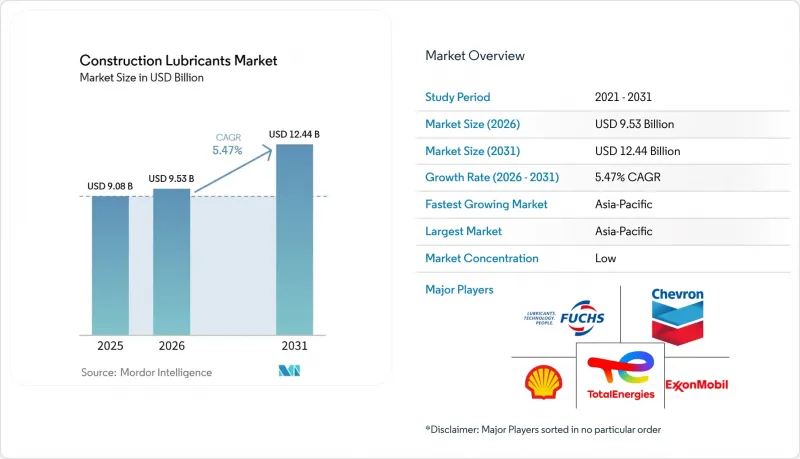
本報告按產品類型(液壓油、引擎油等)、引擎油(礦物油、合成油等)、應用領域(商業建築等)、終端用戶產業(建築公司、施工機械租賃公司等)以及地區(亞太地區、北美地區、歐洲地區、南美地區、中東和非洲地區)進行細分。市場預測以美元計價。
全球建築潤滑油市場趨勢及洞察
基礎建設和大型建設項目擴展
大型土木工程項目需要長期使用重型機械,這支撐了對建築潤滑油的需求。道路、鐵路系統、橋樑、港口、隧道和公用設施網路的建設都離不開挖土機、起重機、裝載機、運輸卡車及相關機械。這些重型機械在整個專案週期中需要定期更換機油、塗抹潤滑脂並監測液壓油。政府資金的投入使得土木工程項目受私人建設資金波動的影響較小。隨著專案重心轉向長期公共基礎設施,建築潤滑油市場也從中受益。計劃於2026年1月開工的印度高速鐵路項目和計劃於2025年12月開工的德克薩斯州高速鐵路合資項目,便是本研究中提及的主要建設項目地域範圍的典型例證。
此外,基礎設施項目通常涉及跨越多個施工階段的供應鏈。承包商需要可靠的已通過核准潤滑油供應,以確保機械設備運作並維持設備保固。這使得在多個地點提供服務並保持產品品質穩定的供應商更具優勢。工程通常涵蓋土方工程、起重、鋪路、挖掘和物料搬運設備。液壓油、引擎油、齒輪油和潤滑脂的需求組成因設備類別而異。因此,基礎設施支出支持更廣泛的建築潤滑油市場,而不僅僅是單一產品類型。
施工機械機械化的進步
隨著機械化程度的提高,大部分建築工作將由動力機械而非人工完成,這將導致潤滑油消耗增加。據報道,印度每1000美元的建築支出對應5美元的機械需求,而全球平均為12美元。這一差異表明,隨著印度機械設備部署量接近全球水平,其部署數量可能會增加。相關資料也提到,印度在採礦和施工機械領域的資本投資增加。設備部署規模的擴大將導致正常運作週期中對引擎、液壓系統、變速箱和潤滑脂的需求增加。
撒哈拉以南非洲和東南亞部分地區也存在著機械化程度不一的情況。這些地區引進的新設備不會取代現有需求,反而會創造對潤滑油的額外需求。 2025-2026會計年度,印度施工機械出口成長了32%,而國內出貨量略有下降。這種出口模式表明,設備製造商正在滿足區域需求並擴大未來的部署規模。每台機器在運作時都需要潤滑,持續產生對認證產品的需求。這種設備的廣泛擴張正在支撐高成長發展中地區的工程潤滑油市場。
原油和基礎油價格的波動會影響潤滑油的生產成本。
原油和基礎油價格波動劇烈,對潤滑油生產成本帶來壓力。 2026年中東地區的供應中斷導致布蘭特原油價格在4月初飆升至近128美元/桶,隨後在6月中旬回落至76美元/桶。在91天內,19家潤滑油生產商進行了37次價格調整。合成潤滑油的價格漲幅高達35%,傳統潤滑油的價格漲幅為25%至26%。成本的快速波動使得供應商難以製定長期合約價格,承包商也難以預測維修成本。這種波動性可能導致買家推遲非必需潤滑油的訂單,從而減緩採購速度。
即使原油價格穩定,基礎油供應仍可能持續緊張。對於許多合成建築潤滑油而言,III類基礎油的供應尤其關鍵。如果成本上漲速度超過成品價格,依賴這些原料的供應商的利潤率將面臨壓力。如果潤滑油價格劇烈波動,建築承包商可能會尋求擺脫固定價格供應模式。一些買家可能會在等待價格穩定期間減少庫存。這些反應可能會影響採購模式,並擾亂建築潤滑油市場的正常訂購時間。
細分市場分析
到2025年,液壓油將佔建築潤滑油市場32.64%的佔有率,成為最大的產品類型。這些液壓油為挖土機、起重機、裝載機、自動卸貨卡車以及其他基礎設施建設工地使用的機械設備提供動力。這些機械設備經常在重載下長時間運作。它們的液壓系統需要黏度穩定、具有耐磨性和抗氧化性的液壓油。隨著高壓系統的普及,市場對即使在更嚴格的運作條件下也能可靠運作的液壓油配方的需求日益成長。液壓油的需求與大型土方工程和物料搬運機械的廣泛應用密切相關。由於這些機械設備廣泛應用於土木工程整體,因此該類別在建築潤滑油市場中仍然佔據核心地位。殼牌的「Tellus S4 VE」正是針對此應用而設計的,據稱在適當條件下有助於提高能源效率並延長換油週期。
預計到2031年,潤滑脂市場將以6.13%的複合年成長率成長,在所有產品類別中成長最高。用於都市區隧道施工的大型挖土機,其銷軸套連接會承受重複應力。這些應用需要潤滑脂能夠在壓力下、運作過程中以及存在污染物的情況下保持其有效性。頻繁的運作循環使得潤滑脂的品質成為維護的關鍵考慮因素。 2026年3月,CITGO推出了“Mystik JT-6 HD SynBlend 460 Moly Plus 2”,專為嚴苛的建築和採礦應用而設計。該產品適用於挖土機、輪式裝載機、鉸接式自動卸貨卡車和履帶式推土機等設備,體現了針對嚴苛的非公路工況持續配方研發的成果。
壓縮機油主要用於挖掘和隧道施工項目,目前仍屬於相對較小的產品類別。其性能取決於可能在多塵環境中持續運作的氣壓系統類型。 2024年10月,雪佛龍在亞太地區推出了「Rykon」系列磺酸鈣複合潤滑脂。該產品系列旨在應對重型機械對鋰基增稠劑的成本壓力和要求。此類產品變化表明,供應商正在努力滿足性能需求並克服原料限制。建築潤滑油的買家在選擇產品時,不僅會考慮初始購買價格,還會考慮生命週期成本。隨著設備設計和運作條件的變化,建築潤滑油市場對專用產品的需求將持續成長。
預計到2025年,礦物油將佔引擎油銷售量的66.41%,反映出其在注重成本的工程車輛中廣泛應用。新興市場的建築公司通常優先考慮能夠以可控成本滿足設備要求的產品。老舊的Tier 3及同等標準的引擎也支持礦物油在亞洲、非洲和南美洲的持續使用。礦物油配方為維護團隊所熟知,並且可以透過當地分銷網路廣泛獲得。這些因素鞏固了礦物油在工程潤滑油市場的地位。此外,大量現有設備無需特殊潤滑油規格,因此礦物油在價格和車輛老化方面都具有優勢。
預計到2031年,生物基油將以8.36%的複合年成長率成長,成為引擎油類型中成長最快的。在歐洲和北美,公共採購要求促使人們在設備選擇中更加重視生物分解性。相關研究指出,美國農業部的「生物優先」(BioPreferred)要求和歐盟生態標章標準是影響合約規範的因素。加州和紐約州也被列為鼓勵使用可生物分解潤滑油的地區,這些地區的公共基礎設施規範也鼓勵使用此類潤滑油。在更廣泛的監管要求成為強制性規定之前,這些政策可能會改變採購決策。生物基產品在水道、保護區和其他對環境要求極高的建築工地周圍尤其重要,這支撐了建築潤滑油市場中成長最快的細分領域。
生物基潤滑油在整個機油市場中所佔佔有率有限。其成長取決於產品成本、設備認證以及穩定的供應保障。道達爾能源收購廢油回收公司Tecoil,體現了致力於將循環基礎油供應體系融入其潤滑油產品組合的努力。根據相關研究,歐洲設備製造商也開始在某些新型號的引擎上預先安裝可生物分解潤滑油。預裝潤滑油可能會影響設備在其整個使用壽命期間所使用的潤滑油產品,從而為已通過核准的永續配方創造一個永續的市場。儘管這種轉變是漸進的,但它正在改變某些施工機械車隊的採購模式。
區域分析
預計到2025年,亞太地區將佔據全球建築潤滑油市場43.95%的佔有率,並將以6.27%的複合年成長率持續成長至2031年。該地區受益於大規模基礎設施項目和施工機械機械化的進步。中國正透過其「十五五」規劃的重點項目推動區域成長,其中包括地鐵網路的擴建和川藏鐵路的建設。
殼牌已將其在泰國的潤滑脂年產能從5000噸提升至15,000噸,以供應40多個國家。該公司也宣布將在印尼新建一座年產能12,000噸的潤滑脂工廠。這些投資體現了殼牌對該地區供應和分銷的重視。日本和韓國對符合嚴格設備標準的高精度合成潤滑脂產品的需求強勁。印尼和越南是私人和工業建築領域的高成長市場。在成本敏感地區,當地供應商展開價格競爭,在亞太地區形成了多元化的市場環境。
北美和歐洲是高級產品市場,重型設備標準和遠端資訊處理技術的應用更為成熟。預計到2028年,5,500億美元的新基礎設施支出以及加拿大1,330億美元的基礎設施計畫將支撐重型設備的運作以及對相關潤滑油的需求。北美車隊營運商優先考慮有助於控制維護預算和提高設備運轉率的產品。歐洲的需求也受到環境法規和生物基產品普及的影響。雖然亞太地區仍是最大的銷售佔有率地區,但這些地區在建築潤滑油市場蘊藏著巨大的價值創造機會。
2024年,殼牌公司在其位於德國韋瑟林(Wesseling)的煉油廠啟動了III類基礎油生產裝置的建設。該裝置預計年產能為30萬噸,計劃於2028年運作。這項投資將有助於鞏固區域合成潤滑油的供應基礎。南美、中東和非洲的需求趨勢正變得日益多元化。
其他好處:
- Excel格式的市場預測(ME)表
- 3個月的分析師支持
目錄
第1章:引言
- 市場分析與定義的前提條件
- 分析範圍
第2章 分析方法
第3章執行摘要
第4章 市場狀況
- 市場概覽
- 市場促進因素
- 基礎建設和大型建設項目擴展
- 施工機械機械化的進步
- 對延長換油週期和提高設備運轉率的需求日益成長。
- 擴大遠端資訊處理、自動化和基於狀態的潤滑監測的應用。
- 嚴格的OEM規格,適用於高性能液壓系統和低排放氣體引擎
- 市場限制因素
- 原油和基礎油價格的波動會影響潤滑油的生產成本。
- 合成和生物性潤滑劑配方高成本
- 設備維護不善和假潤滑油的流通
- 價值鏈分析
- 波特五力分析
第5章:預測市場規模與成長率
- 依產品類型
- 油壓
- 機油
- 齒輪油
- 自動變速箱油 (ATF)
- 潤滑脂
- 壓縮機油
- 其他產品類型
- 機油
- 礦物油
- 合成油
- 生物基油
- 透過使用
- 商業建築
- 由個人和小規模承包商進行的建設
- 對採礦和採石業的支持
- 基礎設施和土木工程
- 按最終用戶行業分類
- 建築公司
- 施工機械租賃公司
- 施工機械製造商(OEM)
- 採礦和採石企業
- 按地區
- 亞太地區
- 中國
- 印度
- 日本
- 韓國
- 其他亞太國家
- 北美洲
- 美國
- 加拿大
- 墨西哥
- 歐洲
- 德國
- 英國
- 法國
- 義大利
- 俄羅斯
- 其他歐洲國家
- 南美洲
- 巴西
- 阿根廷
- 其他南美國家
- 中東和非洲
- 沙烏地阿拉伯
- 南非
- 其他中東和非洲國家
- 亞太地區
第6章 競爭情勢
- 市場集中度
- 策略趨勢
- 市佔率和排名分析
- 公司簡介
- BP plc
- Chevron Corporation
- ENEOS Corporation
- ExxonMobil Corporation
- FUCHS
- Gulf Oil International Ltd.
- Idemitsu Kosan Co., Ltd.
- Indian Oil Corporation Ltd.
- Petro-Canada Lubricants Inc.
- PetroChina Company Limited
- Petronas Lubricants International
- Phillips 66 Company
- Repsol
- Shell plc
- TotalEnergies
- Valvoline
第7章 市場機會與未來展望
According to Mordor Intelligence, the construction lubricants market size was estimated at USD 9.08 billion in 2025 and is estimated to grow from USD 9.53 billion in 2026 to USD 12.44 billion by 2031, at a CAGR of 5.47% during the forecast period (2026-2031).
This report is Segmented by Product Type (Hydraulic Fluids, Engine Oils, and More), Engine Oil (Mineral Oil, Synthetic Oil, and More), Application (Commercial Construction and More), End-User Industry (Contractors, Equipment Rental Fleets, and More), and Geography (Asia-Pacific, North America, Europe, South America, and Middle-East and Africa). The Market Forecasts are Provided in Terms of Value (USD).
Global Construction Lubricants Market Trends and Insights
Expansion of Infrastructure Development and Large-Scale Construction Projects
Civil engineering activity supports construction lubricant demand because large projects require heavy equipment for extended periods. Roads, rail systems, bridges, ports, tunnels, and utility networks use excavators, cranes, loaders, haul trucks, and related machinery. These equipment fleets require scheduled oil changes, grease application, and fluid monitoring throughout the project cycle. Government funding makes civil works less exposed to changes in private building finance. The construction lubricants market benefits as project pipelines shift toward long-duration public infrastructure. India's January 2026 high-speed rail package and the December 2025 Texas High-Speed Rail joint venture illustrate the geographic range of major construction programs cited in the supplied research.
Infrastructure projects also tend to create supply arrangements that span multiple construction phases. Contractors need a reliable supply of approved lubricants to keep machinery operational and to maintain equipment warranties. This can favor suppliers that serve multiple locations and maintain consistent product quality. Work is often spread across earthmoving, lifting, paving, drilling, and material-handling equipment. Each equipment category creates a different mix of hydraulic fluid, engine oil, gear oil, and grease demand. As a result, infrastructure spending can support a broader segment of the construction lubricants market rather than just one product category.
Increasing Mechanization of Construction Equipment Fleets
Mechanization increases lubricant consumption because more construction work is completed by powered equipment rather than manual labor. India's machinery demand was cited at USD 5 per USD 1,000 of construction spending, compared with a global average of USD 12 per USD 1,000. This gap indicates that equipment deployment could rise as the country moves toward peer levels. The supplied material also cited rising Indian capital expenditure in mining and construction equipment-linked sectors. Greater fleet deployment would increase engine, hydraulic, transmission, and grease requirements during normal service cycles.
Mechanization gaps also exist in parts of sub-Saharan Africa and Southeast Asia. New equipment placed in these regions adds lubricant requirements alongside existing demand rather than replacing it. India's construction equipment exports rose 32% in FY2025-26, even while domestic dispatches declined marginally. This export pattern indicates equipment manufacturers were serving regional demand and building a future installed base. Each machine requires lubricant service upon entering operation, creating a recurring need for authorized products. This broad equipment expansion supports the construction lubricants market in high-growth developing regions.
Volatility in Crude Oil and Base Oil Prices Affects Lubricant Production Costs
Crude oil and base oil costs can change rapidly, creating pressure on lubricant production costs. A 2026 Middle-East supply disruption drove Brent crude to nearly USD 128 per barrel in early April before it retreated to USD 76 per barrel by mid-June. Over 91 days, 19 lubricant companies implemented 37 pricing actions. Price increases reached 35% for synthetic grades and 25-26% for conventional grades. Rapid cost movements make it harder for suppliers to price long-term contracts and for contractors to forecast maintenance spending. This volatility can slow purchases when buyers defer nonessential fluid orders.
Base oil availability can remain tight even after crude prices stabilize. Group III supply is particularly important for many synthetic construction lubricants. Suppliers that depend on these inputs can face margin pressure when costs rise faster than finished-product prices. Construction contractors may seek relief from fixed-price supply terms when lubricant prices move sharply. Some buyers reduce inventories while waiting for prices to stabilize. These responses affect buying patterns and can disrupt normal order timing in the construction lubricants market.
Other drivers and restraints analyzed in the detailed report include:
- Growing Demand for Extended Drain Intervals and Enhanced Equipment Uptime
- Rising Adoption of Telematics, Automation, and Condition-Based Lubrication Monitoring
- High Cost of Synthetic and Bio-Based Lubricant Formulations
For complete list of drivers and restraints, kindly check the Table Of Contents.
Segment Analysis
Hydraulic fluids held 32.64% of the construction lubricants market share in 2025, making them the largest product category. They transfer power in excavators, cranes, loaders, dump trucks, and other machinery used on infrastructure sites. These machines often operate under heavy loads and for sustained periods. Their hydraulic systems require fluids with stable viscosity, wear protection, and oxidation resistance. The shift toward high-pressure systems increases the need for formulations that perform reliably under tighter operating tolerances. Hydraulic fluid demand follows the deployment of major earthmoving and lifting fleets. The category remains central to the construction lubricants market because these equipment types are widely used across civil works. Shell's Tellus S4 VE is positioned for this application and is stated to support energy efficiency and longer drain intervals under relevant conditions.
Greases are forecast to grow at a 6.13% CAGR through 2031, the fastest rate among product types. Large excavators used in urban tunneling place repeated loads on pin-and-bush joints. Those applications require greases that remain effective under pressure, in motion, and in the presence of contamination. Frequent duty cycles make grease quality an important maintenance consideration. CITGO launched Mystik JT-6 HD SynBlend 460 Moly Plus 2 in March 2026 for severe construction and mining applications. The product was designed for equipment including excavators, wheel loaders, articulated dump trucks, and track dozers. This reflects continued formulation work for demanding off-highway conditions.
Compressor oils remain a smaller category, although they are relevant to drilling and tunneling projects. Their performance is tied to pneumatic systems that may work continuously in dust-intensive environments. Chevron introduced its Rykon calcium sulfonate complex grease line in Asia-Pacific in October 2024. The product range was described as a response to lithium thickener cost pressure and heavy-duty equipment requirements. Product changes of this type indicate that suppliers are addressing both performance needs and raw-material constraints. Construction lubricant buyers may select products based on lifecycle cost rather than initial purchase price alone. The construction lubricants market will continue to require specialized products as equipment designs and operating conditions change.
Mineral oil accounted for 66.41% of engine oil revenue in 2025, reflecting its broad use in cost-sensitive construction fleets. Contractors in emerging markets often prioritize products that meet equipment requirements at a manageable cost. Older Tier 3 and similar engines also support continued use of mineral oil across Asia, Africa, and South America. Mineral formulations remain familiar to maintenance teams and are widely available through local distribution networks. These factors reinforce mineral oil's position in the construction lubricants market. The category also serves the large installed base of equipment that does not require advanced oil specifications. Its lead is therefore linked to both price and fleet age.
Bio-based oil is forecast to expand at an 8.36% CAGR through 2031, the strongest rate among engine oil types. Public procurement requirements are bringing biodegradability into equipment decisions in Europe and North America. USDA BioPreferred requirements and EU Ecolabel criteria were identified in the supplied research as factors influencing contract specifications. California and New York were also cited as locations where public infrastructure specifications encourage the use of biodegradable fluids. These policies can shift purchasing decisions before wider regulatory requirements become mandatory. Bio-based products are relevant around waterways, protected land, and other sensitive construction settings, supporting the fastest-growing portion of the construction lubricants market.
Bio-based oils represent a limited share of total engine oil. Their growth depends on product cost, equipment approval, and consistent supply availability. TotalEnergies' acquisition of used-oil regeneration company Tecoil reflects an effort to integrate circular base oil supply into its lubricant portfolio. European equipment manufacturers are also beginning to factory-fill certain new machines with biodegradable fluids, according to the supplied research. Factory fill can influence the product selected throughout a machine's service life, creating a sustained channel for approved sustainable formulations. The shift is gradual but is changing the procurement framework for selected construction fleets.
Complete Report Scope:
- By Product Type
- Hydraulic Fluids
- Engine Oils
- Gear Oils
- Automatic Transmission Fluids (ATF)
- Greases
- Compressor Oils
- Other Product Types
- By Engine Oil
- Mineral Oil
- Synthetic Oil
- Bio-Based Oil
- By Application
- Commercial Construction
- Personal and Small-Contractor Construction
- Mining and Quarrying Support
- Infrastructure and Civil Works
- By End-User Industry
- Contractors
- Equipment Rental Fleets
- Construction Equipment OEMs
- Mining and Quarrying Operators
- By Geography
- Asia-Pacific
- China
- India
- Japan
- South Korea
- Rest of Asia-Pacific
- North America
- United States
- Canada
- Mexico
- Europe
- Germany
- United Kingdom
- France
- Italy
- Russia
- Rest of Europe
- South America
- Brazil
- Argentina
- Rest of South America
- Middle-East and Africa
- Saudi Arabia
- South Africa
- Rest of Middle-East and Africa
- Asia-Pacific
Geography Analysis
Asia-Pacific accounted for 43.95% of the construction lubricants market share in 2025 and is projected to expand at a CAGR of 6.27% through 2031. The region benefits from large infrastructure programs and increasing mechanization of equipment. China supports regional growth through its 15th Five-Year Plan priorities, including metro expansion and the Sichuan-Tibet Railway.
Shell expanded its grease manufacturing capacity in Thailand from 5,000 tons to 15,000 tons per year to serve more than 40 countries. The company also announced a grease plant in Indonesia with a capacity of 12,000 tons per year. These investments reflect the importance of regional supply and distribution. Japan and South Korea drive demand for high-precision synthetic products that meet advanced equipment standards. Indonesia and Vietnam are high-growth markets in civil and industrial construction. Regional suppliers compete on price in cost-sensitive locations, creating a varied market environment across Asia-Pacific.
North America and Europe are markets for premium products, where equipment standards and telematics use are more established. USD 550 billion in new U.S. infrastructure spending through 2028 and Canada's USD 133 billion infrastructure plan are expected to support heavy equipment activity and related lubricant demand. North American fleet operators prioritize products that help manage maintenance budgets and machine availability. European demand is also influenced by environmental requirements and the adoption of bio-based products. These regions offer significant value opportunities in the construction lubricants market, even though Asia-Pacific remains the largest by revenue share.
Shell began construction of a Group III base oil unit at its Wesseling refinery in Germany in 2024. The facility is planned to have a capacity of 300,000 tons per year, with commissioning targeted for 2028. This investment supports the regional supply base for synthetic lubricant production. South America, the Middle-East, and Africa present a more varied demand profile.
- BP p.l.c.
- Chevron Corporation
- ENEOS Corporation
- ExxonMobil Corporation
- FUCHS
- Gulf Oil International Ltd.
- Idemitsu Kosan Co., Ltd.
- Indian Oil Corporation Ltd.
- Petro-Canada Lubricants Inc.
- PetroChina Company Limited
- Petronas Lubricants International
- Phillips 66 Company
- Repsol
- Shell plc
- TotalEnergies
- Valvoline
Additional Benefits:
- The market estimate (ME) sheet in Excel format
- 3 months of analyst support
TABLE OF CONTENTS
1 Introduction
- 1.1 Study Assumptions and Market Definition
- 1.2 Scope of the Study
2 Research Methodology
3 Executive Summary
4 Market Landscape
- 4.1 Market Overview
- 4.2 Market Drivers
- 4.2.1 Expansion of Infrastructure Development and Large-Scale Construction Projects
- 4.2.2 Increasing Mechanization of Construction Equipment Fleets
- 4.2.3 Growing Demand for Extended Drain Intervals and Enhanced Equipment Uptime
- 4.2.4 Rising Adoption of Telematics, Automation, and Condition-Based Lubrication Monitoring
- 4.2.5 Stringent OEM Specifications for High-Performance Hydraulic Systems and Low-Emission Engines
- 4.3 Market Restraints
- 4.3.1 Volatility in Crude Oil and Base Oil Prices Affecting Lubricant Production Costs
- 4.3.2 High Cost of Synthetic and Bio-Based Lubricant Formulations
- 4.3.3 Inconsistent Equipment Maintenance Practices and Availability of Counterfeit Lubricants
- 4.4 Value Chain Analysis
- 4.5 Porter's Five Forces Analysis
- 4.5.1 Threat of New Entrants
- 4.5.2 Bargaining Power of Suppliers
- 4.5.3 Bargaining Power of Buyers
- 4.5.4 Threat of Substitutes
- 4.5.5 Competitive Rivalry
5 Market Size and Growth Forecasts (Value)
- 5.1 By Product Type
- 5.1.1 Hydraulic Fluids
- 5.1.2 Engine Oils
- 5.1.3 Gear Oils
- 5.1.4 Automatic Transmission Fluids (ATF)
- 5.1.5 Greases
- 5.1.6 Compressor Oils
- 5.1.7 Other Product Types
- 5.2 By Engine Oil
- 5.2.1 Mineral Oil
- 5.2.2 Synthetic Oil
- 5.2.3 Bio-Based Oil
- 5.3 By Application
- 5.3.1 Commercial Construction
- 5.3.2 Personal and Small-Contractor Construction
- 5.3.3 Mining and Quarrying Support
- 5.3.4 Infrastructure and Civil Works
- 5.4 By End-User Industry
- 5.4.1 Contractors
- 5.4.2 Equipment Rental Fleets
- 5.4.3 Construction Equipment OEMs
- 5.4.4 Mining and Quarrying Operators
- 5.5 By Geography
- 5.5.1 Asia-Pacific
- 5.5.1.1 China
- 5.5.1.2 India
- 5.5.1.3 Japan
- 5.5.1.4 South Korea
- 5.5.1.5 Rest of Asia-Pacific
- 5.5.2 North America
- 5.5.2.1 United States
- 5.5.2.2 Canada
- 5.5.2.3 Mexico
- 5.5.3 Europe
- 5.5.3.1 Germany
- 5.5.3.2 United Kingdom
- 5.5.3.3 France
- 5.5.3.4 Italy
- 5.5.3.5 Russia
- 5.5.3.6 Rest of Europe
- 5.5.4 South America
- 5.5.4.1 Brazil
- 5.5.4.2 Argentina
- 5.5.4.3 Rest of South America
- 5.5.5 Middle-East and Africa
- 5.5.5.1 Saudi Arabia
- 5.5.5.2 South Africa
- 5.5.5.3 Rest of Middle-East and Africa
- 5.5.1 Asia-Pacific
6 Competitive Landscape
- 6.1 Market Concentration
- 6.2 Strategic Moves
- 6.3 Market Share (%)/Ranking Analysis
- 6.4 Company Profiles (includes Global Overview, Market Overview, Core Segments, Financials as available, Strategic Information, Products and Services, and Recent Developments)
- 6.4.1 BP p.l.c.
- 6.4.2 Chevron Corporation
- 6.4.3 ENEOS Corporation
- 6.4.4 ExxonMobil Corporation
- 6.4.5 FUCHS
- 6.4.6 Gulf Oil International Ltd.
- 6.4.7 Idemitsu Kosan Co., Ltd.
- 6.4.8 Indian Oil Corporation Ltd.
- 6.4.9 Petro-Canada Lubricants Inc.
- 6.4.10 PetroChina Company Limited
- 6.4.11 Petronas Lubricants International
- 6.4.12 Phillips 66 Company
- 6.4.13 Repsol
- 6.4.14 Shell plc
- 6.4.15 TotalEnergies
- 6.4.16 Valvoline
7 Market Opportunities and Future Outlook
- 7.1 White-Space and Unmet-Need Assessment

 液態蠟基鏈條潤滑劑市場-2026年至2032年全球預測
 紡織機械油市場分析及預測(至2035年):依類型、產品類型、技術、應用、形態、材料類型、製程、最終用戶、功能及解決方案分類建築潤滑劑市場:按產品類型、設備類型、應用和銷售管道分類的全球市場預測,2026-2032年
 先進工業潤滑油市場預測至2034年:按產品類型、基礎油、形態、通路、應用、最終用戶和地區分類的全球分析按基油類型、最終用途、應用和銷售管道分類的柱塞潤滑劑顆粒市場,全球預測,2026-2032年
 無氧潤滑劑市場規模、佔有率和成長分析:按產品類型、配方類型、應用、終端用戶產業和地區分類-2026-2033年產業預測
 2026年全球建築潤滑劑市場報告按類型、形式、通路、應用和最終用途產業分類的建築矽烷改質聚合物市場-全球預測(2026-2032年)摩托車乾式鏈條潤滑油市場:按配方、應用、通路和最終用戶分類-2026-2032年全球預測潤滑油增黏劑市場:依樹脂類型、形態、應用、終端用戶產業及通路分類,全球預測(2026-2032年)