


 |
市場調查報告書
商品編碼
2119045
液態替代燃料和原料(AFR)燃燒系統:市場佔有率分析、產業趨勢與統計、成長預測(2026-2031)Liquid Alternate Fuel and Raw Materials (AFR) Firing Systems - Market Share Analysis, Industry Trends & Statistics, Growth Forecasts (2026 - 2031) |
||||||

※ 本網頁內容可能與最新版本有所差異。詳細情況請與我們聯繫。
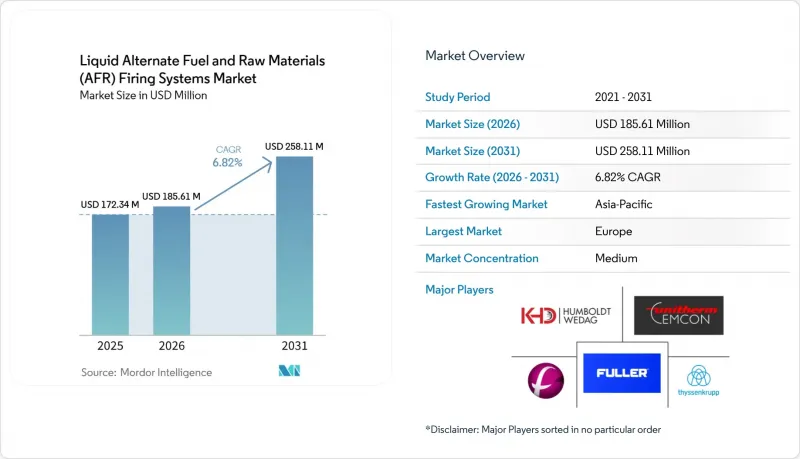
據 Mordor Intelligence 稱,2025 年液態替代燃料和原料 (AFR) 燃燒系統的市場規模為 1.7234 億美元,預計到 2031 年將達到 2.5811 億美元,而 2026 年為 1.8561 億美元,在預測期成長率(2026-2031 年為複合年成長率(2026-2032%)。
本報告按燃燒器系統類型(迴轉窯主燃燒器、煅燒爐主燃燒器、多點燃燒器等)、燃料類型(廢油、廢溶劑、液態生質能/生質油)、終端用戶產業(水泥、石灰、垃圾焚化發電、紙漿和造紙等)以及地區(北美、歐洲、亞太、南美、中東和非洲)進行細分。市場預測以美元計價。
全球替代液體燃料和原料(AFR)燃燒系統市場趨勢和洞察。
強制脫碳和避免排放成本
碳定價機制的引入將改變窯爐的運作成本,使低碳燃料的使用更具吸引力。歐盟排放交易體系(ETS)為水泥生產商提供經濟誘因,鼓勵他們以低碳或部分生物來源的液體取代燃料取代石化燃料燃料。在豪瑞集團位於埃克勒彭斯的工廠,使用廢油和動物脂肪在六個月內將熱替代率從70%提高到近95%。這項改變每年減少了4萬噸淨二氧化碳排放量。中國已將水泥生產商納入國家碳排放交易體系,並於2025年6月發布了企業層面的替代燃料計算指南。這些法規正在推動液體替代燃料燃燒系統市場對能夠測量和記錄燃料使用和排放量的控制系統的需求。
石化燃料價格波動與能源安全
能源成本佔水泥生產成本的40%,使得生產商極易受到煤炭和石油焦價格波動的影響。採用利用廢油和溶劑的柔軟性系統可以緩解傳統燃料價格上漲的影響。一項2026年的研究發現,以含油污泥取代40%的燃料,可將傳統生產成本從每噸392.89元人民幣降至每噸358.45元人民幣,並將二氧化碳排放量減少13.17%。這表明,中東和非洲(MEA)以及南亞的進口燃料市場正在考慮使用液體替代燃料,以確保供應穩定並控制碳排放。 2025年,富勒科技公司對其FUELFLEX熱解器進行了評估,可用於在水泥廠利用廢棄物和RDF(固態廢棄物燃料)生產熱解油。現場生產降低了液體AFR燃燒系統市場對外部液體燃料供應鏈的依賴。
高昂的維修資本支出和複雜的整合
在傳統窯爐中,安全地混燒液態替代燃料並非僅僅更換燃燒器那麼簡單。必要的設備包括雙流體噴嘴、預熱迴路、供料監控、緊急切斷裝置和整合控制系統。這些要求使得全面維修高昂,直到能夠實現營運成本的降低。 2025年的一項研究表明,資本投資成本和技術整合仍然是持續存在的障礙,尤其是在缺乏碳定價獎勵的低收入市場。澳洲水泥公司2026年一項耗資7,750萬澳元的窯爐維修計畫需要停產45天,這清楚地表明了為什麼一些營運商推遲大規模轉型。這種限制導致液態替代燃料燃燒系統市場更傾向於分階段混燒,尤其是在南美洲和東南亞部分地區。
細分市場分析
截至2025年,用於迴轉窯的主燃燒器式液態AFR系統佔據了液態AFR燃燒系統市場47.3%的佔有率。這一地位反映了主燃燒器在水泥熱處理過程中作為主要熱源的作用。由於其廣泛的安裝歷史和明確的運作功能,大多數窯爐現代化改造專案都從這裡開始。主燃燒器可以在現有工廠佈局中同時燃燒液態、固體和氣態燃料。對於旨在擺脫傳統石化燃料的工廠而言,引入主燃燒器是切實可行的第一步。然而,除非工廠增加衛星式或多點式供熱能力,否則主燃燒器的替代率通常保持在50-60%。正是由於這種局限性,營運商正在考慮更廣泛的噴射配置方案。
預計從2026年到2031年,多點液態AFR燃燒系統將以7.7%的複合年成長率成長。這些系統將液態燃料分配到煅燒爐、主燃燒器和衛星噴射點。這種配置使操作人員能夠根據燃料品質和窯爐負荷調整燃燒。 2026年的一項研究發現,與單一燃料基準情況相比,特定的液態燃料和廢棄物混合比例可減少高達93.29%的CO排放。歐洲排放監測要求也建議採用精確且可追溯的噴射控制的系統。煅燒爐系統仍然是主要類別,因為它們可以在煅燒爐前區實現80-100%的熱替代率。 KHD的「Pyrorotor」裝置展示了煅燒爐設備如何處理低品質燃料流。其他系統包括衛星燃燒器,它們以較低的投資提供額外的替代效果。
區域分析
到2025年,歐洲將佔據液態混合燃料燃燒系統41.3%的市場。歐盟的碳排放成本、減少垃圾掩埋廢棄物的要求以及完善的廢棄物將保障液態燃料的穩定供應。法國、德國、義大利、波蘭和西班牙是該地區的主要大宗市場。奧地利和瑞士在熱力替代方面表現出色。霍爾希姆位於埃克勒彭茨的工廠在短短六個月內就實現了近95%的替代率,每年淨減少二氧化碳排放4萬噸。預計到2020年代末,歐洲即將實施的「工業排放指令」將增加對監控和控制設備的投入。
預計亞太地區2026年至2031年的複合年成長率將達到8.7%,在所有區域市場中成長最高。中國將水泥納入全國碳市場,為投資替代燃料提供了更清晰的財務基礎。 KHD於2025年12月為康迪集團寶山工廠運作了第二套熱風轉子系統。康迪集團隨後表示,將考慮在集團內部進一步部署該系統。印尼Semen Baturaja公司在2024年將其替代燃料比例(包括液體燃料)提高了41%,使其熱替代率達到3.18%。該公司位於印度的工廠熱替代率平均僅3-5%,這意味著仍有足夠的空間部署更多系統。
北美、南美以及中東和非洲(MEA)的需求狀況各不相同。 2024年,北美平均熱能替代率為16%,而歐洲則高達52%,顯示穩定的燃料供應比碳定價更具推動力。在南美,循環經濟計劃和對燃燒系統的投資正在推動這一趨勢。中東和非洲地區為燃料轉換提供了直接機遇,但專案取決於當地政策和資金可用性。 2025年8月,中材集團與卡西姆水泥公司簽署了一份價值1200萬美元的EPC契約,將其位於布賴達的工廠生產線從原油燃燒改為天然氣燃燒。該項目工期為15個月。
其他好處:
- Excel格式的市場預測(ME)表
- 3個月的分析師支持
目錄
第1章:引言
- 市場分析與定義的前提條件
- 分析範圍
第2章 分析方法
第3章執行摘要
第4章 市場狀況
- 市場概覽
- 市場促進因素
- 強制脫碳和避免排放成本
- 石化燃料價格波動與能源安全優先事項
- 循環經濟和減少廢棄物掩埋的要求
- 水泥廠現代化改造與熱能取代目標
- 液態空燃比調節劑規格的波動推動了對自適應霧化技術的需求。
- 以本地為中心的廢棄物物流和原料的季節性供應
- 市場限制因素
- 高昂的維修投資成本和複雜的整合過程
- 燃料品質波動和製程不穩定性風險
- 與處理危險液體相關的許可和法律責任風險
- 由於雜質和燃燒器噴嘴磨損造成的腐蝕。
- 價值鏈分析
- 監理情勢
- 技術展望
- 波特五力分析
第5章:預測市場規模與成長率
- 按下燃燒器系統類型
- 迴轉窯主燃燒器類型:液體AFR系統
- 煅燒爐式液態空燃比燃燒系統
- 多點液體空燃比燃燒系統
- 其他
- 按燃料類型
- 廢油
- 用過的溶劑、液態化學殘留物
- 液態生質能/生質油
- 污水污泥和可泵送泥漿
- 其他
- 按最終用戶行業分類
- 水泥業
- 石灰產業
- 垃圾焚化發電發電廠
- 紙漿和造紙業
- 其他工業窯爐和熔爐
- 按地區
- 北美洲
- 美國
- 加拿大
- 墨西哥
- 歐洲
- 德國
- 法國
- 義大利
- 西班牙
- 英國
- 波蘭
- 俄羅斯
- 其他歐洲國家
- 亞太地區
- 中國
- 印度
- 日本
- 韓國
- 澳洲
- 印尼
- 越南
- 泰國
- 其他亞太國家
- 南美洲
- 巴西
- 阿根廷
- 智利
- 其他南美國家
- 中東和非洲
- 沙烏地阿拉伯
- 阿拉伯聯合大公國
- 埃及
- 南非
- 摩洛哥
- 其他中東和非洲國家
- 北美洲
第6章 競爭情勢
- 市場集中度
- 策略趨勢
- 市佔率分析
- 公司簡介
- A TEC Production & Services GmbH
- Dynamis Ltd.
- FCT Combustion Pty Ltd
- Fives Group
- Fuller Technologies, Inc.
- GRECO Combustion Systems Europe GmbH
- KHD Humboldt Wedag International AG
- SATAREM SA
- Sinoma International Engineering Co., Ltd.
- thyssenkrupp Polysius GmbH
- Unitherm Cemcon Feuerungsanlagen GmbH
第7章 市場機會與未來展望
According to Mordor Intelligence, the liquid alternate fuel and Raw Materials Firing Systems Market size was valued at USD 172.34 million in 2025 and is estimated to grow from USD 185.61 million in 2026 to reach USD 258.11 million by 2031, at a CAGR of 6.82% during the forecast period (2026-2031).
This report is Segmented by Burner and System Type (Rotary Kiln Main Burner, Calciner, Multi-Point, Others), Fuel Type (Waste Oils, Used Solvents, Liquid Biomass/Bio-Oils, Others), End-User Industry (Cement, Lime, Waste-To-Energy, Pulp & Paper, Others), and Geography (North America, Europe, Asia-Pacific, South America, and Middle East and Africa). The Market Forecasts are Provided in Terms of Value (USD).
Global Liquid Alternate Fuel and Raw Materials (AFR) Firing Systems Market Trends and Insights
Decarbonization Mandates and Emissions Cost Avoidance
Carbon pricing changes the cost of operating a kiln and makes lower-carbon fuel inputs more attractive. The EU Emissions Trading System gives cement producers a financial reason to replace fossil fuels with liquid alternative fuels that have lower or partly biogenic carbon content. Holcim's Eclepens plant increased its thermal substitution rate from 70% to nearly 95% within 6 months by expanding waste oil and animal fat use. The change reduced net CO2 emissions by 40,000 tonnes annually. China included cement producers in its national carbon emissions trading scheme and issued enterprise-level guidance for alternative-fuel accounting in June 2025. These rules increase demand in the Liquid AFR firing systems market for control systems that can measure and document fuel use and emissions.
Fossil Fuel Price Volatility and Energy Security
Energy represented 40% of cement production costs, leaving producers exposed to coal and petcoke price movements. Flexible systems that use waste oils and solvents can reduce that exposure when conventional fuel prices increase. A 2026 study found that replacing 40% of fuel with oily sludge reduced conventional production costs from CNY 392.89 to CNY 358.45 per tonne and reduced CO2 emissions by 13.17%. The result shows why imported-fuel markets in MEA and South Asia are considering liquid alternative fuels for supply security as well as for carbon management. Fuller Technologies evaluated its FUELFLEX Pyrolyzer in 2025 to produce pyrolysis oil from waste and RDF at cement plants. On-site production can reduce the Liquid AFR firing systems market's dependence on external liquid fuel supply chains.
High Retrofit Capital Expenditure and Integration Complexity
A legacy kiln needs more than a burner replacement to co-fire liquid alternative fuels safely. The required equipment can include dual-fluid atomization nozzles, preheating circuits, feed monitoring, emergency isolation, and control-system integration. These requirements make a full retrofit expensive before operating savings are realized. Research published in 2025 identified capital cost and technical integration as continuing barriers, particularly in lower-income markets without carbon-pricing incentives. Cement Australia's AUD 77.5 million kiln upgrade required a 45-day shutdown in 2026, illustrating why some operators delay extensive conversions. This constraint favors gradual co-firing in the Liquid AFR firing systems market, especially in South America and parts of Southeast Asia.
Other drivers and restraints analyzed in the detailed report include:
- Circular Economy and Landfill Diversion Requirements
- Cement Plant Modernization and Thermal Substitution Targets
- Variable Fuel Quality and Process Instability Risk
For complete list of drivers and restraints, kindly check the Table Of Contents.
Segment Analysis
Rotary Kiln Main Burner Liquid AFR Systems held 47.3% of the Liquid AFR firing systems market size in 2025. Their position reflects the main burner's role as the primary heat source in cement pyroprocessing. Most kiln modernization projects begin with this location because it has a large installed base and a clear operating role. Main burners can co-fire liquid, solid, and gaseous fuels in established plant layouts. Their use provides a practical first step for plants that are moving away from conventional fossil fuels. However, main burner substitution normally reaches 50-60% unless the plant adds satellite or multi-point capability. This limitation creates a reason for operators to consider more extensive injection configurations.
Multi-Point Liquid AFR Firing Systems are expected to grow at a 7.7% CAGR from 2026 to 2031. They distribute liquid fuel across the calciner, main burner, and satellite injection locations. This arrangement lets the operator adjust combustion to fuel quality and kiln load. A 2026 study found that specific mixed liquid-waste ratios can reduce CO emissions by as much as 93.29% against single-fuel baseline cases. European emissions-monitoring requirements also favor systems that offer precise and traceable injection control. Calciner systems remain another major category because they can achieve 80-100% thermal substitution in the precalciner zone. KHD's Pyrorotor installations demonstrate how calciner equipment can process lower-quality fuel streams. Other systems include satellite burners that provide a lower-capital route to incremental substitution gains.
Complete Report Scope:
- By Burner and System Type
- Rotary Kiln Main Burner Liquid AFR Systems
- Calciner Liquid AFR Firing Systems
- Multi-Point Liquid AFR Firing Systems
- Others
- By Fuel Type
- Waste Oils
- Used Solvents and Liquid Chemical Residues
- Liquid Biomass and Bio-Oils
- Sewage Sludge and Pumpable Slurries
- Others
- By End-User Industry
- Cement Industry
- Lime Industry
- Waste-to-Energy Plants
- Pulp & Paper Industry
- Other Industrial Kilns and Furnaces
- By Geography
- North America
- United States
- Canada
- Mexico
- Europe
- Germany
- France
- Italy
- Spain
- United Kingdom
- Poland
- Russia
- Rest of Europe
- Asia-Pacific
- China
- India
- Japan
- South Korea
- Australia
- Indonesia
- Vietnam
- Thailand
- Rest of Asia-Pacific
- South America
- Brazil
- Argentina
- Chile
- Rest of South America
- Middle East and Africa
- Saudi Arabia
- United Arab Emirates
- Egypt
- South Africa
- Morocco
- Rest of Middle East and Africa
- North America
Geography Analysis
Europe held 41.3% of the Liquid AFR firing systems market share in 2025. EU carbon costs, landfill-diversion requirements, and long-established waste infrastructure support a consistent liquid fuel supply. France, Germany, Italy, Poland, and Spain are the region's main high-volume markets. Austria and Switzerland have demonstrated high thermal substitution performance. Holcim's Eclepens plant reached nearly 95% substitution within 6 months and reduced net CO2 output by 40,000 tonnes a year. Europe's upcoming Industrial Emissions Directive requirements are likely to increase spending on monitoring and control equipment through the late 2020s.
Asia-Pacific is projected to expand at an 8.7% CAGR from 2026 to 2031, the fastest rate among the geographic segments. China's inclusion of cement in its national carbon market gives alternative-fuel investments a clearer financial basis. KHD commissioned its second Pyrorotor system for Conch Group's Baoshan plant in December 2025. Conch then stated that it would assess further installations across its network. Indonesia's Semen Baturaja increased liquid-inclusive AFR use by 41% in 2024 and raised thermal substitution to 3.18%. India's plants averaged 3-5% thermal substitution, leaving material capacity for additional system adoption.
North America, South America, and MEA have different demand conditions. North America's average thermal substitution rate was 16% in 2024, compared with 52% in Europe, and fuel security remains a stronger motivation than carbon pricing. South America is building momentum through circular-economy initiatives and combustion-system investment. The Middle East and Africa have direct fuel-conversion opportunities, but projects are shaped by local policy and capital availability. Sinoma signed a USD 12 million EPC contract with Qassim Cement in August 2025 to convert Buraydah plant lines from crude oil firing to natural gas. The project had a 15-month schedule.
- A TEC Production & Services GmbH
- Dynamis Ltd.
- FCT Combustion Pty Ltd
- Fives Group
- Fuller Technologies, Inc.
- GRECO Combustion Systems Europe GmbH
- KHD Humboldt Wedag International AG
- SATAREM S.A.
- Sinoma International Engineering Co., Ltd.
- thyssenkrupp Polysius GmbH
- Unitherm Cemcon Feuerungsanlagen GmbH
Additional Benefits:
- The market estimate (ME) sheet in Excel format
- 3 months of analyst support
TABLE OF CONTENTS
1 INTRODUCTION
- 1.1 Study Assumptions and Market Definition
- 1.2 Scope of the Study
2 RESEARCH METHODOLOGY
3 EXECUTIVE SUMMARY
4 MARKET LANDSCAPE
- 4.1 Market Overview
- 4.2 Market Drivers
- 4.2.1 Decarbonization Mandates and Emissions-Cost Avoidance
- 4.2.2 Fossil-Fuel Price Volatility and Energy-Security Priorities
- 4.2.3 Circular-Economy and Landfill-Diversion Requirements
- 4.2.4 Cement-Plant Modernization and Thermal Substitution Targets
- 4.2.5 Liquid AFR Specification Variability Driving Adaptive Atomization Demand
- 4.2.6 Localized Waste Logistics and Seasonal Feedstock Availability
- 4.3 Market Restraints
- 4.3.1 High Retrofit Capex and Integration Complexity
- 4.3.2 Variable Fuel Quality and Process-Instability Risk
- 4.3.3 Hazardous-Liquid Handling Permitting and Liability Exposure
- 4.3.4 Contaminant-Driven Corrosion and Burner-Tip Wear
- 4.4 Value Chain Analysis
- 4.5 Technology Outlook
- 4.6 Regulatory Landscape
- 4.7 Porter's Five Forces Analysis
- 4.7.1 Bargaining Power of Suppliers
- 4.7.2 Bargaining Power of Buyers
- 4.7.3 Threat of New Entrants
- 4.7.4 Threat of Substitutes
- 4.7.5 Competitive Rivalry
5 MARKET SIZE AND GROWTH FORECASTS
- 5.1 By Burner and System Type
- 5.1.1 Rotary Kiln Main Burner Liquid AFR Systems
- 5.1.2 Calciner Liquid AFR Firing Systems
- 5.1.3 Multi-Point Liquid AFR Firing Systems
- 5.1.4 Others
- 5.2 By Fuel Type
- 5.2.1 Waste Oils
- 5.2.2 Used Solvents and Liquid Chemical Residues
- 5.2.3 Liquid Biomass and Bio-Oils
- 5.2.4 Sewage Sludge and Pumpable Slurries
- 5.2.5 Others
- 5.3 By End-User Industry
- 5.3.1 Cement Industry
- 5.3.2 Lime Industry
- 5.3.3 Waste-to-Energy Plants
- 5.3.4 Pulp & Paper Industry
- 5.3.5 Other Industrial Kilns and Furnaces
- 5.4 By Geography
- 5.4.1 North America
- 5.4.1.1 United States
- 5.4.1.2 Canada
- 5.4.1.3 Mexico
- 5.4.2 Europe
- 5.4.2.1 Germany
- 5.4.2.2 France
- 5.4.2.3 Italy
- 5.4.2.4 Spain
- 5.4.2.5 United Kingdom
- 5.4.2.6 Poland
- 5.4.2.7 Russia
- 5.4.2.8 Rest of Europe
- 5.4.3 Asia-Pacific
- 5.4.3.1 China
- 5.4.3.2 India
- 5.4.3.3 Japan
- 5.4.3.4 South Korea
- 5.4.3.5 Australia
- 5.4.3.6 Indonesia
- 5.4.3.7 Vietnam
- 5.4.3.8 Thailand
- 5.4.3.9 Rest of Asia-Pacific
- 5.4.4 South America
- 5.4.4.1 Brazil
- 5.4.4.2 Argentina
- 5.4.4.3 Chile
- 5.4.4.4 Rest of South America
- 5.4.5 Middle East and Africa
- 5.4.5.1 Saudi Arabia
- 5.4.5.2 United Arab Emirates
- 5.4.5.3 Egypt
- 5.4.5.4 South Africa
- 5.4.5.5 Morocco
- 5.4.5.6 Rest of Middle East and Africa
- 5.4.1 North America
6 COMPETITIVE LANDSCAPE
- 6.1 Market Concentration
- 6.2 Strategic Moves
- 6.3 Market Share Analysis
- 6.4 Company Profiles (includes Global Level Overview, Market Level Overview, Core Segments, Financials as available, Strategic Information, Market Rank/Share, Products and Services, Recent Developments)
- 6.4.1 A TEC Production & Services GmbH
- 6.4.2 Dynamis Ltd.
- 6.4.3 FCT Combustion Pty Ltd
- 6.4.4 Fives Group
- 6.4.5 Fuller Technologies, Inc.
- 6.4.6 GRECO Combustion Systems Europe GmbH
- 6.4.7 KHD Humboldt Wedag International AG
- 6.4.8 SATAREM S.A.
- 6.4.9 Sinoma International Engineering Co., Ltd.
- 6.4.10 thyssenkrupp Polysius GmbH
- 6.4.11 Unitherm Cemcon Feuerungsanlagen GmbH
7 MARKET OPPORTUNITIES AND FUTURE OUTLOOK
- 7.1 White-Space and Unmet-Need Assessment

 2026年全球電子燃料市場報告
 全球電子燃料市場規模、佔有率、趨勢和成長分析報告(2026-2034)
 全球合成燃料(電子燃料、電轉液)市場:按燃料類型、技術、應用和最終用戶分類-市場規模、產業動態、機會分析和預測(2026-2035 年)2026年全球合成燃料(電子燃料)核准市場報告
 2026-2030年全球電子燃料市場
 合成燃料市場預測—按燃料類型、製造技術、原料、應用、最終用戶和地區分類的全球分析—2034年電子燃料市場預測—全球產品、狀態、轉化流程、原料、最終用戶和地區分析—2034年
 電子燃料市場:2026-2032年全球預測(依技術類型、原料、生產規模、應用及通路分類)全球電子燃料(合成燃料)市場:市場規模、市場佔有率、成長率、產業分析、類型、應用和區域分析以及未來預測(2026-2034)
 電子燃料市場規模、佔有率和趨勢分析報告:按產品、狀態、生產方法、技術、最終用途、碳源、碳捕獲類型、地區和細分市場預測(2026-2050 年)