


 |
市場調查報告書
商品編碼
2119031
高密度聚乙烯(HDPE)管材:市場佔有率分析、產業趨勢與統計、成長預測(2026-2031)HDPE Pipes - Market Share Analysis, Industry Trends & Statistics, Growth Forecasts (2026 - 2031) |
||||||

※ 本網頁內容可能與最新版本有所差異。詳細情況請與我們聯繫。
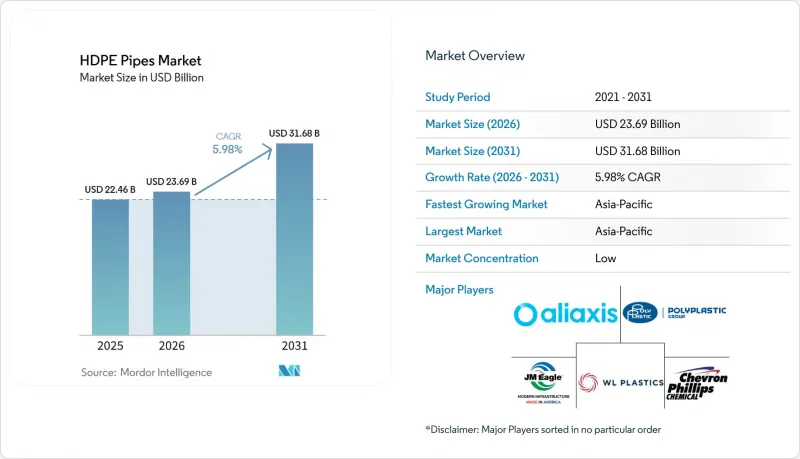
據 Mordor Intelligence 稱,2025 年 HDPE 管道市值為 224.6 億美元,預計到 2031 年將達到 316.8 億美元,而 2026 年為 236.9 億美元,預測期內(2026-2031 年)的複合成長率預計為 5.98%。
本報告按等級(PE 100、PE 63、PE 80)、直徑(小於 110 毫米、110–500 毫米、大於 500 毫米)、應用(供水和配水、廢水、污水、排水、灌溉等)、終端用戶產業(市政公用事業、農業等)和地區(亞太地區、北美等)進行細分。市場預測以美元計價。
全球高密度聚乙烯(HDPE)管道市場趨勢及洞察
地方政府供水和污水處理基礎設施擴建
市政供水和污水處理投資是高密度聚乙烯(HDPE)管道的最大需求來源。美國環保署(EPA)在2025年的研究中估計,未來20年供水和輸水基礎設施的維修需求將達到4,229億美元。 《基礎設施投資與就業法案》透過飲用水州循環基金撥款310億美元,用於支持飲用水投資和鉛水管的更換。印度的「飲用水生命線計畫」(Jal Jeevan Mission)強制要求農村供水幹管使用PE 100標準、尺寸比(SDR)17和公稱壓力(PN)10的管道。這些公共項目確保了監管、公共衛生和氣候變遷適應能力的要求與可靠的採購流程相銜接。因此,HDPE管道市場受私人建設週期的影響較小。
老舊腐蝕管道基礎設施的更新
在成熟經濟體中,鑄鐵管、石棉水泥管和腐蝕的球墨鑄鐵管的更換正在推動對高密度聚乙烯(HDPE)管道的需求。美國土木工程師協會(ASCE)在2025年的報告中指出,美國約有20%的供水幹管將超過其使用壽命。該評估還指出,由於管道老化,每年將造成33.3兆加侖的漏水,並導致供水事業損失超過1,870億美元的收入。 2025年,EYDAP啟動了一項耗資5億歐元的管線更新項目,涵蓋雅典600-700公里的供水管網。聯合公用事業公司(United Utilities)也在2025年簽署了一份價值30億英鎊的契約,用於維修150公里長的霍斯沃特輸水渠,該項目計劃於2026年開工。隨著腐蝕故障的不斷發生導致漏水量增加,從生命週期角度來看,HDPE管的更換變得越來越重要。
熱膨脹和溫度使用限制
樹脂價格波動仍然是高密度聚乙烯(HDPE)管道市場面臨的一項緊迫營運挑戰。長期公共基礎設施合約可能會限制製造商收回不斷上漲的原料成本的能力。對於不採用期貨購買或其他價格管制措施的生產者而言,這種風險更為嚴重。亞洲依賴石腦油裂解裝置的獲利能力仍然容易受到中東航運路線中斷的影響。此外,HDPE在高溫、表面暴露的工業應用中的熱性能有其限制。這些限制使得在超出HDPE使用要求的製程條件下,替代材料仍發揮重要作用。
細分市場分析
預計到2025年,PE 100將佔全球市場佔有率的66.32%,並將以6.61%的複合年成長率成長至2031年。 PE 100受益於基於ISO 4427標準的10 MPa最低強度要求(MRS)。與低等級產品相比,此標準允許在相同壓力水平下使用壁更薄的產品。現代雙峰PE 100化合物可有效防止裂紋緩慢擴展及氧化老化,其設計壽命可達100年。歐洲和北美的公共採購架構擴大指定使用PE 100作為新建耐壓水基礎設施的材料。
抗壓強度為 8 MPa 的 PE 80 仍廣泛應用於燃氣管道以及中低壓供水系統。雖然 PE 63 在承壓應用領域的市場佔有率有所下降,但它在農業支管和低壓家用供水管道中仍然發揮著重要作用。根據 2025 年的一項調查,厚壁 PE 100 對接熔接技術的進步正在擴大其在海水淡化、火力發電和核能管道等領域的應用。這促使 PE 100 在先前使用低等級產品的領域中得到更廣泛的應用。因此,隨著設計人員對接頭品質的信心增強,高密度聚乙烯 (HDPE) 管道市場正在轉向更高性能等級的產品。
到2025年,110-500毫米規格的管道將佔全球市場價值的47.24%。此規格的管道在各地區的高密度聚乙烯(HDPE)管道市場中佔據重要佔有率,主要用於城市供水、污水收集和農業灌溉幹管。預計到2031年,500毫米以上規格的管道將以6.84%的複合年成長率成長。大規模輸水管道和海上能源電纜的保護是推動這一成長的主要因素。 110毫米以下規格的管道則用於使用者連接、小直徑灌溉支管以及通訊用微型管道系統。
對大口徑管道的需求也反映了對海上能源基礎設施的投資。波蘭能源公司 (Polenergia) 和挪威國家石油公司 (Equinor) 向波蘭的 Baltiyk 2 和 Baltiyk 3離岸風力發電運輸了四根 HDPE 管道,每根管道長度超過 1.5 公里,重量超過 200 噸。這兩個項目的總裝置容量為 1440 兆瓦,預計將於 2028 年投入商業運營,屆時將為波蘭超過 200 萬戶家庭供電。 2025 年,沙烏地阿拉伯工業城市吉讚的一個海水冷卻計畫安裝了一根直徑 3.5 公尺的 HDPE 海底取水管道。這些應用也代表了另一個對 HDPE 管道的需求來源。
區域分析
預計到2025年,亞太地區將佔全球市場規模的44.92%,並在2031年之前以6.75%的複合年成長率成長。在中國,都市區管道現代化和工業園區公用設施擴建工程正在進行中。在印度,「Jal Jeevan Mission」計畫正在推廣購買用於農村供水的PE 100 SDR 17管道,而「PM Krishi Sinchayee Yojana」計畫則在支持農業灌溉管道的需求。日本和韓國則致力於提高抗震性能並更換老化的金屬管道網路。
由於政策相關的水利基礎設施支出,北美在HDPE管道市場佔據重要地位。美國環保署(EPA)2025年更新報告估計,未來20年飲用水投資需求將達到6,250億美元,比2018年的評估結果成長30%。飲用水州輪換基金(DWSRF)的310億美元預算撥款用於支持飲用水分配和鉛水管道的維修。在歐洲,市場成長的驅動力來自20世紀管線網路的現代化改造以及對《飲用水指令》的遵守。歐盟委員會在其凝聚政策計畫下,於2021年至2027年撥款3,920億歐元(約4,461.2億美元)用於水資源取得和永續水資源管理。
在南美洲,尤其是巴西,農產品灌溉需求與城市基礎設施現代化密切相關;而在中東和非洲,以專案主導的商業機會則更為顯著,主要體現在供水、區域冷卻管道和光纖基礎設施等領域。沙烏地阿拉伯國家水務局於2025年授予了一份價值2.2億美元的水利基礎設施契約,其中包括97.66公里長的HDPE(高密度聚乙烯)輸水管道,直徑範圍從110毫米到400毫米不等。 2026年7月,Al-Waseir Industrial公司簽署了一份價值1282萬沙烏地裡亞爾(約合340萬美元)的契約,為阿卜杜拉國王經濟城各期基礎設施建設提供HDPE管道。 「沙烏地阿拉伯2030願景」計劃下的計畫(例如NEOM、紅海和吉迪亞)為供水、區域供冷管道和光纖基礎設施提供了多年期HDPE採購計畫儲備。撒哈拉以南非洲的供水開發計畫和海灣合作理事會國家海水淡化廠的擴建正在滿足這些地區的需求,而這些地區在高鹽度、乾旱的環境中,使用金屬管道系統面臨挑戰。
其他好處:
- Excel格式的市場預測(ME)表
- 3個月的分析師支持
目錄
第1章:引言
- 市場分析與定義的前提條件
- 分析範圍
第2章 分析方法
第3章執行摘要
第4章 市場狀況
- 市場概覽
- 市場促進因素
- 地方政府供水和污水處理基礎設施擴建
- 對存在老化和腐蝕風險的管道基礎設施進行更新。
- 節水灌溉系統中HDPE管道的廣泛應用
- 高壓應用領域對高性能PE100管道的需求不斷成長。
- 擴大非開挖管道維修和熔接高密度聚乙烯系統的應用。
- 市場限制因素
- 聚乙烯樹脂價格波動會影響生產成本。
- 與PVC管、球墨鑄鐵管、鋼管和混凝土管競爭。
- 熱膨脹及其對溫度和運作條件的限制
- 價值鏈分析
- 波特五力分析
第5章:預測市場規模與成長率
- 按年級
- PE 100
- PE 63
- PE 80
- 依直徑
- 小於 110 毫米
- 110~500 mm
- 500毫米或以上
- 透過使用
- 供水/配水
- 污水、污水、排水
- 灌溉
- 石油和天然氣
- 工業管道
- 化學處理
- 雨水管理
- 通訊和電力管道
- 其他用途
- 按最終用途行業分類
- 地方政府和公用事業
- 農業
- 石油和天然氣
- 產業
- 建造
- 礦業
- 可再生能源
- 其他終端用戶產業
- 按地區
- 亞太地區
- 中國
- 印度
- 日本
- 韓國
- 其他亞太國家
- 北美洲
- 美國
- 加拿大
- 墨西哥
- 歐洲
- 德國
- 英國
- 法國
- 義大利
- 俄羅斯
- 其他歐洲國家
- 南美洲
- 巴西
- 阿根廷
- 其他南美國家
- 中東和非洲
- 沙烏地阿拉伯
- 南非
- 其他中東和非洲國家
- 亞太地區
第6章 競爭情勢
- 市場集中度
- 策略趨勢
- 市佔率和排名分析
- 公司簡介
- Aliaxis Holdings SA
- Astral Limited
- Chevron Phillips Chemical Company LLC
- China Lesso
- Finolex Industries Limited
- GF Industry and Infrastructure Flow Solutions
- JM EAGLE, INC.
- KWH Pipe Oy
- Orbia
- Pipelife International GmbH
- POLYPLASTIC Group
- Prinsco, Inc.
- Radius Systems
- Supreme Industries Limited
- WL Plastics
第7章 市場機會與未來展望
According to Mordor Intelligence, the HDPE pipes market size was valued at USD 22.46 billion in 2025 and estimated to grow from USD 23.69 billion in 2026 to reach USD 31.68 billion by 2031, at a CAGR of 5.98% during the forecast period (2026-2031).
This report is Segmented by Grade (PE 100, PE 63, and PE 80), Diameter (Less Than 110 Mm, 110-500 Mm, and Above 500 Mm), Application (Water Supply and Distribution, Wastewater, Sewage and Drainage, Irrigation, and More), End-Use Industry (Municipal and Public Utilities, Agriculture, and More), and Geography (Asia-Pacific, North America, and More). The Market Forecasts are Provided in Terms of Value (USD).
Global HDPE Pipes Market Trends and Insights
Expansion of Municipal Water Supply and Wastewater Infrastructure
Municipal water and wastewater investment provides the largest demand base for the HDPE pipes market. The U.S. Environmental Protection Agency identified USD 422.9 billion in distribution and transmission rehabilitation needs over 20 years in its 2025 survey. The Infrastructure Investment and Jobs Act appropriated USD 31 billion through the Drinking Water State Revolving Fund to support drinking water investment and lead service line replacement. India's Jal Jeevan Mission specifies PE 100 Standard Dimension Ratio (SDR) 17, Nominal Pressure (PN) 10 pipe for rural water distribution mains. These public programs turn regulatory, public-health, and climate-resilience requirements into committed procurement. The resulting work reduces the HDPE pipes market's exposure to private construction cycles.
Replacement of Aging and Corrosion-Prone Pipeline Infrastructure
Replacement of cast iron, asbestos cement, and corroding ductile iron pipelines supports the HDPE pipes market demand in mature economies. The American Society of Civil Engineers reported in 2025 that nearly 20% of installed U.S. water mains had exceeded their useful service lives. Its assessment also cited more than 33.3 trillion gallons of annual water loss and more than USD 187 billion in lost utility revenue from failing networks. EYDAP began a EUR 500 million pipeline replacement program for 600-700 km of network in Athens during 2025. United Utilities signed a GBP 3 billion agreement in 2025 to refurbish the 150 km Haweswater Aqueduct, with construction beginning in 2026. Repeated corrosion failures increase water losses and strengthen the life-cycle case for HDPE replacement.
Thermal Expansion and Temperature-Service Limitations
Resin price volatility remains an immediate operational challenge for the HDPE pipes market. Long-term public infrastructure contracts can limit the ability of manufacturers to recover feedstock cost increases. This exposure is more acute for producers without forward-purchase or other price-management arrangements. Naphtha-dependent cracker economics in Asia remain sensitive to disruptions affecting Middle-East shipping routes. HDPE also has thermal performance limits in above-grade, high-temperature industrial applications. These limits preserve a role for alternative materials in process conditions that exceed HDPE service requirements.
Other drivers and restraints analyzed in the detailed report include:
- Increasing Adoption of HDPE Pipes for Water-Efficient Irrigation Systems
- Growing Demand for High-Performance PE 100 Pipes and Fusion-Jointed Systems
- Competition from PVC, Ductile Iron, Steel, and Concrete Pipes
For complete list of drivers and restraints, kindly check the Table Of Contents.
Segment Analysis
PE 100 accounted for 66.32% of global value in 2025 and is projected to expand at a 6.61% CAGR through 2031. PE 100 benefits from its 10 MPa Minimum Required Strength (MRS) rating under ISO 4427. That rating permits thinner wall sections at comparable pressure levels than lower grades. Modern bimodal PE 100 compounds address slow crack growth and oxidative aging over a 100-year design horizon. Public procurement frameworks in Europe and North America increasingly specify PE 100 for new pressure-rated water infrastructure.
PE 80, with an MRS of 8 MPa, continues to serve gas distribution and low-to-medium-pressure water systems. PE 63 is losing ground in pressure applications but remains relevant in agricultural laterals and low-pressure domestic supply lines. A 2025 review found that butt fusion advancements for thick-wall PE 100 are extending its use in desalination, thermal power, and nuclear pipeline applications. This supports wider adoption of PE 100, where lower grades were previously used. The HDPE pipes market is therefore shifting toward higher-performance grades as designers gain confidence in joint quality.
The 110-500 mm range held 47.24% of the global value in 2025. This range anchors the HDPE pipes market revenue in municipal water distribution, wastewater collection, and agricultural irrigation mains across regions. Pipes above 500 mm are forecast to grow at a 6.84% CAGR through 2031. Large water transmission lines and offshore energy cable protection support this growth. Pipes below 110 mm are used in service connections, small-bore irrigation laterals, and telecom microduct systems.
Large-diameter demand also reflects investment in offshore energy infrastructure. Polenergia and Equinor transported 4 HDPE pipes, each 1.5 km long and weighing more than 200 metric tons, for the Baltyk 2 and Baltyk 3 offshore wind farms in Poland. The combined project has 1,440 MW capacity and is expected to supply electricity to more than 2 million Polish households at commercial start-up in 2028. A 3.5-meter-diameter HDPE submarine intake pipe was installed for the Jizan Industrial City seawater cooling project in Saudi Arabia during 2025. These applications provide a separate demand source for the HDPE pipes market.
Complete Report Scope:
- By Grade
- PE 100
- PE 63
- PE 80
- By Diameter
- Less Than 110 mm
- 110-500 mm
- Above 500 mm
- By Application
- Water Supply and Distribution
- Wastewater, Sewage and Drainage
- Irrigation
- Oil and Gas
- Industrial Process Piping
- Chemical Processing
- Stormwater Management
- Telecom and Power Ducting
- Other Applications
- By End-Use Industry
- Municipal and Public Utilities
- Agriculture
- Oil and Gas
- Industrial
- Construction
- Mining
- Renewable Energy
- Other End-Use Industries
- By Geography
- Asia-Pacific
- China
- India
- Japan
- South Korea
- Rest of Asia-Pacific
- North America
- United States
- Canada
- Mexico
- Europe
- Germany
- United Kingdom
- France
- Italy
- Russia
- Rest of Europe
- South America
- Brazil
- Argentina
- Rest of South America
- Middle-East and Africa
- Saudi Arabia
- South Africa
- Rest of Middle-East and Africa
- Asia-Pacific
Geography Analysis
Asia-Pacific accounted for 44.92% of global value in 2025 and is forecast to grow at 6.75% CAGR through 2031. China is pursuing urban pipeline modernization and industrial-park utility expansion. India's Jal Jeevan Mission directs rural distribution procurement toward PE 100 SDR 17 pipe, while the PM Krishi Sinchayee Yojana supports agricultural irrigation pipe demand. Japan and South Korea focus on earthquake-resilience upgrades and replacement of aging metallic networks.
North America is an important part of the HDPE pipes market because of policy-linked water infrastructure spending. The EPA's 2025 update identified USD 625 billion in 20-year drinking-water investment needs, a 30% increase from its 2018 assessment. The USD 31 billion Drinking Water State Revolving Fund (DWSRF) appropriation supports drinking-water distribution and lead service line work. Europe is driven by the replacement of 20th-century networks and Drinking Water Directive compliance, while the European Commission allocated EUR 392 billion (approximately USD 446.12 billion) under 2021-2027 Cohesion Policy programs for water access and sustainable water management.
South America, led by Brazil, combines agribusiness irrigation demand with municipal modernization, while Middle-East and Africa have a stronger project-led opportunity through water supply, district cooling ducting, and fiber infrastructure. Saudi Arabia's National Water Company awarded a USD 220 million water infrastructure contract in 2025 that included 97.66 km of HDPE water lines in 110-400 mm diameters. In July 2026, Alwasail Industrial Co. signed a SAR 12.82 million contract, equivalent to USD 3.4 million, to supply HDPE pipes for King Abdullah Economic City infrastructure phases. Saudi Vision 2030 projects, including NEOM, Red Sea, and Qiddiya, provide a multi-year HDPE procurement pipeline for water supply, district cooling ducting, and fiber infrastructure. Sub-Saharan piped-water programs and GCC desalination extensions support demand where saline and arid conditions challenge metallic pipe systems.
- Aliaxis Holdings SA
- Astral Limited
- Chevron Phillips Chemical Company LLC
- China Lesso
- Finolex Industries Limited
- GF Industry and Infrastructure Flow Solutions
- JM EAGLE, INC.
- KWH Pipe Oy
- Orbia
- Pipelife International GmbH
- POLYPLASTIC Group
- Prinsco, Inc.
- Radius Systems
- Supreme Industries Limited
- WL Plastics
Additional Benefits:
- The market estimate (ME) sheet in Excel format
- 3 months of analyst support
TABLE OF CONTENTS
1 Introduction
- 1.1 Study Assumptions and Market Definition
- 1.2 Scope of the Study
2 Research Methodology
3 Executive Summary
4 Market Landscape
- 4.1 Market Overview
- 4.2 Market Drivers
- 4.2.1 Expansion of Municipal Water Supply and Wastewater Infrastructure
- 4.2.2 Replacement of Aging and Corrosion-Prone Pipeline Infrastructure
- 4.2.3 Increasing Adoption of HDPE Pipes for Water-Efficient Irrigation Systems
- 4.2.4 Growing Demand for High-Performance PE100 Pipes in High-Pressure Applications
- 4.2.5 Increasing Adoption of Trenchless Pipeline Rehabilitation and Fusion-Jointed HDPE Systems
- 4.3 Market Restraints
- 4.3.1 Volatility in Polyethylene Resin Prices Affecting Production Costs
- 4.3.2 Competition from PVC, Ductile Iron, Steel and Concrete Pipes
- 4.3.3 Thermal Expansion and Temperature-Service Limitations
- 4.4 Value Chain Analysis
- 4.5 Porter's Five Forces Analysis
- 4.5.1 Threat of New Entrants
- 4.5.2 Bargaining Power of Suppliers
- 4.5.3 Bargaining Power of Buyers
- 4.5.4 Threat of Substitutes
- 4.5.5 Competitive Rivalry
5 Market Size and Growth Forecasts (Value)
- 5.1 By Grade
- 5.1.1 PE 100
- 5.1.2 PE 63
- 5.1.3 PE 80
- 5.2 By Diameter
- 5.2.1 Less Than 110 mm
- 5.2.2 110-500 mm
- 5.2.3 Above 500 mm
- 5.3 By Application
- 5.3.1 Water Supply and Distribution
- 5.3.2 Wastewater, Sewage and Drainage
- 5.3.3 Irrigation
- 5.3.4 Oil and Gas
- 5.3.5 Industrial Process Piping
- 5.3.6 Chemical Processing
- 5.3.7 Stormwater Management
- 5.3.8 Telecom and Power Ducting
- 5.3.9 Other Applications
- 5.4 By End-Use Industry
- 5.4.1 Municipal and Public Utilities
- 5.4.2 Agriculture
- 5.4.3 Oil and Gas
- 5.4.4 Industrial
- 5.4.5 Construction
- 5.4.6 Mining
- 5.4.7 Renewable Energy
- 5.4.8 Other End-Use Industries
- 5.5 By Geography
- 5.5.1 Asia-Pacific
- 5.5.1.1 China
- 5.5.1.2 India
- 5.5.1.3 Japan
- 5.5.1.4 South Korea
- 5.5.1.5 Rest of Asia-Pacific
- 5.5.2 North America
- 5.5.2.1 United States
- 5.5.2.2 Canada
- 5.5.2.3 Mexico
- 5.5.3 Europe
- 5.5.3.1 Germany
- 5.5.3.2 United Kingdom
- 5.5.3.3 France
- 5.5.3.4 Italy
- 5.5.3.5 Russia
- 5.5.3.6 Rest of Europe
- 5.5.4 South America
- 5.5.4.1 Brazil
- 5.5.4.2 Argentina
- 5.5.4.3 Rest of South America
- 5.5.5 Middle-East and Africa
- 5.5.5.1 Saudi Arabia
- 5.5.5.2 South Africa
- 5.5.5.3 Rest of Middle-East and Africa
- 5.5.1 Asia-Pacific
6 Competitive Landscape
- 6.1 Market Concentration
- 6.2 Strategic Moves
- 6.3 Market Share (%)/Ranking Analysis
- 6.4 Company Profiles (includes Global Overview, Market Overview, Core Segments, Financials as available, Strategic Information, Products and Services, and Recent Developments)
- 6.4.1 Aliaxis Holdings SA
- 6.4.2 Astral Limited
- 6.4.3 Chevron Phillips Chemical Company LLC
- 6.4.4 China Lesso
- 6.4.5 Finolex Industries Limited
- 6.4.6 GF Industry and Infrastructure Flow Solutions
- 6.4.7 JM EAGLE, INC.
- 6.4.8 KWH Pipe Oy
- 6.4.9 Orbia
- 6.4.10 Pipelife International GmbH
- 6.4.11 POLYPLASTIC Group
- 6.4.12 Prinsco, Inc.
- 6.4.13 Radius Systems
- 6.4.14 Supreme Industries Limited
- 6.4.15 WL Plastics
7 Market Opportunities and Future Outlook
- 7.1 White-Space and Unmet-Need Assessment

 HDPE管道市場報告:趨勢、預測和競爭分析(至2035年)
 2026-2030年全球高密度聚乙烯(HDPE)管道市場
 HDPE管道市場分析及預測(至2035年):類型、產品、應用、材料類型、最終用戶、技術、安裝類型、功能、製程、解決方案
 HDPE管道市場規模、佔有率、趨勢及預測(按類型、應用和地區分類,2026-2034年)日本高密度聚乙烯(HDPE)管材市場規模、佔有率、趨勢及預測(按類型、應用和地區分類,2026-2034年)
 HDPE管道市場規模、佔有率和成長分析(按類型、銷售管道、應用和地區分類)-2026-2033年產業預測
 HDPE微導管:全球市場佔有率和排名、總收入和需求預測(2025-2031年)
 全球高密度聚乙烯微製品市場全球高密度聚乙烯管道市場
 全球HDPE管道市場規模研究,按類型(PE 63、PE 80、PE 100)、應用(石油和天然氣、灌溉、水和廢水)和區域預測 2022-2032