


 |
市場調查報告書
商品編碼
2119029
汽車用矽膠:市場佔有率分析、產業趨勢與統計及成長預測(2026-2031 年)Automotive Silicone - Market Share Analysis, Industry Trends & Statistics, Growth Forecasts (2026 - 2031) |
||||||

※ 本網頁內容可能與最新版本有所差異。詳細情況請與我們聯繫。
根據 Mordor Intelligence 估計,2025 年汽車矽膠市值為 26.4 億美元,從 2026 年的 28.1 億美元成長到 2031 年的 39.8 億美元。
預測期(2026-2031 年)的複合年成長率預計為 7.21%。
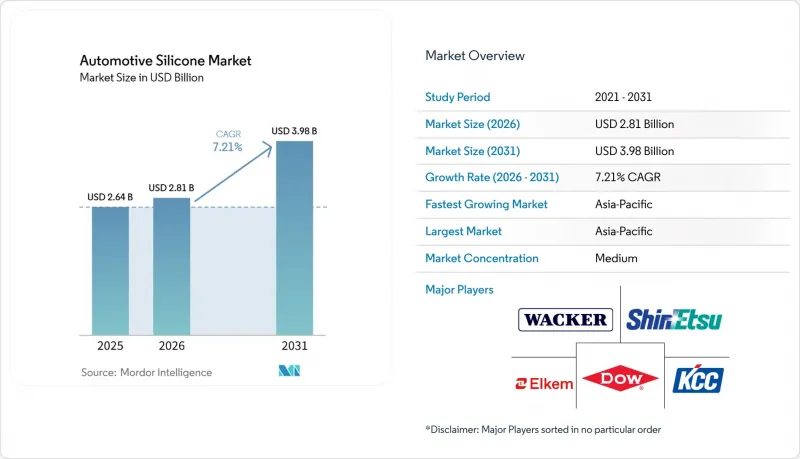
本報告按產品類型(矽橡膠、矽橡膠黏合劑和密封劑等)、車輛類型(掀背車、轎車、SUV等)、應用領域(動力傳動系統和引擎零件、電氣和電子元件等)以及地區(亞太地區、北美地區、歐洲地區、南美地區、中東和非洲地區)進行細分。市場預測以美元計價。
全球汽車矽膠市場趨勢及洞察
電動車產量的擴大正在推動對高壓密封解決方案的需求。
向 800V 電動車架構的過渡提高了電池、連接器和電力電子設備的密封要求。傳統的乙丙橡膠 (EPDM) 化合物在需要高溫高電壓下持久電絕緣的應用上有其限制。 2025 年 9 月,陶氏推出了 DOWSIL EG-4175 矽凝膠,其標稱耐熱溫度為 180 度C,適用於從 400V 過渡到 800V 的系統。汽車矽市場對能夠降低熱劣化、局部放電和電痕風險的產品的需求日益成長。低介電常數和鉑金硫化配方可以滿足高壓設備中的這些要求。這些要求使得能夠滿足電池和電力電子應用認證標準的供應商更具優勢。
汽車電子產品對溫度控管和防火安全有嚴格的要求。
為防止電池熱失控,同一電池組內需要多種保護功能。矽膠材料可用作陶瓷化泡棉、防火屏障、灌封凝膠和高黏度橡膠塗層。瓦克化學於2025年10月發布了“ELASTOSIL R 531/60”,該產品可在205 度C下連續使用,並在800 度C至1000 度C下形成陶瓷層。贏創將其用於電池外殼的“TEGO Therm”塗層描述為噴塗式、高耐火性,並適用於複雜的3D表面。歐盟委員會於2025年2月發布的指南建議,在有頂停車場內,電動車應採用多層防火保護。如果汽車製造商採用整合材料系統而非單一防火材料,汽車矽膠市場將從中受益。
矽膠原料價格波動與供應鏈集中度
汽車矽化合物製造商,尤其是沒有整合上游材料業務的製造商,極易受到矽原料供應和價格波動的影響。供應中斷會導致價格波動,如果供應商無法迅速將成本轉嫁給汽車製造商,利潤空間就會受到擠壓。擴大金屬矽產能需要較長的建設週期和環境核准,這可能導致供應反應延遲。在供應集中的情況下,這會限制買方的柔軟性。因此,汽車矽市場持續面臨短期採購和利潤率的壓力。
細分市場分析
截至2025年,矽橡膠將佔據汽車矽膠市場38.75%的佔有率,成為最大的產品類型。矽橡膠廣泛應用於墊圈、O型環、軟管和動力傳動系統總成密封等領域,這些應用需要低壓縮永久變形和150 度C以上的耐熱性。預計2026年至2031年,黏合劑和密封劑的複合年成長率將達到8.63%,是上述產品類型中成長率最高的。電池單體設計需要能夠阻隔水分、提供電絕緣並支援溫度控管的材料。汽車矽膠市場將受益於這些功能整合到更少的組件中。
矽油可用於阻尼機構和連接器潤滑,而樹脂則可用於製造電池蓋的防火層壓板。凝膠和泡沫材料可保護和封裝對振動敏感的電子設備。 D4、D5 和 D6 環狀矽氧烷的相關法規正在影響流體和黏合劑配方的變化。 2026 年 6 月,陶氏宣布投資 1 億美元用於特種矽酮製造,包括在松江和福井建設工程矽酮材料生產基地,預計 2026 年運作。因此,汽車矽酮市場越來越重視用於汽車電子產品的高純度黏合劑和凝膠。
區域分析
預計到2025年,亞太地區將佔據汽車矽膠市場45.72%的佔有率,並在2031年之前以8.51%的複合年成長率成長。這將使該地區成為規模最大且成長最快的市場。中國憑藉其龐大的新能源汽車生產基地,正在推動對電池級密封和導熱界面材料的需求。日本和韓國透過信越化學和KCC Silicone等公司為區域創新做出貢獻。 KCC Silicone於2025年7月與現代摩比斯達成合作,凸顯了與韓國汽車製造商共同開發在汽車矽膠市場中的重要角色。
北美市場佔據重要地位,這得益於美國一級汽車供應商的強大基礎以及對電池製造領域的國內投資。 2025年9月,漢高完成了位於南達科他州布蘭登工廠的擴建,使其溫度控管材料和黏合劑的生產面積加倍,達到6500平方公尺。同樣在2025年9月,漢高在密西根州麥迪遜海茨開設了北美電池應用中心。這些投資使技術開發和材料供應更貼近原始設備製造商(OEM)的工程團隊。根據《美國-墨西哥-加拿大協定》(USMCA),墨西哥作為北美汽車組裝網路的一部分,也對市場需求做出了貢獻。
歐洲汽車矽膠市場主要受車輛平均二氧化碳排放法規的驅動,這些法規推動了電氣化進程,並增加了對電池密封劑的需求。德國仍然是原始設備製造商 (OEM)、一級供應商和特殊材料製造商的重要合作研發中心。 Elchem 的回收研究為歐洲供應商在廢棄矽膠加工方面提供了潛在的技術優勢。南美洲、中東和非洲的需求規模相對小規模,這些地區的電動車普及率較低,導致每輛車的矽膠用量也較低。
其他好處:
- Excel格式的市場預測(ME)表
- 3個月的分析師支持
目錄
第1章:引言
- 研究假設和市場定義
- 調查範圍
第2章:調查方法
第3章執行摘要
第4章 市場狀況
- 市場概覽
- 市場促進因素
- 電動車產量的擴大正在推動對高壓密封解決方案的需求。
- 汽車電子產品對溫度控管和防火安全有嚴格的要求。
- 輕量化、多材料車輛架構的廣泛應用
- 為了提高耐用性,矽材料在動力傳動系統和車身底部應用的使用正在增加。
- 低揮發性矽材料在高級駕駛輔助系統和先進汽車電子產品的應用日益廣泛。
- 市場限制因素
- 矽膠原料價格波動與供應鏈集中化
- 來自其他彈性體和聚合物材料的競爭日益激烈。
- 矽膠部件的回收和使用後管理所面臨的挑戰。
- 價值鏈分析
- 波特五力分析
第5章 市場規模與成長預測
- 依產品類型
- 矽橡膠
- 矽酮黏合劑和密封劑
- 矽油
- 矽膠樹脂
- 矽膠和泡沫
- 按車輛類型
- 掀背車和轎車
- SUV
- 輕型商用車(LCV)
- 重型商用車(HCV)
- 透過使用
- 動力傳動系統和引擎部件
- 電氣和電子設備
- 室內使用
- 戶外使用
- 溫度控管系統
- 按地區
- 亞太地區
- 中國
- 印度
- 日本
- 韓國
- 其他亞太國家
- 北美洲
- 美國
- 加拿大
- 墨西哥
- 歐洲
- 德國
- 英國
- 法國
- 義大利
- 俄羅斯
- 其他歐洲國家
- 南美洲
- 巴西
- 阿根廷
- 其他南美國家
- 中東和非洲
- 沙烏地阿拉伯
- 南非
- 其他中東和非洲國家
- 亞太地區
第6章 競爭情勢
- 市場集中度
- 策略趨勢
- 市佔率和排名分析
- 公司簡介
- 3M
- Dow
- Elkem ASA
- Evonik Industries AG
- HB Fuller Company
- Henkel AG and Co. KGaA
- KCC Corporation
- Momentive
- Novagard
- Reiss Manufacturing, Inc.
- Rogers Corporation
- Shin-Etsu Chemical Co., Ltd.
- Sika AG
- Siltech Corporation
- Wacker Chemie AG
第7章 市場機會與未來展望
According to Mordor Intelligence, the automotive silicone market size was estimated at USD 2.64 billion in 2025 and is estimated to grow from USD 2.81 billion in 2026 to reach USD 3.98 billion by 2031, at a CAGR of 7.21% during the forecast period (2026-2031).
This report is Segmented by Product Type (Silicone Elastomers, Silicone Adhesives and Sealants, and More), Vehicle Type (Hatchback and Sedan, SUV, and More), Application (Powertrain and Engine Components, Electrical and Electronics, and More), and Geography (Asia-Pacific, North America, Europe, South America, and Middle-East and Africa). The Market Forecasts are Provided in Terms of Value (USD).
Global Automotive Silicone Market Trends and Insights
Growing Electric Vehicle Production Driving Demand for High-Voltage Sealing Solutions
The shift to 800V electric vehicle architecture has raised sealing requirements for batteries, connectors, and power electronics. Conventional Ethylene Propylene Diene Monomer (EPDM) rubber compounds have limitations in applications that require durable electrical insulation at higher temperatures and voltages. Dow introduced DOWSIL EG-4175 Silicone Gel in September 2025 for systems transitioning from 400V to 800V, with a stated temperature capability of 180°C. The automotive silicone market has a growing need for grades that reduce the risks of thermal degradation, partial discharge, and electrical tracking. Low-permittivity and platinum-cured formulations can address these demands in high-voltage hardware. These requirements favor suppliers that can meet qualification standards for battery and power-electronics applications.
Stringent Thermal Management and Fire Safety Requirements in Automotive Electronics
Battery thermal runaway mitigation requires several protective functions within the same battery pack. Silicone materials can serve as ceramifying foams, fire barriers, potting gels, and high-consistency rubber coatings. Wacker Chemie presented ELASTOSIL R 531/60 in October 2025, stating that it can operate continuously at 205°C and form a ceramic layer at 800°C to 1,000°C. Evonik described TEGO Therm coatings for battery housings as sprayable, fire-resistant, and suitable for complex three-dimensional surfaces. European Commission guidance published in February 2025 supports layered fire-containment approaches for electric vehicles in covered parking areas. The automotive silicone market benefits when vehicle manufacturers opt for integrated material systems rather than single-barrier materials.
Volatility in Silicone Raw Material Prices and Supply Chain Concentration
Automotive silicone formulators are exposed to changes in silicone feedstock availability and pricing, particularly those without integrated upstream material positions. Supply disruptions can create price movements that compress margins when suppliers cannot pass costs to vehicle customers quickly. Silicon metal capacity requires long construction timelines and environmental approvals, which can delay supply responses. This limits buyer flexibility when supply is concentrated. As a result, the automotive silicone market remains exposed to short-term procurement and margin pressure.
Other drivers and restraints analyzed in the detailed report include:
- Increasing Adoption of Lightweight and Multi-Material Vehicle Architectures
- Rising Use of Silicone Materials for Enhanced Durability in Powertrain and Underbody Applications
- Growing Competition from Alternative Elastomers and Polymer Materials
For complete list of drivers and restraints, kindly check the Table Of Contents.
Segment Analysis
Silicone elastomers held 38.75% of the automotive silicone market share in 2025, making them the largest product category. They are used in gaskets, O-rings, hoses, and powertrain seals that require low compression set performance and heat resistance above 150°C. Adhesives and sealants are forecast to grow at 8.63% CAGR from 2026 to 2031, the highest rate among the listed product types. Cell-to-pack battery designs require materials that exclude moisture, provide electrical isolation, and support thermal management. The automotive silicone market benefits when these functions are combined in fewer components.
Silicone fluids support damping mechanisms and connector lubrication, while resins can form fire-barrier laminates for battery covers. Gels and foam protect and encapsulate vibration-sensitive electronics. Restrictions on D4, D5, and D6 cyclic siloxanes are influencing reformulation in fluids and adhesives. Dow announced a USD 100 million investment in specialty silicone manufacturing in June 2026, including engineered silicone materials capacity in Songjiang and Fukui, expected to come online in 2026. As a result, the automotive silicone market is placing greater emphasis on high-purity adhesives and gels for automotive electronics.
Complete Report Scope:
- By Product Type
- Silicone Elastomers
- Silicone Adhesives and Sealants
- Silicone Fluids
- Silicone Resins
- Silicone Gels and Foams
- By Vehicle Type
- Hatchback and Sedan
- SUV
- Light Commercial Vehicles (LCV)
- Heavy Commercial Vehicles (HCV)
- By Application
- Powertrain and Engine Components
- Electrical and Electronics
- Interior Applications
- Exterior Applications
- Thermal Management Systems
- By Geography
- Asia-Pacific
- China
- India
- Japan
- South Korea
- Rest of Asia-Pacific
- North America
- United States
- Canada
- Mexico
- Europe
- Germany
- United Kingdom
- France
- Italy
- Russia
- Rest of Europe
- South America
- Brazil
- Argentina
- Rest of South America
- Middle-East and Africa
- Saudi Arabia
- South Africa
- Rest of Middle-East and Africa
- Asia-Pacific
Geography Analysis
Asia-Pacific held 45.72% of the automotive silicone market share in 2025 and is expected to grow at a CAGR of 8.51% through 2031, making it both the largest and fastest-growing regional market. China drives demand for battery-grade sealing and thermal interface materials through its large base of new-energy vehicle production. Japan and South Korea contribute to regional innovation through companies such as Shin-Etsu Chemical and KCC Silicone. KCC Silicone's collaboration with Hyundai MOBIS in July 2025 highlighted the role of Korean OEM co-development in the automotive silicone market.
North America holds a significant position in the market, supported by the United States' Tier 1 automotive supply base and domestic battery manufacturing investment. In September 2025, Henkel completed an expansion of its Brandon, South Dakota, facility, doubling its production area to 6,500 square meters for thermal management materials and adhesives. Henkel also opened its North America Battery Application Center in Madison Heights, Michigan, in September 2025. These investments brought technical development and material supply closer to OEM engineering teams. Mexico contributes to demand as part of the North American vehicle assembly network under the United States-Mexico-Canada Agreement (USMCA).
Europe's automotive silicone market is supported by fleet-average CO2 regulations that encourage electrification and increase demand for battery sealing materials. Germany remains a key co-development location for OEMs, Tier 1 suppliers, and specialty material producers. Elkem's recycling research provides European suppliers with a potential technical advantage in end-of-life silicone processing. South America, the Middle-East, and Africa represent smaller demand centers, with lower silicone content per vehicle reflecting lower electric vehicle adoption rates in these regions.
- 3M
- Dow
- Elkem ASA
- Evonik Industries AG
- H.B. Fuller Company
- Henkel AG and Co. KGaA
- KCC Corporation
- Momentive
- Novagard
- Reiss Manufacturing, Inc.
- Rogers Corporation
- Shin-Etsu Chemical Co., Ltd.
- Sika AG
- Siltech Corporation
- Wacker Chemie AG
Additional Benefits:
- The market estimate (ME) sheet in Excel format
- 3 months of analyst support
TABLE OF CONTENTS
1 Introduction
- 1.1 Study Assumptions and Market Definition
- 1.2 Scope of the Study
2 Research Methodology
3 Executive Summary
4 Market Landscape
- 4.1 Market Overview
- 4.2 Market Drivers
- 4.2.1 Growing Electric Vehicle Production Driving Demand for High-Voltage Sealing Solutions
- 4.2.2 Stringent Thermal Management and Fire Safety Requirements in Automotive Electronics
- 4.2.3 Increasing Adoption of Lightweight and Multi-Material Vehicle Architectures
- 4.2.4 Rising Use of Silicone Materials for Enhanced Durability in Powertrain and Underbody Applications
- 4.2.5 Growing Adoption of Low-Volatile Silicone Materials in ADAS and Advanced Automotive Electronics
- 4.3 Market Restraints
- 4.3.1 Volatility in Silicone Raw Material Prices and Supply Chain Concentration
- 4.3.2 Growing Competition from Alternative Elastomers and Polymer Materials
- 4.3.3 Challenges Associated with Recycling and End-of-Life Management of Silicone Components
- 4.4 Value Chain Analysis
- 4.5 Porter's Five Forces Analysis
- 4.5.1 Threat of New Entrants
- 4.5.2 Bargaining Power of Suppliers
- 4.5.3 Bargaining Power of Buyers
- 4.5.4 Threat of Substitutes
- 4.5.5 Competitive Rivalry
5 Market Size and Growth Forecasts (Value)
- 5.1 By Product Type
- 5.1.1 Silicone Elastomers
- 5.1.2 Silicone Adhesives and Sealants
- 5.1.3 Silicone Fluids
- 5.1.4 Silicone Resins
- 5.1.5 Silicone Gels and Foams
- 5.2 By Vehicle Type
- 5.2.1 Hatchback and Sedan
- 5.2.2 SUV
- 5.2.3 Light Commercial Vehicles (LCV)
- 5.2.4 Heavy Commercial Vehicles (HCV)
- 5.3 By Application
- 5.3.1 Powertrain and Engine Components
- 5.3.2 Electrical and Electronics
- 5.3.3 Interior Applications
- 5.3.4 Exterior Applications
- 5.3.5 Thermal Management Systems
- 5.4 By Geography
- 5.4.1 Asia-Pacific
- 5.4.1.1 China
- 5.4.1.2 India
- 5.4.1.3 Japan
- 5.4.1.4 South Korea
- 5.4.1.5 Rest of Asia-Pacific
- 5.4.2 North America
- 5.4.2.1 United States
- 5.4.2.2 Canada
- 5.4.2.3 Mexico
- 5.4.3 Europe
- 5.4.3.1 Germany
- 5.4.3.2 United Kingdom
- 5.4.3.3 France
- 5.4.3.4 Italy
- 5.4.3.5 Russia
- 5.4.3.6 Rest of Europe
- 5.4.4 South America
- 5.4.4.1 Brazil
- 5.4.4.2 Argentina
- 5.4.4.3 Rest of South America
- 5.4.5 Middle-East and Africa
- 5.4.5.1 Saudi Arabia
- 5.4.5.2 South Africa
- 5.4.5.3 Rest of Middle-East and Africa
- 5.4.1 Asia-Pacific
6 Competitive Landscape
- 6.1 Market Concentration
- 6.2 Strategic Moves
- 6.3 Market Share (%)/Ranking Analysis
- 6.4 Company Profiles (includes Global Overview, Market Overview, Core Segments, Financials as available, Strategic Information, Products and Services, and Recent Developments)
- 6.4.1 3M
- 6.4.2 Dow
- 6.4.3 Elkem ASA
- 6.4.4 Evonik Industries AG
- 6.4.5 H.B. Fuller Company
- 6.4.6 Henkel AG and Co. KGaA
- 6.4.7 KCC Corporation
- 6.4.8 Momentive
- 6.4.9 Novagard
- 6.4.10 Reiss Manufacturing, Inc.
- 6.4.11 Rogers Corporation
- 6.4.12 Shin-Etsu Chemical Co., Ltd.
- 6.4.13 Sika AG
- 6.4.14 Siltech Corporation
- 6.4.15 Wacker Chemie AG
7 Market Opportunities and Future Outlook
- 7.1 White-Space and Unmet-Need Assessment

 汽車矽膠市場-2026-2032年全球市場預測
 汽車矽膠市場預測至2034年:按產品、應用和地區分類的全球分析
 2026年全球汽車矽膠市場報告
 全球汽車矽膠市場規模、佔有率、趨勢和成長分析報告(2026-2034)
 2026-2030年全球汽車用矽膠市場
 汽車用矽膠市場規模、佔有率和成長分析(按產品類型、應用、車輛類型、配置和地區分類)-產業預測,2026-2033年
 汽車矽膠市場規模、佔有率及趨勢分析報告:依產品、應用、地區及細分市場分類,預測(2025-2033)
 汽車矽膠市場:全球產業分析、市場規模、佔有率、成長、趨勢與未來預測(2025-2032 年)
 汽車矽膠市場,按類型、按應用、按車輛類型、按國家和地區 - 2025 年至 2032 年全球行業分析、市場規模、市場佔有率和預測