

 |
市場調查報告書
商品編碼
2119007
水泥產業取代燃料與原料(AFR):市場佔有率分析、產業趨勢與統計、成長預測(2026-2031 年)Alternate Fuel and Raw Materials (AFR) For Cement Industry - Market Share Analysis, Industry Trends & Statistics, Growth Forecasts (2026 - 2031) |
||||||

※ 本網頁內容可能與最新版本有所差異。詳細情況請與我們聯繫。
根據 Mordor Intelligence 預測,水泥產業替代燃料和原料 (AFR) 的市場規模預計將在 2025 年達到 103.1 億美元,在 2026 年達到 113.2 億美元,在 2031 年達到 163.6 億美元。
預計 2026 年至 2031 年的複合年成長率為 7.64%。
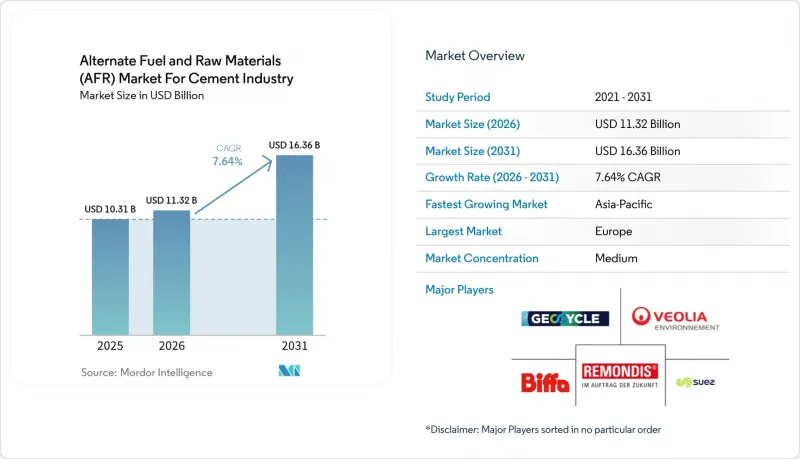
本報告按燃料類型(RDF、SRF 及其他)、原料類型(飛灰、高爐礦渣及其他)、應用領域(一次燃燒及其他應用)和地區(北美、歐洲、亞太、南美、中東和非洲)進行細分。市場預測以美元計價。
水泥產業取代燃料和原料(AFR)的市場洞察和趨勢
脫碳目標和石化燃料替代方案
隨著碳定價機制的實施,燃料轉換正從單純的環境目標轉變為水泥生產商的財務營運需求。當碳排放權影響煤炭、石油焦和加工廢棄物燃料的相對成本時,此趨勢尤其顯著。在窯爐中使用石化燃料的直接成本較高,或營運商能夠將燃料替代帶來的減排效益計入成本的情況下,水泥替代燃料和原料(AFR)具有顯著優勢。歐盟的排放交易體系(ETS)和碳邊境調節機制(CBAM)進一步提升了減少歐洲生產中燃料相關排放的商業性重要性,為採購部門提供了更清晰的燃料來源多元化財務依據。因此,水泥生產商有充分的理由在提高熱替代率之前確保廢棄物衍生燃料的供應,因為新的燃燒器系統和物料搬運設備需要可靠的原料。根據全球水泥與混凝土協會(GCCA)的報告,全球熱能替代率仍低於10%,遠低於2030年22%的目標。因此,燃料替代仍有相當大的空間。印度和東南亞的政策方向也為水泥生產商、廢棄物管理公司和物流業者提供了更清晰的規劃指南。然而,每個地區可能都需要其獨特的收集和預處理模式。
減少掩埋、降低垃圾量和回收利用
掩埋法規將剩餘廢棄物引導至資源回收途徑,從而提高了製備替代燃料的經濟可行性。這是因為對於廢棄物擁有者和市政當局而言,填埋處置的吸引力降低了。這有利於替代燃料和水泥原料(AFR)的發展,因為廢棄物處理和避免掩埋的價值本身就可以成為協同處理的經濟依據,即使在碳價格有限或不存在的地區也是如此。印度關於建築和拆除廢棄物的法規將於2026年4月生效,該法規將回收目標從2025-2026年的25%提高到2028-2029年的100%,這增加了對切實可行的回收途徑的需求。歐洲提案的「循環經濟法案」強化了具有約束力的循環要求,並改善了廢棄物回收投資的長期前景。 Vikat公司在2025年於全球回收了170萬噸廢棄物,其歐洲業務的替代率達到了76.1%。大城市產生的大量垃圾代表潛在的燃料來源,但要使這種材料成為可靠的窯爐原料,必須具備收集、分類、乾燥、儲存和運輸的能力。
與原料波動和窯爐穩定性相關的風險。
燃料的異質性使得水泥廠難以在不增加預處理、儲存和製程控制投資的情況下提高共處理率。 RDF(垃圾衍生燃料)的含水量會隨季節波動,生質能的熱值也會隨著原料來源、天氣和儲存條件的變化而改變。這些波動使得傳統的製程控制難以維持穩定的燃燒,可能需要工廠更頻繁地調整燃料供應。高氯燃料批次會導致旋風分離器堵塞、窯爐沉澱、腐蝕和水泥熟料品質下降,造成生產中斷和維護需求增加。當燃料預處理系統不成熟且品質檢測不足時,水泥替代燃料和原料(AFR)面臨最大的運作限制。希望將熱替代率提高到30%以上的工廠,在能夠大規模利用各種廢棄物之前,需要對物料製備、儲存、輸入和燃燒裝置進行更嚴格的控制。
細分市場分析
截至2025年,RDF將在水泥替代燃料和原料(AFR)市場中佔據33.8%的佔有率,這反映了歐洲成熟的機械和生物處理能力。 SRF預計到2031年將以8.4%的複合年成長率(CAGR)成長,超過整體市場成長率。這一差異表明,水泥運營商需要品質文件更清晰、運作性能更穩定的燃料等級。 EN 15359標準對SRF的熱值、水分含量、灰分含量和氯含量進行了明確分類。 SRF在替代燃料和原料(AFR)市場中的市場規模得益於客戶對可審計且可用於資金籌措談判的供應合約的需求。
儘管規模較小,生質能和廢棄塑膠仍然是具有戰略價值的燃料來源。印度針對不可回收塑膠廢棄物的框架將水泥窯共處理與焚燒並列為處置方法,從而擴大了可進行共燃的材料範圍。關於生質能和工業廢棄物的科學研究證實,它們適用於預煅燒條件,因為它們的熱解發生在合適的溫度範圍內。輪胎衍生燃料、污水污泥和工業溶劑也具有一定的貢獻,德國、日本和韓國都已製定了完善的危險廢棄物共處理法規。雖然預計垃圾衍生燃料(RDF)仍將在水泥替代燃料和原料(AFR)市場中廣泛應用,但在需要窯內可預測燃燒特性的場合,高品質固體回收燃料(SRF)的重要性日益凸顯。
區域分析
到2025年,歐洲將佔據水泥替代燃料和原料(AFR)市場41.5%的佔有率。該地區取得如此成就,得益於數十年來碳排放法規、掩埋稅、廢棄物分類要求、成熟的協同處理能力以及將廢棄物設施與大型窯爐運營商聯繫起來的商業性安排。根據資訊來源的草案顯示,歐洲水泥廠的平均熱替代率為52%,而到2024年,斯洛伐克整個水泥產業的替代率將達到75%。維卡特公司報告稱,其歐洲業務在2025年的替代率為76.1%。這種情況使歐洲在符合標準的固體回收燃料(SRF)、可追溯的供應鏈和長期工廠採購協議方面處於主導地位,同時也提高了旨在為大型水泥集團供貨的供應商的品質和文件標準。
海德堡材料公司於2026年5月在法國埃爾沃特(France-Ervoort)投產了一條新的水泥熟料年產能為125萬噸,旨在將現場二氧化碳排放強度降低近30%,將大規模資本項目與對替代燃料的長期需求連結起來。此類投資將建立起一個長期支持替代燃料供應商的需求基礎。即將訂定的「循環經濟法」和歐洲的EN 15359分類架構將進一步影響採購標準和文件要求。雖然歐洲水泥替代燃料和原料(AFR)市場較為成熟,但與新興的協同加工地區相比,其對燃料品質的要求更高。
預計到2031年,亞太地區的複合年成長率(CAGR)將達到9.4%,為所有地區中最高。印度和東南亞的水泥需求不斷成長,同時各國也推出了促進廢棄物回收和替代燃料使用的政策。與此同時,日本和澳洲正在推動聯合處理技術的引入,這表明兩國在廢棄物管理成熟度方面處於不同的階段。在中國,「碳排放達峰和碳中和」的目標以及對新建窯爐許可證的限制,使得人們更加關注替代燃料。此外,根據一份資訊來源,華信水泥的迪威水泥熟料生產線利用廢棄輪胎、橡膠和纖維,實現了超過60%的替代率。北美、南美以及中東和非洲地區需要加強原料預處理體系,巴西的Chambioa工廠的熱替代率已接近65%,而Geminol公司在挪威發展合作署(NORAD)的支持下,正在南非建造固體回收燃料(SRF)中心。
其他好處:
- Excel格式的市場預測(ME)表
- 3個月的分析師支持
目錄
第1章:引言
- 市場分析與定義的前提條件
- 分析範圍
第2章 分析方法
第3章執行摘要
第4章 市場狀況
- 市場概覽
- 市場促進因素
- 脫碳目標和石化燃料替代方案
- 減少掩埋廢棄物和促進循環經濟的強制性要求。
- 工業界對穩定、高熱值燃料的需求
- 當地社區廢棄物量增加和資源回收率提高
- 高礦物含量廢棄物流與水泥窯的兼容性
- 人工智慧驅動的分類和燃料品質追溯
- 市場限制因素
- 與原料波動和窯爐穩定性相關的風險
- 廢棄物分類和收集基礎設施不完善
- 授權和跨境廢棄物運輸的複雜性。
- 高生物來源殘留廢棄物的競爭
- 供應鏈分析
- 監理情勢
- 技術展望
- 波特五力分析
第5章:預測市場規模與成長率
- 按燃料類型
- 廢棄物衍生燃料(RDF)
- 固態回收燃料(SRF)
- 生質能
- 廢棄塑膠
- 其他類型的燃料
- 依原料類型
- 飛灰
- 高爐爐渣
- 鑄造用砂
- 煉鋼渣
- 其他類型的原料
- 透過使用
- 一次燃燒
- 二次燃燒
- 其他用途
- 按地區
- 北美洲
- 美國
- 加拿大
- 墨西哥
- 歐洲
- 德國
- 法國
- 義大利
- 西班牙
- 英國
- 波蘭
- 俄羅斯
- 其他歐洲國家
- 亞太地區
- 中國
- 印度
- 日本
- 韓國
- 澳洲
- 印尼
- 越南
- 泰國
- 其他亞太國家
- 南美洲
- 巴西
- 阿根廷
- 智利
- 其他南美國家
- 中東和非洲
- 沙烏地阿拉伯
- 阿拉伯聯合大公國
- 埃及
- 南非
- 摩洛哥
- 其他中東和非洲國家
- 北美洲
第6章 競爭情勢
- 市場集中度
- 策略趨勢
- 市佔率和排名分析
- 公司簡介
- Andusia Recovered Fuels Limited
- Averda International Limited
- BEUMER Group GmbH & Co. KG
- Biffa Limited
- Blue Phoenix Group BV
- CEMEX, SAB de CV
- DCC Group
- Ecoserv
- EEW Energy from Waste GmbH
- Enva Group Limited
- Fomento de Construcciones y Contratas, SA
- Geminor AS
- Geocycle SA
- Heidelberg Materials AG
- Indaver NV
- Komptech GmbH
- PAPREC Group
- PreZero International GmbH
- Ragn-Sells AB
- REMONDIS SE & Co. KG
- Renewi plc
- SARIA SE & Co. KG
- SUEZ SA
- Veolia Environnement SA
- Vicat SA
- Viridor Limited
第7章 市場機會與未來展望
目錄
第1章:引言
- 市場分析與定義的前提條件
- 分析範圍
第2章 分析方法
第3章執行摘要
第4章 市場狀況
- 市場概覽
- 市場促進因素
- 脫碳目標和石化燃料替代方案
- 減少掩埋廢棄物和促進循環經濟的強制性要求。
- 工業界對穩定、高熱值燃料的需求
- 當地社區廢棄物量增加和資源回收率提高
- 高礦物含量廢棄物流與水泥窯的兼容性
- 人工智慧驅動的分類和燃料品質追溯
- 市場限制因素
- 與原料波動和窯爐穩定性相關的風險
- 廢棄物分類和收集基礎設施不完善
- 授權和跨境廢棄物運輸的複雜性。
- 高生物來源殘留廢棄物的競爭
- 供應鏈分析
- 監理情勢
- 技術展望
- 波特五力分析
第5章:預測市場規模與成長率
- 按燃料類型
- 再生燃料(RDF)
- 固態再生燃料(SRF)
- 生質能
- 廢棄塑膠
- 其他燃料類型
- 依原料類型
- 飛灰
- 高爐爐渣
- 鑄造用砂
- 煉鋼渣
- 其他類型的原料
- 透過使用
- 一次燃燒
- 二次燃燒
- 其他用途
- 按地區
- 北美洲
- 美國
- 加拿大
- 墨西哥
- 歐洲
- 德國
- 法國
- 義大利
- 西班牙
- 英國
- 波蘭
- 俄羅斯
- 其他歐洲國家
- 亞太地區
- 中國
- 印度
- 日本
- 韓國
- 澳洲
- 印尼
- 越南
- 泰國
- 其他亞太國家
- 南美洲
- 巴西
- 阿根廷
- 智利
- 其他南美國家
- 中東和非洲
- 沙烏地阿拉伯
- 阿拉伯聯合大公國
- 埃及
- 南非
- 摩洛哥
- 其他中東和非洲國家
- 北美洲
第6章 競爭情勢
- 市場集中度
- 策略趨勢
- 市佔率和排名分析
- 公司簡介
- Andusia Recovered Fuels Limited
- Averda International Limited
- BEUMER Group GmbH & Co. KG
- Biffa Limited
- Blue Phoenix Group BV
- CEMEX, SAB de CV
- DCC Group
- Ecoserv
- EEW Energy from Waste GmbH
- Enva Group Limited
- Fomento de Construcciones y Contratas, SA
- Geminor AS
- Geocycle SA
- Heidelberg Materials AG
- Indaver NV
- Komptech GmbH
- PAPREC Group
- PreZero International GmbH
- Ragn-Sells AB
- REMONDIS SE & Co. KG
- Renewi plc
- SARIA SE & Co. KG
- SUEZ SA
- Veolia Environnement SA
- Vicat SA
- Viridor Limited
第7章 市場機會與未來展望
According to Mordor Intelligence, the alternate fuel and raw materials market for cement industry size is projected to expand from USD 10.31 billion in 2025 and USD 11.32 billion in 2026 to USD 16.36 billion by 2031, at a CAGR of 7.64% between 2026 and 2031.
This report is Segmented by Fuel Type (RDF, SRF, and Others), Raw Material Type (Fly Ash, Blast Furnace Slag, and Others), Application (Primary Firing, and Other Applications), and Geography (North America, Europe, Asia-Pacific, South America, and the Middle East and Africa). The Market Forecasts are Provided in Terms of Value in USD.
Insights and Trends of Alternate Fuel and Raw Materials (AFR) Market For Cement Industry
Decarbonization Targets and Fossil-Fuel Substitution
Carbon pricing is changing fuel switching from an environmental objective into a financial operating requirement for cement producers, particularly where carbon allowances influence the relative cost of coal, petcoke, and prepared waste fuels. The alternate fuel and raw materials for the cement market benefit when fossil fuel use carries a higher direct cost at the kiln and when operators can account for the avoided emissions from fuel replacement. The European Union Emissions Trading System and the Carbon Border Adjustment Mechanism raise the commercial importance of lowering fuel-related emissions in European production, which gives procurement teams a clearer financial reason to diversify fuel sources. Cement groups, therefore, have a stronger reason to secure waste-derived fuel volumes before they commit to higher thermal substitution rates, since new burner systems and material handling equipment need dependable feedstock. The Global Cement and Concrete Association reported a global thermal substitution rate below 10%, compared with its 22% target for 2030, leaving substantial room for fuel replacement. Policy direction in India and Southeast Asia is also creating stronger planning signals for cement producers, waste operators, and logistics providers, although each location will need its own collection and pre-processing model.
Landfill Diversion, Waste Volumes, and Resource Recovery
Landfill restrictions redirect residual waste toward recovery pathways and improve the economics of alternative fuel preparation, because disposal options become less attractive for waste holders and municipalities. This supports the alternate fuel and raw materials for cement market, even where carbon prices are limited or absent, since the value of treating and diverting waste can provide a separate economic basis for co-processing. Construction and demolition waste rules in India, which take effect from April 2026, establish recycling targets that rise from 25% in 2025-26 to 100% in 2028-29, increasing the need for practical recovery routes. Europe's proposed Circular Economy Act would strengthen binding circularity requirements and improve longer-term visibility for waste recovery investments . Vicat recovered 1.7 million tonnes of waste worldwide in 2025, while its European operations reached a 76.1% substitution rate . Large urban waste volumes create potential supply, but collection, sorting, drying, storage, and transport capacity must be in place before material becomes a dependable kiln input.
Feedstock Variability and Kiln-Stability Risk
Fuel heterogeneity limits the ability of cement plants to increase co-processing rates without additional investment in preparation, storage, and process control. RDF moisture can shift between seasons, while biomass calorific value can change as material sources, weather, and storage conditions change. These variations make it harder to maintain stable combustion using conventional process controls and can require plants to adjust feed rates more often. Chlorine-rich fuel batches can cause cyclone blockages, kiln build-up, corrosion, and declines in clinker quality, which can disrupt production as well as increase maintenance needs. The alternate fuel and raw materials for the cement market faces its greatest operational constraint where fuel preparation is immature, and quality checks are inconsistent. Plants that seek thermal substitution above 30% need greater control over material preparation, storage, dosing, and combustion settings before they can rely on diverse waste streams at scale.
Other drivers and restraints analyzed in the detailed report include:
- Consistent High-Calorific Fuel and Kiln Compatibility
- Digital Sorting and Fuel-Quality Traceability
- Waste Segregation, Permitting, and Feedstock Competition
For complete list of drivers and restraints, kindly check the Table Of Contents.
Segment Analysis
RDF held 33.8% of the alternate fuel and raw materials for the cement market share in the fuel segment during 2025, reflecting established mechanical and biological treatment capacity in Europe. SRF is forecast to grow at an 8.4% CAGR through 2031, faster than the overall market. This difference indicates that cement operators are seeking fuel grades with clearer quality documentation and more stable operating performance. EN 15359 classification gives SRF a defined framework for calorific value, moisture, ash, and chlorine. The alternate fuel and raw materials for the cement market size for SRF are supported by customer demand for supply arrangements that can be audited and used in financing discussions.
Biomass and waste plastics remain smaller but strategically useful fuel streams. India's framework for non-recyclable plastic waste identifies cement kiln co-processing as a disposal pathway alongside incineration, expanding the material eligible for co-firing. Scientific work on biomass and industrial wastes supports their compatibility with precalciner conditions because their thermal breakdown occurs within a suitable temperature range. Tire-derived fuel, sewage sludge, and industrial solvents also contribute, where hazardous waste co-processing rules are well established in Germany, Japan, and South Korea. The alternate fuel and raw materials for cement market will continue to use RDF widely, but higher-quality SRF is becoming more important where kilns require predictable combustion behavior.
Complete Report Scope:
- By Fuel Type
- Refuse-Derived Fuel (RDF)
- Solid Recovered Fuel (SRF)
- Biomass
- Waste Plastics
- Other Fuel Types
- By Raw Material Type
- Fly Ash
- Blast Furnace Slag
- Foundry Sand
- Steel Slag
- Other Raw Material Types
- By Application
- Primary Firing
- Secondary Firing
- Other Applications
- By Geography
- North America
- United States
- Canada
- Mexico
- Europe
- Germany
- France
- Italy
- Spain
- United Kingdom
- Poland
- Russia
- Rest of Europe
- Asia-Pacific
- China
- India
- Japan
- South Korea
- Australia
- Indonesia
- Vietnam
- Thailand
- Rest of Asia-Pacific
- South America
- Brazil
- Argentina
- Chile
- Rest of South America
- Middle East
- Saudi Arabia
- United Arab Emirates
- Egypt
- South Africa
- Morocco
- Rest of Middle East and Africa
- North America
Geography Analysis
Europe held 41.5% of the alternate fuel and raw materials for cement market share in 2025. The region's role reflects decades of carbon regulation, landfill taxation, waste separation requirements, established co-processing capacity, and commercial arrangements that connect waste treatment facilities with major kiln operators. European cement plants averaged 52% thermal substitution, while Slovakia reached 75% across its cement industry in 2024, according to the source draft. Vicat reported a 76.1% substitution rate in its European operations during 2025. These conditions make Europe a leading location for specification-grade SRF, traceable supply chains, and long-term plant offtake agreements, while also raising the quality and documentation threshold for suppliers that seek to serve major cement groups.
Heidelberg Materials opened a new kiln line at Airvault, France, in May 2026 after an investment exceeding EUR 350 million (~USD 402.55 million), with the facility designed to use up to 90% alternative fuels. The plant has a dry-process clinker capacity of 1.25 million tonnes per year and is intended to reduce site carbon dioxide intensity by nearly 30%, linking a major capital project with long-term demand for alternative fuels. Such investments establish demand infrastructure that can support alternative fuel suppliers for extended periods. Europe's forthcoming Circular Economy Act and EN 15359 classification framework will further affect procurement standards and documentation needs. The alternate fuel and raw materials for cement market in Europe is more mature, but it also requires higher fuel quality than less developed co-processing locations.
Asia-Pacific is projected to grow at a 9.4% CAGR through 2031, the fastest rate among regions. India and Southeast Asia combine rising cement demand with policy efforts to improve waste recovery and alternative fuel use, while Japan and Australia are increasing co-processing adoption and demonstrate different stages of waste management maturity. China's dual-carbon targets and restrictions on new kiln permits are directing attention toward fuel substitution, while Huaxin Cement's Diwei clinker line achieved substitution above 60% using waste tires, rubber, and textiles, according to the source draft. North America, South America, and the Middle East and Africa need stronger feedstock preparation, while Brazil's Xambioa plant reached nearly 65% thermal substitution, and Geminor is developing a South African SRF hub with Norad support.
- Andusia Recovered Fuels Limited
- Averda International Limited
- BEUMER Group GmbH & Co. KG
- Biffa Limited
- Blue Phoenix Group B.V.
- CEMEX, S.A.B. de C.V.
- DCC Group
- Ecoserv
- EEW Energy from Waste GmbH
- Enva Group Limited
- Fomento de Construcciones y Contratas, S.A.
- Geminor AS
- Geocycle SA
- Heidelberg Materials AG
- Indaver NV
- Komptech GmbH
- PAPREC Group
- PreZero International GmbH
- Ragn-Sells AB
- REMONDIS SE & Co. KG
- Renewi plc
- SARIA SE & Co. KG
- SUEZ S.A.
- Veolia Environnement S.A.
- Vicat SA
- Viridor Limited
Additional Benefits:
- The market estimate (ME) sheet in Excel format
- 3 months of analyst support
TABLE OF CONTENTS
1 INTRODUCTION
- 1.1 Study Assumptions and Market Definition
- 1.2 Scope of the Study
2 RESEARCH METHODOLOGY
3 EXECUTIVE SUMMARY
4 MARKET LANDSCAPE
- 4.1 Market Overview
- 4.2 Market Drivers
- 4.2.1 Decarbonization Targets and Fossil-Fuel Substitution
- 4.2.2 Landfill Diversion and Circular-Economy Mandates
- 4.2.3 Industrial Demand for Consistent High-Calorific Fuel
- 4.2.4 Rising Waste Volumes and Local Resource Recovery
- 4.2.5 Cement-Kiln Compatibility with Mineral-Rich Waste Streams
- 4.2.6 AI-Enabled Sorting and Fuel-Quality Traceability
- 4.3 Market Restraints
- 4.3.1 Feedstock Variability and Kiln-Stability Risk
- 4.3.2 Inconsistent Waste Segregation and Collection Infrastructure
- 4.3.3 Permitting and Cross-Border Waste-Movement Complexity
- 4.3.4 Competition for High-Biogenic Residual Waste
- 4.4 Supply-Chain Analysis
- 4.5 Technological Outlook
- 4.6 Regulatory Landscape
- 4.7 Porter's Five Forces Analysis
- 4.7.1 Bargaining Power of Suppliers
- 4.7.2 Bargaining Power of Buyers
- 4.7.3 Threat of New Entrants
- 4.7.4 Threat of Substitutes
- 4.7.5 Competitive Rivalry
5 MARKET SIZE AND GROWTH FORECASTS
- 5.1 By Fuel Type
- 5.1.1 Refuse-Derived Fuel (RDF)
- 5.1.2 Solid Recovered Fuel (SRF)
- 5.1.3 Biomass
- 5.1.4 Waste Plastics
- 5.1.5 Other Fuel Types
- 5.2 By Raw Material Type
- 5.2.1 Fly Ash
- 5.2.2 Blast Furnace Slag
- 5.2.3 Foundry Sand
- 5.2.4 Steel Slag
- 5.2.5 Other Raw Material Types
- 5.3 By Application
- 5.3.1 Primary Firing
- 5.3.2 Secondary Firing
- 5.3.3 Other Applications
- 5.4 By Geography
- 5.4.1 North America
- 5.4.1.1 United States
- 5.4.1.2 Canada
- 5.4.1.3 Mexico
- 5.4.2 Europe
- 5.4.2.1 Germany
- 5.4.2.2 France
- 5.4.2.3 Italy
- 5.4.2.4 Spain
- 5.4.2.5 United Kingdom
- 5.4.2.6 Poland
- 5.4.2.7 Russia
- 5.4.2.8 Rest of Europe
- 5.4.3 Asia-Pacific
- 5.4.3.1 China
- 5.4.3.2 India
- 5.4.3.3 Japan
- 5.4.3.4 South Korea
- 5.4.3.5 Australia
- 5.4.3.6 Indonesia
- 5.4.3.7 Vietnam
- 5.4.3.8 Thailand
- 5.4.3.9 Rest of Asia-Pacific
- 5.4.4 South America
- 5.4.4.1 Brazil
- 5.4.4.2 Argentina
- 5.4.4.3 Chile
- 5.4.4.4 Rest of South America
- 5.4.5 Middle East
- 5.4.5.1 Saudi Arabia
- 5.4.5.2 United Arab Emirates
- 5.4.5.3 Egypt
- 5.4.5.4 South Africa
- 5.4.5.5 Morocco
- 5.4.5.6 Rest of Middle East and Africa
- 5.4.1 North America
6 COMPETITIVE LANDSCAPE
- 6.1 Market Concentration
- 6.2 Strategic Moves
- 6.3 Market Share (%)/Ranking Analysis
- 6.4 Company Profiles (includes Global Level Overview, Market Level Overview, Core Segments, Financials as available, Strategic Information, Market Rank/Share, Products and Services, Recent Developments)
- 6.4.1 Andusia Recovered Fuels Limited
- 6.4.2 Averda International Limited
- 6.4.3 BEUMER Group GmbH & Co. KG
- 6.4.4 Biffa Limited
- 6.4.5 Blue Phoenix Group B.V.
- 6.4.6 CEMEX, S.A.B. de C.V.
- 6.4.7 DCC Group
- 6.4.8 Ecoserv
- 6.4.9 EEW Energy from Waste GmbH
- 6.4.10 Enva Group Limited
- 6.4.11 Fomento de Construcciones y Contratas, S.A.
- 6.4.12 Geminor AS
- 6.4.13 Geocycle SA
- 6.4.14 Heidelberg Materials AG
- 6.4.15 Indaver NV
- 6.4.16 Komptech GmbH
- 6.4.17 PAPREC Group
- 6.4.18 PreZero International GmbH
- 6.4.19 Ragn-Sells AB
- 6.4.20 REMONDIS SE & Co. KG
- 6.4.21 Renewi plc
- 6.4.22 SARIA SE & Co. KG
- 6.4.23 SUEZ S.A.
- 6.4.24 Veolia Environnement S.A.
- 6.4.25 Vicat SA
- 6.4.26 Viridor Limited
7 MARKET OPPORTUNITIES AND FUTURE OUTLOOK
- 7.1 White-Space and Unmet-Need Assessment

 全球水泥添加劑市場規模、佔有率、趨勢和成長分析報告(2026-2034年)
 2026年全球碳回收混凝土添加劑市場報告
 水泥添加劑市場:產品類型、形態、應用、通路、最終用途-2026-2032年全球市場預測全球空氣噴射器市場規模、佔有率、趨勢和成長分析報告(2026-2034年)
 日本水泥添加劑市場規模、佔有率、趨勢和預測:按類型、功能和地區分類,2026-2034年水泥添加劑市場(按添加劑類型、形式、井類型、應用、最終用途和分銷管道分類)—全球預測(2026-2032 年)水泥添加劑市場-2026-2031年預測
 水泥和混凝土添加劑市場規模、佔有率和成長分析(按類型、應用和地區分類)—2026-2033年產業預測
 水泥添加劑市場:全球2025-2029