


 |
市場調查報告書
商品編碼
2118979
形狀記憶合金:市佔率分析、產業趨勢與統計、成長預測(2026-2031)Shape Memory Alloys - Market Share Analysis, Industry Trends & Statistics, Growth Forecasts (2026 - 2031) |
||||||

※ 本網頁內容可能與最新版本有所差異。詳細情況請與我們聯繫。
據 Mordor Intelligence 稱,2025 年形狀記憶合金市值為 98.1 億美元,預計到 2031 年將達到 166.4 億美元,而 2026 年為 107.5 億美元,預測期(2026-2031 年)的複合年成長率為 9.13%。
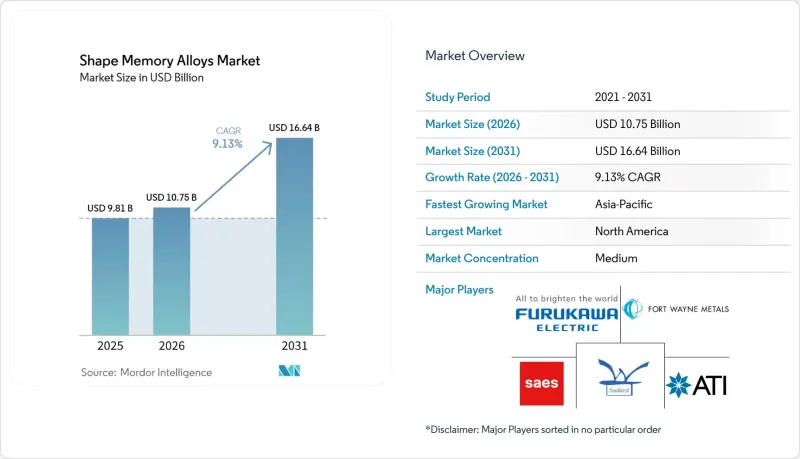
本報告按類型(鎳鈦合金(鎳鈦諾)、銅合金、鐵基(鐵、錳、矽))、終端應用產業(生物醫學、航太與國防、汽車、家用電子電器、工業與機器人等)以及地區(亞太地區、北美、歐洲、南美、中東和非洲)進行細分。市場預測以美元計價。
全球形狀記憶合金市場趨勢及洞察
形狀記憶合金在微創醫療設備的應用日益廣泛
鎳鈦諾合金可以壓縮成極小的輸送導管,並在體內自動變形為可控形狀。這項特性奠定了鎳鈦諾合金在心臟介入器械領域的重要地位。 2025年6月,Adona Medical完成了「Delphi」可調式心房分流器首個人體試驗的病患招募工作。該試驗共招募了10名患者,據通報手術成功率達100%,所有植入均透過非接觸式感應加熱進行術後調整。這種設計使鎳鈦諾合金從被動結構轉變為可調式植入組件。可調式植入還可透過拓展材料在體內植入後的功能,進而惠及形狀記憶合金市場。 2024年1月,Confluent Medical Technologies和ATI宣布投資超過5,000萬美元,將位於奧勒岡州米勒斯堡的醫用級鎳鈦諾合金溶解產能擴大三倍以上,目標是在2027年投入營運。
航太和國防領域對輕量化、高性能驅動系統的需求日益成長。
在航太應用中,對能夠承受熱循環並防止執行器疲勞失效的系統有著迫切的需求。形狀記憶合金(SMA)執行器可以減少自適應飛機系統中馬達、幫浦和電子元件的數量。一項關於可變面積風扇噴嘴概念的研究表明,在氣動載荷作用下,捆綁式形狀記憶合金(SMA)電纜執行器可以將噴嘴出口面積改變高達20%。研究也指出,與固定形狀噴嘴結構相比,單位推力燃油消耗量最多可降低9%,成本降低2-3%,航程增加5-6%。一項2025年的研究發現,鎳鈦合金和碳纖維-聚醚酮(CF-PEKK)纖維-金屬層壓板即使在高溫下也能保持結構完整性,並在飛機變形表面上表現出假塑性行為。這些發現支持了人們的預期,即形狀記憶合金在航太系統中的認證過程將會非常漫長。在形狀記憶合金市場,子系統認證對於減輕重量和降低複雜性等優勢在大規模生產的飛機中體現至關重要。
形狀記憶合金成形性限制及加工/連結方面的挑戰
鎳鈦諾的超彈性使得其切割和連接比傳統金屬更困難。車削研究表明,切削力範圍為 60 N 至 175 N,最大切削力出現在切削速度為 20–60 m/min 時。這些研究還表明,應力誘導馬氏體相變可使加工表面的顯微硬度在低切削速度下達到 360 HV。硬質合金刀具可能會出現缺口磨損和點蝕,而陶瓷刀具的抗彎強度不足以滿足此應用的需求。多晶鑽石刀具在 130 m/min 的切割速度下表現出最佳的耐磨性能,但其高昂的成本可能會限制其在大規模生產中的經濟可行性。此外,加工過程中發生的表面相變會改變成品零件的相變溫度和回復應力,從而增加精度和安全性至關重要的設計中的風險。
細分市場分析
預計到2025年,鎳鈦諾合金將佔市場銷售額的71.25%。這得歸功於其悠久的臨床應用歷史、穩定的供應基礎以及豐富的線材、管材、板材和成型件等多種產品形式。當工程師需要可恢復形變和生物相容性以用於體內應用時,鎳鈦諾合金仍然是首選材料。在機械載重作用下,鎳鈦諾合金的回復應變率可達6%至8%,而大多數傳統彈簧鋼的回復應變率低於1%。其符合ISO 10993-1標準的生物相容性也推動了其在醫療設備的應用。預計到2031年,鎳鈦諾合金市場將以9.76%的複合年成長率成長。
在IV型鎳鈦諾配方中,添加鉿、銅或鈀可以拓寬材料的相變溫度範圍。這些配方有望使鎳鈦諾能夠在二元鎳鈦諾無法承受的高溫航太環境中運作。銅基合金,包括Cu-Al-Mn和Cu-Al-Be,具有超彈性行為,而材料成本僅為鎳鈦諾的三分之一到一半。這種成本優勢在對生物相容性要求不高的結構應用和地震阻尼應用中尤其有利。 2025年7月發表的一項研究表明,單晶Cu-Al-Mn合金可在50-75 K的低溫環境下作為致動器運行,最大輸出功可達42.12 × 10⁶ J·m⁻³。鐵基Fe-Mn-Si合金在土木基礎設施領域備受關注,但由於大規模生產能力有限以及缺乏標準化的安裝標準,其商業化仍處於早期階段。
區域分析
2025年,北美佔全球銷售額的39.72%。該地區擁有強大的醫療設備創新基礎、聯邦政府支持的航太研究以及認證的鎳鈦諾製造商。結構性心臟和神經血管器械消耗了該地區大部分高價值的鎳鈦諾組件。 Axel Johnson於2026年7月1日完成了對Fort Wayne Metals Research Products的收購。該公司宣佈在印第安納州追加投資1,850萬美元,並在其製造部門創造150個新的就業機會。美國是推動區域銷售的主要力量,而加拿大和墨西哥雖然規模較小,但市場成長迅速。北美形狀記憶合金市場也得益於當地強大的線材和管材製造能力。
在歐洲,德國正在整合精密汽車零件供應商、醫療技術製造商和材料研究機構。預計到2025年,德國供應商的SMA氣動閥累計出貨量將超過1.4億台。英國、法國、義大利和俄羅斯則透過航太、國防和工業機器人領域推動需求成長。諸如Nadcap認證和DIN EN 9100航太認證等採購要求有利於成熟的供應商,使得低成本競爭對手難以進入市場。
預計到2031年,亞太地區的複合年成長率將達到10.22%,在所有地區中增速最高。中國正將鎳鈦合金定位為航太設備和高性能生物醫學醫療設備的首選先進材料。日本除了擁有精密機器人技術的生產能力外,由於人口老化,也正在推動對微創醫療設備的需求。日本和韓國的電子產品製造商正在折疊式智慧型手機和先進的相機模組中使用鎳鈦諾致動器。 Confluent Medical Technologies決定在印度開設一家專門的鎳鈦諾線材工廠,這反映出本地化生產在該國醫療設備製造地中的重要性日益凸顯。
南美洲、中東和非洲仍處於起步階段,但巴西對醫療設備的需求以及沙烏地阿拉伯對醫療保健領域的投資正在為未來的成長奠定基礎。由於這些地區形狀記憶合金的本地產量有限,目前對成品醫療設備上。
其他好處:
- Excel格式的市場預測(ME)表
- 3個月的分析師支持
目錄
第1章:引言
- 研究假設和市場定義
- 調查範圍
第2章:調查方法
第3章執行摘要
第4章 市場狀況
- 市場概覽
- 市場促進因素
- 形狀記憶合金在微創醫療設備的應用日益廣泛
- 航太和國防領域對輕量化、高性能驅動系統的需求日益成長。
- 汽車電氣化程度的不斷提高,推動了對小型熱致動器和機械致動器的需求。
- 擴大精密加工零件在家用電子電器和工業設備的應用。
- 在高循環、高性能應用中,傳統金屬合金正逐漸被其他材料取代。
- 市場限制因素
- 形狀記憶合金成形性的限制以及加工和連接方面面臨的挑戰。
- 較窄的處理視窗可實現一致的相變性能。
- 安全關鍵型應用的長期認證和核准要求
- 價值鏈分析
- 波特五力分析
第5章 市場規模與成長預測
- 按類型
- 鎳鈦合金(鎳鈦諾)
- 銅合金
- 鐵基合金(鐵、錳、矽)
- 按最終用途行業分類
- 生物醫學
- 航太/國防
- 車
- 家用電子產品
- 工業與機器人
- 建築/土木工程
- 其他終端用戶產業
- 按地區
- 亞太地區
- 中國
- 印度
- 日本
- 韓國
- 其他亞太國家
- 北美洲
- 美國
- 加拿大
- 墨西哥
- 歐洲
- 德國
- 英國
- 法國
- 義大利
- 俄羅斯
- 其他歐洲國家
- 南美洲
- 巴西
- 阿根廷
- 其他南美國家
- 中東和非洲
- 沙烏地阿拉伯
- 南非
- 其他中東和非洲國家
- 亞太地區
第6章 競爭情勢
- 市場集中度
- 策略趨勢
- 市佔率和排名分析
- 公司簡介
- ATI
- Baoji Seabird Metal Materials Co. Ltd.
- Confluent Medical Technologies
- DYNALLOY, Inc.
- EUROFLEX GmbH
- Fort Wayne Metals Research Products, LLC
- FURUKAWA ELECTRIC CO., LTD.
- G.RAU GmbH & Co. KG
- Huizhou Zhilian Smart Nitinol Co., Ltd.
- INGPULS GmbH
- Mishra Dhatu Nigam Limited(MIDHANI)
- Nippon Seisen Co., Ltd.
- SAES Getters SpA
- Shenzhen Starspring Materials.,Ltd.
- Ultimate Wireforms, Inc.
- Vascotube
第7章 市場機會與未來展望
According to Mordor Intelligence, the shape memory alloys market was valued at USD 9.81 billion in 2025 and is estimated to grow from USD 10.75 billion in 2026 to reach USD 16.64 billion by 2031, at a CAGR of 9.13% during the forecast period (2026-2031).
This report is Segmented by Type (Nickel-Titanium (Nitinol), Copper-Based Alloys, and Iron-Based Alloys (Iron-Manganese-Silicon)), End-Use Industry (Biomedical, Aerospace and Defense, Automotive, Consumer Electronics, Industrial and Robotics, and More), and Geography (Asia-Pacific, North America, Europe, South America, and Middle-East and Africa). The Market Forecasts are Provided in Terms of Value (USD).
Global Shape Memory Alloys Market Trends and Insights
Increasing Adoption of Shape Memory Alloys in Minimally Invasive Medical Devices
Nitinol can be compressed into very small delivery catheters and can self-expand to controlled shapes inside the body. This capability supports its established role in interventional cardiac devices. Adona Medical completed enrollment in June 2025 for its first-in-human Delphi adjustable interatrial shunt study. The study enrolled 10 patients and reported 100% procedural success, while all implants were adjusted after implantation through non-contact inductive heating. This design moves Nitinol beyond a passive structure and toward an adjustable implant component. The shape memory alloys market can benefit as adjustable implants increase the functional role of the material after placement. Confluent Medical Technologies and ATI announced an investment of more than USD 50 million in January 2024 to more than triple medical Nitinol melt capacity in Millersburg, Oregon, with operations targeted for 2027.
Growing Demand for Lightweight and High-Performance Actuation Systems in Aerospace and Defense
Aerospace applications require systems that tolerate thermal cycling and avoid actuator fatigue failure. Shape memory alloy actuators can reduce the number of motors, pumps, and electronic components used in adaptive aircraft systems. Research on variable-area fan nozzle concepts found that bundled shape memory alloy (SMA) cable actuators could vary the nozzle exit area by up to 20% under aerodynamic load. The same work reported up to 9% improvement in thrust-specific fuel consumption, 2-3% cost savings, and 5-6% range improvements compared with fixed-geometry nozzle configurations. A 2025 study found that NiTi and carbon fiber-polyether ketone (CF-PEKK) fiber-metal laminates maintained structural integrity at elevated temperatures and displayed pseudo-ductile behavior for aircraft morphing surfaces. These findings support the longer qualification path for the shape memory alloys market in aerospace systems. The shape memory alloys market depends on subsystem qualification before these weight and complexity benefits reach production aircraft.
Limited Formability and Challenges Associated with Machining and Joining Shape Memory Alloys
Nitinol's superelasticity makes cutting and joining more difficult than for conventional metals. Turning studies reported cutting forces of 60 N to 175 N, with the highest forces observed at cutting speeds of 20-60 m/min. The same work found machined-surface microhardness of up to 360 HV at low cutting speeds because of stress-induced martensitic transformation. Cemented carbide tools can experience notch wear and pitting, while ceramic tools lack sufficient flexural strength for this application. Polycrystalline diamond tools at 130 m/min showed the most favorable wear profile, but their cost can limit high-volume machining economics. Surface transformation caused during machining can also alter finished-component transformation temperature and recovery stress, which raises the risk in precision and safety-critical designs.
Other drivers and restraints analyzed in the detailed report include:
- Rising Electrification of Vehicles Driving Demand for Compact Thermal and Mechanical Actuators
- Expanding Use of Precision-Engineered Components in Consumer Electronics and Industrial Equipment
- Narrow Processing Window for Achieving Consistent Phase Transformation Performance
For complete list of drivers and restraints, kindly check the Table Of Contents.
Segment Analysis
Nitinol held 71.25% of revenue in 2025, supported by its long clinical record, established supply base, and availability as wire, tube, sheet, and foam. It remains the default material when engineers require recoverable deformation and compatibility with in vivo use. Its recovery strain reaches 6-8% under mechanical loading, compared with less than 1% for most conventional spring steels. Its biocompatibility under ISO 10993-1 also supports medical-device selection. Nitinol is forecast to grow at a 9.76% CAGR through 2031.
Quaternary Nitinol formulations add hafnium, copper, or palladium to broaden the material's transformation-temperature range. These formulations may allow actuation in higher-temperature aerospace settings that binary Nitinol cannot address. Copper-based alloys, including Cu-Al-Mn and Cu-Al-Be, offer superelastic behavior at one-third to one-half of Nitinol's material cost. This cost position favors structural and seismic-damping uses where biocompatibility is not required. Research published in July 2025 found that single-crystal Cu-Al-Mn alloys could operate as cryogenic actuators at 50-75 K and achieved a maximum work output of 42.12 X 10⁶ J*m-3. Iron-based Fe-Mn-Si alloys are gaining attention for civil infrastructure, but limited large-scale production and the absence of standardized installation codes keep them at an early commercial stage.
Complete Report Scope:
- By Type
- Nickel-Titanium (Nitinol)
- Copper-Based Alloys
- Iron-Based Alloys (Iron-Manganese-Silicon)
- By End-Use Industry
- Biomedical
- Aerospace and Defense
- Automotive
- Consumer Electronics
- Industrial and Robotics
- Construction and Civil Engineering
- Other End-Use Industries
- By Geography
- Asia-Pacific
- China
- India
- Japan
- South Korea
- Rest of Asia-Pacific
- North America
- United States
- Canada
- Mexico
- Europe
- Germany
- United Kingdom
- France
- Italy
- Russia
- Rest of Europe
- South America
- Brazil
- Argentina
- Rest of South America
- Middle-East and Africa
- Saudi Arabia
- South Africa
- Rest of Middle-East and Africa
- Asia-Pacific
Geography Analysis
North America held 39.72% of global revenue in 2025. The region has a large medical-device innovation base, federally supported aerospace research, and qualified Nitinol manufacturers. Structural heart and neurovascular devices consume many of the region's higher-value Nitinol components. Axel Johnson completed its acquisition of Fort Wayne Metals Research Products on July 1, 2026. The company announced USD 18.5 million in follow-on local investment and 150 additional manufacturing positions in Indiana. The United States leads regional revenue, while Canada and Mexico are smaller but growing markets. The shape memory alloys market in North America is also supported by qualified local wire and tubing capacity.
In Europe, Germany combines precision automotive suppliers, medical technology makers, and active materials research. SMA pneumatic valves introduced by German suppliers have exceeded 140 million cumulative units by 2025. The United Kingdom, France, Italy, and Russia contribute demand through aerospace, defense, and industrial robotics. Procurement requirements for Nadcap accreditation or DIN EN 9100 aerospace certification favor established suppliers and make market entry harder for lower-cost competitors.
Asia-Pacific is forecast to grow at a 10.22% CAGR through 2031, the fastest regional rate. China has identified NiTi alloys as a priority advanced material for aerospace equipment and high-performance biomedical devices. Japan combines precision robotics capacity with an aging population that supports demand for minimally invasive instruments. Japanese and South Korean electronics manufacturers are incorporating Nitinol actuators into foldable smartphones and advanced camera modules. Confluent Medical Technologies' decision to open a dedicated Nitinol wire facility in India reflects the growing importance of local production for the country's medical-device manufacturing base.
South America, and Middle-East and Africa remain early-stage regions, although Brazil's medical-device demand and Saudi Arabia's healthcare investment provide a foundation for future growth. The shape memory alloys market has limited local manufacturing in these regions, so demand remains concentrated in imported finished medical devices.
- ATI
- Baoji Seabird Metal Materials Co. Ltd.
- Confluent Medical Technologies
- DYNALLOY, Inc.
- EUROFLEX GmbH
- Fort Wayne Metals Research Products, LLC
- FURUKAWA ELECTRIC CO., LTD.
- G.RAU GmbH & Co. KG
- Huizhou Zhilian Smart Nitinol Co., Ltd.
- INGPULS GmbH
- Mishra Dhatu Nigam Limited (MIDHANI)
- Nippon Seisen Co., Ltd.
- SAES Getters S.p.A.
- Shenzhen Starspring Materials.,Ltd.
- Ultimate Wireforms, Inc.
- Vascotube
Additional Benefits:
- The market estimate (ME) sheet in Excel format
- 3 months of analyst support
TABLE OF CONTENTS
1 Introduction
- 1.1 Study Assumptions and Market Definition
- 1.2 Scope of the Study
2 Research Methodology
3 Executive Summary
4 Market Landscape
- 4.1 Market Overview
- 4.2 Market Drivers
- 4.2.1 Increasing Adoption of Shape Memory Alloys in Minimally Invasive Medical Devices
- 4.2.2 Growing Demand for Lightweight and High-Performance Actuation Systems in Aerospace and Defense
- 4.2.3 Rising Electrification of Vehicles Driving Demand for Compact Thermal and Mechanical Actuators
- 4.2.4 Expanding Use of Precision-Engineered Components in Consumer Electronics and Industrial Equipment
- 4.2.5 Increasing Replacement of Conventional Metallic Alloys in High-Cycle and High-Performance Applications
- 4.3 Market Restraints
- 4.3.1 Limited Formability and Challenges Associated with Machining and Joining Shape Memory Alloys
- 4.3.2 Narrow Processing Window for Achieving Consistent Phase Transformation Performance
- 4.3.3 Lengthy Qualification and Certification Requirements for Safety-Critical Applications
- 4.4 Value Chain Analysis
- 4.5 Porter's Five Forces Analysis
- 4.5.1 Threat of New Entrants
- 4.5.2 Bargaining Power of Suppliers
- 4.5.3 Bargaining Power of Buyers
- 4.5.4 Threat of Substitutes
- 4.5.5 Competitive Rivalry
5 Market Size and Growth Forecasts (Value)
- 5.1 By Type
- 5.1.1 Nickel-Titanium (Nitinol)
- 5.1.2 Copper-Based Alloys
- 5.1.3 Iron-Based Alloys (Iron-Manganese-Silicon)
- 5.2 By End-Use Industry
- 5.2.1 Biomedical
- 5.2.2 Aerospace and Defense
- 5.2.3 Automotive
- 5.2.4 Consumer Electronics
- 5.2.5 Industrial and Robotics
- 5.2.6 Construction and Civil Engineering
- 5.2.7 Other End-Use Industries
- 5.3 By Geography
- 5.3.1 Asia-Pacific
- 5.3.1.1 China
- 5.3.1.2 India
- 5.3.1.3 Japan
- 5.3.1.4 South Korea
- 5.3.1.5 Rest of Asia-Pacific
- 5.3.2 North America
- 5.3.2.1 United States
- 5.3.2.2 Canada
- 5.3.2.3 Mexico
- 5.3.3 Europe
- 5.3.3.1 Germany
- 5.3.3.2 United Kingdom
- 5.3.3.3 France
- 5.3.3.4 Italy
- 5.3.3.5 Russia
- 5.3.3.6 Rest of Europe
- 5.3.4 South America
- 5.3.4.1 Brazil
- 5.3.4.2 Argentina
- 5.3.4.3 Rest of South America
- 5.3.5 Middle-East and Africa
- 5.3.5.1 Saudi Arabia
- 5.3.5.2 South Africa
- 5.3.5.3 Rest of Middle-East and Africa
- 5.3.1 Asia-Pacific
6 Competitive Landscape
- 6.1 Market Concentration
- 6.2 Strategic Moves
- 6.3 Market Share (%)/Ranking Analysis
- 6.4 Company Profiles (includes Global Overview, Market Overview, Core Segments, Financials as available, Strategic Information, Products and Services, and Recent Developments)
- 6.4.1 ATI
- 6.4.2 Baoji Seabird Metal Materials Co. Ltd.
- 6.4.3 Confluent Medical Technologies
- 6.4.4 DYNALLOY, Inc.
- 6.4.5 EUROFLEX GmbH
- 6.4.6 Fort Wayne Metals Research Products, LLC
- 6.4.7 FURUKAWA ELECTRIC CO., LTD.
- 6.4.8 G.RAU GmbH & Co. KG
- 6.4.9 Huizhou Zhilian Smart Nitinol Co., Ltd.
- 6.4.10 INGPULS GmbH
- 6.4.11 Mishra Dhatu Nigam Limited (MIDHANI)
- 6.4.12 Nippon Seisen Co., Ltd.
- 6.4.13 SAES Getters S.p.A.
- 6.4.14 Shenzhen Starspring Materials.,Ltd.
- 6.4.15 Ultimate Wireforms, Inc.
- 6.4.16 Vascotube
7 Market Opportunities and Future Outlook
- 7.1 White-Space and Unmet-Need Assessment

 形狀記憶合金和聚合物市場預測至2034年-按材料類型、形狀、功能特性、加工技術、應用、最終用戶和地區分類的全球分析
 形狀記憶合金市場-2026-2032年全球市場預測形狀記憶合金市場預測—全球分析(按合金類型、功能、產品形式、製造流程、應用、最終用戶和地區分類)—2034年
 形狀記憶合金市場規模、佔有率、趨勢和預測:按合金類型、最終用途行業、功能類型、應用和地區分類,2026-2034年
 全球形狀記憶合金市場規模、佔有率、趨勢和成長分析報告(2026-2034)
 2026年全球形狀記憶合金市場報告
 形狀記憶合金市場規模、佔有率和成長分析(按合金類型、製造流程、終端應用產業和地區分類)-2026-2033年產業預測2032年形狀記憶合金市場預測:按產品類型、形狀、功能、應用和地區進行的全球分析
 形狀記憶合金的全球市場 (~2033年):類型·終端用戶產業·各地區
 全球形狀記憶合金市場:市場規模、佔有率、趨勢分析(按產品、最終用途和地區)、細分市場預測(2025-2030 年)