


 |
市場調查報告書
商品編碼
2118955
量子演算法開發軟體:市場佔有率分析、產業趨勢與統計、成長預測(2026-2031)Quantum Algorithm Development Software - Market Share Analysis, Industry Trends & Statistics, Growth Forecasts (2026 - 2031) |
||||||

※ 本網頁內容可能與最新版本有所差異。詳細情況請與我們聯繫。
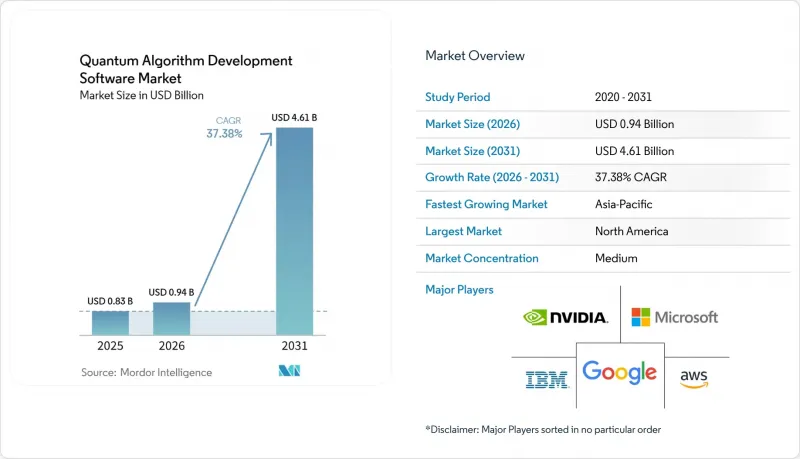
根據 Mordor Intelligence 預測,量子演算法開發軟體的市場規模將從 2025 年的 8.3 億美元和 2026 年的 9.4 億美元成長到 2031 年的 46.1 億美元,2026 年至 2031 年的年複合成長率(CAGR)為 37.38%。
本報告按產品類型(量子糾錯軟體等)、部署模式(本地部署、雲端部署、混合部署)、應用領域(量子機器學習、密碼學和安全性等)、終端用戶產業(汽車和航太、化學和材料等)以及地區進行細分。市場預測以美元計價。
全球量子演算法開發軟體市場趨勢及洞察。
公營和私營部門擴大量子投資
公共和私人資金正在改變量子演算法開發軟體市場的優先事項。 2026年5月,美國商務部根據《晶片與科學法案》(CHIPS and Science Act)向九家量子公司發放了總額達20.1億美元的意向書(LOI)。這筆支持資金包括向IBM提供10億美元,並分別向Atom Computing、D-Wave、Quantinuum、Rigetti和PsiQuantum各提供1億美元。這些資金將硬體目標與軟體整合里程碑連結起來,並支援整個量子技術堆疊的開發。同樣在2026年6月,IBM宣布將在未來五年內投資超過100億美元用於量子運算。該公司表示,近70%的量子開發人員使用Qiskit,該軟體已執行超過4兆次電路執行,顯示開發人員工具在量子演算法開發軟體市場中仍發揮核心作用。商務部的這項計畫也為軟體供應商提供了更清晰的整合合作夥伴和已獲資助的客戶專案資訊。
透過雲端原生方式存取量子硬體
雲端交付使開發人員無需購買低溫系統或維護專用設備即可運行量子程式。 IBM、亞馬遜雲端服務和微軟已於 2026 年中前提供商業量子雲端服務。這種模式使客戶能夠透過軟體開發工具包和服務介面在運作硬體上測試演算法。雲端收入在 2025 年佔總收入的 72.49%,顯示遠端存取已成為更受歡迎的採用方式。 2026 年,Qiskit v2.5 新增了用於容錯編譯的預設路徑管理器,並增強了多執行緒轉譯器的執行。這些改進縮短了大規模電路和批量工作負載的編譯時間,提高了基於雲端的開發環境在量子演算法開發軟體市場中的實際價值。
量子力學優勢何時能夠得到證實仍未可知。
在商業性意義的問題上,量子技術缺乏可驗證、可復現的優勢,這持續阻礙企業在量子演算法開發軟體市場的採購決策。大規模企業通常會在批准預算以擴大應用範圍之前尋求價值證明。然而,進行可信賴的價值驗證試點需要足夠的軟體功能和技術資源來進行有效的測試。這形成了一個惡性循環,有利於那些擁有充足研發預算的早期採用者。美國國防高級研究計劃局(DARPA)的「量子基準測試舉措」旨在支持對量子技術效用進行更嚴格的評估。 PsiQuantum公司獲得了1.25億美元的擴大契約,用於評估商業性路徑,但更廣泛的應用仍需要獨立的檢驗。在相關問題類別的結果得到基準測試的證實之前,量子演算法開發軟體市場可能更依賴技術領導者,而不是大型企業的採購。
細分市場分析
到2025年,量子演算法開發平台和SDK將佔量子演算法開發軟體市場收入的56.77%。這一佔有率表明,開發者軟體是量子演算法開發軟體市場的主要商業性切入點。 Qiskit、PennyLane、TKET和Cirq等軟體為開發者提供評估硬體效能所需的程式設計、編譯和執行功能。這些功能不僅限於電路說明,還會影響使用者如何選擇設備、管理工作負載以及解讀結果。量子模擬軟體、最佳化軟體和編譯工具則服務於尋求更特定功能的研發公司和學術團隊。
預計到2031年,量子糾錯軟體的複合年成長率將達到38.45%。此產品系列中量子演算法開發軟體的市場規模與在具有顯著雜訊和有限保真度的硬體上獲得實際電路結果的需求密切相關。 NVIDIA在2026年報告稱,其「伊辛解碼器」在顏色碼的邏輯錯誤率方面提高了347.7倍以上。 IBM也發布了“Qiskit Paulice”,這是一款支援NISQ的工具,可以自動向電路中添加硬體高效的錯誤檢測迴路。這些進展表明,錯誤管理正在成為平台的核心要素,而不僅僅是一個可選功能。韓國的Qunova Computing和日本的Quemix也在建構容錯演算法的早期出口能力,亞太地區在其中扮演專業產品供應商的角色。
到2025年,雲端運算在量子演算法開發軟體市場總收入中佔比高達72.49%。因此,無需購置低溫基礎設施或運行專用實體系統即可存取處理器,這一優勢極大地推動了量子演算法開發軟體市場的發展。客戶可以訂閱服務,並根據使用量支付電路執行費用。這種方式降低了初始實驗的成本負擔,也使得研發和業務團隊即使身處不同的設施,也能使用同一套遠端存取的資源協同工作。
預計2026年至2031年間,混合部署的複合年成長率將達到39.07%。目前的處理器仍依賴傳統系統進行資料準備、錯誤後篩選、工作流程控制和結果解釋。 2026年6月,KQC發布了“Qubiteer”,這是一個面向金融、材料和物流行業的量子人工智慧混合平台,用於問題建模、求解器選擇和執行。此次發布表明,供應商不再將混合操作視為獨立的量子組件,而是將其作為完整的工作流程來呈現。對於有空氣間隙要求的政府機構和國防相關企業而言,本地部署仍然是小規模的選擇。混合部署的成長並不一定會減少雲端的使用,因為雲端系統作為執行這些整合工作流程的基礎,正發揮越來越重要的作用。
區域分析
2025年,北美佔據了量子演算法開發軟體市場37.11%的佔有率。聯邦政府計畫、雲端平台的集中以及金融服務和政府的初期需求支撐了這一地位。 《國家量子舉措法案》和DARPA的量子基準測試舉措為該地區的活動提供了持續的政策架構。 2026年5月,美國商務部向九家量子公司發放了總額達20.1億美元的意向書。這筆支持資金包括向IBM撥款10億美元,資金發放與軟體整合里程碑的完成情況掛鉤。 IBM Quantum、亞馬遜網路服務Braket和微軟Azure Quantum也為使用者提供了領先的雲端開發環境。雖然美國是該地區最大的單一需求國,但加拿大透過Xanadu、1QBit、Agnostiq和Multiverse Computing等公司增強了其軟硬體能力。
到2025年,歐洲將佔據全球第二大佔有率,其中德國、英國、法國和義大利將成為該地區的主要活動中心。 2026年6月,Classiq和TEA TEK集團宣布達成數百萬歐元的合作協議,將在那不勒斯建立一個量子計算中心。該計劃將專注於歐盟範圍內的量子軟體研究和服務。 2025年4月,英國承諾將在量子科技投入1.21億英鎊(1.54億美元),用於詐欺偵測和打擊金融犯罪等應用。此外,歐盟於2024年4月發布的《關於協調量子安全數位基礎設施的合作備忘錄》也提高了對加密軟體採購的重視程度。
預計到2031年,亞太地區的複合年成長率將達到38.10%。這一成長率使該地區成為量子演算法開發軟體市場成長最快的地區。日本正投入公共和企業資金,以加強特定產業應用和國內軟體開發能力。 2026年3月,日本理化學研究所(RIKEN)與大阪大學量子資訊與量子生物學研究所合作,重新發布了升級版量子運算雲端服務「Ei-II」。該服務擴大了產業界和學術界對演算法研究的存取範圍。 2025年4月,瑞穗租賃投資Quemix公司,用於研究容錯演算法;同時,IPA的2026年「Mitou Target」計畫也支援量子軟體開發。 Classiq 和 QAI 於 2026 年 7 月在韓國推出了本地「量子即服務」服務。南美洲、中東和非洲仍處於早期階段,但巴西表現出最高的機構興趣,沙烏地阿拉伯中央銀行 (SAMA) 與 Multiverse Computing 合作,探索量子最佳化在其中央銀行支付系統中的應用。
其他好處:
- Excel格式的市場預測(ME)表
- 3個月的分析師支持
目錄
第1章:引言
- 研究假設和市場定義
- 調查範圍
第2章:調查方法
第3章執行摘要
第4章 市場狀況
- 市場概覽
- 市場促進因素
- 公營和私營部門擴大量子投資
- 透過雲端原生方式存取量子硬體
- 業界對最佳化和模擬的需求
- 向後量子密碼學過渡的要求
- 引入混合量子-經典工作流程
- 以NISQ和容錯系統為導向的硬體感知軟體創新
- 市場限制因素
- 何時才能實現可證明的量子優勢尚不確定。
- 硬體架構碎片化和可移植性限制
- 量子領域人才短缺和高昂的教育成本
- 設定基準的難度和投資報酬的不確定性。
- 產業價值鏈分析
- 監理情勢
- 技術展望
- 宏觀經濟因素對市場的影響
- 波特五力分析
第5章 市場規模與成長預測
- 依產品類型
- 量子演算法開發平台和SDK
- 量子模擬軟體
- 量子演算法最佳化和編譯軟體
- 量子糾錯軟體
- 其他產品類型
- 部署模式
- 現場
- 雲
- 混合
- 透過使用
- 最佳化
- 模擬與建模
- 量子機器學習
- 密碼技術與安全
- 其他用途
- 按最終用戶行業分類
- 銀行、金融服務和保險(BFSI)
- 製藥和生物技術
- 政府/國防
- 汽車和航太
- 化學/材料
- 能源公用事業
- 教育和研究機構
- 其他終端用戶產業
- 按地區
- 北美洲
- 美國
- 加拿大
- 墨西哥
- 南美洲
- 巴西
- 阿根廷
- 其他南美國家
- 歐洲
- 德國
- 英國
- 法國
- 義大利
- 西班牙
- 俄羅斯
- 其他歐洲國家
- 亞太地區
- 中國
- 日本
- 印度
- 韓國
- 澳洲和紐西蘭
- 其他亞太國家
- 中東
- 沙烏地阿拉伯
- 阿拉伯聯合大公國
- 土耳其
- 其他中東國家
- 非洲
- 南非
- 奈及利亞
- 其他非洲國家
- 北美洲
第6章 競爭情勢
- 市場集中度
- 策略趨勢
- 市佔率分析
- 公司簡介
- IBM Corporation
- Google LLC
- Microsoft Corporation
- Amazon Web Services, Inc.
- NVIDIA Corporation
- Quantinuum Limited
- Xanadu Quantum Technologies Inc.
- IonQ, Inc.
- D-Wave Quantum Inc.
- Rigetti Computing, Inc.
- Q-CTRL Pty Ltd
- Riverlane Limited
- Classiq Technologies Ltd.
- QC Ware Corp.
- Zapata Computing Holdings Inc.
- 1QBit Information Technologies Inc.
- Algorithmiq Inc.
- Strangeworks, Inc.
- Phasecraft Limited
- Entropica Labs Pte. Ltd.
- ProteinQure Inc.
- Agnostiq Inc.
- Multiverse Computing SL
- Terra Quantum AG
- BlueQubit, Inc.
第7章 市場機會與未來展望
According to Mordor Intelligence, the quantum algorithm development software market size is projected to expand from USD 0.83 billion in 2025 and USD 0.94 billion in 2026 to USD 4.61 billion by 2031, registering a CAGR of 37.38% between 2026 and 2031.
This report is Segmented by Product Type (Quantum Error Mitigation and Error Correction Software, and More), Deployment Mode (On-Premises, Cloud, and Hybrid), Application (Quantum Machine Learning, Cryptography and Security, and More), End-User Industry (Automotive and Aerospace, Chemicals and Materials, and More), and Geography. The Market Forecasts are Provided in Terms of Value (USD).
Global Quantum Algorithm Development Software Market Trends and Insights
Public and Private Quantum Investment Expansion
Public and private funding are changing the priorities of the quantum algorithm development software market. In May 2026, the U.S. Department of Commerce announced USD 2.01 billion in letters of intent for 9 quantum companies under the CHIPS and Science Act. The package included USD 1 billion for IBM and USD 100 million each for Atom Computing, D-Wave, Quantinuum, Rigetti, and PsiQuantum. The commitments tied hardware targets to software integration milestones, which support development across the quantum technology stack. IBM also committed more than USD 10 billion to quantum computing over 5 years in June 2026. The company stated that Qiskit was used by nearly 70% of quantum developers and had executed more than 4 trillion circuits, showing why developer tools remain central to the quantum algorithm development software market. The Department of Commerce program also gives software suppliers a clearer set of integration partners and funded customer programs.
Cloud-Native Access to Quantum Hardware
Cloud delivery lets developers run quantum programs without buying cryogenic systems or maintaining specialized equipment. IBM, Amazon Web Services, and Microsoft offered commercial quantum cloud access by mid-2026. This model enables customers to test algorithms on production hardware through software development kits and service interfaces. Cloud accounted for 72.49% of 2025 revenue, indicating that remote access was already the preferred deployment route. Qiskit v2.5 added preset pass managers for fault-tolerant compilation and expanded multithreaded transpiler execution in 2026. These changes reduced compilation time for larger circuits and batch workloads, improving the practical value of the quantum algorithm development software market's cloud-based development environments.
Uncertain Timing of Demonstrable Quantum Advantage
The lack of a reproducible quantum advantage on commercially meaningful problems continues to delay enterprise buying decisions in the quantum algorithm development software market. Large organizations often require proof of value before approving budgets for wider deployment. Yet credible proof-of-value pilots require sufficient software capabilities and technical resources to run meaningful tests. This creates a cycle that favors early adopters with larger research budgets. DARPA's Quantum Benchmarking Initiative is intended to support more rigorous evaluation of quantum utility. PsiQuantum received an expanded USD 125 million agreement to assess commercial routes to utility-scale quantum computing, but independent validation remains necessary for wider adoption. Until benchmarks confirm results on relevant problem classes, the quantum algorithm development software market will rely more heavily on technology leaders than on broad enterprise procurement.
Other drivers and restraints analyzed in the detailed report include:
- Industry Demand for Optimization and Simulation
- Post-Quantum Cryptography Migration Requirements
- Hardware Architecture Fragmentation and Limited Portability
For complete list of drivers and restraints, kindly check the Table Of Contents.
Segment Analysis
Quantum Algorithm Development Platforms and SDKs accounted for 56.77% of the quantum algorithm development software market revenue in 2025. This share showed that developer-facing software was the main commercial entry point for the quantum algorithm development software market. Qiskit, PennyLane, TKET, and Cirq provide the programming, compilation, and execution functions developers need to evaluate hardware performance. Their role is not limited to writing circuits because they also shape how users select devices, manage workloads, and interpret results. Quantum simulation software, optimization software, and compilation tools serve research-intensive enterprise and academic teams that need more targeted capabilities.
Quantum Error Mitigation and Error Correction Software is projected to grow at a 38.45% CAGR through 2031. The quantum algorithm development software market size for this product group is linked to the need for usable circuit results on hardware with meaningful noise and limited fidelity. NVIDIA reported in 2026 that its Ising Decoder delivered more than 347.7x improvement in logical error rates for color codes. IBM also released Qiskit Paulice, a NISQ-compatible tool that automatically adds hardware-efficient error-detection loops to circuits. These developments show why error management is becoming a core part of a platform rather than an optional feature. Qunova Computing in South Korea and Quemix in Japan are also building early export capabilities in fault-tolerant algorithms, giving the Asia-Pacific a role as a supplier of specialized products.
Cloud accounted for 72.49% of the revenue in the quantum algorithm development software market in 2025. The quantum algorithm development software market was therefore strongly shaped by the ability to access processors without buying cryogenic infrastructure or operating a dedicated physical system. Customers can subscribe to services and pay for circuit execution based on their usage. This approach reduces the financial commitment associated with early experimentation. It also allows research, development, and business teams to work with the same set of remotely accessible resources, even when they are located in different facilities.
Hybrid deployment is projected to grow at a 39.07% CAGR between 2026 and 2031. Current processors still rely on classical systems for data preparation, error post-selection, workflow control, and result interpretation. KQC launched Qubiteer in June 2026 as a quantum AI hybrid platform for problem modeling, solver selection, and execution across finance, materials, and logistics. The launch showed how suppliers are presenting hybrid operations as complete workflows rather than as a standalone quantum component. On-premises deployment remains a smaller option for government agencies and defense contractors with air-gap requirements. Hybrid growth does not necessarily reduce cloud use, as cloud systems increasingly serve as the execution backbone for these combined workflows.
Complete Report Scope:
- By Product Type
- Quantum Algorithm Development Platforms and SDKs
- Quantum Simulation Software
- Quantum Algorithm Optimization and Compilation Software
- Quantum Error Mitigation and Error Correction Software
- Other Product Types
- By Deployment Mode
- On-Premises
- Cloud
- Hybrid
- By Application
- Optimization
- Simulation and Modeling
- Quantum Machine Learning
- Cryptography and Security
- Other Applications
- By End-User Industry
- Banking, Financial Services, and Insurance (BFSI)
- Pharmaceutical and Biotechnology
- Government and Defense
- Automotive and Aerospace
- Chemicals and Materials
- Energy and Utilities
- Education and Research Institutions
- Other End-User Industries
- By Geography
- North America
- United States
- Canada
- Mexico
- South America
- Brazil
- Argentina
- Rest of South America
- Europe
- Germany
- United Kingdom
- France
- Italy
- Spain
- Russia
- Rest of Europe
- Asia-Pacific
- China
- Japan
- India
- South Korea
- Australia and New Zealand
- Rest of Asia-Pacific
- Middle East
- Saudi Arabia
- United Arab Emirates
- Turkey
- Rest of Middle East
- Africa
- South Africa
- Nigeria
- Rest of Africa
- North America
Geography Analysis
North America held 37.11% of the quantum algorithm development software market share in 2025. Federal programs, the concentration of cloud platforms, and early demand from financial services and government underpinned this position. The National Quantum Initiative Act and DARPA's Quantum Benchmarking Initiative provided a continuing policy framework for regional activity. In May 2026, the Department of Commerce announced USD 2.01 billion in letters of intent for 9 quantum companies. The package included an intended USD 1 billion allocation for IBM and connected funding to software integration milestones. IBM Quantum, Amazon Web Services Braket, and Microsoft Azure Quantum also gave users access to major cloud-based development environments. The United States was the largest single regional consumer, while Canada added software and hardware capabilities through Xanadu, 1QBit, Agnostiq, and Multiverse Computing.
Europe held a meaningful secondary share in 2025. Germany, the United Kingdom, France, and Italy were major centers of activity in the region. Classiq and TEA TEK Group announced a multi-million-euro partnership in June 2026 to establish a quantum computing hub in Naples. The initiative targets quantum software research and services across the European Union. The United Kingdom committed GBP 121 million (USD 154 million) to quantum technology in April 2025. The funding targeted fraud detection and financial crime applications. The European Union's April 2024 memorandum on coordinated quantum-safe digital infrastructure also increased attention on the procurement of cryptographic software.
Asia-Pacific is projected to expand at a 38.10% CAGR through 2031. This rate makes it the fastest-growing regional part of the quantum algorithm development software market. Japan is directing public funding and corporate capital toward specific industrial applications and domestic software capability. RIKEN relaunched the upgraded Ei-II quantum computer cloud service in March 2026 with Osaka University's Quantum Information and Quantum Biology Institute. The service broadened access for industrial and academic algorithm research. Mizuho Lease invested in Quemix in April 2025 for research on fault-tolerant algorithms, while the IPA 2026 Mitou Target program supported quantum software development. Classiq and QAI established a local Quantum-as-a-Service offering in South Korea in July 2026. South America, the Middle East, and Africa remained early-stage regions, although Brazil led institutional interest and Saudi Arabia's SAMA explored quantum optimization for central bank settlement systems with Multiverse Computing.
- IBM Corporation
- Google LLC
- Microsoft Corporation
- Amazon Web Services, Inc.
- NVIDIA Corporation
- Quantinuum Limited
- Xanadu Quantum Technologies Inc.
- IonQ, Inc.
- D-Wave Quantum Inc.
- Rigetti Computing, Inc.
- Q-CTRL Pty Ltd
- Riverlane Limited
- Classiq Technologies Ltd.
- QC Ware Corp.
- Zapata Computing Holdings Inc.
- 1QBit Information Technologies Inc.
- Algorithmiq Inc.
- Strangeworks, Inc.
- Phasecraft Limited
- Entropica Labs Pte. Ltd.
- ProteinQure Inc.
- Agnostiq Inc.
- Multiverse Computing S.L.
- Terra Quantum AG
- BlueQubit, Inc.
Additional Benefits:
- The market estimate (ME) sheet in Excel format
- 3 months of analyst support
TABLE OF CONTENTS
1 INTRODUCTION
- 1.1 Study Assumptions and Market Definition
- 1.2 Scope of the Study
2 RESEARCH METHODOLOGY
3 EXECUTIVE SUMMARY
4 MARKET LANDSCAPE
- 4.1 Market Overview
- 4.2 Market Drivers
- 4.2.1 Public and Private Quantum Investment Expansion
- 4.2.2 Cloud-Native Access to Quantum Hardware
- 4.2.3 Industry Demand for Optimization and Simulation
- 4.2.4 Post-Quantum Cryptography Migration Requirements
- 4.2.5 Hybrid Quantum-Classical Workflow Adoption
- 4.2.6 Hardware-Aware Software Innovation for NISQ and Fault-Tolerant Systems
- 4.3 Market Restraints
- 4.3.1 Uncertain Timing of Demonstrable Quantum Advantage
- 4.3.2 Hardware Architecture Fragmentation and Limited Portability
- 4.3.3 Quantum Talent Scarcity and High Training Costs
- 4.3.4 Benchmarking Difficulty and Unclear Return on Investment
- 4.4 Industry Value Chain Analysis
- 4.5 Regulatory Landscape
- 4.6 Technological Outlook
- 4.7 Impact of Macroeconomic Factors on the Market
- 4.8 Porter's Five Forces Analysis
- 4.8.1 Threat of New Entrants
- 4.8.2 Bargaining Power of Suppliers
- 4.8.3 Bargaining Power of Buyers
- 4.8.4 Threat of Substitutes
- 4.8.5 Intensity of Competitive Rivalry
5 MARKET SIZE AND GROWTH FORECASTS (VALUE)
- 5.1 By Product Type
- 5.1.1 Quantum Algorithm Development Platforms and SDKs
- 5.1.2 Quantum Simulation Software
- 5.1.3 Quantum Algorithm Optimization and Compilation Software
- 5.1.4 Quantum Error Mitigation and Error Correction Software
- 5.1.5 Other Product Types
- 5.2 By Deployment Mode
- 5.2.1 On-Premises
- 5.2.2 Cloud
- 5.2.3 Hybrid
- 5.3 By Application
- 5.3.1 Optimization
- 5.3.2 Simulation and Modeling
- 5.3.3 Quantum Machine Learning
- 5.3.4 Cryptography and Security
- 5.3.5 Other Applications
- 5.4 By End-User Industry
- 5.4.1 Banking, Financial Services, and Insurance (BFSI)
- 5.4.2 Pharmaceutical and Biotechnology
- 5.4.3 Government and Defense
- 5.4.4 Automotive and Aerospace
- 5.4.5 Chemicals and Materials
- 5.4.6 Energy and Utilities
- 5.4.7 Education and Research Institutions
- 5.4.8 Other End-User Industries
- 5.5 By Geography
- 5.5.1 North America
- 5.5.1.1 United States
- 5.5.1.2 Canada
- 5.5.1.3 Mexico
- 5.5.2 South America
- 5.5.2.1 Brazil
- 5.5.2.2 Argentina
- 5.5.2.3 Rest of South America
- 5.5.3 Europe
- 5.5.3.1 Germany
- 5.5.3.2 United Kingdom
- 5.5.3.3 France
- 5.5.3.4 Italy
- 5.5.3.5 Spain
- 5.5.3.6 Russia
- 5.5.3.7 Rest of Europe
- 5.5.4 Asia-Pacific
- 5.5.4.1 China
- 5.5.4.2 Japan
- 5.5.4.3 India
- 5.5.4.4 South Korea
- 5.5.4.5 Australia and New Zealand
- 5.5.4.6 Rest of Asia-Pacific
- 5.5.5 Middle East
- 5.5.5.1 Saudi Arabia
- 5.5.5.2 United Arab Emirates
- 5.5.5.3 Turkey
- 5.5.5.4 Rest of Middle East
- 5.5.6 Africa
- 5.5.6.1 South Africa
- 5.5.6.2 Nigeria
- 5.5.6.3 Rest of Africa
- 5.5.1 North America
6 COMPETITIVE LANDSCAPE
- 6.1 Market Concentration
- 6.2 Strategic Moves
- 6.3 Market Share Analysis
- 6.4 Company Profiles (includes Global Level Overview, Market Level Overview, Core Segments, Financials as available, Strategic Information, Market Rank/Share, Products and Services, Recent Developments)
- 6.4.1 IBM Corporation
- 6.4.2 Google LLC
- 6.4.3 Microsoft Corporation
- 6.4.4 Amazon Web Services, Inc.
- 6.4.5 NVIDIA Corporation
- 6.4.6 Quantinuum Limited
- 6.4.7 Xanadu Quantum Technologies Inc.
- 6.4.8 IonQ, Inc.
- 6.4.9 D-Wave Quantum Inc.
- 6.4.10 Rigetti Computing, Inc.
- 6.4.11 Q-CTRL Pty Ltd
- 6.4.12 Riverlane Limited
- 6.4.13 Classiq Technologies Ltd.
- 6.4.14 QC Ware Corp.
- 6.4.15 Zapata Computing Holdings Inc.
- 6.4.16 1QBit Information Technologies Inc.
- 6.4.17 Algorithmiq Inc.
- 6.4.18 Strangeworks, Inc.
- 6.4.19 Phasecraft Limited
- 6.4.20 Entropica Labs Pte. Ltd.
- 6.4.21 ProteinQure Inc.
- 6.4.22 Agnostiq Inc.
- 6.4.23 Multiverse Computing S.L.
- 6.4.24 Terra Quantum AG
- 6.4.25 BlueQubit, Inc.
7 MARKET OPPORTUNITIES AND FUTURE OUTLOOK
- 7.1 White-Space and Unmet-Need Assessment


