


 |
市場調查報告書
商品編碼
2118915
蛋白質水解酵素:市場佔有率分析、產業趨勢與統計、成長預測(2026-2031)Protein Hydrolysis Enzymes - Market Share Analysis, Industry Trends & Statistics, Growth Forecasts (2026 - 2031) |
||||||

※ 本網頁內容可能與最新版本有所差異。詳細情況請與我們聯繫。
根據 Mordor Intelligence 預測,2025 年全球蛋白質水解酵素市場規模預計為 26.7 億美元,2026 年將達到 28.1 億美元,到 2031 年將進一步擴大至 37.8 億美元,2026 年至 2031 年的複合年成長率為 6.13%。
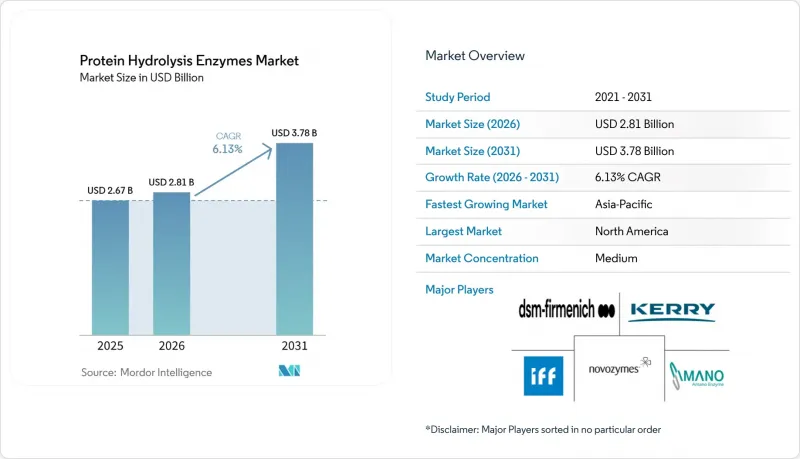
本報告按原料(動物蛋白、植物蛋白、微生物)、形態(液體、粉末)、應用領域(食品飲料、清潔劑和清潔劑、藥品、動物飼料、紡織皮革及其他)以及地區(北美、歐洲、亞太、南美、中東和非洲)進行細分。市場預測以美元計價。
全球蛋白質水解酵素市場趨勢及洞察
高蛋白機能性食品的需求
對高蛋白機能性食品日益成長的需求是蛋白質水解酵素市場的主要驅動力。食品生產商越來越需要酵素技術來修飾蛋白質結構並增強其原料的功能性。蛋白質水解酵素將未消化的蛋白質分解成更小的胜肽和胺基酸,從而改善其溶解性、消化率、分散性、乳化性、發泡和保水性。這使得開發用於現代食品配方的高性能蛋白質原料成為可能。與傳統蛋白質原料相比,以酵素法加工生產的水解蛋白具有更優異的功能特性。這些特性使其能夠添加到飲料、乳製品、蛋白粉、營養棒、臨床營養產品、嬰幼兒配方奶粉、烘焙產品和特種營養配方中,而不會顯著影響產品的質地或加工效率。
在嬰幼兒及醫療營養產品的應用範圍擴大
蛋白質水解酵素在嬰幼兒和專業營養配方中的應用日益廣泛,是推動蛋白質水解酵素市場發展的重要因素。這些酵素能夠生產部分水解和完全水解的蛋白質,從而提高消化率並降低致敏性。可控制的酵素解作用可以將複雜的乳蛋白質和其他膳食蛋白分解成更小、更易吸收的胜肽段。這些胜肽段廣泛應用於嬰幼兒專用配方奶粉、經腸營養產品和臨床營養補充品。精確控制水解程度的能力使生產商能夠生產符合嚴格營養標準和監管要求的配方,同時始終保持蛋白質的品質和功能。隨著嬰幼兒營養需求的不斷成長,對這些特殊配方的需求也持續成長。例如,根據世界銀行預測,印度2024年的總合生育率將達到每名婦女1.96個孩子,這意味著作為全球出生人口最多的國家之一,印度對嬰幼兒營養產品的需求將持續旺盛。
特殊酵素的生產和純化成本高昂
特種酵素的高昂生產和純化成本仍是限制蛋白質水解酵素市場發展的主要因素。生產高性能蛋白質水解酵素需要複雜的發酵系統、下游純化技術和嚴格的品管程序。生產過程涉及多個階段,包括微生物菌株開發、控制發酵、酵素回收、濃縮、純化、穩定化和製劑配製,每個階段都會增加操作複雜性和生產成本。確保酵素的高純度和穩定的活性通常需要先進的過濾、超過濾、層析法和乾燥技術。對於用於食品、製藥和臨床營養領域的酵素而言,這一點尤其重要,因為這些領域必須滿足嚴格的品質標準。維持無菌生產環境、檢驗批次間一致性、遵守監管要求都會進一步增加生產成本。
細分市場分析
2025年,微生物酵素按原料計佔市場規模的51.23%。此細分市場維持主導地位的原因在於,微生物菌株能夠生產活性穩定、純度高的特異性蛋白水解酶。微生物酶生產可在標準化條件下進行可控發酵,使生產商能夠在滿足嚴格品質標準的同時,實現一致的水解性能。監管機構對微生物酶日益成長的信心進一步推動了市場應用。例如,歐洲食品安全局(EFSA)更新了其對用於11種食品生產流程的微生物食品酵素的安全評估,這提高了微生物酶技術的接受度,並支持了市場的持續成長。
預計2026年至2031年間,植物來源蛋白水解酵素的複合年成長率將達7.87%。這一成長主要得益於木瓜蛋白酶、鳳梨蛋白酶和無花果蛋白酶等天然酵素的創新發展。這些酵素具有廣泛的基材特異性,且在溫和的加工條件下即可發揮高效的蛋白水解活性。它們能夠在保持蛋白質功能的同時,降低加工難度,因此備受青睞,尤其適合尋求天然加工助劑的生產商。目前,旨在提高酶穩定性、萃取效率和催化性能的研究正在進一步增強植物來源源酶的商業性可行性。此外,永續種植和萃取技術的進步也提高了優質植物酵素原料的穩定性和供應量,從而增強了該領域的長期成長前景。
區域分析
到2025年,北美將佔全球蛋白質水解酵素市場32.12%的佔有率,並繼續保持在該地區的領先地位。該地區受益於成熟的生物技術產業生態系統、先進的酵素生產能力以及精準發酵技術的廣泛應用。酵素開發公司、生物技術研究機構和大型生產設施之間的緊密合作,推動了酵素工程和商業化生產的持續創新。高度自動化的生產基礎設施和嚴格的品管體系,使製造商能夠生產出性能卓越、品質穩定且擴充性的蛋白質水解酵素。
預計亞太地區在2026年至2031年間將以7.61%的複合年成長率達到最高成長。這一成長主要得益於工業酶生產能力的快速擴張、微生物發酵基礎設施投資的增加以及生物技術園區和生命科學叢集的建設。該地區各國正透過發酵技術的進步、生物製程的最佳化以及產學研合作,不斷提升國內酵素生產能力。此外,契約製造的擴張和高技能生物技術人才的儲備也增強了該地區在全球酵素生產領域的競爭力。
歐洲、南美洲以及中東和非洲地區透過工業生物技術和酵素生產能力的進步,持續鞏固其市場地位。歐洲憑藉著強力的法律規範、微生物菌株開發的持續創新以及對永續生物製程技術的投資,仍然是酵素研究的領先中心。在南美,基於發酵的生產方式正逐步擴展,這得益於工業生物技術所需的豐富農業原料。在中東和非洲,對生物技術基礎設施和產業多元化投入的增加,正在促進特種酶的引進和本地化生產。
其他好處:
- Excel格式的市場預測(ME)表
- 3個月的分析師支持
目錄
第1章:引言
- 研究假設和市場定義
- 調查範圍
第2章:調查方法
第3章執行摘要
第4章 市場狀況
- 市場概覽
- 市場促進因素
- 高蛋白和機能性食品的需求
- 在嬰幼兒及醫療營養產品的應用範圍擴大
- 擴大植物來源原料的生產
- 酶工程技術的進步提高了酶的效率和特異性。
- 對改善食品風味和最佳化食品配方的需求
- 人們對永續的酶基食品加工解決方案的興趣日益濃厚。
- 市場限制因素
- 特殊酵素的生產和提純成本高昂
- 食品安全核准和嚴格的監管要求
- 對酶加工條件的敏感性
- 實現均勻蛋白質水解程度的挑戰
- 供應鏈分析
- 監理情勢
- 技術展望
- 波特五力分析
第5章 市場規模與成長預測
- 來源
- 動物性蛋白質
- 植物蛋白
- 微生物
- 按形式
- 液體
- 粉末
- 透過使用
- 食品/飲料
- 清潔劑和清潔劑
- 製藥
- 動物飼料
- 紡織品和皮革
- 其他
- 按地區
- 北美洲
- 美國
- 加拿大
- 墨西哥
- 其他北美國家
- 歐洲
- 英國
- 德國
- 法國
- 義大利
- 西班牙
- 荷蘭
- 其他歐洲國家
- 亞太地區
- 中國
- 日本
- 印度
- 澳洲
- 其他亞太國家
- 南美洲
- 中東和非洲
- 北美洲
第6章 競爭情勢
- 市場集中度
- 策略趨勢
- Market Positioning Analysis
- 公司簡介
- Novonesis A/S
- dsm-firmenich AG
- International Flavors & Fragrances Inc.
- Kerry Group plc
- Amano Enzyme Inc.
- BASF SE
- Associated British Foods plc
- DuPont de Nemours, Inc.
- Advanced Enzyme Technologies Limited
- AB Enzymes GmbH
- Dyadic International, Inc.
- Specialty Enzymes and Biotechnologies Co.
- Biocatalysts Ltd.
- Solvay SA
- Chr. Hansen Holding A/S
- Jiangsu Boli Bioproducts Co., Ltd.
- Rossari Biotech Limited
- Enzyme Development Corporation
- Aumgene Biosciences
- Enzybel International SA
第7章 市場機會與未來展望
According to Mordor Intelligence, the global protein hydrolysis enzymes market was valued at USD 2.67 billion in 2025 and is projected to reach USD 2.81 billion in 2026, further expanding to USD 3.78 billion by 2031, registering a CAGR of 6.13% during 2026-2031.
This report is Segmented by Source (Animal Protein, Plant Protein, and Microorganisms), Form (Liquid and Powder), Application (Food and Beverages, Detergent and Cleansing, Pharmaceutical, Animal Feed, Textile and Leather, and Others), and Geography (North America, Europe, Asia-Pacific, South America, and Middle East and Africa). The Market Forecasts are Provided in Value (USD).
Global Protein Hydrolysis Enzymes Market Trends and Insights
Demand for high-protein and functional food products
The growing demand for high-protein and functional food products is a major driver of the protein hydrolysis enzymes market. Food manufacturers increasingly require enzymatic technologies to modify protein structures and enhance ingredient functionality. Protein hydrolysis enzymes break intact proteins into smaller peptides and amino acids, improving solubility, digestibility, dispersibility, emulsification, foaming, and water-binding properties. This enables the development of high-performance protein ingredients for modern food formulations. Compared to conventional protein ingredients, hydrolyzed proteins produced through enzymatic processing offer superior functional characteristics. These properties support their incorporation into beverages, dairy products, protein powders, nutritional bars, clinical nutrition products, infant formula, bakery products, and specialized nutritional formulations without significantly affecting texture or processing efficiency.
Increasing utilization in infant and medical nutrition formulations
The increasing use of protein hydrolysis enzymes in infant and medical nutrition formulations is a significant driver of the protein hydrolysis enzymes market. These enzymes enable the production of partially and extensively hydrolyzed proteins with improved digestibility and reduced allergenic potential. Controlled enzymatic hydrolysis breaks down complex milk and other dietary proteins into smaller peptides that are easier to absorb. These peptides are widely used in specialized infant formulas, enteral nutrition products, and clinical nutritional supplements. The ability to precisely control the degree of hydrolysis allows manufacturers to produce formulations that meet stringent nutritional and regulatory specifications while maintaining consistent protein quality and functionality. Demand for these specialized formulations continues to grow alongside infant nutrition requirements. For instance, according to the World Bank, India's total fertility rate stood at 1.96 children per woman in 2024, indicating a substantial and continuous need for infant nutrition products in one of the world's largest birth cohorts .
High production and purification costs of specialty enzymes
High production and purification costs of specialty enzymes remain a significant restraint on the protein hydrolysis enzymes market. Manufacturing high-performance proteolytic enzymes requires sophisticated fermentation systems, downstream purification technologies, and rigorous quality control procedures. Production involves multiple stages, including microbial strain development, controlled fermentation, enzyme recovery, concentration, purification, stabilization, and formulation, each adding to operational complexity and manufacturing costs. Achieving high enzyme purity and consistent activity often requires advanced filtration, ultrafiltration, chromatography, and drying technologies, particularly for enzymes intended for food, pharmaceutical, and clinical nutrition applications where stringent quality standards must be met. Maintaining sterile production environments, validating batch consistency, and complying with regulatory requirements further increase production expenses.
Other drivers and restraints analyzed in the detailed report include:
- Expansion of plant-based protein ingredient manufacturing
- Advancements in enzyme engineering improving efficiency and specificity
- Strict regulatory requirements for approval and food safety
For complete list of drivers and restraints, kindly check the Table Of Contents.
Segment Analysis
Microorganisms accounted for 51.23% of the market value by source in 2025. The segment maintains its leading position due to the ability of microbial strains to produce highly specific proteolytic enzymes with consistent activity and high purity. Microbial enzyme production enables controlled fermentation under standardized conditions, allowing manufacturers to achieve uniform hydrolysis performance while maintaining stringent quality specifications. Regulatory confidence in microbial enzymes continues to strengthen market adoption; for instance, the European Food Safety Authority (EFSA) updated the safety evaluation of a microbial food enzyme for use across 11 food manufacturing processes, reinforcing the acceptance of microbial enzyme technologies and supporting continued market growth .
Plant-derived protein hydrolysis enzymes are projected to expand at a CAGR of 7.87% during 2026-2031. Growth is supported by increasing innovation in naturally sourced enzymes such as papain, bromelain, and ficin, which offer broad substrate specificity and effective proteolytic activity under mild processing conditions. These enzymes are valued for their ability to preserve protein functionality while reducing harsh processing requirements, making them suitable for manufacturers seeking naturally derived processing aids. Ongoing research aimed at improving enzyme stability, extraction efficiency, and catalytic performance is further enhancing the commercial viability of plant-derived enzymes. In addition, advancements in sustainable cultivation and extraction technologies are improving the consistency and availability of botanical enzyme sources, strengthening the long-term growth outlook for this segment.
Complete Report Scope:
- By Source
- Animal Protein
- Plant Protein
- Microorganisms
- By Form
- Liquid
- Powder
- By Application
- Food and Beverages
- Detergent and Cleansing
- Pharmaceutical
- Animal Feed
- Textile and Leather
- Others
- By Geography
- North America
- United States
- Canada
- Mexico
- Rest of North America
- Europe
- United Kingdom
- Germany
- France
- Italy
- Spain
- Netherlands
- Rest of Europe
- Asia-Pacific
- China
- Japan
- India
- Australia
- Rest of Asia-Pacific
- South America
- Middle East and Africa
- North America
Geography Analysis
North America accounted for 32.12% of the global protein hydrolysis enzymes market value in 2025, maintaining its leading regional position. The region benefits from a well-established industrial biotechnology ecosystem, advanced enzyme manufacturing capabilities, and widespread adoption of precision fermentation technologies. Strong integration between enzyme developers, biotechnology research institutions, and large-scale manufacturing facilities supports continuous innovation in enzyme engineering and commercial production. Highly automated production infrastructure and stringent quality management systems further enable manufacturers to produce high-performance protein hydrolysis enzymes with consistent quality and scalability.
Asia-Pacific is projected to register the fastest CAGR of 7.61% during 2026-2031. The region's growth is supported by the rapid expansion of industrial enzyme manufacturing capacity, increasing investments in microbial fermentation infrastructure, and the development of biotechnology parks and life science clusters. Countries across the region continue to strengthen domestic enzyme production through advancements in fermentation technology, bioprocess optimization, and research collaborations between academia and industry. Expanding contract manufacturing capabilities and growing availability of skilled biotechnology expertise are also enhancing regional competitiveness in global enzyme production.
Europe, South America, and the Middle East and Africa continue to strengthen their positions through advancements in industrial biotechnology and enzyme manufacturing capabilities. Europe remains a key center for enzyme research, supported by strong regulatory oversight, continuous innovation in microbial strain development, and investments in sustainable bioprocessing technologies. South America is gradually expanding fermentation-based manufacturing, supported by its abundant agricultural feedstocks used in industrial biotechnology. The Middle East and Africa are witnessing increasing investments in biotechnology infrastructure and industrial diversification initiatives that are fostering the adoption and local production of specialty enzymes.
- Novonesis A/S
- dsm-firmenich AG
- International Flavors & Fragrances Inc.
- Kerry Group plc
- Amano Enzyme Inc.
- BASF SE
- Associated British Foods plc
- DuPont de Nemours, Inc.
- Advanced Enzyme Technologies Limited
- AB Enzymes GmbH
- Dyadic International, Inc.
- Specialty Enzymes and Biotechnologies Co.
- Biocatalysts Ltd.
- Solvay S.A.
- Chr. Hansen Holding A/S
- Jiangsu Boli Bioproducts Co., Ltd.
- Rossari Biotech Limited
- Enzyme Development Corporation
- Aumgene Biosciences
- Enzybel International S.A.
Additional Benefits:
- The market estimate (ME) sheet in Excel format
- 3 months of analyst support
TABLE OF CONTENTS
1 INTRODUCTION
- 1.1 Study Assumptions and Market Definition
- 1.2 Scope of the Study
2 RESEARCH METHODOLOGY
3 EXECUTIVE SUMMARY
4 MARKET LANDSCAPE
- 4.1 Market Overview
- 4.2 Market Drivers
- 4.2.1 Demand for high-protein and functional food products
- 4.2.2 Increasing utilization in infant and medical nutrition formulations
- 4.2.3 Expansion of plant-based protein ingredient manufacturing
- 4.2.4 Advancements in enzyme engineering improving efficiency and specificity
- 4.2.5 Demand for flavor enhancement and food formulation optimization
- 4.2.6 Growing preference for sustainable enzyme-based food processing solutions
- 4.3 Market Restraints
- 4.3.1 High production and purification costs of specialty enzymes
- 4.3.2 Strict regulatory requirements for approval and food safety
- 4.3.3 Sensitivity of enzymes to processing conditions
- 4.3.4 Challenges in achieving consistent degree of protein hydrolysis
- 4.4 Supply Chain Analysis
- 4.5 Regulatory Landscape
- 4.6 Technological Outlook
- 4.7 Porter's Five Forces Analysis
- 4.7.1 Threat of New Entrants
- 4.7.2 Bargaining Power of Buyers
- 4.7.3 Bargaining Power of Suppliers
- 4.7.4 Threat of Substitutes
- 4.7.5 Intensity of Competitive Rivalry
5 MARKET SIZE AND GROWTH FORECASTS (VALUE)
- 5.1 By Source
- 5.1.1 Animal Protein
- 5.1.2 Plant Protein
- 5.1.3 Microorganisms
- 5.2 By Form
- 5.2.1 Liquid
- 5.2.2 Powder
- 5.3 By Application
- 5.3.1 Food and Beverages
- 5.3.2 Detergent and Cleansing
- 5.3.3 Pharmaceutical
- 5.3.4 Animal Feed
- 5.3.5 Textile and Leather
- 5.3.6 Others
- 5.4 By Geography
- 5.4.1 North America
- 5.4.1.1 United States
- 5.4.1.2 Canada
- 5.4.1.3 Mexico
- 5.4.1.4 Rest of North America
- 5.4.2 Europe
- 5.4.2.1 United Kingdom
- 5.4.2.2 Germany
- 5.4.2.3 France
- 5.4.2.4 Italy
- 5.4.2.5 Spain
- 5.4.2.6 Netherlands
- 5.4.2.7 Rest of Europe
- 5.4.3 Asia-Pacific
- 5.4.3.1 China
- 5.4.3.2 Japan
- 5.4.3.3 India
- 5.4.3.4 Australia
- 5.4.3.5 Rest of Asia-Pacific
- 5.4.4 South America
- 5.4.5 Middle East and Africa
- 5.4.1 North America
6 COMPETITIVE LANDSCAPE
- 6.1 Market Concentration
- 6.2 Strategic Moves
- 6.3 Market Positioning Analysis
- 6.4 Company Profiles (includes Global level Overview, Market level overview, Core Segments, Financials as available, Strategic Information, Market Rank/Share for key companies, Products and Services, and Recent Developments)
- 6.4.1 Novonesis A/S
- 6.4.2 dsm-firmenich AG
- 6.4.3 International Flavors & Fragrances Inc.
- 6.4.4 Kerry Group plc
- 6.4.5 Amano Enzyme Inc.
- 6.4.6 BASF SE
- 6.4.7 Associated British Foods plc
- 6.4.8 DuPont de Nemours, Inc.
- 6.4.9 Advanced Enzyme Technologies Limited
- 6.4.10 AB Enzymes GmbH
- 6.4.11 Dyadic International, Inc.
- 6.4.12 Specialty Enzymes and Biotechnologies Co.
- 6.4.13 Biocatalysts Ltd.
- 6.4.14 Solvay S.A.
- 6.4.15 Chr. Hansen Holding A/S
- 6.4.16 Jiangsu Boli Bioproducts Co., Ltd.
- 6.4.17 Rossari Biotech Limited
- 6.4.18 Enzyme Development Corporation
- 6.4.19 Aumgene Biosciences
- 6.4.20 Enzybel International S.A.


