


 |
市場調查報告書
商品編碼
2118900
氣霧劑瓶蓋:市場佔有率分析、產業趨勢與統計、成長預測(2026-2031)Aerosol Caps - Market Share Analysis, Industry Trends & Statistics, Growth Forecasts (2026 - 2031) |
||||||

※ 本網頁內容可能與最新版本有所差異。詳細情況請與我們聯繫。
預計到 2025 年,氣霧劑瓶蓋市場價值將達到 4.3052 億美元,預計在預測期(2026-2031 年)內將以 4.89% 的複合年成長率成長,從 2026 年的 4.4876 億美元成長到 2031 年的 5.6971 億美元。
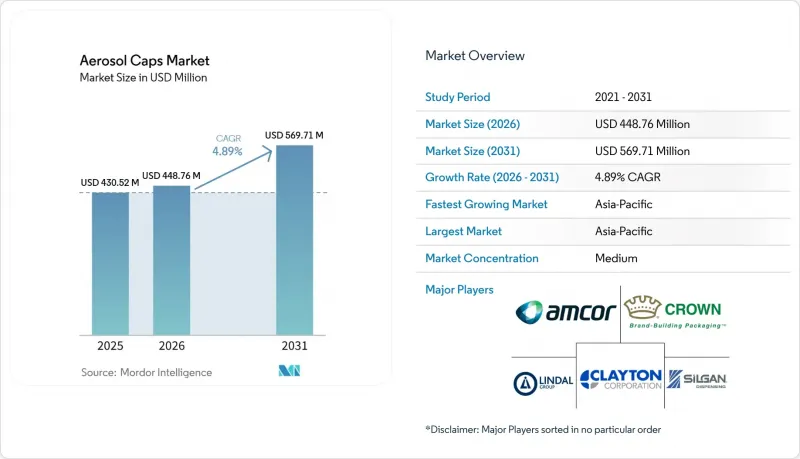
本報告按類型(單層蓋、雙層蓋、頸縮蓋、按扣/卡扣式蓋、兒童安全蓋等)、應用領域(個人護理/化妝品、家居用品、汽車/工業等)和地區(亞太地區、北美地區、歐洲地區、南美地區、中東和非洲地區)進行細分。市場預測以美元計價。
全球氣霧劑蓋市場趨勢與洞察
個人護理和化妝品行業對優質氣霧劑包裝的需求不斷成長。
個人護理和化妝品行業仍然是推動先進氣霧劑蓋規格發展的主要價值創造驅動力。品牌擁有者需要金屬質感、客製化顏色和符合人體工學的形狀,以支持產品在商店中的定位。這些要求提高了模具和設計的難度,這對專注於標準單層組件的供應商來說是一個挑戰。個人護理氣霧劑產品為品牌所有者提供了一個明確的理由,讓他們在氣霧劑蓋的外觀、易用性和整體產品展示方面進行差異化。這一趨勢有利於高價值的個人護理產品,而非低規格的家用產品。因此,在氣霧劑蓋市場,能夠為整個品牌組合提供一致的裝飾、貼合度和噴嘴相容性的供應商變得越來越重要。
更廣泛地採用輕巧且可回收的噴霧器蓋設計
包裝要求的不斷提高,使得氣霧劑蓋開發中材料選擇的重要性日益凸顯。歐盟的《包裝和包裝廢棄物法規》規定,到2030年,歐洲市場的包裝必須可回收利用,這給採用不相容材料組合的蓋體設計帶來了壓力。採用全聚丙烯蓋體和內襯設計可以避免混合材料規格所帶來的分離難題。這種方法為品牌所有者提供了一條清晰的途徑,使其能夠在應用場景和當地回收系統允許的情況下使用再生聚丙烯。這項變更將影響產品認證,因為除了相容性、外觀和噴霧性能之外,現在還必須考慮可回收性。如果供應商能夠將材料簡化從一個孤立的產品概念轉化為可複製、可大規模生產的設計,氣霧劑蓋市場將從中受益。
多成分、多層氣霧劑蓋回收所面臨的挑戰
由聚丙烯外殼、聚甲醛 (POM) 內襯、金屬零件或其他混合材料組成的瓶蓋在回收系統中仍然難以處理。其複雜性會限制材料分類,並使可回收性聲明難以明確。 2026 年 2 月,罐頭製造商協會 (TCMI) 和家用及商用產品協會 (HCPA) 聯合發布了氣霧劑材料收集設施操作指南。該指南旨在支援更安全、更一致的氣霧劑容器處理,目標是到 2030 年實現 85% 的家庭回收率。瓶蓋供應商仍面臨單一瓶蓋內混合聚合物這項獨特挑戰。氣霧劑瓶蓋市場也面臨實際的限制,因為品牌必須淘汰那些不符合其包裝回收計畫或未來歐洲合規要求的設計。
細分市場分析
到2025年,單層蓋將佔氣霧劑蓋市場31.82%的佔有率,這反映了其在除臭劑、空氣清新劑和工業噴霧產品等大批量生產產品中的廣泛應用。單層蓋的廣泛採用歸功於其結構簡單、組裝工藝熟悉以及單價低廉。雙層蓋和圓頂蓋適用於需要高階外觀或特定噴霧效果的品牌。頸縮式蓋和卡扣式/按扣式設計可滿足特定產品方案中對罐體直徑和生產線相容性的要求。聚氨酯(PU)泡棉蓋的應用範圍較為有限,例如需要在運送過程中提供保護的化妝品。
預計到2031年,兒童安全瓶蓋的年複合成長率將達到6.24%。標準規格和安全規格之間的差異對供應商的規劃至關重要。雖然單層瓶蓋的單價需求龐大,但它們最容易受到區域製造商的價格競爭。此外,它們也更容易面臨減少材料用量的要求,以及品牌對傳統混合材料設計的嚴格審查。由於兒童安全瓶蓋必須滿足既定的性能和安全要求,因此獲得認證的供應商數量有限。這使得供應商如果擁有必要的測試和生產控制系統,就能提高單件產品的附加價值。開發可客製化的安全和高階規格的供應商,可以在滿足關鍵合規要求的同時,將相關的模具概念應用於多個客戶。
區域分析
到2025年,亞太地區將佔據氣霧劑瓶蓋市場41.35%的佔有率,預計到2031年將以5.44%的複合年成長率成長。中國擁有成熟的氣霧劑容器、閥門及相關組件生產基地。印度受益於個人保健產品消費量的成長、製藥業的活性化以及對契約製造的投資。日本和韓國則憑藉其高階產品優勢,滿足了化妝品品牌對高精度和差異化瓶蓋設計的需求。東南亞的製造地也吸引了尋求區域供應關係的全球品牌的注意。
區域合規要求使跨境採購作業更加複雜。印度須遵守印度標準局 (BIS) 的規定,而中國則有其自身的噴霧劑包裝標準。日本的《高壓氣體安全法》也為供應商和品牌所有者增加了合規的考量。這些不同的要求可能有利於那些已經擁有認證和營運經驗的本地製造商,但也可能延長單瓶蓋設計在多個國家獲得認證所需的時間。
北美和歐洲仍然是醫藥、消費品和個人護理等高附加價值氣霧劑應用的重要市場。受監管應用中對兒童安全包裝的要求正在推動北美市場的需求。在歐洲,隨著包裝可回收性法規的生效,供應商正轉向採用單一材料和再生材料製成的瓶蓋方案。雖然南美洲、中東和非洲的市場規模較小,但對當地氣霧劑生產的投資可能會創造對附近瓶蓋和噴嘴生產能力的需求。能夠提供可靠前置作業時間和靈活設計方案的區域供應商可以幫助客戶縮短漫長的供應路線,從而使客戶受益。
其他好處:
- Excel格式的市場預測(ME)表
- 3個月的分析師支持
目錄
第1章:引言
- 研究假設和市場定義
- 調查範圍
第2章:調查方法
第3章執行摘要
第4章 市場狀況
- 市場概覽
- 市場促進因素
- 個人護理和化妝品行業對高檔氣霧劑容器的需求不斷成長。
- 更廣泛地採用輕巧、可回收的噴霧器蓋設計
- 對具有防篡改和兒童安全功能的噴霧器蓋解決方案的需求不斷成長。
- 擴大氣霧劑日常消費品和家居用品的契約製造。
- 氣霧劑瓶蓋製造和品質檢驗流程自動化的進步。
- 市場限制因素
- 回收多成分、多層氣霧劑蓋所面臨的挑戰。
- 與全球品牌擁有者進行長期產品認證和批准流程
- 包裝重量減輕和可重複使用包裝推廣方面取得了進展。
- 價值鏈分析
- 波特五力分析
第5章 市場規模與成長預測
- 按類型
- 單層帽
- 雙層蓋
- 領口帽
- 卡扣式/卡扣鎖蓋
- 兒童安全帽(CRC)
- 聚氨酯泡棉帽
- 圓頂形帽
- 其他類型
- 透過使用
- 個人護理化妝品
- 家用產品
- 汽車和工業
- 食物
- 油漆和塗料
- 藥品和醫療保健
- 其他用途
- 按地區
- 亞太地區
- 中國
- 印度
- 日本
- 韓國
- 其他亞太國家
- 北美洲
- 美國
- 加拿大
- 墨西哥
- 歐洲
- 德國
- 英國
- 法國
- 義大利
- 俄羅斯
- 其他歐洲國家
- 南美洲
- 巴西
- 阿根廷
- 其他南美國家
- 中東和非洲
- 沙烏地阿拉伯
- 南非
- 其他中東和非洲國家
- 亞太地區
第6章 競爭情勢
- 市場集中度
- 策略趨勢
- 市佔率和排名分析
- 公司簡介
- Amcor plc
- AptarGroup, Inc.
- Capardoni e C. Srl
- Clayton Corp.
- Coster Tecnologie Speciali SpA
- Crown
- LINDAL Group Holding GmbH
- MITANI VALVE CO.,LTD
- Precision Valve Corporation
- Shenzhen i-Like Fine Chemical Co., Ltd.
- Silgan Dispensing Systems
- Summit Packaging Systems
第7章 市場機會與未來展望
According to Mordor Intelligence, the aerosol caps market was valued at USD 430.52 million in 2025 and is estimated to grow from USD 448.76 million in 2026 to reach USD 569.71 million by 2031, at a CAGR of 4.89% during the forecast period (2026-2031).
This report is Segmented by Type (Single-Wall Caps, Double-Wall Caps, Necked-In Caps, Snap-On / Snap-Lock Caps, Child-Resistant Caps (CRC), and More), Application (Personal Care and Cosmetics, Household Products, Automotive and Industrial, and More), and Geography (Asia-Pacific, North America, Europe, South America, Middle-East and Africa). The Market Forecasts are Provided in Terms of Value (USD).
Global Aerosol Caps Market Trends and Insights
Growing Demand for Premium Aerosol Packaging in Personal Care and Cosmetic Products
Personal care and cosmetics remain the main value driver for advanced aerosol cap specifications. Brand owners are seeking metallic finishes, tailored colors, and ergonomic shapes that support product positioning at the shelf. These requirements raise tooling and design demands, which can be difficult for suppliers focused on standard single-wall parts. Personal care aerosol formats give brand owners a clear reason to differentiate closure appearance, handling, and overall product presentation. This mix favors higher-value personal care formats over lower-specification household formats. The aerosol caps market, therefore, gives greater weight to suppliers that can provide consistent decoration, fit, and actuator compatibility across a brand portfolio.
Increasing Adoption of Lightweight and Recyclable Aerosol Cap Designs
Packaging requirements are making material selection a more important part of aerosol cap development. The European Union Packaging and Packaging Waste Regulation requires packaging on the European market to be recyclable by 2030, creating pressure on cap designs that combine incompatible materials. An all-polypropylene cap and insert design can avoid the separation issues associated with mixed-material formats. This approach also gives brand owners a clearer route to using recycled polypropylene where the application and local collection system permit it. The change affects product qualification because recyclability must be considered alongside fit, appearance, and dispensing performance. The aerosol caps market can benefit when suppliers convert material simplification into repeatable, production-ready designs rather than isolated product concepts.
Challenges Associated with Recycling Multicomponent and Multilayer Aerosol Caps
Caps that combine polypropylene shells, Polyoxymethylene (POM) inserts, metal elements, or other mixed materials remain difficult to manage in recovery systems. Their complexity can limit material sorting and make it harder to present a clear recyclability claim. The Can Manufacturers Institute and the Household & Commercial Products Association issued an aerosol playbook for material recovery facilities in February 2026. The playbook supports safer and more consistent handling of aerosol containers and targets 85% household recycling access by 2030. Cap suppliers must still address the distinct issue of mixed polymers within an individual closure. The aerosol caps market faces a practical constraint where brands exclude designs that cannot support their packaging recovery commitments or future European compliance needs.
Other drivers and restraints analyzed in the detailed report include:
- Rising Demand for Tamper-Evident and Child-Resistant Aerosol Closure Solutions
- Expansion of Contract Manufacturing for Aerosol-Based FMCG and Household Products
- Lengthy Product Qualification and Approval Cycles with Global Brand Owners
For complete list of drivers and restraints, kindly check the Table Of Contents.
Segment Analysis
Single-wall caps held 31.82% of the aerosol caps market size in 2025, reflecting their use in high-volume deodorant, air freshener, and industrial spray products. Their widespread use comes from straightforward construction, familiar assembly processes, and a low unit cost. Double-wall caps and domed caps are more relevant where brands seek a premium appearance or a particular spray presentation. Necked-in caps and snap-on or snap-lock designs meet can-diameter and line-compatibility requirements in defined product programs. Polyurethane (PU) foam caps serve a narrower role where cosmetic products need protection during distribution.
Child-resistant caps are projected to grow at a 6.24% CAGR through 2031. The difference between standard and safety-led formats is important for supplier planning. Single-wall caps generate substantial unit demand, but they also face the greatest price competition from regional manufacturers. They are more exposed to requests for lower material use and to brand scrutiny of conventional mixed-material designs. Child-resistant caps have a smaller qualified supplier base because they must meet documented performance and safety requirements. This can support a higher value per unit when the supplier has the required testing and production controls. Suppliers that develop configurable safety and premium formats can use related tooling concepts across several customers while keeping critical compliance features consistent.
Complete Report Scope:
- By Type
- Single-Wall Caps
- Double-Wall Caps
- Necked-In Caps
- Snap-On / Snap-Lock Caps
- Child-Resistant Caps (CRC)
- PU Foam Caps
- Domed Caps
- Other Types
- By Application
- Personal Care and Cosmetics
- Household Products
- Automotive and Industrial
- Food Products
- Paints and Coatings
- Pharmaceuticals and Healthcare
- Other Applications
- By Geography
- Asia-Pacific
- China
- India
- Japan
- South Korea
- Rest of Asia-Pacific
- North America
- United States
- Canada
- Mexico
- Europe
- Germany
- United Kingdom
- France
- Italy
- Russia
- Rest of Europe
- South America
- Brazil
- Argentina
- Rest of South America
- Middle-East and Africa
- Saudi Arabia
- South Africa
- Rest of Middle-East and Africa
- Asia-Pacific
Geography Analysis
Asia-Pacific accounted for 41.35% of the aerosol caps market size in 2025 and is forecast to grow at a 5.44% CAGR through 2031. China has an established base for aerosol containers, valves, and related components. India is supported by growing personal care consumption, pharmaceutical activity, and contract manufacturing investment. Japan and South Korea contribute premium value because cosmetics brands often specify high-precision and differentiated closure designs. Southeast Asian manufacturing hubs also attract interest from global brands seeking regional supply relationships.
Regional compliance requirements make cross-border sourcing more complex. India applies Bureau of Indian Standards requirements, while China uses its own aerosol packaging standards. Japan's High-Pressure Gas Safety Act adds another compliance consideration for suppliers and brand owners. These differing requirements can support local manufacturers that already have certification and operating experience. They can also extend the time needed to qualify one cap design across several countries.
North America and Europe remain important for high-value pharmaceutical, household, and personal care aerosol uses. Child-resistant packaging requirements in regulated applications support North American demand. Europe is moving suppliers toward mono-material and recycled-content cap options as packaging recyclability rules take effect. South America, and Middle-East and Africa are smaller regions, but local aerosol production investment can create demand for nearby cap and actuator capacity. Regional suppliers that offer dependable lead times and adaptable designs can benefit when customers seek to reduce long supply routes.
- Amcor plc
- AptarGroup, Inc.
- Capardoni e C. Srl
- Clayton Corp.
- Coster Tecnologie Speciali S.p.A
- Crown
- LINDAL Group Holding GmbH
- MITANI VALVE CO.,LTD
- Precision Valve Corporation
- Shenzhen i-Like Fine Chemical Co., Ltd.
- Silgan Dispensing Systems
- Summit Packaging Systems
Additional Benefits:
- The market estimate (ME) sheet in Excel format
- 3 months of analyst support
TABLE OF CONTENTS
1 Introduction
- 1.1 Study Assumptions and Market Definition
- 1.2 Scope of the Study
2 Research Methodology
3 Executive Summary
4 Market Landscape
- 4.1 Market Overview
- 4.2 Market Drivers
- 4.2.1 Growing Demand for Premium Aerosol Packaging in Personal Care and Cosmetic Products
- 4.2.2 Increasing Adoption of Lightweight and Recyclable Aerosol Cap Designs
- 4.2.3 Rising Demand for Tamper-Evident and Child-Resistant Aerosol Closure Solutions
- 4.2.4 Expansion of Contract Manufacturing for Aerosol-Based FMCG and Household Products
- 4.2.5 Increasing Automation of Aerosol Cap Manufacturing and Quality Inspection Processes
- 4.3 Market Restraints
- 4.3.1 Challenges Associated with Recycling Multicomponent and Multilayer Aerosol Caps
- 4.3.2 Lengthy Product Qualification and Approval Cycles with Global Brand Owners
- 4.3.3 Increasing Packaging Lightweighting and Adoption of Refillable Packaging Formats
- 4.4 Value Chain Analysis
- 4.5 Porter's Five Forces Analysis
- 4.5.1 Threat of New Entrants
- 4.5.2 Bargaining Power of Suppliers
- 4.5.3 Bargaining Power of Buyers
- 4.5.4 Threat of Substitutes
- 4.5.5 Competitive Rivalry
5 Market Size and Growth Forecasts (Value)
- 5.1 By Type
- 5.1.1 Single-Wall Caps
- 5.1.2 Double-Wall Caps
- 5.1.3 Necked-In Caps
- 5.1.4 Snap-On / Snap-Lock Caps
- 5.1.5 Child-Resistant Caps (CRC)
- 5.1.6 PU Foam Caps
- 5.1.7 Domed Caps
- 5.1.8 Other Types
- 5.2 By Application
- 5.2.1 Personal Care and Cosmetics
- 5.2.2 Household Products
- 5.2.3 Automotive and Industrial
- 5.2.4 Food Products
- 5.2.5 Paints and Coatings
- 5.2.6 Pharmaceuticals and Healthcare
- 5.2.7 Other Applications
- 5.3 By Geography
- 5.3.1 Asia-Pacific
- 5.3.1.1 China
- 5.3.1.2 India
- 5.3.1.3 Japan
- 5.3.1.4 South Korea
- 5.3.1.5 Rest of Asia-Pacific
- 5.3.2 North America
- 5.3.2.1 United States
- 5.3.2.2 Canada
- 5.3.2.3 Mexico
- 5.3.3 Europe
- 5.3.3.1 Germany
- 5.3.3.2 United Kingdom
- 5.3.3.3 France
- 5.3.3.4 Italy
- 5.3.3.5 Russia
- 5.3.3.6 Rest of Europe
- 5.3.4 South America
- 5.3.4.1 Brazil
- 5.3.4.2 Argentina
- 5.3.4.3 Rest of South America
- 5.3.5 Middle-East and Africa
- 5.3.5.1 Saudi Arabia
- 5.3.5.2 South Africa
- 5.3.5.3 Rest of Middle-East and Africa
- 5.3.1 Asia-Pacific
6 Competitive Landscape
- 6.1 Market Concentration
- 6.2 Strategic Moves
- 6.3 Market Share (%)/Ranking Analysis
- 6.4 Company Profiles (includes Global Overview, Market Overview, Core Segments, Financials as available, Strategic Information, Products and Services, and Recent Developments)
- 6.4.1 Amcor plc
- 6.4.2 AptarGroup, Inc.
- 6.4.3 Capardoni e C. Srl
- 6.4.4 Clayton Corp.
- 6.4.5 Coster Tecnologie Speciali S.p.A
- 6.4.6 Crown
- 6.4.7 LINDAL Group Holding GmbH
- 6.4.8 MITANI VALVE CO.,LTD
- 6.4.9 Precision Valve Corporation
- 6.4.10 Shenzhen i-Like Fine Chemical Co., Ltd.
- 6.4.11 Silgan Dispensing Systems
- 6.4.12 Summit Packaging Systems
7 Market Opportunities and Future Outlook
- 7.1 White-Space and Unmet-Need Assessment

 全球氣霧劑市場規模、佔有率、趨勢和成長分析報告(2026-2034)
 氣霧劑市場:依產品類型、推進劑類型、包裝材料、應用和分銷管道分類-全球預測,2026-2032年氣霧劑蓋市場:全球市場按蓋類型、材質、尺寸、應用和銷售管道分類的預測,2026-2032年氣溶膠致動器市場:2026-2032年全球市場預測(依致動器類型、推進劑類型、容器材質、應用與通路分類)
 氣霧劑阻隔包裝市場預測至2034年-按產品類型、材料、推進劑類型、阻隔技術、應用和地區分類的全球分析
 2026年全球航太推進劑市場報告氣霧劑除塵劑市場:依配方、推進劑、最終用戶、應用及分銷管道分類-2026-2032年全球市場預測氣溶膠中和器市場:按技術、應用和最終用戶分類 - 2026-2032年全球市場預測全球氣霧劑噴灑系統市場規模、佔有率、趨勢和成長分析報告(2026-2034年)氣霧劑稀釋劑市場:依推進劑類型、產品類型、通路、應用和最終用戶分類-2026-2032年全球預測