


 |
市場調查報告書
商品編碼
2118873
乙烯:市場佔有率分析、行業趨勢和統計數據、成長預測(2026-2031)Ethylene - Market Share Analysis, Industry Trends & Statistics, Growth Forecasts (2026 - 2031) |
||||||

※ 本網頁內容可能與最新版本有所差異。詳細情況請與我們聯繫。
根據 Mordor Intelligence 估計,2025 年乙烯市值為 1,885.2 億美元,並將從 2026 年的 1,982.1 億美元持續成長到 2031 年的 2,648.4 億美元。
預測期(2026-2031 年)的複合年成長率預計為 5.97%。
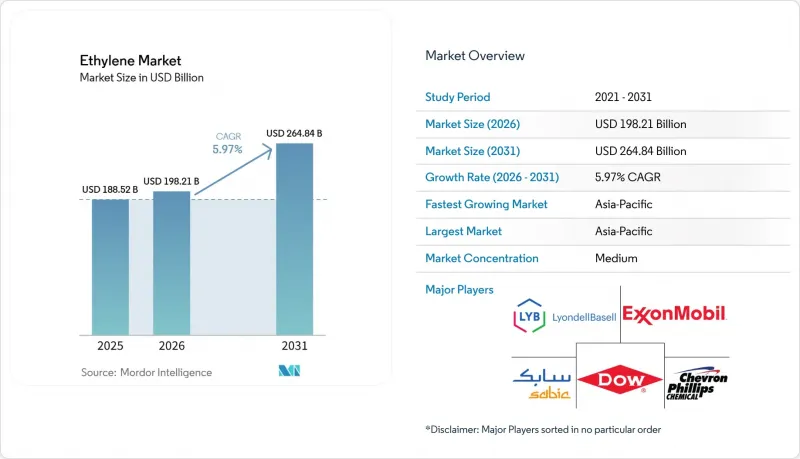
本報告按原料(石腦油、乙烷、丙烷等)、應用領域(聚乙烯、環氧乙烷等)、終端用戶產業(包裝、建築、汽車、紡織、化學、農業、消費品等)和地區(亞太地區、北美、歐洲、南美、中東和非洲)進行細分。市場預測以美元計價。
全球乙烯市場趨勢與洞察
包裝應用中對聚乙烯的需求不斷成長
聚乙烯廣泛應用於軟包裝薄膜、容器、托盤纏繞膜和防護材料,因此包裝產業的需求持續支撐著乙烯市場。電子商務物流對拉伸膜和托盤纏繞膜的需求不斷成長,推動了聚乙烯在物流領域的應用。食品安全法規也促進了對能夠抑制水分遷移和保護包裝商品的材料的需求。歐盟關於包裝和包裝廢棄物的法規鼓勵採用可回收設計,這可能導致單一材料聚乙烯包裝的使用量增加。 2025年3月,北歐化工(Borealis)推出了用於非食品軟包裝的Borcycle M CWT120CL,顯示再生線性低密度聚乙烯(LDPE)領域的商業活動持續活躍。雖然這些變化支撐了對聚乙烯的需求,但也要求生產商提高再生材料含量和可回收性。
人們越來越關注循環經濟和低碳乙烯生產。
隨著客戶對整個供應鏈的排放進行評估,低碳生產在乙烯市場的重要性日益凸顯。中國石油天然氣集團公司(中石油)於2026年7月在庫爾勒啟動了一個全循環綠色低碳乙烯計畫。該計畫結合了太陽能發電、裂解爐廢氣二氧化碳捕集和氫氣循環利用技術。根據中石油介紹,該計畫每年將利用10億千瓦時的太陽能,並減少137萬噸二氧化碳排放。此外,可再生能源電化學先進轉化技術(REACT)計畫於2026年5月啟動,旨在開發將回收的二氧化碳轉化為乙烯的電解設備。這些項目表明,生產商正在並行推進傳統裂解路線和低排放路線的發展,而不是將二者視為獨立的業務。
原油和液態天然氣(NGL)原料價格波動
即使下游需求保持穩定,原料價格波動也會擠壓裂解裝置的利潤空間。如果原油價格上漲幅度超過聚合物價格,以石腦油為原料的裝置受到的影響尤其嚴重。如果中東地區的航運路線中斷,依賴中東原油的生產商將面臨更大的風險。由此導致的利潤波動可能造成維修延遲、運轉率下降或延後新增產能的決策。多原料裂解裝置提供了一個切實可行的解決方案,但需要大量的資本投資和完善的物流系統。因此,如果營運商能夠在不中斷生產的情況下實現供應鏈多元化並調整原料使用,乙烯市場將從中受益。
細分市場分析
到2025年,石腦油將佔乙烯市場佔有率的42.57%,這反映了歐洲和亞洲大部分地區已建成的石腦油裂解裝置。乙烷是成長最快的原料,預計到2031年將以6.84%的複合年成長率成長。美國墨西哥灣沿岸的生產商受益於豐富的液態天然氣(NGL)供應和完善的乙烷基礎設施。這確保了乙烷基裂解裝置即使在原油價格飆升的情況下也能保持永續的原料優勢。亞洲和歐洲不斷擴大的進口能力也支撐了乙烷基乙烯生產市場規模。此外,與石腦油相比,乙烷的生產排放強度更低,這使其在碳排放合規成本較高的地區更具吸引力。
美國乙烷裂解成本與歐洲石腦油裂解成本的差異分別為每噸123美元及792美元。這一差異促使亞洲和歐洲買家尋求更長期的乙烷供應。同時,在某些地區,由於煉油廠一體化程度高且基礎設施完善,石油衍生原料更具優勢,因此石腦油仍不可或缺。對於能夠獲得聯產氣的中東生產商而言,丙烷和丁烷也至關重要。柔軟性的裂解裝置可以根據相對價格的波動來選擇這些原料。這種柔軟性提高了供應的韌性,但並不能消除物流限制或區域供應風險。
區域分析
預計到2025年,亞太地區將佔據全球乙烯市場佔有率的46.72%,並在2031年之前以6.81%的複合年成長率成長。BASF湛江廠將於2026年3月全面運作,新增乙烯裂解產能100萬噸/年。該地區正經歷需求中心林立和新增供應量大規模的雙重局面。印度的包裝和建設活動進一步推動了乙烯消費量的成長。韓國的前景則是喜憂參半,一方面有大型新計畫運作,另一方面老舊的石腦油裂解裝置面臨壓力。
S-OIL公司的沙欣(Shaheen)計畫於2026年7月完成機械完工,設計年產乙烯180萬噸。該計畫採用原油製取化學品的技術,預計2027年投入商業營運。繼Aster公司於2026年5月決定擴大在布科姆(Bucom)的出口產能後,新加坡正進一步鞏固其作為物流樞紐的地位。由於頁岩氣生產支撐了乙烷供應,北美仍保持成本競爭力。加拿大已融入美國供應鏈,而墨西哥正致力於重啟乙烯衍生物的生產。墨西哥國家石油公司(Pemex)已在其2025-2035年計畫中撥款42億美元,用於重啟其坎格雷赫拉(Cangrejera)和莫雷洛斯(Morelos)煉油廠的生產。
歐洲正受到石腦油價格飆升、碳排放法規合規要求以及能源成本上漲的影響。由於成本劣勢,與使用乙烷作為原料的地區相比,歐洲乙烯市場規模更加受限。歐盟委員會修訂後的基準進一步凸顯了本地資產排放績效的重要性。中東地區擁有原料優勢,沙烏地阿拉伯、阿拉伯聯合大公國和卡達能夠以具有競爭力的價格獲得天然氣。 2026年7月,塔斯尼公司完成了沙烏地阿拉伯乙烯和聚乙烯公司的擴建工程,提高了其在朱拜勒的產能。在南美洲,原料成本高昂,但布拉斯科公司已批准投資42億巴西幣(約7.4億美元),將其在里約熱內盧的產能擴大22萬噸/年。
其他好處:
- Excel格式的市場預測(ME)表
- 3個月的分析師支持
目錄
第1章:引言
- 研究假設和市場定義
- 調查範圍
第2章:調查方法
第3章執行摘要
第4章 市場狀況
- 市場概覽
- 市場促進因素
- 包裝應用中對聚乙烯的需求不斷成長
- 重點關注循環經濟和低碳乙烯生產
- 原料柔軟性和蒸汽裂解操作數位化最佳化方面的進步
- 電動車冷卻和溫度控管系統對乙二醇的需求增加。
- 增加對亞太地區和中東地區綜合石化計畫的投資。
- 市場限制因素
- 原油和液化天然氣(NGL)原料價格波動
- 對以石腦油為原料生產乙烯制定嚴格的碳排放法規。
- 新建乙烯生產設施的法規核准和授權程序耗時過長。
- 價值鏈分析
- 波特五力分析
- 生產能力分析
第5章 市場規模與成長預測
- 按原料
- 石腦油
- 乙烷
- 丙烷
- 丁烷
- 其他
- 透過使用
- 聚乙烯
- 環氧乙烷
- 乙苯
- 二氯乙烷(EDC)
- 醋酸乙烯單體(VAM)
- 其他
- 按最終用途行業分類
- 包裝
- 建築/施工
- 車
- 纖維
- 化學
- 農業
- 醫療和藥品
- 消費品
- 其他
- 按地區
- 亞太地區
- 中國
- 印度
- 日本
- 韓國
- 其他亞太國家
- 北美洲
- 美國
- 加拿大
- 墨西哥
- 歐洲
- 德國
- 英國
- 法國
- 義大利
- 俄羅斯
- 其他歐洲國家
- 南美洲
- 巴西
- 阿根廷
- 其他南美國家
- 中東和非洲
- 沙烏地阿拉伯
- 南非
- 其他中東和非洲國家
- 亞太地區
第6章 競爭情勢
- 市場集中度
- 策略趨勢
- 市佔率和排名分析
- 公司簡介
- SABIC
- Borealis AG
- Braskem
- Chevron Phillips Chemical Company LLC
- China Petrochemical Corporation
- Exxon Mobil Corporation
- Formosa Plastics Corporation
- INEOS Group Limited
- LG Chem Ltd.
- Lotte Chemical Corporation
- LyondellBasell Industries Holdings BV
- Mitsubishi Chemical Corporation
- NOVA Chemicals Corporation
- PetroChina Company Limited
- PTT Global Chemical Public Company Limited
- Reliance Industries Limited
- Sasol Limited
- Shell plc
- TotalEnergies
第7章 市場機會與未來展望
According to Mordor Intelligence, the ethylene market was valued at USD 188.52 billion in 2025 and is estimated to grow from USD 198.21 billion in 2026 to reach USD 264.84 billion by 2031, at a CAGR of 5.97% during the forecast period (2026-2031).
This report is Segmented by Feedstock (Naphtha, Ethane, Propane, and More), Application (Polyethylene, Ethylene Oxide, and More), End-Use Industry (Packaging, Building & Construction, Automotive, Textile, Chemicals, Agriculture, Consumer Goods, and More), and Geography (Asia-Pacific, North America, Europe, South America, and Middle-East and Africa). The Market Forecasts are Provided in Terms of Value (USD).
Global Ethylene Market Trends and Insights
Growing Demand for Polyethylene in Packaging Applications
Packaging demand continues to support the ethylene market because polyethylene is widely used in flexible films, containers, pallet wrap, and protective materials. E-commerce distribution requires more stretch film and pallet wrap, which raises polyethylene use in logistics. Food safety rules also support demand for materials that limit moisture transfer and protect packaged goods. The EU Packaging and Packaging Waste Regulation supports recyclable designs and can increase the use of mono-material polyethylene packaging. Borealis introduced Borcycle M CWT120CL in March 2025 for flexible non-food packaging, showing continued commercial activity in recycled linear low-density polyethylene. These changes support polyethylene demand while requiring producers to improve recycled-content and recyclability credentials.
Rising Focus on Circular Economy and Low-Carbon Ethylene Production
Low-carbon production is becoming more relevant to the ethylene market as customers assess emissions across their supply chains. China National Petroleum Corporation launched its full-chain green and low-carbon ethylene project in Korla in July 2026. The project combines photovoltaic electricity, carbon capture from cracker furnace flue gas, and hydrogen recycling. CNPC stated that the project uses 1 billion kWh of photovoltaic electricity each year and can reduce carbon emissions by 1.37 million metric tons annually. The Renewable Electrochemical Advanced Conversion of CO2 to Target products (REACT) program began in May 2026 to develop an electrolyzer that converts recycled carbon dioxide into ethylene. These projects show that producers are pursuing lower-emission routes alongside conventional cracking rather than treating them as separate businesses.
Volatility in Crude Oil and Natural Gas Liquid Feedstock Prices
Feedstock volatility can compress cracker margins even when downstream demand remains stable. Naphtha-based plants are particularly exposed when crude oil prices rise faster than polymer prices. Producers that rely on Middle Eastern cargoes also face greater risk when regional shipping routes are disrupted. The resulting margin changes can delay maintenance, reduce operating rates, or postpone new capacity decisions. Multi-feed crackers offer a practical response, but they require capital investment and suitable logistics. The ethylene market, therefore, benefits when operators can diversify supply arrangements and adjust feedstock use without interrupting production.
Other drivers and restraints analyzed in the detailed report include:
- Advancements in Feedstock Flexibility and Digital Optimization of Steam Cracking Operations
- Increasing Demand for Ethylene Glycol in Electric Vehicle Cooling and Thermal Management Systems
- Stringent Carbon Emission Regulations for Naphtha-Based Ethylene Production
For complete list of drivers and restraints, kindly check the Table Of Contents.
Segment Analysis
Naphtha accounted for 42.57% of the ethylene market share in 2025, reflecting the established naphtha cracker base in Europe and much of Asia. Ethane is the fastest-growing feedstock and is expected to expand at a 6.84% CAGR through 2031. United States Gulf Coast producers benefit from a substantial natural gas liquids supply and established ethane infrastructure. This gives ethane-based crackers a durable feedstock advantage when crude oil prices are elevated. The ethylene market size for ethane-based output is supported by growing import capacity in Asia and Europe. Ethane also has a lower reported production-emissions intensity than naphtha, which adds to its appeal where carbon compliance costs are material.
The cost difference between United States ethane cracking and European naphtha cracking was USD 123 per metric ton and USD 792 per metric ton, respectively. This difference encourages Asian and European buyers to secure longer-term ethane supplies. Naphtha remains necessary where refinery integration and legacy infrastructure favor oil-derived feedstocks. Propane and butane are also important for Middle Eastern producers with access to associated gas. Flexible crackers can choose among these feedstocks when relative prices change. This flexibility improves resilience, but it does not remove exposure to logistics limits and regional supply risks.
Complete Report Scope:
- By Feedstock
- Naphtha
- Ethane
- Propane
- Butane
- Other Feedstocks
- By Application
- Polyethylene
- Ethylene Oxide
- Ethyl Benzene
- Ethylene Dichloride (EDC)
- Vinyl Acetate Monomer (VAM)
- Other Applications
- By End-Use Industry
- Packaging
- Building & Construction
- Automotive
- Textile
- Chemicals
- Agriculture
- Healthcare & Pharmaceuticals
- Consumer Goods
- Other End-Use Industries
- By Geography
- Asia-Pacific
- China
- India
- Japan
- South Korea
- Rest of Asia-Pacific
- North America
- United States
- Canada
- Mexico
- Europe
- Germany
- United Kingdom
- France
- Italy
- Russia
- Rest of Europe
- South America
- Brazil
- Argentina
- Rest of South America
- Middle-East and Africa
- Saudi Arabia
- South Africa
- Rest of Middle-East and Africa
- Asia-Pacific
Geography Analysis
Asia-Pacific accounted for 46.72% of the ethylene market share in 2025 and is projected to grow at a 6.81% CAGR through 2031. BASF's Zhanjiang complex entered full operation in March 2026 and added a 1 million metric ton-per-year ethylene cracker. The region combines large demand centers with substantial new supply. India's packaging and construction activity supports further ethylene consumption. South Korea faces an uneven outlook because older naphtha crackers are under pressure while major new projects enter service.
S-OIL's Shaheen Project reached mechanical completion in July 2026 and is designed to produce 1.8 million metric tons of ethylene per year. The project uses crude-to-chemicals technology and is expected to begin commercial operations in 2027. Singapore is strengthening its logistics role after Aster's May 2026 investment decision to expand export capacity at Bukom. North America remains cost-competitive because shale production supports ethane supply. Canada is integrated with the United States supply chains, while Mexico is seeking to reactivate ethylene derivative production. Pemex allocated USD 4.2 billion in its 2025 to 2035 plan to revive output at the Cangrejera and Morelos complexes.
Europe is affected by high naphtha costs, carbon compliance, and utility costs. A weaker cost position constrains the ethylene market size in Europe more than in ethane-based regions. The European Commission's revised benchmark makes emissions performance more important for local assets. The Middle East has a more favorable feedstock position because Saudi Arabia, the United Arab Emirates, and Qatar can use competitively priced gas. Tasnee completed its Saudi Ethylene and Polyethylene Company expansion in July 2026, adding capacity at Al Jubail. South America has higher feedstock costs, but Braskem approved BRL 4.2 billion, USD 740 million, for a 220,000 metric tons-per-year expansion in Rio de Janeiro.
- SABIC
- Borealis AG
- Braskem
- Chevron Phillips Chemical Company LLC
- China Petrochemical Corporation
- Exxon Mobil Corporation
- Formosa Plastics Corporation
- INEOS Group Limited
- LG Chem Ltd.
- Lotte Chemical Corporation
- LyondellBasell Industries Holdings B.V.
- Mitsubishi Chemical Corporation
- NOVA Chemicals Corporation
- PetroChina Company Limited
- PTT Global Chemical Public Company Limited
- Reliance Industries Limited
- Sasol Limited
- Shell plc
- TotalEnergies
Additional Benefits:
- The market estimate (ME) sheet in Excel format
- 3 months of analyst support
TABLE OF CONTENTS
1 Introduction
- 1.1 Study Assumptions and Market Definition
- 1.2 Scope of the Study
2 Research Methodology
3 Executive Summary
4 Market Landscape
- 4.1 Market Overview
- 4.2 Market Drivers
- 4.2.1 Growing Demand for Polyethylene in Packaging Applications
- 4.2.2 Rising Focus on Circular Economy and Low-Carbon Ethylene Production
- 4.2.3 Advancements in Feedstock Flexibility and Digital Optimization of Steam Cracking Operations
- 4.2.4 Increasing Demand for Ethylene Glycol in Electric Vehicle Cooling and Thermal Management Systems
- 4.2.5 Increasing Investments in Integrated Petrochemical Complexes Across Asia-Pacific and the Middle East
- 4.3 Market Restraints
- 4.3.1 Volatility in Crude Oil and Natural Gas Liquid (NGL) Feedstock Prices
- 4.3.2 Stringent Carbon Emission Regulations for Naphtha-Based Ethylene Production
- 4.3.3 Lengthy Regulatory Approval and Permitting Processes for New Ethylene Production Facilities
- 4.4 Value Chain Analysis
- 4.5 Porter's Five Forces Analysis
- 4.5.1 Threat of New Entrants
- 4.5.2 Bargaining Power of Suppliers
- 4.5.3 Bargaining Power of Buyers
- 4.5.4 Threat of Substitutes
- 4.5.5 Competitive Rivalry
- 4.6 Production Capacity Analysis
5 Market Size and Growth Forecasts (Value)
- 5.1 By Feedstock
- 5.1.1 Naphtha
- 5.1.2 Ethane
- 5.1.3 Propane
- 5.1.4 Butane
- 5.1.5 Other Feedstocks
- 5.2 By Application
- 5.2.1 Polyethylene
- 5.2.2 Ethylene Oxide
- 5.2.3 Ethyl Benzene
- 5.2.4 Ethylene Dichloride (EDC)
- 5.2.5 Vinyl Acetate Monomer (VAM)
- 5.2.6 Other Applications
- 5.3 By End-Use Industry
- 5.3.1 Packaging
- 5.3.2 Building & Construction
- 5.3.3 Automotive
- 5.3.4 Textile
- 5.3.5 Chemicals
- 5.3.6 Agriculture
- 5.3.7 Healthcare & Pharmaceuticals
- 5.3.8 Consumer Goods
- 5.3.9 Other End-Use Industries
- 5.4 By Geography
- 5.4.1 Asia-Pacific
- 5.4.1.1 China
- 5.4.1.2 India
- 5.4.1.3 Japan
- 5.4.1.4 South Korea
- 5.4.1.5 Rest of Asia-Pacific
- 5.4.2 North America
- 5.4.2.1 United States
- 5.4.2.2 Canada
- 5.4.2.3 Mexico
- 5.4.3 Europe
- 5.4.3.1 Germany
- 5.4.3.2 United Kingdom
- 5.4.3.3 France
- 5.4.3.4 Italy
- 5.4.3.5 Russia
- 5.4.3.6 Rest of Europe
- 5.4.4 South America
- 5.4.4.1 Brazil
- 5.4.4.2 Argentina
- 5.4.4.3 Rest of South America
- 5.4.5 Middle-East and Africa
- 5.4.5.1 Saudi Arabia
- 5.4.5.2 South Africa
- 5.4.5.3 Rest of Middle-East and Africa
- 5.4.1 Asia-Pacific
6 Competitive Landscape
- 6.1 Market Concentration
- 6.2 Strategic Moves
- 6.3 Market Share (%)/Ranking Analysis
- 6.4 Company Profiles (includes Global Overview, Market Overview, Core Segments, Financials as available, Strategic Information, Products and Services, and Recent Developments)
- 6.4.1 SABIC
- 6.4.2 Borealis AG
- 6.4.3 Braskem
- 6.4.4 Chevron Phillips Chemical Company LLC
- 6.4.5 China Petrochemical Corporation
- 6.4.6 Exxon Mobil Corporation
- 6.4.7 Formosa Plastics Corporation
- 6.4.8 INEOS Group Limited
- 6.4.9 LG Chem Ltd.
- 6.4.10 Lotte Chemical Corporation
- 6.4.11 LyondellBasell Industries Holdings B.V.
- 6.4.12 Mitsubishi Chemical Corporation
- 6.4.13 NOVA Chemicals Corporation
- 6.4.14 PetroChina Company Limited
- 6.4.15 PTT Global Chemical Public Company Limited
- 6.4.16 Reliance Industries Limited
- 6.4.17 Sasol Limited
- 6.4.18 Shell plc
- 6.4.19 TotalEnergies
7 Market Opportunities and Future Outlook
- 7.1 White-Space and Unmet-Need Assessment

 乙烯市場:2026-2032年全球市場預測(依衍生性產品類型、製造流程、原料、終端用戶產業及通路分類)
 全球乙烯市場:依來源、衍生物及地區分類乙烯吸收劑市場:按形態、材料、應用、終端用戶產業和銷售管道的全球市場預測,2026-2032年
 乙烯吸收劑市場規模、佔有率、趨勢和預測:按產品、應用、最終用戶和地區分類,2026-2034年
 全球四氯乙烯市場規模、佔有率、趨勢和成長分析報告(2026-2034年)
 2026年全球乙烯基石油化工市場報告
 乙烯吸收劑市場-全球產業規模、佔有率、趨勢、機會及預測(依產品、化學品、應用、最終用途產業、地區及競爭格局分類),2021-2031年三氯乙烯市場按製程、純度等級、形態、應用和最終用途產業分類-全球預測,2026-2032年乙烯-丙烯酸丁酯共聚物市場按形態、等級、應用和最終用途產業分類-2026-2032年全球預測
 全球乙烯吸附劑市場:預測(至 2032 年)—按產品類型、形式、包裝、分銷管道、應用、最終用戶和地區進行分析