


 |
市場調查報告書
商品編碼
2118870
氟化鋁:市場佔有率分析、產業趨勢與統計、成長預測(2026-2031)Aluminum Fluoride - Market Share Analysis, Industry Trends & Statistics, Growth Forecasts (2026 - 2031) |
||||||

※ 本網頁內容可能與最新版本有所差異。詳細情況請與我們聯繫。
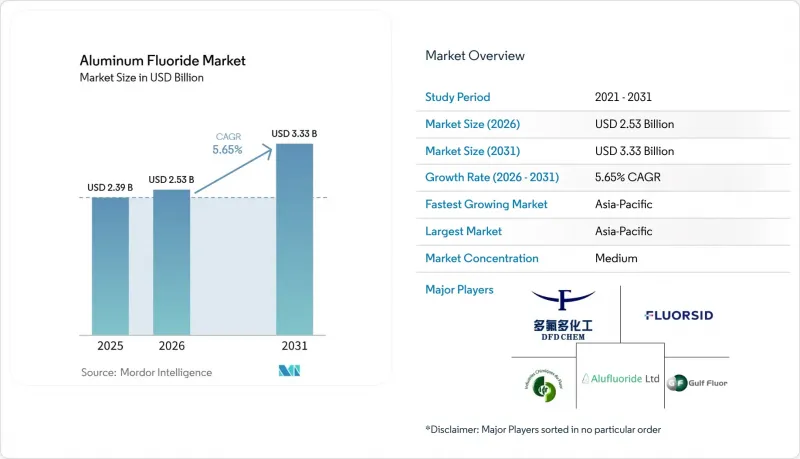
根據 Mordor Intelligence 預測,2025 年氟化鋁市值將達到 23.9 億美元,從 2026 年的 25.3 億美元成長到 2031 年的 33.3 億美元,預測期(2026-2031 年)的年複合成長率(CAGR)為 5.65%。
本報告依製造流程(乾法、濕法)、形態(粉末、顆粒)、應用(電解添加劑、助熔劑、催化劑/觸媒撐體等)、終端用戶產業(鋁提煉、化學等)和地區(亞太地區、北美地區、歐洲地區、南美地區、中東和非洲地區)進行細分。市場預測以美元計價。
全球氟化鋁市場趨勢及洞察
電動車和交通運輸領域對輕質鋁的需求不斷成長
2024年全球電動車銷量超過1,700萬輛,較去年同期成長25%。這一成長推動了對汽車結構和電池系統輕量材料的需求。汽車製造商正在擴大輕量材料在這些應用中的使用,隨著鋁產量的增加,電解添加劑的需求也隨之成長,從而帶動了氟化鋁市場的發展。此外,現代冶煉廠的設計需要對熔池成分進行更精確的控制,使得化學成分的一致性日益重要。這種關係促進了需求的成長,並可能使能夠滿足嚴格製程規範的供應商受益。
高純度氟化鋁和改良的電解在冶煉中的性能。
冶煉廠業者越來越重視氟化鋁原料的管理,不再僅僅將其視為常規採購決策,而是將其視為能源管理的重要組成部分。根據ICSOBA會議論文集,在500 kA電解槽中改進電解成分管理,可使每噸鋁的直流能耗降低628 kWh。電流效率的提升可在維持電解液穩定狀態的同時降低能耗。改良通風罩安裝和氣體處理可以提高廢氣中氟化氫的回收率,從而有可能減少單一工廠補充純水所需的量。然而,更大規模、更有效率的電解槽線需要在整個運作過程中使用可靠的添加劑,這仍然是氟化鋁市場的主要需求。因此,買家更加重視純度、可重複性和技術支援。
有關氟化物排放和廢棄物管理的環境法規
遵守環境法規會導致氟化鋁生產商和冶煉廠的資本投資和營運成本增加。美國針對氟化鋁生產子類別的法規規定,30 天平均氟化物排放量限值為每公斤產品 0.63 公斤。研究報告也提及印度修訂後的 2025 年法規,該法規規定電解槽車間的氟化物總排放量為每噸鋁 0.8 公斤,氟化鋁的使用量為每噸鋁 20 公斤。這些要求可能會增加對精確運作和高品質產品的需求。配備更強大的氣體處理系統和電解槽的工廠可以從廢氣中回收更多的氟化氫。雖然這種回收可以減少穩定工廠的替代需求,但更嚴格的監管標準可能會使小規模供應商更難進入市場。
細分市場分析
截至2025年,乾法製程佔據了氟化鋁市場72.81%的佔有率。這是因為現有冶煉廠採用的是基於無水氟化氫和氫氧化鋁的成熟生產過程。該製程滿足了大規模冶煉廠客戶的需求,這些客戶優先考慮穩定的供應、一致的產品特性以及與現有處理系統的兼容性。在氟化氫和硫酸可以同時取得的地區,乾式製程擁有堅實的基礎。它還可以提供符合傳統冶煉廠規格的產品等級。然而,乾法製程的經濟性仍然高度依賴酸級螢石的供應和成本。這些壓力迫使生產商探索其他原料來源。
預計到2031年,濕式製程將以6.12%的複合年成長率成長。該製程透過將磷酸鹽肥料生產中回收的氟矽酸與氫氧化鋁反應,降低了對螢石供應鏈的依賴。一項2025年的研究檢視了氟矽酸(磷酸鹽化學品製造的一個產品環節)的濕式合成,並報告稱其純度和反應收率均有所提高。印度製造商已利用附近的磷酸鹽生產設施作為氟矽酸的來源。此外,與乾式製程相比,濕式製程還有可能減少氟化氫氣體的排放。
由於濕式製程的產品密度和顆粒特性可能與乾式製程有所不同,冶煉廠在切換製程前可能需要調整配料設定。即使濕式製程在經濟上更具優勢,這些操作變更也會產生切換成本。因此,如果冶煉廠已經已調整的物料處理、儲存和熔罐控制流程以適應其熟悉的牌號,那麼乾式製程可能仍然是最重要的選擇。這項決策不僅限於化學品的採購價格;還需要考慮評估顆粒行為、進料速率以及對常規電解槽控制的影響所需的工作量。
採用濕式製程的生產商如果能夠從附近的磷酸鹽企業穩定採購氟矽酸,就能增強自身市場地位。這種合作模式可以將化肥產品轉化為可預測的工業原料,從而緩解採礦業供應緊張的影響。現有研究也表明,該製程有助於減少氟化氫的排放,這在排放法規嚴格的地區尤其重要。然而,由於連續冶煉製程無法長時間停產,客戶可能仍會將乾法製程視為合格的替代方案。這種情況使得多種生產製程能夠在氟化鋁市場共存。
因此,生產商之間的競爭不僅體現在基礎原料的成本上,也體現在供應的穩定性和產品的一致性上。濕式製程的擴張並不意味著所有工廠都會立即更換供應商。濕式製程很可能首先在新工廠中佔據市場佔有率,因為這些工廠可以根據產品的特性設計接收和分配系統。在現有工廠中,濕式製程的採用速度將取決於合格評估和運作測試的結果。這種情況鼓勵逐步過渡,而不是突然取代乾式製程的產量。
預計到2025年,粉狀氟化鋁將佔氟化鋁市場62.33%的佔有率。其主導地位反映了運作中已建立完善的儲存、氣動輸送和計量系統。工廠員工熟悉粉狀產品,且這些產品符合現有的採購規範。許多老廠的設備也運作於粉末狀產品。此外,生產商可以透過成熟的包裝和物流網路運輸粉末。這些因素為粉狀產品的普及提供了堅實的基礎。
隨著現代電解槽中自動化物料處理系統的引入,預計2031年,顆粒狀氟化鋁的年複合成長率將達到5.93%。顆粒狀物料可以減少處理過程中的粉塵,並改善稱重設備的流量控制。 ICSOBA發布的一項研究比較了低堆積密度和高堆積密度的氟化鋁,並探討了產品特性如何影響冶煉過程中的流動性。在印度和中東的新計畫中,可以在設計階段就指定使用顆粒狀物料處理系統,而無需改造過時的設備。顆粒狀產品可能具有溢價優勢,因為它們可以減輕清潔和維護的負擔。此外,透過乾式洗滌回收的細氟化鋁可以與濃縮氧化鋁一起重新添加到熔池中,從而降低每噸金屬的淨交換需求。
因此,物料形態的選擇不僅取決於包裝,還取決於操作方式。粉末狀物料在現有系統中仍然實用,因為其在傳統工廠中經過多年實踐檢驗,應用日臻完善。此外,粉狀物料供應充足,方便採購商比較不同供應商的提案。如果專案旨在以最少的人工干預控制物料流動,顆粒狀物料可能更具吸引力。處理過程中較低的粉塵水平有助於保持工作場所的清潔,並減輕輸送設備的負荷。如果設施從一開始就考慮到自動化配料,這一優勢尤其重要。
在新建的工廠中,可以在試運行前選擇顆粒的儲存和供應設施;而在舊工廠中,則可能需要評估改造現有系統的成本。這種差異解釋了為什麼氟化鋁市場對兩種形態的需求持續存在。顆粒級產品在高電流冶煉爐中具有實際優勢,因為這些冶煉爐需要可控制且可重複的添加量。另一方面,在現有系統運作穩定且預期轉換帶來的收益不大的工廠中,粉末仍然是一個合適的選擇。因此,生產商需要根據每位客戶的營運條件調整產品形態、密度、包裝和物流。產品形態的選擇取決於冶煉廠的建成時間、自動化程度、回收材料的管理政策。這些因素表明,雖然對粉末的需求將持續存在,但預計在預測期內對顆粒的需求成長速度將更快。
區域分析
預計到2025年,亞太地區將佔全球氟化鋁市場佔有率的49.82%,並將在2031年之前保持6.18%的複合年成長率。中國是該地區最大的生產國和消費國,其冶煉設施吸收了國內大部分產量。該地區也供應了全球60%以上的氟化鋁產量。印度和中東地區透過鋁產能擴張計畫產生了補充需求。日本和韓國則受益於光學和電子應用等小規模的高階細分市場。這些國家的半導體和精密光學設備供應鏈對純度認證的要求比一般冶煉應用更為嚴格。
北美和歐洲的需求得益於成熟的冶煉設施和嚴格的合規要求。到2025年,美國100%的酸級氟化鈣將依賴進口,其中墨西哥佔64%,越南佔12%,中國佔10%。這種高度依賴性使區域生產商面臨物流和原料供應中斷的風險。歐洲也面臨類似的壓力,因為氟化學品的成本不斷上漲,但當地供應商可以透過縮短前置作業時間、提供合規支援和供應保障來留住客戶。美國鋁業公司(Alcoa)於2025年4月與IGNIS Equity Holdings達成的交易旨在穩定西班牙聖西普里安鋁業綜合體,並維持重要的本地消費基礎。
南美洲、中東和非洲的市場規模相對小規模,但它們在區域供應鏈中佔有重要的戰略地位。巴西的水力發電基礎設施支撐著鋁提煉的需求,而阿根廷則作為一個利基消費市場貢獻力量。在南美洲,當地的螢石資源和磷酸鹽產品在原料供應上有一定的優勢。在沿岸地區,氟化鋁的生產使得冶煉廠的供貨週期比從亞洲和歐洲進口更短。沿岸地區的產能與一項旨在利用低成本電力發展鋁價值鏈的更廣泛計劃密切相關。每個新的冶煉項目都會產生持續的氟化鋁需求,為氟化鋁市場提供長期的區域需求基礎。
該地區的現狀凸顯了生產基地對客戶的重要性。由於冶煉廠持續使用氟化鋁,交付延遲可能成為營運方面的問題。位置產能不斷成長地區附近的生產商可以縮短運輸時間,提供更快速的服務。當買家需要根據生產計劃和維護要求調整訂單時,這種地理位置的接近性至關重要。在南美洲,水力發電和原生鋁的結合支撐了冶煉廠的運作中需求。雖然本地原料供應的優勢有助於提升競爭力,但這並不能取代可靠的加工和運輸的重要性。
在中東和非洲,對鋁價值鏈的投資為區域供應商提供了支持運作的機會。沿岸地區的位置尤其有利於服務原本需要依賴較長運輸路線的客戶。這些區域趨勢不會改變亞太地區在氟化鋁市場的主導地位。然而,它們將催生中國以外地區的新需求,並支持更廣泛的供應商群體。這一趨勢也提升了供應合約、本地庫存以及適合每位客戶運作的產品等級的重要性。因此,區域因素會影響供應成本以及買家可能需求的產品類型。
其他好處:
- Excel格式的市場預測(ME)表
- 3個月的分析師支持
目錄
第1章:引言
- 研究假設和市場定義
- 調查範圍
第2章:調查方法
第3章執行摘要
第4章 市場狀況
- 市場概覽
- 市場促進因素
- 電動車和交通運輸領域對輕質鋁的需求不斷成長
- 在最新的節能冶煉製程中擴大高純度氟化鋁的應用。
- 為滿足基礎設施和工業需求,對鋁生產能力的投資正在增加。
- 供應鏈一體化進程以及支持原料穩定供應的貿易政策。
- 由於電解性能的提高,節能型鋁提煉正受到越來越多的關注。
- 市場限制因素
- 嚴格的環境法規,涉及氟化物排放和廢棄物管理。
- 螢石和氟化氫原料的供應和價格波動
- 對高性能和特殊應用有嚴格的品質和純度要求。
- 價值鏈分析
- 波特五力分析
第5章 市場規模與成長預測
- 透過製造程序
- 乾法
- 濕法
- 按形式
- 粉末
- 顆粒
- 透過使用
- 電解添加劑
- 通量
- 催化劑和觸媒撐體
- 光學鍍膜
- 按最終用途行業分類
- 鋁提煉
- 化學
- 陶瓷和玻璃
- 電子設備/光學裝置
- 其他
- 按地區
- 亞太地區
- 中國
- 印度
- 日本
- 韓國
- 其他亞太國家
- 北美洲
- 美國
- 加拿大
- 墨西哥
- 歐洲
- 德國
- 英國
- 法國
- 義大利
- 俄羅斯
- 其他歐洲國家
- 南美洲
- 巴西
- 阿根廷
- 其他南美國家
- 中東和非洲
- 沙烏地阿拉伯
- 南非
- 其他中東和非洲國家
- 亞太地區
第6章 競爭情勢
- 市場集中度
- 策略趨勢
- 市佔率和排名分析
- 公司簡介
- AB LIFOSA
- Alufluor
- Alufluoride Limited
- Aluminum Corporation of China Limited
- Asian Metal Ltd
- Do-Fluoride Chemicals Co., Ltd.
- Fluorsid
- Gulf Fluor
- Henan Weilai Aluminum Co., Ltd.
- Hunan Nonferrous Metals Corporation Limited
- Industries Chimiques du Fluor
- Koura Global
- Orbia Fluor and Energy Materials
- PhosAgro Group
- Tanfac Industries Limited
第7章 市場機會與未來展望
According to Mordor Intelligence, the aluminum fluoride market was valued at USD 2.39 billion in 2025 and is estimated to grow from USD 2.53 billion in 2026 to reach USD 3.33 billion by 2031, at a CAGR of 5.65% during the forecast period (2026-2031).
This report is Segmented by Production Process (Dry Process, Wet Process), Form (Powder, Granules), Application (Electrolyte Additive, Flux Agent, Catalyst & Catalyst Support, and More), End-Use Industry (Aluminum Smelting, Chemicals, and More), and Geography (Asia-Pacific, North America, Europe, South America, Middle East and Africa). The Market Forecasts are Provided in Terms of Value (USD).
Global Aluminum Fluoride Market Trends and Insights
Growing Demand for Lightweight Aluminum in Electric Vehicles and Transportation Applications
Global electric vehicle sales exceeded 17 million units in 2024, increasing by 25% from the previous year. This growth supports demand for lightweight materials in vehicle structures and battery systems. Vehicle manufacturers are increasing their use of lightweight materials across these applications, which supports the aluminum fluoride market as higher aluminum output requires more electrolyte additives. Newer smelter designs also require tighter control of bath composition, increasing the importance of consistent chemical quality. This relationship supports volume demand and may favor suppliers that meet stringent process specifications.
High-Purity Aluminum Fluoride and Enhanced Electrolyte Performance in Smelting
Smelter operators increasingly manage aluminum fluoride dosing as part of energy management rather than as a routine purchasing decision. Proceedings from ICSOBA reported that improved electrolyte composition management in 500 kA cells reduced direct-current energy use by 628 kWh per tonne of aluminum. Improved current efficiency can reduce energy consumption while maintaining stable bath conditions. Better hooding and gas treatment can recover more hydrogen fluoride from exhaust streams, which may reduce net make-up requirements at individual plants. Even so, larger and more efficient potlines that require reliable additions throughout operation continue to support the aluminum fluoride market. Buyers are therefore placing greater value on purity, repeatability, and technical support.
Environmental Rules for Fluoride Emissions and Waste Management
Environmental compliance increases capital and operating costs for aluminum fluoride producers and smelters. The US rule for the aluminum fluoride production subcategory sets a 30-day average fluoride effluent limit of 0.63 kg/kkg of product. The supplied research also cited India's revised 2025 rules, which set a total fluoride limit of 0.8 kg per tonne of aluminum from electrolytic pot rooms and an aluminum fluoride use limit of 20 kg per tonne of aluminum. These requirements can increase demand for accurate dosing and high-quality products. Facilities that install stronger gas treatment systems and pot hooding can recover more hydrogen fluoride from exhaust. This recovery can lower replacement needs at mature plants, while higher compliance standards can make market entry more difficult for smaller suppliers.
Other drivers and restraints analyzed in the detailed report include:
- Investment in Aluminum Production Capacity
- Supply Chain Integration and Raw Material Availability
- Fluorspar and Hydrogen Fluoride Volatility and Specialty Quality Requirements
For complete list of drivers and restraints, kindly check the Table Of Contents.
Segment Analysis
The dry process held 72.81% of the aluminum fluoride market share in 2025, as established plants use a proven route based on anhydrous hydrogen fluoride and aluminum hydroxide. This process serves large smelter customers that prioritize reliable volumes, consistent product properties, and compatibility with existing handling systems. Dry production has an established base in regions with integrated access to hydrogen fluoride and sulfuric acid. It can also deliver grades that align with conventional smelter specifications. However, dry-route economics remain sensitive to the availability and cost of acid-grade fluorspar. These pressures encourage producers to assess alternative feedstock routes.
The wet process is forecast to expand at a 6.12% CAGR through 2031. It reacts fluorosilicic acid recovered from phosphate fertilizer production with aluminum hydroxide, reducing dependence on the fluorspar supply chain. A 2025 study examined wet synthesis from the fluorosilicic acid byproduct of phosphorus chemical production and reported improvements in purity and reaction yield. Indian manufacturers have used nearby phosphoric acid operations as a source of fluorosilicic acid. Wet processing can also generate less hydrogen fluoride off-gas than dry processing.
Product density and particle characteristics may differ from dry-route output, so smelters may need to adjust dosing settings before switching. These operational changes create switching costs, even when wet-process economics are favorable. For this reason, the dry route is likely to remain important where smelters have already calibrated material handling, storage, and bath-control practices around a familiar grade. The decision is not limited to the chemical's purchase price. It also includes the work required to confirm particle behavior, feeding rates, and the impact on routine potline control.
A wet-route producer can strengthen its position when it has dependable access to fluorosilicic acid from nearby phosphate operations. That connection can convert a fertilizer byproduct into a predictable industrial input and reduce exposure to mining-related supply restrictions. Available research also links this route to a lower hydrogen fluoride off-gas burden, which can be important in locations with stricter emission requirements. However, customers may still retain dry-route supply as a qualified alternative because continuous smelting does not allow extended interruptions. This dynamic creates room for more than one process route in the aluminum fluoride market.
Producers therefore compete on supply security and product consistency, as well as on the cost of the underlying feedstock. Wet-route expansion does not mean all plants will change their sourcing at once. The wet process is more likely to gain share first where new facilities can design receiving and dosing systems around its product characteristics. In established plants, qualification and operating trials can determine the pace of adoption. This mix supports a gradual shift rather than a sudden replacement of dry-process output.
Powder accounted for 62.33% of the aluminum fluoride market size in 2025. Its leading position reflects the established storage, pneumatic conveying, and dosing systems used at operating smelters. Plant personnel are familiar with powder products, and these products align with existing procurement specifications. Many older facilities operate equipment designed around powder grades. Producers can also transport powder through established packaging and logistics networks. These factors sustain a large installed base for this form.
Granules are projected to grow at a CAGR of 5.93% through 2031 as modern pot rooms adopt automated material handling systems. Granular material can reduce dust during handling and improve flow control in dosing equipment. Research presented by ICSOBA compared low-bulk-density and high-bulk-density aluminum fluoride and discussed how product characteristics affect flowability in smelting. New projects in India and the Middle East can specify granular handling systems during the design phase instead of adapting older equipment. Granules may command a price premium because they can reduce cleaning and maintenance requirements. Fine aluminum fluoride captured during dry scrubbing can also return to the bath with enriched alumina, which can constrain net replacement demand per tonne of metal.
Form selection, therefore, depends on operating practices rather than packaging alone. Powder remains practical for existing systems because conventional plants have refined its use over many years. Its broad availability also helps purchasers compare offers across suppliers. Granules can be more attractive when a project aims to control material flow with fewer manual interventions. Lower dust levels during handling can support cleaner work areas and reduce the burden on conveying equipment. This advantage is especially relevant when a facility is designed around automated dosing from the outset.
A new plant can select storage and feed equipment for granules before commissioning, while an older plant may need to evaluate the cost of modifying established systems. This difference explains why the aluminum fluoride market continues to demand both forms. Granular grades can offer practical benefits in high-amperage smelters that require controlled and repeatable additions. Powder remains an appropriate option when current systems operate reliably and a plant does not identify sufficient benefits from conversion. Producers must therefore align form, density, packaging, and logistics with each customer's operating conditions. The form segment is shaped by the age of the smelter, its level of automation, and its approach to recovered material management. These factors support continued demand for powder while allowing granules to grow faster through the forecast period.
Complete Report Scope:
- By Production Process
- Dry Process
- Wet Process
- By Form
- Powder
- Granules
- By Application
- Electrolyte Additive
- Flux Agent
- Catalyst & Catalyst Support
- Optical Coatings
- By End-Use Industry
- Aluminum Smelting
- Chemicals
- Ceramics & Glass
- Electronics & Optics
- Other End-use Industry
- By Geography
- Asia-Pacific
- China
- India
- Japan
- South Korea
- Rest of Asia-Pacific
- North America
- United States
- Canada
- Mexico
- Europe
- Germany
- United Kingdom
- France
- Italy
- Russia
- Rest of Europe
- South America
- Brazil
- Argentina
- Rest of South America
- Middle-East and Africa
- Saudi Arabia
- South Africa
- Rest of Middle-East and Africa
- Asia-Pacific
Geography Analysis
Asia Pacific accounted for 49.82% of the aluminum fluoride market in 2025 and is projected to register a CAGR of 6.18% through 2031. China represents the largest regional production and consumption center, as its smelting base absorbs much of its domestic output. The region also supplied more than 60% of global aluminum fluoride output. India and the Middle East are adding complementary demand through aluminum capacity projects. Japan and South Korea support a smaller premium segment for optical-grade and electronics-grade materials. Their semiconductor and precision optics supply chains require more stringent purity certifications than bulk smelter applications.
North America and Europe's demand is supported by mature smelting assets and high compliance requirements. The United States obtained 100% of its acid-grade fluorspar from imports in 2025, including 64% from Mexico, 12% from Vietnam, and 10% from China. This dependence increases regional producers' exposure to logistics and feedstock disruptions. Europe faces similar pressure from higher fluorochemical costs, although local suppliers can retain customers through shorter lead times, compliance support, and supply assurance. Alcoa's April 2025 transaction with IGNIS Equity Holdings was intended to stabilize the San Ciprian aluminum complex in Spain, preserving an important local consumption base.
South America and the Middle East and Africa remain smaller markets but hold strategic importance for regional supply. Brazil's hydroelectric power base supports aluminum smelting demand, while Argentina contributes niche consumption. Local fluorspar sources and phosphate byproduct streams can provide some feedstock advantages in South America. In the Gulf, aluminum fluoride production can serve smelters with shorter delivery times than imports from Asia or Europe. Gulf capacity is tied to broader plans to use lower-cost power for aluminum value-chain development. Each new smelting project can create a lasting offtake requirement for aluminum fluoride, giving the aluminum fluoride market a long-term regional demand base.
The regional landscape also highlights why production location matters to customers. Smelters use aluminum fluoride continuously, so delivery disruptions can create operational concerns. Producers located near growing capacity can reduce transit times and provide more responsive service. This proximity can be important when buyers need to adjust orders in response to production schedules or maintenance requirements. In South America, the link between hydroelectric power and primary aluminum helps sustain demand from operating smelters. A local feedstock advantage can support competitiveness, but it does not eliminate the need for reliable processing and transportation.
In the Middle East and Africa, investment in the aluminum value chain gives regional suppliers an opportunity to support new capacity as it is commissioned. The Gulf location can be particularly useful for serving customers that would otherwise depend on longer supply routes. These regional developments do not change Asia Pacific's leading role in the aluminum fluoride market. However, they create additional demand points outside China and can support a broader supplier base. This trend also increases the importance of supply contracts, local inventories, and product grades suited to each customer's operating system. Geography, therefore, affects both supply costs and the types of products buyers are likely to request.
- AB LIFOSA
- Alufluor
- Alufluoride Limited
- Aluminum Corporation of China Limited
- Asian Metal Ltd
- Do-Fluoride Chemicals Co., Ltd.
- Fluorsid
- Gulf Fluor
- Henan Weilai Aluminum Co., Ltd.
- Hunan Nonferrous Metals Corporation Limited
- Industries Chimiques du Fluor
- Koura Global
- Orbia Fluor and Energy Materials
- PhosAgro Group
- Tanfac Industries Limited
Additional Benefits:
- The market estimate (ME) sheet in Excel format
- 3 months of analyst support
TABLE OF CONTENTS
1 Introduction
- 1.1 Study Assumptions and Market Definition
- 1.2 Scope of the Study
2 Research Methodology
3 Executive Summary
4 Market Landscape
- 4.1 Market Overview
- 4.2 Market Drivers
- 4.2.1 Growing Demand for Lightweight Aluminum in Electric Vehicles and Transportation Applications
- 4.2.2 Increasing Adoption of High-Purity Aluminum Fluoride in Modern Energy-Efficient Smelting Operations
- 4.2.3 Rising Investments in Aluminum Production Capacity to Meet Infrastructure and Industrial Demand
- 4.2.4 Improving Supply Chain Integration and Trade Policies Supporting Stable Raw Material Availability
- 4.2.5 Growing Focus on Energy-Efficient Aluminum Smelting Through Enhanced Electrolyte Performance
- 4.3 Market Restraints
- 4.3.1 Stringent Environmental Regulations Governing Fluoride Emissions and Waste Management
- 4.3.2 Volatility in Fluorspar and Hydrogen Fluoride Feedstock Supply and Prices
- 4.3.3 Stringent Quality and Purity Requirements for High-Performance and Specialty Applications
- 4.4 Value Chain Analysis
- 4.5 Porter's Five Forces Analysis
- 4.5.1 Threat of New Entrants
- 4.5.2 Bargaining Power of Suppliers
- 4.5.3 Bargaining Power of Buyers
- 4.5.4 Threat of Substitutes
- 4.5.5 Competitive Rivalry
5 Market Size and Growth Forecasts (Value)
- 5.1 By Production Process
- 5.1.1 Dry Process
- 5.1.2 Wet Process
- 5.2 By Form
- 5.2.1 Powder
- 5.2.2 Granules
- 5.3 By Application
- 5.3.1 Electrolyte Additive
- 5.3.2 Flux Agent
- 5.3.3 Catalyst & Catalyst Support
- 5.3.4 Optical Coatings
- 5.4 By End-Use Industry
- 5.4.1 Aluminum Smelting
- 5.4.2 Chemicals
- 5.4.3 Ceramics & Glass
- 5.4.4 Electronics & Optics
- 5.4.5 Other End-use Industry
- 5.5 By Geography
- 5.5.1 Asia-Pacific
- 5.5.1.1 China
- 5.5.1.2 India
- 5.5.1.3 Japan
- 5.5.1.4 South Korea
- 5.5.1.5 Rest of Asia-Pacific
- 5.5.2 North America
- 5.5.2.1 United States
- 5.5.2.2 Canada
- 5.5.2.3 Mexico
- 5.5.3 Europe
- 5.5.3.1 Germany
- 5.5.3.2 United Kingdom
- 5.5.3.3 France
- 5.5.3.4 Italy
- 5.5.3.5 Russia
- 5.5.3.6 Rest of Europe
- 5.5.4 South America
- 5.5.4.1 Brazil
- 5.5.4.2 Argentina
- 5.5.4.3 Rest of South America
- 5.5.5 Middle-East and Africa
- 5.5.5.1 Saudi Arabia
- 5.5.5.2 South Africa
- 5.5.5.3 Rest of Middle-East and Africa
- 5.5.1 Asia-Pacific
6 Competitive Landscape
- 6.1 Market Concentration
- 6.2 Strategic Moves
- 6.3 Market Share (%)/Ranking Analysis
- 6.4 Company Profiles (includes Global Overview, Market Overview, Core Segments, Financials as available, Strategic Information, Products and Services, and Recent Developments)
- 6.4.1 AB LIFOSA
- 6.4.2 Alufluor
- 6.4.3 Alufluoride Limited
- 6.4.4 Aluminum Corporation of China Limited
- 6.4.5 Asian Metal Ltd
- 6.4.6 Do-Fluoride Chemicals Co., Ltd.
- 6.4.7 Fluorsid
- 6.4.8 Gulf Fluor
- 6.4.9 Henan Weilai Aluminum Co., Ltd.
- 6.4.10 Hunan Nonferrous Metals Corporation Limited
- 6.4.11 Industries Chimiques du Fluor
- 6.4.12 Koura Global
- 6.4.13 Orbia Fluor and Energy Materials
- 6.4.14 PhosAgro Group
- 6.4.15 Tanfac Industries Limited
7 Market Opportunities and Future Outlook
- 7.1 White-Space and Unmet-Need Assessment

 氟化鈣窗市場:全球市場預測,2026-2032年用於太陽能發電的耐候性PVDF薄膜市場:2026-2032年全球市場預測
 2026-2034年全球氟化鈉市場規模、佔有率、趨勢和成長分析報告氟化鈉市場規模、佔有率、成長、全球產業分析、區域趨勢及2026-2034年預測
 氟化鈣晶體 - 全球市佔率及排名、2026年至2032年總銷售及需求預測五氟硫基化合物市場按產品類型、純度等級、製造技術、應用、終端用戶產業和銷售管道分類-2026-2032年全球預測氟化浸沒冷卻液市場按類型、純度等級、應用、終端用戶產業和分銷管道分類 - 全球預測(2026-2032 年)紫外光級氟化鈣晶體市場按形態、純度、應用、終端用戶產業和銷售管道,全球預測(2026-2032年)高性能含氟液體市場按產品類型、純度、形態、應用、終端用戶產業和分銷管道分類,全球預測(2026-2032年)
 無機氟化物市場規模、佔有率及成長分析(按形態、類型、最終用途、應用和地區分類)-2026-2033年產業預測