


 |
市場調查報告書
商品編碼
2118857
對話式行銷軟體:市場佔有率分析、產業趨勢與統計、成長預測(2026-2031)Conversational Marketing Software - Market Share Analysis, Industry Trends & Statistics, Growth Forecasts (2026 - 2031) |
||||||

※ 本網頁內容可能與最新版本有所差異。詳細情況請與我們聯繫。
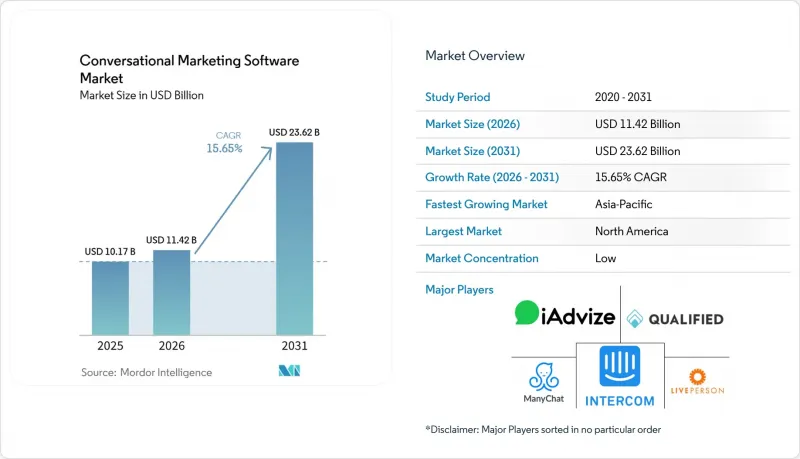
據 Mordor Intelligence 稱,對話式行銷軟體市場在 2025 年的價值為 101.7 億美元,預計到 2031 年將達到 236.2 億美元,而 2026 年為 117.6 億美元,預測期(2026-2031 年)的複合年成長率為 15.65%。
本報告按交付方式(軟體和服務)、部署模式(雲端、混合、本地部署)、企業規模(大型企業、中小企業)、最終用戶(IT與電信、銀行、金融服務和保險、汽車與交通運輸、醫療保健與生命科學等)以及地區進行細分。市場預測以美元計價。
全球對話式行銷軟體市場趨勢及洞察
即時個人化客戶參與
如今,買家可以在幾分鐘內自由切換產品頁面、訊息和銷售對話,因此「一刀切」式行銷方式的有效性正在降低。當平台能夠識別用戶訪問的即時目的並據此自訂對話時,對話式行銷軟體市場將從中受益。客戶團隊可以利用這些互動提供相關的產品訊息,將諮詢傳輸交給合適的負責人,並在潛在客戶離開管道前提案後續步驟。這使得對話式工具的價值從依賴預定的宣傳活動轉向更多地依賴日常客戶活動。利用即時會話資料的服務提供者將更緊密地融入收入和服務流程中。隨著客戶使用同一平台進行客戶獲取、支援和客戶維繫,服務提供者的角色也將擴展。
人工智慧驅動的線索篩選與轉化
自動化線索篩選使銷售團隊能夠處理入境諮詢,而無需以相同的速度增加銷售開發人員。互動式軟體可以收集基本需求、識別購買意願、安排會議,並將線索引導至合適的團隊。這可以減少諮詢量高峰期的延誤,尤其是當客戶於標準工作時間之外進行諮詢時。根據 Fin 公司報告,其客服人員每週處理超過 200 萬次客戶互動,這充分展現了專業客服人員在客戶互動工作流程中的強大能力。其商業性價值在於供應商能否將對話與合格的銷售管道和已完成的銷售活動連結起來。能夠證明這種相關性的供應商不僅在減少人工工作方面更具競爭力,而且在業務成果方面也更具優勢。
資料隱私和同意管理的複雜性
個人化對話需要存取客戶歷史記錄、行為訊號和會話訊息,這直接要求獲得明確的同意並進行資料管理。企業必須解釋如何使用這些信息,將資訊收集限制在適當的用途範圍內,並尊重客戶的資料權利。如果平台保留對話歷史記錄或利用其改進自動回复,這些義務將更具挑戰性。歐洲資料保護委員會指出,企業在開發和使用人工智慧模型時必須認真評估資料保護方面的挑戰。根據《一般資料保護規範》(GDPR),罰款最高可達2000萬歐元(2,260萬美元)或全球年營業額的4%,以較高者為準。這種風險可能導致漫長的採購審查,並有利於那些能夠證明其擁有完善管治流程的供應商。
細分市場分析
到2025年,軟體將佔據對話式行銷軟體市場72.41%的佔有率。買家更傾向於按月訂閱軟體,因為這樣可以在不增加員工的情況下擴展自動化規模。軟體層支援創建代理商、對話管理、管道整合和客戶互動回顧。 Fin於2026年7月推出了其API平台,讓開發者和企業透過API存取其對話式人工智慧功能。
預計到2031年,服務業將以16.82%的複合年成長率成長,超過對話式行銷軟體市場的整體成長率。此領域涵蓋部署、配置、模型評估、提示建立和人工交接設計。這一領域至關重要,因為僅購買軟體不足以充分培訓員工、明確營運職責或重新設計客戶流程。 ISO/IEC 42001:2023為尋求系統化管治的組織提供了一個人工智慧管理系統框架。
到 2025 年,雲端採用率將佔市場佔有率的 68.19%。雲端支援可擴展運算、快速更新和通用管理環境,以滿足不斷變化的客戶需求。 LivePerson 於 2025 年在 Google Cloud Marketplace 上線,展示了市場交付如何簡化現有雲端用戶的採購流程。只要客戶的安全性和資料居住策略允許,雲端仍將是可行的預設選擇。
預計到2031年,混合部署將以16.34%的複合年成長率成長。這種部署方式讓受監管的機構在保留某些資料、管理功能或系統在本地部署的同時,利用雲端容量來支援其他功能。這種方法適用於金融服務、醫療保健、政府機構以及跨司法管轄區營運的客戶。在某些國防、關鍵基礎設施和空氣間隙環境中,本地部署仍然是必要的,但其擁有成本高且更新周期較長。
區域分析
2025年,北美將佔據對話式行銷軟體市場37.63%的佔有率。該地區受益於B2B軟體供應商的高度集中以及成熟的客戶關係管理(CRM)基礎設施。利用現有的Salesforce、HubSpot和Marketo環境可以降低整合工作量。 2026年6月, 銷售團隊簽署了收購Fin的最終協議,顯示互動式代理在客戶關係管理(CRM)平台中的作用日益增強。雖然美國仍然是該地區的主要需求來源,但加拿大市場也在成長,這主要得益於隱私標準的推動,促使當地企業採用本地雲端服務。
預計到2031年,亞太地區的複合年成長率將達到16.85%。通訊市場模式分散,WhatsApp、LINE、微信、KakaoTalk、Zalo等應用程式層出不窮,凸顯了有效提升顧客互動體驗的重要性。行動優先的趨勢和電子商務的蓬勃發展正在推動全部區域對話式商務的發展。印度憑藉其大規模的數位基本客群和不斷變化的客戶數據管理需求,引領市場需求。儘管中國、日本和韓國仍然是重要的投資中心,但預計印尼、越南、泰國、菲律賓和馬來西亞也將受益於通訊帶來的進一步成長機會。
以德國、英國和法國為首的歐洲市場是重要的收入來源。 GDPR(一般資料保護規則)和歐盟人工智慧法規正在加強對透明度、資料最小化和人工監督的監管。對話式行銷軟體市場需要滿足這些期望,才能在監管嚴格的歐洲市場吸引客戶。歐洲資料保護委員會強調了與人工智慧模型相關的資料保護問題,包括需要採取適當的保障措施。巴西和阿根廷等南美洲國家正在湧現新的機遇,而沙烏地阿拉伯、阿拉伯聯合大公國、奈及利亞和南非等中東和非洲地區則正在支撐早期階段的需求。
其他好處:
- Excel格式的市場預測(ME)表
- 3個月的分析師支持
目錄
第1章:引言
- 研究假設和市場定義
- 調查範圍
第2章:調查方法
第3章執行摘要
第4章 市場狀況
- 市場概覽
- 市場促進因素
- 即時個人化客戶參與
- 人工智慧驅動的線索篩選與轉化
- 全通路通訊的實施
- 生成式人工智慧與多語言對話的擴展
- 利用API整合收入和運營
- 降低推理成本使得中型企業也能採用這項技術。
- 市場限制因素
- 資料隱私和同意管理的複雜性
- 舊有系統整合和資料孤島造成的摩擦
- 幻覺、品牌安全與誤送風險
- 增加LLM向人類的推理成本和交接成本
- 宏觀經濟因素對市場的影響
- 產業價值鏈分析
- 科技趨勢
- 監理情勢
- 波特五力分析
第5章 市場規模與成長預測
- 報價
- 軟體
- 服務
- 按部署模式
- 雲
- 混合
- 現場
- 按公司規模
- 大公司
- 小型企業
- 最終用戶
- 資訊科技/通訊
- BFSI
- 汽車和運輸業
- 醫療保健和生命科學
- 能源公用事業
- 工業製造
- 零售與電子商務
- 旅遊與飯店
- 其他最終用戶
- 按地區
- 北美洲
- 美國
- 加拿大
- 墨西哥
- 南美洲
- 巴西
- 阿根廷
- 其他南美國家
- 歐洲
- 德國
- 英國
- 法國
- 俄羅斯
- 西班牙
- 其他歐洲國家
- 亞太地區
- 中國
- 日本
- 印度
- 韓國
- 東南亞
- 其他亞太國家
- 中東和非洲
- 中東
- 沙烏地阿拉伯
- 阿拉伯聯合大公國
- 其他中東國家
- 非洲
- 南非
- 奈及利亞
- 其他非洲國家
- 中東
- 北美洲
第6章 競爭情勢
- 市場集中度
- 策略趨勢
- 市佔率分析
- 公司簡介
- Intercom
- Manychat, Inc.
- LivePerson, Inc.
- iAdvize
- Qualified.com, Inc.
- Conversica, Inc.
- Saleswhale Pte. Ltd.
- Whisbi Technologies, SL
- Snaps Media, Inc.
- Verloop Technology Solutions Private Limited
- Automat Technologies, Inc.
- Spectrm GmbH
- Audiense Co.
- Zoovu Ltd.
- Crisp IM SAS
- Chatfuel
- Customers.ai, Inc.
- Tidio Ltd.
- Landbot.io, SL
- MobileMonkey, Inc.
- Dashly LLC
- Botpress Technologies Inc.
第7章 市場機會與未來展望
According to Mordor Intelligence, the conversational marketing software market size was valued at USD 10.17 billion in 2025 and estimated to grow from USD 11.76 billion in 2026 to reach USD 23.62 billion by 2031, at a CAGR of 15.65% during the forecast period (2026-2031).
This report is Segmented by Offering (Software, and Services), Deployment Model (Cloud, Hybrid, and On-Premises), Enterprise Size (Large Enterprises, and Small and Mid-Sized Enterprises), End Users (IT and Telecommunication, BFSI, Automotive and Transportation, Healthcare and Life Sciences, and More), and Geography. The Market Forecasts are Provided in Terms of Value (USD).
Global Conversational Marketing Software Market Trends and Insights
Real-Time Personalized Customer Engagement
Generic outreach is becoming less effective when buyers can move between product pages, messages, and sales conversations within minutes. The Conversational Marketing Software Market benefits when a platform identifies the purpose of a live visit and changes the conversation accordingly. Customer teams can use these interactions to offer relevant product information, route a request, or suggest a next step before a prospect leaves the channel. This makes the value of conversational tools less dependent on scheduled campaigns and more dependent on daily customer activity. Providers that work with live session data can become more closely embedded in revenue and service processes. Their role also expands when customers use the same platform for acquisition, support, and retention work.
AI-Powered Lead Qualification and Conversion
Automated qualification gives sales teams a way to respond to inbound interest without expanding their sales development staff at the same pace. Conversational software can collect basic requirements, identify buyer intent, schedule meetings, and direct a lead to the appropriate team. This can reduce delays during high-volume periods, especially when interest arrives outside standard business hours. Fin reported that its customer agent handled more than 2 million customer resolutions each week, showing the scale at which specialized agents can operate in customer-facing workflows. The commercial value depends on whether providers can connect conversations to a qualified pipeline and completed sales activity. Vendors that show this connection can compete on business outcomes rather than only on reduced manual work.
Data Privacy and Consent Management Complexity
Personalized conversations require access to customer histories, behavioral signals, and session information, which creates a direct need for clear consent and data controls. Organizations must explain how they use information, restrict collection to appropriate purposes, and support customers' rights over their data. These duties become harder when platforms retain conversation histories or use them to improve automated responses. The European Data Protection Board stated that organizations need a careful assessment of data protection issues when developing and using AI models. GDPR penalties can reach EUR 20 million (USD 22.6 million) or 4% of global annual revenue, whichever is higher. This risk can lengthen procurement reviews and favor providers that can show detailed governance processes.
Other drivers and restraints analyzed in the detailed report include:
- Omnichannel Messaging Adoption
- Generative AI and Multilingual Conversation Expansion
- Legacy-System Integration and Data-Silo Friction
For complete list of drivers and restraints, kindly check the Table Of Contents.
Segment Analysis
Software accounted for 72.41% of the conversational marketing software market share in 2025. Buyers favor recurring software subscriptions because they can extend automation without matching increases in staff. The software layer supports agent creation, conversation management, channel connections, and customer-interaction review. Fin launched its API Platform in July 2026, giving developers and enterprises access to its conversational AI capabilities through an API.
Services are projected to expand at a 16.82% CAGR through 2031, faster than the Conversational Marketing Software Market. The segment covers implementation, configuration, model evaluation, prompt work, and human-handoff design. It remains important because a software purchase alone does not adequately prepare employees, clarify ownership of operations, or redesign customer processes. ISO/IEC 42001:2023 provides an AI management system framework for organizations seeking structured governance.
Cloud deployment held 68.19% share in 2025. It supports scalable computing, faster updates, and a common administrative environment for changing customer demand. LivePerson's Google Cloud Marketplace availability in 2025 showed how marketplace distribution can simplify procurement for existing cloud users. Cloud remains the practical default where customer security and data residency policies permit it.
Hybrid deployment is projected to expand at a 16.34% CAGR through 2031. It allows regulated organizations to retain selected data, controls, or systems while using cloud capacity for other functions. This approach is relevant to financial services, health care, government, and customers with operations across different jurisdictions. On-premises deployment remains necessary for some defense, critical infrastructure, and air-gapped environments, but it has higher ownership costs and slower refresh cycles.
Complete Report Scope:
- By Offering
- Software
- Services
- By Deployment Model
- Cloud
- Hybrid
- On-Premises
- By Enterprise Size
- Large Enterprises
- Small and Mid-sized Enterprises
- By End Users
- IT and Telecommunication
- BFSI
- Automotive and Transportation
- Healthcare and Life Sciences
- Energy and Utilities
- Industrial Manufacturing
- Retail and E-commerce
- Travel and Hospitality
- Other End Users
- By Geography
- North America
- United States
- Canada
- Mexico
- South America
- Brazil
- Argentina
- Rest of South America
- Europe
- Germany
- United Kingdom
- France
- Russia
- Spain
- Rest of Europe
- Asia-Pacific
- China
- Japan
- India
- South Korea
- Southeast Asia
- Rest of Asia-Pacific
- Middle East and Africa
- Middle East
- Saudi Arabia
- United Arab Emirates
- Rest of Middle East
- Africa
- South Africa
- Nigeria
- Rest of Africa
- Middle East
- North America
Geography Analysis
North America held 37.63% of the conversational marketing software market share in 2025. The region benefits from a dense base of business-to-business software vendors and an established customer relationship management infrastructure. Existing Salesforce, HubSpot, and Marketo environments can reduce integration work. Salesforce signed a definitive agreement in June 2026 to acquire Fin, indicating the growing role of conversational agents within customer relationship management platforms. The United States remains the main source of regional demand, while Canada is developing as privacy standards encourage local cloud capabilities.
Asia-Pacific is projected to expand at a 16.85% CAGR through 2031. WhatsApp, Line, WeChat, KakaoTalk, and Zalo create a fragmented messaging environment, underscoring the value of coordinated customer interactions. Mobile-first behavior and e-commerce expansion support conversational commerce across the region. India adds demand through its large digital customer base and evolving customer data management requirements. China, Japan, and South Korea remain important investment centers, while Indonesia, Vietnam, Thailand, the Philippines, and Malaysia offer further messaging-led growth opportunities.
Europe is a significant revenue base, led by Germany, the United Kingdom, and France. GDPR and the EU AI Act increase scrutiny of transparency, data minimization, and human oversight. The Conversational Marketing Software Market must meet these expectations to compete for regulated European accounts. The European Data Protection Board has highlighted data protection issues related to AI models, including the need for appropriate safeguards. South America offers emerging potential through Brazil and Argentina, while Saudi Arabia, the United Arab Emirates, Nigeria, and South Africa support earlier-stage demand in Middle East and Africa.
- Intercom
- Manychat, Inc.
- LivePerson, Inc.
- iAdvize
- Qualified.com, Inc.
- Conversica, Inc.
- Saleswhale Pte. Ltd.
- Whisbi Technologies, S.L.
- Snaps Media, Inc.
- Verloop Technology Solutions Private Limited
- Automat Technologies, Inc.
- Spectrm GmbH
- Audiense Co.
- Zoovu Ltd.
- Crisp IM SAS
- Chatfuel
- Customers.ai, Inc.
- Tidio Ltd.
- Landbot.io, S.L.
- MobileMonkey, Inc.
- Dashly LLC
- Botpress Technologies Inc.
Additional Benefits:
- The market estimate (ME) sheet in Excel format
- 3 months of analyst support
TABLE OF CONTENTS
1 INTRODUCTION
- 1.1 Study Assumptions and Market Definition
- 1.2 Scope of the Study
2 RESEARCH METHODOLOGY
3 EXECUTIVE SUMMARY
4 MARKET LANDSCAPE
- 4.1 Market Overview
- 4.2 Market Drivers
- 4.2.1 Real-Time Personalized Customer Engagement
- 4.2.2 AI-Powered Lead Qualification and Conversion
- 4.2.3 Omnichannel Messaging Adoption
- 4.2.4 Generative AI and Multilingual Conversation Expansion
- 4.2.5 API-Based Revenue-Operations Integration
- 4.2.6 Lower Inference Costs Enabling Mid-Market Adoption
- 4.3 Market Restraints
- 4.3.1 Data Privacy and Consent Management Complexity
- 4.3.2 Legacy-System Integration and Data-Silo Friction
- 4.3.3 Hallucination, Brand-Safety, and Misrouting Risk
- 4.3.4 Escalating LLM Inference and Human-Handoff Costs
- 4.4 Impact of Macroeconomic Factors on the Market
- 4.5 Industry Value-Chain Analysis
- 4.6 Technology Outlook
- 4.7 Regulatory Landscape
- 4.8 Porter's Five Forces Analysis
- 4.8.1 Threat of New Entrants
- 4.8.2 Bargaining Power of Suppliers
- 4.8.3 Bargaining Power of Buyers
- 4.8.4 Threat of Substitutes
- 4.8.5 Intensity of Competitive Rivalry
5 MARKET SIZE AND GROWTH FORECASTS (VALUE)
- 5.1 By Offering
- 5.1.1 Software
- 5.1.2 Services
- 5.2 By Deployment Model
- 5.2.1 Cloud
- 5.2.2 Hybrid
- 5.2.3 On-Premises
- 5.3 By Enterprise Size
- 5.3.1 Large Enterprises
- 5.3.2 Small and Mid-sized Enterprises
- 5.4 By End Users
- 5.4.1 IT and Telecommunication
- 5.4.2 BFSI
- 5.4.3 Automotive and Transportation
- 5.4.4 Healthcare and Life Sciences
- 5.4.5 Energy and Utilities
- 5.4.6 Industrial Manufacturing
- 5.4.7 Retail and E-commerce
- 5.4.8 Travel and Hospitality
- 5.4.9 Other End Users
- 5.5 By Geography
- 5.5.1 North America
- 5.5.1.1 United States
- 5.5.1.2 Canada
- 5.5.1.3 Mexico
- 5.5.2 South America
- 5.5.2.1 Brazil
- 5.5.2.2 Argentina
- 5.5.2.3 Rest of South America
- 5.5.3 Europe
- 5.5.3.1 Germany
- 5.5.3.2 United Kingdom
- 5.5.3.3 France
- 5.5.3.4 Russia
- 5.5.3.5 Spain
- 5.5.3.6 Rest of Europe
- 5.5.4 Asia-Pacific
- 5.5.4.1 China
- 5.5.4.2 Japan
- 5.5.4.3 India
- 5.5.4.4 South Korea
- 5.5.4.5 Southeast Asia
- 5.5.4.6 Rest of Asia-Pacific
- 5.5.5 Middle East and Africa
- 5.5.5.1 Middle East
- 5.5.5.1.1 Saudi Arabia
- 5.5.5.1.2 United Arab Emirates
- 5.5.5.1.3 Rest of Middle East
- 5.5.5.2 Africa
- 5.5.5.2.1 South Africa
- 5.5.5.2.2 Nigeria
- 5.5.5.2.3 Rest of Africa
- 5.5.5.1 Middle East
- 5.5.1 North America
6 COMPETITIVE LANDSCAPE
- 6.1 Market Concentration
- 6.2 Strategic Moves
- 6.3 Market Share Analysis
- 6.4 Company Profiles (includes Global Level Overview, Market Level Overview, Core Segments, Financials as available, Strategic Information, Market Rank/Share, Products and Services, Recent Developments)
- 6.4.1 Intercom
- 6.4.2 Manychat, Inc.
- 6.4.3 LivePerson, Inc.
- 6.4.4 iAdvize
- 6.4.5 Qualified.com, Inc.
- 6.4.6 Conversica, Inc.
- 6.4.7 Saleswhale Pte. Ltd.
- 6.4.8 Whisbi Technologies, S.L.
- 6.4.9 Snaps Media, Inc.
- 6.4.10 Verloop Technology Solutions Private Limited
- 6.4.11 Automat Technologies, Inc.
- 6.4.12 Spectrm GmbH
- 6.4.13 Audiense Co.
- 6.4.14 Zoovu Ltd.
- 6.4.15 Crisp IM SAS
- 6.4.16 Chatfuel
- 6.4.17 Customers.ai, Inc.
- 6.4.18 Tidio Ltd.
- 6.4.19 Landbot.io, S.L.
- 6.4.20 MobileMonkey, Inc.
- 6.4.21 Dashly LLC
- 6.4.22 Botpress Technologies Inc.
7 MARKET OPPORTUNITIES AND FUTURE OUTLOOK
- 7.1 White-Space and Unmet-Need Assessment

 對話式人工智慧市場-2026-2032年全球市場預測
 虛擬代理自動化市場:預測(至 2034 年)—按組件、代理類型、整合類型、應用、最終用戶和地區分類的全球分析
 對話式人工智慧市場-全球產業規模、佔有率、趨勢、機會、預測:按組件、部署、類型、技術、最終用戶、地區和競爭格局分類,2021-2031年
 2026年全球人工智慧語音互動服務市場報告
 互動式人工智慧市場規模及預測(2021-2034)、全球及區域佔有率、趨勢與成長機會分析報告:按類型、部署方式、業務功能、產業及地區分類2026年全球對話智慧軟體市場報告2026年全球語音機器人市場報告
 對話式人工智慧市場:按組件、類型、部署方式、公司規模、最終用戶產業和地區分類2026年全球語音人工智慧(AI)市場報告
 全球互動式人工智慧市場規模、佔有率、趨勢和成長分析報告(2026-2034)