


 |
市場調查報告書
商品編碼
2118851
反向ETL軟體:市佔率分析、產業趨勢與統計、成長預測(2026-2031年)Reverse Extract Transform Load Software - Market Share Analysis, Industry Trends & Statistics, Growth Forecasts (2026 - 2031) |
||||||

※ 本網頁內容可能與最新版本有所差異。詳細情況請與我們聯繫。
根據 Mordor Intelligence 預測,反向 ETL(提取、轉換、加載)軟體市場將從 2025 年的 11.2 億美元和 2026 年的 13.1 億美元成長到 2031 年的 31.4 億美元,2026 年至 2031 年的年複合成長率(CAGR)為 19.1%。
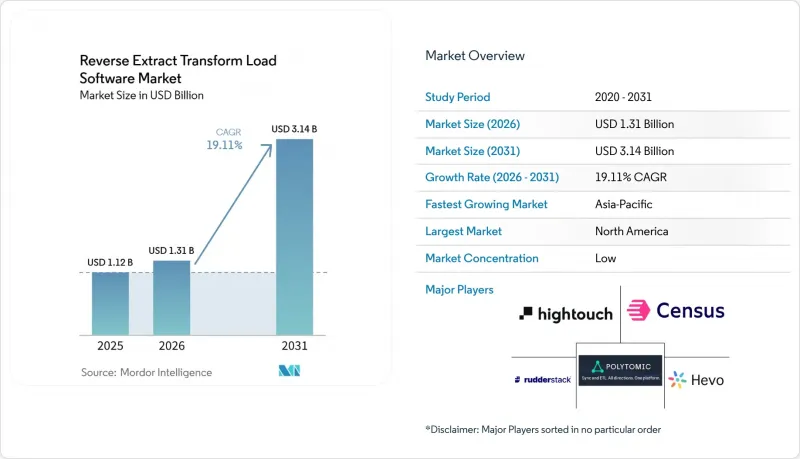
本報告按產品/服務(軟體、服務)、部署模式(雲端、混合、本地部署)、應用領域(銷售和行銷活動等)、企業規模(大型企業、中小企業)、最終用戶(金融、保險和證券(BFSI)、汽車和交通運輸等)以及地區進行細分。市場預測以美元(USD)為單位。
全球反向ETL軟體市場趨勢與洞察
雲端資料倉儲與湖倉的實施
雲端資料倉儲和湖倉的普及是推動反向 ETL 軟體市場需求的關鍵基礎。這是因為每個新的工作負載都會產生更多可供業務工具使用的資料。 Snowflake 報告稱,其 2025 會計年度產品銷售額年增 30% 至 35 億美元,截至 2025 年 1 月 31 日的淨收入留存率高達 126%,表明現有企業客戶的採用率進一步提高。這種採用率的提高促使託管資料倉儲環境中已有的資料在營運用例方面得到拓展。在 2026 年資料與人工智慧高峰會上,Databricks 發布了 Agent Bricks,該產品支援在 Unity Catalog管治的湖倉環境中運行自主資料代理程式。此外,在亞太地區和中東及非洲地區,雲端基礎設施、監管政策的明確以及政府數位化專案等因素的推動下,企業資料現代化進程正在加速。受監管的組織往往更傾向於符合 ISO/IEC 27001 標準的雲端環境,因為在資料發送到目標位置之前,完善的控制措施至關重要。
資料倉儲原生AI代理與決策工作流程
駐留在資料倉儲中的人工智慧代理正在改變反向 ETL 的角色,使其從定期同步轉變為基於事件的管治資訊交付。 Snowflake Cortex Agents 於 2025 年 11 月正式發布,在 Snowflake管治環境中採用與人類使用者相同的基於角色的存取控制。 2026 年,Databricks 發布了 Genie Agents,該代理能夠處理結構化表格和非結構化文檔,並透過模型上下文協定 (MCP) 連接跨系統執行操作。這些系統不僅利用資料倉儲中的數據,還能產生需要發送到 CRM、行銷和支援應用程式的訊號。 2026 年 4 月,GrowthLoop 在 Google BigQuery 和 Snowflake 上發布了可組合的 AI 決策功能,而無需從雲端複製資料。歐洲對透明度和人工監督的要求可能會延遲某些代理的部署,但這並不消除在管治下長期運作的必要性。
對資料品質和身分解析的依賴性
反向 ETL 工作流程的可靠性取決於從上游系統接收的識別資料。在每次同步週期中,CRM 記錄、廣告導向和客戶訊息中都可能出現重複記錄、客戶識別資訊碎片化和聯絡資訊過時等問題。解決身分識別問題的責任通常落在資料庫轉換、客戶資料平台或手動 SQL 工作流程上,而不是啟動產品。醫療保健和金融服務業由於需要跨系統和產品線管理複雜的標識符,面臨額外的挑戰。美國衛生與公眾服務部要求各機構保護健康訊息,這可能需要在傳輸患者識別碼之前,在資料倉儲層進行字段級脫敏。實施預同步品質門控、模式協定和身份驗證可以減少低品質資料的傳播,並將更成熟的平台與更簡單的配置工具區分開來。
細分市場分析
到2025年,軟體將佔據反向ETL(提取、轉換、加載)軟體市場71.36%的佔有率。這主要歸功於核心平台許可,其中包括預先建立的目標連接器、管治控制、同步調度基礎架構以及企業用於日常資料倉儲到工具啟動的可視化受眾建立器。
隨著客戶的應用場景從最初的行銷活動擴展到收入管理、醫療保健數據工作流程和人工智慧代理編配等領域,對部署支援和託管整合的需求日益成長,預計到2031年,服務市場將以20.28%的複合年成長率成長。因此,反向ETL軟體市場正在產生服務需求,因為客戶需要在初始部署後添加目標位置、修改管治設定並獲得持續的運維支援。 Fivetran於2025年5月收購Census,新增了200多個反向ETL連接器和專業服務功能。這表明,隨著軟體定價的日趨成熟,平台公司可以如何擴展其服務範圍。此外,GDPR和CCPA的要求要求遵守基於同意的資料匿名化、刪除傳播和資料居住管理,這超越了標準的平台上線流程。隨著目標系統、隱私義務和激活環境的不斷演變,這些要求將成為保障服務合約持續性的關鍵因素。
預計到 2025 年,雲端採用將佔總收入的 66.74%,這反映出積極採用雲端技術的企業主要集中在那些已將其主要資料儲存遷移到雲端託管資料倉儲的企業。雲端資料倉儲為資料團隊提供了一個通用環境,用於儲存運算指標、客戶屬性、產品訊號以及需要發送到營運工具的業務資料。此模型支援跨多個來源資料集和外部目標進行集中管理,從而減少了分散式點對點流程的需求。它也與企業分析和啟動的核心資料環境(例如 Snowflake、Google BigQuery、Amazon Redshift 和 Databricks)相容。隨著資料倉儲託管的資料擴大被用於報告和儀錶板之外的其他用途,反向 ETL(提取、轉換、載入)軟體市場也繼續依賴這種雲端基礎設施。
對於金融機構、醫療保健系統和政府機構而言,將敏感資料完全遷移到公共雲端環境並非總是可行,因此預計到 2031 年,混合部署的複合年成長率將達到 19.84%。混合設計為這些機構提供了一條可控路徑,使其能夠透過資料倉儲原生連接器利用本地或私有雲端中的數據,而無需進行完整的基礎設施遷移。在資料居住和分類要求優先於營運效率的空氣間隙。隨著 Fivetran 於 2026 年 2 月推出 Activations 功能,混合部署應運而生,為企業提供了通用管治和監控平台。 ISO/IEC 27001 要求,特別是歐盟成員國和波灣合作理事會(GCC) 管轄範圍內的區域主權要求,不僅沒有阻礙雲的採用,反而正在塑造混合部署的藍圖。
區域分析
2025年,北美地區貢獻了33.28%的收入。這主要得益於雲端資料倉儲的早期應用、成熟的API優先SaaS生態系統,以及Hightouch、GrowthLoop和RudderStack等廠商的存在。美國仍然是企業早期採用和資料倉儲原生活化開發的關鍵區域中心。 Hightouch在2026年4月完成D輪融資,籌集了1.5億美元,企業估值達到27.5億美元,顯示北美地區對數據激活基礎設施的投資興趣仍然濃厚。加拿大正在推動金融服務和醫療保健產業的軟體需求。在墨西哥,隨著近岸技術服務的擴張,中階市場正在湧現新的商機。 Fivetran、Census和Hightouch強大的行銷套件的整合加劇了競爭壓力,促使獨立供應商專注於應用工作流程和受監管行業。
在亞太地區,受中國、印度、日本、韓國和東南亞等地對雲端倉庫和數位經濟項目投資不斷成長的推動,預計到2031年,該地區的複合年成長率將達到20.24%。印度的資料工程人才儲備以及主要雲端服務供應商開放新的區域可用區,正在緩解先前限制反向ETL軟體市場的基礎設施相關延遲問題。中國的國家數據居住要求催生了對在國內數據邊界內運行的本地化激活管道的需求。 Snowflake報告稱,其2025會計年度的國際營收年增31%,反映出資料倉儲在海外市場的應用日益廣泛。雖然日本和韓國的企業資料環境已經成熟,但東南亞的企業正在直接遷移到雲端原生、可組合的架構。這些趨勢正在進一步擴大該地區反向ETL軟體市場的基礎。
歐洲反向 ETL 軟體市場正受到 GDPR 實施的影響,GDPR 的實施推動了對資料居住管理、同意溝通和自動刪除權的需求。歐洲資料保護委員會將於 2025 年啟動關於刪除權的協調執法措施,這將增加下游啟動點對刪除工作流程的需求。英國於 2025 年 6 月通過了《資料(使用和存取)法案》,該法案引入的規則將影響資料共用、線上身份驗證和資料保存。德國、英國和法國仍然是歐洲最大的市場。 DinMo 作為一款以隱私為中心的、可組合的客戶資料平台 (CDP),其定位反映了歐洲企業客戶對資料最小化和同意管理的需求。南美洲仍在發展中,但巴西憑藉對金融科技和數位銀行的投資發揮主導作用。在中東和非洲,沙烏地阿拉伯和阿拉伯聯合大公國正在推動資料中心容量擴張和國家主導的人工智慧項目,而南非和奈及利亞則在金融服務和電信業引領人工智慧的應用。
其他好處:
- Excel格式的市場預測(ME)表
- 3個月的分析師支持
目錄
第1章:引言
- 研究假設和市場定義
- 調查範圍
第2章:調查方法
第3章執行摘要
第4章 市場狀況
- 市場概覽
- 市場促進因素
- 雲端資料倉儲與湖倉的實施
- 可組合客戶資料平台的實施
- 對即時客戶和收入激活的需求
- 擴大所有業務部門的自助資料存取範圍
- API優先的SaaS平台的普及
- 專為倉庫設計的AI代理和決策工作流程
- 市場限制因素
- 對資料品質和ID解析度的依賴性
- 目標 API 的速率限制和模式可變性
- 去中心化活化環境下的管治複雜性。
- 使用自訂腳本計算倉庫成本及替代方案
- 宏觀經濟因素對市場的影響
- 產業價值鏈分析
- 科技趨勢
- 監理情勢
- 波特五力分析
第5章 市場規模與成長預測
- 報價
- 軟體
- 服務
- 按安裝模式
- 雲
- 混合
- 現場
- 透過使用
- 銷售和行銷活動
- 客戶經驗- 客戶360度
- 收益管理
- 產品分析和產品主導成長
- 客戶支援工作
- 商業智慧與分析
- 按公司規模
- 大公司
- 小型企業
- 最終用戶
- 資訊科技/通訊
- BFSI
- 汽車和交通運輸
- 醫療保健和生命科學
- 能源與公共產業
- 工業製造
- 航太/國防
- 其他
- 按地區
- 北美洲
- 美國
- 加拿大
- 墨西哥
- 南美洲
- 巴西
- 阿根廷
- 其他南美國家
- 歐洲
- 德國
- 英國
- 法國
- 俄羅斯
- 西班牙
- 其他歐洲國家
- 亞太地區
- 中國
- 日本
- 印度
- 韓國
- 東南亞
- 其他亞太國家
- 中東和非洲
- 中東
- 沙烏地阿拉伯
- 阿拉伯聯合大公國
- 其他中東國家
- 非洲
- 南非
- 奈及利亞
- 其他非洲國家
- 中東
- 北美洲
第6章 競爭情勢
- 市場集中度
- 策略趨勢
- 市佔率分析
- 公司簡介
- Hightouch, Inc.
- Census, Inc.
- Polytomic Inc.
- RudderStack Inc.
- Weld ApS
- Hevo Data Inc.
- Integrate.io Inc.
- DataChannel Inc.
- Syncari Inc.
- Lytics Inc.
- MessageGears LLC
- DinMo SAS
- Peliqan BV
- Omnata Limited
- GrowthLoop Inc.
- SeekWell Inc.
- Datazip Technologies Private Limited
- Canner Inc.
- Castled Data Technologies Private Limited
- Grouparoo Inc.
第7章 市場機會與未來展望
According to Mordor Intelligence, the reverse extract transform load software market size is projected to expand from USD 1.12 billion in 2025 and USD 1.31 billion in 2026 to USD 3.14 billion by 2031, registering a CAGR of 19.11% between 2026 and 2031.
This report is Segmented by Offering (Software, and Services), Deployment Model (Cloud, Hybrid, and On-Premises), Application (Sales and Marketing Activation, and More), Enterprise Size (Large Enterprises, and Small and Mid-Sized Enterprises), End Users (BFSI, Automotive and Transportation, and More), and Geography. The Market Forecasts are Provided in Terms of Value (USD).
Global Reverse Extract Transform Load Software Market Trends and Insights
Cloud Data Warehouse and Lakehouse Adoption
Cloud warehouse and lakehouse adoption provides the primary foundation for Reverse Extract Transform Load Software Market demand, as each new workload generates more data that can be used in business tools. Snowflake reported USD 3.5 billion in fiscal 2025 product revenue, up 30% year over year, and a 126% net revenue retention rate as of January 31, 2025, showing deeper use by existing enterprise customers. That deeper use increases the number of operational cases for data that already sits in governed warehouse environments. Databricks introduced Agent Bricks at its 2026 Data and AI Summit to support autonomous data agents within a lakehouse environment governed by Unity Catalog. Adoption is also advancing in Asia-Pacific, the Middle East, and Africa as cloud infrastructure, regulatory clarity, and government digital programs support enterprise data modernization. Regulated organizations also favor cloud environments aligned with ISO/IEC 27001 because documented controls are important before data is sent to operational destinations.
Warehouse-Native AI Agent and Decisioning Workflows
Warehouse-resident AI agents are changing the role of reverse ETL from scheduled synchronization toward event-based delivery of governed information. Snowflake Cortex Agents became generally available in November 2025 and use the same role-based access controls as human users in Snowflake's governed environment. Databricks announced Genie Agents in 2026 to work with structured tables and unstructured documents, then take actions across systems through Model Context Protocol connections. These systems consume warehouse data but also generate signals that must be sent to CRM, marketing, and support applications. GrowthLoop launched Composable AI Decisioning in April 2026 on Google BigQuery and Snowflake, without copying data out of the cloud. European requirements for transparency and human oversight can slow some agent deployments, although they do not remove the longer-term need for governed activation.
Data Quality and Identity Resolution Dependency
A reverse ETL workflow is only as dependable as the identity data that it receives from upstream systems. Duplicate records, fragmented customer identities, and outdated contact details can be repeated into CRM records, advertising audiences, and customer messages at every sync cycle. Responsibility for identity resolution often sits in dbt transformations, a customer data platform, or manual SQL workflows rather than in the activation product. Healthcare and financial services face added difficulty because they manage complex identifiers across systems and product lines. The U.S. Department of Health and Human Services requires organizations to protect health information, which can require field-level masking at the warehouse layer before patient identifiers are transmitted. Pre-sync quality gates, schema contracts, and identity checks can limit the spread of poor data and distinguish more mature platforms from simpler configuration tools.
Other drivers and restraints analyzed in the detailed report include:
- Demand for Real-Time Customer and Revenue Activation
- Expansion of Self-Service Data Access Across Business Functions
- Destination API Rate Limits and Schema Volatility
For complete list of drivers and restraints, kindly check the Table Of Contents.
Segment Analysis
Software held 71.36% of the Reverse Extract Transform Load Software Market share in 2025, because core platform licensing covered the pre-built destination connectors, governance controls, sync scheduling infrastructure, and visual audience builders that enterprises use in routine warehouse-to-tool activation.
Services are projected to expand at a 20.28% CAGR through 2031 as customers extend activation from initial marketing programs into revenue operations, healthcare data workflows, and AI agent orchestration, increasing the need for implementation support and managed integrations. The Reverse Extract Transform Load Software Market is therefore generating service demand as customers add destinations, revise governance settings, and require continuing operational support after initial deployment. Fivetran's May 2025 acquisition of Census added more than 200 reverse ETL connectors and professional services capabilities, demonstrating how platform companies can broaden their service attachment as software pricing matures. GDPR and CCPA obligations also require support for consent-aware suppression, deletion propagation, and data-residency controls that go beyond standard platform onboarding. Those requirements can sustain service engagement because destination systems, privacy obligations, and activation estates change over time.
Cloud deployment held 66.74% of 2025 revenue, reflecting the concentration of active deployments among organizations that had already moved their primary data stores to cloud-hosted warehouses. Cloud warehouses give data teams a common environment for calculated metrics, customer attributes, product signals, and business data that must be sent to operational tools. The model supports central administration across multiple source data sets and external destinations, reducing the need for scattered point-to-point processes. It also aligns with Snowflake, Google BigQuery, Amazon Redshift, and Databricks as core data environments for enterprise analytics and activation. The Reverse Extract Transform Load Software Market continues to rely on this cloud foundation because warehouse-hosted data is increasingly used beyond reporting and dashboard functions.
Hybrid deployment is projected to expand at a 19.84% CAGR through 2031, as financial institutions, healthcare systems, and government organizations cannot always move sensitive data entirely into public cloud environments. Hybrid designs give these organizations a controlled path to activate on-premises or private-cloud data through warehouse-native connectors without requiring a full infrastructure migration. On-premises systems also retain a role in sovereign data settings and air-gapped defense or clinical environments where data residency and classification requirements outweigh operational efficiency. Fivetran introduced Hybrid Deployment with its Activations rollout in February 2026, giving enterprises a shared governance and monitoring plane across cloud and on-premises activation pipelines. ISO/IEC 27001 expectations and regional sovereignty requirements, particularly in EU member states and Gulf Cooperation Council jurisdictions, continue to shape hybrid road maps rather than weakening cloud adoption.
Complete Report Scope:
- By Offering
- Software
- Services
- By Deployment Model
- Cloud
- Hybrid
- On-Premises
- By Application
- Sales and Marketing Activation
- Customer Experience and Customer 360
- Revenue Operations
- Product Analytics and Product-Led Growth
- Customer Support Operations
- Business Intelligence and Analytics
- By Enterprise Size
- Large Enterprises
- Small and Mid-sized Enterprises
- By End Users
- IT and Telecommunication
- BFSI
- Automotive and Transportation
- Healthcare and Life Sciences
- Energy and Utilities
- Industrial Manufacturing
- Aerospace and Defense
- Other End Users
- By Geography
- North America
- United States
- Canada
- Mexico
- South America
- Brazil
- Argentina
- Rest of South America
- Europe
- Germany
- United Kingdom
- France
- Russia
- Spain
- Rest of Europe
- Asia-Pacific
- China
- Japan
- India
- South Korea
- Southeast Asia
- Rest of Asia-Pacific
- Middle East and Africa
- Middle East
- Saudi Arabia
- United Arab Emirates
- Rest of Middle East
- Africa
- South Africa
- Nigeria
- Rest of Africa
- Middle East
- North America
Geography Analysis
North America accounted for 33.28% of 2025 revenue, driven by early cloud warehouse adoption, a mature API-first SaaS ecosystem, and the presence of vendors such as Hightouch, GrowthLoop, and RudderStack. The United States remained the main regional center for early enterprise deployment and warehouse-native activation development. Hightouch raised USD 150 million in a Series D round at a USD 2.75 billion valuation in April 2026, indicating continued investment interest in North American data activation infrastructure. Canada contributes to the demand for Reverse Extract Transform Load Software in financial services and healthcare organizations. Mexico is emerging as a mid-market opportunity amid the expansion of nearshore technology services. The combination of Fivetran, Census, and Hightouch's wider marketing suite raises competitive pressure and encourages independent providers to specialize in application workflows or regulated verticals.
Asia-Pacific is projected to grow at a 20.24% CAGR through 2031 as cloud warehouse investment and digital-economy programs advance across China, India, Japan, South Korea, and Southeast Asia. India's data engineering talent base and new regional availability zones from major cloud providers are reducing infrastructure delays that previously constrained the Reverse Extract Transform Load Software Market. China's national data-residency framework creates demand for localized activation pipelines that operate within domestic data boundaries. Snowflake reported 31% year-over-year growth in international revenue during fiscal 2025, which reflects expanding warehouse use outside its domestic market. Japan and South Korea have mature enterprise data environments, while Southeast Asian organizations are moving directly into cloud-native, composable architectures. These developments create a broader base for the Reverse Extract Transform Load Software Market in the region.
The Reverse Extract Transform Load Software Market in Europe is shaped by GDPR enforcement, which drives demand for data-residency controls, consent propagation, and automated right-to-erasure. The European Data Protection Board started a coordinated enforcement action on the right to erasure in 2025, increasing the need for deletion workflows across downstream activation destinations. The United Kingdom passed the Data (Use and Access) Act in June 2025, introducing rules affecting data sharing, online identity verification, and data retention. Germany, the United Kingdom, and France remain the largest European markets. DinMo's privacy-oriented composable CDP position reflects the need for data minimization and consent management in European enterprise accounts. South America remains less developed, with Brazil leading through fintech and digital banking investments. In the Middle East and Africa, Saudi Arabia and the UAE are building data-center capacity and sovereign AI programs, while South Africa and Nigeria lead adoption in financial services and telecommunications.
- Hightouch, Inc.
- Census, Inc.
- Polytomic Inc.
- RudderStack Inc.
- Weld ApS
- Hevo Data Inc.
- Integrate.io Inc.
- DataChannel Inc.
- Syncari Inc.
- Lytics Inc.
- MessageGears LLC
- DinMo SAS
- Peliqan B.V.
- Omnata Limited
- GrowthLoop Inc.
- SeekWell Inc.
- Datazip Technologies Private Limited
- Canner Inc.
- Castled Data Technologies Private Limited
- Grouparoo Inc.
Additional Benefits:
- The market estimate (ME) sheet in Excel format
- 3 months of analyst support
TABLE OF CONTENTS
1 INTRODUCTION
- 1.1 Study Assumptions and Market Definition
- 1.2 Scope of the Study
2 RESEARCH METHODOLOGY
3 EXECUTIVE SUMMARY
4 MARKET LANDSCAPE
- 4.1 Market Overview
- 4.2 Market Drivers
- 4.2.1 Cloud Data Warehouse and Lakehouse Adoption
- 4.2.2 Composable Customer Data Platform Adoption
- 4.2.3 Demand for Real-Time Customer and Revenue Activation
- 4.2.4 Expansion of Self-Service Data Access Across Business Functions
- 4.2.5 Proliferation of API-First SaaS Destinations
- 4.2.6 Warehouse-Native AI Agent and Decisioning Workflows
- 4.3 Market Restraints
- 4.3.1 Data Quality and Identity Resolution Dependency
- 4.3.2 Destination API Rate Limits and Schema Volatility
- 4.3.3 Governance Complexity Across Distributed Activation Destinations
- 4.3.4 Warehouse Compute Costs and Custom-Script Substitution
- 4.4 Impact of Macroeconomic Factors on the Market
- 4.5 Industry Value-Chain Analysis
- 4.6 Technology Outlook
- 4.7 Regulatory Landscape
- 4.8 Porter's Five Forces Analysis
- 4.8.1 Threat of New Entrants
- 4.8.2 Bargaining Power of Suppliers
- 4.8.3 Bargaining Power of Buyers
- 4.8.4 Threat of Substitutes
- 4.8.5 Intensity of Competitive Rivalry
5 MARKET SIZE AND GROWTH FORECASTS (VALUE)
- 5.1 By Offering
- 5.1.1 Software
- 5.1.2 Services
- 5.2 By Deployment Model
- 5.2.1 Cloud
- 5.2.2 Hybrid
- 5.2.3 On-Premises
- 5.3 By Application
- 5.3.1 Sales and Marketing Activation
- 5.3.2 Customer Experience and Customer 360
- 5.3.3 Revenue Operations
- 5.3.4 Product Analytics and Product-Led Growth
- 5.3.5 Customer Support Operations
- 5.3.6 Business Intelligence and Analytics
- 5.4 By Enterprise Size
- 5.4.1 Large Enterprises
- 5.4.2 Small and Mid-sized Enterprises
- 5.5 By End Users
- 5.5.1 IT and Telecommunication
- 5.5.2 BFSI
- 5.5.3 Automotive and Transportation
- 5.5.4 Healthcare and Life Sciences
- 5.5.5 Energy and Utilities
- 5.5.6 Industrial Manufacturing
- 5.5.7 Aerospace and Defense
- 5.5.8 Other End Users
- 5.6 By Geography
- 5.6.1 North America
- 5.6.1.1 United States
- 5.6.1.2 Canada
- 5.6.1.3 Mexico
- 5.6.2 South America
- 5.6.2.1 Brazil
- 5.6.2.2 Argentina
- 5.6.2.3 Rest of South America
- 5.6.3 Europe
- 5.6.3.1 Germany
- 5.6.3.2 United Kingdom
- 5.6.3.3 France
- 5.6.3.4 Russia
- 5.6.3.5 Spain
- 5.6.3.6 Rest of Europe
- 5.6.4 Asia-Pacific
- 5.6.4.1 China
- 5.6.4.2 Japan
- 5.6.4.3 India
- 5.6.4.4 South Korea
- 5.6.4.5 Southeast Asia
- 5.6.4.6 Rest of Asia-Pacific
- 5.6.5 Middle East and Africa
- 5.6.5.1 Middle East
- 5.6.5.1.1 Saudi Arabia
- 5.6.5.1.2 United Arab Emirates
- 5.6.5.1.3 Rest of Middle East
- 5.6.5.2 Africa
- 5.6.5.2.1 South Africa
- 5.6.5.2.2 Nigeria
- 5.6.5.2.3 Rest of Africa
- 5.6.5.1 Middle East
- 5.6.1 North America
6 COMPETITIVE LANDSCAPE
- 6.1 Market Concentration
- 6.2 Strategic Moves
- 6.3 Market Share Analysis
- 6.4 Company Profiles (includes Global Level Overview, Market Level Overview, Core Segments, Financials as available, Strategic Information, Market Rank/Share, Products and Services, Recent Developments)
- 6.4.1 Hightouch, Inc.
- 6.4.2 Census, Inc.
- 6.4.3 Polytomic Inc.
- 6.4.4 RudderStack Inc.
- 6.4.5 Weld ApS
- 6.4.6 Hevo Data Inc.
- 6.4.7 Integrate.io Inc.
- 6.4.8 DataChannel Inc.
- 6.4.9 Syncari Inc.
- 6.4.10 Lytics Inc.
- 6.4.11 MessageGears LLC
- 6.4.12 DinMo SAS
- 6.4.13 Peliqan B.V.
- 6.4.14 Omnata Limited
- 6.4.15 GrowthLoop Inc.
- 6.4.16 SeekWell Inc.
- 6.4.17 Datazip Technologies Private Limited
- 6.4.18 Canner Inc.
- 6.4.19 Castled Data Technologies Private Limited
- 6.4.20 Grouparoo Inc.
7 MARKET OPPORTUNITIES AND FUTURE OUTLOOK
- 7.1 White-Space and Unmet-Need Assessment

 雲端資料管理服務市場:全球市場預測(2026-2032年)
 動態資料管理系統市場規模、佔有率和成長分析:按資料庫類型、部署模型、資料類型、最終用戶產業和地區分類-2026-2033年產業預測
 2026年儀器安裝基數資料文件
 2026年全球資料管理技術市場報告
 2034 年雲端資料管理服務市場預測:按服務類型、服務模式、部署方法、最終用戶和地區進行全球分析。2026年全球雲端數據居住管理市場報告
 全球雲端資料管理服務市場規模、佔有率、趨勢及成長分析報告(2026-2034年)2026年全球實證應用資料駐留控制市場報告2026年全球數據駐留管道市場報告2026年全球金融開放式血緣提取、轉換與加載(ETL)系統市場報告