


 |
市場調查報告書
商品編碼
2118248
機密計算軟體:市場佔有率分析、行業趨勢和統計數據、成長預測(2026-2031 年)Confidential Computing Software - Market Share Analysis, Industry Trends & Statistics, Growth Forecasts (2026 - 2031) |
||||||

※ 本網頁內容可能與最新版本有所差異。詳細情況請與我們聯繫。
據 Mordor Intelligence 稱,2025 年機密計算軟體的市場規模為 32.5 億美元,預計到 2031 年將從 2026 年的 39.1 億美元成長至 114.2 億美元,預測期(2026-2031 年)的複合年成長率為 23.91%。
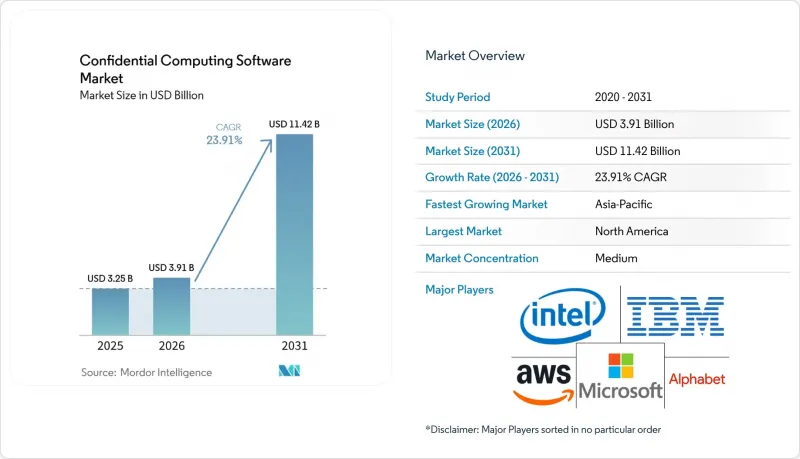
本報告按組件(軟體和服務)、部署模式(雲端、混合、本地部署)、企業規模(大型企業、中小企業)、最終用戶(汽車與交通、醫療保健與生命科學、零售與電子商務、工業製造等)以及地區進行細分。市場預測以價值(美元)表示。
全球機密運算軟體市場趨勢與洞察
使用中的資料保護監管要求
監管要求是敏感計算軟體市場持續需求的來源。歐盟人工智慧法案(2024/1689 號條例)於 2024 年 8 月生效,該條例強制要求對高風險人工智慧系統處理的個人資料採取安全保障措施。資料保護條例(DORA)於 2025 年 1 月生效,使金融服務業的 ICT 風險管理受到更多關注。 2026 年 5 月,瑞典資料保護機構得出結論:如果資料控制者保留對身分檢驗和加密金鑰的控制權,則可信任執行環境 (TEE) 可以作為 GDPR 第 32 條規定的安全保障措施。這一觀點是基於沃爾沃集團、愛立信和 CanaryBit 等公司的實際應用案例。這使得身分驗證金鑰管理不再只是一個技術細節,而是成為受監管機構面臨的管治挑戰。
不斷擴展的雲端和混合雲端工作負載
將高度敏感的工作負載遷移到雲端和混合環境,正在拓展敏感運算軟體的應用場景。由於處理器在使用資料時以明文形式處理,因此會產生傳統儲存或網路加密無法彌補的安全漏洞。雲端服務供應商正在將敏感虛擬機器和敏感容器新增至其標準運算目錄中,只需進行組態選擇,即可在相容的執行個體上使用這些服務。 2026 年 2 月,微軟正式向 Azure 政府版用戶推出 AMD SEV-SNP 敏感虛擬機,從而將硬體保護擴展到美國政府所有敏感等級分類的工作負載。 Google雲端也確認將於 2026 年在其 G4 系列機器上提供敏感的 GKE 節點,這些節點配備了 NVIDIA RTX PRO 6000 Blackwell Server Edition GPU。這些服務正透過現有的雲端運營模式,讓敏感的 AI 和資料處理更加便利。
高昂的實施和整合成本
在敏感運算軟體市場,部署成本可能成為推廣應用的一大障礙,尤其對於技術預算有限的企業而言更是如此。部署到生產環境需要相容的 AMD SEV-SNP、Intel TDX 或 NVIDIA 敏感運算硬體。此外,還需要對應用程式進行修改、配置認證管道,並與現有的身分和金鑰管理系統整合。雖然雲端敏感虛擬機可以減輕硬體採購的負擔,但並不能消除維修和認證整合的成本。大型企業通常能夠以合規性要求和高價值工作負載為由,證明這些成本的合理性。而小規模企業則可能因為在混合架構中整合本地和雲端解決方案的額外成本而推遲採用。
細分市場分析
到2025年,軟體收入將佔總收入的74.18%。企業正在使用安全區域管理平台、敏感虛擬機器軟體和遠端認證工具,以擴展其在現有雲端和本地環境中的保護範圍。這些產品支援部署,無需對應用程式進行徹底重新設計。隨著企業對Kubernetes工作負載和基於GPU的推理進行保護,對敏感AI軟體和敏感容器軟體的投資也不斷增加。安全區域管理和遠端認證軟體仍然是重要的持續收入來源,因為它們支援核心營運需求。預計2026年至2031年,服務業的敏感計算軟體市場將以25.82%的複合年成長率成長。
服務業的快速成長源於這樣一個事實:在敏感運算軟體市場中,多廠商的TEE環境通常需要外部支援來進行實施、整合、監控和策略管理。 2026年,紅帽公司正式發布了裸機上的「機密容器」解決方案,將基於硬體的記憶體加密和認證引入本地Kubernetes環境,並擴展了混合部署中的適用場景。同樣在2026年3月,Fortanix與NVIDIA生態系統一起加入了“思科安全AI工廠”,將敏感AI功能整合到更廣泛的企業基礎架構產品中。
到 2025 年,雲端運算收入將佔總收入的 68.41%。微軟、Google雲端和亞馬遜雲端服務 (AWS) 已將敏感功能整合到各自的運算服務中,從而降低了客戶運行相容的 TEE 硬體的需求。在空氣間隙環境、敏感資料處理以及高度敏感的製造工作負載中,本地部署仍然至關重要。微軟於 2026 年 2 月發布的 Azure 政府版表明,政府需求也可以透過雲端鄰近基礎設施來滿足。紅帽公司的裸機支援為需要進一步隔離雲端提供者的組織提供了另一種選擇。
混合部署預計將在2026年至2031年間以24.63%的複合年成長率成長。金融服務、醫療保健和政府機構需要對某些工作負荷進行本地控制,而分析、人工智慧推理和災害復原原則需要雲端規模的處理能力。混合架構在本地TEE節點上運行最敏感的處理,同時利用高度敏感的雲端虛擬機器來擴展容量。共用的身份驗證策略使這些環境能夠在通用管理模型下協同工作。此外,Fortanix和NTT Data於2026年2月合作在印度部署自主人工智慧工廠,也推動了敏感運算軟體市場的發展。
區域分析
2025年,北美佔據了敏感計算軟體市場34.62%的佔有率。美國受惠於超大規模資料中心業者、龐大的受監管企業客戶群以及聯邦政府對使用中資料保護的要求。 2026年2月,微軟擴展了Azure政府版敏感虛擬機的功能,使其涵蓋美國政府所有敏感分類級別,從而簡化了政府用戶在FedRAMP認證環境下的採購流程。加拿大也有雲端相關的金融服務和醫療保健機構需要履行資料居住義務。
歐洲擁有技術先進的買家群體,尤其是在德國、英國和法國。 NIS2 的要求正在鼓勵關鍵服務提供者進行投資。瑞典當局於 2026 年 5 月發布的關於 GDPR 的聲明為評估 TEE 作為技術保護手段的組織提供了實用指南。歐盟委員會於 2026 年 1 月提案旨在使成員國之間的網路安全要求更加協調一致。
預計亞太地區2026年至2031年的複合年成長率將達到25.73%。中國於2025年1月發布了GB/T 45230-2025標準,並於2025年8月生效,為國內技術環境(TEE)採購提供了正式依據。印度的數據主權計劃正在推動對安全人工智慧基礎設施的需求。 Fortanix與NTT DATA合作在印度部署人工智慧工廠,也促進了安全運算軟體市場的發展。南美、中東和非洲仍處於發展初期,但沙烏地阿拉伯、阿拉伯聯合大公國、巴西和阿根廷在人工智慧主權、銀行、金融科技和安全支付等領域已展現出初步需求。
其他好處:
- Excel格式的市場預測(ME)表
- 3個月的分析師支持
目錄
第1章:引言
- 研究假設和市場定義
- 調查範圍
第2章:調查方法
第3章執行摘要
第4章 市場狀況
- 市場概覽
- 市場促進因素
- 保護使用中資料的監管要求
- 不斷擴展的雲端和混合雲端工作負載
- 高度敏感的工作負載面臨日益嚴重的網路安全威脅。
- 將人工智慧引入高度敏感的模型和數據
- 跨部門數據合作,無須揭露數據
- 遠端衰減作為企業採購要求
- 市場限制因素
- 高昂的實施和整合成本
- 缺乏機密計算和密碼學方面的技能
- 碎片化的身份驗證和信任/策略生態系統
- 效能開銷和易受TEE特定攻擊。
- 宏觀經濟因素對市場的影響
- 產業價值鏈分析
- 科技趨勢
- 監理情勢
- 波特五力分析
第5章 市場規模與成長預測
- 按組件
- 軟體
- 用於機密資訊的虛擬機器軟體
- 機密容器軟體
- 飛地管理軟體
- 遠端衰減軟體
- 機密人工智慧軟體
- 服務
- 軟體
- 按部署模式
- 雲
- 混合
- 現場
- 按公司規模
- 大公司
- 小型企業
- 最終用戶
- 資訊科技/通訊
- BFSI
- 汽車和運輸業
- 醫療保健和生命科學
- 零售與電子商務
- 工業製造
- 其他最終用戶
- 按地區
- 北美洲
- 美國
- 加拿大
- 墨西哥
- 南美洲
- 巴西
- 阿根廷
- 其他南美國家
- 歐洲
- 德國
- 英國
- 法國
- 俄羅斯
- 西班牙
- 其他歐洲國家
- 亞太地區
- 中國
- 日本
- 印度
- 韓國
- 東南亞
- 其他亞太國家
- 中東和非洲
- 中東
- 沙烏地阿拉伯
- 阿拉伯聯合大公國
- 其他中東國家
- 非洲
- 南非
- 奈及利亞
- 其他非洲國家
- 中東
- 北美洲
第6章 競爭情勢
- 市場集中度
- 策略趨勢
- 市佔率分析
- 公司簡介
- Advanced Micro Devices, Inc.
- Arm Holdings plc
- NVIDIA Corporation
- Microsoft Corporation
- Alphabet Inc.
- Amazon Web Services, Inc.
- International Business Machines Corporation
- Alibaba Group Holding Limited
- Oracle Corporation
- Fortanix, Inc.
- Anjuna Security, Inc.
- Edgeless Systems GmbH
- Profian, Inc.
- Opaque Systems, Inc.
- Decentriq AG
- Cosmian SA
- Thales SA
- Nillion Network
- Enveil
- HUB Cyber Security(Israel)Ltd.
- Applied Blockchain Limited
- Evervault Limited
- Duality Technologies, Inc.
- Zama SAS
- Arcium AG
- RISC Zero, Inc.
- Enclaive GmbH
第7章 市場機會與未來展望
According to Mordor Intelligence, the confidential computing software market size was valued at USD 3.25 billion in 2025 and estimated to grow from USD 3.91 billion in 2026 to reach USD 11.42 billion by 2031, at a CAGR of 23.91% during the forecast period (2026-2031).
This report is Segmented by Component (Software, and Services), Deployment Model (Cloud, Hybrid, and On-Premises), Enterprise Size (Large Enterprises, and Small and Mid-Sized Enterprises), End Users (Automotive and Transportation, Healthcare and Life Sciences, Retail and E-Commerce, Industrial Manufacturing, and More), and Geography. The Market Forecasts are Provided in Terms of Value (USD).
Global Confidential Computing Software Market Trends and Insights
Regulatory Requirements for Data-in-Use Protection
Regulatory requirements are creating a durable source of demand for the Confidential Computing Software Market. The EU AI Act (Regulation 2024/1689) has been in effect since August 2024 and requires safeguards for personal data processed by high-risk AI systems. DORA became applicable in January 2025 and has increased attention on ICT risk management within financial services. Sweden's data protection authority concluded in May 2026 that trusted execution environments can serve as a safeguard under GDPR Article 32 when controllers retain control of attestation verification and encryption keys. This position came from an operational deployment involving Volvo Group, Ericsson, and CanaryBit. It moves attestation key control from an engineering detail to a governance issue for regulated organizations.
Expansion of Cloud and Hybrid-Cloud Workloads
The movement of sensitive workloads into cloud and hybrid environments is widening the use case for the Confidential Computing Software Market. Data is available in plaintext while a processor uses it, leaving a gap that conventional storage and network encryption do not close. Cloud providers have added confidential virtual machines and confidential containers to their standard compute catalogs, reducing activation to a configuration choice for compatible instances. Microsoft made AMD SEV-SNP confidential VMs generally available for Azure Government in February 2026, extending hardware-enforced protection to U.S. government workloads across classification levels. Google Cloud also confirmed confidential GKE nodes on G4 machine series with NVIDIA RTX PRO 6000 Blackwell Server Edition GPUs in 2026. These offerings make confidential AI and data processing more accessible through existing cloud operating models.
High Implementation and Integration Costs
Implementation costs can limit adoption in the Confidential Computing Software Market, especially for organizations with limited technology budgets. Production deployments require compatible AMD SEV-SNP, Intel TDX, or NVIDIA Confidential Computing hardware. They also require application changes, attestation pipeline configuration, and integration with existing identity and key-management systems. Cloud confidential virtual machines reduce the burden of hardware procurement but do not remove retrofitting and attestation integration costs. Large enterprises can often justify these expenses based on compliance requirements and high-value workloads. Smaller organizations may delay deployment when hybrid architectures add on-premises and cloud integration costs.
Other drivers and restraints analyzed in the detailed report include:
- Rising Cybersecurity Threats Against Sensitive Workloads
- Confidential AI Adoption for Sensitive Models and Data
- Shortage of Confidential-Computing and Cryptography Skills
For complete list of drivers and restraints, kindly check the Table Of Contents.
Segment Analysis
Software held 74.18% of revenue in 2025. Enterprises use enclave management platforms, confidential virtual machine software, and remote attestation tools to extend protection across current cloud and on-premises environments. These products can support deployment without a complete application redesign. Confidential AI software and confidential container software are receiving greater investment as organizations protect Kubernetes workloads and GPU-based inference. Enclave management and remote attestation software remain important recurring revenue categories because they support core operating requirements. The Confidential Computing Software Market size for services is projected to grow at a 25.82% CAGR from 2026 to 2031.
Services grow faster because multi-vendor TEE environments often require external support for implementation, integration, monitoring, and policy management within the Confidential Computing Software Market. Red Hat made Confidential Containers on bare metal generally available in 2026, bringing hardware-backed memory encryption and attestation to on-premises Kubernetes environments and expanding the serviceable use case for hybrid deployments. Fortanix also joined the Cisco Secure AI Factory, alongside the NVIDIA ecosystem, in March 2026. This placed confidential AI capabilities within a broader enterprise infrastructure offer.
Cloud captured 68.41% of revenue in 2025. Microsoft, Google Cloud, and Amazon Web Services have built confidential capabilities into their compute services, reducing the need for customers to operate compatible TEE hardware. On-premises deployments continue to matter for air-gapped, classified, and highly sensitive manufacturing workloads. Microsoft's February 2026 Azure Government release showed that government requirements can also be served through cloud-adjacent infrastructure. Red Hat's bare-metal support provides organizations with another option when they need greater separation from a cloud operator.
Hybrid deployments are projected to expand at a 24.63% CAGR between 2026 and 2031. Financial services, healthcare, and government organizations need local control for some workloads but cloud-scale capacity for analytics, AI inference, and disaster recovery. Hybrid architectures place the most sensitive processing on local TEE nodes while using confidential cloud virtual machines for additional capacity. Shared attestation policies can connect those environments under a common control model. The Confidential Computing Software Market is also gaining from Fortanix and NTT DATA's February 2026 partnership for sovereign AI factory deployments in India.
Complete Report Scope:
- By Component
- Software
- Confidential Virtual Machine Software
- Confidential Container Software
- Enclave Management Software
- Remote Attestation Software
- Confidential AI Software
- Services
- Software
- By Deployment Model
- Cloud
- Hybrid
- On-Premises
- By Enterprise Size
- Large Enterprises
- Small and Mid-sized Enterprises
- By End Users
- IT and Telecommunication
- BFSI
- Automotive and Transportation
- Healthcare and Life Sciences
- Retail and E-Commerce
- Industrial Manufacturing
- Other End Users
- By Geography
- North America
- United States
- Canada
- Mexico
- South America
- Brazil
- Argentina
- Rest of South America
- Europe
- Germany
- United Kingdom
- France
- Russia
- Spain
- Rest of Europe
- Asia-Pacific
- China
- Japan
- India
- South Korea
- Southeast Asia
- Rest of Asia-Pacific
- Middle East and Africa
- Middle East
- Saudi Arabia
- United Arab Emirates
- Rest of Middle East
- Africa
- South Africa
- Nigeria
- Rest of Africa
- Middle East
- North America
Geography Analysis
North America held 34.62% of the Confidential Computing Software Market share in 2025. The United States benefits from hyperscaler research and development, a large base of regulated enterprise buyers, and federal requirements for data-in-use protection. Microsoft expanded Azure Government confidential virtual machines across U.S. government classification levels in February 2026. This created a clearer procurement path for government users in FedRAMP-authorized environments. Canada also has cloud-adjacent financial services and healthcare organizations with data residency responsibilities.
Europe has a technically advanced buyer base, especially in Germany, the United Kingdom, and France. NIS2 obligations are encouraging investment among operators of essential services. The Swedish authority's May 2026 GDPR position offers a practical basis for organizations evaluating TEEs as a technical safeguard. A January 2026 European Commission proposal seeks to align cybersecurity requirements more closely across member states.
Asia-Pacific is projected to expand at a 25.73% CAGR between 2026 and 2031. China issued GB/T 45230-2025 in January 2025, with implementation beginning in August 2025, providing a formal basis for domestic TEE procurement. India's data sovereignty agenda is driving demand for secure AI infrastructure. The Fortanix and NTT DATA partnership for Indian AI factory deployments also serves the Confidential Computing Software Market. South America, the Middle East, and Africa remain early-stage regions, though Saudi Arabia, the UAE, Brazil, and Argentina show early demand in AI sovereignty, banking, fintech, and secure payment use cases.
- Advanced Micro Devices, Inc.
- Arm Holdings plc
- NVIDIA Corporation
- Microsoft Corporation
- Alphabet Inc.
- Amazon Web Services, Inc.
- International Business Machines Corporation
- Alibaba Group Holding Limited
- Oracle Corporation
- Fortanix, Inc.
- Anjuna Security, Inc.
- Edgeless Systems GmbH
- Profian, Inc.
- Opaque Systems, Inc.
- Decentriq AG
- Cosmian SA
- Thales S.A.
- Nillion Network
- Enveil
- HUB Cyber Security (Israel) Ltd.
- Applied Blockchain Limited
- Evervault Limited
- Duality Technologies, Inc.
- Zama SAS
- Arcium AG
- RISC Zero, Inc.
- Enclaive GmbH
Additional Benefits:
- The market estimate (ME) sheet in Excel format
- 3 months of analyst support
TABLE OF CONTENTS
1 INTRODUCTION
- 1.1 Study Assumptions and Market Definition
- 1.2 Scope of the Study
2 RESEARCH METHODOLOGY
3 EXECUTIVE SUMMARY
4 MARKET LANDSCAPE
- 4.1 Market Overview
- 4.2 Market Drivers
- 4.2.1 Regulatory Requirements for Data-in-Use Protection
- 4.2.2 Expansion of Cloud and Hybrid-Cloud Workloads
- 4.2.3 Rising Cybersecurity Threats Against Sensitive Workloads
- 4.2.4 Confidential AI Adoption for Sensitive Models and Data
- 4.2.5 Cross-Domain Data Collaboration Without Data Disclosure
- 4.2.6 Remote Attestation as an Enterprise Procurement Requirement
- 4.3 Market Restraints
- 4.3.1 High Implementation and Integration Costs
- 4.3.2 Shortage of Confidential-Computing and Cryptography Skills
- 4.3.3 Fragmented Attestation and Trust-Policy Ecosystems
- 4.3.4 Performance Overhead and Exposure to TEE-Specific Attacks
- 4.4 Impact of Macroeconomic Factors on the Market
- 4.5 Industry Value-Chain Analysis
- 4.6 Technology Outlook
- 4.7 Regulatory Landscape
- 4.8 Porter's Five Forces Analysis
- 4.8.1 Threat of New Entrants
- 4.8.2 Bargaining Power of Suppliers
- 4.8.3 Bargaining Power of Buyers
- 4.8.4 Threat of Substitutes
- 4.8.5 Intensity of Competitive Rivalry
5 MARKET SIZE AND GROWTH FORECASTS (VALUE)
- 5.1 By Component
- 5.1.1 Software
- 5.1.1.1 Confidential Virtual Machine Software
- 5.1.1.2 Confidential Container Software
- 5.1.1.3 Enclave Management Software
- 5.1.1.4 Remote Attestation Software
- 5.1.1.5 Confidential AI Software
- 5.1.2 Services
- 5.1.1 Software
- 5.2 By Deployment Model
- 5.2.1 Cloud
- 5.2.2 Hybrid
- 5.2.3 On-Premises
- 5.3 By Enterprise Size
- 5.3.1 Large Enterprises
- 5.3.2 Small and Mid-sized Enterprises
- 5.4 By End Users
- 5.4.1 IT and Telecommunication
- 5.4.2 BFSI
- 5.4.3 Automotive and Transportation
- 5.4.4 Healthcare and Life Sciences
- 5.4.5 Retail and E-Commerce
- 5.4.6 Industrial Manufacturing
- 5.4.7 Other End Users
- 5.5 By Geography
- 5.5.1 North America
- 5.5.1.1 United States
- 5.5.1.2 Canada
- 5.5.1.3 Mexico
- 5.5.2 South America
- 5.5.2.1 Brazil
- 5.5.2.2 Argentina
- 5.5.2.3 Rest of South America
- 5.5.3 Europe
- 5.5.3.1 Germany
- 5.5.3.2 United Kingdom
- 5.5.3.3 France
- 5.5.3.4 Russia
- 5.5.3.5 Spain
- 5.5.3.6 Rest of Europe
- 5.5.4 Asia-Pacific
- 5.5.4.1 China
- 5.5.4.2 Japan
- 5.5.4.3 India
- 5.5.4.4 South Korea
- 5.5.4.5 Southeast Asia
- 5.5.4.6 Rest of Asia-Pacific
- 5.5.5 Middle East and Africa
- 5.5.5.1 Middle East
- 5.5.5.1.1 Saudi Arabia
- 5.5.5.1.2 United Arab Emirates
- 5.5.5.1.3 Rest of Middle East
- 5.5.5.2 Africa
- 5.5.5.2.1 South Africa
- 5.5.5.2.2 Nigeria
- 5.5.5.2.3 Rest of Africa
- 5.5.5.1 Middle East
- 5.5.1 North America
6 COMPETITIVE LANDSCAPE
- 6.1 Market Concentration
- 6.2 Strategic Moves
- 6.3 Market Share Analysis
- 6.4 Company Profiles (includes Global Level Overview, Market Level Overview, Core Segments, Financials as available, Strategic Information, Market Rank/Share, Products and Services, Recent Developments)
- 6.4.1 Advanced Micro Devices, Inc.
- 6.4.2 Arm Holdings plc
- 6.4.3 NVIDIA Corporation
- 6.4.4 Microsoft Corporation
- 6.4.5 Alphabet Inc.
- 6.4.6 Amazon Web Services, Inc.
- 6.4.7 International Business Machines Corporation
- 6.4.8 Alibaba Group Holding Limited
- 6.4.9 Oracle Corporation
- 6.4.10 Fortanix, Inc.
- 6.4.11 Anjuna Security, Inc.
- 6.4.12 Edgeless Systems GmbH
- 6.4.13 Profian, Inc.
- 6.4.14 Opaque Systems, Inc.
- 6.4.15 Decentriq AG
- 6.4.16 Cosmian SA
- 6.4.17 Thales S.A.
- 6.4.18 Nillion Network
- 6.4.19 Enveil
- 6.4.20 HUB Cyber Security (Israel) Ltd.
- 6.4.21 Applied Blockchain Limited
- 6.4.22 Evervault Limited
- 6.4.23 Duality Technologies, Inc.
- 6.4.24 Zama SAS
- 6.4.25 Arcium AG
- 6.4.26 RISC Zero, Inc.
- 6.4.27 Enclaive GmbH
7 MARKET OPPORTUNITIES AND FUTURE OUTLOOK
- 7.1 White-Space and Unmet-Need Assessment

 2026-2030年全球安全運算市場
 機密運算與人工智慧
 全球機密計算市場規模、佔有率、趨勢和成長分析報告(2026-2034)
 機密計算市場:全球預測,2026-2032年機密運算市場:依組件、部署模式、應用、產業、國家及地區分類-全球產業分析、市場規模、市場佔有率及2026年至2033年預測
 2026年全球機密計算市場報告
 機密計算市場分析及至 2035 年預測:按類型、產品類型、服務、技術、組件、應用、部署類型和最終用戶分類機密運算市場規模、佔有率、成長及全球產業分析:按類型、應用和地區分類的洞察,2026-2034 年預測全球醫療保健產業機密運算市場:按組件、部署方式、應用程式、最終用戶、國家和地區分類-產業分析、市場規模、佔有率和預測(2025-2032年)
 全球機密運算市場