


 |
市場調查報告書
商品編碼
2118231
塗料磨料:市場佔有率分析、產業趨勢與統計、成長預測(2026-2031)Coated Abrasive - Market Share Analysis, Industry Trends & Statistics, Growth Forecasts (2026 - 2031) |
||||||

※ 本網頁內容可能與最新版本有所差異。詳細情況請與我們聯繫。
據 Mordor Intelligence 稱,2025 年塗層磨料市場價值為 149.2 億美元,預計到 2031 年將達到 202.6 億美元,而 2026 年為 156.8 億美元,預測期內(2026-2031 年)的複合年成長率預計為 5.26%。
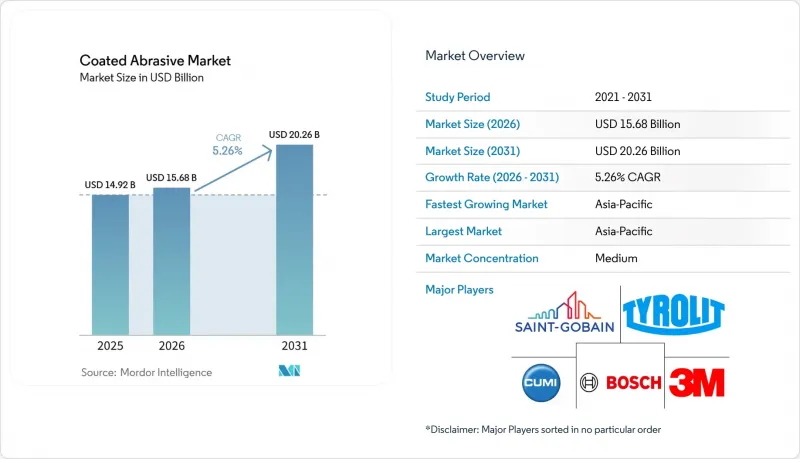
本報告按產品類型(圓盤、皮帶、捲材、片材及其他產品類型)、材料類型(氧化鋁、碳化矽等)、終端應用產業(金屬加工、汽車、木工和家具等)以及地區(亞太地區、北美地區、歐洲地區、南美地區以及中東和非洲地區)進行細分。市場預測以美元計價。
全球塗料磨料市場趨勢與洞察
金屬加工和製造業對精密表面處理的需求日益成長。
隨著製造業的現代化,整個塗附磨料市場對錶面精加工性能的要求日益提高。航太、造船和精密加工領域的自動化生產線需要能夠提供一致表面光潔度和尺寸精度的磨料。熔融氧化鋁和碳化矽被用於航太、汽車、家具和鋼鐵等產業的黏結型和塗附型磨料產品的下游加工。高合金鋼、鈦和鎳基高溫合金需要能夠在不影響切割性能的前提下加工硬質材料的磨料。因此,對於精密加工應用而言,結構化磨料比基礎紙基磨料更為合適。更高的切削速度和更長的刀具壽命可以減少停機時間和返工,這為買家提供了選擇價格更高的產品的充分理由。
汽車生產的擴張和售後維修活動的增加正在推動磨料的消耗。
汽車生產推動了塗料磨料在底漆、車身噴漆、傳動系統加工和零件去毛邊等方面的需求。電動車和混合動力汽車也帶動了電池外殼、電力電子基板和鋁製結構件精加工需求的成長。這些應用所採用的規格與傳統動力傳動系統精加工有所不同。由於北美和歐洲老舊車輛的使用壽命延長,維修活動也支撐了這項需求。車身修理廠在修復噴漆表面和車身面板時需要進行多道拋光工序。因此,塗料磨料市場同時受到汽車生產和維修需求的驅動。
原料價格波動影響磨料顆粒和基材的成本。
原料成本波動仍然是整個塗附磨料價值鍊和塗附磨料市場利潤率面臨的風險。美國拋光精煉氧化鋁的進口價格從2023年的每噸1,380美元上漲至2024年的每噸1,500美元。同期,粗碳化矽的價格從每噸905美元下跌至每噸770美元。這些價格波動表明,同時使用這兩種磨料的製造商可能面臨不同的成本壓力。中國占美國粗熔融氧化鋁進口量的94%和粗碳化矽進口量的98%,這使得採購風險集中。關稅措施和出口許可證壓力進一步凸顯了雙重採購和採購計畫的重要性。
細分市場分析
2025年,砂碟佔塗層磨料市場佔有率的34.86%。它們與角研磨機、隨機軌道砂光機和機器人砂光頭配合使用,滿足了金屬加工和汽車車身製造的需求。憑藉標準的安裝系統和廣泛的粒度範圍,砂碟可用於材料去除、打磨和拋光。它們廣泛應用於代工製造廠和目的地設備製造商 (OEM) 的精整線。在塗層磨料市場,高階砂碟系統與除塵器配合使用時仍是首選。 2026年4月,3M推出了“Hookit Blue網狀磨料”,該產品採用陶瓷和氧化鋁混合材料,並具有開放式網狀結構,除塵效率高達95%。
在塗層磨料市場,預計2026年至2031年間,砂帶的複合年成長率將達到5.94%。寬幅砂帶適用於家具製造、工程木地板和鋼帶的連續拋光。其性能與機器轉速、工件加工能力和砂帶耐用性密切相關。 2026年2月,Mirka公司擴展了其「Iridium」系列產品線,推出了適用於木材、油漆和實體表面的軟性防塵手持式砂紙。卷材產品在維護工作和需要柔軟性成型的定長切割應用中繼續發揮重要作用。
區域分析
預計到2025年,亞太地區將佔據全球磨料片材市場45.41%的佔有率,並在2031年之前以6.02%的複合年成長率成長。中國Delta地區是工具機和自動化研磨單元的中心。印度是第二大成長中心,這得益於其工業基礎和汽車供應鏈。日本和韓國則透過精密機械、半導體製造設備和汽車零件精加工等產業創造了需求。中國國家標準(GB)和日本工業標準(JIS)的認證要求提高了產品規格,使認證的供應商擁有了競爭優勢。
北美地區憑藉其汽車製造、航太航太和建設活動,仍然是塗層磨料的重要市場。美國對半導體製造業的投資,催生了該地區對晶圓和基板加工用高規格產品的需求。中國供應了美國94%的粗熔融氧化鋁和98%的粗碳化矽進口,這使得其供應鏈極易受到貿易環境變化的影響。墨西哥的汽車供應鏈為電動驅動系統零件的精密加工提供了支援。
歐洲磨料市場對優質塗料的需求主要集中在德國、法國和義大利,這些國家的精密加工、汽車製造和航太產業都十分發達。東歐正透過投資汽車和電子製造業來擴大其區域影響力。南美洲依賴巴西的汽車和農業機械產業,而阿根廷則憑藉其輕工業和機械產業做出貢獻。沙烏地阿拉伯的工業多元化和基礎設施項目為中東和非洲的鋼鐵加工和建築精加工提供了支持。歐洲的生態設計和生產者責任法規提高了買家對生命週期文件的關注度,Milka 已透過已通過核准的2026 年生命週期評估 (LCA) 工具滿足了這項需求。
其他好處:
- Excel格式的市場預測(ME)表
- 3個月的分析師支持
目錄
第1章:引言
- 研究假設和市場定義
- 調查範圍
第2章:調查方法
第3章執行摘要
第4章 市場狀況
- 市場概覽
- 市場促進因素
- 金屬加工和製造業對精密表面處理的需求日益成長。
- 汽車產量增加和售後維修活動的擴張正在推動磨料的消耗。
- 木工和家具製造業的擴張支撐了對塗料磨料的需求。
- 高性能陶瓷和氧化鋯磨料在工業應用中的採用範圍不斷擴大。
- 擴大可回收和生物基材的使用
- 市場限制因素
- 原料價格波動會影響磨料顆粒和基材的成本。
- 與黏結磨料和不織布磨料的競爭
- 惡劣的工作條件下需要頻繁更換零件,且效能不穩定。
- 價值鏈分析
- 波特五力分析
第5章 市場規模與成長預測
- 依產品類型
- 磁碟
- 腰帶
- 卷
- 座位
- 其他產品類型
- 材料類型
- 氧化鋁
- 碳化矽
- 氧化鋯氧化鋁
- 陶瓷氧化鋁
- 石榴石
- 埃默里
- 其他材料類型
- 按最終用途行業分類
- 金屬加工
- 車
- 木工和家具
- 電子和半導體
- 航太/國防
- 建造
- 機械/設備
- 其他終端用戶產業
- 按地區
- 亞太地區
- 中國
- 印度
- 日本
- 韓國
- 其他亞太國家
- 北美洲
- 美國
- 加拿大
- 墨西哥
- 歐洲
- 德國
- 英國
- 法國
- 義大利
- 俄羅斯
- 其他歐洲國家
- 南美洲
- 巴西
- 阿根廷
- 其他南美國家
- 中東和非洲
- 沙烏地阿拉伯
- 南非
- 其他中東和非洲國家
- 亞太地區
第6章 競爭情勢
- 市場集中度
- 策略趨勢
- 市佔率和排名分析
- 公司簡介
- 3M
- Bibielle SpA
- Carborundum Universal Limited
- Deerfos Co., Ltd.
- Hermes Schleifmittel GmbH
- Hubei Yuli Abrasive Belts Group Co., Ltd.
- Klingspor AG
- Kovax Corporation
- Mirka Ltd.
- Robert Bosch GmbH
- Saint-Gobain
- Sak Abrasives Limited
- Sia Abrasives Industries AG
- Smirdex SA
- Tyrolit AG
- VSM AG
第7章 市場機會與未來展望
According to Mordor Intelligence, the coated abrasive market was valued at USD 14.92 billion in 2025 and is estimated to grow from USD 15.68 billion in 2026 to reach USD 20.26 billion by 2031, at a CAGR of 5.26% during the forecast period (2026-2031).
This report is Segmented by Product Type (Discs, Belts, Rolls, Sheets, and Other Product Types), Material Type (Aluminum Oxide, Silicon Carbide, and More), End-Use Industry (Metal Fabrication, Automotive, Woodworking & Furniture, and More), and Geography (Asia-Pacific, North America, Europe, South America, and Middle-East and Africa). The Market Forecasts are Provided in Value (USD).
Global Coated Abrasive Market Trends and Insights
Growing Demand for Precision Surface Finishing in Metalworking and Manufacturing Industries
Manufacturing modernization is raising performance requirements for surface finishing work across the coated abrasive market. Automated lines in aerospace, shipbuilding, and precision machining need abrasives that produce consistent finishes and dimensional accuracy. Fused aluminum oxide and silicon carbide are used downstream in bonded and coated abrasive products serving aerospace, automotive, furniture, and steel applications. Higher-alloy steels, titanium, and nickel superalloys need products that can work on hard materials without losing cutting performance. Structured abrasive formats are therefore more relevant in precision applications than basic paper products. Buyers can justify premium products when higher cut rates and longer tool life reduce downtime and rework.
Increasing Automotive Production and Aftermarket Repair Activities Driving Abrasive Consumption
Automotive production supports coated abrasive demand in paint preparation, body refinishing, drivetrain work, and component deburring. Electric and hybrid vehicles add finishing needs for battery housings, power electronics substrates, and aluminum structural parts. These applications use specifications that differ from conventional powertrain finishing work. Repair activity also supports demand because older vehicles remain in service longer in North America and Europe. Body shops require several sanding stages when repairing painted surfaces and body panels. This gives the coated abrasive market exposure to both vehicle production and replacement work.
Volatility in Raw Material Prices Affecting Abrasive Grain and Backing Material Costs
Raw material cost changes remain a margin risk across the coated abrasive value chain and the coated abrasive market. U.S. import prices for ground and refined fused aluminum oxide increased from USD 1,380 per metric ton in 2023 to USD 1,500 per metric ton in 2024. In the same period, crude silicon carbide prices declined from USD 905 per metric ton to USD 770 per metric ton. These movements show that manufacturers using both grains can face different cost pressures at the same time. China supplied 94% of U.S. crude fused aluminum oxide imports and 98% of U.S. crude silicon carbide imports, concentrating sourcing exposure. Tariff measures and export licensing pressures have made dual sourcing and procurement planning more important.
Other drivers and restraints analyzed in the detailed report include:
- Rising Adoption of High-Performance Ceramic and Zirconia Abrasives for Industrial Applications
- Increasing Use of Recyclable and Bio-Based Backing Materials
- Competition from Bonded Abrasives and Non-Woven Abrasive Products
For complete list of drivers and restraints, kindly check the Table Of Contents.
Segment Analysis
Discs held 34.86% of the coated abrasive market size in 2025. Their use with angle grinders, random orbital sanders, and robotic sanding heads supports demand in metal fabrication and automotive bodywork. Standard attachment systems and a broad grit range make discs useful for stock removal, sanding, and polishing. They are widely used in job shops and original equipment manufacturer finishing lines. The coated abrasive market continues to favor premium disc systems when they work with dust extraction equipment. In April 2026, 3M introduced Hookit Blue Net Abrasives with a ceramic and aluminum oxide blend and an open net structure that provides up to 95% dust extraction.
Belts are forecast to grow at a 5.94% CAGR from 2026 to 2031 in the coated abrasive market. Wide-belt lines support furniture production, engineered wood flooring, and continuous steel strip polishing. Their performance is closely linked to machine speed, workpiece throughput, and belt endurance. Mirka extended its Iridium range in February 2026 with flexible, dust-repellent handsanding sheets for wood, paint, and solid surfaces. Rolls retain a role in maintenance work and cut-to-length applications where format flexibility matters.
Complete Report Scope:
- By Product Type
- Discs
- Belts
- Rolls
- Sheets
- Other Product Types
- By Material Type
- Aluminum Oxide
- Silicon Carbide
- Zirconia Alumina
- Ceramic Alumina
- Garnet
- Emery
- Other Material Types
- By End-Use Industry
- Metal Fabrication
- Automotive
- Woodworking & Furniture
- Electronics & Semiconductor
- Aerospace & Defense
- Construction
- Machinery & Equipment
- Other End-Use Industries
- By Geography
- Asia-Pacific
- China
- India
- Japan
- South Korea
- Rest of Asia-Pacific
- North America
- United States
- Canada
- Mexico
- Europe
- Germany
- United Kingdom
- France
- Italy
- Russia
- Rest of Europe
- South America
- Brazil
- Argentina
- Rest of South America
- Middle-East and Africa
- Saudi Arabia
- South Africa
- Rest of Middle-East and Africa
- Asia-Pacific
Geography Analysis
Asia-Pacific held 45.41% of the coated abrasive market share in 2025 and is forecast to grow at a 6.02% CAGR through 2031. China's Yangtze River Delta concentrates machine tools and automated grinding cells. India is a secondary growth center, supported by its industrial base and automotive supply chain. Japan and South Korea generate demand through precision machinery, semiconductor equipment, and automotive parts finishing. China's Guobiao (GB) standards and Japan's Japanese Industrial Standards (JIS) certification requirements are tightening product specifications and favoring certified suppliers.
North America remains an important coated abrasive market because of automotive production, aerospace manufacturing, and construction activity. U.S. semiconductor fabrication investment is creating localized demand for high-specification products used in wafer and substrate work. China supplied 94% of U.S. crude fused aluminum oxide imports and 98% of U.S. crude silicon carbide imports, making supply chains vulnerable to changes in trade conditions. Mexico's automotive supply chain supports precision finishing for electric drivetrain components.
Europe's premium demand in the coated abrasive market is centered on Germany, France, and Italy, where precision machining, automotive production, and aerospace are well established. Eastern Europe broadens its regional footprint through automotive and electronics manufacturing investment. South America relies on Brazil's automotive and agricultural equipment sectors, while Argentina contributes through the light industry and machinery. Saudi industrial diversification and infrastructure projects support steel fabrication and construction finishing in the Middle-East and Africa. European ecodesign and producer responsibility rules are increasing buyer attention to lifecycle documentation, which Mirka addressed through its approved 2026 LCA tool.
- 3M
- Bibielle S.p.A.
- Carborundum Universal Limited
- Deerfos Co., Ltd.
- Hermes Schleifmittel GmbH
- Hubei Yuli Abrasive Belts Group Co., Ltd.
- Klingspor AG
- Kovax Corporation
- Mirka Ltd.
- Robert Bosch GmbH
- Saint-Gobain
- Sak Abrasives Limited
- Sia Abrasives Industries AG
- Smirdex S.A.
- Tyrolit AG
- VSM AG
Additional Benefits:
- The market estimate (ME) sheet in Excel format
- 3 months of analyst support
TABLE OF CONTENTS
1 Introduction
- 1.1 Study Assumptions and Market Definition
- 1.2 Scope of the Study
2 Research Methodology
3 Executive Summary
4 Market Landscape
- 4.1 Market Overview
- 4.2 Market Drivers
- 4.2.1 Growing Demand for Precision Surface Finishing in Metalworking and Manufacturing Industries
- 4.2.2 Increasing Automotive Production and Aftermarket Repair Activities Driving Abrasive Consumption
- 4.2.3 Expansion of Woodworking and Furniture Manufacturing Supporting Demand for Coated Abrasives
- 4.2.4 Rising Adoption of High-Performance Ceramic and Zirconia Abrasives for Industrial Applications
- 4.2.5 Increasing Use of Recyclable and Bio-Based Backing Materials
- 4.3 Market Restraints
- 4.3.1 Volatility in Raw Material Prices Affecting Abrasive Grain and Backing Material Costs
- 4.3.2 Competition from Bonded Abrasives and Non-Woven Abrasive Products
- 4.3.3 Frequent Replacement Requirements and Performance Variability Under Heavy-Duty Applications
- 4.4 Value Chain Analysis
- 4.5 Porter's Five Forces Analysis
- 4.5.1 Threat of New Entrants
- 4.5.2 Bargaining Power of Suppliers
- 4.5.3 Bargaining Power of Buyers
- 4.5.4 Threat of Substitutes
- 4.5.5 Competitive Rivalry
5 Market Size and Growth Forecasts (Value)
- 5.1 By Product Type
- 5.1.1 Discs
- 5.1.2 Belts
- 5.1.3 Rolls
- 5.1.4 Sheets
- 5.1.5 Other Product Types
- 5.2 By Material Type
- 5.2.1 Aluminum Oxide
- 5.2.2 Silicon Carbide
- 5.2.3 Zirconia Alumina
- 5.2.4 Ceramic Alumina
- 5.2.5 Garnet
- 5.2.6 Emery
- 5.2.7 Other Material Types
- 5.3 By End-Use Industry
- 5.3.1 Metal Fabrication
- 5.3.2 Automotive
- 5.3.3 Woodworking & Furniture
- 5.3.4 Electronics & Semiconductor
- 5.3.5 Aerospace & Defense
- 5.3.6 Construction
- 5.3.7 Machinery & Equipment
- 5.3.8 Other End-Use Industries
- 5.4 By Geography
- 5.4.1 Asia-Pacific
- 5.4.1.1 China
- 5.4.1.2 India
- 5.4.1.3 Japan
- 5.4.1.4 South Korea
- 5.4.1.5 Rest of Asia-Pacific
- 5.4.2 North America
- 5.4.2.1 United States
- 5.4.2.2 Canada
- 5.4.2.3 Mexico
- 5.4.3 Europe
- 5.4.3.1 Germany
- 5.4.3.2 United Kingdom
- 5.4.3.3 France
- 5.4.3.4 Italy
- 5.4.3.5 Russia
- 5.4.3.6 Rest of Europe
- 5.4.4 South America
- 5.4.4.1 Brazil
- 5.4.4.2 Argentina
- 5.4.4.3 Rest of South America
- 5.4.5 Middle-East and Africa
- 5.4.5.1 Saudi Arabia
- 5.4.5.2 South Africa
- 5.4.5.3 Rest of Middle-East and Africa
- 5.4.1 Asia-Pacific
6 Competitive Landscape
- 6.1 Market Concentration
- 6.2 Strategic Moves
- 6.3 Market Share (%)/Ranking Analysis
- 6.4 Company Profiles (includes Global Overview, Market Overview, Core Segments, Financials as available, Strategic Information, Products and Services, and Recent Developments)
- 6.4.1 3M
- 6.4.2 Bibielle S.p.A.
- 6.4.3 Carborundum Universal Limited
- 6.4.4 Deerfos Co., Ltd.
- 6.4.5 Hermes Schleifmittel GmbH
- 6.4.6 Hubei Yuli Abrasive Belts Group Co., Ltd.
- 6.4.7 Klingspor AG
- 6.4.8 Kovax Corporation
- 6.4.9 Mirka Ltd.
- 6.4.10 Robert Bosch GmbH
- 6.4.11 Saint-Gobain
- 6.4.12 Sak Abrasives Limited
- 6.4.13 Sia Abrasives Industries AG
- 6.4.14 Smirdex S.A.
- 6.4.15 Tyrolit AG
- 6.4.16 VSM AG
7 Market Opportunities and Future Outlook
- 7.1 White-Space and Unmet-Need Assessment

 塗料磨料市場規模、佔有率和趨勢分析報告:按產品、最終用途、地區和細分市場分類的預測(2026-2033 年)
 塗料磨料市場-全球產業規模、佔有率、趨勢、機會、預測:按類型、應用、地區和競爭格局分類,2021-2031年
 塗料磨料市場報告:按顆粒類型、基材、應用和地區分類(2026-2034 年)
 全球塗料磨料市場規模、佔有率、趨勢和成長分析報告(2026-2034年)
 塗附磨料市場:基材、產品類型、磨料、銷售管道、應用、最終用途-2026-2032年全球市場預測
 塗附磨料市場規模、佔有率及成長分析(按類型、應用及地區分類)-2026-2033年產業預測
 砂紙砂布的全球市場:粒子類別,各產品類型,基材,各終端用戶產業,各地區,機會,預測,2018年~2032年
 塗附磨俱市場(2025-2029)