


 |
市場調查報告書
商品編碼
2118222
丁基橡膠:市場佔有率分析、產業趨勢與統計、成長預測(2026-2031)Butyl Rubber - Market Share Analysis, Industry Trends & Statistics, Growth Forecasts (2026 - 2031) |
||||||

※ 本網頁內容可能與最新版本有所差異。詳細情況請與我們聯繫。
根據 Mordor Intelligence 預測,丁基橡膠市場規模將從 2025 年的 44.6 億美元和 2026 年的 46.6 億美元成長到 2031 年的 60.3 億美元,2026 年至 2031 年的複合年成長率為 5.29%。
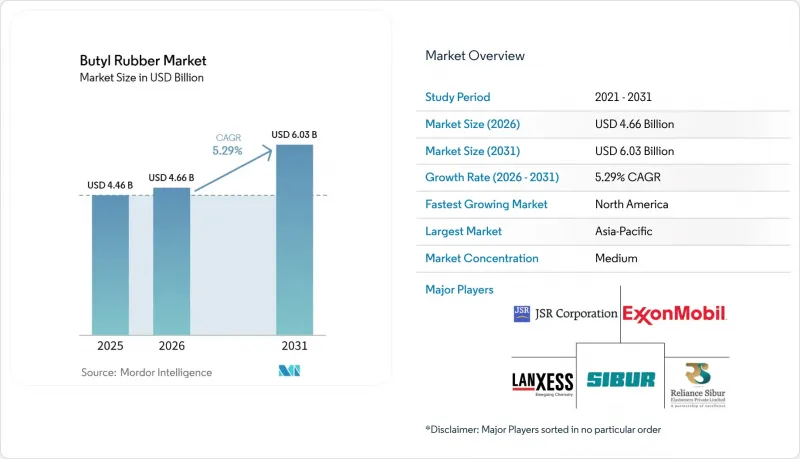
本報告按類型(典型丁基橡膠 (IIR)、氯丁基橡膠 (CIIR)、溴丁基橡膠 (BIIR))、應用(輪胎製造、醫療/製藥等)、終端用戶行業(汽車、消費品等)和地區(亞太地區、北美地區、歐洲地區、南美地區、中東和非洲地區)進行細分。市場預測以美元計價。
全球丁基橡膠市場趨勢與洞察
電動車的日益普及推動了對高性能丁基橡膠輪胎的需求。
與內燃機車相比,電池式電動車) 需要性能更高的輪胎內襯,因為電池組增加的車身重量會對氣密層造成更大的壓力。此外,瞬時扭力會加速內襯接縫處的磨損,因此耐用化合物對汽車製造商和輪胎供應商變得越來越重要。據埃克森美孚公司稱,高性能鹵代丁基橡膠內襯可透過提高氣密性,將電動車輪胎的使用壽命延長高達 17%。這些不斷提高的性能要求促使溴代丁基橡膠和氯代丁基橡膠化合物在新電動車輪胎規格中的應用日益廣泛。因此,丁基橡膠市場正逐漸從高階輪胎項目中的標準鐵基內襯 (IIR) 轉向其他產品。此外,每輛電動車材料用量的增加也推動了汽車產量成長與整個丁基橡膠市場對專用內襯化合物需求成長之間的關聯。
擴大丁基橡膠在藥品瓶蓋和無菌包裝應用的使用。
丁基橡膠因其低氣體滲透性、優異的耐滅菌性和針頭穿刺後的可重複密封性,被廣泛應用於注射劑的瓶塞、活塞組件和針頭保護裝置套中。此外,藥品密封材料必須滿足嚴格的萃取性、洗脫性和尺寸穩定性要求。人用藥品註冊技術要求國際協調會議 (ICH) 已於 2025 年 8 月批准了關於萃取性和洗脫性的 Q3E 指南草案,並公開徵求意見,包括其與彈性體容器和密封系統的相關性。這個過程將提高對藥用級材料新供應商的文件和測試要求。合格工作需要 6 至 12 個月,這使得擁有現有技術記錄和客戶認可的製造商更具優勢。儘管丁基橡膠市場受益於生物製藥、生物相似藥和預填充式注射器的成長,但對於新供應商而言,進入這些應用領域仍然充滿挑戰。
異丁烯和石油化學原料價格的波動正在影響生產成本。
由於異丁烯是生產各種等級丁基橡膠的關鍵原料,原油和煉油業務的經濟狀況變化會影響生產商的成本。擁有一體化生產系統的製造商比在公開市場上採購原料的供應商更能有效應對這種風險。本研究報告指出,如果投入成本的上漲速度超過成品價格的上漲速度,價格波動可能會對利潤率造成壓力。對於亞洲、北美和歐洲那些上游環節缺乏一體化生產系統的中型生產商而言,這種風險更為嚴重。此外,中國供應量的增加也削弱了部分供應商將成本上漲轉嫁給客戶的能力。因此,即使現有市場和新興市場對輪胎和藥品的需求不斷成長,丁基橡膠市場仍對原物料價格的波動十分敏感。
細分市場分析
截至2025年,普通丁基橡膠(IIR)佔據丁基橡膠市場49.62%的佔有率,而溴化丁基橡膠(BIIR)預計在2026年至2031年間將以6.18%的複合年成長率成長。 IIR憑藉其在輪胎內胎、減震器、電纜絕緣、工業軟管和口香糖基料等領域的成熟應用,一直保持著主導地位。在這些應用中,其低氣體滲透性和耐化學性仍然是重要的考慮因素。普通IIR丁基橡膠的市場規模仍然高度依賴輪胎產量和一般工業需求。在高階輪胎設計領域,由於需要更快的硫化速度和更高的與鄰近化合物的相容性,鹵化等級的橡膠正逐漸被採用。
由於電動車輪胎規格、高階OEM項目以及其與天然橡膠胎面膠料的共硫化能力,溴化丁基橡膠的需求日益成長。埃克森美孚的「Exxpro」溴化丁基離子聚合物系列和阿朗新科的「X_Butyl BB」系列產品滿足了對性能要求極高的應用需求,其認證週期長達數年。這些認證週期有助於防止現有供應商在已通過核准的輪胎設計中被迅速取代。 CIIR在藥用瓶蓋的製造上扮演不同的角色。該行業要求在自動化生產過程中實現尺寸的重複性和低萃取率。擁有全系列鹵化等級產品的供應商可以抓住成長更快、更專業化的需求。另一方面,僅專注於通用IIR的供應商則面臨著來自區域產能擴張和日益激烈的競爭的巨大壓力。
區域分析
到2025年,亞太地區將佔全球需求的46.37%,成為全球最大的市場。中國對部分進口鹵代丁基橡膠徵收關稅,促進了在地採購,並限制了部分外國供應商的市場准入。信實西布爾彈性體公司(Reliance Sibur Elastomers)位於賈姆訥格爾的工廠,普通丁基橡膠年產能為12萬噸,鹵代丁基橡膠年產能為6萬噸,增強了印度的國內供應體系。印度輪胎產能的提升也支撐了內襯材料需求的成長。日本和韓國繼續保持其作為高品質鹵代丁基橡膠出口國的地位,尤其是在中國以外的市場。這種區域格局使得丁基橡膠市場呈現出輪胎需求驅動的巨大需求、不斷擴大的本地供應以及貿易保護措施的顯著作用。
預計到2031年,北美地區的複合年成長率將達到6.53%,是各區域中成長最快的。對藥品包裝的需求以及對電動車輪胎的要求是推動該地區丁基橡膠市場成長的主要動力。此外,該地區輪胎製造商、製藥企業和特殊材料研發機構的地理位置優勢也為其發展提供了助力。埃克森美孚的產品系列能夠滿足汽車產業客戶(包括電動車應用)對輪胎內襯的需求。儘管歐洲地區的供應相對有限,但對藥品包裝和高階輪胎的需求仍支撐著歐洲市場。因此,歐洲買家更重視特種等級產品和可靠的供應鏈。
南美洲、中東和非洲市場規模雖小規模,但各自擁有獨特的市場需求格局。巴西的原料供應情況證實了其對工業橡膠基材的持續投資,這與汽車和建設活動的需求相符。這些建設活動帶動了當地對輪胎、密封及相關橡膠製品的消費。在中東,一體化石化資產支撐著上游原料供應,而建築投資則推動了對防水卷材和黏合密封劑的需求。非洲的需求規模仍然小規模,但與都市化、基礎設施投資和汽車普及密切相關。這些地區為丁基橡膠市場提供了更多管道,儘管其市場規模小於亞太、北美和歐洲,需求集中度較低。
其他好處:
- Excel格式的市場預測(ME)表
- 3個月的分析師支持
目錄
第1章:引言
- 研究假設和市場定義
- 調查範圍
第2章:調查方法
第3章執行摘要
第4章 市場狀況
- 市場概覽
- 市場促進因素
- 電動車的日益普及帶動了對高性能丁基橡膠輪胎的需求。
- 丁基橡膠在藥品瓶蓋和無菌包裝應用中得到更廣泛的應用。
- 擴大鹵化丁基橡膠在高性能和高階輪胎製造的應用
- 亞太地區輪胎產能的擴大正在支撐市場成長。
- 黏合劑、密封劑和建築應用領域對丁基橡膠的需求不斷成長。
- 市場限制因素
- 異丁烯和石油化學原料價格的波動正在影響生產成本。
- 缺乏回收基礎設施以及鹵代丁基橡膠廢棄物處理的挑戰
- 醫藥級丁基橡膠有嚴格的監管批准要求和漫長的合格審查流程。
- 價值鏈分析
- 波特五力分析
第5章 市場規模與成長預測
- 按類型
- 標準丁基橡膠(IIR)
- 氯丁基橡膠(CIIR)
- 溴丁基橡膠(BIIR)
- 透過使用
- 輪胎製造
- 醫療和製藥
- 黏合劑和密封劑
- 軟管和皮帶
- 防護衣和工業產品
- 屋頂及防水膜材料
- 其他用途
- 按最終用戶行業分類
- 車
- 藥品和醫療保健
- 建造
- 工業製造
- 消費品
- 其他終端用戶產業
- 按地區
- 亞太地區
- 中國
- 印度
- 日本
- 韓國
- 其他亞太國家
- 北美洲
- 美國
- 加拿大
- 墨西哥
- 歐洲
- 德國
- 英國
- 法國
- 義大利
- 俄羅斯
- 其他歐洲國家
- 南美洲
- 巴西
- 阿根廷
- 其他南美國家
- 中東和非洲
- 沙烏地阿拉伯
- 南非
- 其他中東和非洲國家
- 亞太地區
第6章 競爭情勢
- 市場集中度
- 策略趨勢
- 市佔率和排名分析
- 公司簡介
- ARLANXEO
- China Petrochemical Corporation
- Denka Elastlution Co., Ltd.
- ENEOS Materials Corporation
- Exxon Mobil Corporation
- Formosa Synthetic Rubber(Ningbo)Corporation Limited
- JSR Corporation
- Kumho Petrochemical Co., Ltd.
- LANXESS
- Reliance Sibur Elastomers Private Limited
- SABIC
- SIBUR Holding PJSC
- Zeon Corporation
- Zhejiang Cenway Materials Co., Ltd.
第7章 市場機會與未來展望
According to Mordor Intelligence, the butyl rubber market size is projected to expand from USD 4.46 billion in 2025 and USD 4.66 billion in 2026 to USD 6.03 billion by 2031, and is expected to register a CAGR of 5.29% between 2026 and 2031.
This report is Segmented by Type (Regular Butyl Rubber (IIR), Chlorobutyl Rubber (CIIR), and Bromobutyl Rubber (BIIR)), Application (Tire Manufacturing, Medical and Pharmaceutical, and More), End-User Industry (Automotive, Consumer Goods, and More), and Geography (Asia-Pacific, North America, Europe, South America, and Middle-East and Africa). The Market Forecasts are Provided in Terms of Value (USD).
Global Butyl Rubber Market Trends and Insights
Increasing EV Adoption Driving Demand for High-Performance Butyl Rubber Tires
Battery electric vehicles place greater demands on tire inner liners than internal-combustion vehicles because battery packs increase vehicle weight and stress the air-barrier layer. Instant torque can also increase wear at liner junctions, making durable compounds more important for vehicle manufacturers and tire suppliers. Exxon Mobil states that high-performance halobutyl inner liners can extend electric-car tire life by up to 17% through improved air retention. This performance need is increasing the use of bromobutyl and chlorobutyl compounds in new electric vehicle tire specifications. The butyl rubber market, therefore, faces a gradual shift away from standard IIR in premium tire programs. Higher material use per electric vehicle also links growth in vehicle production with greater demand for specialized inner-liner compounds across the butyl rubber market.
Rising Use of Butyl Rubber in Pharmaceutical Closures and Sterile Packaging Applications
Butyl rubber is used in stoppers, plunger components, and needle shields for injectable medicines because it offers low gas permeability, sterilization resistance, and resealing after needle penetration. Pharmaceutical closures must also meet demanding requirements for extractables, leachables, and dimensional consistency. The International Council for Harmonisation of Technical Requirements for Pharmaceuticals for Human Use (ICH) Q3E draft guideline for extractables and leachables was endorsed in August 2025 and opened for public consultation, including its relevance to elastomeric container-closure systems. This process raises the documentation and testing requirements for new suppliers of pharmaceutical-grade material. Qualification work can take 6 to 12 months, which supports the position of producers with existing technical records and customer approvals. The butyl rubber market benefits from growth in biologics, biosimilars, and prefilled syringes, although entry into this application remains difficult for new suppliers.
Volatility in Isobutylene and Petrochemical Feedstock Prices Affecting Production Costs
Isobutylene is the main feedstock used to produce all butyl rubber grades, so changes in crude oil and refining economics affect producer costs. Integrated producers can manage this exposure better than suppliers that buy feedstock on the open market. The supplied research notes that price changes can compress margins when input costs rise faster than finished-product prices. This risk is more severe for mid-scale producers in Asia, North America, and Europe that do not have integrated upstream operations. Chinese supply additions have also reduced the ability of some suppliers to pass higher costs to customers. The butyl rubber market, therefore, remains sensitive to feedstock cycles even where tire and pharmaceutical demand is growing in established and emerging regions.
Other drivers and restraints analyzed in the detailed report include:
- Growing Adoption of Halobutyl Rubber in High-Performance and Premium Tire Manufacturing
- Expansion of Tire Manufacturing Capacity Across Asia-Pacific Supporting Market Growth
- Limited Recycling Infrastructure and Challenges in Processing for Halogenated Butyl Rubber Waste
For complete list of drivers and restraints, kindly check the Table Of Contents.
Segment Analysis
Regular Butyl Rubber (IIR) held 49.62% of the butyl rubber market share in 2025, while Bromobutyl Rubber (BIIR) is forecast to grow at a 6.18% CAGR from 2026 to 2031. IIR retained this leading position because it has established uses in tire inner tubes, vibration dampers, cable insulation, industrial hoses, and chewing gum base. Its low gas permeability and chemical resistance remain important across these applications. The butyl rubber market size for regular IIR continues to depend heavily on tire volume and general industrial demand. Premium tire designs are gradually moving toward halogenated grades where faster curing and stronger compatibility with adjacent compounds are needed.
Bromobutyl Rubber is gaining from electric vehicle tire specifications, premium original-equipment programs, and its co-vulcanization performance with natural-rubber tread compounds. Exxon Mobil's Exxpro bromobutyl ionomer range and ARLANXEO's X_Butyl BB range address performance-focused applications where approval cycles can take several years. These qualification cycles help protect established suppliers from rapid replacement in approved tire designs. CIIR serves a different role in pharmaceutical closure production, where automated processes require repeatable dimensions and low extractable profiles. Suppliers that improve their mix of halogenated grades can access faster-growing and more specialized demand. Suppliers focused only on commodity IIR face greater pressure from regional capacity additions and price competition.
Complete Report Scope:
- By Type
- Regular Butyl Rubber (IIR)
- Chlorobutyl Rubber (CIIR)
- Bromobutyl Rubber (BIIR)
- By Application
- Tire Manufacturing
- Medical and Pharmaceutical
- Adhesives and Sealants
- Hoses and Belts
- Protective Clothing and Industrial Products
- Roofing and Waterproofing Membranes
- Other Applications
- By End-User Industry
- Automotive
- Pharmaceutical and Healthcare
- Construction
- Industrial Manufacturing
- Consumer Goods
- Other End-user Industry
- By Geography
- Asia-Pacific
- China
- India
- Japan
- South Korea
- Rest of Asia-Pacific
- North America
- United States
- Canada
- Mexico
- Europe
- Germany
- United Kingdom
- France
- Italy
- Russia
- Rest of Europe
- South America
- Brazil
- Argentina
- Rest of South America
- Middle-East and Africa
- Saudi Arabia
- South Africa
- Rest of Middle-East and Africa
- Asia-Pacific
Geography Analysis
Asia-Pacific held 46.37% of global demand in 2025, giving the region the leading position worldwide. China's duties on selected imported halogenated butyl rubber support local sourcing and limit access for some foreign suppliers. Reliance Sibur Elastomers' Jamnagar facility has 120 kilotons per annum (ktpa) of regular butyl capacity and 60 ktpa of halobutyl capacity, strengthening India's domestic supply position. India's tire capacity additions also support higher consumption of inner-liner materials. Japan and South Korea retain positions in premium halobutyl exports, particularly for markets outside China. This regional mix gives the butyl rubber market high-volume tire demand, growing local supply, and an important role for trade protection.
North America is forecast to grow at a 6.53% CAGR through 2031, the fastest rate among the geographic segments. Pharmaceutical packaging demand and electric vehicle tire requirements provide the principal support for the butyl rubber market in the region. The region also benefits from proximity between tire makers, pharmaceutical producers, and specialty-material development activity. Exxon Mobil's product portfolio addresses tire inner-liner requirements for automotive customers, including electric vehicle applications. European demand is supported by pharmaceutical packaging and premium tire specifications, despite a more limited regional supply. European buyers consequently place greater value on specialized grades and dependable supply arrangements.
South America and Middle-East and Africa remain smaller markets, but each has distinct demand conditions. The supplied material identifies continued investment in Brazil's industrial-rubber base, which is consistent with demand from automotive and construction activity. Brazil's automotive and construction activity supports local consumption of tires, seals, and related rubber products. In the Middle East, integrated petrochemical assets can support upstream feedstock availability, while construction investment supports waterproofing membranes and adhesive sealants. African demand remains smaller and is linked to urbanization, infrastructure investment, and vehicle adoption. These regions provide additional outlets for the butyl rubber market, although their scale remains below that of Asia-Pacific, North America, and Europe, and their demand is less concentrated.
- ARLANXEO
- China Petrochemical Corporation
- Denka Elastlution Co., Ltd.
- ENEOS Materials Corporation
- Exxon Mobil Corporation
- Formosa Synthetic Rubber (Ningbo) Corporation Limited
- JSR Corporation
- Kumho Petrochemical Co., Ltd.
- LANXESS
- Reliance Sibur Elastomers Private Limited
- SABIC
- SIBUR Holding PJSC
- Zeon Corporation
- Zhejiang Cenway Materials Co., Ltd.
Additional Benefits:
- The market estimate (ME) sheet in Excel format
- 3 months of analyst support
TABLE OF CONTENTS
1 Introduction
- 1.1 Study Assumptions and Market Definition
- 1.2 Scope of the Study
2 Research Methodology
3 Executive Summary
4 Market Landscape
- 4.1 Market Overview
- 4.2 Market Drivers
- 4.2.1 Increasing Adoption of Electric Vehicles Boosting Demand for High-Performance Butyl Rubber Tires
- 4.2.2 Rising Use of Butyl Rubber in Pharmaceutical Closures and Sterile Packaging Applications
- 4.2.3 Growing Adoption of Halobutyl Rubber in High-Performance and Premium Tire Manufacturing
- 4.2.4 Expansion of Tire Manufacturing Capacity Across Asia-Pacific Supporting Market Growth
- 4.2.5 Increasing Demand for Butyl Rubber in Adhesives, Sealants, and Construction Applications
- 4.3 Market Restraints
- 4.3.1 Volatility in Isobutylene and Petrochemical Feedstock Prices Affecting Production Costs
- 4.3.2 Limited Recycling Infrastructure and Challenges in Processing Halogenated Butyl Rubber Waste
- 4.3.3 Stringent Regulatory Approval and Lengthy Qualification Processes for Pharmaceutical-Grade Butyl Rubber
- 4.4 Value Chain Analysis
- 4.5 Porter's Five Forces Analysis
- 4.5.1 Threat of New Entrants
- 4.5.2 Bargaining Power of Suppliers
- 4.5.3 Bargaining Power of Buyers
- 4.5.4 Threat of Substitutes
- 4.5.5 Competitive Rivalry
5 Market Size and Growth Forecasts (Value)
- 5.1 By Type
- 5.1.1 Regular Butyl Rubber (IIR)
- 5.1.2 Chlorobutyl Rubber (CIIR)
- 5.1.3 Bromobutyl Rubber (BIIR)
- 5.2 By Application
- 5.2.1 Tire Manufacturing
- 5.2.2 Medical and Pharmaceutical
- 5.2.3 Adhesives and Sealants
- 5.2.4 Hoses and Belts
- 5.2.5 Protective Clothing and Industrial Products
- 5.2.6 Roofing and Waterproofing Membranes
- 5.2.7 Other Applications
- 5.3 By End-User Industry
- 5.3.1 Automotive
- 5.3.2 Pharmaceutical and Healthcare
- 5.3.3 Construction
- 5.3.4 Industrial Manufacturing
- 5.3.5 Consumer Goods
- 5.3.6 Other End-user Industry
- 5.4 By Geography
- 5.4.1 Asia-Pacific
- 5.4.1.1 China
- 5.4.1.2 India
- 5.4.1.3 Japan
- 5.4.1.4 South Korea
- 5.4.1.5 Rest of Asia-Pacific
- 5.4.2 North America
- 5.4.2.1 United States
- 5.4.2.2 Canada
- 5.4.2.3 Mexico
- 5.4.3 Europe
- 5.4.3.1 Germany
- 5.4.3.2 United Kingdom
- 5.4.3.3 France
- 5.4.3.4 Italy
- 5.4.3.5 Russia
- 5.4.3.6 Rest of Europe
- 5.4.4 South America
- 5.4.4.1 Brazil
- 5.4.4.2 Argentina
- 5.4.4.3 Rest of South America
- 5.4.5 Middle-East and Africa
- 5.4.5.1 Saudi Arabia
- 5.4.5.2 South Africa
- 5.4.5.3 Rest of Middle-East and Africa
- 5.4.1 Asia-Pacific
6 Competitive Landscape
- 6.1 Market Concentration
- 6.2 Strategic Moves
- 6.3 Market Share (%)/Ranking Analysis
- 6.4 Company Profiles (includes Global Overview, Market Overview, Core Segments, Financials as available, Strategic Information, Products and Services, and Recent Developments)
- 6.4.1 ARLANXEO
- 6.4.2 China Petrochemical Corporation
- 6.4.3 Denka Elastlution Co., Ltd.
- 6.4.4 ENEOS Materials Corporation
- 6.4.5 Exxon Mobil Corporation
- 6.4.6 Formosa Synthetic Rubber (Ningbo) Corporation Limited
- 6.4.7 JSR Corporation
- 6.4.8 Kumho Petrochemical Co., Ltd.
- 6.4.9 LANXESS
- 6.4.10 Reliance Sibur Elastomers Private Limited
- 6.4.11 SABIC
- 6.4.12 SIBUR Holding PJSC
- 6.4.13 Zeon Corporation
- 6.4.14 Zhejiang Cenway Materials Co., Ltd.
7 Market Opportunities and Future Outlook
- 7.1 White-Space and Unmet-Need Assessment

 丁基橡膠市場規模、佔有率、成長、全球產業分析、區域趨勢及2026年至2034年預測。
 丁基橡膠市場 - 全球產業規模、佔有率、趨勢、機會、預測:銷售管道、最終用途、地區和競爭格局(2021-2031年)2026-2034年全球丁基橡膠市場規模、佔有率、趨勢和成長分析報告
 丁基橡膠市場:按產品類型、終端用戶產業和應用分類 - 全球預測(2026-2032年)
 2026年全球丁基橡膠市場報告
 丁基橡膠市場規模、佔有率及成長分析(按類型、應用和地區分類)-2026-2033年產業預測
 丁基橡膠:全球市場佔有率和排名、總銷售額和需求預測(2025-2031 年)
 2030 年丁基橡膠市場預測:按產品、應用、最終用戶和地區進行的全球分析
 丁基橡膠市場報告:趨勢、預測和競爭分析(至 2030 年)