


 |
市場調查報告書
商品編碼
2118209
無頭CMS軟體:市場佔有率分析、產業趨勢與統計、成長預測(2026-2031年)Headless CMS Software - Market Share Analysis, Industry Trends & Statistics, Growth Forecasts (2026 - 2031) |
||||||

※ 本網頁內容可能與最新版本有所差異。詳細情況請與我們聯繫。
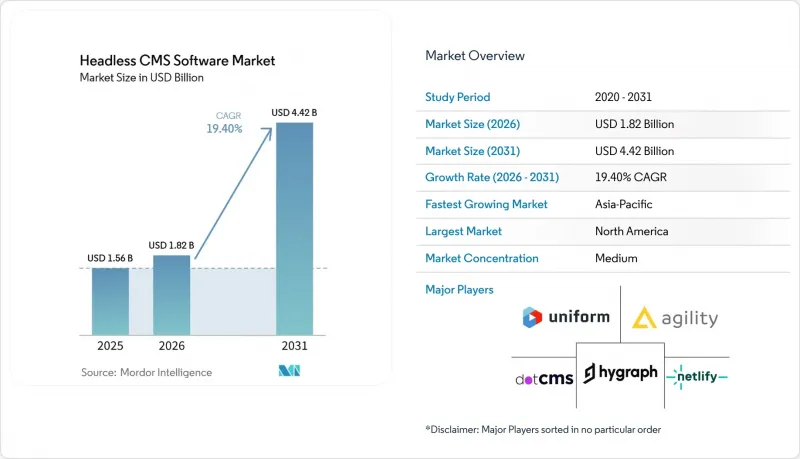
據 Mordor Intelligence 稱,無頭 CMS 軟體市場預計將從 2025 年的 15.6 億美元成長到 2026 年的 18.2 億美元,到 2031 年達到 44.2 億美元,預計 2026 年至 2031 年的複合年成長率為 19.40%。
本報告按元件(軟體和服務)、部署類型(雲端、本地部署、混合部署)、組織規模(大型企業、中小企業)、應用程式(網站和入口網站管理、電子商務內容管理等)、最終用戶產業(零售、電子商務等)以及地區進行細分。市場預測以美元計價。
全球無頭CMS軟體市場趨勢及洞察
跨網路、應用程式和新興平台的全通路內容傳送。
如今,內容分發管道已遠遠超出網站,涵蓋應用程式、自助服務終端、穿戴式裝置、語音介面和身臨其境型格式。 Storyblok 於 2025 年 5 月發布的《2025 年 CMS 現況報告》基於對 1300 位 CMS 用戶的調查,預計內容傳送管道中成長最快的將是 AR、VR 和語音控制音箱(15%),其次是智慧型手錶(14%)。報告也指出,61% 的團隊同時運行兩個或多個 CMS,凸顯了 2025 年多通路發布模式的片段化特徵。無頭模式透過一次性儲存內容,並透過 API 將其分發到每個終端,無需為每個顯示裝置重建內容層,從而減輕了這種負擔。這在無頭 CMS 軟體市場意義重大,因為對於那些業務拓展到 Web 和行動端以外的品牌而言,基於頁面的系統已接近其實際應用極限,遷移正成為營運的必然選擇,而非未來的選項。
引入 API 優先且可組合的架構。
企業軟體採購趨勢正朝著模組化架構轉變,而無頭內容管理系統(CMS)則處於此轉型過程中的內容層。根據MACH聯盟的報告,87%的成員公司已廣泛採用MACH技術,93%的採用者表示他們的投資已達到或超過預期回報率。這種發展勢頭正在推動無頭CMS軟體市場,因為API優先的內容平台能夠自然地與企業自行選擇的商務、個人化、搜尋和資料工具整合。一個重要的指標是銷售團隊於2026年6月1日簽署最終協議,收購徵兆一個被超過4,800家企業品牌使用的可組合內容平台。這項交易表明,無頭內容基礎設施正從專門的架構選擇轉變為企業軟體的核心層。
與舊有系統和資料模型整合的複雜性。
傳統內容管理系統 (CMS) 環境很少是獨立的系統,因為它們通常與基於舊資料結構建構的客戶關係管理 (CRM)、產品資訊管理 (PIM)、數位資產管理 (DAM)、分析和商務平台緊密相連。根據 Sanity 發布的《2025 年企業指南》,從單體 CMS 遷移到完全無頭環境的標準流程通常需要 16 到 24 週的時間來配置和整合核心模型。因此,許多組織在遷移期間會並行運行舊有系統系統和無頭系統,導致內容一致性問題、路由衝突和版本控制系統過載。這對無頭 CMS 軟體市場構成了重大障礙,因為擁有最豐富內容資產的公司往往擁有最複雜、相互交織的傳統技術堆疊。因此,即使無頭架構的長期商業價值已經確立,遷移過程仍然會被延誤。
細分市場分析
在2025年的無頭CMS軟體市場中,軟體收入佔比高達70.45%,這表明基於訂閱的平台收入仍然是該領域的主旋律。這一主導地位主要由SaaS原生供應商推動,他們將核心內容建模、API交付、工作流程控制和使用者存取整合到循環授權模式中。授權仍然是大多數交易中的第一層商業性環節,因為企業通常購買的是託管雲端平台而非安裝軟體形式的無頭CMS。軟體收入的集中也反映了這樣一個現實:買家通常會先訂閱平台,然後再逐步增加在整合、遷移和維運支援方面的投入。即使實際提供的服務範圍遠遠超出許可本身,這一趨勢也確保了軟體在無頭CMS軟體市場中仍然是供應商定位的核心。
預計到2031年,服務板塊的複合年成長率將達到22.02%,成為該結構中成長最快的組成部分。這種成長速度主要源自於無頭部署所需的許多複雜性,例如內容模型重構、舊有系統遷移、前端建置以及多通路整合。許多買家仍然低估了將內容從傳統的基於頁面的工作流程中解耦,並在網路、應用程式和電商環境中建立新的交付層所需的工作量。這種認知差距導致企業對部署合作夥伴、託管支援和架構專家的需求持續成長,這些專家可以幫助企業從平台購買過渡到全面營運。隨著時間的推移,基本API功能的兼容性更容易得到保障,與人工智慧內容模型、管治設計和多區域部署相關的服務將比單純的功能清單對購買決策產生更直接的影響。
到 2025 年,基於雲端的部署將佔據 67.11% 的市場佔有率,這印證了操作便利性和強大的擴充性仍然是該市場中最顯著的優勢。 SaaS 交付模式減輕了基礎設施管理的負擔,縮短了設定時間,並支援跨通路內容傳送,而無需購買者維護底層託管環境。對許多組織而言,這仍然是實現無頭部署的最便捷途徑,並減輕了內部 IT 團隊的負擔。雲端部署也與大多數供應商打包現代工作流程、個人化和整合功能的方式相契合。在無頭 CMS 軟體市場,即使更複雜的管治需求開始影響企業藍圖,雲端部署模式也成為營收領先的部署模式。
預計到2031年,混合部署將以21.62%的複合年成長率成長,成為成長最快的交付模式。這反映了企業的需求:既需要雲端原生API的柔軟性,也需要對資料儲存位置、儲存網站或內容管治進行更嚴格的控制。政府機構、金融服務機構和醫療保健機構在這方面尤其重要,因為某些內容如果不採取額外的管理措施,就無法完全遷移到第三方公共雲端環境。混合模式為這些使用者提供了一個切實可行的折衷方案,既能確保交付層和整合功能保持最新狀態,又能將某些內容和系統保留在內部控制之下。因此,混合模式的採用並非權宜之計,而是在受監管和安全關鍵型內容環境中的一種審慎的營運模式。
區域分析
到2025年,北美將佔據無頭CMS軟體市場36.14%的佔有率,成為收入最高的區域貢獻者。該地區受益於眾多數位化原生零售商、媒體公司、科技公司和金融服務機構的集中,這些機構將全通路內容傳送視為競爭的必要條件,而不僅僅是附加功能。美國仍然是主要的收入來源,而加拿大和墨西哥則透過對跨境數位商務的需求(這種需求傾向於統一的內容模式)為市場提供了支持。早期採用也反映了該地區強大的SaaS生態系統以及能夠減少企業客戶採用過程中阻力的專業實施合作夥伴的存在。雖然南美洲的貢獻仍然較小,但巴西和阿根廷持續表現出濃厚的興趣,因為行動優先商務的成長和數位化的進步使採用結構化內容系統的重要性日益凸顯。
預計到2031年,亞太地區將以20.89%的複合年成長率成長,成為無頭CMS軟體市場成長最快的地區。中國、印度、日本和韓國是推動這項市場需求的主要力量,但各國的原因各不相同。中國擁有大規模的電子商務基礎設施和內容密集型數位平台,這些平台需要可擴展的、API驅動的交付方式,因此具有顯著優勢。印度擁有大規模的軟體開發社區,精通JavaScript和API優先架構,這使得無頭CMS軟體的普及應用變得更加便捷,從而推動了市場成長。澳洲和紐西蘭也憑藉可組合架構的廣泛應用展現出強勁的成長勢頭,而韓國先進的企業技術環境則為該地區的持續成長提供了有力支撐。
歐洲在無頭CMS軟體市場佔據了相當大的佔有率,儘管調查數據並未具體說明區域細分。英國、德國和法國是市場需求的核心,其驅動力主要來自多語言發布、無障礙存取、管治以及傳統內容環境現代化等方面的需求。尤其值得一提的是德國,大規模工業和企業組織需要可審計的工作流程和結構化的多區域發布。在法國,對資料管理和部署選項的重視促使自託管和私有雲端模式的接受度不斷提高。同時,北歐和比荷盧經濟聯盟國家作為次市場市場仍在持續發展。中東和非洲地區仍處於早期市場階段,阿拉伯聯合大公國和沙烏地阿拉伯在數位政府和企業技術方面的投資不斷增加,而南非和奈及利亞則繼續支撐著該地區的早期需求。
其他好處:
- Excel格式的市場預測(ME)表
- 3個月的分析師支持
目錄
第1章:引言
- 研究假設和市場定義
- 調查範圍
第2章:調查方法
第3章執行摘要
第4章 市場狀況
- 市場概覽
- 市場促進因素
- 跨網路、應用程式和新興平台的全通路內容傳送。
- 採用 API 優先和可組合的架構。
- 與新一代人工智慧相容的內容管理
- 加速在地化進程,管治,並實現多區域出版。
- 安全性、效能、開發者自主性以及與單體式內容管理系統的對比
- 中型企業的低程式碼內容管理
- 市場限制因素
- 與舊有系統和資料模型整合的複雜性
- 實施成本和技術技能要求不斷上升
- 分散式API和工作流程中的管治負擔
- 由於平台特定的擴充程式和託管服務,存在供應商鎖定風險。
- 產業價值鏈分析
- 宏觀經濟因素對市場的影響
- 科技趨勢
- 監理情勢
- 波特五力分析
第5章 市場規模與成長預測
- 按組件
- 軟體
- 服務
- 依部署類型
- 基於雲端的
- 現場
- 混合
- 按組織規模
- 大公司
- 小型企業
- 透過使用
- 網站和入口網站管理
- 行動和應用程式內容管理
- 電子商務內容管理
- 數位體驗平台(DXP)
- 利用API進行全通路內容傳送
- 按最終用戶行業分類
- 零售與電子商務
- 媒體與出版
- 銀行、金融服務和保險(BFSI)
- 醫療保健和生命科學
- 資訊科技/通訊
- 政府和公共行政
- 旅遊與飯店
- 其他終端用戶產業
- 按地區
- 北美洲
- 美國
- 加拿大
- 墨西哥
- 南美洲
- 巴西
- 阿根廷
- 其他南美國家
- 歐洲
- 德國
- 英國
- 法國
- 義大利
- 西班牙
- 俄羅斯
- 其他歐洲國家
- 亞太地區
- 中國
- 日本
- 印度
- 韓國
- 澳洲和紐西蘭
- 其他亞太國家
- 中東
- 沙烏地阿拉伯
- 阿拉伯聯合大公國
- 土耳其
- 其他中東國家
- 非洲
- 南非
- 奈及利亞
- 其他非洲國家
- 北美洲
第6章 競爭情勢
- 市場集中度
- 策略趨勢
- 市佔率分析
- 公司簡介
- Contentful GmbH
- Contentstack Inc.
- Sanity AS
- Strapi SAS
- Hygraph GmbH
- Agility Inc.
- ButterCMS, LLC
- Prismic.io SAS
- DatoCMS Srl
- DotCMS LLC
- Crownpeak Technology, Inc.
- Kentico Software sro
- Kontent.ai, Inc.
- Magnolia International Ltd.
- Bloomreach, Inc.
- Directus, Inc.
- Uniform Systems, Inc.
- Ghost Foundation
- Netlify, Inc.
- Liferay, Inc.
第7章 市場機會與未來展望
According to Mordor Intelligence, the headless CMS software market size is expected to increase from USD 1.56 billion in 2025 to USD 1.82 billion in 2026 and reach USD 4.42 billion by 2031, growing at a CAGR of 19.40% over 2026-2031.
This report is Segmented by Component (Software and Services), Deployment Type (Cloud-Based, On-Premises, and Hybrid), Organization Size (Large Enterprises, and Small and Medium Enterprises), Application (Website and Portal Management, E-Commerce Content Management, and More), End User Industry (Retail and E-Commerce, and More), and Geography. The Market Forecasts are Provided in Terms of Value (USD).
Global Headless CMS Software Market Trends and Insights
Omnichannel Content Delivery across Web, Apps, and Emerging Surfaces
Content operations now extend well beyond websites into apps, kiosks, wearables, voice interfaces, and immersive formats. The Storyblok State of CMS 2025 report, published in May 2025 and based on 1,300 CMS users, found that the biggest planned increases in content delivery channels were AR and VR and voice-activated speakers at 15%, followed by smartwatches at 14%. The same report said 61% of teams operated 2 or more CMSs simultaneously, showing how fragmented multichannel publishing still was in 2025. A headless model addresses this strain by storing content once and distributing it through APIs to each endpoint without rebuilding the content layer for every surface. That matters in the Headless CMS Software Market because brands expanding beyond web and mobile are reaching a practical limit with page-based systems, so migration is becoming an operating need rather than a future preference.
API-First and Composable Architecture Adoption
Enterprise software buying is moving toward modular stacks, and headless CMS sits at the content layer of that shift. The MACH Alliance reported that 87% of member enterprises had widely implemented MACH technologies, and 93% of adopters said their investment met or exceeded ROI expectations. That momentum supports the Headless CMS Software Market because API-first content platforms naturally integrate with commerce, personalization, search, and data tools selected independently. A major signal came on June 1, 2026, when Salesforce signed a definitive agreement to acquire Contentful, a composable content platform used by more than 4,800 enterprise brands. The deal showed that headless content infrastructure is moving from a specialist architecture choice into a core enterprise software layer.
Integration Complexity with Legacy Systems and Data Models
Legacy CMS environments are rarely isolated systems because they are often tied to CRM, PIM, DAM, analytics, and commerce platforms built on older data structures. Sanity's 2025 enterprise guidance said that a standard migration from a monolithic CMS to a fully headless setup typically required 16-24 weeks for core model configuration and integration wiring. Many organizations, therefore, run legacy and headless systems in parallel during migration, which creates content consistency issues, routing conflicts, and strain on version control systems. This is a serious barrier for the Headless CMS Software Market because the enterprises with the largest content estates also tend to have the most entangled legacy stacks. The result is a slower migration path, even when the long-term business case for a headless architecture has already been accepted.
Other drivers and restraints analyzed in the detailed report include:
- Generative AI-Ready Content Operations
- Faster Localization, Governance, and Multiregion Publishing
- Higher Implementation Cost and Technical Skill Requirements
For complete list of drivers and restraints, kindly check the Table Of Contents.
Segment Analysis
Software accounted for 70.45% of the Headless CMS Software Market in 2025, underscoring how subscription-based platform revenue still defines the category. This lead came from SaaS-native vendors that package core content modeling, API delivery, workflow controls, and user access within recurring license structures. Enterprises have generally bought headless CMS as a managed cloud platform rather than as installed software, so licensing remains the first commercial layer in most deals. Revenue concentration in software also reflects how buyers often start with platform subscriptions before they expand spending into integration, migration, and operational support. In the Headless CMS Software Market, this keeps software at the center of vendor positioning even when the real delivery effort extends far beyond the license itself.
Services are projected to expand at a 22.02% CAGR through 2031, making them the fastest-growing component of this structure. The pace is tied to the complexity of content model redesign, legacy migration, frontend buildout, and multichannel integration required by headless deployments. Many buyers still underestimate the work required to decouple content from older page-based workflows and to stand up new delivery layers across web, app, and commerce environments. That gap creates durable demand for implementation partners, managed support, and architecture specialists that can help enterprises move from platform purchase to full-scale operation. Over time, as baseline API capabilities become easier to match, services tied to AI-ready content models, governance design, and multilocale rollout are likely to influence buying decisions more directly than feature checklists alone.
Cloud-based deployment held a 67.11% share in 2025, confirming that operational simplicity and elastic scale remain the strongest default advantages in this market. SaaS delivery reduces infrastructure management, shortens setup time, and supports content distribution across channels without requiring buyers to maintain underlying hosting environments. For many organizations, that is still the cleanest route into headless adoption, as it reduces the burden on internal IT teams. Cloud deployment also aligns with how most vendors package their newest workflow, personalization, and integration features. In the Headless CMS Software Market, this made cloud the leading deployment model by revenue, even as more complex governance demands began to shape enterprise roadmaps.
Hybrid deployment is projected to expand at a 21.62% CAGR through 2031, making it the fastest-growing delivery model. This reflects the needs of enterprises that want cloud-native API flexibility but also need tighter control over data residency, storage location, or content governance. Organizations in government, financial services, and healthcare are especially relevant here because some content cannot be moved fully into third-party public cloud environments without additional controls. Hybrid models give these users a practical middle path, where delivery layers and integrations can remain modern while selected content or systems stay closer to internal control. That is why hybrid adoption is rising not as a temporary compromise, but as a deliberate operating model for regulated and security-sensitive content environments.
Complete Report Scope:
- By Component
- Software
- Services
- By Deployment Type
- Cloud-Based
- On-Premises
- Hybrid
- By Organization Size
- Large Enterprises
- Small and Medium Enterprises
- By Application
- Website and Portal Management
- Mobile and Application Content Management
- E-Commerce Content Management
- Digital Experience Platforms (DXP)
- API-Driven Omnichannel Content Delivery
- By End User Industry
- Retail and E-Commerce
- Media and Publishing
- Banking, Financial Services, and Insurance (BFSI)
- Healthcare and Life Sciences
- IT and Telecommunication
- Government and Public Administration
- Travel and Hospitality
- Other End User Industries
- By Geography
- North America
- United States
- Canada
- Mexico
- South America
- Brazil
- Argentina
- Rest of South America
- Europe
- Germany
- United Kingdom
- France
- Italy
- Spain
- Russia
- Rest of Europe
- Asia-Pacific
- China
- Japan
- India
- South Korea
- Australia and New Zealand
- Rest of Asia-Pacific
- Middle East
- Saudi Arabia
- United Arab Emirates
- Turkey
- Rest of Middle East
- Africa
- South Africa
- Nigeria
- Rest of Africa
- North America
Geography Analysis
North America held a 36.14% share of the Headless CMS Software Market in 2025, making it the largest regional contributor by revenue. The region benefited from a dense base of digital-native retailers, media companies, technology firms, and financial services organizations that treat omnichannel content delivery as a competitive requirement rather than a side capability. The United States remained the main revenue center, while Canada and Mexico added support through cross-border digital commerce needs that favor unified content models. Early adoption also reflected the strength of the regional SaaS ecosystem and the availability of specialist implementation partners that can reduce deployment friction for enterprise buyers. South America remained a smaller contributor, but Brazil and Argentina continued to show interest as mobile-first commerce growth and digital modernization created a clearer case for structured content systems.
Asia-Pacific is projected to expand at a 20.89% CAGR through 2031, making it the fastest-growing region in the Headless CMS Software Market. China, India, Japan, and South Korea are driving most of that demand, although the reasons differ by country. China benefits from a large e-commerce base and content-intensive digital platforms that require scalable API-driven delivery. India adds momentum through a large software development community that is comfortable with JavaScript and API-first architectures, making adoption easier to implement in practice. Australia and New Zealand also show strong movement in line with broader composable architecture adoption, while South Korea's advanced enterprise technology environment supports continued regional growth.
Europe holds a significant share of the Headless CMS Software Market, even though the input does not assign a single regional percentage. The United Kingdom, Germany, and France form the core of demand, supported by needs around multilingual publishing, accessibility, governance, and modernization of legacy content environments. Germany stands out as a market where large industrial and enterprise organizations need audit-ready workflows and structured multiregion publishing. France remains receptive to self-hosted and private-cloud models where data control and deployment choice are important, while the Nordics and Benelux continue to develop as secondary markets. The Middle East and Africa remain early-stage markets, but the UAE and Saudi Arabia are seeing greater investment in digital government and enterprise technology, while South Africa and Nigeria continue to anchor the region's early demand base.
- Contentful GmbH
- Contentstack Inc.
- Sanity AS
- Strapi SAS
- Hygraph GmbH
- Agility Inc.
- ButterCMS, LLC
- Prismic.io SAS
- DatoCMS S.r.l.
- DotCMS LLC
- Crownpeak Technology, Inc.
- Kentico Software s.r.o.
- Kontent.ai, Inc.
- Magnolia International Ltd.
- Bloomreach, Inc.
- Directus, Inc.
- Uniform Systems, Inc.
- Ghost Foundation
- Netlify, Inc.
- Liferay, Inc.
Additional Benefits:
- The market estimate (ME) sheet in Excel format
- 3 months of analyst support
TABLE OF CONTENTS
1 INTRODUCTION
- 1.1 Study Assumptions and Market Definition
- 1.2 Scope of the Study
2 RESEARCH METHODOLOGY
3 EXECUTIVE SUMMARY
4 MARKET LANDSCAPE
- 4.1 Market Overview
- 4.2 Market Drivers
- 4.2.1 Omnichannel Content Delivery Across Web, Apps, and Emerging Surfaces
- 4.2.2 API-First and Composable Architecture Adoption
- 4.2.3 Generative AI-Ready Content Operations
- 4.2.4 Faster Localization, Governance, and Multiregion Publishing
- 4.2.5 Security, Performance, and Developer Autonomy Versus Monolithic CMS
- 4.2.6 Low-Code Content Operations for Mid-Market Adoption
- 4.3 Market Restraints
- 4.3.1 Integration Complexity With Legacy Systems and Data Models
- 4.3.2 Higher Implementation Cost and Technical Skill Requirements
- 4.3.3 Governance Burden Across Distributed APIs and Workflows
- 4.3.4 Vendor Lock-In Risk From Platform-Specific Extensions and Hosting
- 4.4 Industry Value Chain Analysis
- 4.5 Impact of Macroeconomic Factors on the Market
- 4.6 Technology Outlook
- 4.7 Regulatory Landscape
- 4.8 Porter's Five Forces Analysis
- 4.8.1 Threat of New Entrants
- 4.8.2 Bargaining Power of Suppliers
- 4.8.3 Bargaining Power of Buyers
- 4.8.4 Threat of Substitutes
- 4.8.5 Competitive Rivalry
5 MARKET SIZE AND GROWTH FORECASTS (VALUE)
- 5.1 By Component
- 5.1.1 Software
- 5.1.2 Services
- 5.2 By Deployment Type
- 5.2.1 Cloud-Based
- 5.2.2 On-Premises
- 5.2.3 Hybrid
- 5.3 By Organization Size
- 5.3.1 Large Enterprises
- 5.3.2 Small and Medium Enterprises
- 5.4 By Application
- 5.4.1 Website and Portal Management
- 5.4.2 Mobile and Application Content Management
- 5.4.3 E-Commerce Content Management
- 5.4.4 Digital Experience Platforms (DXP)
- 5.4.5 API-Driven Omnichannel Content Delivery
- 5.5 By End User Industry
- 5.5.1 Retail and E-Commerce
- 5.5.2 Media and Publishing
- 5.5.3 Banking, Financial Services, and Insurance (BFSI)
- 5.5.4 Healthcare and Life Sciences
- 5.5.5 IT and Telecommunication
- 5.5.6 Government and Public Administration
- 5.5.7 Travel and Hospitality
- 5.5.8 Other End User Industries
- 5.6 By Geography
- 5.6.1 North America
- 5.6.1.1 United States
- 5.6.1.2 Canada
- 5.6.1.3 Mexico
- 5.6.2 South America
- 5.6.2.1 Brazil
- 5.6.2.2 Argentina
- 5.6.2.3 Rest of South America
- 5.6.3 Europe
- 5.6.3.1 Germany
- 5.6.3.2 United Kingdom
- 5.6.3.3 France
- 5.6.3.4 Italy
- 5.6.3.5 Spain
- 5.6.3.6 Russia
- 5.6.3.7 Rest of Europe
- 5.6.4 Asia-Pacific
- 5.6.4.1 China
- 5.6.4.2 Japan
- 5.6.4.3 India
- 5.6.4.4 South Korea
- 5.6.4.5 Australia and New Zealand
- 5.6.4.6 Rest of Asia-Pacific
- 5.6.5 Middle East
- 5.6.5.1 Saudi Arabia
- 5.6.5.2 United Arab Emirates
- 5.6.5.3 Turkey
- 5.6.5.4 Rest of Middle East
- 5.6.6 Africa
- 5.6.6.1 South Africa
- 5.6.6.2 Nigeria
- 5.6.6.3 Rest of Africa
- 5.6.1 North America
6 COMPETITIVE LANDSCAPE
- 6.1 Market Concentration
- 6.2 Strategic Moves
- 6.3 Market Share Analysis
- 6.4 Company Profiles (includes Global Level Overview, Market Level Overview, Core Segments, Financials as available, Strategic Information, Market Rank/Share, Products and Services, Recent Developments)
- 6.4.1 Contentful GmbH
- 6.4.2 Contentstack Inc.
- 6.4.3 Sanity AS
- 6.4.4 Strapi SAS
- 6.4.5 Hygraph GmbH
- 6.4.6 Agility Inc.
- 6.4.7 ButterCMS, LLC
- 6.4.8 Prismic.io SAS
- 6.4.9 DatoCMS S.r.l.
- 6.4.10 DotCMS LLC
- 6.4.11 Crownpeak Technology, Inc.
- 6.4.12 Kentico Software s.r.o.
- 6.4.13 Kontent.ai, Inc.
- 6.4.14 Magnolia International Ltd.
- 6.4.15 Bloomreach, Inc.
- 6.4.16 Directus, Inc.
- 6.4.17 Uniform Systems, Inc.
- 6.4.18 Ghost Foundation
- 6.4.19 Netlify, Inc.
- 6.4.20 Liferay, Inc.
7 MARKET OPPORTUNITIES AND FUTURE OUTLOOK
- 7.1 White-Space and Unmet-Need Assessment

 全球無頭CMS軟體市場規模、佔有率、趨勢和成長分析報告(2026-2034年)
 無頭CMS軟體市場-2026-2032年全球市場預測Web內容管理市場:2026-2032年全球市場預測(按元件、內容類型、部署方式、產業、最終用戶和組織規模分類)
 2026年全球Java內容管理系統(CMS)軟體市場報告
 無頭內容管理系統軟體市場規模、佔有率和趨勢分析報告:按組件、部署、應用、最終用途、地區和細分市場預測(2026-2033 年)
 Web內容管理市場報告:按元件、部署類型、組織規模、產業和地區分類(2026-2034年)
 無頭CMS軟體市場分析及預測(至2035年):類型、產品類型、服務、技術、組件、應用、部署模式、最終用戶、功能2026年全球網路內容管理市場報告網路內容管理市場分析及預測(至2035年):按類型、產品類型、服務、技術、組件、應用、部署類型、最終用戶和解決方案分類全球網路內容管理市場規模、佔有率、趨勢和成長分析報告(2026-2034年)