


 |
市場調查報告書
商品編碼
2118166
中東和非洲灌溉幫浦市場:市場佔有率分析、產業趨勢和統計數據以及成長預測(2026-2031 年)Middle East and Africa Irrigation Pumps - Market Share Analysis, Industry Trends & Statistics, Growth Forecasts (2026 - 2031) |
||||||

※ 本網頁內容可能與最新版本有所差異。詳細情況請與我們聯繫。
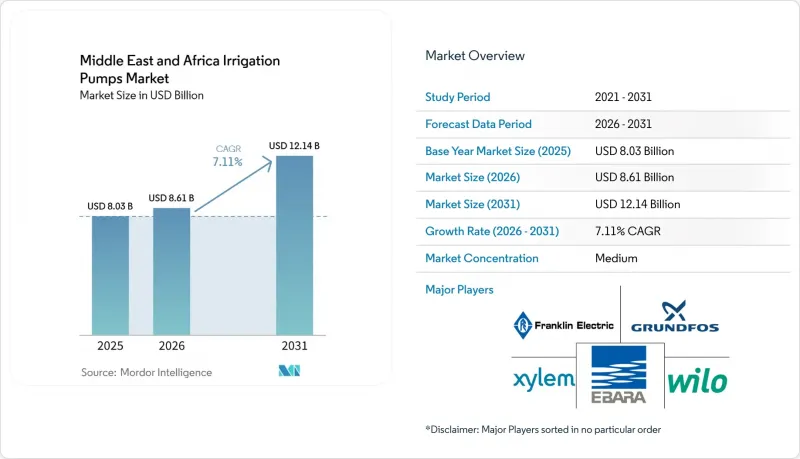
根據 Mordor Intelligence 預測,中東和非洲的灌溉幫浦市場規模將從 2025 年的 80.3 億美元和 2026 年的 86.1 億美元成長到 2031 年的 121.4 億美元,2026 年至 2031 年的年複合成長率(CAGR)為 7.11%。
本報告按類型(潛水泵、離心式幫浦、渦流泵和其他灌溉泵)和地區(中東和非洲)進行細分。報告以美元計價,呈現市場規模和預測數據。
中東和非洲灌溉幫浦市場趨勢及洞察
在缺水農場推廣加壓灌溉
在這一地區的許多農業區,漫灌正逐漸被滴灌、噴水灌溉和微灌系統所取代。這種轉變意義重大,因為加壓灌溉比基本的漫灌系統需要更可靠的幫浦性能和更精確的壓力控制。沙烏地阿拉伯灌溉局和國際灌溉排水委員會(ICID)於2024年合作開展了「灌溉部門綜合管理促進永續發展」項目,旨在提高沙烏地阿拉伯農民的灌溉效率和用水生產力。在摩洛哥,於2025年啟動的「賽斯灌溉計畫3期」正在擴建供水基礎設施,並計畫每年從姆德茲大壩供水1.25億立方公尺。這些項目不僅增加了對標準離心式幫浦的需求,也增加了對增壓系統、調壓泵組和配水泵的需求。這種轉變正在改善中東和非洲灌溉泵浦市場的銷售結構,因為需要更先進技術的系統通常單位成本更高。此外,老舊水泵往往無法滿足現代灌溉系統對壓力和流量穩定性的要求,這推動了水泵的更換需求。因此,節水灌溉方式催生了一個市場,該市場與農場層面水泵系統需求的成長以及更複雜的技術要求直接相關。
擴大離網灌溉叢集中太陽能水泵的使用
在中東和非洲,太陽能水泵正成為灌溉水泵市場最顯著的成長趨勢之一。這主要是由於大片農業區持續缺乏可靠的電網,以及農村灌溉計畫持續面臨柴油燃料成本的沉重負擔。在衣索比亞,零星的試點計畫正朝著全面部署的方向發展,國際水資源管理研究所(IWMI)正在協調一個全國性的平台,計劃在2026年安裝1750台太陽能水泵。摩洛哥在太陽能灌溉水泵的運作方面也擁有豐富的經驗。在沙烏地阿拉伯,努科電力公司(Nuuko Power)於2025年10月在利雅德建造了一個4.58兆瓦的太陽能水泵系統,該系統在灌溉2560英畝土地的同時,降低了年度營運成本。隨著太陽能技術的普及,供應商群體也不斷擴大。這是因為低成本製造商能夠更有效地與那些優先考慮投資回報率和降低燃料成本的買家競爭。隨著這一擴張的持續,中東和非洲的灌溉泵市場正逐漸形成多元化的競爭格局,其中包括全球泵浦品牌、本地銷售合作夥伴以及專注於太陽能發電的新參與企業。
農村灌溉走廊電網可靠性低。
在許多灌溉區,電力供應不穩定仍然是快速推廣電動水泵最明顯的障礙之一。電壓波動和停電會損壞馬達和控制部件,增加維護成本,並削弱生產者的信心。在電力供應不穩定的地區,農民往往繼續使用柴油水泵,或推遲升級到更先進的電力系統。這限制了需要穩定電壓的變速驅動器和智慧控制系統的普及。即使在最需要擴大灌溉的地區,電力供應不穩定也會減緩電動水泵的推廣速度。因此,中東和非洲許多農村地區的灌溉水泵市場未能充分利用尖端電力技術。實際上,這導致了市場兩極化,只有在電力品質、資金籌措和技術支援良好的地區,對最新設備的需求成長最快。此外,電力供應不穩定也使得制定灌溉計畫變得困難,降低了作物生長尖峰時段的作業效率,並阻礙了對自動化灌溉基礎設施的投資,進一步限制了全部區域的長期現代化進程。
細分市場分析
預計到2025年,潛水泵將成為中東和非洲灌溉泵市場的主導類型,佔41.8%的市場佔有率。這主要歸功於深井灌溉在沙烏地阿拉伯、埃及以及北非部分乾旱農地的持續重要地位。這一強勁的市場地位反映了該地區對地下水灌溉的持續依賴,尤其是在地表水資源有限或分佈不均的地區。離心式幫浦在利用灌溉管道的農業和地表灌溉系統中繼續發揮重要作用,而渦流泵則用於含泥沙的水體。其他類型的灌溉幫浦也繼續滿足農業灌溉的特定流量需求。
預計潛水泵將呈現最高成長率,2026年至2031年間的複合年成長率將達到8.5%,這主要得益於更深井的使用、太陽能發電的普及以及依賴地下水的農業地區持續的灌溉需求。這一成長與沙漠農業和偏遠灌溉走廊對可靠的高揚程水泵的需求密切相關。離心式幫浦預計將在新建供水管網和地表水灌溉項目的地區穩步成長,尤其是在像摩洛哥的賽斯項目這樣的大型項目中。渦流泵預計將在涉及懸浮固體的應用中保持穩定地位,儘管規模可能有所縮小。同時,其他類型的灌溉幫浦將繼續在一些特定的、高流量的農業應用中得到應用。
其他好處:
- Excel格式的市場預測(ME)表
- 3個月的分析師支持
目錄
第1章:引言
- 研究假設和市場定義
- 調查範圍
第2章:調查方法
第3章執行摘要
第4章 市場動態
- 市場概覽
- 市場促進因素
- 在缺水農場推廣加壓灌溉
- 擴大離網灌溉叢集中太陽能水泵的使用
- 政府對灌溉系統現代化改造提供補貼。
- 以節能型電力系統取代柴油泵
- 乾旱和半乾旱農業區對地下水的依賴
- 引進精準灌溉技術應用於高價值作物
- 市場限制因素
- 農村灌溉走廊電網可靠性的局限性
- 太陽能發電和變速泵浦系統的初始成本較高
- 鑽孔資源的枯竭導致水泵運作和更換成本增加。
- 農場規模的分散化減緩了標準化農業機械的普及。
- 監理情勢
- 技術展望
- 波特五力分析
第5章 市場規模與成長預測
- 按類型
- 潛水泵
- 離心式幫浦
- 渦流泵
- 其他類型的灌溉泵
- 按地區
- 中東
- 阿拉伯聯合大公國
- 沙烏地阿拉伯
- 卡達
- 科威特
- 阿曼
- 巴林
- 以色列
- 其他中東國家
- 非洲
- 埃及
- 南非
- 奈及利亞
- 肯亞
- 摩洛哥
- 阿爾及利亞
- 衣索比亞
- 其他非洲國家
- 中東
第6章 競爭情勢
- 市場集中度
- 策略趨勢
- 市佔率分析
- 公司簡介
- Grundfos Holding A/S
- Xylem Inc.
- Franklin Electric Co., Inc.
- Ebara Corporation
- Wilo Group
- KSB SE and Co. KGaA
- Sulzer Ltd
- The Gorman-Rupp Company
- Kirloskar Brothers Limited
- Shakti Pumps(India)Limited
- Jain Irrigation Systems Ltd.
- Davey Water
- Valmont Industries, Inc
- LEO Group Pump(Zhejiang)Co., Ltd.
- Shimge Pump Industry Group Co., Ltd.
第7章 市場機會與未來展望
According to Mordor Intelligence, the Middle East and Africa irrigation pumps market size is projected to expand from USD 8.03 billion in 2025 and USD 8.61 billion in 2026 to USD 12.14 billion by 2031, registering a CAGR of 7.11% between 2026 and 2031.
This report is Segmented by Type (Submersible Pump, Centrifugal Pump, Vortex Pump, and Other Irrigation Pump Types) and by Geography (Middle East and Africa). The Report Offers Market Size and Forecasts in Terms of Value (USD).
Middle East and Africa Irrigation Pumps Market Trends and Insights
Expansion of Pressurized Irrigation in Water-Stressed Farms
Flood irrigation is steadily losing ground to drip, sprinkler, and micro-irrigation systems across many farming zones in this region. That change matters because pressurized irrigation needs more reliable pumping performance and tighter pressure control than basic flood systems. The Saudi Irrigation Organization and the International Commission on Irrigation and Drainage (ICID) worked on an Integrated Irrigation Sector Management for Sustainable Development in 2024 to promote efficient irrigation and better water productivity among farmers in Saudi Arabia. Morocco is also expanding distribution infrastructure through the Saiss irrigation project 3, initiated in 2025, to convey 125 million cubic meters of water each year from the M'Dez dam. These projects raise demand for booster systems, pressure-regulated pump sets, and distribution pumps rather than only standard centrifugal units. That shift improves the sales mix in the Middle East and Africa irrigation pumps market because more engineered systems usually carry a higher unit value. It also supports replacement demand, as older pumps often do not meet the pressure and flow stability requirements of modern irrigation layouts. The result is a market where water-saving irrigation methods are directly tied to stronger demand for pump systems and higher technical requirements at the farm level.
Rising Solar-Powered Pump Adoption in Off-Grid Irrigation Clusters
Solar pumping is becoming one of the clearest growth themes in the Middle East and Africa irrigation pumps market. This is because large agricultural areas still lack reliable grid electricity, and diesel costs remain a burden for irrigation operations in rural areas. Ethiopia is moving from scattered pilots to scale, with the International Water Management Institute coordinating a national platform to mobilize 1,750 solar pumps in 2026. Morocco also shows a strong operating case, with solar irrigation pumping. In Saudi Arabia, a 4.58 MW solar water-pumping installation completed in Riyadh by Nuuko Power in October 2025 irrigated 2,560 acres while reducing annual operating costs. Solar adoption is also widening the supplier base, as lower-cost manufacturers can compete more effectively with buyers who focus on payback and fuel savings. As this spread continues, the Middle East and Africa irrigation pumps market is moving closer to a mixed competitive structure that includes global pump brands, local channel partners, and solar-focused entrants.
Limited Grid Reliability in Rural Irrigation Corridors
Unreliable electricity supply remains one of the clearest barriers to faster adoption of electric pumps in many irrigation zones. Voltage fluctuations and outages can damage motors and control components, increasing maintenance costs and eroding growers' confidence. Where supply is unstable, farmers often stay with diesel or delay upgrades to more advanced electric systems. This limits the spread of variable-speed drives and intelligent control systems that need stable voltage to perform well. It also slows adoption in the very corridors where irrigation expansion is most needed. As a result, the Middle East and Africa irrigation pumps market cannot fully benefit from premium electric technologies in many rural areas. The practical outcome is a split market in which modern equipment demand grows fastest only where power quality, financing, and technical support are available. In addition, unreliable grid access complicates irrigation scheduling, reduces operational efficiency during peak growing periods, and discourages investment in automated irrigation infrastructure, further constraining long-term modernization efforts across agricultural regions.
Other drivers and restraints analyzed in the detailed report include:
- Government Subsidy Support for Irrigation Modernization
- Groundwater Dependence in Arid and Semi-Arid Farming Belts
- High Upfront Cost of Solar and Variable-Speed Pump Systems
For complete list of drivers and restraints, kindly check the Table Of Contents.
Segment Analysis
Submersible pumps accounted for 41.8% of the Middle East and Africa irrigation pump market share in 2025, making them the leading type segment, as deep-borehole irrigation remains central across Saudi Arabia, Egypt, and several arid farming zones in North Africa. Their strong position reflects the region's continued reliance on groundwater for irrigation, particularly in areas with limited or uneven access to surface water. Centrifugal pumps remained important in canal-fed agriculture and surface irrigation systems, while vortex pumps were used for sediment-laden water conditions. Other irrigation pump types continued to support specialized agricultural flow requirements.
Submersible pumps are anticipated to grow at the fastest rate, at a CAGR of 8.5% from 2026 to 2031, supported by deeper borehole use, rising solar integration, and continued irrigation demand across groundwater-dependent farming belts. Their growth is also tied to the need for reliable high-head pumping in desert agriculture and remote irrigation corridors. Centrifugal pumps are likely to see steady expansion where new distribution networks and surface-water irrigation projects are being developed, especially in organized schemes such as Morocco's Saiss project. Vortex pumps should retain a smaller but stable role in applications with suspended solids, while other irrigation pump types will continue serving niche high-flow agricultural uses.
Complete Report Scope:
- By Type
- Submersible Pump
- Centrifugal Pump
- Vortex Pump
- Other Irrigation Pump Types
- By Geography
- Middle East
- United Arab Emirates
- Saudi Arabia
- Qatar
- Kuwait
- Oman
- Bahrain
- Israel
- Rest of Middle East
- Africa
- Egypt
- South Africa
- Nigeria
- Kenya
- Morocco
- Algeria
- Ethiopia
- Rest of Africa
- Middle East
List of Companies Covered in this Report:
- Grundfos Holding A/S
- Xylem Inc.
- Franklin Electric Co., Inc.
- Ebara Corporation
- Wilo Group
- KSB SE and Co. KGaA
- Sulzer Ltd
- The Gorman-Rupp Company
- Kirloskar Brothers Limited
- Shakti Pumps (India) Limited
- Jain Irrigation Systems Ltd.
- Davey Water
- Valmont Industries, Inc
- LEO Group Pump (Zhejiang) Co., Ltd.
- Shimge Pump Industry Group Co., Ltd.
Additional Benefits:
- The market estimate (ME) sheet in Excel format
- 3 months of analyst support
TABLE OF CONTENTS
1 INTRODUCTION
- 1.1 Study Assumptions and Market Definition
- 1.2 Scope of the Study
2 RESEARCH METHODOLOGY
3 EXECUTIVE SUMMARY
4 MARKET DYNAMICS
- 4.1 Market Overview
- 4.2 Market Drivers
- 4.2.1 Expansion of pressurized irrigation in water-stressed farms
- 4.2.2 Rising solar-powered pump adoption in off-grid irrigation clusters
- 4.2.3 Government subsidy support for irrigation modernization
- 4.2.4 Replacement of diesel pumping with energy-efficient electric systems
- 4.2.5 Groundwater dependence in arid and semi-arid farming belts
- 4.2.6 Precision irrigation deployment on high-value crops
- 4.3 Market Restraints
- 4.3.1 Limited grid reliability in rural irrigation corridors
- 4.3.2 High upfront cost of solar and variable-speed pump systems
- 4.3.3 Borehole depletion increasing pump downtime and replacement burden
- 4.3.4 Fragmented farm sizes slowing standardized equipment adoption
- 4.4 Regulatory Landscape
- 4.5 Technological Outlook
- 4.6 Porter's Five Forces Analysis
- 4.6.1 Bargaining Power of Buyers
- 4.6.2 Bargaining Power of Suppliers
- 4.6.3 Threat of New Entrants
- 4.6.4 Threat of Substitute Products
- 4.6.5 Intensity of Competitive Rivalry
5 MARKET SIZE AND GROWTH FORECASTS (Value)
- 5.1 By Type
- 5.1.1 Submersible Pump
- 5.1.2 Centrifugal Pump
- 5.1.3 Vortex Pump
- 5.1.4 Other Irrigation Pump Types
- 5.2 By Geography
- 5.2.1 Middle East
- 5.2.1.1 United Arab Emirates
- 5.2.1.2 Saudi Arabia
- 5.2.1.3 Qatar
- 5.2.1.4 Kuwait
- 5.2.1.5 Oman
- 5.2.1.6 Bahrain
- 5.2.1.7 Israel
- 5.2.1.8 Rest of Middle East
- 5.2.2 Africa
- 5.2.2.1 Egypt
- 5.2.2.2 South Africa
- 5.2.2.3 Nigeria
- 5.2.2.4 Kenya
- 5.2.2.5 Morocco
- 5.2.2.6 Algeria
- 5.2.2.7 Ethiopia
- 5.2.2.8 Rest of Africa
- 5.2.1 Middle East
6 COMPETITIVE LANDSCAPE
- 6.1 Market Concentration
- 6.2 Strategic Moves
- 6.3 Market Share Analysis
- 6.4 Company Profiles (Includes Global Level Overview, Market Level Overview, Core Segments, Financials as Available, Strategic Information, Market Rank/Share, Products and Services, and Recent Developments)
- 6.4.1 Grundfos Holding A/S
- 6.4.2 Xylem Inc.
- 6.4.3 Franklin Electric Co., Inc.
- 6.4.4 Ebara Corporation
- 6.4.5 Wilo Group
- 6.4.6 KSB SE and Co. KGaA
- 6.4.7 Sulzer Ltd
- 6.4.8 The Gorman-Rupp Company
- 6.4.9 Kirloskar Brothers Limited
- 6.4.10 Shakti Pumps (India) Limited
- 6.4.11 Jain Irrigation Systems Ltd.
- 6.4.12 Davey Water
- 6.4.13 Valmont Industries, Inc
- 6.4.14 LEO Group Pump (Zhejiang) Co., Ltd.
- 6.4.15 Shimge Pump Industry Group Co., Ltd.
7 MARKET OPPORTUNITIES AND FUTURE OUTLOOK

 北美灌溉幫浦:市場佔有率分析、產業趨勢與統計資料、成長預測(2026-2031 年)歐洲灌溉幫浦:市場佔有率分析、產業趨勢與統計資料、成長預測(2026-2031 年)南美洲灌溉幫浦:市場佔有率分析、產業趨勢與統計及成長預測(2026-2031 年)
 農業泵浦市場-全球產業規模、佔有率、趨勢、機會和預測:按類型、材料類型、動力來源、馬力、揚程、最終用戶、地區和競爭格局分類,2021-2031年
 電動背負式噴霧器市場:按動力來源、應用、最終用戶和分銷管道分類 - 全球預測(2026-2032 年)
 可調式流量微型噴灌:全球市佔率和排名、總銷售額和需求預測(2025-2031 年)
 全球灌溉幫浦市場
 2030 年農業泵浦市場預測:按類型、材料類型、馬力、泵浦頭尺寸、動力來源、最終用戶和地區進行的全球分析