


 |
市場調查報告書
商品編碼
2118132
非洲有機堆肥:市場佔有率分析、產業趨勢與統計及成長預測(2026-2031 年)Africa Organic Compost - Market Share Analysis, Industry Trends & Statistics, Growth Forecasts (2026 - 2031) |
||||||

※ 本網頁內容可能與最新版本有所差異。詳細情況請與我們聯繫。
據 Mordor Intelligence 稱,2025 年非洲有機堆肥市場價值 1.8 億美元,預計將從 2026 年的 1.96 億美元成長到 2031 年的 3.02 億美元,2026 年至 2031 年的複合年成長率為 8.90%。
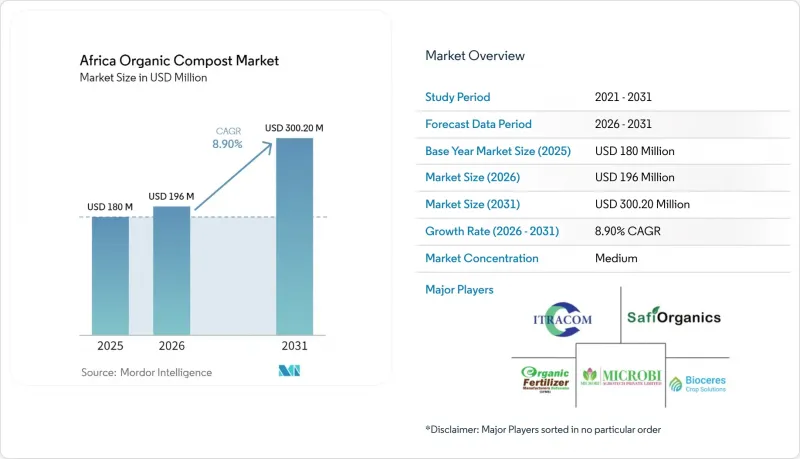
本報告按產品類型(風力牽引式堆肥、曝氣靜態堆肥及其他)、原料(城市有機廢棄物、農業殘渣及其他)、形態(顆粒狀堆肥、粉狀堆肥及其他)、應用領域(田間作物、水果和蔬菜及其他)以及地區(南非、肯亞及其他)進行分類。市場預測以美元計價。
非洲有機堆肥市場趨勢與洞察
集約化農業區土壤有機質減少的進程
非洲集約化農業區土壤有機質的下降是推動該地區有機堆肥市場成長的關鍵因素。根據國際農業發展基金(IFAD)預測,2024年,非洲約75%至80%的耕地將劣化,土壤預計每年每公頃流失30至60公斤必需養分。這種持續的養分流失將降低土壤肥力、保水性和生物活性,最終對作物長期產量產生負面影響。因此,農民越來越依賴有機堆肥來恢復土壤有機質、改善土壤結構並增強應對氣候變遷相關生產挑戰的能力,這促進了市場的永續成長。
利用堆肥進行土壤修復,並有證據表明農業產量可以恢復。
農業研究表明,利用堆肥進行土壤改良能夠顯著提高作物產量,從而推動非洲有機堆肥市場的成長。 Teka等人發表在《堆肥科學與利用》期刊上的研究報告《蚯蚓堆肥對埃塞俄比亞乾旱地區土壤肥力和作物產量的影響》(2024年)指出,施用10噸/公頃的蚯蚓堆肥可使糧食產量比未處理的對照組提高1.5倍。此外,土壤有機碳、總氮和有效磷含量也得到改善。這些經科學驗證的產量和土壤健康改善正在推動有機堆肥在非洲農業系統中得到更廣泛的應用。
原料污染和堆肥品質差異
原料污染和堆肥品質的差異是非洲有機堆肥市場的主要挑戰,尤其是在有機廢棄物來自混合都市廢棄物的情況下。 2025年發表在《永續食品系統前沿》(Frontiers in Sustainable Food Systems)期刊上的一項研究指出,垃圾分類不充分以及廢棄物管理、衛生和農業機構之間缺乏協調,阻礙了非洲國家高品質堆肥的生產。受污染的原料可能含有塑膠、病原體和其他雜質,這會降低堆肥的功效,使其難以達到品質標準。這些問題導致加工成本增加、買家信心下降,以及堆肥產品在全部區域的商業性。
細分市場分析
2025年,條垛式堆肥在非洲有機堆肥市場佔了38.0%的最大市場。此方法之所以能保持主導地位,是因為它能夠處理多種有機物料,並且適用於各種規模的作業。條垛式堆肥所需的配套設施相對簡單,因此被市政、農業和商業堆肥企業廣泛採用。其處理大量有機物的能力使其在多個終端應用領域中廣泛應用。這些特點確保了條垛式堆肥仍然是非洲許多堆肥廠的首選產品類型。
預計蚯蚓糞將呈現最高的成長率,2026年至2031年間的複合年成長率將達13.2%。這一成長主要得益於市場對高價值有機土壤改良劑的需求不斷成長,這類改良劑能夠提高養分利用效率和生物活性。蚯蚓糞正日益受到重視改善土壤結構、提高養分利用效率和推廣永續耕作方式的生產者的青睞。在土壤健康管理日益重要的密集農業系統中,蚯蚓糞尤其具有吸引力。人們對再生農業實踐的認知不斷提高,以及對高品質有機材料需求的持續成長,預計將進一步加速蚯蚓糞在非洲農業市場的普及。
預計到2025年,都市區有機廢棄物將佔堆肥總量的33.0%,成為最大的市佔率。這一主導地位主要歸因於都市區有機廢棄物的持續產生及其作為堆肥生產原料的大規模性。都市區有機廢棄物為堆肥生產商提供了大量可生物分解的物質,這些物質可加工成農業肥料。人們對廢棄物回收、減少掩埋和資源回收的日益重視,進一步凸顯了城市廢棄物在堆肥生產中的重要性。這些因素表明,城市廢棄物將繼續作為市場上的主要原料類別佔據主導地位。
預計2026年至2031年間,農業殘餘物將以11.1%的複合年成長率在非洲有機堆肥市場中佔據領先地位。隨著生產者尋求在其農業區附近易於取得的替代材料,農業殘餘物的重要性日益凸顯。作物殘餘物不僅能解決廢棄物處理難題,還能轉化為土壤改良產品,進而創造價值。此外,其更廣泛的利用還能透過將有機物重新納入生產系統,促進循環農業實踐。隨著人們對永續資源利用的日益關注,預計農業殘餘物將在該地區未來的堆肥生產中發揮更關鍵的作用。
其他好處
- Excel格式的市場預測(ME)表
- 3個月的分析師支持
目錄
第1章:引言
- 研究假設和市場定義
- 調查範圍
第2章:調查方法
第3章執行摘要
第4章 市場狀況
- 市場概覽
- 市場促進因素
- 集約化農業區土壤有機質減少的進程
- 利用堆肥進行土壤修復,並有證據表明農業產量可以恢復。
- 地方政府的有機廢棄物回收政策正在創造穩定的原料來源。
- 比較小規模農戶購買農業材料的經濟承受能力和進口合成肥料的價格波動。
- 拓展經認證的有機園藝和出口作物的價值鏈
- 碳排放和土壤健康以及堆肥生產商的循環經濟資金籌措
- 市場限制因素
- 原料污染和堆肥品質差異
- 收集、分類和物流的基礎設施不足。
- 工業用堆肥設備的投資回收期很長。
- 農民在經濟作物種植系統中更傾向於使用速效肥料
- 價值鏈分析
- 監理情勢
- 技術展望
- 波特五力分析
第5章 市場規模與成長預測
- 依產品類型
- 風堆肥
- 曝氣式靜態堆肥系統
- 容器內的堆肥
- 蚯蚓堆肥
- 博卡西堆肥
- 按原料
- 城市有機廢棄物
- 農業殘餘物
- 牲畜糞便
- 食品加工廢棄物
- 廚餘垃圾
- 按形式
- 顆粒狀堆肥
- 粉狀堆肥
- 顆粒狀堆肥
- 液態堆肥
- 透過使用
- 田間作物
- 園藝
- 水果和蔬菜
- 草坪和景觀美化
- 苗床和溫室
- 按地區
- 南非
- 肯亞
- 奈及利亞
- 摩洛哥
- 埃及
- 衣索比亞
- 其他非洲國家
第6章 競爭情勢
- 市場集中度
- 策略趨勢
- 市佔率分析
- 公司簡介
- ITRACOM Holdings Ltd.
- Safi Organics Limited
- Organic Fertilizer Manufacturers Botswana(Proprietary)Limited
- Micro Biological Fertilizer International Limited
- Hello Nature International Srl(Italpollina SpA)
- T. Stanes and Company Limited
- Bioceres Crop Solutions Corp.(Bioceres Group Limited)
- Miegos Fertilizers(Outgreens Group)
- Integrated Recycling and Compost Plant Limited
- PolyOrganics(Pty)Ltd.
- Agri Organics(Pty)Ltd.
- Reliance Compost(Pty)Ltd.
第7章 市場機會與未來展望
According to Mordor Intelligence, the Africa organic compost market size was valued at USD 180.0 million in 2025 and is projected to grow from USD 196.0 million in 2026 to USD 300.20 million by 2031, registering a CAGR of 8.90% during 2026-2031.
This report is Segmented by Product Type (Windrow Compost, Aerated Static Pile Compost, and More), by Feedstock Source (Municipal Organic Waste, Agricultural Residues, and More), by Form (Granular Compost, Powdered Compost, and More), by Application (Row Crops, Fruits and Vegetables, and More), and by Geography (South Africa, Kenya, and More). The Market Forecasts are Provided in Terms of Value (USD).
Africa Organic Compost Market Trends and Insights
Rising Soil Organic Matter Depletion Across Intensively Farmed Zones
The depletion of soil organic matter in Africa's intensively cultivated agricultural regions is a significant factor driving the growth of the organic compost market in the region. According to the International Fund for Agricultural Development (IFAD), in 2024, approximately 75-80% of Africa's cultivated land is projected to be degraded, with soils losing 30-60 kg of essential nutrients per hectare annually. This ongoing nutrient loss diminishes soil fertility, water retention capacity, and biological activity, ultimately impacting long-term crop productivity. Consequently, farmers are increasingly turning to organic compost to restore soil organic matter, improve soil structure, and enhance resilience to climate-related production challenges, thereby contributing to the market's sustained growth.
Compost-Based Soil Restoration Supported by Agronomic Yield Recovery Evidence
Compost-based soil restoration is gaining traction as agronomic studies highlight its measurable productivity benefits, driving growth in the African organic compost market. A study titled "Effect of Vermicompost on Soil Fertility and Crop Productivity in the Drylands of Ethiopia" by Teka et al. (2024), published in Compost Science and Utilization, reported that applying 10 t ha-1 of vermicompost led to a 1.5-fold increase in grain yield compared to untreated control plots. Additionally, it enhanced soil organic carbon, total nitrogen, and available phosphorus levels. These scientifically validated improvements in yield and soil health are promoting the broader adoption of organic compost in African farming systems.
Feedstock Contamination and Inconsistent Compost Quality
Feedstock contamination and inconsistent compost quality are key challenges in the Africa organic compost market, especially when organic waste is sourced from mixed municipal streams. A 2025 study published in Frontiers in Sustainable Food Systems highlights that inadequate source segregation and poor coordination among waste management, sanitation, and agricultural institutions hinder the production of high-quality compost in African countries. Contaminated feedstocks may introduce plastics, pathogens, and other impurities, reducing compost effectiveness and complicating compliance with quality standards. These issues lead to higher processing costs, diminished buyer confidence, and limited commercial adoption of compost products across the region.
Other drivers and restraints analyzed in the detailed report include:
- Municipal Organic Waste Diversion Policies Creating Reliable Feedstock Streams
- Smallholder Input Affordability Versus Imported Synthetic Fertilizer Volatility
- Weak Collection, Sorting, and Logistics Infrastructure
For complete list of drivers and restraints, kindly check the Table Of Contents.
Segment Analysis
Windrow accounted for the largest at 38.0% of the Africa Organic Compost Market share in 2025. This method remains dominant due to its adaptability for processing a wide range of organic feedstocks and its suitability for various operational scales. Windrow composting is widely adopted as it requires relatively simple infrastructure and can be utilized in municipal, agricultural, and commercial composting operations. Its ability to handle large volumes of organic material makes it widely used across multiple end-use sectors. These attributes continue to position windrow compost as the preferred product type in many African composting facilities.
Vermicompost is projected to grow at the fastest CAGR of 13.2% from 2026 to 2031. This growth is driven by increasing demand for value-added organic soil amendments that enhance nutrient availability and biological activity. Vermicompost is gaining traction among growers focused on improving soil structure, nutrient efficiency, and sustainable cultivation practices. The product is particularly appealing for intensive agricultural systems where soil health management is a growing priority. Rising awareness of regenerative farming practices and the increasing demand for premium organic inputs are projected to further drive the adoption of vermicompost in African agricultural markets.
Municipal organic waste accounted for the largest share, at 33.0%, in 2025. This leading position is attributed to the consistent generation of organic waste from urban areas and its availability as a large-scale feedstock for compost production. Municipal organic waste provides compost producers with a significant amount of biodegradable material that can be processed into agricultural inputs. The growing focus on waste diversion, landfill reduction, and resource recovery further reinforces the importance of municipal waste streams in compost manufacturing. These factors continue to support its dominance as the primary feedstock category in the market.
Agricultural residues are forecast to grow at the fastest CAGR of 11.1% for the Africa organic compost market size from 2026 to 2031. Agricultural residues are becoming increasingly significant as producers explore alternative feedstocks that are readily available near farming regions. Crop residues present opportunities for value creation by converting them into soil-enhancing products while addressing disposal challenges. Their expanding use also promotes circular agricultural practices by reintegrating organic matter into production systems. With rising interest in sustainable resource utilization, agricultural residues are projected to play a more prominent role in future compost production across the region.
Complete Report Scope:
- By Product Type
- Windrow Compost
- Aerated Static Pile Compost
- In-Vessel Compost
- Vermicompost
- Bokashi Compost
- By Feedstock Source
- Municipal Organic Waste
- Agricultural Residues
- Animal Manure
- Food Processing Waste
- Green Waste
- By Form
- Granular Compost
- Powdered Compost
- Pelletized Compost
- Liquid Compost
- By Application
- Row Crops
- Horticulture
- Fruits and Vegetables
- Turf and Landscaping
- Nursery and Greenhouse
- By Geography
- South Africa
- Kenya
- Nigeria
- Morocco
- Egypt
- Ethopia
- Rest of Africa
List of Companies Covered in this Report:
- ITRACOM Holdings Ltd.
- Safi Organics Limited
- Organic Fertilizer Manufacturers Botswana (Proprietary) Limited
- Micro Biological Fertilizer International Limited
- Hello Nature International S.r.l. (Italpollina S.p.A.)
- T. Stanes and Company Limited
- Bioceres Crop Solutions Corp. (Bioceres Group Limited)
- Miegos Fertilizers (Outgreens Group)
- Integrated Recycling and Compost Plant Limited
- PolyOrganics (Pty) Ltd.
- Agri Organics (Pty) Ltd.
- Reliance Compost (Pty) Ltd.
Additional Benefits:
- The market estimate (ME) sheet in Excel format
- 3 months of analyst support
TABLE OF CONTENTS
1 Introduction
- 1.1 Study Assumptions and Market Definition
- 1.2 Scope of the Study
2 Research Methodology
3 Executive Summary
4 Market Landscape
- 4.1 Market Overview
- 4.2 Market Drivers
- 4.2.1 Rising soil organic matter depletion across intensively farmed zones
- 4.2.2 Compost-based soil restoration supported by agronomic yield recovery evidence
- 4.2.3 Municipal organic waste diversion policies creating reliable feedstock streams
- 4.2.4 Smallholder input affordability versus imported synthetic fertilizer volatility
- 4.2.5 Expansion of certified organic horticulture and export crop value chains
- 4.2.6 Carbon soil health and circular economy financing for compost producers
- 4.3 Market Restraints
- 4.3.1 Feedstock contamination and inconsistent compost quality
- 4.3.2 Weak collection, sorting, and logistics infrastructure
- 4.3.3 Long payback cycles for industrial composting assets
- 4.3.4 Farmer preference for fast-acting nutrient inputs in cash crop systems
- 4.4 Value Chain Analysis
- 4.5 Regulatory Landscape
- 4.6 Technological Outlook
- 4.7 Porter's Five Forces Analysis
- 4.7.1 Bargaining Power of Suppliers
- 4.7.2 Bargaining Power of Buyers
- 4.7.3 Threat of New Entrants
- 4.7.4 Threat of Substitutes
- 4.7.5 Intensity of Competitive Rivalry
5 Market Size and Growth Forecasts (Value)
- 5.1 By Product Type
- 5.1.1 Windrow Compost
- 5.1.2 Aerated Static Pile Compost
- 5.1.3 In-Vessel Compost
- 5.1.4 Vermicompost
- 5.1.5 Bokashi Compost
- 5.2 By Feedstock Source
- 5.2.1 Municipal Organic Waste
- 5.2.2 Agricultural Residues
- 5.2.3 Animal Manure
- 5.2.4 Food Processing Waste
- 5.2.5 Green Waste
- 5.3 By Form
- 5.3.1 Granular Compost
- 5.3.2 Powdered Compost
- 5.3.3 Pelletized Compost
- 5.3.4 Liquid Compost
- 5.4 By Application
- 5.4.1 Row Crops
- 5.4.2 Horticulture
- 5.4.3 Fruits and Vegetables
- 5.4.4 Turf and Landscaping
- 5.4.5 Nursery and Greenhouse
- 5.5 By Geography
- 5.5.1 South Africa
- 5.5.2 Kenya
- 5.5.3 Nigeria
- 5.5.4 Morocco
- 5.5.5 Egypt
- 5.5.6 Ethopia
- 5.5.7 Rest of Africa
6 Competitive Landscape
- 6.1 Market Concentration
- 6.2 Strategic Moves
- 6.3 Market Share Analysis
- 6.4 Company Profiles (Includes Global Level Overview, Market Level Overview, Core Segments, Financials as Available, Strategic Information, Market Rank/Share for Key Companies, Products and Services, and Recent Developments)
- 6.4.1 ITRACOM Holdings Ltd.
- 6.4.2 Safi Organics Limited
- 6.4.3 Organic Fertilizer Manufacturers Botswana (Proprietary) Limited
- 6.4.4 Micro Biological Fertilizer International Limited
- 6.4.5 Hello Nature International S.r.l. (Italpollina S.p.A.)
- 6.4.6 T. Stanes and Company Limited
- 6.4.7 Bioceres Crop Solutions Corp. (Bioceres Group Limited)
- 6.4.8 Miegos Fertilizers (Outgreens Group)
- 6.4.9 Integrated Recycling and Compost Plant Limited
- 6.4.10 PolyOrganics (Pty) Ltd.
- 6.4.11 Agri Organics (Pty) Ltd.
- 6.4.12 Reliance Compost (Pty) Ltd.
7 Market Opportunities and Future Outlook

 堆肥和表土市場規模、佔有率和成長分析:按產品類型、原料、應用、最終用戶、分銷管道和地區分類-2026-2033年產業預測
 蚯蚓糞市場規模、佔有率和成長分析:依產品類型、原料、應用、最終用戶、通路和地區分類-2026-2033年產業預測
 堆肥市場規模、佔有率和成長分析:按產品類型、原料來源、形態、製造方法、應用、分銷管道和地區分類-2026-2033年產業預測
 堆肥攪拌機市場規模、佔有率和成長分析:按設備形狀、驅動系統、攪拌葉片機構、廢棄物類型、最終用戶和地區分類-2026-2033年產業預測
 堆肥茶市場預測至2034年:按類型、製造方法、原料、應用、最終用戶和地區分類的全球分析
 2026年全球堆肥市場報告蚯蚓堆肥市場預測(至 2032 年):按產品、來源、包裝、形式、應用、最終用戶和地區進行的全球分析
 蚯蚓堆肥的全球市場
 全球蚯蚓堆肥市場規模(依應用、產品類型、區域範圍和預測)全球堆肥市場:2034 年的市場機會與策略